Oral mucosa
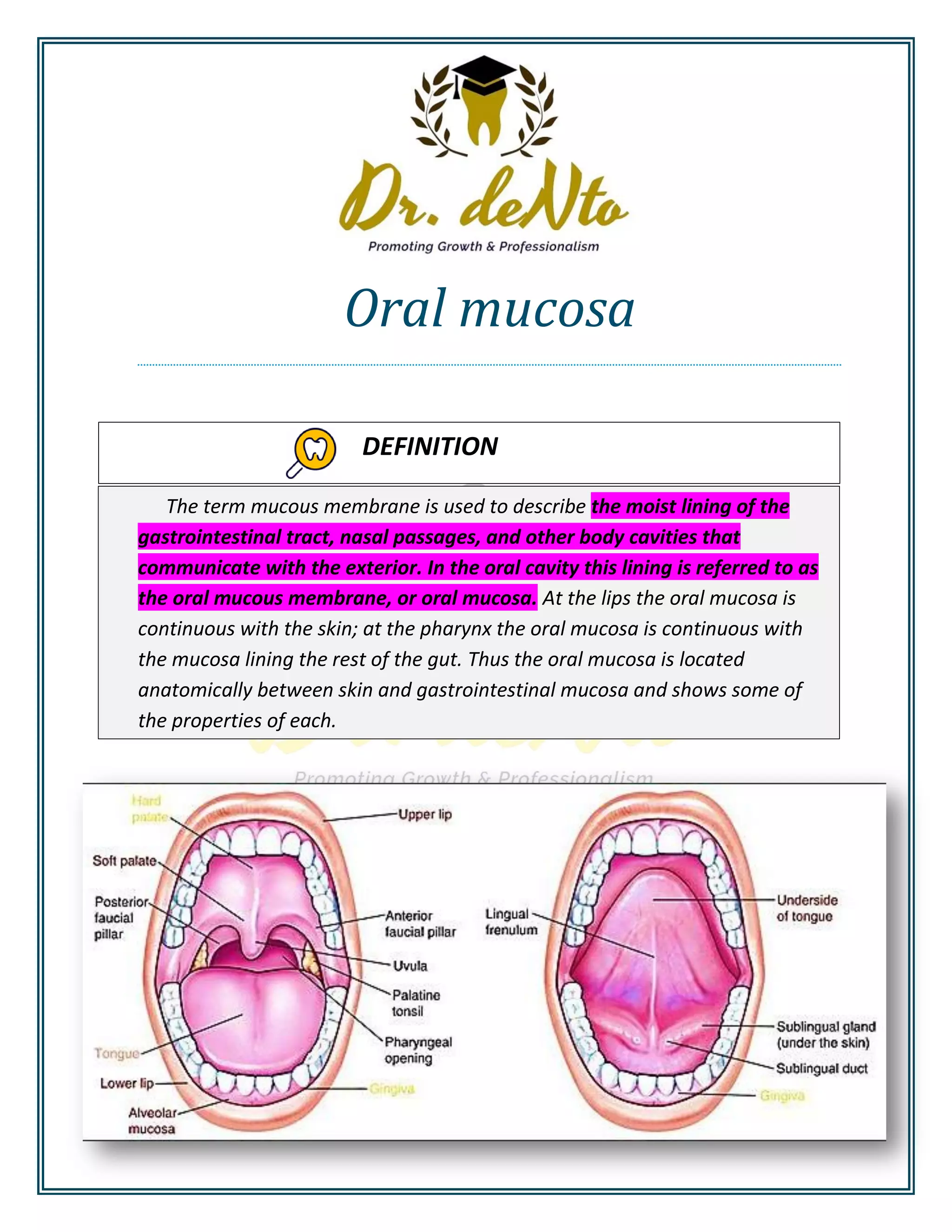
The term mucous membrane is used to describe the moist lining of the
gastrointestinal tract, nasal passages, and other body cavities that
communicate with the exterior. In the oral cavity this lining is referred to as
the oral mucous membrane, or oral mucosa. At the lips the oral mucosa is
continuous with the skin; at the pharynx the oral mucosa is continuous with
the mucosa lining the rest of the gut. Thus the oral mucosa is located
anatomically between skin and gastrointestinal mucosa and shows some of
the properties of each.
DEFINITION
FUNCTION OF ORAL MUCOSA
 Defensive: The oral mucosa acts as an efficient barrier against the entry
of these microorganisms and the toxins produced by them. It also secretes
antibodies and has an efficient humoral and cell - mediated immunity.
 Secretion: The oral mucosa is kept moist due to saliva secreted by
salivary glands. Minor salivary glands are situated within oral mucosa,
whereas the major salivary glands are situated at a distance from the
mucosa. The moist surface prevents the mucosa from drying. It helps in
speech, mastication, swallowing and perception of taste. It also helps to
retain water and electrolytes.
 Sensory: The oral mucosa has receptors which respond to touch,
pressure, pain and temperature. The sensation of taste is perceived by the
taste buds present in the anterior ⅔ of dorsum of tongue. Touch
sensation in the soft palate result in gag reflex.
 Protection: It separates and protects the deeper tissues from
compressive and shearing forces that might result because of mastication
and 1 surface abrasion that might occur due to hard particles in diet.
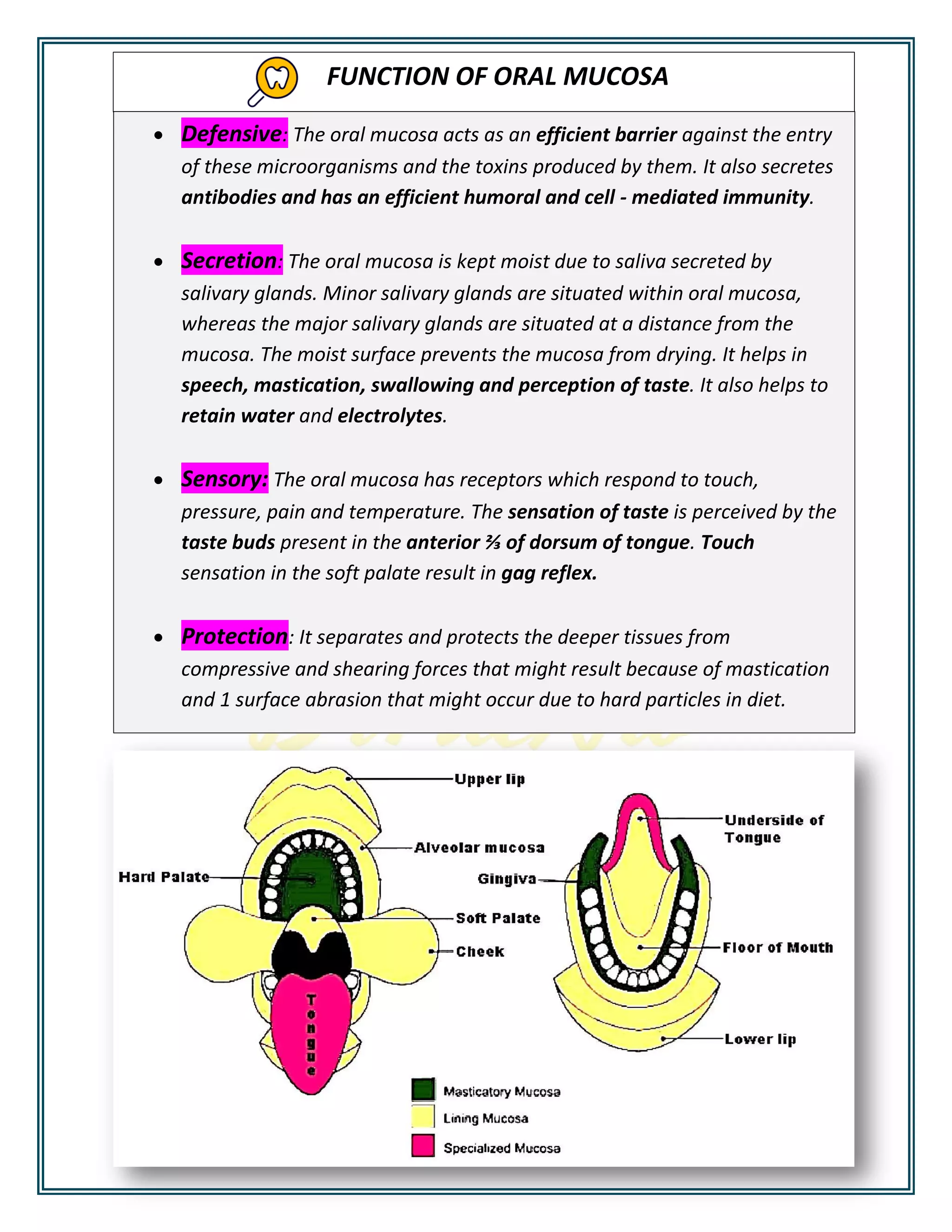
CLASSIFICATION OF ORAL MUCOSA
Based on the Structure of Surface Layers
I. Keratinized mucosa: Examples: Hard palate and gingiva.
a. Orthokeratinization
b. Parakeratinization
II. Nonkeratinized mucosa: Examples: Cheek, palate, vestibule and floor of
mouth.
MASTICATORY MUCOSA
(This contributes to about 25% of total
area)
Bound to bone and does not stretch,
and bears masticatory forces.
Eg:- Gingiva and hard palate
LINING OR REFLECTING MUCOSA
(60%)
Not exposed so much to masticatory
forces. It is stretchable.
Eg:- Lip , cheek , vestibule , alveolar
mucosa , floor of the mouth and the
soft palate
SPECIALIZED MUCOSA
(15%)
Performs function of sensation of
taste in addition to general
sensory functions.
Eg:- Dorsum of the tongue and
taste buds
Based on Functional Criteria
COMPONENTS
 The two main components of the oral mucosa are stratified squamous oral
epithelium and underlying connective tissue layer known as lamina
propria.
 The irregular junction between the epithelium and connective tissue has
upward projections of connective tissue (connective tissue papilla)
interdigitating with epithelial ridges (retepegs).
 The two tissues are intimately connected. At their junction there are two
different structures with very similar names, the basal lamina and the
basement membrane. The basal lamina evident at the electron microscopic
level and is epithelial in origin. The basement membrane is evident at the
light microscopic level.
 In some regions such as the lip and cheek, a layer of loose fatty or glandular
connective tissue separates the oral mucosa from the underlying muscle.
This layer is known as submucosa.
 In some regions such as the gingiva and hard palate, oral mucosa is directly
attached to the periosteum of the underlying bone without any intervening
submucosa. This type of firm attachment is known as mucoperiosteum.
Basement membrane
Light Microscopic
appearance
 Its appears Thick and
it includes the
reticular fibers.
 1 to 4 um wide and is
relatively cell free.
 Stain positively with
the periodic acid -
Schiff method,
Indicating that it
contains neutral
mucopolysaccharides
Electron microscopic appearance
 it is a basal complex consisting of
lamina and fibers
 it’s made up of three layers
1. Lamina lucida- is a clear zone below
epithelial cells
20-40nm wide glycoprotein layer
Its Contain:-
 Type IV collagen
 Antigen bound by the Antibody
KF-1
 Laminin
 Bullous pemphigoid antigen
2. Lamina densa-is a dark zone below lamina
lucida( 45 nm thick)
 contains type IV collagen coated
with heparin sulfate in chicken wire
( netlike ) configuration
3. Lamina fibroreticularis ( sublamina densa )
is located adjacent to lamina propria(50 nm)
 Its contains Anchoring fibrils (type
VII collagen) and collagen fibers
(type I and II)
Basement membrane
(Type IV collagen,
Antigen bound by
the Antibody KF-1,
Laminin)
(Type IV Collagen
Coated With
Heparin Sulfate)
Type VII Collagen
Type I and II Collagen
Papillary portion
Reticular portion
Papillary portion Reticular portion
 The papillary portion is between the
epithelial ridges.
 The reticular portion is below
the papillary portion
 The papillary layer is made up of
loosely arranged, thin collagen fibres.
 It’s made up of finger - like projections
of the connective tissue ( papilla )
which extend deep into the epithelium
and interdigitate with the epithelial
ridges
 The reticular layer contains
netlike arrangement of thick
collagen fibers arranged in
bundles and also contains fine
immature argyrophilic
reticular fibers.
 The number, length and width of these
papillae vary in different parts of the
oral cavity.
 The papillary zone may be absent in
some areas.
o Alveolar mucosa – short or
absent
o Masticatory mucosal area –
increase length and number
 Reticular portion is always
present.
 the reticular portion is also of
variable depth
Lamina Propria
 The lamina propria may be described as a connective tissue of variable
thickness
 Function:- supports the epithelium and exchange of material between
the epithelium and the blood vessels in the connective tissue

Lamina Propria
The ground substance in the lamina propria contains
 Glycoproteins
 Proteoglycans (Hyaluronan , heparan sulfate , versican , decorin ,
biglycan and sindecan)
 Fibroblasts
 Mast cells
 Macrophages
 Collagen fibers type I and III (bundles)
 Elastic fibers
The blood supply comes from the plexus of large vessels in the submucosa or from
the deeper part of the reticular layer. These give rise to small branches which form a
capillary plexus between the papillary and reticular layer
Submucosa
 The submucosa consists of connective tissue of varying thickness and density.
 Function:-It attaches the mucous membrane to the underlying structures.
 The attachment is loose or firm depends on the character of the submucosa.
 May be present or absent.
Components
1. Blood vessels
a. Larger arteries divide into smaller branches, which then enter the
lamina propria. Here they again divide to form a subepithelial capillary
network in the papilla.
b. The veins originating from the capillary network course back along the
path taken by the arteries.
2. Nerves
a. The sensory nerves of the mucous membrane tend to be more
concentrated toward the anterior part of the mouth (rugae, tip of
tongue, etc. ) . Myelinated nerve fibers as they traverse the submucosa
but lose their myelin sheath before split ting into their end.
b. Specialized receptors for cold (Krause end bulbs), touch (Meissner’s
corpuscles) and free nerve endings (pain receptors) are found. The
elongated or globular in shape mechanoreceptive corpuscles are present
in the mucosae of gingiva, cheek, tongue and soft and hard palate.
3. Glands
4. Adipose tissue
Structures of Oral Epithelium
ORAL EPITHELIUM
 The cells present in keratinized epithelium are called keratinocytes (keratin
producing cells).
 The keratinocytes are arranged in four cell layers. ( basal layer ,prickle cell layer ,
granular layer, keratinized layer )
 These layers are named according to their morphologic appearance
Keratinocytes, only in the basal layer, have mitotic activity. This is proliferative
stage.
 The cells become determined or committed; migrate to the superficial surfaces
going through the semi - apoptotic series of events. This is termed as
differentiation
 Superficial cell layers become dead and toughened and shed off in proper time.
This process is called desquamation.
 After mitosis , leaving the basal layer of a cell is called migration
 The time taken by a cell to divide and pass through the entire epithelium is
termed as turnover.
o The turnover time in the oral mucosa faster than skin but slower than
intestinal mucosa
o The turnover time in the nonkeratinized oral epithelium faster than
keratinized oral epithelium
Gingiva: 41-57 days
Cheek: 25 days
Junctional epithelium: 5-6 days
 This whole process from the onset of determination is called keratinization or
cornification.
 In general , maturation follows two main patterns :
o Keratinization .
o Nonkeratinization
 Keratinized epithelium has 4 layers :
o The basal layer ( stratum basale )
o The prickle cell layer ( stratum spinosum )
o The granular layer ( stratum granulosum )
o The keratinized layer ( stratum corneum )
 The layers in nonkeratinized epithelium are :
o Basal layer ( stratum basale )
o Intermediate layer ( stratum intermedium )
o Superficial layer ( stratum superficiale )
Ultrastructure of the Epithelial Cells of basal layer are the least differentiated.
They contain:
o Cytoplasmic organelles
o Desmosomes
o Tonofilaments ( synthesized by ribosomes )
Tonofilaments represent intracellular proteins known as
cytokeratins (characteristic constituents of epithelial cells). So,
these epithelium cells are called keratinocytes.
Cell Junction
 Important property of any epithelium is its ability to function as a barrier
which depends on close contact or cohesiveness of epithelial cells.
1. Occluding junctions (zonula occludens)
2. Adhesive junctions
(a) cell to cell
(i) zonula adherens
(ii) macula adherens(desmosomes)
(b) cell to matrix
(i) focal adhesions
(ii) hemidesmosomes
3. Communicating (gap) junctions
TIGHT JUNCTIONS
 The opposing cell membranes are held in close contact by the presence
of transmembrane adhesive proteins ( occludin , claudin ) arranged in
anastomosing strands that encircle the cell .
 They control the passage of material through intercellular spaces
adjacent cell membranes
COMMUNICATING OR GAP JUNCTIONS
 These are plaque like regions of cell membrane where intercellular space
narrows to 2-3 nm .
 Transmembrane proteins are of connexin family
 These junctions have electrically coupled cells and allow for coordinated
response to a stimulus by cells that are interconnected
DESMOSOMES
 Desmosomes also known as macula adhaerens, are cell structure specialized for
cell-to-cell adhesion. They are type of junctional complexes.
 They are localized spot-like adhesions randomly arranged on the lateral sides of
plasma membranes.
 They form adhesive bonds in a network that gives mechanical strength to
tissues frequently subjected to mechanical forces such as epidermis, oral
epithelium and myocardium.
 Extracellularly, desmosomes are separated by a 25-30 nm space
STRUCTURE OF DESMOSOMES
 Desmosome consists of three component -
 The Transmembrane molecules
(CADHERINS : desmoglein, desmocollin )
 The Plaque molecules or cytoplasmic adaptor protein
(CATENINS : desmoplakin, plakoglobin ,plakophillin)
 Intermediate filament (IF)
HEMIDESMOSOMES
 Hemidesmosomes look like half desmosomes , are similar type of cell junctions that
help in the attachment basal cells to the basement membrane , thereby to the
connective tissue .
 They are not merely an adhesive complex ; instead they also transduce signals that
may critically affect the cell behavior .
 They help to prevent cell migration and displacement .
 Their functional activity is modulated by growth factors and extracellular matrix
protein.
 Regulation of the hemidesmosome - basement protein .
 Regulation of the hemidesmosome – basement membrane adhesive interaction is
necessary for various biological processes such as tissue morphogenesis and wound
healing.
Three classes of proteins are involved in the molecular organization of this complex:
(a)Cytoplasmic plaque proteins,
( integrin α 6 β 4, collagen XVII ( BP 180))
(b) Transmembrane proteins,
(bullous pemhigoid antigen 230 ( BP 230) and plectin)
(c) Basement membrane associated proteins
HEMIDESMOSOMES
TONOFILAMENTS
 Tonofilaments - are fibrous proteins synthesized by the ribosomes and are
seen as long filaments .
 Diameter is approximately 8nm .
 Chemically , they are a class of intracellular proteins known as
CYTOKERATINS which are characteristically present in epithelial tissues .
 These become aggregated to form bundles of filaments called as tonofibrils .
 Due to presence of these keratin filaments epithelial cells are also called as "
keratinocytes
CYTOKERATINS
 Keratins (previously also called cytokeratins) are filament forming proteins of
epithelial cells and are essential for normal tissue structure and function
 Function of Cytokeratins
o Providing a mechanical linkage and force distribution system .
o Form a complex network which extends from the surface of the nucleus
to the cell membrane.
o Organization of the cytoplasm and cellular communication
mechanisms.
o Supporting the nucleus and providing tensile strength to the cell.
o Interact with desmosomes and hemidesmosomes
 Molecular weight is 40-200 Kda .
 These are classified according to their size and charge .
Diameter Molecular
Wight
Found in
Microfilaments 4 - 6 nm 25 Kda glandular and simple
epithelia
Intermediate filaments 7 - 11 nm stratified epithelia
Microtubules 2 5nm 55 Kda keratinized stratified epi
thelium
 About 20 types of cytokeratin are recognized.
Basic (Neutral, type II
cytokeratins)
Acidic (type 1 cytokeratins )
CK1,CK2,CK3,CK4,CK5,CK6,CK7,CK8 CK9,CK10, CK12,CK13, CK14, CK16,
CK17, CK18,CK19,CK20
 Always occurs in pairs of combination of type 1 & type11
 Absence of pair susceptible to degeneration by proteases
 Cytokeratins shows tissue & layer specificity.
o Suprabasal layers in masticatory mucosa – CK1 & 10
o Suprabasal layers in lining mucosa – CK4 & 13
o Ventral surface of tongue - CK5, 6, & 14
o Soft palate – CK7, 8, & 18
Stratum Basale
Basal Layer
Stratum Spinosum
Spinous(Prickle) Layer
Stratum
Granulosum
Granular Layer
Stratum
Corneam
Cornified Layer
Site Resting on the
Basement Membrane
Resting on the Basal
Layer
Resting on the Spinous
Membrane Layer
On the Top of the
surface
No. Single cell layer 4-8 cell layer
(Nasal mucosa 20 cell layer thick)
4-8 cell layer 20 cell layer
Shape Cuboidal cells
( high cuboid )
Irregularly Polyhedral
cells
( larger than the basal
cells )
Flatter & wider than
spinous cells,the cells
are closely packed
Flat ( squamea )
Cells ( larger &
flatter than the
granular cells )
1 - Mitotic Function
( DNA Synthesis &
undergo mitosis,thus
providing new cells)
1 - Mitotic Function
(inactive but can differentiate)
2 - Protein Synthesis
( most active )
These cells synthesize
additional proteins that differ
from those made in the basal
cells
1 - Mitotic Function
2 - Protein Synthesis
( at lower rate )
Protection
Contain:-
 All cell organelles
are present.
abundant RER ,
ribosomes
(indicative of
protein
synthesizing
activities)
 Desmosomes:-
Protoplasmic
junctions connect
the cells to each
other
 Hemidesmosomes
Connect cell to basal
lamina
 Gap junctions are
occasionally seen .
Tight junctions are
not seen the oral
epithelial cells.
Contain:-
 The intercellular
spaces rich in
glycoproteins
glycosaminoglycan
s and fibronectin
 By Light
microscopic
Intercellular
Bridges connect the
cell to each other
across which the
tonofibrils pass
from cell to cell
 By electron
microscopic
the intercellular
bridges are
desmosomes
the tonofibrils are
bundle of
tonofilaments
So , it consists of
Contain:-
 The cell
organelles starts
degenerating and
nuclei become
pyknotic
indicating the cell
death .
 KERATOHYALIN
GRANULES
( blue staining with
hematoxylin and eosin )
which give the surface a "
grainy " appearance .
These protein granules
promote dehydration of
the cells and aggregation
of tonofibrils . Further
dehydration locks the
tonofibrils tightly.
 Acidophilic
dead cells
( i.e. Devoid of nuclei
and other organelles
like ribosomes ,
mitochondria etc.)
the cornified layer is
formed by densely
packed tonofibrils and
keratohyalin granules.
Cross - linkage by
disulfide bonds give
the layer the chemical
and mechanical
stability.
The cells do not
synthesize proteins
and the water loss
from the cells is
ultimate
FunctionCharacteristics
 intermediate
tonofilaments of 10
nm composed of
keratins 5 and 14
 keratinocyte basal
cells are made up
of two populations
:
 This small stem (
non serrated )
basal cell is only
germinative
 serrated cell(transit
amplifying cells)
are rich in
tonofilaments
which along with it
the pedicles helps
in attachment to
the basement
membrane.
Desmosomes &
Tonofilaments
 Keratin - 1 , 10.and
transglutaminase -
K synthesize
 The spiny
appearance of this
spinous layer is due
to the shrinkage of
cells during tissue
preparation but the
desmosomes are
intact which
creates spines .
These strong
desmosomes act as
tensile support
system of
epithelium.
 In the upper part of
this layer there are
ODLAND’S BODIES .
 Keratin- 1 , 2,10
and several other
proteins
synthesize like
profilaggrin ,
involucrin ,
loricrin
 The cells also
contain lamellar
granules ( also
called ODLAND
BODIES OR
KERATINO
SOMES ) which
are membrane
coated glycolipid
granules ,
responsible for
the formation of
lipid layer over
the cornified
layer in SC cells .
 Filaggrin
( filament aggregating
protein ) is an
important component
of SC which acts as a
regulator of epithelial
homeostasis .
Depending on the
organelles destruction
inside the cell , two
types of keratinized
squama are seen
ORTHOKERATINIZED
( 20-30 % ,
organelles are all
destroyed )
Complete
keratinization
No nuclei
PARAKERATINIZED
( 50-70 % ,
pyknotic and
condensed nudei
and partially lysed
organelles ) .
Innermost layer of
stratum spinous
adjacent to basal
layer - parabasal cell
The basal and para -
basal cell layer are
collectively called
STRATUM
GERMINATIVUM .
ODLAND’S BODIES KERATOHYALIN GRANULES
STRATUM BASALE
STRATUM SPINOSUM
STRATUM GRANULOSUM
Keratohyalin granules
STRATUM CORNEAM
Basal Layer
STRATUM BASAL
Intermedium layer
STRATUM INTERMEDIUM
Superficial Layer
STRATUM
SUPERFICIAL
Site Resting on the Basement
Membrane
Resting on the Basal Layer On the Top of the surface
shape Single cell layer
Cuboidal cells
(Similar to keratinized
type)
Large Ovoid
No prickly appearance
( larger than the cells of the
Stratum Spinosum )
Slightly Flat Cells
function 1 - Mitotic Function
( DNA Synthesis
providing new cells )
1 - Mitotic Function
2 - Protein synthesis
Charact
eristics
Contain:-
DESMOSOMES :
 connect the cell
to each other
HEMIDESMOSOMES :
 connect the layer
to the CT
NO INTERCELLULAR SPACES
as the to each other cells do
not have a prickly appearance
LESS PROMINENT
INTERCELLULAR BRIDGES
But attached by desmosomes &
other junctions
ODLAND BODIES :
 circular , amorphous
core
 discharge the content in
the intercellular space ,
the discharge have
different composition
and don't form an
effective barrier as the
keratinized epithelium .
KERATOHYALINE GRANULES
 appear in the surface of
this layer but more
regular and spherical
 not associated with
tonofilament
 contribute to thickening
of the cell membrane
 Produce loricrin not
filaggrin
 Retain their
nuclei.
 Dispersed
tonofilaments
 Decreased
number of cell
organelles.
 Surface layer
don't dehydrate.
 Thickened cell
membrane but
not like the
keratinized one.
 Form stretchy
surface that can
tolerate
compression.
KERATOHYALINE GRANULES
The layers in Keratinized epithelium & non-keratinized epithelium
C) Superficial layer
( stratum superficiale )
B) Intermediate layer
( stratum intermedium ) .
A) Basal layer
( stratum basale )
What is Odland bodies ?
They are also known as :
o Membrane coating granules
o Cytoplasmic lamellated bodies
o Keratinosomes
o Microgranules
o Cementosomes
 Are modified lysosomes
 Site:- Upper Spinous & Granular layers of Keratinized S. epithelium &
Upper Intermediate layer of Non-keratinized S. epithelium
 Shape:- : Ovoid shape & Lamellar in Keratinized S. epithelium &
circular , amorphous core in Non - keratinized S. epithelium
 Size:- 0.25 microns
 Contain :- Glycolipids, phospholipids, cholesterols & acid phosphatase
 It has series of internal lamellae with alternating electron lucent and dense
bands.
 Derived from Golgi apparatus
 Size do not increase but density increases as it moves to superficial layer
 Function:- Act as barrier at the junction of the granular and cornified layer.
Membrane-coating granules in oral epithelium. A, elongated lamellate type seen in
keratinized epithelium. B, circular type with a dense core found in nonkeratinized
epithelium.
l
KERATOHYALIN GRANULES
 Size 0.5 - 1 micrometer .
 Synthesized by ribosomes .
KERATINIZED NON KERATINIZED
 Seen in granular layer
 small & irregular
 associated by tonofilaments
 form matrix in which the
filaments are embedded
filaggrin
 Appear in the surface of prickle
layer
 More regular and spherical ,
 Not associated with tonofilament
 Contribute to thickening of the cell
membrane .
 Produce loricrin not filaggrin
keratohyaline granules in oral epithelium. A, From the granular layer, irregularly shaped
granules are associated intimately with tonofilaments. B, A granule of the type occasionally
seen in nonkeratinized oral epithelium is regular in shape but is not associated with
tonofilaments.
KERATINOCYTES 90% NON-KERATINOCYTES 10%
 Cells have tonofilaments
 That synthesize Cytokeratin(type
of intermediate filaments)
 Desmosomes
 Show cell division, maturation
and desquamation.
 Don’t turn into keratinocytes or
share in keratin formation
 Have a clear halo around the
nucleus, and so known, clear
cells.
 Lack desmosomes except Merkel
cells.
 Not stained with routine H&E
stain.
 Not arranged in layers but found
scattered in mucosa.
 Don’t show cell division,
maturation and desquamation.
NON-KERATINOCYTES
Depending of the position , the clear cells are divided into
1. Low - level clear cells ( melanocytes and merkel cells ) [ basal ]
2. High level clear cells ( langerhans cells )( supra - basal )
MELANOCYTES
 Origin - From neural crest cells and migrate to epithelium
 Site - Basal layer of oral epithelium.
 Shape - Lack desmosomes and tonofilaments.
o Dendritic cell each cell connects with 30-40 keratinocytes by its dendrites.
 Function –
o Melanin pigment produced by the cell is transferred to the adjacent basal
cells .
o Elaborate melanin in the form of small granules called melanosomes.
o If injected in epithelium cell Called…melanophore.
o If engulfed by Connective Tissue macrophage….melanophage
 Stain - Melanocytes detected by the Dopa reaction,Silver-staining techniques,
Mosan Fontana stain
Difference in colour of skin in different
racial groups is due to
1. Differences in melanin synthesis
rate
2. Melanin granules size
3. Slow breakdown of adjacent
keratinocytes
l.e. in dark races there is -increased
melanocytes activity , but their number not
differ
LANGERHANS CELL
 Site - Supra basal layers (higher level cells).
 Origin - Bone marrow
 Shape - dendritic cells are found in stratum spinosum and stratum granulosum
 The cell has a convoluted nucleus and characteristic rod - like or tennis - racket
shaped granules , Birbeck granules
 The cell does not pose melanin or keratin but has vimentin - type intermediate
filaments .
 LCs are antigen - presenting cells ( APCs ) of epidermis . In the presence of
antigens by bacterial plaque and chemotactic factors by keratinocytes , cells
migrate to the superficial epithelium . The cells with antigens bind to specific
helper T - cells and mount an immune response . Also produces IL - 1 , 13
(contact hypersensitivity ).
 Stain - Gold chloride or CD1a surface antigen, ATPase & Immunofluorescent
Markers
Bone marrow
Blood stream
Lamina propria
Basal lamina
Epithelium
(1) Keratinocyte,
(2) Merkel cell,
(3) Microvilli,
(4) Lobulated nuclei with
Few nucleoli &
intranuclear rodlet
(5) Dense core granules,
(6) Tactile meniscus
MERKEL CELL
 Non - dendritic , commonly seen in masticatory mucosa .
 Site - basal cell layer
 Origin – Neural crest, May be from division of keratinocytes
 Shape - Has tonofilaments and desmosomes
 Nucleus shows deep invagination and characteristic rodet .
 Cytoplasm shows electro - dense granules at the side where the cell receives
axon terminal .
 The cell acts as an exteroceptor for discriminative touch . The cell , resembling a
spiky hemisphere and disk - like sensory terminal of neuron collectively called
merkel or tactile disk , responsible for light or discriminative touch.
 Stain – PAS stain
INFLAMMATORY CELLS
 Site - In case of inflammation ,epithelium they migrate into oral epithelium
 Different Types include.
o Lymphocytes
o monocytes
o neutrophils
o granulocytes
o mast cells
 These inflammatory cells are transient and do not reproduce themselves in
the epithelium like other non-keratinocytes.
YouTube – Dr.deNto
Facebook – De Nto

Oral mucosa membrane

  • 1.
    Oral mucosa The termmucous membrane is used to describe the moist lining of the gastrointestinal tract, nasal passages, and other body cavities that communicate with the exterior. In the oral cavity this lining is referred to as the oral mucous membrane, or oral mucosa. At the lips the oral mucosa is continuous with the skin; at the pharynx the oral mucosa is continuous with the mucosa lining the rest of the gut. Thus the oral mucosa is located anatomically between skin and gastrointestinal mucosa and shows some of the properties of each. DEFINITION
  • 2.
    FUNCTION OF ORALMUCOSA  Defensive: The oral mucosa acts as an efficient barrier against the entry of these microorganisms and the toxins produced by them. It also secretes antibodies and has an efficient humoral and cell - mediated immunity.  Secretion: The oral mucosa is kept moist due to saliva secreted by salivary glands. Minor salivary glands are situated within oral mucosa, whereas the major salivary glands are situated at a distance from the mucosa. The moist surface prevents the mucosa from drying. It helps in speech, mastication, swallowing and perception of taste. It also helps to retain water and electrolytes.  Sensory: The oral mucosa has receptors which respond to touch, pressure, pain and temperature. The sensation of taste is perceived by the taste buds present in the anterior ⅔ of dorsum of tongue. Touch sensation in the soft palate result in gag reflex.  Protection: It separates and protects the deeper tissues from compressive and shearing forces that might result because of mastication and 1 surface abrasion that might occur due to hard particles in diet.
  • 3.
    CLASSIFICATION OF ORALMUCOSA Based on the Structure of Surface Layers I. Keratinized mucosa: Examples: Hard palate and gingiva. a. Orthokeratinization b. Parakeratinization II. Nonkeratinized mucosa: Examples: Cheek, palate, vestibule and floor of mouth. MASTICATORY MUCOSA (This contributes to about 25% of total area) Bound to bone and does not stretch, and bears masticatory forces. Eg:- Gingiva and hard palate LINING OR REFLECTING MUCOSA (60%) Not exposed so much to masticatory forces. It is stretchable. Eg:- Lip , cheek , vestibule , alveolar mucosa , floor of the mouth and the soft palate SPECIALIZED MUCOSA (15%) Performs function of sensation of taste in addition to general sensory functions. Eg:- Dorsum of the tongue and taste buds Based on Functional Criteria
  • 4.
    COMPONENTS  The twomain components of the oral mucosa are stratified squamous oral epithelium and underlying connective tissue layer known as lamina propria.  The irregular junction between the epithelium and connective tissue has upward projections of connective tissue (connective tissue papilla) interdigitating with epithelial ridges (retepegs).  The two tissues are intimately connected. At their junction there are two different structures with very similar names, the basal lamina and the basement membrane. The basal lamina evident at the electron microscopic level and is epithelial in origin. The basement membrane is evident at the light microscopic level.
  • 5.
     In someregions such as the lip and cheek, a layer of loose fatty or glandular connective tissue separates the oral mucosa from the underlying muscle. This layer is known as submucosa.  In some regions such as the gingiva and hard palate, oral mucosa is directly attached to the periosteum of the underlying bone without any intervening submucosa. This type of firm attachment is known as mucoperiosteum. Basement membrane Light Microscopic appearance  Its appears Thick and it includes the reticular fibers.  1 to 4 um wide and is relatively cell free.  Stain positively with the periodic acid - Schiff method, Indicating that it contains neutral mucopolysaccharides Electron microscopic appearance  it is a basal complex consisting of lamina and fibers  it’s made up of three layers 1. Lamina lucida- is a clear zone below epithelial cells 20-40nm wide glycoprotein layer Its Contain:-  Type IV collagen  Antigen bound by the Antibody KF-1  Laminin  Bullous pemphigoid antigen 2. Lamina densa-is a dark zone below lamina lucida( 45 nm thick)  contains type IV collagen coated with heparin sulfate in chicken wire ( netlike ) configuration 3. Lamina fibroreticularis ( sublamina densa ) is located adjacent to lamina propria(50 nm)  Its contains Anchoring fibrils (type VII collagen) and collagen fibers (type I and II) Basement membrane
  • 6.
    (Type IV collagen, Antigenbound by the Antibody KF-1, Laminin) (Type IV Collagen Coated With Heparin Sulfate) Type VII Collagen Type I and II Collagen
  • 7.
    Papillary portion Reticular portion Papillaryportion Reticular portion  The papillary portion is between the epithelial ridges.  The reticular portion is below the papillary portion  The papillary layer is made up of loosely arranged, thin collagen fibres.  It’s made up of finger - like projections of the connective tissue ( papilla ) which extend deep into the epithelium and interdigitate with the epithelial ridges  The reticular layer contains netlike arrangement of thick collagen fibers arranged in bundles and also contains fine immature argyrophilic reticular fibers.  The number, length and width of these papillae vary in different parts of the oral cavity.  The papillary zone may be absent in some areas. o Alveolar mucosa – short or absent o Masticatory mucosal area – increase length and number  Reticular portion is always present.  the reticular portion is also of variable depth Lamina Propria  The lamina propria may be described as a connective tissue of variable thickness  Function:- supports the epithelium and exchange of material between the epithelium and the blood vessels in the connective tissue  Lamina Propria
  • 8.
    The ground substancein the lamina propria contains  Glycoproteins  Proteoglycans (Hyaluronan , heparan sulfate , versican , decorin , biglycan and sindecan)  Fibroblasts  Mast cells  Macrophages  Collagen fibers type I and III (bundles)  Elastic fibers The blood supply comes from the plexus of large vessels in the submucosa or from the deeper part of the reticular layer. These give rise to small branches which form a capillary plexus between the papillary and reticular layer
  • 9.
    Submucosa  The submucosaconsists of connective tissue of varying thickness and density.  Function:-It attaches the mucous membrane to the underlying structures.  The attachment is loose or firm depends on the character of the submucosa.  May be present or absent. Components 1. Blood vessels a. Larger arteries divide into smaller branches, which then enter the lamina propria. Here they again divide to form a subepithelial capillary network in the papilla. b. The veins originating from the capillary network course back along the path taken by the arteries. 2. Nerves a. The sensory nerves of the mucous membrane tend to be more concentrated toward the anterior part of the mouth (rugae, tip of tongue, etc. ) . Myelinated nerve fibers as they traverse the submucosa but lose their myelin sheath before split ting into their end. b. Specialized receptors for cold (Krause end bulbs), touch (Meissner’s corpuscles) and free nerve endings (pain receptors) are found. The elongated or globular in shape mechanoreceptive corpuscles are present in the mucosae of gingiva, cheek, tongue and soft and hard palate. 3. Glands 4. Adipose tissue
  • 10.
    Structures of OralEpithelium ORAL EPITHELIUM  The cells present in keratinized epithelium are called keratinocytes (keratin producing cells).  The keratinocytes are arranged in four cell layers. ( basal layer ,prickle cell layer , granular layer, keratinized layer )  These layers are named according to their morphologic appearance Keratinocytes, only in the basal layer, have mitotic activity. This is proliferative stage.  The cells become determined or committed; migrate to the superficial surfaces going through the semi - apoptotic series of events. This is termed as differentiation  Superficial cell layers become dead and toughened and shed off in proper time. This process is called desquamation.  After mitosis , leaving the basal layer of a cell is called migration  The time taken by a cell to divide and pass through the entire epithelium is termed as turnover. o The turnover time in the oral mucosa faster than skin but slower than intestinal mucosa o The turnover time in the nonkeratinized oral epithelium faster than keratinized oral epithelium Gingiva: 41-57 days Cheek: 25 days Junctional epithelium: 5-6 days  This whole process from the onset of determination is called keratinization or cornification.
  • 11.
     In general, maturation follows two main patterns : o Keratinization . o Nonkeratinization  Keratinized epithelium has 4 layers : o The basal layer ( stratum basale ) o The prickle cell layer ( stratum spinosum ) o The granular layer ( stratum granulosum ) o The keratinized layer ( stratum corneum )  The layers in nonkeratinized epithelium are : o Basal layer ( stratum basale ) o Intermediate layer ( stratum intermedium ) o Superficial layer ( stratum superficiale ) Ultrastructure of the Epithelial Cells of basal layer are the least differentiated. They contain: o Cytoplasmic organelles o Desmosomes o Tonofilaments ( synthesized by ribosomes ) Tonofilaments represent intracellular proteins known as cytokeratins (characteristic constituents of epithelial cells). So, these epithelium cells are called keratinocytes.
  • 12.
    Cell Junction  Importantproperty of any epithelium is its ability to function as a barrier which depends on close contact or cohesiveness of epithelial cells. 1. Occluding junctions (zonula occludens) 2. Adhesive junctions (a) cell to cell (i) zonula adherens (ii) macula adherens(desmosomes) (b) cell to matrix (i) focal adhesions (ii) hemidesmosomes 3. Communicating (gap) junctions
  • 13.
    TIGHT JUNCTIONS  Theopposing cell membranes are held in close contact by the presence of transmembrane adhesive proteins ( occludin , claudin ) arranged in anastomosing strands that encircle the cell .  They control the passage of material through intercellular spaces adjacent cell membranes COMMUNICATING OR GAP JUNCTIONS  These are plaque like regions of cell membrane where intercellular space narrows to 2-3 nm .  Transmembrane proteins are of connexin family  These junctions have electrically coupled cells and allow for coordinated response to a stimulus by cells that are interconnected
  • 14.
    DESMOSOMES  Desmosomes alsoknown as macula adhaerens, are cell structure specialized for cell-to-cell adhesion. They are type of junctional complexes.  They are localized spot-like adhesions randomly arranged on the lateral sides of plasma membranes.  They form adhesive bonds in a network that gives mechanical strength to tissues frequently subjected to mechanical forces such as epidermis, oral epithelium and myocardium.  Extracellularly, desmosomes are separated by a 25-30 nm space STRUCTURE OF DESMOSOMES  Desmosome consists of three component -  The Transmembrane molecules (CADHERINS : desmoglein, desmocollin )  The Plaque molecules or cytoplasmic adaptor protein (CATENINS : desmoplakin, plakoglobin ,plakophillin)  Intermediate filament (IF)
  • 15.
    HEMIDESMOSOMES  Hemidesmosomes looklike half desmosomes , are similar type of cell junctions that help in the attachment basal cells to the basement membrane , thereby to the connective tissue .  They are not merely an adhesive complex ; instead they also transduce signals that may critically affect the cell behavior .  They help to prevent cell migration and displacement .  Their functional activity is modulated by growth factors and extracellular matrix protein.  Regulation of the hemidesmosome - basement protein .  Regulation of the hemidesmosome – basement membrane adhesive interaction is necessary for various biological processes such as tissue morphogenesis and wound healing. Three classes of proteins are involved in the molecular organization of this complex: (a)Cytoplasmic plaque proteins, ( integrin α 6 β 4, collagen XVII ( BP 180)) (b) Transmembrane proteins, (bullous pemhigoid antigen 230 ( BP 230) and plectin) (c) Basement membrane associated proteins
  • 16.
  • 17.
    TONOFILAMENTS  Tonofilaments -are fibrous proteins synthesized by the ribosomes and are seen as long filaments .  Diameter is approximately 8nm .  Chemically , they are a class of intracellular proteins known as CYTOKERATINS which are characteristically present in epithelial tissues .  These become aggregated to form bundles of filaments called as tonofibrils .  Due to presence of these keratin filaments epithelial cells are also called as " keratinocytes CYTOKERATINS  Keratins (previously also called cytokeratins) are filament forming proteins of epithelial cells and are essential for normal tissue structure and function  Function of Cytokeratins o Providing a mechanical linkage and force distribution system . o Form a complex network which extends from the surface of the nucleus to the cell membrane. o Organization of the cytoplasm and cellular communication mechanisms. o Supporting the nucleus and providing tensile strength to the cell. o Interact with desmosomes and hemidesmosomes  Molecular weight is 40-200 Kda .  These are classified according to their size and charge .
  • 18.
    Diameter Molecular Wight Found in Microfilaments4 - 6 nm 25 Kda glandular and simple epithelia Intermediate filaments 7 - 11 nm stratified epithelia Microtubules 2 5nm 55 Kda keratinized stratified epi thelium  About 20 types of cytokeratin are recognized. Basic (Neutral, type II cytokeratins) Acidic (type 1 cytokeratins ) CK1,CK2,CK3,CK4,CK5,CK6,CK7,CK8 CK9,CK10, CK12,CK13, CK14, CK16, CK17, CK18,CK19,CK20  Always occurs in pairs of combination of type 1 & type11  Absence of pair susceptible to degeneration by proteases  Cytokeratins shows tissue & layer specificity. o Suprabasal layers in masticatory mucosa – CK1 & 10 o Suprabasal layers in lining mucosa – CK4 & 13 o Ventral surface of tongue - CK5, 6, & 14 o Soft palate – CK7, 8, & 18
  • 19.
    Stratum Basale Basal Layer StratumSpinosum Spinous(Prickle) Layer Stratum Granulosum Granular Layer Stratum Corneam Cornified Layer Site Resting on the Basement Membrane Resting on the Basal Layer Resting on the Spinous Membrane Layer On the Top of the surface No. Single cell layer 4-8 cell layer (Nasal mucosa 20 cell layer thick) 4-8 cell layer 20 cell layer Shape Cuboidal cells ( high cuboid ) Irregularly Polyhedral cells ( larger than the basal cells ) Flatter & wider than spinous cells,the cells are closely packed Flat ( squamea ) Cells ( larger & flatter than the granular cells ) 1 - Mitotic Function ( DNA Synthesis & undergo mitosis,thus providing new cells) 1 - Mitotic Function (inactive but can differentiate) 2 - Protein Synthesis ( most active ) These cells synthesize additional proteins that differ from those made in the basal cells 1 - Mitotic Function 2 - Protein Synthesis ( at lower rate ) Protection Contain:-  All cell organelles are present. abundant RER , ribosomes (indicative of protein synthesizing activities)  Desmosomes:- Protoplasmic junctions connect the cells to each other  Hemidesmosomes Connect cell to basal lamina  Gap junctions are occasionally seen . Tight junctions are not seen the oral epithelial cells. Contain:-  The intercellular spaces rich in glycoproteins glycosaminoglycan s and fibronectin  By Light microscopic Intercellular Bridges connect the cell to each other across which the tonofibrils pass from cell to cell  By electron microscopic the intercellular bridges are desmosomes the tonofibrils are bundle of tonofilaments So , it consists of Contain:-  The cell organelles starts degenerating and nuclei become pyknotic indicating the cell death .  KERATOHYALIN GRANULES ( blue staining with hematoxylin and eosin ) which give the surface a " grainy " appearance . These protein granules promote dehydration of the cells and aggregation of tonofibrils . Further dehydration locks the tonofibrils tightly.  Acidophilic dead cells ( i.e. Devoid of nuclei and other organelles like ribosomes , mitochondria etc.) the cornified layer is formed by densely packed tonofibrils and keratohyalin granules. Cross - linkage by disulfide bonds give the layer the chemical and mechanical stability. The cells do not synthesize proteins and the water loss from the cells is ultimate FunctionCharacteristics
  • 20.
     intermediate tonofilaments of10 nm composed of keratins 5 and 14  keratinocyte basal cells are made up of two populations :  This small stem ( non serrated ) basal cell is only germinative  serrated cell(transit amplifying cells) are rich in tonofilaments which along with it the pedicles helps in attachment to the basement membrane. Desmosomes & Tonofilaments  Keratin - 1 , 10.and transglutaminase - K synthesize  The spiny appearance of this spinous layer is due to the shrinkage of cells during tissue preparation but the desmosomes are intact which creates spines . These strong desmosomes act as tensile support system of epithelium.  In the upper part of this layer there are ODLAND’S BODIES .  Keratin- 1 , 2,10 and several other proteins synthesize like profilaggrin , involucrin , loricrin  The cells also contain lamellar granules ( also called ODLAND BODIES OR KERATINO SOMES ) which are membrane coated glycolipid granules , responsible for the formation of lipid layer over the cornified layer in SC cells .  Filaggrin ( filament aggregating protein ) is an important component of SC which acts as a regulator of epithelial homeostasis . Depending on the organelles destruction inside the cell , two types of keratinized squama are seen ORTHOKERATINIZED ( 20-30 % , organelles are all destroyed ) Complete keratinization No nuclei PARAKERATINIZED ( 50-70 % , pyknotic and condensed nudei and partially lysed organelles ) . Innermost layer of stratum spinous adjacent to basal layer - parabasal cell The basal and para - basal cell layer are collectively called STRATUM GERMINATIVUM . ODLAND’S BODIES KERATOHYALIN GRANULES
  • 22.
  • 23.
  • 24.
    Basal Layer STRATUM BASAL Intermediumlayer STRATUM INTERMEDIUM Superficial Layer STRATUM SUPERFICIAL Site Resting on the Basement Membrane Resting on the Basal Layer On the Top of the surface shape Single cell layer Cuboidal cells (Similar to keratinized type) Large Ovoid No prickly appearance ( larger than the cells of the Stratum Spinosum ) Slightly Flat Cells function 1 - Mitotic Function ( DNA Synthesis providing new cells ) 1 - Mitotic Function 2 - Protein synthesis Charact eristics Contain:- DESMOSOMES :  connect the cell to each other HEMIDESMOSOMES :  connect the layer to the CT NO INTERCELLULAR SPACES as the to each other cells do not have a prickly appearance LESS PROMINENT INTERCELLULAR BRIDGES But attached by desmosomes & other junctions ODLAND BODIES :  circular , amorphous core  discharge the content in the intercellular space , the discharge have different composition and don't form an effective barrier as the keratinized epithelium . KERATOHYALINE GRANULES  appear in the surface of this layer but more regular and spherical  not associated with tonofilament  contribute to thickening of the cell membrane  Produce loricrin not filaggrin  Retain their nuclei.  Dispersed tonofilaments  Decreased number of cell organelles.  Surface layer don't dehydrate.  Thickened cell membrane but not like the keratinized one.  Form stretchy surface that can tolerate compression.
  • 25.
    KERATOHYALINE GRANULES The layersin Keratinized epithelium & non-keratinized epithelium C) Superficial layer ( stratum superficiale ) B) Intermediate layer ( stratum intermedium ) . A) Basal layer ( stratum basale )
  • 26.
    What is Odlandbodies ? They are also known as : o Membrane coating granules o Cytoplasmic lamellated bodies o Keratinosomes o Microgranules o Cementosomes  Are modified lysosomes  Site:- Upper Spinous & Granular layers of Keratinized S. epithelium & Upper Intermediate layer of Non-keratinized S. epithelium  Shape:- : Ovoid shape & Lamellar in Keratinized S. epithelium & circular , amorphous core in Non - keratinized S. epithelium  Size:- 0.25 microns  Contain :- Glycolipids, phospholipids, cholesterols & acid phosphatase  It has series of internal lamellae with alternating electron lucent and dense bands.  Derived from Golgi apparatus  Size do not increase but density increases as it moves to superficial layer  Function:- Act as barrier at the junction of the granular and cornified layer. Membrane-coating granules in oral epithelium. A, elongated lamellate type seen in keratinized epithelium. B, circular type with a dense core found in nonkeratinized epithelium.
  • 27.
    l KERATOHYALIN GRANULES  Size0.5 - 1 micrometer .  Synthesized by ribosomes . KERATINIZED NON KERATINIZED  Seen in granular layer  small & irregular  associated by tonofilaments  form matrix in which the filaments are embedded filaggrin  Appear in the surface of prickle layer  More regular and spherical ,  Not associated with tonofilament  Contribute to thickening of the cell membrane .  Produce loricrin not filaggrin keratohyaline granules in oral epithelium. A, From the granular layer, irregularly shaped granules are associated intimately with tonofilaments. B, A granule of the type occasionally seen in nonkeratinized oral epithelium is regular in shape but is not associated with tonofilaments.
  • 28.
    KERATINOCYTES 90% NON-KERATINOCYTES10%  Cells have tonofilaments  That synthesize Cytokeratin(type of intermediate filaments)  Desmosomes  Show cell division, maturation and desquamation.  Don’t turn into keratinocytes or share in keratin formation  Have a clear halo around the nucleus, and so known, clear cells.  Lack desmosomes except Merkel cells.  Not stained with routine H&E stain.  Not arranged in layers but found scattered in mucosa.  Don’t show cell division, maturation and desquamation. NON-KERATINOCYTES Depending of the position , the clear cells are divided into 1. Low - level clear cells ( melanocytes and merkel cells ) [ basal ] 2. High level clear cells ( langerhans cells )( supra - basal )
  • 29.
    MELANOCYTES  Origin -From neural crest cells and migrate to epithelium  Site - Basal layer of oral epithelium.  Shape - Lack desmosomes and tonofilaments. o Dendritic cell each cell connects with 30-40 keratinocytes by its dendrites.  Function – o Melanin pigment produced by the cell is transferred to the adjacent basal cells . o Elaborate melanin in the form of small granules called melanosomes. o If injected in epithelium cell Called…melanophore. o If engulfed by Connective Tissue macrophage….melanophage  Stain - Melanocytes detected by the Dopa reaction,Silver-staining techniques, Mosan Fontana stain Difference in colour of skin in different racial groups is due to 1. Differences in melanin synthesis rate 2. Melanin granules size 3. Slow breakdown of adjacent keratinocytes l.e. in dark races there is -increased melanocytes activity , but their number not differ
  • 30.
    LANGERHANS CELL  Site- Supra basal layers (higher level cells).  Origin - Bone marrow  Shape - dendritic cells are found in stratum spinosum and stratum granulosum  The cell has a convoluted nucleus and characteristic rod - like or tennis - racket shaped granules , Birbeck granules  The cell does not pose melanin or keratin but has vimentin - type intermediate filaments .  LCs are antigen - presenting cells ( APCs ) of epidermis . In the presence of antigens by bacterial plaque and chemotactic factors by keratinocytes , cells migrate to the superficial epithelium . The cells with antigens bind to specific helper T - cells and mount an immune response . Also produces IL - 1 , 13 (contact hypersensitivity ).  Stain - Gold chloride or CD1a surface antigen, ATPase & Immunofluorescent Markers Bone marrow Blood stream Lamina propria Basal lamina Epithelium
  • 31.
    (1) Keratinocyte, (2) Merkelcell, (3) Microvilli, (4) Lobulated nuclei with Few nucleoli & intranuclear rodlet (5) Dense core granules, (6) Tactile meniscus MERKEL CELL  Non - dendritic , commonly seen in masticatory mucosa .  Site - basal cell layer  Origin – Neural crest, May be from division of keratinocytes  Shape - Has tonofilaments and desmosomes  Nucleus shows deep invagination and characteristic rodet .  Cytoplasm shows electro - dense granules at the side where the cell receives axon terminal .  The cell acts as an exteroceptor for discriminative touch . The cell , resembling a spiky hemisphere and disk - like sensory terminal of neuron collectively called merkel or tactile disk , responsible for light or discriminative touch.  Stain – PAS stain
  • 32.
    INFLAMMATORY CELLS  Site- In case of inflammation ,epithelium they migrate into oral epithelium  Different Types include. o Lymphocytes o monocytes o neutrophils o granulocytes o mast cells  These inflammatory cells are transient and do not reproduce themselves in the epithelium like other non-keratinocytes. YouTube – Dr.deNto Facebook – De Nto