The race to (X)Gigabit
Network Access
From historical xDSL & DOCSIS copper
to nowadays
mixed/all optical network
1
Zaccone Carmelo 09/18
Observations on Broadband evolution
• ICT and communication technologies are the backbone of the digital
economy and society
• Evolution of the market players (mainly related to the changing
nature of the subscriptions)
• Network Operators: continue the business in “access path & connection”
• Over The Top: increasing offering in ”service & application”
• Evolution of the consumer behaviour
• Content: subscription vs acquisition based
• Usage: on-demand/online vs download/offline
OECD Digital Economy Outlook 2017
http://www.oecd.org/sti/ieconomy/
http://www.oecd.org/sti/broadband/broadband-statistics/ 2
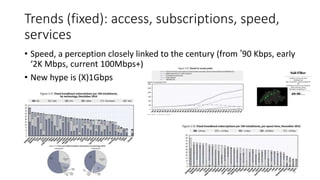
Trends (fixed): access, subscriptions, speed,
services
• Speed, a perception closely linked to the century (from ’90 Kbps, early
‘2K Mbps, current 100Mbps+)
• New hype is (X)1Gbps
3
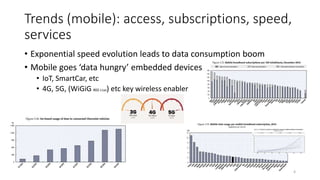
Trends (mobile): access, subscriptions, speed,
services
• Exponential speed evolution leads to data consumption boom
• Mobile goes ‘data hungry’ embedded devices
• IoT, SmartCar, etc
• 4G, 5G, (WiGiG 802.11ad) etc key wireless enabler
4
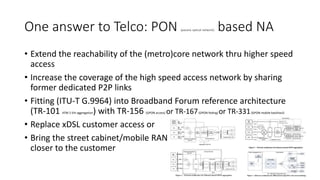
One answer to Telco: PON (passive optical network) based NA
• Extend the reachability of the (metro)core network thru higher speed
access
• Increase the coverage of the high speed access network by sharing
former dedicated P2P links
• Fitting (ITU-T G.9964) into Broadband Forum reference architecture
(TR-101 ATM 2 Eth aggregation) with TR-156 (GPON access) or TR-167(GPON feding) or TR-331(GPON mobile backhaul)
• Replace xDSL customer access or
• Bring the street cabinet/mobile RAN
closer to the customer
5
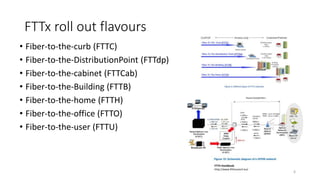
FTTx roll out flavours
• Fiber-to-the-curb (FTTC)
• Fiber-to-the-DistributionPoint (FTTdp)
• Fiber-to-the-cabinet (FTTCab)
• Fiber-to-the-Building (FTTB)
• Fiber-to-the-home (FTTH)
• Fiber-to-the-office (FTTO)
• Fiber-to-the-user (FTTU)
FTTH Handbook
http://www.ftthcouncil.eu/
6
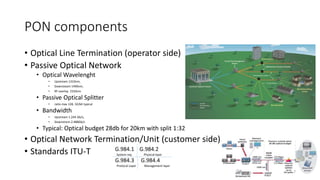
PON components
• Optical Line Termination (operator side)
• Passive Optical Network
• Optical Wavelenght
• Upstream 1310nm,
• Downsteam 1490nm,
• RF overlay 1550nm
• Passive Optical Splitter
• ratio max 128, 32/64 typical
• Bandwidth
• Upstream 1.244 Gb/s,
• Downstrem 2.488Gb/s
• Typical: Optical budget 28db for 20km with split 1:32
• Optical Network Termination/Unit (customer side)
• Standards ITU-T G.984.1 G.984.2
System req Physical layer
G.984.3 G.984.4
Protocol Layer Management layer
7
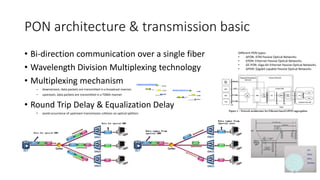
PON architecture & transmission basic
• Bi-direction communication over a single fiber
• Wavelength Division Multiplexing technology
• Multiplexing mechanism
– downstream, data packets are transmitted in a broadcast manner,
– upstream, data packets are transmitted in a TDMA manner
• Round Trip Delay & Equalization Delay
• avoid occurrence of upstream transmission collision on optical splitters
Different PON types:
• APON: ATM Passive Optical Networks
• EPON: Ethernet Passive Optical Networks
• GE-PON: Giga-bit Ethernet Passive Optical Networks
• GPON: Gigabit-capable Passive Optical Networks
8
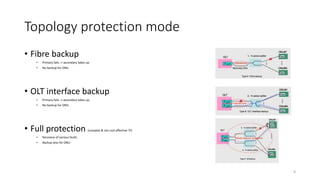
Topology protection mode
• Fibre backup
• Primary fails -> secondary takes up
• No backup for ONU
• OLT interface backup
• Primary fails -> secondary takes up
• No backup for ONU
• Full protection (complex & not cost effective )
• Recovery of various faults
• Backup also for ONU
9
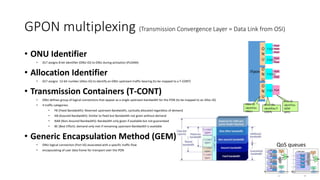
GPON multiplexing (Transmission Convergence Layer = Data Link from OSI)
• ONU Identifier
• OLT assigns 8-bit identifier (ONU-ID) to ONU during activation (PLOAM)
• Allocation Identifier
• OLT assigns 12-bit number (Alloc-ID) to identify an ONU upstream traffic-bearing (to be mapped to a T-CONT)
• Transmission Containers (T-CONT)
• ONU defines group of logical connections that appear as a single upstream bandwidth for the PON (to be mapped to an Alloc-ID)
• 4 traffic categories:
• FB (Fixed Bandwidth): Reserved upstream Bandwidth, cyclically allocated regardless of demand
• AB (Assured Bandwidth): Similar to fixed but Bandwidth not given without demand
• NAB (Non-Assured Bandwidth): Bandwidth only given if available but not guaranteed
• BE (Best Effort): demand only met if remaining upstream Bandwidth is available
• Generic Encapsulation Method (GEM)
• ONU logical connection (Port-ID) associated with a specific traffic flow
• encapsulating of user data frame for transport over the PON
QoS queues
10
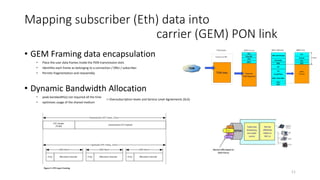
Mapping subscriber (Eth) data into
carrier (GEM) PON link
• GEM Framing data encapsulation
• Place the user data frames inside the PON transmission slots
• Identifies each frame as belonging to a connection / ONU / subscriber
• Permits fragmentation and reassembly
• Dynamic Bandwidth Allocation
• peak bandwidth(s) not required all the time
• optimizes usage of the shared medium
-> Oversubscription levels and Service Level Agreements (SLA)
11
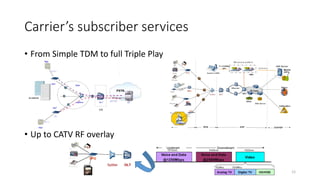
Carrier’s subscriber services
• From Simple TDM to full Triple Play
• Up to CATV RF overlay
IPTV
Phone
PC
SFU
OLTSplitter
12
Extra for the tech hungry
Broadband Forum TR-156
Using GPON Access in the context of TR-101
Broadband Forum TR-247/ATP-247
Abstract Test Plan for GPON ONU Conformance
13
Ethernet services across GPON
scenario & interoperability/conformance
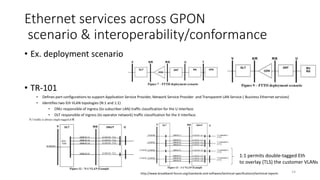
• Ex. deployment scenario
• TR-101
• Defines port configurations to support Application Service Provider, Network Service Provider and Transparent LAN Service ( Business Ethernet services)
• Identifies two Eth VLAN topologies (N:1 and 1:1)
• ONU responsible of ingress (to subscriber LAN) traffic classification for the U interface.
• OLT responsible of ingress (to operator network) traffic classification for the V interface.
14
1:1 permits double-tagged Eth
to overlay (TLS) the customer VLANs
http://www.broadband-forum.org/standards-and-software/technical-specifications/technical-reports
GPON ONU conformance
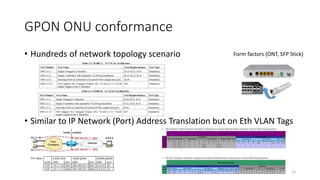
• Hundreds of network topology scenario
• Similar to IP Network (Port) Address Translation but on Eth VLAN Tags
15
Form factors (ONT, SFP Stick)

Carrier broadband evolution thru PON

  • 1.
    The race to(X)Gigabit Network Access From historical xDSL & DOCSIS copper to nowadays mixed/all optical network 1 Zaccone Carmelo 09/18
  • 2.
    Observations on Broadbandevolution • ICT and communication technologies are the backbone of the digital economy and society • Evolution of the market players (mainly related to the changing nature of the subscriptions) • Network Operators: continue the business in “access path & connection” • Over The Top: increasing offering in ”service & application” • Evolution of the consumer behaviour • Content: subscription vs acquisition based • Usage: on-demand/online vs download/offline OECD Digital Economy Outlook 2017 http://www.oecd.org/sti/ieconomy/ http://www.oecd.org/sti/broadband/broadband-statistics/ 2
  • 3.
    Trends (fixed): access,subscriptions, speed, services • Speed, a perception closely linked to the century (from ’90 Kbps, early ‘2K Mbps, current 100Mbps+) • New hype is (X)1Gbps 3
  • 4.
    Trends (mobile): access,subscriptions, speed, services • Exponential speed evolution leads to data consumption boom • Mobile goes ‘data hungry’ embedded devices • IoT, SmartCar, etc • 4G, 5G, (WiGiG 802.11ad) etc key wireless enabler 4
  • 5.
    One answer toTelco: PON (passive optical network) based NA • Extend the reachability of the (metro)core network thru higher speed access • Increase the coverage of the high speed access network by sharing former dedicated P2P links • Fitting (ITU-T G.9964) into Broadband Forum reference architecture (TR-101 ATM 2 Eth aggregation) with TR-156 (GPON access) or TR-167(GPON feding) or TR-331(GPON mobile backhaul) • Replace xDSL customer access or • Bring the street cabinet/mobile RAN closer to the customer 5
  • 6.
    FTTx roll outflavours • Fiber-to-the-curb (FTTC) • Fiber-to-the-DistributionPoint (FTTdp) • Fiber-to-the-cabinet (FTTCab) • Fiber-to-the-Building (FTTB) • Fiber-to-the-home (FTTH) • Fiber-to-the-office (FTTO) • Fiber-to-the-user (FTTU) FTTH Handbook http://www.ftthcouncil.eu/ 6
  • 7.
    PON components • OpticalLine Termination (operator side) • Passive Optical Network • Optical Wavelenght • Upstream 1310nm, • Downsteam 1490nm, • RF overlay 1550nm • Passive Optical Splitter • ratio max 128, 32/64 typical • Bandwidth • Upstream 1.244 Gb/s, • Downstrem 2.488Gb/s • Typical: Optical budget 28db for 20km with split 1:32 • Optical Network Termination/Unit (customer side) • Standards ITU-T G.984.1 G.984.2 System req Physical layer G.984.3 G.984.4 Protocol Layer Management layer 7
  • 8.
    PON architecture &transmission basic • Bi-direction communication over a single fiber • Wavelength Division Multiplexing technology • Multiplexing mechanism – downstream, data packets are transmitted in a broadcast manner, – upstream, data packets are transmitted in a TDMA manner • Round Trip Delay & Equalization Delay • avoid occurrence of upstream transmission collision on optical splitters Different PON types: • APON: ATM Passive Optical Networks • EPON: Ethernet Passive Optical Networks • GE-PON: Giga-bit Ethernet Passive Optical Networks • GPON: Gigabit-capable Passive Optical Networks 8
  • 9.
    Topology protection mode •Fibre backup • Primary fails -> secondary takes up • No backup for ONU • OLT interface backup • Primary fails -> secondary takes up • No backup for ONU • Full protection (complex & not cost effective ) • Recovery of various faults • Backup also for ONU 9
  • 10.
    GPON multiplexing (TransmissionConvergence Layer = Data Link from OSI) • ONU Identifier • OLT assigns 8-bit identifier (ONU-ID) to ONU during activation (PLOAM) • Allocation Identifier • OLT assigns 12-bit number (Alloc-ID) to identify an ONU upstream traffic-bearing (to be mapped to a T-CONT) • Transmission Containers (T-CONT) • ONU defines group of logical connections that appear as a single upstream bandwidth for the PON (to be mapped to an Alloc-ID) • 4 traffic categories: • FB (Fixed Bandwidth): Reserved upstream Bandwidth, cyclically allocated regardless of demand • AB (Assured Bandwidth): Similar to fixed but Bandwidth not given without demand • NAB (Non-Assured Bandwidth): Bandwidth only given if available but not guaranteed • BE (Best Effort): demand only met if remaining upstream Bandwidth is available • Generic Encapsulation Method (GEM) • ONU logical connection (Port-ID) associated with a specific traffic flow • encapsulating of user data frame for transport over the PON QoS queues 10
  • 11.
    Mapping subscriber (Eth)data into carrier (GEM) PON link • GEM Framing data encapsulation • Place the user data frames inside the PON transmission slots • Identifies each frame as belonging to a connection / ONU / subscriber • Permits fragmentation and reassembly • Dynamic Bandwidth Allocation • peak bandwidth(s) not required all the time • optimizes usage of the shared medium -> Oversubscription levels and Service Level Agreements (SLA) 11
  • 12.
    Carrier’s subscriber services •From Simple TDM to full Triple Play • Up to CATV RF overlay IPTV Phone PC SFU OLTSplitter 12
  • 13.
    Extra for thetech hungry Broadband Forum TR-156 Using GPON Access in the context of TR-101 Broadband Forum TR-247/ATP-247 Abstract Test Plan for GPON ONU Conformance 13
  • 14.
    Ethernet services acrossGPON scenario & interoperability/conformance • Ex. deployment scenario • TR-101 • Defines port configurations to support Application Service Provider, Network Service Provider and Transparent LAN Service ( Business Ethernet services) • Identifies two Eth VLAN topologies (N:1 and 1:1) • ONU responsible of ingress (to subscriber LAN) traffic classification for the U interface. • OLT responsible of ingress (to operator network) traffic classification for the V interface. 14 1:1 permits double-tagged Eth to overlay (TLS) the customer VLANs http://www.broadband-forum.org/standards-and-software/technical-specifications/technical-reports
  • 15.
    GPON ONU conformance •Hundreds of network topology scenario • Similar to IP Network (Port) Address Translation but on Eth VLAN Tags 15 Form factors (ONT, SFP Stick)