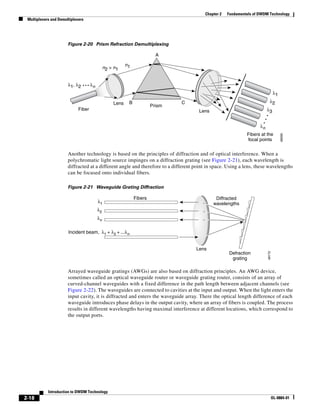
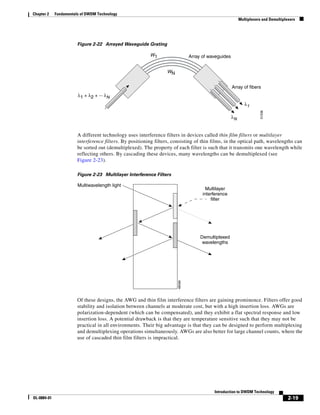
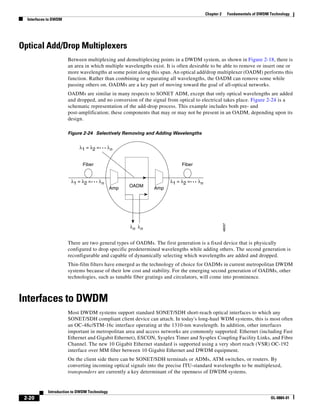
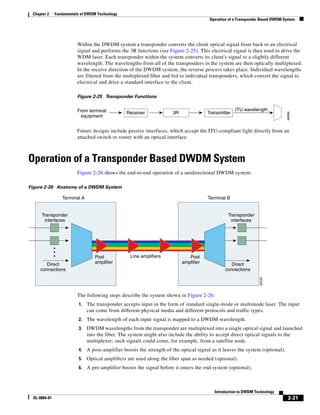
Introduction to DWDM Technology
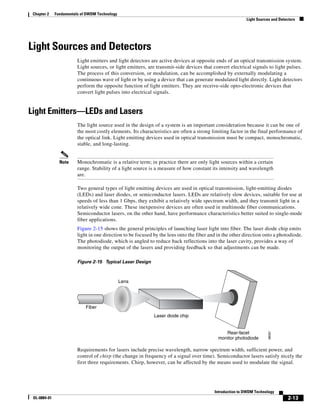
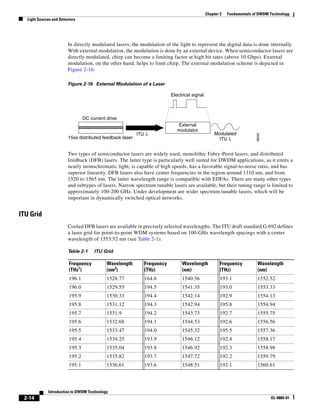
Last Updated: June 4, 2001


Corporate Headquarters
Cisco Systems, Inc.
170 West Tasman Drive
San Jose, CA 95134-1706
USA
http://www.cisco.com
Tel: 408 526-4000
       800 553-NETS (6387)
Fax: 408 526-4100


Text Part Number: OL-0884-01
THE SPECIFICATIONS AND INFORMATION REGARDING THE PRODUCTS IN THIS MANUAL ARE SUBJECT TO CHANGE WITHOUT NOTICE. ALL
STATEMENTS, INFORMATION, AND RECOMMENDATIONS IN THIS MANUAL ARE BELIEVED TO BE ACCURATE BUT ARE PRESENTED WITHOUT
WARRANTY OF ANY KIND, EXPRESS OR IMPLIED. USERS MUST TAKE FULL RESPONSIBILITY FOR THEIR APPLICATION OF ANY PRODUCTS.

THE SOFTWARE LICENSE AND LIMITED WARRANTY FOR THE ACCOMPANYING PRODUCT ARE SET FORTH IN THE INFORMATION PACKET THAT
SHIPPED WITH THE PRODUCT AND ARE INCORPORATED HEREIN BY THIS REFERENCE. IF YOU ARE UNABLE TO LOCATE THE SOFTWARE LICENSE
OR LIMITED WARRANTY, CONTACT YOUR CISCO REPRESENTATIVE FOR A COPY.

The following information is for FCC compliance of Class A devices: This equipment has been tested and found to comply with the limits for a Class A digital device, pursuant
to part 15 of the FCC rules. These limits are designed to provide reasonable protection against harmful interference when the equipment is operated in a commercial
environment. This equipment generates, uses, and can radiate radio-frequency energy and, if not installed and used in accordance with the instruction manual, may cause
harmful interference to radio communications. Operation of this equipment in a residential area is likely to cause harmful interference, in which case users will be required
to correct the interference at their own expense.

The following information is for FCC compliance of Class B devices: The equipment described in this manual generates and may radiate radio-frequency energy. If it is not
installed in accordance with Cisco’s installation instructions, it may cause interference with radio and television reception. This equipment has been tested and found to
comply with the limits for a Class B digital device in accordance with the specifications in part 15 of the FCC rules. These specifications are designed to provide reasonable
protection against such interference in a residential installation. However, there is no guarantee that interference will not occur in a particular installation.

Modifying the equipment without Cisco’s written authorization may result in the equipment no longer complying with FCC requirements for Class A or Class B digital
devices. In that event, your right to use the equipment may be limited by FCC regulations, and you may be required to correct any interference to radio or television
communications at your own expense.

You can determine whether your equipment is causing interference by turning it off. If the interference stops, it was probably caused by the Cisco equipment or one of its
peripheral devices. If the equipment causes interference to radio or television reception, try to correct the interference by using one or more of the following measures:

• Turn the television or radio antenna until the interference stops.

• Move the equipment to one side or the other of the television or radio.

• Move the equipment farther away from the television or radio.

• Plug the equipment into an outlet that is on a different circuit from the television or radio. (That is, make certain the equipment and the television or radio are on circuits
controlled by different circuit breakers or fuses.)

Modifications to this product not authorized by Cisco Systems, Inc. could void the FCC approval and negate your authority to operate the product.

The Cisco implementation of TCP header compression is an adaptation of a program developed by the University of California, Berkeley (UCB) as part of UCB’s public
domain version of the UNIX operating system. All rights reserved. Copyright © 1981, Regents of the University of California.

NOTWITHSTANDING ANY OTHER WARRANTY HEREIN, ALL DOCUMENT FILES AND SOFTWARE OF THESE SUPPLIERS ARE PROVIDED “AS IS” WITH
ALL FAULTS. CISCO AND THE ABOVE-NAMED SUPPLIERS DISCLAIM ALL WARRANTIES, EXPRESSED OR IMPLIED, INCLUDING, WITHOUT
LIMITATION, THOSE OF MERCHANTABILITY, FITNESS FOR A PARTICULAR PURPOSE AND NONINFRINGEMENT OR ARISING FROM A COURSE OF
DEALING, USAGE, OR TRADE PRACTICE.

IN NO EVENT SHALL CISCO OR ITS SUPPLIERS BE LIABLE FOR ANY INDIRECT, SPECIAL, CONSEQUENTIAL, OR INCIDENTAL DAMAGES, INCLUDING,
WITHOUT LIMITATION, LOST PROFITS OR LOSS OR DAMAGE TO DATA ARISING OUT OF THE USE OR INABILITY TO USE THIS MANUAL, EVEN IF CISCO
OR ITS SUPPLIERS HAVE BEEN ADVISED OF THE POSSIBILITY OF SUCH DAMAGES.


CCSP, CCVP, the Cisco Square Bridge logo, Follow Me Browsing, and StackWise are trademarks of Cisco Systems, Inc.; Changing the Way We Work, Live, Play, and Learn, and
iQuick Study are service marks of Cisco Systems, Inc.; and Access Registrar, Aironet, BPX, Catalyst, CCDA, CCDP, CCIE, CCIP, CCNA, CCNP, Cisco, the Cisco Certified
Internetwork Expert logo, Cisco IOS, Cisco Press, Cisco Systems, Cisco Systems Capital, the Cisco Systems logo, Cisco Unity, Enterprise/Solver, EtherChannel, EtherFast,
EtherSwitch, Fast Step, FormShare, GigaDrive, GigaStack, HomeLink, Internet Quotient, IOS, IP/TV, iQ Expertise, the iQ logo, iQ Net Readiness Scorecard, LightStream,
Linksys, MeetingPlace, MGX, the Networkers logo, Networking Academy, Network Registrar, Packet, PIX, Post-Routing, Pre-Routing, ProConnect, RateMUX, ScriptShare,
SlideCast, SMARTnet, The Fastest Way to Increase Your Internet Quotient, and TransPath are registered trademarks of Cisco Systems, Inc. and/or its affiliates in the United States
and certain other countries.

All other trademarks mentioned in this document or Website are the property of their respective owners. The use of the word partner does not imply a partnership relationship
between Cisco and any other company. (0601R)


Any Internet Protocol (IP) addresses used in this document are not intended to be actual addresses. Any examples, command display output, and figures included in the
document are shown for illustrative purposes only. Any use of actual IP addresses in illustrative content is unintentional and coincidental.

Introduction to DWDM Technology
© 2000 Cisco Systems, Inc. All rights reserved.
C O N T E N T S


              Preface     vii

                 Additional Reading         vii


CHAPTER   1   Introducing DWDM            1-1

                 Global Network Hierarchy                1-1

                 Economic Forces          1-3

                        Bandwidth Demand            1-3

                        Competition and Reliability              1-4

                 Options for Increasing Carrier Bandwidth                    1-5

                        Increase the Bit Rate           1-5

                        Increase the Number of Wavelengths                     1-5

                        Time-Division Multiplexing               1-5

                            SONET and TDM                1-6

                        Wavelength Division Multiplexing                 1-8

                        TDM and WDM Compared                    1-9

                 Additional Drivers in Metropolitan Area Networks                         1-10

                        Value of DWDM in the Metropolitan Area                        1-11

                        Requirements in the Metropolitan Area                      1-12

                 Why DWDM?          1-12

                        SONET with DWDM                 1-13

                        Enhancing Performance and Reliability                   1-15
                            Network Management Capability                      1-16

                        Additional Benefits         1-16


CHAPTER   2   Fundamentals of DWDM Technology                          2-1

                 Evolution of Fiber Optic Transmission                 2-1

                        Development of DWDM Technology                       2-2

                        DWDM System Functions                   2-3

                        Enabling Technologies             2-4

                 Components and Operation                 2-5

                 Optical Fibers     2-5

                        How Fiber Works           2-5


                                                                                                 Introduction to DWDM Technology
 OL-0884-01                                                                                                                        iii
Contents


                                  Multimode and Single-Mode Fiber                       2-6

                                  Single-Mode Fiber Designs                    2-7

                                       Transmission Challenges                   2-8

                                       Attenuation             2-8

                                       Dispersion            2-10

                                  Summary            2-12

                             Light Sources and Detectors                 2-13

                                  Light Emitters—LEDs and Lasers                       2-13

                                       ITU Grid         2-14

                                  Light Detectors            2-15

                             Optical Amplifiers             2-15

                                  Erbium-Doped Fiber Amplifier                   2-16

                             Multiplexers and Demultiplexers                    2-16

                                  Techniques for Multiplexing and Demultiplexing                             2-17

                                  Optical Add/Drop Multiplexers                      2-20

                             Interfaces to DWDM               2-20

                             Operation of a Transponder Based DWDM System                                  2-21


CHAPTER   3             DWDM in Metropolitan Area Networks                                  3-1

                             Technologies in the Metropolitan Market                          3-1

                                  SONET/SDH             3-1

                                  ATM          3-1

                                  Gigabit Ethernet            3-2

                                  IP     3-2

                                  Fibre Channel             3-3
                                  Dynamic Packet Transport                 3-3

                                  FDDI         3-4

                                  Support for Legacy Traffic               3-4

                             Applications and Services in the MAN                       3-5

                                  Storage Area Networks                  3-5

                                  Migration from SONET/SDH                      3-7

                             Topologies and Protection Schemes for DWDM                              3-9

                                  Point-to-Point Topologies               3-10

                                  Ring Topologies             3-10

                                  Mesh Topologies                 3-12

                             Practical Considerations in Deploying DWDM                             3-13

              Introduction to DWDM Technology
  iv                                                                                                                OL-0884-01
Contents


                 Optical Power Budget      3-13

                 Interoperability Issues   3-14

              Future of DWDM     3-14


INDEX


                                                  Introduction to DWDM Technology
 OL-0884-01                                                                               v
Contents


           Introduction to DWDM Technology
vi                                           OL-0884-01
Preface

              This Introduction to DWDM Technology is intended for readers who want to gain a basic understanding
              of dense wavelength division multiplexing (DWDM) technology and its role in metropolitan area
              networks (MANs). The contents are organized as follows:


              Chapter                     Title                       Description
              Chapter 1                   Introducing DWDM            Differentiates the MAN from other segments
                                                                      of the global network; describes the driving
                                                                      forces behind DWDM; contrasts time division
                                                                      multiplexing (TDM) with wavelength
                                                                      division multiplexing (WDM); presents the
                                                                      advantages of DWDM in the MAN
              Chapter 2                   Fundamentals of DWDM Summarizes the evolution of fiber optic
                                          Technology           transmission and DWDM technology; briefly
                                                               describes the main components; explains the
                                                               operation of a DWDM system
              Chapter 3                   DWDM in Metropolitan        Surveys the data link and network
                                          Area Networks               technologies used in the MAN; describes
                                                                      sample applications for DWDM; presents
                                                                      sample topologies and protection schemes;
                                                                      offers practical considerations for deploying
                                                                      DWDM


Additional Reading
              Readers who are interested in more detailed information about optical networking will find that there is
              a wide selection of resources available, especially on SONET. The following publications are good,
              basic texts:
               •   Dutton, Harry J. R. Understanding Optical Communications. Research Triangle Park: IBM
                   Corporation; 1998.
               •   Goff, David R. Fiber Optic Reference Guide, 2nd edition. Boston: Focal Press; 1999.
               •   Goralski, Walter J. SONET, 2nd edition. New York: McGraw-Hill; 2000.
               •   Kaminow, Ivan P., and Koch, Thomas L., eds. Optical Fiber Telecommunications. San Diego:
                   Academic Press; 1997.


                                                                              Introduction to DWDM Technology
 OL-0884-01                                                                                                      vii
Preface
Additional Reading


                     The following publication is a detailed text on DWDM, particularly from the standpoint of theory and
                     optical components:
                          Kartalopoulos, Stamatios V. Introduction to DWDM Technology: Data in a Rainbow. New York:
                          IEEE Press; 1999.
                     Although comprehensive texts specifically about DWDM are not yet plentiful, there is a variety of
                     information in the form of tutorials, white papers, and so on, to be found on the World Wide Web.
                     For definitions of terms and acronyms used in this Introduction, refer to the Glossary of Optical
                     Networking Terms.


           Introduction to DWDM Technology
viii                                                                                                              OL-0884-01
C H A P T E R                      1
             Introducing DWDM

             The following discussion provides some background on why dense wavelength division multiplexing
             (DWDM) is an important innovation in optical networks and what benefits it can provide. We begin with
             a high-level view of the segments of the global network and the economic forces driving the revolution
             in fiber optic networks. We then examine the differences between traditional time-division multiplexing
             (TDM) and wavelength division multiplexing (WDM). Finally, we explore the advantages of this new
             technology.


Global Network Hierarchy
             It is the nature of modern communications networks to be in a state of ongoing evolution. Factors such
             as new applications, changing patterns of usage, and redistribution of content make the definition of
             networks a work in progress. Nevertheless, we can broadly define the larger entities that make up the
             global network based on variables such as transport technology, distance, applications, and so on.
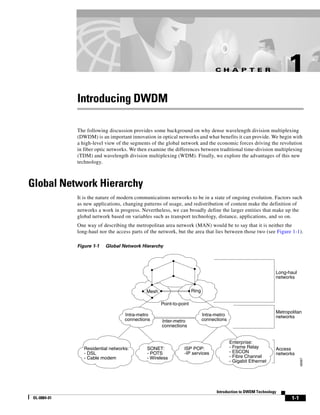
             One way of describing the metropolitan area network (MAN) would be to say that it is neither the
             long-haul nor the access parts of the network, but the area that lies between those two (see Figure 1-1).

             Figure 1-1   Global Network Hierarchy


                                                                                                                Long-haul
                                                                                                                networks


                                             Mesh                    Ring

                                                    Point-to-point
                                                                                                                Metropolitan
                                   Intra-metro                              Intra-metro                         networks
                                   connections      Inter-metro             connections
                                                    connections


                                                                                          Enterprise:
                Residential networks:        SONET:            ISP POP:                   - Frame Relay         Access
                - DSL                        - POTS            -IP services               - ESCON               networks
                - Cable modem                - Wireless                                   - Fibre Channel
                                                                                                                             49367


                                                                                          - Gigabit Ethernet


                                                                                  Introduction to DWDM Technology
OL-0884-01                                                                                                             1-1
Chapter 1   Introducing DWDM
Global Network Hierarchy


                     Long-Haul Networks
                     Long-haul networks are at the core of the global network. Dominated by a small group of large
                     transnational and global carriers, long-haul networks connect the MANs. Their application is transport,
                     so their primary concern is capacity. In many cases these networks, which have traditionally been based
                     on Synchronous Optical Network (SONET) or Synchronous Digital Hierarchy (SDH) technology, are
                     experiencing fiber exhaust as a result of high bandwidth demand.

                     Access Networks
                     At the other end of the spectrum are the access networks. These networks are the closest to the end users,
                     at the edge of the MAN. They are characterized by diverse protocols and infrastructures, and they span
                     a broad spectrum of rates. Customers range from residential Internet users to large corporations and
                     institutions. The predominance of IP traffic, with its inherently bursty, asymmetric, and unpredictable
                     nature, presents many challenges, especially with new real-time applications. At the same time, these
                     networks are required to continue to support legacy traffic and protocols, such as IBM’s Enterprise
                     System Connection (ESCON).

                     Metropolitan Area Networks
                     Between these two large and different networking domains lie the MANs. These networks channel traffic
                     within the metropolitan domain (among businesses, offices, and metropolitan areas) and between large
                     long-haul points of presence (POPs). The MANs have many of the same characteristics as the access
                     networks, such as diverse networking protocols and channel speeds. Like access networks, MANs have
                     been traditionally SONET/SDH based, using point-to-point or ring topologies with add/drop
                     multiplexers (ADMs).
                     The MAN lies at a critical juncture. On the one hand, it must meet the needs created by the dynamics of
                     the ever-increasing bandwidth available in long-haul transport networks. On the other hand, it must
                     address the growing connectivity requirements and access technologies that are resulting in demand for
                     high-speed, customized data services.

                     Metropolitan and Long-Haul Networks Compared
                     There is a natural tendency to regard the MAN as simply a scaled-down version of the long-haul network.
                     It is true that networks serving the metropolitan area encompass shorter distances than in the long-haul
                     transport networks. Upon closer examination, however, these differences are superficial compared to
                     other factors. Network shape is more stable in long-haul, while topologies change frequently in the
                     MAN. Many more types of services and traffic types must be supported in MANs, from traditional voice
                     and leased line services to new applications, including data storage, distributed applications, and video.
                     The long-haul, by contrast, is about big pipes.
                     Another important way in which metropolitan networks today differ from trunk-oriented long haul
                     networks is that they encompass a collection of low bit-rate asynchronous and synchronous transmission
                     equipment, short loops, small cross-sections, and a variety of users with varying bandwidth demands.
                     These fundamental differences between the two types of networks have powerful implications for the
                     requirements in the metropolitan domain. Protocol and speed transparency, scalability, and dynamic
                     provisioning are at least as important as capacity, which rules in the long-haul market.

                     An Alternative View
                     The preceding breakdown of the global network represents a somewhat simplified view. In reality, the
                     lines between the domains are not always so clear-cut. Long-haul and metropolitan networks are
                     sometimes not clearly delineated; the same holds true for the access and metropolitan domains.


           Introduction to DWDM Technology
1-2                                                                                                                  OL-0884-01
Chapter 1    Introducing DWDM
                                                                                                                               Economic Forces


                        Furthermore, other views of the global network exist. One, for example, defines the access network as
                        part of, rather than separate from, the MAN, while also including enterprise connectivity in the
                        metropolitan domain. In this view, the metropolitan market breaks down as follows:
                            •             Core—These are essentially scaled-down long-haul systems. They are considered the core of the
                                          MAN, because they interconnect carrier POPs and do not directly interface with end users.
                            •             Metropolitan access—This is the segment between carrier POPs and access facilities, which could
                                          be equipment at customer premises or at an aggregation point.
                            •             Enterprise—This is the part of the network dedicated to serving the needs of enterprises. Using
                                          owned or leased fiber (or leased fiber capacity), connectivity is provided between geographically
                                          disparate enterprise sites and for new applications, such as storage area networks (SANs).


Economic Forces
                        As we enter the twenty-first century, it goes without saying that information services have permeated
                        society and commerce. Information, while still a tool, has become a commodity in itself. Yet the
                        universal acceptance and ubiquitous adoption of information technology systems has strained the
                        backbones on which they were built. High demand—coupled with high usage rates, a deregulated
                        telecommunications environment, and high availability requirements—is rapidly depleting the
                        capacities of fibers that, when installed 10 years ago, were expected to suffice for the foreseeable future.


Bandwidth Demand
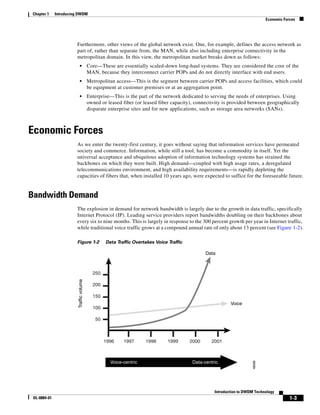
                        The explosion in demand for network bandwidth is largely due to the growth in data traffic, specifically
                        Internet Protocol (IP). Leading service providers report bandwidths doubling on their backbones about
                        every six to nine months. This is largely in response to the 300 percent growth per year in Internet traffic,
                        while traditional voice traffic grows at a compound annual rate of only about 13 percent (see Figure 1-2).

                        Figure 1-2                Data Traffic Overtakes Voice Traffic

                                                                                                Data


                                            250
                         Traffic volume


                                            200

                                            150
                                                                                                            Voice
                                            100

                                             50


                                                  1996    1997      1998       1999      2000      2001


                                                    Voice-centric                         Data-centric
                                                                                                                       48066


                                                                                                    Introduction to DWDM Technology
 OL-0884-01                                                                                                                                1-3
Chapter 1   Introducing DWDM
  Economic Forces


                      At the same time that network traffic volume is increasing, the nature of the traffic itself is becoming
                      more complex. Traffic carried on a backbone can originate as circuit based (TDM voice and fax), packet
                      based (IP), or cell based (ATM and Frame Relay). In addition, there is an increasing proportion of delay
                      sensitive data, such as voice over IP and streaming video.
                      In response to this explosive growth in bandwidth demand, along with the emergence of IP as the
                      common foundation for all services, long-haul service providers are moving away from TDM based
                      systems, which were optimized for voice but now prove to be costly and inefficient. Meanwhile,
                      metropolitan networks are also experiencing the impact of growing congestion, as well as rapidly
                      changing requirements that call for simpler and faster provisioning than is possible with older equipment
                      and technologies. Of key importance in the metropolitan area is the growth in storage area networks
                      (SANs), discussed in the “Storage Area Networks” section on page 3-5.


Competition and Reliability
                      While the demand for bandwidth is driven largely by new data applications, Internet usage, and the
                      growth in wireless communications, two additional factors come into play: competition and network
                      availability.
                      The telecommunication sector, long a beneficiary of government regulation, is now a highly competitive
                      industry. Competition was first introduced into the U.S. long-distance market in 1984, and the 1996
                      Telecommunications Reform Act is now resulting in an increasingly broad array of new operators. These
                      new carriers are striving to meet the new demand for additional services and capacity.
                      There are two main effects on the industry from competition:
                       •   Enhanced services are created by newcomers trying to compete with incumbents. In the
                           metropolitan market, for example, there are broadband wireless and DSL services to homes and
                           small and medium-sized business, high-speed private line and VPN services to corporations, and
                           transparent LAN services to enterprise network customers.
                       •   New carriers coming onto the scene create new infrastructure so that they do not have to lease from
                           existing operators. Using this strategy, they have more control over provisioning and reliability.
                      As telecommunications and data services have become more critical to business operations, service
                      providers have been required to ensure that their networks are fault tolerant. To meet these requirements,
                      providers have had to build backup routes, often using simple 1:1 redundancy in ring or point-to-point
                      configurations. Achieving the required level of reliability, however, means reserving dedicated capacity
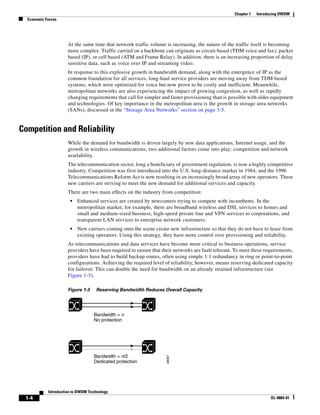
                      for failover. This can double the need for bandwidth on an already strained infrastructure (see
                      Figure 1-3).

                      Figure 1-3    Reserving Bandwidth Reduces Overall Capacity


                                   Bandwidth = n
                                   No protection


                                   Bandwidth = n/2
                                                                    48067


                                   Dedicated protection


            Introduction to DWDM Technology
 1-4                                                                                                                  OL-0884-01
Chapter 1    Introducing DWDM
                                                                                              Options for Increasing Carrier Bandwidth


Options for Increasing Carrier Bandwidth
                        Faced with the challenge of dramatically increasing capacity while constraining costs, carriers have two
                        options: Install new fiber or increase the effective bandwidth of existing fiber.
                        Laying new fiber is the traditional means used by carriers to expand their networks. Deploying new fiber,
                        however, is a costly proposition. It is estimated at about $70,000 per mile, most of which is the cost of
                        permits and construction rather than the fiber itself. Laying new fiber may make sense only when it is
                        desirable to expand the embedded base.
                        Increasing the effective capacity of existing fiber can be accomplished in two ways:
                          •   Increase the bit rate of existing systems.
                          •   Increase the number of wavelengths on a fiber.


Increase the Bit Rate
                        Using TDM, data is now routinely transmitted at 2.5 Gbps (OC-48) and, increasingly, at 10 Gbps
                        (OC-192); recent advances have resulted in speeds of 40 Gbps (OC-768). The electronic circuitry that
                        makes this possible, however, is complex and costly, both to purchase and to maintain. In addition, there
                        are significant technical issues that may restrict the applicability of this approach. Transmission at
                        OC-192 over single-mode (SM) fiber, for example, is 16 times more affected by chromatic dispersion
                        than the next lower aggregate speed, OC-48. The greater transmission power required by the higher bit
                        rates also introduces nonlinear effects that can affect waveform quality. Finally, polarization mode
                        dispersion, another effect that limits the distance a light pulse can travel without degradation, is also an
                        issue. These characteristics of light in fiber are discussed further in the “Optical Fibers” section on
                        page 2-5.


Increase the Number of Wavelengths
                        In this approach, many wavelengths are combined onto a single fiber. Using wavelength division
                        multiplexing (WDM) technology several wavelengths, or light colors, can simultaneously multiplex
                        signals of 2.5 to 40 Gbps each over a strand of fiber. Without having to lay new fiber, the effective
                        capacity of existing fiber plant can routinely be increased by a factor of 16 or 32. Systems with 128 and
                        160 wavelengths are in operation today, with higher density on the horizon. The specific limits of this
                        technology are not yet known.


Time-Division Multiplexing
                        Time-division multiplexing (TDM) was invented as a way of maximizing the amount of voice traffic that
                        could be carried over a medium. In the telephone network before multiplexing was invented, each
                        telephone call required its own physical link. This proved to be an expensive and unscalable solution.
                        Using multiplexing, more than one telephone call could be put on a single link.
                        TDM can be explained by an analogy to highway traffic. To transport all the traffic from four tributaries
                        to another city, you can send all the traffic on one lane, providing the feeding tributaries are fairly
                        serviced and the traffic is synchronized. So, if each of the four feeds puts a car onto the trunk highway
                        every four seconds, then the trunk highway would get a car at the rate of one each second. As long as
                        the speed of all the cars is synchronized, there would be no collision. At the destination the cars can be
                        taken off the highway and fed to the local tributaries by the same synchronous mechanism, in reverse.


                                                                                         Introduction to DWDM Technology
 OL-0884-01                                                                                                                       1-5
Chapter 1   Introducing DWDM
  Options for Increasing Carrier Bandwidth


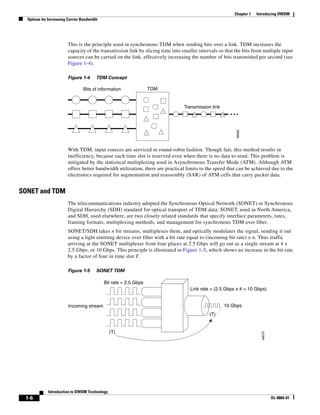
                         This is the principle used in synchronous TDM when sending bits over a link. TDM increases the
                         capacity of the transmission link by slicing time into smaller intervals so that the bits from multiple input
                         sources can be carried on the link, effectively increasing the number of bits transmitted per second (see
                         Figure 1-4).

                         Figure 1-4      TDM Concept

                                 Bits of information               TDM


                                                                                 Transmission link
                                                                                                       ...


                                                                                                          48069
                         With TDM, input sources are serviced in round-robin fashion. Though fair, this method results in
                         inefficiency, because each time slot is reserved even when there is no data to send. This problem is
                         mitigated by the statistical multiplexing used in Asynchronous Transfer Mode (ATM). Although ATM
                         offers better bandwidth utilization, there are practical limits to the speed that can be achieved due to the
                         electronics required for segmentation and reassembly (SAR) of ATM cells that carry packet data.


SONET and TDM
                         The telecommunications industry adopted the Synchronous Optical Network (SONET) or Synchronous
                         Digital Hierarchy (SDH) standard for optical transport of TDM data. SONET, used in North America,
                         and SDH, used elsewhere, are two closely related standards that specify interface parameters, rates,
                         framing formats, multiplexing methods, and management for synchronous TDM over fiber.
                         SONET/SDH takes n bit streams, multiplexes them, and optically modulates the signal, sending it out
                         using a light emitting device over fiber with a bit rate equal to (incoming bit rate) x n. Thus traffic
                         arriving at the SONET multiplexer from four places at 2.5 Gbps will go out as a single stream at 4 x
                         2.5 Gbps, or 10 Gbps. This principle is illustrated in Figure 1-5, which shows an increase in the bit rate
                         by a factor of four in time slot T.

                         Figure 1-5      SONET TDM

                                             Bit rate = 2.5 Gbps
                                                                                    Link rate = (2.5 Gbps x 4 = 10 Gbps)


                         Incoming stream                                                             10 Gbps
                                                                                             (T)


                                               (T)
                                                                                                                       48070


             Introduction to DWDM Technology
 1-6                                                                                                                           OL-0884-01
Chapter 1    Introducing DWDM
                                                                                          Options for Increasing Carrier Bandwidth


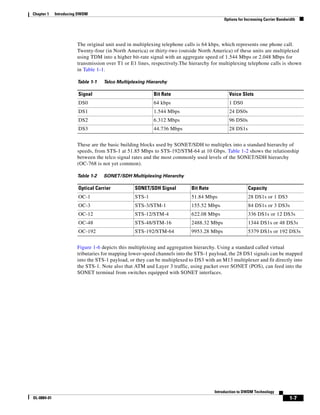
                       The original unit used in multiplexing telephone calls is 64 kbps, which represents one phone call.
                       Twenty-four (in North America) or thirty-two (outside North America) of these units are multiplexed
                       using TDM into a higher bit-rate signal with an aggregate speed of 1.544 Mbps or 2.048 Mbps for
                       transmission over T1 or E1 lines, respectively.The hierarchy for multiplexing telephone calls is shown
                       in Table 1-1.

                       Table 1-1   Telco Multiplexing Hierarchy

                        Signal                           Bit Rate                            Voice Slots
                        DS0                              64 kbps                             1 DS0
                        DS1                              1.544 Mbps                          24 DS0s
                        DS2                              6.312 Mbps                          96 DS0s
                        DS3                              44.736 Mbps                         28 DS1s


                       These are the basic building blocks used by SONET/SDH to multiplex into a standard hierarchy of
                       speeds, from STS-1 at 51.85 Mbps to STS-192/STM-64 at 10 Gbps. Table 1-2 shows the relationship
                       between the telco signal rates and the most commonly used levels of the SONET/SDH hierarchy
                       (OC-768 is not yet common).

                       Table 1-2   SONET/SDH Multiplexing Hierarchy

                        Optical Carrier          SONET/SDH Signal          Bit Rate                    Capacity
                        OC-1                     STS-1                     51.84 Mbps                  28 DS1s or 1 DS3
                        OC-3                     STS-3/STM-1               155.52 Mbps                 84 DS1s or 3 DS3s
                        OC-12                    STS-12/STM-4              622.08 Mbps                 336 DS1s or 12 DS3s
                        OC-48                    STS-48/STM-16             2488.32 Mbps                1344 DS1s or 48 DS3s
                        OC-192                   STS-192/STM-64            9953.28 Mbps                5379 DS1s or 192 DS3s


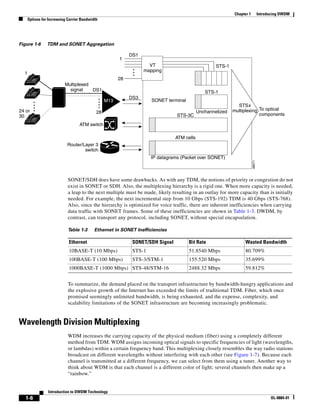
                       Figure 1-6 depicts this multiplexing and aggregation hierarchy. Using a standard called virtual
                       tributaries for mapping lower-speed channels into the STS-1 payload, the 28 DS1 signals can be mapped
                       into the STS-1 payload, or they can be multiplexed to DS3 with an M13 multiplexer and fit directly into
                       the STS-1. Note also that ATM and Layer 3 traffic, using packet over SONET (POS), can feed into the
                       SONET terminal from switches equipped with SONET interfaces.


                                                                                      Introduction to DWDM Technology
OL-0884-01                                                                                                                    1-7
Chapter 1           Introducing DWDM
   Options for Increasing Carrier Bandwidth


Figure 1-6    TDM and SONET Aggregation

                                                          DS1
                                                     1
                                                                  VT                              STS-1
                                                                mapping
  1
                                                     28
                        Multiplexed
                          signal    DS1                                                      STS-1
                                                          DS3
                                               M13                 SONET terminal
                                                                                                            STSx
24 or                                     28                                              Unchannelized   multiplexing To optical
30                                                                            STS-3C                                   components

                                ATM switch

                                                                              ATM cells
                         Router/Layer 3
                                 switch
                                                                   IP datagrams (Packet over SONET)


                                                                                                                      48071
                          SONET/SDH does have some drawbacks. As with any TDM, the notions of priority or congestion do not
                          exist in SONET or SDH. Also, the multiplexing hierarchy is a rigid one. When more capacity is needed,
                          a leap to the next multiple must be made, likely resulting in an outlay for more capacity than is initially
                          needed. For example, the next incremental step from 10 Gbps (STS-192) TDM is 40 Gbps (STS-768).
                          Also, since the hierarchy is optimized for voice traffic, there are inherent inefficiencies when carrying
                          data traffic with SONET frames. Some of these inefficiencies are shown in Table 1-3. DWDM, by
                          contrast, can transport any protocol, including SONET, without special encapsulation.

                          Table 1-3      Ethernet in SONET Inefficiencies

                          Ethernet                         SONET/SDH Signal         Bit Rate                   Wasted Bandwidth
                          10BASE-T (10 Mbps)               STS-1                    51.8540 Mbps                80.709%
                          100BASE-T (100 Mbps)             STS-3/STM-1              155.520 Mbps                35.699%
                          1000BASE-T (1000 Mbps) STS-48/STM-16                      2488.32 Mbps                59.812%


                          To summarize, the demand placed on the transport infrastructure by bandwidth-hungry applications and
                          the explosive growth of the Internet has exceeded the limits of traditional TDM. Fiber, which once
                          promised seemingly unlimited bandwidth, is being exhausted, and the expense, complexity, and
                          scalability limitations of the SONET infrastructure are becoming increasingly problematic.


Wavelength Division Multiplexing
                          WDM increases the carrying capacity of the physical medium (fiber) using a completely different
                          method from TDM. WDM assigns incoming optical signals to specific frequencies of light (wavelengths,
                          or lambdas) within a certain frequency band. This multiplexing closely resembles the way radio stations
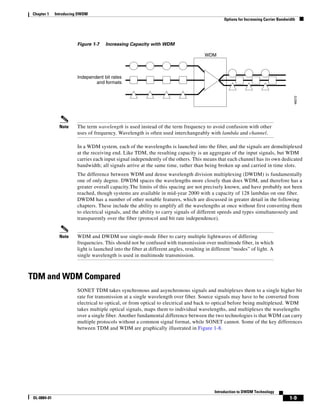
                          broadcast on different wavelengths without interfering with each other (see Figure 1-7). Because each
                          channel is transmitted at a different frequency, we can select from them using a tuner. Another way to
                          think about WDM is that each channel is a different color of light; several channels then make up a
                          “rainbow.”


              Introduction to DWDM Technology
   1-8                                                                                                                              OL-0884-01
Chapter 1     Introducing DWDM
                                                                                               Options for Increasing Carrier Bandwidth


                        Figure 1-7    Increasing Capacity with WDM

                                                                                      WDM


                         Independent bit rates
                                 and formats


                                                                                                                                      48072
                Note    The term wavelength is used instead of the term frequency to avoid confusion with other
                        uses of frequency. Wavelength is often used interchangeably with lambda and channel.

                        In a WDM system, each of the wavelengths is launched into the fiber, and the signals are demultiplexed
                        at the receiving end. Like TDM, the resulting capacity is an aggregate of the input signals, but WDM
                        carries each input signal independently of the others. This means that each channel has its own dedicated
                        bandwidth; all signals arrive at the same time, rather than being broken up and carried in time slots.
                        The difference between WDM and dense wavelength division multiplexing (DWDM) is fundamentally
                        one of only degree. DWDM spaces the wavelengths more closely than does WDM, and therefore has a
                        greater overall capacity.The limits of this spacing are not precisely known, and have probably not been
                        reached, though systems are available in mid-year 2000 with a capacity of 128 lambdas on one fiber.
                        DWDM has a number of other notable features, which are discussed in greater detail in the following
                        chapters. These include the ability to amplify all the wavelengths at once without first converting them
                        to electrical signals, and the ability to carry signals of different speeds and types simultaneously and
                        transparently over the fiber (protocol and bit rate independence).


                Note    WDM and DWDM use single-mode fiber to carry multiple lightwaves of differing
                        frequencies. This should not be confused with transmission over multimode fiber, in which
                        light is launched into the fiber at different angles, resulting in different “modes” of light. A
                        single wavelength is used in multimode transmission.


TDM and WDM Compared
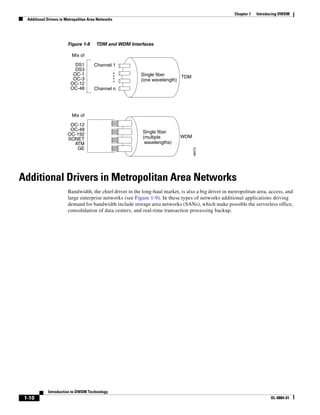
                        SONET TDM takes synchronous and asynchronous signals and multiplexes them to a single higher bit
                        rate for transmission at a single wavelength over fiber. Source signals may have to be converted from
                        electrical to optical, or from optical to electrical and back to optical before being multiplexed. WDM
                        takes multiple optical signals, maps them to individual wavelengths, and multiplexes the wavelengths
                        over a single fiber. Another fundamental difference between the two technologies is that WDM can carry
                        multiple protocols without a common signal format, while SONET cannot. Some of the key differences
                        between TDM and WDM are graphically illustrated in Figure 1-8.


                                                                                           Introduction to DWDM Technology
 OL-0884-01                                                                                                                        1-9
Chapter 1   Introducing DWDM
  Additional Drivers in Metropolitan Area Networks


                        Figure 1-8      TDM and WDM Interfaces

                           Mix of

                            DS1        Channel 1
                            DS3
                           OC-1                           Single fiber
                           OC-3                                            TDM
                                                          (one wavelength)
                          OC-12
                          OC-48        Channel n


                           Mix of
                         OC-12
                         OC-48
                        OC-192                             Single fiber
                        SONET                              (multiple         WDM
                          ATM                               wavelengths)
                           GE


                                                                                   48073
Additional Drivers in Metropolitan Area Networks
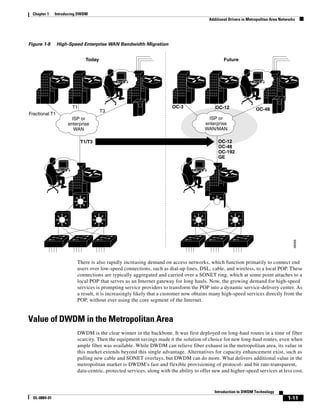
                        Bandwidth, the chief driver in the long-haul market, is also a big driver in metropolitan area, access, and
                        large enterprise networks (see Figure 1-9). In these types of networks additional applications driving
                        demand for bandwidth include storage area networks (SANs), which make possible the serverless office,
                        consolidation of data centers, and real-time transaction processing backup.


             Introduction to DWDM Technology
 1-10                                                                                                                    OL-0884-01
Chapter 1    Introducing DWDM
                                                                                        Additional Drivers in Metropolitan Area Networks


Figure 1-9      High-Speed Enterprise WAN Bandwidth Migration


                              Today                                                             Future


                       T1                                             OC-3                 OC-12
                                      T3                                                                          OC-48
Fractional T1
                       ISP or                                                           ISP or
                     enterprise                                                       enterprise
                        WAN                                                           WAN/MAN

                            T1/T3                                                            OC-12
                                                                                             OC-48
                                                                                             OC-192
                                                                                             GE


                                                                                                                                       48068
                         There is also rapidly increasing demand on access networks, which function primarily to connect end
                         users over low-speed connections, such as dial-up lines, DSL, cable, and wireless, to a local POP. These
                         connections are typically aggregated and carried over a SONET ring, which at some point attaches to a
                         local POP that serves as an Internet gateway for long hauls. Now, the growing demand for high-speed
                         services is prompting service providers to transform the POP into a dynamic service-delivery center. As
                         a result, it is increasingly likely that a customer now obtains many high-speed services directly from the
                         POP, without ever using the core segment of the Internet.


Value of DWDM in the Metropolitan Area
                         DWDM is the clear winner in the backbone. It was first deployed on long-haul routes in a time of fiber
                         scarcity. Then the equipment savings made it the solution of choice for new long-haul routes, even when
                         ample fiber was available. While DWDM can relieve fiber exhaust in the metropolitan area, its value in
                         this market extends beyond this single advantage. Alternatives for capacity enhancement exist, such as
                         pulling new cable and SONET overlays, but DWDM can do more. What delivers additional value in the
                         metropolitan market is DWDM’s fast and flexible provisioning of protocol- and bit rate-transparent,
                         data-centric, protected services, along with the ability to offer new and higher-speed services at less cost.


                                                                                           Introduction to DWDM Technology
  OL-0884-01                                                                                                                        1-11
Chapter 1   Introducing DWDM
  Why DWDM?


                    The need to provision services of varying types in a rapid and efficient manner in response to the
                    changing demands of customers is a distinguishing characteristic of the metropolitan networks. With
                    SONET, which is the foundation of the vast majority of existing MANs, service provisioning is a lengthy
                    and complex process. Network planning and analysis, ADM provisioning, Digital Crossconnect System
                    (DCS) reconfiguration, path and circuit verification, and service creation can take several weeks. By
                    contrast, with DWDM equipment in place provisioning new service can be as simple as turning on
                    another lightwave in an existing fiber pair.
                    Potential providers of DWDM-based services in metropolitan areas, where abundant fiber plant already
                    exists or is being built, include incumbent local exchange carriers (ILECs), competitive local exchange
                    carriers (CLECs), inter-exchange carriers (IXCs), Internet service providers (ISPs), cable companies,
                    private network operators, and utility companies. Such carriers can often offer new services for less cost
                    than older ones. Much of the cost savings is due to reducing unnecessary layers of equipment, which also
                    lowers operational costs and simplifies the network architecture.
                    Carriers can create revenue today by providing protocol-transparent, high-speed LAN and SAN services
                    to large organizations, as well as a mixture of lower-speed services (Token Ring, FDDI, Ethernet) to
                    smaller organizations. In implementing an optical network, they are ensuring that they can play in the
                    competitive field of the future.


Requirements in the Metropolitan Area
                    The requirements in the metropolitan market may differ in some respects from those in the long-haul
                    network market, yet metropolitan networks are still just a geographically distinguished segment of the
                    global network. What happens in the core must be supported right to the edge. IP, for example, is the
                    dominant traffic type, so interworking with this layer is a requirement, while not ignoring other traffic
                    (TDM). Network management is now of primary concern, and protection schemes that ensure high
                    availability are a given.
                    Key requirements for DWDM systems in the MAN include the following:
                     •   Multiprotocol support
                     •   Scalability
                     •   Reliability and availability
                     •   Openness (interfaces, network management, standard fiber types, electromagnetic compatibility)
                     •   Ease of installation and management
                     •   Size and power consumption
                     •   Cost effectiveness


Why DWDM?
                    From both technical and economic perspectives, the ability to provide potentially unlimited transmission
                    capacity is the most obvious advantage of DWDM technology. The current investment in fiber plant can
                    not only be preserved, but optimized by a factor of at least 32. As demands change, more capacity can
                    be added, either by simple equipment upgrades or by increasing the number of lambdas on the fiber,
                    without expensive upgrades. Capacity can be obtained for the cost of the equipment, and existing fiber
                    plant investment is retained.


          Introduction to DWDM Technology
 1-12                                                                                                               OL-0884-01
Chapter 1     Introducing DWDM
                                                                                                                      Why DWDM?


                        Bandwidth aside, DWDM’s most compelling technical advantages can be summarized as follows:
                          •     Transparency—Because DWDM is a physical layer architecture, it can transparently support both
                                TDM and data formats such as ATM, Gigabit Ethernet, ESCON, and Fibre Channel with open
                                interfaces over a common physical layer.
                          •     Scalability—DWDM can leverage the abundance of dark fiber in many metropolitan area and
                                enterprise networks to quickly meet demand for capacity on point-to-point links and on spans of
                                existing SONET/SDH rings.
                          •     Dynamic provisioning—Fast, simple, and dynamic provisioning of network connections give
                                providers the ability to provide high-bandwidth services in days rather than months.
                        In the following sections we discuss some additional advantages, including migration from SONET and
                        reliability.


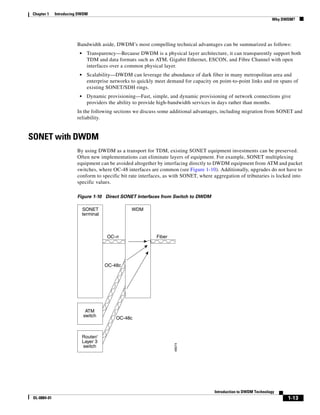
SONET with DWDM
                        By using DWDM as a transport for TDM, existing SONET equipment investments can be preserved.
                        Often new implementations can eliminate layers of equipment. For example, SONET multiplexing
                        equipment can be avoided altogether by interfacing directly to DWDM equipment from ATM and packet
                        switches, where OC-48 interfaces are common (see Figure 1-10). Additionally, upgrades do not have to
                        conform to specific bit rate interfaces, as with SONET, where aggregation of tributaries is locked into
                        specific values.

                        Figure 1-10 Direct SONET Interfaces from Switch to DWDM

                              SONET                 WDM
                              terminal


                                         OC-n                  Fiber


                                         OC-48c


                               ATM
                              switch         OC-48c


                              Router/
                              Layer 3
                                                                       48074


                              switch


                                                                                         Introduction to DWDM Technology
 OL-0884-01                                                                                                                 1-13
Chapter 1     Introducing DWDM
 Why DWDM?


                   Optical signals become attenuated as they travel through fiber and must be periodically regenerated in
                   core networks. In SONET/SDH optical networks prior to the introduction of DWDM, each separate fiber
                   carrying a single optical signal, typically at 2.5 Gbps, required a separate electrical regenerator every 60
                   to 100 km (37 to 62 mi). As additional fibers were “turned up” in a core network, the total cost of
                   regenerators could become very large, because not only the cost of the regenerators themselves, but also
                   the facilities to house and power them, had to be considered. The need to add regenerators also increased
                   the time required to light new fibers
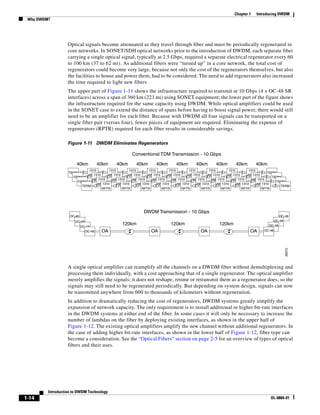
                   The upper part of Figure 1-11 shows the infrastructure required to transmit at 10 Gbps (4 x OC-48 SR
                   interfaces) across a span of 360 km (223 mi) using SONET equipment; the lower part of the figure shows
                   the infrastructure required for the same capacity using DWDM. While optical amplifiers could be used
                   in the SONET case to extend the distance of spans before having to boost signal power, there would still
                   need to be an amplifier for each fiber. Because with DWDM all four signals can be transported on a
                   single fiber pair (versus four), fewer pieces of equipment are required. Eliminating the expense of
                   regenerators (RPTR) required for each fiber results in considerable savings.

                   Figure 1-11 DWDM Eliminates Regenerators

                                                          Conventional TDM Transmission - 10 Gbps

                       40km           40km      40km         40km        40km        40km         40km        40km        40km         40km
                             1310         1310         1310         1310         1310         1310         1310         1310         1310
                   TERM                                                                                                                          TERM
                                1310
                             RPTR        RPTR1310     RPTR1310     RPTR1310     RPTR1310     RPTR1310     RPTR1310     RPTR1310     RPTR1310
                     TERM                                                                                                                          TERM
                               RPTR1310     RPTR1310     RPTR1310     RPTR1310     RPTR1310     RPTR1310     RPTR1310     RPTR1310     RPTR1310
                        TERM                                                                                                                          TERM
                                  RPTR1310     RPTR1310     RPTR1310     RPTR1310     RPTR1310     RPTR1310     RPTR1310     RPTR1310     RPTR1310
                          TERM                                                                                                                          TERM
                                     RPTR         RPTR         RPTR         RPTR         RPTR         RPTR         RPTR         RPTR         RPTR


                                                                 DWDM Transmission - 10 Gbps
                    OC-48                                                                                                                              OC-48
                       OC-48                                                                                                                        OC-48
                                                    120km                         120km                         120km                          OC-48
                            OC-48
                              OC-48    OA                             OA                            OA                             OA       OC-48


                                                                                                                                                          48075
                   A single optical amplifier can reamplify all the channels on a DWDM fiber without demultiplexing and
                   processing them individually, with a cost approaching that of a single regenerator. The optical amplifier
                   merely amplifies the signals; it does not reshape, retime or retransmit them as a regenerator does, so the
                   signals may still need to be regenerated periodically. But depending on system design, signals can now
                   be transmitted anywhere from 600 to thousands of kilometers without regeneration.
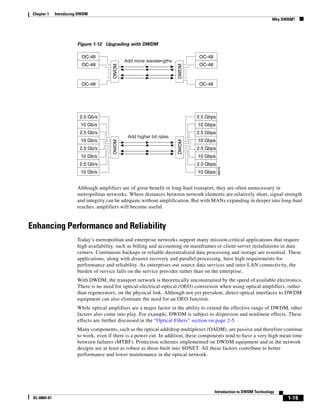
                   In addition to dramatically reducing the cost of regenerators, DWDM systems greatly simplify the
                   expansion of network capacity. The only requirement is to install additional or higher bit-rate interfaces
                   in the DWDM systems at either end of the fiber. In some cases it will only be necessary to increase the
                   number of lambdas on the fiber by deploying existing interfaces, as shown in the upper half of
                   Figure 1-12. The existing optical amplifiers amplify the new channel without additional regenerators. In
                   the case of adding higher bit-rate interfaces, as shown in the lower half of Figure 1-12, fiber type can
                   become a consideration. See the “Optical Fibers” section on page 2-5 for an overview of types of optical
                   fibers and their uses.


         Introduction to DWDM Technology
1-14                                                                                                                                            OL-0884-01
Chapter 1    Introducing DWDM
                                                                                                                    Why DWDM?


                        Figure 1-12 Upgrading with DWDM

                           OC-48                                               OC-48
                                               Add more wavelengths
                           OC-48                                               OC-48


                                        DWDM


                                                                       DWDM
                           OC-48                                               OC-48


                          2.5 Gb/s                                            2.5 Gbps
                          10 Gb/s                                              10 Gbps
                          2.5 Gb/s                                            2.5 Gbps
                                                Add higher bit rates
                          10 Gb/s                                              10 Gbps
                                        DWDM


                                                                       DWDM
                          2.5 Gb/s                                            2.5 Gbps
                          10 Gb/s                                              10 Gbps
                          2.5 Gb/s                                            2.5 Gbps


                                                                                         48076
                          10 Gb/s                                              10 Gbps


                        Although amplifiers are of great benefit in long-haul transport, they are often unnecessary in
                        metropolitan networks. Where distances between network elements are relatively short, signal strength
                        and integrity can be adequate without amplification. But with MANs expanding in deeper into long-haul
                        reaches, amplifiers will become useful.


Enhancing Performance and Reliability
                        Today’s metropolitan and enterprise networks support many mission-critical applications that require
                        high availability, such as billing and accounting on mainframes or client-server installations in data
                        centers. Continuous backups or reliable decentralized data processing and storage are essential. These
                        applications, along with disaster recovery and parallel processing, have high requirements for
                        performance and reliability. As enterprises out source data services and inter-LAN connectivity, the
                        burden of service falls on the service provider rather than on the enterprise.
                        With DWDM, the transport network is theoretically unconstrained by the speed of available electronics.
                        There is no need for optical-electrical-optical (OEO) conversion when using optical amplifiers, rather
                        than regenerators, on the physical link. Although not yet prevalent, direct optical interfaces to DWDM
                        equipment can also eliminate the need for an OEO function.
                        While optical amplifiers are a major factor in the ability to extend the effective range of DWDM, other
                        factors also come into play. For example, DWDM is subject to dispersion and nonlinear effects. These
                        effects are further discussed in the “Optical Fibers” section on page 2-5.
                        Many components, such as the optical add/drop multiplexer (OADM), are passive and therefore continue
                        to work, even if there is a power cut. In addition, these components tend to have a very high mean time
                        between failures (MTBF). Protection schemes implemented on DWDM equipment and in the network
                        designs are at least as robust as those built into SONET. All these factors contribute to better
                        performance and lower maintenance in the optical network.


                                                                                       Introduction to DWDM Technology
 OL-0884-01                                                                                                               1-15
Chapter 1   Introducing DWDM
  Why DWDM?


Network Management Capability
                    One of the primary advantages offered by SONET technology is the capability of the data
                    communication channel (DCC). Used for operations functions, DCCs ship such things as alarms,
                    administration data, signal control information, and maintenance messages. When SONET is transported
                    over DWDM, DCCs continue to perform these functions between SONET network elements. In addition,
                    a DWDM system can have its own management channel for the optical layer. For out-of-band
                    management, an additional wavelength (for example, a 33rd wavelength in a 32-wavelength system) can
                    be used as an optical supervisory channel. For inband management, a small amount of bandwidth (for
                    example, 8 kHz) can be reserved for management on a per-channel basis.


Additional Benefits
                    The shift in the makeup of traffic from voice to data has important implications for the design and
                    operation of carrier networks. The introduction of cell-switching technologies such as ATM and Frame
                    Relay demonstrates the limitations of the narrow-band, circuit-switched network design, but the limits
                    of these technologies are being reached. Data is no longer an add-on to the voice-centric network, but is
                    central. There are fundamentally different requirements of a data-centric network; two of these are the
                    aggregation model and the open versus proprietary interfaces.
                    Aggregation in a voice-centric network consists of multiplexing numerous times onto transmission
                    facilities and at many points in the network. Aggregation in a data-centric network, by contrast, tends to
                    happen at the edge. With OC-48 (and higher) interfaces readily available on cell and packet switches, it
                    becomes possible to eliminate costly SONET multiplexing and digital cross-connect equipment. OC-48
                    connections can interface directly to DWDM equipment.
                    Finally, service providers and enterprises can respond more quickly to changing demands by allocating
                    bandwidth on demand. The ability to provision services rapidly by providing wavelength on demand
                    creates new revenue opportunities such as wavelength leasing (an alternative to leasing of physical links
                    or bit rate-limited tunnels), disaster recovery, and optical VPNs.


          Introduction to DWDM Technology
 1-16                                                                                                               OL-0884-01
C H A P T E R                      2
              Fundamentals of DWDM Technology

              The emergence of DWDM is one of the most recent and important phenomena in the development of
              fiber optic transmission technology. In the following discussion we briefly trace the stages of fiber optic
              technology and the place of DWDM in that development. We then examine the functions and
              components of a DWDM system, including the enabling technologies, and conclude with a high-level
              description of the operation of a DWDM system.


Evolution of Fiber Optic Transmission
              The reality of fiber optic transmission had been experimentally proven in the nineteenth century, but the
              technology began to advance rapidly in the second half of the twentieth century with the invention of the
              fiberscope, which found applications in industry and medicine, such as in laparoscopic surgery.
              After the viability of transmitting light over fiber had been established, the next step in the development
              of fiber optics was to find a light source that would be sufficiently powerful and narrow. The
              light-emitting diode (LED) and the laser diode proved capable of meeting these requirements. Lasers
              went through several generations in the 1960s, culminating with the semiconductor lasers that are most
              widely used in fiber optics today.
              Light has an information-carrying capacity 10,000 times greater than the highest radio frequencies.
              Additional advantages of fiber over copper include the ability to carry signals over long distances, low
              error rates, immunity to electrical interference, security, and light weight.
              Aware of these characteristics, researchers in the mid-1960s proposed that optical fiber might be a
              suitable transmission medium. There was an obstacle, however, and that was the loss of signal strength,
              or attenuation, seen in the glass they were working with. Finally, in 1970, Corning produced the first
              communication-grade fibers. With attenuation less than 20 decibels per kilometer (dB/km), this purified
              glass fiber exceeded the threshold for making fiber optics a viable technology.
              Innovation at first proceeded slowly, as private and government monopolies that ran the telephone
              companies were cautious. AT&T first standardized transmission at DS3 speed (45 Mbps) for multimode
              fibers. Soon thereafter, single-mode fibers were shown to be capable of transmission rates 10 times that
              of the older type, as well as spans of 32 km (20 mi). In the early 1980s, MCI, followed by Sprint, adopted
              single-mode fibers for its long-distance network in the U.S.
              Further developments in fiber optics are closely tied to the use of the specific regions on the optical
              spectrum where optical attenuation is low. These regions, called windows, lie between areas of high
              absorption. The earliest systems were developed to operate around 850 nm, the first window in
              silica-based optical fiber. A second window (S band), at 1310 nm, soon proved to be superior because


                                                                                Introduction to DWDM Technology
 OL-0884-01                                                                                                        2-1
Chapter 2                Fundamentals of DWDM Technology
    Evolution of Fiber Optic Transmission


                             of its lower attenuation, followed by a third window (C band) at 1550 nm with an even lower optical loss.
                             Today, a fourth window (L band) near 1625 nm is under development and early deployment. These four
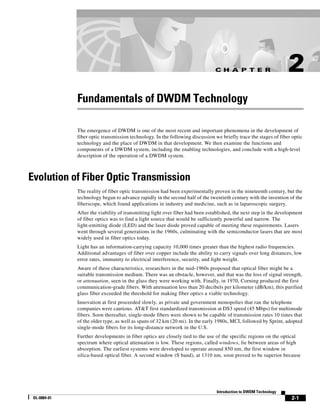
                             windows are shown relative to the electromagnetic spectrum in Figure 2-1.

Figure 2-1     Wavelength Regions

               Ultraviolet             Visible                                                 Infrared


   X-rays,                                                                                                                                                                                Radio waves,
gamma rays                                                                                                                                                                                long waves
                                                     700    800                  900 1000 1100 1200 1300 1400 1500 1600 1700                                                         nm


                                                                                                                                                           Fourth window "L" band
                                                                                                                                   Third window "C" band
                                                                                                          Second window
                                                                  First window


                                                                                                                                                                                                   48077
                                                              850                                     1310                     1550 1625


Development of DWDM Technology
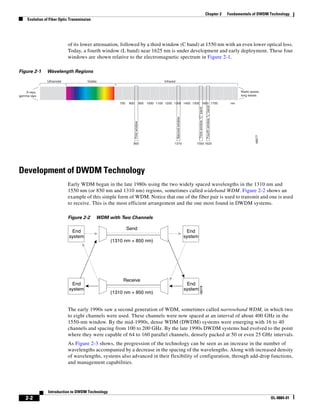
                             Early WDM began in the late 1980s using the two widely spaced wavelengths in the 1310 nm and
                             1550 nm (or 850 nm and 1310 nm) regions, sometimes called wideband WDM. Figure 2-2 shows an
                             example of this simple form of WDM. Notice that one of the fiber pair is used to transmit and one is used
                             to receive. This is the most efficient arrangement and the one most found in DWDM systems.

                             Figure 2-2      WDM with Two Channels

                                                           Send
                              End                                                                                          End
                             system                                                                                       system
                                                  (1310 nm + 850 nm)


                                                       Receive
                              End                                                                                          End
                                                                                                                                     48078


                             system                                                                                       system
                                                  (1310 nm + 850 nm)


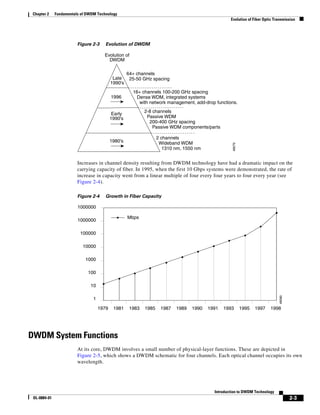
                             The early 1990s saw a second generation of WDM, sometimes called narrowband WDM, in which two
                             to eight channels were used. These channels were now spaced at an interval of about 400 GHz in the
                             1550-nm window. By the mid-1990s, dense WDM (DWDM) systems were emerging with 16 to 40
                             channels and spacing from 100 to 200 GHz. By the late 1990s DWDM systems had evolved to the point
                             where they were capable of 64 to 160 parallel channels, densely packed at 50 or even 25 GHz intervals.
                             As Figure 2-3 shows, the progression of the technology can be seen as an increase in the number of
                             wavelengths accompanied by a decrease in the spacing of the wavelengths. Along with increased density
                             of wavelengths, systems also advanced in their flexibility of configuration, through add-drop functions,
                             and management capabilities.


                Introduction to DWDM Technology
   2-2                                                                                                                                                                                                     OL-0884-01
Chapter 2    Fundamentals of DWDM Technology
                                                                                                    Evolution of Fiber Optic Transmission


                         Figure 2-3     Evolution of DWDM

                                       Evolution of
                                         DWDM

                                                     64+ channels
                                             Late     25-50 GHz spacing
                                            1990's
                                                       16+ channels 100-200 GHz spacing
                                            1996         Dense WDM, integrated systems
                                                          with network management, add-drop functions.
                                                             2-8 channels
                                             Early
                                            1990's            Passive WDM
                                                               200-400 GHz spacing
                                                                 Passive WDM components/parts

                                                                    2 channels
                                            1980's                   Wideband WDM


                                                                                                     48079
                                                                       1310 nm, 1550 nm


                         Increases in channel density resulting from DWDM technology have had a dramatic impact on the
                         carrying capacity of fiber. In 1995, when the first 10 Gbps systems were demonstrated, the rate of
                         increase in capacity went from a linear multiple of four every four years to four every year (see
                         Figure 2-4).

                         Figure 2-4     Growth in Fiber Capacity

                         1000000

                                                     Mbps
                         1000000

                          100000

                           10000

                             1000

                              100

                               10
                                                                                                                                48080


                                 1

                                     1979    1981     1983   1985    1987   1989   1990   1991   1993        1995   1997   1998


DWDM System Functions
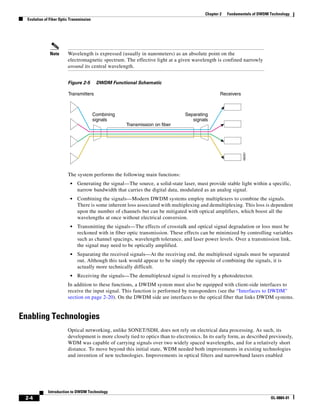
                         At its core, DWDM involves a small number of physical-layer functions. These are depicted in
                         Figure 2-5, which shows a DWDM schematic for four channels. Each optical channel occupies its own
                         wavelength.


                                                                                            Introduction to DWDM Technology
 OL-0884-01                                                                                                                             2-3
Chapter 2   Fundamentals of DWDM Technology
  Evolution of Fiber Optic Transmission


               Note      Wavelength is expressed (usually in nanometers) as an absolute point on the
                         electromagnetic spectrum. The effective light at a given wavelength is confined narrowly
                         around its central wavelength.


                         Figure 2-5        DWDM Functional Schematic

                         Transmitters                                                             Receivers


                                          Combining                             Separating
                                          signals                                  signals
                                                      Transmission on fiber


                                                                                                              48081
                         The system performs the following main functions:
                           •   Generating the signal—The source, a solid-state laser, must provide stable light within a specific,
                               narrow bandwidth that carries the digital data, modulated as an analog signal.
                           •   Combining the signals—Modern DWDM systems employ multiplexers to combine the signals.
                               There is some inherent loss associated with multiplexing and demultiplexing. This loss is dependent
                               upon the number of channels but can be mitigated with optical amplifiers, which boost all the
                               wavelengths at once without electrical conversion.
                           •   Transmitting the signals—The effects of crosstalk and optical signal degradation or loss must be
                               reckoned with in fiber optic transmission. These effects can be minimized by controlling variables
                               such as channel spacings, wavelength tolerance, and laser power levels. Over a transmission link,
                               the signal may need to be optically amplified.
                           •   Separating the received signals—At the receiving end, the multiplexed signals must be separated
                               out. Although this task would appear to be simply the opposite of combining the signals, it is
                               actually more technically difficult.
                           •   Receiving the signals—The demultiplexed signal is received by a photodetector.
                         In addition to these functions, a DWDM system must also be equipped with client-side interfaces to
                         receive the input signal. This function is performed by transponders (see the “Interfaces to DWDM”
                         section on page 2-20). On the DWDM side are interfaces to the optical fiber that links DWDM systems.


Enabling Technologies
                         Optical networking, unlike SONET/SDH, does not rely on electrical data processing. As such, its
                         development is more closely tied to optics than to electronics. In its early form, as described previously,
                         WDM was capable of carrying signals over two widely spaced wavelengths, and for a relatively short
                         distance. To move beyond this initial state, WDM needed both improvements in existing technologies
                         and invention of new technologies. Improvements in optical filters and narrowband lasers enabled


              Introduction to DWDM Technology
 2-4                                                                                                                       OL-0884-01
Chapter 2    Fundamentals of DWDM Technology
                                                                                                            Components and Operation


                         DWDM to combine more than two signal wavelengths on a fiber. The invention of the flat-gain optical
                         amplifier, coupled in line with the transmitting fiber to boost the optical signal, dramatically increased
                         the viability of DWDM systems by greatly extending the transmission distance.
                         Other technologies that have been important in the development of DWDM include improved optical
                         fiber with lower loss and better optical transmission characteristics, EDFAs, and devices such as fiber
                         Bragg gratings used in optical add/drop multiplexers.


Components and Operation
                         DWDM is a core technology in an optical transport network. The essential components of DWDM can
                         be classified by their place in the system as follows:
                          •   On the transmit side, lasers with precise, stable wavelengths
                          •   On the link, optical fiber that exhibits low loss and transmission performance in the relevant
                              wavelength spectra, in addition to flat-gain optical amplifiers to boost the signal on longer spans
                          •   On the receive side, photodetectors and optical demultiplexers using thin film filters or diffractive
                              elements
                          •   Optical add/drop multiplexers and optical cross-connect components
                         These and other components, along with their underlying technologies, are discussed in the following
                         sections. While much of this information, particularly the pros and cons of various competing
                         technologies, may be of more importance to a system designer than to an end user or network designer,
                         it may also be of interest to other readers. Note as well that this is summary information and is not
                         intended to be complete or authoritative. For in-depth information on components and underlying
                         technologies, refer to the sources cited in the “Additional Reading” section on page vii.


Optical Fibers
                         The following discussion of DWDM components and technologies includes a refresher on optical fibers,
                         with emphasis on their application for DWDM. Background information on subjects such as the
                         properties of light and optical theory can be found in many readily available printed sources and online,
                         for example, in the tutorial at http://www.vislab.usyd.edu.au/photonics/fibres/index.html.


How Fiber Works
                         The main job of optical fibers is to guide lightwaves with a minimum of attenuation (loss of signal).
                         Optical fibers are composed of fine threads of glass in layers, called the core and cladding, that can
                         transmit light at about two-thirds the speed of light in a vacuum. Though admittedly an
                         oversimplification, the transmission of light in optical fiber is commonly explained using the principle
                         of total internal reflection. With this phenomenon, 100 percent of light that strikes a surface is reflected.
                         By contrast, a mirror reflects about 90 percent of the light that strikes it.
                         Light is either reflected (it bounces back) or refracted (its angle is altered while passing through a
                         different medium) depending upon the angle of incidence (the angle at which light strikes the interface
                         between an optically denser and optically thinner material).
                         Total internal reflection happens when the following conditions are met:
                          •   Beams pass from a more dense to a less dense material. The difference between the optical density
                              of a given material and a vacuum is the material’s refractive index.


                                                                                           Introduction to DWDM Technology
 OL-0884-01                                                                                                                      2-5
Chapter 2   Fundamentals of DWDM Technology
    Optical Fibers


                           •   The incident angle is less than the critical angle. The critical angle is the angle of incidence at which
                               light stops being refracted and is instead totally reflected.
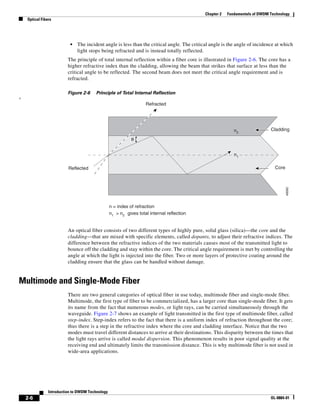
                          The principle of total internal reflection within a fiber core is illustrated in Figure 2-6. The core has a
                          higher refractive index than the cladding, allowing the beam that strikes that surface at less than the
                          critical angle to be reflected. The second beam does not meet the critical angle requirement and is
                          refracted.

                          Figure 2-6    Principle of Total Internal Reflection
<
                                                                    Refracted


                                                                                                            n2                Cladding

                                                             θ


                                                                                                            n1

                          Reflected                                                                                             Core


                                                                                                                                       48082
                                                  n = index of refraction
                                                  n1 > n2 gives total internal reflection


                          An optical fiber consists of two different types of highly pure, solid glass (silica)—the core and the
                          cladding—that are mixed with specific elements, called dopants, to adjust their refractive indices. The
                          difference between the refractive indices of the two materials causes most of the transmitted light to
                          bounce off the cladding and stay within the core. The critical angle requirement is met by controlling the
                          angle at which the light is injected into the fiber. Two or more layers of protective coating around the
                          cladding ensure that the glass can be handled without damage.


Multimode and Single-Mode Fiber
                          There are two general categories of optical fiber in use today, multimode fiber and single-mode fiber.
                          Multimode, the first type of fiber to be commercialized, has a larger core than single-mode fiber. It gets
                          its name from the fact that numerous modes, or light rays, can be carried simultaneously through the
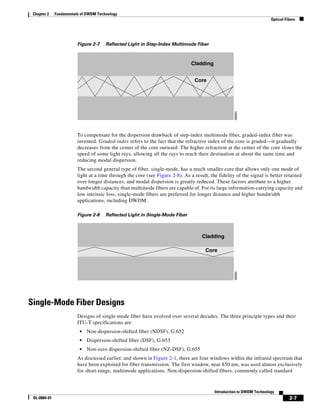
                          waveguide. Figure 2-7 shows an example of light transmitted in the first type of multimode fiber, called
                          step-index. Step-index refers to the fact that there is a uniform index of refraction throughout the core;
                          thus there is a step in the refractive index where the core and cladding interface. Notice that the two
                          modes must travel different distances to arrive at their destinations. This disparity between the times that
                          the light rays arrive is called modal dispersion. This phenomenon results in poor signal quality at the
                          receiving end and ultimately limits the transmission distance. This is why multimode fiber is not used in
                          wide-area applications.


                Introduction to DWDM Technology
    2-6                                                                                                                       OL-0884-01
Chapter 2    Fundamentals of DWDM Technology
                                                                                                                        Optical Fibers


                         Figure 2-7    Reflected Light in Step-Index Multimode Fiber


                                                                                Cladding


                                                                                 Core


                                                                                                     48083
                         To compensate for the dispersion drawback of step-index multimode fiber, graded-index fiber was
                         invented. Graded-index refers to the fact that the refractive index of the core is graded—it gradually
                         decreases from the center of the core outward. The higher refraction at the center of the core slows the
                         speed of some light rays, allowing all the rays to reach their destination at about the same time and
                         reducing modal dispersion.
                         The second general type of fiber, single-mode, has a much smaller core that allows only one mode of
                         light at a time through the core (see Figure 2-8). As a result, the fidelity of the signal is better retained
                         over longer distances, and modal dispersion is greatly reduced. These factors attribute to a higher
                         bandwidth capacity than multimode fibers are capable of. For its large information-carrying capacity and
                         low intrinsic loss, single-mode fibers are preferred for longer distance and higher bandwidth
                         applications, including DWDM.

                         Figure 2-8    Reflected Light in Single-Mode Fiber


                                                                                     Cladding

                                                                                       Core
                                                                                                     48084


Single-Mode Fiber Designs
                         Designs of single-mode fiber have evolved over several decades. The three principle types and their
                         ITU-T specifications are:
                          •   Non-dispersion-shifted fiber (NDSF), G.652
                          •   Dispersion-shifted fiber (DSF), G.653
                          •   Non-zero dispersion-shifted fiber (NZ-DSF), G.655
                         As discussed earlier, and shown in Figure 2-1, there are four windows within the infrared spectrum that
                         have been exploited for fiber transmission. The first window, near 850 nm, was used almost exclusively
                         for short-range, multimode applications. Non-dispersion-shifted fibers, commonly called standard


                                                                                           Introduction to DWDM Technology
 OL-0884-01                                                                                                                       2-7
Chapter 2   Fundamentals of DWDM Technology
  Optical Fibers


                        single-mode (SM) fibers, were designed for use in the second window, near 1310 nm. To optimize the
                        fiber’s performance in this window, the fiber was designed so that chromatic dispersion would be close
                        to zero near the 1310-nm wavelength.
                        As optical fiber use became more common and the needs for greater bandwidth and distance increased,
                        a third window, near 1550 nm, was exploited for single-mode transmission. The third window, or C band,
                        offered two advantages: it had much lower attenuation, and its operating frequency was the same as that
                        of the new erbium-doped fiber amplifiers (EDFAs). However, its dispersion characteristics were severely
                        limiting. This was overcome to a certain extent by using narrower linewidth and higher power lasers. But
                        because the third window had lower attenuation than the 1310-nm window, manufacturers came up with
                        the dispersion-shifted fiber design, which moved the zero-dispersion point to the 1550-nm region.
                        Although this solution now meant that the lowest optical attenuation and the zero-dispersion points
                        coincided in the 1550-nm window, it turned out that there are destructive nonlinearities in optical fiber
                        near the zero-dispersion point for which there is no effective compensation. Because of this limitation,
                        these fibers are not suitable for DWDM applications.
                        The third type, non-zero dispersion-shifted fiber, is designed specifically to meet the needs of DWDM
                        applications. The aim of this design is to make the dispersion low in the 1550-nm region, but not zero.
                        This strategy effectively introduces a controlled amount of dispersion, which counters nonlinear effects
                        such as four-wave mixing (see the “Other Nonlinear Effects” section on page 2-11) that can hinder the
                        performance of DWDM systems.


Transmission Challenges
                        Transmission of light in optical fiber presents several challenges that must be dealt with. These fall into
                        the following three broad categories:
                         •   Attenuation—decay of signal strength, or loss of light power, as the signal propagates through the
                             fiber
                         •   Chromatic dispersion—spreading of light pulses as they travel down the fiber
                         •   Nonlinearities—cumulative effects from the interaction of light with the material through which it
                             travels, resulting in changes in the lightwave and interactions between lightwaves
                        Each of these effects has several causes, not all of which affect DWDM. The discussion in the following
                        sections addresses those causes that are relevant to DWDM.


Attenuation
                        Attenuation in optical fiber is caused by intrinsic factors, primarily scattering and absorption, and by
                        extrinsic factors, including stress from the manufacturing process, the environment, and physical
                        bending. The most common form of scattering, Rayleigh scattering, is caused by small variations in the
                        density of glass as it cools. These variations are smaller than the wavelengths used and therefore act as
                        scattering objects (see Figure 2-9). Scattering affects short wavelengths more than long wavelengths and
                        limits the use of wavelengths below 800 nm.


              Introduction to DWDM Technology
  2-8                                                                                                                     OL-0884-01
Chapter 2    Fundamentals of DWDM Technology
                                                                                                                                                                                  Optical Fibers


                        Figure 2-9               Rayleigh Scattering


                                                                                                                                                          48085
                        Attenuation due to absorption is caused by the intrinsic properties of the material itself, the impurities
                        in the glass, and any atomic defects in the glass. These impurities absorb the optical energy, causing the
                        light to become dimmer (see Figure 2-10). While Rayleigh scattering is important at shorter
                        wavelengths, intrinsic absorption is an issue at longer wavelengths and increases dramatically above
                        1700 nm. However, absorption due to water peaks introduced in the fiber manufacturing process are
                        being eliminated in some new fiber types.

                        Figure 2-10 Absorption


                                                                                                        48086
                        The primary factors affecting attenuation in optical fibers are the length of the fiber and the wavelength
                        of the light. Figure 2-11 shows the loss in decibels per kilometer (dB/km) by wavelength from Rayleigh
                        scattering, intrinsic absorption, and total attenuation from all causes.

                        Figure 2-11 Total Attenuation Curve

                                       5
                                                        First window


                                                                                                        Third window "C" band
                                                                                                                                 Fourth window "L" band
                                                                                        Second window


                                       4


                                       3
                        Optical loss
                         (dB/km)


                                                                       Total
                                       2                               attenuation


                                                                                                                                                                     Intrinsic
                                       1
                                                 Intrinsic scattering                                                                                                absorbtion
                                                           (Rayleigh
                                                                                                                                                                                   48087


                                       0
                                           0.7    0.8          0.9     1.0   1.1 1.2 1.3 1.4 1.5                                1.6                          1.7   1.8   1.9   2.0
                                                                             Wavelength (micrometers)


                                                                                                                                Introduction to DWDM Technology
OL-0884-01                                                                                                                                                                                  2-9
Chapter 2     Fundamentals of DWDM Technology
   Optical Fibers


                         Attenuation in fiber is compensated primarily through the use of optical amplifiers, as described in the
                         “Optical Amplifiers” section on page 2-15.


Dispersion
                         Dispersion is the spreading of light pulses as they travel down optical fiber. Dispersion results in
                         distortion of the signal (see Figure 2-12), which limits the bandwidth of the fiber.

                         Figure 2-12 Principle of Dispersion


                                                                                                                48088
                                          Time          Fiber                                         Time


                         Two general types of dispersion affect DWDM systems. One of these effects, chromatic dispersion, is
                         linear while the other, polarization mode dispersion (PMD), is nonlinear.

Chromatic Dispersion

                         Chromatic dispersion occurs because different wavelengths propagate at different speeds. The effect of
                         chromatic dispersion increases as the square of the bit rate. In single-mode fiber, chromatic dispersion
                         has two components, material dispersion and waveguide dispersion.
                         Material dispersion occurs when wavelengths travel at different speeds through the material. A light
                         source, no matter how narrow, emits several wavelengths within a range. Thus, when this range of
                         wavelengths travels through a medium, each individual wavelength arrives at a different time.
                         The second component of chromatic dispersion, waveguide dispersion, occurs because of the different
                         refractive indices of the core and the cladding of fiber. The effective refractive index varies with
                         wavelength as follows:
                          •   At short wavelengths, the light is well confined within the core. Thus the effective refractive index
                              is close to the refractive index of the core material.
                          •   At medium wavelengths, the light spreads slightly into the cladding. This decreases the effective
                              refractive index.
                          •   At long wavelengths, much of the light spreads into the cladding. This brings the effective refractive
                              index very close to that of the cladding.
                         This result of the phenomenon of waveguide dispersion is a propagation delay in one or more of the
                         wavelengths relative to others.
                         Total chromatic dispersion, along with its components, is plotted by wavelength in Figure 2-13 for
                         dispersion-shifted fiber. For non-dispersion-shifted fiber, the zero dispersion wavelength is 1310 nm.


               Introduction to DWDM Technology
  2-10                                                                                                                       OL-0884-01
Chapter 2     Fundamentals of DWDM Technology
                                                                                                                           Optical Fibers


                          Figure 2-13 Chromatic Dispersion

                                                  30                                                   Material
                                                                                                       dispersion
                                                  20                                                   component

                          Dispersion (ps/nm*km)   10                                                   Total
                                                                                                       chromatic
                                                   0                                                   dispersion

                                                  -10
                                                                                                       Wavelength
                                                  -20                                                  dispersion
                                                                                                       component
                                                  -30

                                                  -40

                                                  -50

                                                    1100   1200      1300       1400   1500         1600


                                                                                                                  48089
                                                              Wavelength (nm)


                          Though chromatic dispersion is generally not an issue at speeds below OC-48, it does increase with
                          higher bit rates due to the spectral width required. New types of zero-dispersion-shifted fibers greatly
                          reduce these effects. The phenomenon can also be mitigated with dispersion compensators.

Polarization Mode Dispersion

                          Most single-mode fibers support two perpendicular polarization modes, a vertical one and a horizontal
                          one. Because these polarization states are not maintained, there occurs an interaction between the pulses
                          that results is a smearing of the signal.
                          Polarization mode dispersion (PMD) is caused by ovality of the fiber shape as a result of the
                          manufacturing process or from external stressors. Because stress can vary over time, PMD, unlike
                          chromatic dispersion, is subject to change over time. PMD is generally not a problem at speeds below
                          OC-192.

Other Nonlinear Effects

                          In addition to PMD, there are other nonlinear effects. Because nonlinear effects tend to manifest
                          themselves when optical power is very high, they become important in DWDM.
                          Linear effects such as attenuation and dispersion can be compensated, but nonlinear effects accumulate.
                          They are the fundamental limiting mechanisms to the amount of data that can be transmitted in optical
                          fiber. The most important types of nonlinear effects are stimulated Brillouin scattering, stimulated
                          Raman scattering, self-phase modulation, and four-wave mixing. In DWDM, four-wave mixing is the
                          most critical of these types.
                          Four-wave mixing is caused by the nonlinear nature of the refractive index of the optical fiber. Nonlinear
                          interactions among different DWDM channels creates sidebands that can cause interchannel
                          interference. In Figure 2-14 three frequencies interact to produce a fourth frequency, resulting in
                          cross-talk and signal-to-noise degradation.


                                                                                              Introduction to DWDM Technology
  OL-0884-01                                                                                                                        2-11
Chapter 2   Fundamentals of DWDM Technology
  Optical Fibers


                        Figure 2-14 Four-Wave Mixing


                        Power


                                        f1      ffwm         f3       f2


                                                                                            48090
                                             Frequencies

                        The effect of four-wave mixing is to limit the channel capacity of a DWDM system. Four-wave mixing
                        cannot be filtered out, either optically or electrically, and increases with the length of the fiber. Due to
                        its propensity for four-wave-mixing, DSF is unsuitable for WDM applications. This prompted the
                        invention of NZ-DSF, which takes advantage of the fact that a small amount of chromatic dispersion can
                        be used to mitigate four-wave mixing.


Summary
                        In the long-distance network, the majority of embedded fiber is standard single-mode (G.652) with high
                        dispersion in the 1550-nm window, which limits the distance for OC-192 transmission. Dispersion can
                        be mitigated to some extent, and at some cost, using dispersion compensators. Non-zero
                        dispersion-shifted fiber can be deployed for OC-192 transport, but higher optical power introduces
                        nonlinear effects.
                        In the short-haul network, PMD and nonlinear effects are not so critical as they are in long-haul systems,
                        where higher speeds (OC-192 and higher) are more common. DWDM systems using optical signals of
                        2.5 Gbps or less are not subject to these nonlinear effects at short distances.
                        The major types of single-mode fibers and their application can be summarized as follows:
                         •      Non-dispersion-shifted fiber (standard SM fiber)—accounts for greater than 95 percent of deployed
                                plant; suitable for TDM (single-channel) use in the 1310-nm region or DWDM use in the 1550-nm
                                region (with dispersion compensators). This type of fiber can also support 10 Gigabit Ethernet
                                standard at distances over 300 meters.
                         •      Dispersion-shifted fiber—suitable for TDM use in the 1550-nm region, but unsuitable for DWDM
                                in this region.
                         •      Non-zero dispersion-shifted fiber—good for both TDM and DWDM use in the 1550-nm region.
                         •      Newer generation fibers—includes types that allow the energy to travel further into the cladding,
                                creating a small amount of dispersion to counter four-wave mixing, and dispersion-flattened fibers,
                                which permit use of wavelengths farther from the optimum wavelength without pulse spreading.


               Note     As bit rates increase to 40 Gbps and beyond, the interdependence between system design
                        and fiber design will become increasingly important for strategic planning.


              Introduction to DWDM Technology
 2-12                                                                                                                      OL-0884-01
Chapter 2    Fundamentals of DWDM Technology
                                                                                                           Light Sources and Detectors


Light Sources and Detectors
                         Light emitters and light detectors are active devices at opposite ends of an optical transmission system.
                         Light sources, or light emitters, are transmit-side devices that convert electrical signals to light pulses.
                         The process of this conversion, or modulation, can be accomplished by externally modulating a
                         continuous wave of light or by using a device that can generate modulated light directly. Light detectors
                         perform the opposite function of light emitters. They are receive-side opto-electronic devices that
                         convert light pulses into electrical signals.


Light Emitters—LEDs and Lasers
                         The light source used in the design of a system is an important consideration because it can be one of
                         the most costly elements. Its characteristics are often a strong limiting factor in the final performance of
                         the optical link. Light emitting devices used in optical transmission must be compact, monochromatic,
                         stable, and long-lasting.


                Note     Monochromatic is a relative term; in practice there are only light sources within a certain
                         range. Stability of a light source is a measure of how constant its intensity and wavelength
                         are.

                         Two general types of light emitting devices are used in optical transmission, light-emitting diodes
                         (LEDs) and laser diodes, or semiconductor lasers. LEDs are relatively slow devices, suitable for use at
                         speeds of less than 1 Gbps, they exhibit a relatively wide spectrum width, and they transmit light in a
                         relatively wide cone. These inexpensive devices are often used in multimode fiber communications.
                         Semiconductor lasers, on the other hand, have performance characteristics better suited to single-mode
                         fiber applications.
                         Figure 2-15 shows the general principles of launching laser light into fiber. The laser diode chip emits
                         light in one direction to be focused by the lens onto the fiber and in the other direction onto a photodiode.
                         The photodiode, which is angled to reduce back reflections into the laser cavity, provides a way of
                         monitoring the output of the lasers and providing feedback so that adjustments can be made.

                         Figure 2-15 Typical Laser Design


                                                Lens


                             Fiber
                                                              Laser diode chip


                                                                                                Rear-facet
                                                                                                                       48091


                                                                                             monitor photodiode

                         Requirements for lasers include precise wavelength, narrow spectrum width, sufficient power, and
                         control of chirp (the change in frequency of a signal over time). Semiconductor lasers satisfy nicely the
                         first three requirements. Chirp, however, can be affected by the means used to modulate the signal.


                                                                                           Introduction to DWDM Technology
 OL-0884-01                                                                                                                       2-13
Chapter 2   Fundamentals of DWDM Technology
  Light Sources and Detectors


                        In directly modulated lasers, the modulation of the light to represent the digital data is done internally.
                        With external modulation, the modulation is done by an external device. When semiconductor lasers are
                        directly modulated, chirp can become a limiting factor at high bit rates (above 10 Gbps). External
                        modulation, on the other hand, helps to limit chirp. The external modulation scheme is depicted in
                        Figure 2-16.

                        Figure 2-16 External Modulation of a Laser

                                                                         Electrical signal


                                 DC current drive
                                                                            External
                                                                            modulator
                                                          ITU λ                                   Modulated


                                                                                                                       48092
                        15xx distributed feedback laser                                             ITU λ


                        Two types of semiconductor lasers are widely used, monolithic Fabry-Perot lasers, and distributed
                        feedback (DFB) lasers. The latter type is particularly well suited for DWDM applications, as it emits a
                        nearly monochromatic light, is capable of high speeds, has a favorable signal-to-noise ratio, and has
                        superior linearity. DFB lasers also have center frequencies in the region around 1310 nm, and from
                        1520 to 1565 nm. The latter wavelength range is compatible with EDFAs. There are many other types
                        and subtypes of lasers. Narrow spectrum tunable lasers are available, but their tuning range is limited to
                        approximately 100-200 GHz. Under development are wider spectrum tunable lasers, which will be
                        important in dynamically switched optical networks.


ITU Grid
                        Cooled DFB lasers are available in precisely selected wavelengths. The ITU draft standard G.692 defines
                        a laser grid for point-to-point WDM systems based on 100-GHz wavelength spacings with a center
                        wavelength of 1553.52 nm (see Table 2-1).

                        Table 2-1     ITU Grid

                         Frequency          Wavelength       Frequency        Wavelength             Frequency          Wavelength
                         (THz1)             (nm2)            (THz)            (nm)                   (THz)              (nm)
                         196.1              1528.77          164.6            1540.56                193.1              1552.52
                         196.0              1529.55          194.5            1541.35                193.0              1553.33
                         195.9              1530.33          194.4            1542.14                192.9              1554.13
                         195.8              1531.12          194.3            1542.94                195.8              1554.94
                         195.7              1531.9           194.2            1543.73                192.7              1555.75
                         195.6              1532.68          194.1            1544.53                192.6              1556.56
                         195.5              1533.47          194.0            1545.32                195.5              1557.36
                         195.4              1534.25          193.9            1546.12                192.4              1558.17
                         195.3              1535.04          193.8            1546.92                192.3              1558.98
                         195.2              1535.82          193.7            1547.72                192.2              1559.79
                         195.1              1536.61          193.6            1548.51                192.1              1560.61


             Introduction to DWDM Technology
 2-14                                                                                                                          OL-0884-01
Chapter 2    Fundamentals of DWDM Technology
                                                                                                                    Optical Amplifiers


                         Table 2-1    ITU Grid (continued)

                         Frequency            Wavelength      Frequency         Wavelength        Frequency           Wavelength
                         (THz1)               (nm2)           (THz)             (nm)              (THz)               (nm)
                         195.0                1537.40         193.5             1549.32           192.0               1561.42
                         194.9                1538.19         192.4             1550.12           191.9               1562.23
                         194.8                1538.98         193.3             1550.92           191.8               1563.05
                         194.7                1539.77         193.2             1551.72           191.7               1563.86
                         1. THz = terahertz
                         2. nm = nanometer


                         While this grid defines a standard, users are free to use the wavelengths in arbitrary ways and to choose
                         from any part of the spectrum. In addition, manufacturers can deviate from the grid by extending the
                         upper and lower bounds or by spacing the wavelengths more closely, typically at 50 GHz, to double the
                         number of channels. The closer the spacing, the more channel crosstalk results. In addition, the impact
                         of some fiber nonlinearities, such as FWM, increases. Spacing at 50 GHz also limits the maximum data
                         rate per wavelength to 10 Gbps. The implications of the flexibility in implementation are twofold: There
                         is no guarantee of compatibility between two end systems from different vendors, and there exists a
                         design trade-off in the spacing of wavelengths between number of channels and maximum bit rate.


Light Detectors
                         On the receive end, it is necessary to recover the signals transmitted at different wavelengths on the fiber.
                         Because photodetectors are by nature wideband devices, the optical signals are demultiplexed before
                         reaching the detector.
                         Two types of photodetectors are widely deployed, the positive-intrinsic-negative (PIN) photodiode and
                         the avalanche photodiode (APD). PIN photodiodes work on principles similar to, but in the reverse of,
                         LEDs. That is, light is absorbed rather than emitted, and photons are converted to electrons in a 1:1
                         relationship. APDs are similar devices to PIN photodiodes, but provide gain through an amplification
                         process: One photon acting on the device releases many electrons. PIN photodiodes have many
                         advantages, including low cost and reliability, but APDs have higher receive sensitivity and accuracy.
                         However, APDs are more expensive than PIN photodiodes, they can have very high current
                         requirements, and they are temperature sensitive.


Optical Amplifiers
                         Due to attenuation, there are limits to how long a fiber segment can propagate a signal with integrity
                         before it has to be regenerated. Before the arrival of optical amplifiers (OAs), there had to be a repeater
                         for every signal transmitted, as discussed earlier and shown in Figure 1-11. The OA has made it possible
                         to amplify all the wavelengths at once and without optical-electrical-optical (OEO) conversion. Besides
                         being used on optical links, optical amplifiers also can be used to boost signal power after multiplexing
                         or before demultiplexing, both of which can introduce loss into the system.


                                                                                           Introduction to DWDM Technology
 OL-0884-01                                                                                                                      2-15
Chapter 2       Fundamentals of DWDM Technology
  Multiplexers and Demultiplexers


Erbium-Doped Fiber Amplifier
                        By making it possible to carry the large loads that DWDM is capable of transmitting over long distances,
                        the EDFA was a key enabling technology. At the same time, it has been a driving force in the
                        development of other network elements and technologies.
                        Erbium is a rare-earth element that, when excited, emits light around 1.54 micrometers—the low-loss
                        wavelength for optical fibers used in DWDM. Figure 2-17 shows a simplified diagram of an EDFA. A
                        weak signal enters the erbium-doped fiber, into which light at 980 nm or 1480 nm is injected using a
                        pump laser. This injected light stimulates the erbium atoms to release their stored energy as additional
                        1550-nm light. As this process continues down the fiber, the signal grows stronger. The spontaneous
                        emissions in the EDFA also add noise to the signal; this determines the noise figure of an EDFA.

                        Figure 2-17 Erbium-Doped Fiber Amplifier Design


                            Isolator           Coupler                     Coupler       Isolator

                                                         Erbium-doped
                                                         fiber (10-50 m)


                                       Pump                                      Pump


                                                                                                          48093
                                       laser                                     laser


                        The key performance parameters of optical amplifiers are gain, gain flatness, noise level, and output
                        power. EDFAs are typically capable of gains of 30 dB or more and output power of +17 dB or more. The
                        target parameters when selecting an EDFA, however, are low noise and flat gain. Gain should be flat
                        because all signals must be amplified uniformly. While the signal gain provided with EDFA technology
                        is inherently wavelength-dependent, it can be corrected with gain flattening filters. Such filters are often
                        built into modern EDFAs.
                        Low noise is a requirement because noise, along with signal, is amplified. Because this effect is
                        cumulative, and cannot be filtered out, the signal-to-noise ratio is an ultimate limiting factor in the
                        number of amplifiers that can be concatenated and, therefore, the length of a single fiber link. In practice,
                        signals can travel for up to 120 km (74 mi) between amplifiers. At longer distances of 600 to 1000 km
                        (372 to 620 mi) the signal must be regenerated. That is because the optical amplifier merely amplifies
                        the signals and does not perform the 3R functions (reshape, retime, retransmit). EDFAs are available for
                        the C-band and the L-band.


Multiplexers and Demultiplexers
                        Because DWDM systems send signals from several sources over a single fiber, they must include some
                        means to combine the incoming signals. This is done with a multiplexer, which takes optical wavelengths
                        from multiple fibers and converges them into one beam. At the receiving end the system must be able to
                        separate out the components of the light so that they can be discreetly detected. Demultiplexers perform
                        this function by separating the received beam into its wavelength components and coupling them to
                        individual fibers. Demultiplexing must be done before the light is detected, because photodetectors are
                        inherently broadband devices that cannot selectively detect a single wavelength.


             Introduction to DWDM Technology
 2-16                                                                                                                              OL-0884-01
Chapter 2    Fundamentals of DWDM Technology
                                                                                                      Multiplexers and Demultiplexers


                         In a unidirectional system (see Figure 2-18), there is a multiplexer at the sending end and a demultiplexer
                         at the receiving end. Two system would be required at each end for bidirectional communication, and
                         two separate fibers would be needed.

                         Figure 2-18 Multiplexing and Demultiplexing in a Unidirectional System

                                MUX                              DEMUX


                              DEMUX                                MUX


                                                                                  51183
                         In a bidirectional system, there is a multiplexer/demultiplexer at each end (see Figure 2-19) and
                         communication is over a single fiber pair.

                         Figure 2-19 Multiplexing and Demultiplexing in a Bidirectional System

                           MUX/DEMUX                           MUX/DEMUX
                                                                                  51184


                         Multiplexers and demultiplexers can be either passive or active in design. Passive designs are based on
                         prisms, diffraction gratings, or filters, while active designs combine passive devices with tunable filters.
                         The primary challenges in these devices is to minimize cross-talk and maximize channel separation.
                         Cross-talk is a measure of how well the channels are separated, while channel separation refers to the
                         ability to distinguish each wavelength.


Techniques for Multiplexing and Demultiplexing
                         A simple form of multiplexing or demultiplexing of light can be done using a prism. Figure 2-20
                         demonstrates the demultiplexing case. A parallel beam of polychromatic light impinges on a prism
                         surface; each component wavelength is refracted differently. This is the “rainbow” effect. In the output
                         light, each wavelength is separated from the next by an angle. A lens then focuses each wavelength to
                         the point where it needs to enter a fiber. The same components can be used in reverse to multiplex
                         different wavelengths onto one fiber.


                                                                                          Introduction to DWDM Technology
 OL-0884-01                                                                                                                      2-17
Chapter 2   Fundamentals of DWDM Technology
 Multiplexers and Demultiplexers


                       Figure 2-20 Prism Refraction Demultiplexing

                                                                          A

                                                          n1
                                               n2 > n1


                       λ1, λ2        λn
                                                                                                                                 λ1

                                                   Lens    B                    C                                           λ2
                                                                        Prism
                             Fiber                                                    Lens                               λ3


                                                                                                                    λn
                                                                                                             Fibers at the


                                                                                                                                      48095
                                                                                                             focal points


                       Another technology is based on the principles of diffraction and of optical interference. When a
                       polychromatic light source impinges on a diffraction grating (see Figure 2-21), each wavelength is
                       diffracted at a different angle and therefore to a different point in space. Using a lens, these wavelengths
                       can be focused onto individual fibers.

                       Figure 2-21 Waveguide Grating Diffraction

                                                               Fibers                         Diffracted
                                          λ1                                                 wavelengths
                                          λ2
                                          λn

                       Incident beam, λ1 + λ2 + ...λn


                                                                                    Lens


                                                                                                                         49172
                                                                                                     Defraction
                                                                                                      grating

                       Arrayed waveguide gratings (AWGs) are also based on diffraction principles. An AWG device,
                       sometimes called an optical waveguide router or waveguide grating router, consists of an array of
                       curved-channel waveguides with a fixed difference in the path length between adjacent channels (see
                       Figure 2-22). The waveguides are connected to cavities at the input and output. When the light enters the
                       input cavity, it is diffracted and enters the waveguide array. There the optical length difference of each
                       waveguide introduces phase delays in the output cavity, where an array of fibers is coupled. The process
                       results in different wavelengths having maximal interference at different locations, which correspond to
                       the output ports.


            Introduction to DWDM Technology
2-18                                                                                                                         OL-0884-01
Chapter 2    Fundamentals of DWDM Technology
                                                                                                           Multiplexers and Demultiplexers


                        Figure 2-22 Arrayed Waveguide Grating

                                                           W1                   Array of waveguides


                                                                   WN


                                                                                                      Array of fibers
                        λ1 + λ2 + ... λN
                                                                                                              λ1


                                                                                                                       51036
                                                                                                      λN


                        A different technology uses interference filters in devices called thin film filters or multilayer
                        interference filters. By positioning filters, consisting of thin films, in the optical path, wavelengths can
                        be sorted out (demultiplexed). The property of each filter is such that it transmits one wavelength while
                        reflecting others. By cascading these devices, many wavelengths can be demultiplexed (see
                        Figure 2-23).

                        Figure 2-23 Multilayer Interference Filters

                        Multiwavelength light
                                                                                        Multilayer
                                                                                      interference
                                                                                          filter


                                                                                     Demultiplexed
                                                                                      wavelengths
                                                                        48096


                        Of these designs, the AWG and thin film interference filters are gaining prominence. Filters offer good
                        stability and isolation between channels at moderate cost, but with a high insertion loss. AWGs are
                        polarization-dependent (which can be compensated), and they exhibit a flat spectral response and low
                        insertion loss. A potential drawback is that they are temperature sensitive such that they may not be
                        practical in all environments. Their big advantage is that they can be designed to perform multiplexing
                        and demultiplexing operations simultaneously. AWGs are also better for large channel counts, where the
                        use of cascaded thin film filters is impractical.


                                                                                           Introduction to DWDM Technology
OL-0884-01                                                                                                                            2-19
Chapter 2           Fundamentals of DWDM Technology
  Interfaces to DWDM


Optical Add/Drop Multiplexers
                       Between multiplexing and demultiplexing points in a DWDM system, as shown in Figure 2-18, there is
                       an area in which multiple wavelengths exist. It is often desirable to be able to remove or insert one or
                       more wavelengths at some point along this span. An optical add/drop multiplexer (OADM) performs this
                       function. Rather than combining or separating all wavelengths, the OADM can remove some while
                       passing others on. OADMs are a key part of moving toward the goal of all-optical networks.
                       OADMs are similar in many respects to SONET ADM, except that only optical wavelengths are added
                       and dropped, and no conversion of the signal from optical to electrical takes place. Figure 2-24 is a
                       schematic representation of the add-drop process. This example includes both pre- and
                       post-amplification; these components that may or may not be present in an OADM, depending upon its
                       design.

                       Figure 2-24 Selectively Removing and Adding Wavelengths


                            λ1 = λ2 =      λn


                             Fiber                                         Fiber


                        λ1 = λ2 =     λn                              λ1 = λ2 =    λn
                                              Amp   OADM      Amp


                                                                                                    48097
                                                    λn λ n


                       There are two general types of OADMs. The first generation is a fixed device that is physically
                       configured to drop specific predetermined wavelengths while adding others. The second generation is
                       reconfigurable and capable of dynamically selecting which wavelengths are added and dropped.
                       Thin-film filters have emerged as the technology of choice for OADMs in current metropolitan DWDM
                       systems because of their low cost and stability. For the emerging second generation of OADMs, other
                       technologies, such as tunable fiber gratings and circulators, will come into prominence.


Interfaces to DWDM
                       Most DWDM systems support standard SONET/SDH short-reach optical interfaces to which any
                       SONET/SDH compliant client device can attach. In today's long-haul WDM systems, this is most often
                       an OC-48c/STM-16c interface operating at the 1310-nm wavelength. In addition, other interfaces
                       important in metropolitan area and access networks are commonly supported: Ethernet (including Fast
                       Ethernet and Gigabit Ethernet), ESCON, Sysplex Timer and Sysplex Coupling Facility Links, and Fibre
                       Channel. The new 10 Gigabit Ethernet standard is supported using a very short reach (VSR) OC-192
                       interface over MM fiber between 10 Gigabit Ethernet and DWDM equipment.
                       On the client side there can be SONET/SDH terminals or ADMs, ATM switches, or routers. By
                       converting incoming optical signals into the precise ITU-standard wavelengths to be multiplexed,
                       transponders are currently a key determinant of the openness of DWDM systems.


            Introduction to DWDM Technology
 2-20                                                                                                                            OL-0884-01
Chapter 2    Fundamentals of DWDM Technology
                                                                                        Operation of a Transponder Based DWDM System


                         Within the DWDM system a transponder converts the client optical signal from back to an electrical
                         signal and performs the 3R functions (see Figure 2-25). This electrical signal is then used to drive the
                         WDM laser. Each transponder within the system converts its client's signal to a slightly different
                         wavelength. The wavelengths from all of the transponders in the system are then optically multiplexed.
                         In the receive direction of the DWDM system, the reverse process takes place. Individual wavelengths
                         are filtered from the multiplexed fiber and fed to individual transponders, which convert the signal to
                         electrical and drive a standard interface to the client.

                         Figure 2-25 Transponder Functions


                         From terminal                                                               ITU wavelength
                                                Receiver              3R               Transmitter


                                                                                                                               48098
                           equipment


                         Future designs include passive interfaces, which accept the ITU-compliant light directly from an
                         attached switch or router with an optical interface.


Operation of a Transponder Based DWDM System
                         Figure 2-26 shows the end-to-end operation of a unidirectional DWDM system.

Figure 2-26 Anatomy of a DWDM System

                 Terminal A                                                            Terminal B


      Transponder                                                                                Transponder
       interfaces                                                                                 interfaces


                                  Post            Line amplifiers             Post
        Direct                    amplifier                                amplifier               Direct
     connections                                                                                connections
                                                                                                                 48099


                         The following steps describe the system shown in Figure 2-26:
                         1.   The transponder accepts input in the form of standard single-mode or multimode laser. The input
                              can come from different physical media and different protocols and traffic types.
                         2.   The wavelength of each input signal is mapped to a DWDM wavelength.
                         3.   DWDM wavelengths from the transponder are multiplexed into a single optical signal and launched
                              into the fiber. The system might also include the ability to accept direct optical signals to the
                              multiplexer; such signals could come, for example, from a satellite node.
                         4.   A post-amplifier boosts the strength of the optical signal as it leaves the system (optional).
                         5.   Optical amplifiers are used along the fiber span as needed (optional).
                         6.   A pre-amplifier boosts the signal before it enters the end system (optional).


                                                                                          Introduction to DWDM Technology
 OL-0884-01                                                                                                                     2-21
Chapter 2   Fundamentals of DWDM Technology
 Operation of a Transponder Based DWDM System


                      7.   The incoming signal is demultiplexed into individual DWDM lambdas (or wavelengths).
                      8.   The individual DWDM lambdas are mapped to the required output type (for example, OC-48
                           single-mode fiber) and sent out through the transponder.


           Introduction to DWDM Technology
2-22                                                                                                              OL-0884-01
C H A P T E R                      3
              DWDM in Metropolitan Area Networks

              The long distances made possible by advances in technologies such as optical amplifiers, dispersion
              compensators, and new fiber types, resulted in the initial deployment of DWDM technology in the
              long-haul transoceanic and terrestrial networks. Once these technologies became commercially viable
              in the long-haul market, it was the next logical step to deploy them in the metropolitan area and,
              eventually, in the access networks using hybrid architectures of fiber and coaxial media.
              We begin the following discussion by considering the main transport and network technologies used in
              metropolitan networks. We then briefly explore some of the potential applications for DWDM in these
              networks and examine the topologies that can be deployed. We continue by examining the protection
              mechanisms and schemes that are available to ensure reliability, and we conclude with a look at the
              future of optical networking.


Technologies in the Metropolitan Market
              Numerous technologies for transport and encapsulation of data have been advocated in the metropolitan
              market. A characteristic of these networks, as noted earlier, is that they are called upon to support a
              variety of older and new traffic types and rates. Overall, however, there is a trend toward using a common
              optical layer for transporting digital data.


SONET/SDH
              SONET/SDH has been the foundation for MANs over the last decade, serving as the fundamental
              transport layer for both TDM-based circuit switched network and most overlay data networks. While
              SONET/SDH has evolved into a very resilient technology, it remains fairly expensive to implement.
              Inherent inefficiencies in adapting data services to the voice-optimized hierarchy and an inflexible
              multiplexing hierarchy remain problematic. More importantly, capacity scaling limitations—OC-768
              may be the practical limit of SONET/SDH—and unresponsiveness to bursty IP traffic make any
              TDM-based technology a poor choice for the future.


ATM
              Many service providers favor ATM because it can encapsulate different protocols and traffic types into
              a common format for transmission over a SONET infrastructure. Meanwhile the data networking world,
              which is overwhelmingly IP-oriented, favors packet over SONET (POS), which obviates the costly ATM


                                                                               Introduction to DWDM Technology
 OL-0884-01                                                                                                       3-1
Chapter 3   DWDM in Metropolitan Area Networks
     Technologies in the Metropolitan Market


                           intermediate layer. Advancements in IP, combined with the scaling capacity of gigabit and multigigabit
                           routers, make it possible to envisage an IP-based network that is well suited for carrying primarily data
                           traffic, and secondarily voice.
                           Nevertheless ATM remains strong in the metropolitan area. It can accommodate higher speed line
                           interfaces and provide managed virtual circuit services while offering traffic management capabilities.
                           Thus ATM edge devices are commonly used to terminate traffic, including VoIP, DSL, and Frame Relay.


Gigabit Ethernet
                           Gigabit Ethernet (GE) is a proven technology for easy migration from and integration into traditional
                           Ethernet. It is relatively inexpensive compared to other technologies that offer the same transmission
                           rate, but does not provide quality of service (QoS) or fault tolerance on its own. When confined to
                           point-to-point topologies, collisions and carrier sense multiple access (CSMA) are not of concern,
                           resulting in more effective use of the full bandwidth. Because the optical physical layer can support
                           much longer distances than traditional Category 5 cable, Gigabit Ethernet over fiber (1000BASE-LX,
                           for example) can be extended into the wide-area realm using DWDM.
                           The latest advancement in Ethernet technology, 10 Gigabit Ethernet, is being driven by a need to
                           interconnect Ethernet LANs operating at 10, 100, or 1000 Mbps. Ten Gigabit Ethernet can be used for
                           aggregating slower access links, in the backbone networks, and for WAN access. Using 1550-nm serial
                           lasers, distances of 40 to 80 km (25 to 50 mi) are possible with 10 Gigabit Ethernet over standard SM
                           fiber. With such technology, service providers can build simple Ethernet networks over dark fiber
                           without SONET or ATM and provision high-speed 10/100/1000 Mbps services at very low cost. In
                           addition, a very short reach (VSR) OC-192 interface can be used to connect 10 Gigabit Ethernet to
                           DWDM equipment over MM fiber.
                           Ethernet offers the technical advantages of a proven, adaptable, reliable, and uncomplicated technology.
                           Implementations are standard and interoperable, and cost is much less than SONET or ATM.
                           Architecturally, Ethernet’s advantage is its emerging potential to serve as a scalable, end-to-end solution.
                           Network management can also be improved by using Ethernet across the MAN and WAN.


IP
                           Clearly, as traditional circuit-switched services migrate to IP networks and data grows, networks must
                           evolve to accommodate the traffic. However, IP may need to become as complex as ATM to replace its
                           functionality. Thus, both ATM and IP are candidates for transport directly over DWDM. In either case,
                           the result is simplified network infrastructure, lower cost due to fewer network elements and less fiber,
                           open interfaces, increased flexibility, and stability. The question is, in which format will IP travel over
                           an optical network: IP over ATM over SONET, IP over SONET (as POS), or IP over Gigabit Ethernet or
                           10 Gigabit Ethernet? (See Figure 3-1.)


                Introduction to DWDM Technology
 3-2                                                                                                                          OL-0884-01
Chapter 3    DWDM in Metropolitan Area Networks
                                                                                            Technologies in the Metropolitan Market


                         Figure 3-1    Data Link and Network Protocols over the Optical Layer


                                      IP


                                                   GE/10GE
                                                             FC
                                      ATM
                              SONET


                                                                  49368
                           Optical physical layer


Fibre Channel
                         Fibre Channel is the predominant data link technology used in storage area networks (SANs). See the
                         “Storage Area Networks” section on page 3-5. Fibre Channel is an economical replacement for the Small
                         Computer System Interface (SCSI) protocol as a high-speed interface for applications such as data
                         backup, recovery, and mirroring. Fibre Channel interfaces are available at 100 MBps today; 200 MBps
                         interfaces should be available in the near future, and 400 MBps interfaces are in testing.


                Note     By convention, transfer rates for storage are specified in megabytes per second (MBps).

                         Fibre Channel comes without the very short distance limitations of SCSI; it also avoids the termination
                         restrictions of SCSI because each node acts as an optical repeater. Fibre Channel can be implemented in
                         a point-to-point, arbitrated loop, or mesh topology using a switch. As shown in Figure 3-1, Fibre
                         Channel, like other protocols, can be carried directly over the optical layer using DWDM.


Dynamic Packet Transport
                         Dynamic Packet Transport (DPT) is a Cisco protocol that provides an alternative to SONET for more
                         efficient transport of data in ring architectures. DPT supports basic packet processing, fairness,
                         multicasting, Intelligent Protection Switching (IPS), topology discovery, Address Resolution Protocol
                         (ARP), routing, and network management. DPT can run over dark fiber, SONET, or WDM.
                         DPT’s chief advantage over SONET is its ability to reuse bandwidth that would have otherwise been lost.
                         Bandwidth is consumed only on traversed segments, and multiple nodes can transmit concurrently.
                         DPT is based on bidirectional counter rotating rings (see Figure 3-2). Packets are transported on both
                         rings in concatenated payload, while control messages are carried in the opposite direction from data.


                                                                                       Introduction to DWDM Technology
 OL-0884-01                                                                                                                    3-3
Chapter 3           DWDM in Metropolitan Area Networks
  Technologies in the Metropolitan Market


                        Figure 3-2      DPT Ring Architecture

                                                        Outer ring


                                                                                      Inner ring
                        Outer ring
                                                                                        control
                          data
                                                       Outer ring
                                                        control


                                                                Inner ring
                                                                   data


                                                        Inner ring


                                                                                                   49369
FDDI
                        FDDI is at this point a legacy technology. Having served a need at one time, it has been replaced by more
                        advanced technologies. Although FDDI is capable of scaling to the metropolitan area, it is also a shared
                        media technology with a relatively low capacity by current standards. This limitation, along with falling
                        availability of FDDI interfaces on network equipment, is causing FDDI to be replaced by Gigabit
                        Ethernet, or ATM. Nevertheless, it is also a protocol that can be transparently transported over the optical
                        layer using DWDM.


Support for Legacy Traffic
                        In spite of the disproportionate growth of data traffic versus voice, legacy traffic won’t suddenly vanish.
                        Networks must support diverse low speed connections in addition to newer, higher speed data
                        connection. Thus DWDM must be complimented by electrical (TDM/FDM) multiplexing to ensure
                        efficient use of lightwaves. At the same time, legacy traffic must be augmented with high-capacity data
                        transport without impacting efficient IP transport.
                        For ISPs, the situation is different: All of their traffic is IP. ISPs need rapid build-out of networks and
                        favor packet-over-lightwave or Gigabit Ethernet, rather than ATM or SONET. Other requirements of this
                        market include load sharing strategies for resilience, leverage of dark fiber, and simpler datacom-like
                        management.


             Introduction to DWDM Technology
 3-4                                                                                                                               OL-0884-01
Chapter 3    DWDM in Metropolitan Area Networks
                                                                                                           Applications and Services in the MAN


Applications and Services in the MAN
                         The metropolitan network market is being driven by demand for new application services and the
                         introduction of high speed access. Taken together, these forces are creating a bottleneck in the MAN.
                         New applications include e-commerce transactions, packetized voice, and streaming multimedia. New
                         services, primarily to the enterprise, include interconnecting and consolidating data centers, transparent
                         extension of the LAN across the MAN by connecting geographically disparate locations using
                         wavelengths over dark fiber, a trend towards SAN architecture, the server-less office, real-time
                         transactions backup, and high-speed disaster recovery. For service providers, new services include
                         support for access technologies such as DSL, cable, and wireless (which still requires a land-based
                         transport infrastructure) and wavelength leasing or wavelength-on-demand.
                         Two of the most important applications for DWDM technology in the MAN are in the areas of SANs and
                         SONET migration.


Storage Area Networks
                         Storage area networks (SANs) represent the latest stage in the evolution of mass data storage for
                         enterprises and other large institutions. In host-centric environments, storage, as well as applications,
                         was centralized and centrally managed. With the advent of client/server environments, information that
                         was previously centralized became distributed across the network. The management problems created
                         by this decentralization are addressed in two principal ways: network attached storage (NAS), where
                         storage devices are directly attached to the LAN, and SANs.
                         Composed of servers, storage devices (tapes, disk arrays), and network devices (multiplexers, hubs,
                         routers, switches, and so on), a SAN constitutes an entirely separate network from the LAN (see
                         Figure 3-3). As a separate network, the SAN can relieve bottlenecks in the LAN by providing the
                         resources for applications such as data mirroring, transaction processing, and backup and restoration.

                         Figure 3-3     SAN Architecture


                                                                                                             Local area
                                                                                                             network
                                Server             Server          Server           Server


                             Fibre Channel                                                   Fibre Channel
                                    switch                                                   switch
                                                   FC                              FC

                                                                                                             Storage area
                                                                                                             network


                                                            Tape            Tape
                                      Disk array                                             Disk array
                                                                                                                                49370


                                                                                                    Introduction to DWDM Technology
 OL-0884-01                                                                                                                                3-5
Chapter 3   DWDM in Metropolitan Area Networks
Applications and Services in the MAN


                      A number of types of interfaces have been used to connect servers to devices in a SAN. The most
                      prevalent is IBM’s Enterprise System Connection (ESCON), a 17-MBps half-duplex protocol over fiber.
                      Fibre Channel, on which IBM’s FICON is based, is also frequently employed in SANs and has a much
                      higher capacity than ESCON (see the “Fibre Channel” section on page 3-3.) Both technologies, however,
                      have significant distance limitations. For example, the standard maximum distance without repeaters is
                      around 3 km (1.9 mi) for half duplex ESCON and around 10 km (6.2 mi) for full duplex 100-MBps Fibre
                      Channel. There is performance degradation as distances increase beyond these numbers.
                      This distance limitation can be overcome by transporting data between one or more enterprise locations
                      and one or more SANs over the optical layer using DWDM. In Figure 3-4, for example, the distance
                      separating the enterprise location and the SAN sites can be greatly extended. Access to the ring is by
                      way of “satellite” OADMs with Fibre Channel or ESCON interfaces at each SAN location (one of these
                      could provide data mirroring). These interfaces can also support Sysplex Timer and Sysplex Coupling
                      Link interfaces, used in IBM environments for distributing loads across the members of a server
                      complex.

                      Figure 3-4       SAN Access over the Optical Layer

                              Enterprise


                        Fibre Channel                                          Fibre Channel
                           ESCON             OADM                      OADM       ESCON


                              Primary                                         Standby
                               SAN                                             SAN
                                                                                                49371


                             New York                                         New Jersey


                      In addition to overcoming distance limitations, DWDM can also reduce fiber requirements in SANs.
                      Both ESCON and FICON require a pair of fibers for every channel. By multiplexing these channels over
                      DWDM transport, significant savings can be realized.


           Introduction to DWDM Technology
3-6                                                                                                                   OL-0884-01
Chapter 3    DWDM in Metropolitan Area Networks
                                                                                                Applications and Services in the MAN


Migration from SONET/SDH
                         As a transport technology, SONET is an “agnostic” protocol that can transport all traffic types, while
                         providing interoperability, protection schemes, network management, and support for a TDM hierarchy.
                         Although SONET may continue to be the interface standard and transport protocol of choice well into
                         the foreseeable future, upgrading it is expensive, as line-rate specific network elements are required at
                         each point of traffic ingress or egress.
                         Using DWDM to increase the capacity of embedded fiber, while preserving SONET infrastructure,
                         offers an alternative to expensive SONET upgrades. Migration from SONET to DWDM may in fact be
                         the single most important application in the near term. In general, this migration begins by replacing
                         backbones with DWDM, then moves toward the edges of the network.
                         In one common scenario, bandwidth on a SONET ring can be increased greatly by replacing SONET
                         ADMs with DWDM equipment. In the example shown in Figure 3-5, there are three options for
                         upgrading the ring:
                          •   Replace or upgrade the equipment; for example, from OC-48 to OC-192.
                          •   Install a new ring on new or existing fiber.
                          •   Install one or more new rings by deploying DWDM.

                         Figure 3-5    Migrating the SONET Ring to DWDM—Before


                                            SONET
                                                    ADM


                              SONET                                    SONET
                                    ADM                             ADM


                                                    ADM

                                                          SONET
                                                                                 49372


                         The third option is shown in Figure 3-6. By using DWDM to increase the capacity of the existing ring,
                         one fiber can essentially act as many.


                                                                                         Introduction to DWDM Technology
 OL-0884-01                                                                                                                     3-7
Chapter 3     DWDM in Metropolitan Area Networks
Applications and Services in the MAN


                      Figure 3-6       Migrating the SONET Ring to DWDM—First Stage

                                          SONET
                                       ADM


                                          SONET
                                       ADM


                            SONET                                    SONET
                         ADM                                              ADM


                         ADM                                              ADM


                                                                                      49373
                            SONET                                    SONET


                      In a second type of scenario, DWDM can be used to remove an entire class of equipment, the SONET
                      ADMs. This change, which might constitute a second phase of SONET migration, allows routers and
                      other devices to bypass SONET equipment and interface directly to DWDM, while simplifying traffic
                      from IP/ATM/SONET to POS to eventually IP directly over the optical layer (see Figure 3-7).


           Introduction to DWDM Technology
3-8                                                                                                                   OL-0884-01
Chapter 3    DWDM in Metropolitan Area Networks
                                                                                       Topologies and Protection Schemes for DWDM


                        Figure 3-7    Migrating the SONET Ring to DWDM—Second Stage


                                                        OC-48


                              OC-12                                         OC-12
                              OC-48                                         OC-48


                                                                                          49374
                        In this phase of migration, end user sites are served by OADMs rather than SONET ADMs. In this way
                        DWDM rings and mesh networks can eliminate the increased cost and complexity of introducing more
                        SONET elements into the network to meet demand. The advantage here for carriers is the ability to offer
                        bit-rate-independent services, freeing them from the DS1/DS3/OC-n framework. Such a scheme would
                        also allow enterprise LAN access to be extended across the MAN or WAN without a SONET
                        infrastructure.
                        A further advantage in migrating from SONET to the optical layer is that protection and restoration
                        becomes less susceptible to failure of electronic components; a common survivability platform for all
                        network services is created, including those without built-in protection.


Topologies and Protection Schemes for DWDM
                        Network architectures are based on many factors, including types of applications and protocols,
                        distances, usage and access patterns, and legacy network topologies. In the metropolitan market, for
                        example, point-to-point topologies might be used for connecting enterprise locations, ring topologies for
                        connecting inter-office facilities (IOFs) and for residential access, and mesh topologies might be used
                        for inter-POP connections and connections to the long-haul backbone. In effect, the optical layer must
                        be capable of supporting many topologies and, because of unpredictable developments in this area, those
                        topologies must be flexible.
                        Today, the main topologies in deployment are point-to-point and ring. With point-to-point links over
                        DWDM between large enterprise sites, there needs only to be a customer premise device for converting
                        application traffic to specific wavelengths and multiplexing. Carriers with linear-ring topologies can
                        evolve toward full rings based on OADMs. As configurable optical cross-connects and switches become
                        more common, these point-to-point and ring networks will be interconnected into meshes, transforming
                        optical metropolitan networks into fully flexible platforms.


                                                                                        Introduction to DWDM Technology
OL-0884-01                                                                                                                    3-9
Chapter 3   DWDM in Metropolitan Area Networks
  Topologies and Protection Schemes for DWDM


Point-to-Point Topologies
                       Point-to-point topologies can be implemented with or without OADM. These networks are characterized
                       by ultra-high channel speeds (10 to 40 Gbps), high signal integrity and reliability, and fast path
                       restoration. In long-haul networks, the distance between transmitter and receiver can be several hundred
                       kilometers, and the number of amplifiers required between endpoints is typically less than 10. In the
                       MAN, amplifiers are often not needed.
                       Protection in point-to-point topologies can be provided in a couple of ways. In first generation
                       equipment, redundancy is at the system level. Parallel links connect redundant systems at either end.
                       Switchover in case of failure is the responsibility of the client equipment (a switch or router, for
                       example), while the DWDM systems themselves just provide capacity.
                       In second generation equipment, redundancy is at the card level. Parallel links connect single systems at
                       either end that contain redundant transponders, multiplexers, and CPUs. Here protection has migrated to
                       the DWDM equipment, with switching decisions under local control. One type of implementation, for
                       example, uses a 1 + 1 protection scheme based on SONET Automatic Protection Switching (APS). See
                       Figure 3-8.

                       Figure 3-8     Point-to-Point Architecture


                       APS                                          APS


                                               OADM


                       APS                                          APS
                                                                          49375


Ring Topologies
                       Rings are the most common architecture found in metropolitan areas and span a few tens of kilometers.
                       The fiber ring might contain as few as four wavelength channels, and typically fewer nodes than
                       channels. Bit rate is in the range of 622 Mbps to 10 Gbps per channel.
                       Ring configurations can be deployed with one or more DWDM systems, supporting any-to-any traffic,
                       or they can have a hub station and one or more OADM nodes, or satellites (see Figure 3-9). At the hub
                       node traffic originates, is terminated and managed, and connectivity with other networks is established.
                       At the OADM nodes, selected wavelengths are dropped and added, while the others pass through
                       transparently (express channels). In this way, ring architectures allow nodes on the ring to provide access
                       to network elements such as routers, switches, or servers by adding or dropping wavelength channels in
                       the optical domain. With increase in number of OADMs, however, the signal is subject to loss and
                       amplification can be required.


            Introduction to DWDM Technology
 3-10                                                                                                                     OL-0884-01
Chapter 3    DWDM in Metropolitan Area Networks
                                                                                        Topologies and Protection Schemes for DWDM


                        Figure 3-9       DWDM Hub and Satellite Ring Architecture

                                                   Hub


                         λ1, λ2,....λn                        λ1, λ2,....λn


                           OADM                                   OADM


                                           λ1, λ2,....λn
                          λ9-12
                                                                   λ1-4
                           λ1, λ2,....λn          OADM
                                                           λ1, λ2,....λn


                                                                               49376
                                                   λ5-8


                        Candidate networks for DWDM application in the metropolitan area are often already based on SONET
                        ring structures with 1 + 1 fiber protection. Thus schemes such as Unidirectional Path Switched Ring
                        (UPSR) or Bidirectional Line Switched Ring (BLSR) can be reused for DWDM implementations.
                        Figure 3-10 shows a UPSR scheme with two fibers. Here, hub and nodes send on two counter-rotating
                        rings, but the same fiber is normally being used by all equipment to receive the signal; hence the name
                        unidirectional. If the working ring should fail, the receiving equipment switches to the other pair.
                        Although this provides full redundancy to the path, no bandwidth reuse is possible, as the redundant fiber
                        must always be ready to carry the working traffic. This scheme is most commonly used in access
                        networks.

                        Figure 3-10 UPSR Protection on a DWDM Ring

                                                 Hub


                                                UPSR


                          OADM


                                                           OADM
                                                                       49377


                        Other schemes, such as Bidirectional Line Switched Ring (BLSR), allow traffic to travel from the
                        sending to the receiving node by the most direct route. Because of this, BLSR is considered preferable
                        for core SONET networks, especially when implemented with four fibers, which offers complete
                        redundancy.


                                                                                        Introduction to DWDM Technology
OL-0884-01                                                                                                                    3-11
Chapter 3   DWDM in Metropolitan Area Networks
  Topologies and Protection Schemes for DWDM


Mesh Topologies
                       Mesh architectures are the future of optical networks. As networks evolve, rings and point-to-point
                       architectures will still have a place, but mesh promises to be the most robust topology. This development
                       will be enabled by the introduction of configurable optical cross-connects and switches that will in some
                       cases replace and in other cases supplement fixed DWDM devices.
                       From a design standpoint, there is a graceful evolutionary path available from point-to-point to mesh
                       topologies. By beginning with point-to-point links, equipped with OADM nodes at the outset for
                       flexibility, and subsequently interconnecting them, the network can evolve into a mesh without a
                       complete redesign. Additionally, mesh and ring topologies can be joined by point-to-point links (see
                       Figure 3-11).

                       Figure 3-11 Mesh, Point-to-Point, and Ring Architectures


                                                                                                 Ring

                                 Mesh               Point-to-point


                                                                                                                          49378
                       DWDM mesh networks, consisting of interconnected all-optical nodes, will require the next generation
                       of protection. Where previous protection schemes relied upon redundancy at the system, card, or fiber
                       level, redundancy will now migrate to the wavelength level. This means, among other things, that a data
                       channel might change wavelengths as it makes its way through the network, due either to routing or to
                       a switch in wavelength because of a fault. The situation is analogous to that of a virtual circuit through
                       an ATM cloud, which can experience changes in its virtual path identifier (VPI)/virtual channel identifier
                       (VCI) values at switching points. In optical networks, this concept is sometimes called a light path.
                       Mesh networks will therefore require a high degree of intelligence to perform the functions of protection
                       and bandwidth management, including fiber and wavelength switching. The benefits in flexibility and
                       efficiency, however, are potentially great. Fiber usage, which can be low in ring solutions because of the
                       requirement for protection fibers on each ring, can be improved in a mesh design. Protection and
                       restoration can be based on shared paths, thereby requiring fewer fiber pairs for the same amount of
                       traffic and not wasting unused wavelengths.
                       Finally, mesh networks will be highly dependent upon software for management. A protocol based on
                       Multiprotocol Label Switching (MPLS) is under development to support routed paths through an
                       all-optical network. In addition, network management will require an as-yet unstandardized channel to
                       carry messages among the network elements.


            Introduction to DWDM Technology
 3-12                                                                                                                    OL-0884-01
Chapter 3    DWDM in Metropolitan Area Networks
                                                                                             Practical Considerations in Deploying DWDM


Practical Considerations in Deploying DWDM
                         In deploying a DWDM-based network there are some considerations that will affect one’s choice of
                         vendor, equipment type, design, and so on. Some of these questions are as follows:
                          •   Is the DWDM system compatible with existing fiber plant?
                              As discussed in the “Optical Fibers” section on page 2-5, some types of older fiber are not suitable
                              for DWDM use, while newer types, such as NZ-DSF, are optimized for DWDM. Standard SM fiber
                              (G. 652), which currently accounts for the majority of installed fiber, can support DWDM in the
                              metropolitan area. If new fiber must be laid, a type should be chosen that will allow for future
                              growth, particularly as DWDM systems expand into new wavelength regions and higher bit rates.
                          •   What is my migration and provisioning strategy?
                              Because DWDM is capable of supporting massive growth in bandwidth demands over time without
                              forklift upgrades, it represents a long-term investment. As discussed in the “Mesh Topologies”
                              section on page 3-12, both point-to-point and ring topologies can serve as foundations for future
                              growth into mesh topologies. Planning should allow for flexible additions of nodes, such as
                              OADMs, to meet the changing demands of customers and usage.
                          •   What network management tools can I use?
                              A comprehensive network management tool will be needed for provisioning, performance
                              monitoring, fault identification and isolation, and remedial action. Such a tool should be
                              standards-based (SNMP, for example) and be able to interoperate with the existing operating system.
                          •   What is my strategy for protection and restoration?
                              Designing a protection strategy is a complex process that must take into account many variables.
                              There are hard failures (equipment failures, such as laser or photodetector, and fiber breaks) and soft
                              failures such as signal degradation (for example, unacceptable BER). The former must be addressed
                              through redundancy at the device, component, or fiber level. The latter must be addressed by the
                              system through intelligent wavelength monitoring and management. Protection and survivability
                              strategies depend upon service type, system, and network architectures. In many networks, they also
                              depend on the transport protocol.
                         Two additional and important considerations are calculation of the optical power budget and
                         interoperability.


Optical Power Budget
                         Optical power budgets, or link loss budgets, are a critical part of planning an optical network. Vendors
                         must provide guidelines, or engineering rules, to use for their equipment. In general, there are many
                         factors that can result in optical signal loss. The most obvious of these is the distance of the fiber itself;
                         this tends to be the most important factor in long-haul transport. In MANs, the number of access nodes,
                         such as OADMs, is generally the most significant contributor to optical loss.
                         The key to precise optical power budget calculation is to get an accurate reading on the fiber using an
                         optical time domain reflectometer (OTDR). Using an OTDR, you can obtain the following information
                         about a span:
                          •   Length of the fiber
                          •   Attenuation in dB of the whole link, as well as the attenuation of separate sections of the fiber (if
                              any)


                                                                                            Introduction to DWDM Technology
 OL-0884-01                                                                                                                        3-13
Chapter 3   DWDM in Metropolitan Area Networks
  Future of DWDM


                       •   Attenuation characteristics of the fiber itself
                       •   Locations of connectors, joints, and faults in the cable
                      The goal in calculating optical loss is to ensure that the total loss does not exceed the span budget. The
                      following are typical values for the main elements in a span:
                       •   Connector splice loss—This is 0.2 dB if the connectors are modern single-mode connectors from
                           the same vendor. If the manufacturers of the two connectors (halves of the connection) are different,
                           then the average loss is 0.35 dB.
                       •   Fiber loss—This is about 0.25 dB/km due to attenuation.
                       •   Fiber aging—This is about 2 dB over the life of the system.
                      Because optical power loss (or gain) is measured in a logarithmic value, decibels (dBs), the combined
                      effect of all contributing elements can be calculated using simple addition. Assume a span budget of
                      25 dBm (a dBm is the signal power level in relation to one milliwatt), we can make the following
                      addition:
                           total system loss + (fiber length *.25) + fiber aging margin + connector/splice losses
                      If the sum is less than 25, then we are within the span budget. If not, then some changes must be made.
                      This might include adding an amplifier or reducing the number of loss-inducing elements on the span.
                      Fiber conditioning, which includes resplicing fiber, connector cleaning, and so on, may also be required
                      to reduce loss.
                      It is also important to ensure that the client side or tributary equipment does not overdrive the local
                      receive laser of the DWDM equipment. This means that the client or tributary equipment must operate
                      within the specifications of the DWDM client interface.
                      Although it is generally not an issue at the distances used in the MAN, remember that optical amplifiers
                      boost the entire input, including noise. Thus over time the signal-to-noise ratio becomes so high that a
                      clear signal can no longer be detected at the receiving end. At this point regenerators must be used to
                      perform the 3R functions.


Interoperability Issues
                      Because DWDM uses specific wavelengths for transmission, the wavelengths used must be the same on
                      either end of any given connection. Toward this end, the ITU has standardized on a grid with spacings
                      of 100 GHz (see Table 2-1 on page 2-14). However, vendors may use wider spacing, sometimes at
                      200 GHz, or narrower. In addition, different vendors who do use the same grid may not use the same
                      lambda numbering scheme. That is, lambda 1 on vendor A’s equipment may be assigned a different
                      wavelength from lambda 1 on vendor B’s equipment. Hence, it is important to be aware of the potential
                      interoperability problems posed by different grid alignments.
                      Other interoperability issues include power levels, inter- and intra-channel isolation, PMD tolerances,
                      and fiber types. All these contribute to the challenges of transmission between different systems at
                      Layer 1.


Future of DWDM
                      DWDM will continue to provide the bandwidth for large amounts of data. In fact, the capacity of systems
                      will grow as technologies advance that allow closer spacing, and therefore higher numbers, of
                      wavelengths. But DWDM is also moving beyond transport to become the basis of all-optical networking


            Introduction to DWDM Technology
 3-14                                                                                                                     OL-0884-01
Chapter 3     DWDM in Metropolitan Area Networks
                                                                                                                          Future of DWDM


                          with wavelength provisioning and mesh-based protection. Switching at the photonic layer will enable
                          this evolution, as will the routing protocols that allow light paths to traverse the network in much the
                          same way as virtual circuits do today.
                          These and other advances are converging such that an all-optical infrastructure can be envisioned.
                          Figure 3-12 shows an example of such an infrastructure, using mesh, ring, and point-to-point topologies
                          at the optical layer to support the needs of enterprise, metropolitan access, and metropolitan core
                          networks.

Figure 3-12 Next Generation Metropolitan Optical Network

                                                                                         POP               To/from
                             Enterprise                                                                    national
                                                                      Data center                         backbone
Residential access


                                                           DWDM rings


                                                                                                  DWDM mesh


                                                    DWDM bus


                                                                                                                  49379


                                                                                          Introduction to DWDM Technology
  OL-0884-01                                                                                                                        3-15
Chapter 3   DWDM in Metropolitan Area Networks
 Future of DWDM


           Introduction to DWDM Technology
3-16                                                                             OL-0884-01
I N D E X


                                                  competition         1-4
A

absorption          2-8
access networks
                                                  D
    about     1-2                                 demultiplexers
    demand        1-11                              See multiplexers/demultiplexers
additional reading             vii                dense wavelength division multiplexing
arrayed waveguide gratings                 2-18     See DWDM
Asynchronous Transfer Mode                        dispersion
    See ATM                                         causes      2-10
ATM                                                 chromatic         2-10
    statistical multiplexing           1-6          definition        2-8
    technology in MANs               3-1            modal       2-6
attenuation                                         polarization mode                2-11
    causes       2-8                              dispersion-shifted fiber
    definition         2-8                          See DSF
                                                  DPT    3-3
                                                  DSF    2-7, 2-12
B
                                                  DWDM
bandwidth                                           advantages         1-12, 1-16
    demand        1-3                               considerations for deployment                  3-13
    drivers      1-3                                future of     3-14
    options for increasing           1-5            requirements in MAN                     1-12
bit rate, increasing                                topologies         3-9 to 3-12
    DWDM          1-14                              value in MAN              1-11
    TDM       1-5                                   See also WDM
                                                  DWDM components
                                                    demultiplexers            2-16
C
                                                    light detectors          2-13, 2-15
chromatic dispersion                                light sources           2-13
    effects      2-10                               multiplexers            2-16
    material        2-10                            optical amplifiers             2-15
    waveguide           2-10                        optical fibers          2-5


                                                                            Introduction to DWDM Technology
    OL-0884-01                                                                                                  1
Index


    overview         2-5
                                                       G
    passive        1-15
    transponders           2-21                        Gigabit Ethernet
DWDM systems                                               DWDM interfaces                    2-20
    channel density               2-3                      technology in MANs                   3-2
    components             2-5, 2-13 to 2-21
    development             2-2
                                                       I
    enabling technologies                  2-4
    functions        2-3                               Internet Protocol
    interfaces       2-20                                  See IP
    interoperability           3-14                    interoperability            3-14
    operation        2-21                              IP
Dynamic Packet Transport                                   technology in MANs                   3-2
    See DPT                                                traffic growth          1-3
                                                       ITU laser grid            2-14

E
                                                       L
EDFAs
    operation        2-16                              lasers
    performance parameters                      2-16       designs        2-14
erbium-doped fiber amplifiers                              ITU grid        2-14
    See EDFAs                                              modulating            2-14
ESCON                                                      operation        2-13
    DWDM interfaces                     2-20           LEDs        2-13
    in SANs         3-6                                light emitting diodes
                                                           See LEDs
                                                       link loss budgets
F
                                                           See optical power budgets
FDDI         3-4                                       long-haul networks
Fiber Distributed Data Interface                           about     1-2
    See FDDI                                               MANs, compared                 1-2
fiber optic transmission                   2-1
Fibre Channel
                                                       M
    DWDM interfaces                     2-20
    in SANs         3-6                                MANs
    technology in MANs                    3-3              about     1-2
four-wave mixing                  2-11                     access segment               1-3
                                                           applications in          3-5


                    Introduction to DWDM Technology
     2                                                                                                OL-0884-01
Index


  breakdown           1-2                                         about    2-11
  core segment              1-3                                   definition      2-8
  DWDM in             1-11                                        four-wave mixing               2-11
  enterprise segment                1-3                       nonlinearities
  long-haul networks, compared                          1-2       See nonlinear effects
  market drivers             1-10                             non-zero dispersion-shifted fiber
  requirements for DWDM                         1-12              See NZ-DSF
  services in         3-5                                     NZ-DSF         2-7, 2-12
  technologies             3-1
mesh topologies              3-12
                                                              O
metropolitan area networks
  See MANs                                                    OADMs
migrating to DWDM                                                 function      2-20
  from SONET, advantages                         1-13             ring topologies             3-10
  from SONET, scenarios                        3-7                types   2-20
  strategies         3-13                                     optical add/drop multiplexers
modal dispersion             2-6                                  See OADMs
multilayer interference filters                      2-19     optical amplifiers
multimode fibers             2-6                                  advantages          1-14
multiplexers/demultiplexers                                       EDFAs        2-16
  function       2-16                                             function      2-15
  optical add/drop                2-20                        optical fibers
  technologies             2-17                                   compatibility          3-13
                                                                  composition           2-6
                                                                  multimode        2-6
N
                                                                  operation       2-5
NDSF       2-7, 2-12                                              single-mode           2-6
network management                      3-13                      transmission challenges                2-8
networks                                                          types and uses          2-12
  access       1-2                                            optical power budgets
  carrier competition                   1-4                       about    3-13
  economic forces                 1-3                             calculating      3-14
  hierarchy          1-1
  long-haul          1-2
                                                              P
  metropolitan area                1-2, 1-10
  reliability        1-4                                      point-to-point topologies                 3-10
non-dispersion-shifted fiber                                  protection
  See NDSF                                                        mesh    3-12
nonlinear effects

                                                                                        Introduction to DWDM Technology
  OL-0884-01                                                                                                                 3
Index


    point-to-point            3-10                    Synchronous Optical Network
    ring     3-11                                         See SONET/SDH
    strategies       3-13
provisioning
                                                      T
    ease of      1-13
    SONET           1-12                              TDM
    strategies       3-13                                 about     1-5
                                                          SONET          1-6
                                                          WDM, compared                      1-9
R
                                                      time-division multiplexing
Rayleigh scattering                2-8                    See TDM
reliability                                           topologies
    enhancing          1-15                               mesh      3-12
    market driver           1-4                           overview         3-9
ring topologies             3-10                          point-to-point           3-10
                                                          ring    3-10
                                                      total internal reflection                    2-5
S
                                                      traffic types
SANs                                                      data versus voice              1-3
    about     3-5                                         legacy support               3-4
    interfaces        3-6                             transparency             1-13
scalability         1-13
single-mode fibers
                                                      W
    about     2-6
    designs      2-7                                  wavelength division multiplexing
SONET/SDH                                                 See WDM
    about     1-6                                     wavelengths
    DCC connectivity                 1-16                 increasing number                   1-5
    DWDM interfaces                  2-20                 regions     2-1
    hierarchy        1-7                                  single-mode fiber designs                      2-7
    migrating to DWDM                    1-13, 3-7        windows          2-1
    multiplexing            1-6                       WDM
    technology in MANs                   3-1              about     1-8
spectral filters           2-19                           narrowband             2-2
storage area networks                                     TDM, compared                  1-9
    See SANs                                              wideband         2-2
Synchronous Digital Hierarchy                             See also DWDM
    See SONET/SDH


                    Introduction to DWDM Technology
     4                                                                                                         OL-0884-01

Introduction to dwdm technology

  • 1.
    Introduction to DWDMTechnology Last Updated: June 4, 2001 Corporate Headquarters Cisco Systems, Inc. 170 West Tasman Drive San Jose, CA 95134-1706 USA http://www.cisco.com Tel: 408 526-4000 800 553-NETS (6387) Fax: 408 526-4100 Text Part Number: OL-0884-01
  • 2.
    THE SPECIFICATIONS ANDINFORMATION REGARDING THE PRODUCTS IN THIS MANUAL ARE SUBJECT TO CHANGE WITHOUT NOTICE. ALL STATEMENTS, INFORMATION, AND RECOMMENDATIONS IN THIS MANUAL ARE BELIEVED TO BE ACCURATE BUT ARE PRESENTED WITHOUT WARRANTY OF ANY KIND, EXPRESS OR IMPLIED. USERS MUST TAKE FULL RESPONSIBILITY FOR THEIR APPLICATION OF ANY PRODUCTS. THE SOFTWARE LICENSE AND LIMITED WARRANTY FOR THE ACCOMPANYING PRODUCT ARE SET FORTH IN THE INFORMATION PACKET THAT SHIPPED WITH THE PRODUCT AND ARE INCORPORATED HEREIN BY THIS REFERENCE. IF YOU ARE UNABLE TO LOCATE THE SOFTWARE LICENSE OR LIMITED WARRANTY, CONTACT YOUR CISCO REPRESENTATIVE FOR A COPY. The following information is for FCC compliance of Class A devices: This equipment has been tested and found to comply with the limits for a Class A digital device, pursuant to part 15 of the FCC rules. These limits are designed to provide reasonable protection against harmful interference when the equipment is operated in a commercial environment. This equipment generates, uses, and can radiate radio-frequency energy and, if not installed and used in accordance with the instruction manual, may cause harmful interference to radio communications. Operation of this equipment in a residential area is likely to cause harmful interference, in which case users will be required to correct the interference at their own expense. The following information is for FCC compliance of Class B devices: The equipment described in this manual generates and may radiate radio-frequency energy. If it is not installed in accordance with Cisco’s installation instructions, it may cause interference with radio and television reception. This equipment has been tested and found to comply with the limits for a Class B digital device in accordance with the specifications in part 15 of the FCC rules. These specifications are designed to provide reasonable protection against such interference in a residential installation. However, there is no guarantee that interference will not occur in a particular installation. Modifying the equipment without Cisco’s written authorization may result in the equipment no longer complying with FCC requirements for Class A or Class B digital devices. In that event, your right to use the equipment may be limited by FCC regulations, and you may be required to correct any interference to radio or television communications at your own expense. You can determine whether your equipment is causing interference by turning it off. If the interference stops, it was probably caused by the Cisco equipment or one of its peripheral devices. If the equipment causes interference to radio or television reception, try to correct the interference by using one or more of the following measures: • Turn the television or radio antenna until the interference stops. • Move the equipment to one side or the other of the television or radio. • Move the equipment farther away from the television or radio. • Plug the equipment into an outlet that is on a different circuit from the television or radio. (That is, make certain the equipment and the television or radio are on circuits controlled by different circuit breakers or fuses.) Modifications to this product not authorized by Cisco Systems, Inc. could void the FCC approval and negate your authority to operate the product. The Cisco implementation of TCP header compression is an adaptation of a program developed by the University of California, Berkeley (UCB) as part of UCB’s public domain version of the UNIX operating system. All rights reserved. Copyright © 1981, Regents of the University of California. NOTWITHSTANDING ANY OTHER WARRANTY HEREIN, ALL DOCUMENT FILES AND SOFTWARE OF THESE SUPPLIERS ARE PROVIDED “AS IS” WITH ALL FAULTS. CISCO AND THE ABOVE-NAMED SUPPLIERS DISCLAIM ALL WARRANTIES, EXPRESSED OR IMPLIED, INCLUDING, WITHOUT LIMITATION, THOSE OF MERCHANTABILITY, FITNESS FOR A PARTICULAR PURPOSE AND NONINFRINGEMENT OR ARISING FROM A COURSE OF DEALING, USAGE, OR TRADE PRACTICE. IN NO EVENT SHALL CISCO OR ITS SUPPLIERS BE LIABLE FOR ANY INDIRECT, SPECIAL, CONSEQUENTIAL, OR INCIDENTAL DAMAGES, INCLUDING, WITHOUT LIMITATION, LOST PROFITS OR LOSS OR DAMAGE TO DATA ARISING OUT OF THE USE OR INABILITY TO USE THIS MANUAL, EVEN IF CISCO OR ITS SUPPLIERS HAVE BEEN ADVISED OF THE POSSIBILITY OF SUCH DAMAGES. CCSP, CCVP, the Cisco Square Bridge logo, Follow Me Browsing, and StackWise are trademarks of Cisco Systems, Inc.; Changing the Way We Work, Live, Play, and Learn, and iQuick Study are service marks of Cisco Systems, Inc.; and Access Registrar, Aironet, BPX, Catalyst, CCDA, CCDP, CCIE, CCIP, CCNA, CCNP, Cisco, the Cisco Certified Internetwork Expert logo, Cisco IOS, Cisco Press, Cisco Systems, Cisco Systems Capital, the Cisco Systems logo, Cisco Unity, Enterprise/Solver, EtherChannel, EtherFast, EtherSwitch, Fast Step, FormShare, GigaDrive, GigaStack, HomeLink, Internet Quotient, IOS, IP/TV, iQ Expertise, the iQ logo, iQ Net Readiness Scorecard, LightStream, Linksys, MeetingPlace, MGX, the Networkers logo, Networking Academy, Network Registrar, Packet, PIX, Post-Routing, Pre-Routing, ProConnect, RateMUX, ScriptShare, SlideCast, SMARTnet, The Fastest Way to Increase Your Internet Quotient, and TransPath are registered trademarks of Cisco Systems, Inc. and/or its affiliates in the United States and certain other countries. All other trademarks mentioned in this document or Website are the property of their respective owners. The use of the word partner does not imply a partnership relationship between Cisco and any other company. (0601R) Any Internet Protocol (IP) addresses used in this document are not intended to be actual addresses. Any examples, command display output, and figures included in the document are shown for illustrative purposes only. Any use of actual IP addresses in illustrative content is unintentional and coincidental. Introduction to DWDM Technology © 2000 Cisco Systems, Inc. All rights reserved.
  • 3.
    C O NT E N T S Preface vii Additional Reading vii CHAPTER 1 Introducing DWDM 1-1 Global Network Hierarchy 1-1 Economic Forces 1-3 Bandwidth Demand 1-3 Competition and Reliability 1-4 Options for Increasing Carrier Bandwidth 1-5 Increase the Bit Rate 1-5 Increase the Number of Wavelengths 1-5 Time-Division Multiplexing 1-5 SONET and TDM 1-6 Wavelength Division Multiplexing 1-8 TDM and WDM Compared 1-9 Additional Drivers in Metropolitan Area Networks 1-10 Value of DWDM in the Metropolitan Area 1-11 Requirements in the Metropolitan Area 1-12 Why DWDM? 1-12 SONET with DWDM 1-13 Enhancing Performance and Reliability 1-15 Network Management Capability 1-16 Additional Benefits 1-16 CHAPTER 2 Fundamentals of DWDM Technology 2-1 Evolution of Fiber Optic Transmission 2-1 Development of DWDM Technology 2-2 DWDM System Functions 2-3 Enabling Technologies 2-4 Components and Operation 2-5 Optical Fibers 2-5 How Fiber Works 2-5 Introduction to DWDM Technology OL-0884-01 iii
  • 4.
    Contents Multimode and Single-Mode Fiber 2-6 Single-Mode Fiber Designs 2-7 Transmission Challenges 2-8 Attenuation 2-8 Dispersion 2-10 Summary 2-12 Light Sources and Detectors 2-13 Light Emitters—LEDs and Lasers 2-13 ITU Grid 2-14 Light Detectors 2-15 Optical Amplifiers 2-15 Erbium-Doped Fiber Amplifier 2-16 Multiplexers and Demultiplexers 2-16 Techniques for Multiplexing and Demultiplexing 2-17 Optical Add/Drop Multiplexers 2-20 Interfaces to DWDM 2-20 Operation of a Transponder Based DWDM System 2-21 CHAPTER 3 DWDM in Metropolitan Area Networks 3-1 Technologies in the Metropolitan Market 3-1 SONET/SDH 3-1 ATM 3-1 Gigabit Ethernet 3-2 IP 3-2 Fibre Channel 3-3 Dynamic Packet Transport 3-3 FDDI 3-4 Support for Legacy Traffic 3-4 Applications and Services in the MAN 3-5 Storage Area Networks 3-5 Migration from SONET/SDH 3-7 Topologies and Protection Schemes for DWDM 3-9 Point-to-Point Topologies 3-10 Ring Topologies 3-10 Mesh Topologies 3-12 Practical Considerations in Deploying DWDM 3-13 Introduction to DWDM Technology iv OL-0884-01
  • 5.
    Contents Optical Power Budget 3-13 Interoperability Issues 3-14 Future of DWDM 3-14 INDEX Introduction to DWDM Technology OL-0884-01 v
  • 6.
    Contents Introduction to DWDM Technology vi OL-0884-01
  • 7.
    Preface This Introduction to DWDM Technology is intended for readers who want to gain a basic understanding of dense wavelength division multiplexing (DWDM) technology and its role in metropolitan area networks (MANs). The contents are organized as follows: Chapter Title Description Chapter 1 Introducing DWDM Differentiates the MAN from other segments of the global network; describes the driving forces behind DWDM; contrasts time division multiplexing (TDM) with wavelength division multiplexing (WDM); presents the advantages of DWDM in the MAN Chapter 2 Fundamentals of DWDM Summarizes the evolution of fiber optic Technology transmission and DWDM technology; briefly describes the main components; explains the operation of a DWDM system Chapter 3 DWDM in Metropolitan Surveys the data link and network Area Networks technologies used in the MAN; describes sample applications for DWDM; presents sample topologies and protection schemes; offers practical considerations for deploying DWDM Additional Reading Readers who are interested in more detailed information about optical networking will find that there is a wide selection of resources available, especially on SONET. The following publications are good, basic texts: • Dutton, Harry J. R. Understanding Optical Communications. Research Triangle Park: IBM Corporation; 1998. • Goff, David R. Fiber Optic Reference Guide, 2nd edition. Boston: Focal Press; 1999. • Goralski, Walter J. SONET, 2nd edition. New York: McGraw-Hill; 2000. • Kaminow, Ivan P., and Koch, Thomas L., eds. Optical Fiber Telecommunications. San Diego: Academic Press; 1997. Introduction to DWDM Technology OL-0884-01 vii
  • 8.
    Preface Additional Reading The following publication is a detailed text on DWDM, particularly from the standpoint of theory and optical components: Kartalopoulos, Stamatios V. Introduction to DWDM Technology: Data in a Rainbow. New York: IEEE Press; 1999. Although comprehensive texts specifically about DWDM are not yet plentiful, there is a variety of information in the form of tutorials, white papers, and so on, to be found on the World Wide Web. For definitions of terms and acronyms used in this Introduction, refer to the Glossary of Optical Networking Terms. Introduction to DWDM Technology viii OL-0884-01
  • 9.
    C H AP T E R 1 Introducing DWDM The following discussion provides some background on why dense wavelength division multiplexing (DWDM) is an important innovation in optical networks and what benefits it can provide. We begin with a high-level view of the segments of the global network and the economic forces driving the revolution in fiber optic networks. We then examine the differences between traditional time-division multiplexing (TDM) and wavelength division multiplexing (WDM). Finally, we explore the advantages of this new technology. Global Network Hierarchy It is the nature of modern communications networks to be in a state of ongoing evolution. Factors such as new applications, changing patterns of usage, and redistribution of content make the definition of networks a work in progress. Nevertheless, we can broadly define the larger entities that make up the global network based on variables such as transport technology, distance, applications, and so on. One way of describing the metropolitan area network (MAN) would be to say that it is neither the long-haul nor the access parts of the network, but the area that lies between those two (see Figure 1-1). Figure 1-1 Global Network Hierarchy Long-haul networks Mesh Ring Point-to-point Metropolitan Intra-metro Intra-metro networks connections Inter-metro connections connections Enterprise: Residential networks: SONET: ISP POP: - Frame Relay Access - DSL - POTS -IP services - ESCON networks - Cable modem - Wireless - Fibre Channel 49367 - Gigabit Ethernet Introduction to DWDM Technology OL-0884-01 1-1
  • 10.
    Chapter 1 Introducing DWDM Global Network Hierarchy Long-Haul Networks Long-haul networks are at the core of the global network. Dominated by a small group of large transnational and global carriers, long-haul networks connect the MANs. Their application is transport, so their primary concern is capacity. In many cases these networks, which have traditionally been based on Synchronous Optical Network (SONET) or Synchronous Digital Hierarchy (SDH) technology, are experiencing fiber exhaust as a result of high bandwidth demand. Access Networks At the other end of the spectrum are the access networks. These networks are the closest to the end users, at the edge of the MAN. They are characterized by diverse protocols and infrastructures, and they span a broad spectrum of rates. Customers range from residential Internet users to large corporations and institutions. The predominance of IP traffic, with its inherently bursty, asymmetric, and unpredictable nature, presents many challenges, especially with new real-time applications. At the same time, these networks are required to continue to support legacy traffic and protocols, such as IBM’s Enterprise System Connection (ESCON). Metropolitan Area Networks Between these two large and different networking domains lie the MANs. These networks channel traffic within the metropolitan domain (among businesses, offices, and metropolitan areas) and between large long-haul points of presence (POPs). The MANs have many of the same characteristics as the access networks, such as diverse networking protocols and channel speeds. Like access networks, MANs have been traditionally SONET/SDH based, using point-to-point or ring topologies with add/drop multiplexers (ADMs). The MAN lies at a critical juncture. On the one hand, it must meet the needs created by the dynamics of the ever-increasing bandwidth available in long-haul transport networks. On the other hand, it must address the growing connectivity requirements and access technologies that are resulting in demand for high-speed, customized data services. Metropolitan and Long-Haul Networks Compared There is a natural tendency to regard the MAN as simply a scaled-down version of the long-haul network. It is true that networks serving the metropolitan area encompass shorter distances than in the long-haul transport networks. Upon closer examination, however, these differences are superficial compared to other factors. Network shape is more stable in long-haul, while topologies change frequently in the MAN. Many more types of services and traffic types must be supported in MANs, from traditional voice and leased line services to new applications, including data storage, distributed applications, and video. The long-haul, by contrast, is about big pipes. Another important way in which metropolitan networks today differ from trunk-oriented long haul networks is that they encompass a collection of low bit-rate asynchronous and synchronous transmission equipment, short loops, small cross-sections, and a variety of users with varying bandwidth demands. These fundamental differences between the two types of networks have powerful implications for the requirements in the metropolitan domain. Protocol and speed transparency, scalability, and dynamic provisioning are at least as important as capacity, which rules in the long-haul market. An Alternative View The preceding breakdown of the global network represents a somewhat simplified view. In reality, the lines between the domains are not always so clear-cut. Long-haul and metropolitan networks are sometimes not clearly delineated; the same holds true for the access and metropolitan domains. Introduction to DWDM Technology 1-2 OL-0884-01
  • 11.
    Chapter 1 Introducing DWDM Economic Forces Furthermore, other views of the global network exist. One, for example, defines the access network as part of, rather than separate from, the MAN, while also including enterprise connectivity in the metropolitan domain. In this view, the metropolitan market breaks down as follows: • Core—These are essentially scaled-down long-haul systems. They are considered the core of the MAN, because they interconnect carrier POPs and do not directly interface with end users. • Metropolitan access—This is the segment between carrier POPs and access facilities, which could be equipment at customer premises or at an aggregation point. • Enterprise—This is the part of the network dedicated to serving the needs of enterprises. Using owned or leased fiber (or leased fiber capacity), connectivity is provided between geographically disparate enterprise sites and for new applications, such as storage area networks (SANs). Economic Forces As we enter the twenty-first century, it goes without saying that information services have permeated society and commerce. Information, while still a tool, has become a commodity in itself. Yet the universal acceptance and ubiquitous adoption of information technology systems has strained the backbones on which they were built. High demand—coupled with high usage rates, a deregulated telecommunications environment, and high availability requirements—is rapidly depleting the capacities of fibers that, when installed 10 years ago, were expected to suffice for the foreseeable future. Bandwidth Demand The explosion in demand for network bandwidth is largely due to the growth in data traffic, specifically Internet Protocol (IP). Leading service providers report bandwidths doubling on their backbones about every six to nine months. This is largely in response to the 300 percent growth per year in Internet traffic, while traditional voice traffic grows at a compound annual rate of only about 13 percent (see Figure 1-2). Figure 1-2 Data Traffic Overtakes Voice Traffic Data 250 Traffic volume 200 150 Voice 100 50 1996 1997 1998 1999 2000 2001 Voice-centric Data-centric 48066 Introduction to DWDM Technology OL-0884-01 1-3
  • 12.
    Chapter 1 Introducing DWDM Economic Forces At the same time that network traffic volume is increasing, the nature of the traffic itself is becoming more complex. Traffic carried on a backbone can originate as circuit based (TDM voice and fax), packet based (IP), or cell based (ATM and Frame Relay). In addition, there is an increasing proportion of delay sensitive data, such as voice over IP and streaming video. In response to this explosive growth in bandwidth demand, along with the emergence of IP as the common foundation for all services, long-haul service providers are moving away from TDM based systems, which were optimized for voice but now prove to be costly and inefficient. Meanwhile, metropolitan networks are also experiencing the impact of growing congestion, as well as rapidly changing requirements that call for simpler and faster provisioning than is possible with older equipment and technologies. Of key importance in the metropolitan area is the growth in storage area networks (SANs), discussed in the “Storage Area Networks” section on page 3-5. Competition and Reliability While the demand for bandwidth is driven largely by new data applications, Internet usage, and the growth in wireless communications, two additional factors come into play: competition and network availability. The telecommunication sector, long a beneficiary of government regulation, is now a highly competitive industry. Competition was first introduced into the U.S. long-distance market in 1984, and the 1996 Telecommunications Reform Act is now resulting in an increasingly broad array of new operators. These new carriers are striving to meet the new demand for additional services and capacity. There are two main effects on the industry from competition: • Enhanced services are created by newcomers trying to compete with incumbents. In the metropolitan market, for example, there are broadband wireless and DSL services to homes and small and medium-sized business, high-speed private line and VPN services to corporations, and transparent LAN services to enterprise network customers. • New carriers coming onto the scene create new infrastructure so that they do not have to lease from existing operators. Using this strategy, they have more control over provisioning and reliability. As telecommunications and data services have become more critical to business operations, service providers have been required to ensure that their networks are fault tolerant. To meet these requirements, providers have had to build backup routes, often using simple 1:1 redundancy in ring or point-to-point configurations. Achieving the required level of reliability, however, means reserving dedicated capacity for failover. This can double the need for bandwidth on an already strained infrastructure (see Figure 1-3). Figure 1-3 Reserving Bandwidth Reduces Overall Capacity Bandwidth = n No protection Bandwidth = n/2 48067 Dedicated protection Introduction to DWDM Technology 1-4 OL-0884-01
  • 13.
    Chapter 1 Introducing DWDM Options for Increasing Carrier Bandwidth Options for Increasing Carrier Bandwidth Faced with the challenge of dramatically increasing capacity while constraining costs, carriers have two options: Install new fiber or increase the effective bandwidth of existing fiber. Laying new fiber is the traditional means used by carriers to expand their networks. Deploying new fiber, however, is a costly proposition. It is estimated at about $70,000 per mile, most of which is the cost of permits and construction rather than the fiber itself. Laying new fiber may make sense only when it is desirable to expand the embedded base. Increasing the effective capacity of existing fiber can be accomplished in two ways: • Increase the bit rate of existing systems. • Increase the number of wavelengths on a fiber. Increase the Bit Rate Using TDM, data is now routinely transmitted at 2.5 Gbps (OC-48) and, increasingly, at 10 Gbps (OC-192); recent advances have resulted in speeds of 40 Gbps (OC-768). The electronic circuitry that makes this possible, however, is complex and costly, both to purchase and to maintain. In addition, there are significant technical issues that may restrict the applicability of this approach. Transmission at OC-192 over single-mode (SM) fiber, for example, is 16 times more affected by chromatic dispersion than the next lower aggregate speed, OC-48. The greater transmission power required by the higher bit rates also introduces nonlinear effects that can affect waveform quality. Finally, polarization mode dispersion, another effect that limits the distance a light pulse can travel without degradation, is also an issue. These characteristics of light in fiber are discussed further in the “Optical Fibers” section on page 2-5. Increase the Number of Wavelengths In this approach, many wavelengths are combined onto a single fiber. Using wavelength division multiplexing (WDM) technology several wavelengths, or light colors, can simultaneously multiplex signals of 2.5 to 40 Gbps each over a strand of fiber. Without having to lay new fiber, the effective capacity of existing fiber plant can routinely be increased by a factor of 16 or 32. Systems with 128 and 160 wavelengths are in operation today, with higher density on the horizon. The specific limits of this technology are not yet known. Time-Division Multiplexing Time-division multiplexing (TDM) was invented as a way of maximizing the amount of voice traffic that could be carried over a medium. In the telephone network before multiplexing was invented, each telephone call required its own physical link. This proved to be an expensive and unscalable solution. Using multiplexing, more than one telephone call could be put on a single link. TDM can be explained by an analogy to highway traffic. To transport all the traffic from four tributaries to another city, you can send all the traffic on one lane, providing the feeding tributaries are fairly serviced and the traffic is synchronized. So, if each of the four feeds puts a car onto the trunk highway every four seconds, then the trunk highway would get a car at the rate of one each second. As long as the speed of all the cars is synchronized, there would be no collision. At the destination the cars can be taken off the highway and fed to the local tributaries by the same synchronous mechanism, in reverse. Introduction to DWDM Technology OL-0884-01 1-5
  • 14.
    Chapter 1 Introducing DWDM Options for Increasing Carrier Bandwidth This is the principle used in synchronous TDM when sending bits over a link. TDM increases the capacity of the transmission link by slicing time into smaller intervals so that the bits from multiple input sources can be carried on the link, effectively increasing the number of bits transmitted per second (see Figure 1-4). Figure 1-4 TDM Concept Bits of information TDM Transmission link ... 48069 With TDM, input sources are serviced in round-robin fashion. Though fair, this method results in inefficiency, because each time slot is reserved even when there is no data to send. This problem is mitigated by the statistical multiplexing used in Asynchronous Transfer Mode (ATM). Although ATM offers better bandwidth utilization, there are practical limits to the speed that can be achieved due to the electronics required for segmentation and reassembly (SAR) of ATM cells that carry packet data. SONET and TDM The telecommunications industry adopted the Synchronous Optical Network (SONET) or Synchronous Digital Hierarchy (SDH) standard for optical transport of TDM data. SONET, used in North America, and SDH, used elsewhere, are two closely related standards that specify interface parameters, rates, framing formats, multiplexing methods, and management for synchronous TDM over fiber. SONET/SDH takes n bit streams, multiplexes them, and optically modulates the signal, sending it out using a light emitting device over fiber with a bit rate equal to (incoming bit rate) x n. Thus traffic arriving at the SONET multiplexer from four places at 2.5 Gbps will go out as a single stream at 4 x 2.5 Gbps, or 10 Gbps. This principle is illustrated in Figure 1-5, which shows an increase in the bit rate by a factor of four in time slot T. Figure 1-5 SONET TDM Bit rate = 2.5 Gbps Link rate = (2.5 Gbps x 4 = 10 Gbps) Incoming stream 10 Gbps (T) (T) 48070 Introduction to DWDM Technology 1-6 OL-0884-01
  • 15.
    Chapter 1 Introducing DWDM Options for Increasing Carrier Bandwidth The original unit used in multiplexing telephone calls is 64 kbps, which represents one phone call. Twenty-four (in North America) or thirty-two (outside North America) of these units are multiplexed using TDM into a higher bit-rate signal with an aggregate speed of 1.544 Mbps or 2.048 Mbps for transmission over T1 or E1 lines, respectively.The hierarchy for multiplexing telephone calls is shown in Table 1-1. Table 1-1 Telco Multiplexing Hierarchy Signal Bit Rate Voice Slots DS0 64 kbps 1 DS0 DS1 1.544 Mbps 24 DS0s DS2 6.312 Mbps 96 DS0s DS3 44.736 Mbps 28 DS1s These are the basic building blocks used by SONET/SDH to multiplex into a standard hierarchy of speeds, from STS-1 at 51.85 Mbps to STS-192/STM-64 at 10 Gbps. Table 1-2 shows the relationship between the telco signal rates and the most commonly used levels of the SONET/SDH hierarchy (OC-768 is not yet common). Table 1-2 SONET/SDH Multiplexing Hierarchy Optical Carrier SONET/SDH Signal Bit Rate Capacity OC-1 STS-1 51.84 Mbps 28 DS1s or 1 DS3 OC-3 STS-3/STM-1 155.52 Mbps 84 DS1s or 3 DS3s OC-12 STS-12/STM-4 622.08 Mbps 336 DS1s or 12 DS3s OC-48 STS-48/STM-16 2488.32 Mbps 1344 DS1s or 48 DS3s OC-192 STS-192/STM-64 9953.28 Mbps 5379 DS1s or 192 DS3s Figure 1-6 depicts this multiplexing and aggregation hierarchy. Using a standard called virtual tributaries for mapping lower-speed channels into the STS-1 payload, the 28 DS1 signals can be mapped into the STS-1 payload, or they can be multiplexed to DS3 with an M13 multiplexer and fit directly into the STS-1. Note also that ATM and Layer 3 traffic, using packet over SONET (POS), can feed into the SONET terminal from switches equipped with SONET interfaces. Introduction to DWDM Technology OL-0884-01 1-7
  • 16.
    Chapter 1 Introducing DWDM Options for Increasing Carrier Bandwidth Figure 1-6 TDM and SONET Aggregation DS1 1 VT STS-1 mapping 1 28 Multiplexed signal DS1 STS-1 DS3 M13 SONET terminal STSx 24 or 28 Unchannelized multiplexing To optical 30 STS-3C components ATM switch ATM cells Router/Layer 3 switch IP datagrams (Packet over SONET) 48071 SONET/SDH does have some drawbacks. As with any TDM, the notions of priority or congestion do not exist in SONET or SDH. Also, the multiplexing hierarchy is a rigid one. When more capacity is needed, a leap to the next multiple must be made, likely resulting in an outlay for more capacity than is initially needed. For example, the next incremental step from 10 Gbps (STS-192) TDM is 40 Gbps (STS-768). Also, since the hierarchy is optimized for voice traffic, there are inherent inefficiencies when carrying data traffic with SONET frames. Some of these inefficiencies are shown in Table 1-3. DWDM, by contrast, can transport any protocol, including SONET, without special encapsulation. Table 1-3 Ethernet in SONET Inefficiencies Ethernet SONET/SDH Signal Bit Rate Wasted Bandwidth 10BASE-T (10 Mbps) STS-1 51.8540 Mbps 80.709% 100BASE-T (100 Mbps) STS-3/STM-1 155.520 Mbps 35.699% 1000BASE-T (1000 Mbps) STS-48/STM-16 2488.32 Mbps 59.812% To summarize, the demand placed on the transport infrastructure by bandwidth-hungry applications and the explosive growth of the Internet has exceeded the limits of traditional TDM. Fiber, which once promised seemingly unlimited bandwidth, is being exhausted, and the expense, complexity, and scalability limitations of the SONET infrastructure are becoming increasingly problematic. Wavelength Division Multiplexing WDM increases the carrying capacity of the physical medium (fiber) using a completely different method from TDM. WDM assigns incoming optical signals to specific frequencies of light (wavelengths, or lambdas) within a certain frequency band. This multiplexing closely resembles the way radio stations broadcast on different wavelengths without interfering with each other (see Figure 1-7). Because each channel is transmitted at a different frequency, we can select from them using a tuner. Another way to think about WDM is that each channel is a different color of light; several channels then make up a “rainbow.” Introduction to DWDM Technology 1-8 OL-0884-01
  • 17.
    Chapter 1 Introducing DWDM Options for Increasing Carrier Bandwidth Figure 1-7 Increasing Capacity with WDM WDM Independent bit rates and formats 48072 Note The term wavelength is used instead of the term frequency to avoid confusion with other uses of frequency. Wavelength is often used interchangeably with lambda and channel. In a WDM system, each of the wavelengths is launched into the fiber, and the signals are demultiplexed at the receiving end. Like TDM, the resulting capacity is an aggregate of the input signals, but WDM carries each input signal independently of the others. This means that each channel has its own dedicated bandwidth; all signals arrive at the same time, rather than being broken up and carried in time slots. The difference between WDM and dense wavelength division multiplexing (DWDM) is fundamentally one of only degree. DWDM spaces the wavelengths more closely than does WDM, and therefore has a greater overall capacity.The limits of this spacing are not precisely known, and have probably not been reached, though systems are available in mid-year 2000 with a capacity of 128 lambdas on one fiber. DWDM has a number of other notable features, which are discussed in greater detail in the following chapters. These include the ability to amplify all the wavelengths at once without first converting them to electrical signals, and the ability to carry signals of different speeds and types simultaneously and transparently over the fiber (protocol and bit rate independence). Note WDM and DWDM use single-mode fiber to carry multiple lightwaves of differing frequencies. This should not be confused with transmission over multimode fiber, in which light is launched into the fiber at different angles, resulting in different “modes” of light. A single wavelength is used in multimode transmission. TDM and WDM Compared SONET TDM takes synchronous and asynchronous signals and multiplexes them to a single higher bit rate for transmission at a single wavelength over fiber. Source signals may have to be converted from electrical to optical, or from optical to electrical and back to optical before being multiplexed. WDM takes multiple optical signals, maps them to individual wavelengths, and multiplexes the wavelengths over a single fiber. Another fundamental difference between the two technologies is that WDM can carry multiple protocols without a common signal format, while SONET cannot. Some of the key differences between TDM and WDM are graphically illustrated in Figure 1-8. Introduction to DWDM Technology OL-0884-01 1-9
  • 18.
    Chapter 1 Introducing DWDM Additional Drivers in Metropolitan Area Networks Figure 1-8 TDM and WDM Interfaces Mix of DS1 Channel 1 DS3 OC-1 Single fiber OC-3 TDM (one wavelength) OC-12 OC-48 Channel n Mix of OC-12 OC-48 OC-192 Single fiber SONET (multiple WDM ATM wavelengths) GE 48073 Additional Drivers in Metropolitan Area Networks Bandwidth, the chief driver in the long-haul market, is also a big driver in metropolitan area, access, and large enterprise networks (see Figure 1-9). In these types of networks additional applications driving demand for bandwidth include storage area networks (SANs), which make possible the serverless office, consolidation of data centers, and real-time transaction processing backup. Introduction to DWDM Technology 1-10 OL-0884-01
  • 19.
    Chapter 1 Introducing DWDM Additional Drivers in Metropolitan Area Networks Figure 1-9 High-Speed Enterprise WAN Bandwidth Migration Today Future T1 OC-3 OC-12 T3 OC-48 Fractional T1 ISP or ISP or enterprise enterprise WAN WAN/MAN T1/T3 OC-12 OC-48 OC-192 GE 48068 There is also rapidly increasing demand on access networks, which function primarily to connect end users over low-speed connections, such as dial-up lines, DSL, cable, and wireless, to a local POP. These connections are typically aggregated and carried over a SONET ring, which at some point attaches to a local POP that serves as an Internet gateway for long hauls. Now, the growing demand for high-speed services is prompting service providers to transform the POP into a dynamic service-delivery center. As a result, it is increasingly likely that a customer now obtains many high-speed services directly from the POP, without ever using the core segment of the Internet. Value of DWDM in the Metropolitan Area DWDM is the clear winner in the backbone. It was first deployed on long-haul routes in a time of fiber scarcity. Then the equipment savings made it the solution of choice for new long-haul routes, even when ample fiber was available. While DWDM can relieve fiber exhaust in the metropolitan area, its value in this market extends beyond this single advantage. Alternatives for capacity enhancement exist, such as pulling new cable and SONET overlays, but DWDM can do more. What delivers additional value in the metropolitan market is DWDM’s fast and flexible provisioning of protocol- and bit rate-transparent, data-centric, protected services, along with the ability to offer new and higher-speed services at less cost. Introduction to DWDM Technology OL-0884-01 1-11
  • 20.
    Chapter 1 Introducing DWDM Why DWDM? The need to provision services of varying types in a rapid and efficient manner in response to the changing demands of customers is a distinguishing characteristic of the metropolitan networks. With SONET, which is the foundation of the vast majority of existing MANs, service provisioning is a lengthy and complex process. Network planning and analysis, ADM provisioning, Digital Crossconnect System (DCS) reconfiguration, path and circuit verification, and service creation can take several weeks. By contrast, with DWDM equipment in place provisioning new service can be as simple as turning on another lightwave in an existing fiber pair. Potential providers of DWDM-based services in metropolitan areas, where abundant fiber plant already exists or is being built, include incumbent local exchange carriers (ILECs), competitive local exchange carriers (CLECs), inter-exchange carriers (IXCs), Internet service providers (ISPs), cable companies, private network operators, and utility companies. Such carriers can often offer new services for less cost than older ones. Much of the cost savings is due to reducing unnecessary layers of equipment, which also lowers operational costs and simplifies the network architecture. Carriers can create revenue today by providing protocol-transparent, high-speed LAN and SAN services to large organizations, as well as a mixture of lower-speed services (Token Ring, FDDI, Ethernet) to smaller organizations. In implementing an optical network, they are ensuring that they can play in the competitive field of the future. Requirements in the Metropolitan Area The requirements in the metropolitan market may differ in some respects from those in the long-haul network market, yet metropolitan networks are still just a geographically distinguished segment of the global network. What happens in the core must be supported right to the edge. IP, for example, is the dominant traffic type, so interworking with this layer is a requirement, while not ignoring other traffic (TDM). Network management is now of primary concern, and protection schemes that ensure high availability are a given. Key requirements for DWDM systems in the MAN include the following: • Multiprotocol support • Scalability • Reliability and availability • Openness (interfaces, network management, standard fiber types, electromagnetic compatibility) • Ease of installation and management • Size and power consumption • Cost effectiveness Why DWDM? From both technical and economic perspectives, the ability to provide potentially unlimited transmission capacity is the most obvious advantage of DWDM technology. The current investment in fiber plant can not only be preserved, but optimized by a factor of at least 32. As demands change, more capacity can be added, either by simple equipment upgrades or by increasing the number of lambdas on the fiber, without expensive upgrades. Capacity can be obtained for the cost of the equipment, and existing fiber plant investment is retained. Introduction to DWDM Technology 1-12 OL-0884-01
  • 21.
    Chapter 1 Introducing DWDM Why DWDM? Bandwidth aside, DWDM’s most compelling technical advantages can be summarized as follows: • Transparency—Because DWDM is a physical layer architecture, it can transparently support both TDM and data formats such as ATM, Gigabit Ethernet, ESCON, and Fibre Channel with open interfaces over a common physical layer. • Scalability—DWDM can leverage the abundance of dark fiber in many metropolitan area and enterprise networks to quickly meet demand for capacity on point-to-point links and on spans of existing SONET/SDH rings. • Dynamic provisioning—Fast, simple, and dynamic provisioning of network connections give providers the ability to provide high-bandwidth services in days rather than months. In the following sections we discuss some additional advantages, including migration from SONET and reliability. SONET with DWDM By using DWDM as a transport for TDM, existing SONET equipment investments can be preserved. Often new implementations can eliminate layers of equipment. For example, SONET multiplexing equipment can be avoided altogether by interfacing directly to DWDM equipment from ATM and packet switches, where OC-48 interfaces are common (see Figure 1-10). Additionally, upgrades do not have to conform to specific bit rate interfaces, as with SONET, where aggregation of tributaries is locked into specific values. Figure 1-10 Direct SONET Interfaces from Switch to DWDM SONET WDM terminal OC-n Fiber OC-48c ATM switch OC-48c Router/ Layer 3 48074 switch Introduction to DWDM Technology OL-0884-01 1-13
  • 22.
    Chapter 1 Introducing DWDM Why DWDM? Optical signals become attenuated as they travel through fiber and must be periodically regenerated in core networks. In SONET/SDH optical networks prior to the introduction of DWDM, each separate fiber carrying a single optical signal, typically at 2.5 Gbps, required a separate electrical regenerator every 60 to 100 km (37 to 62 mi). As additional fibers were “turned up” in a core network, the total cost of regenerators could become very large, because not only the cost of the regenerators themselves, but also the facilities to house and power them, had to be considered. The need to add regenerators also increased the time required to light new fibers The upper part of Figure 1-11 shows the infrastructure required to transmit at 10 Gbps (4 x OC-48 SR interfaces) across a span of 360 km (223 mi) using SONET equipment; the lower part of the figure shows the infrastructure required for the same capacity using DWDM. While optical amplifiers could be used in the SONET case to extend the distance of spans before having to boost signal power, there would still need to be an amplifier for each fiber. Because with DWDM all four signals can be transported on a single fiber pair (versus four), fewer pieces of equipment are required. Eliminating the expense of regenerators (RPTR) required for each fiber results in considerable savings. Figure 1-11 DWDM Eliminates Regenerators Conventional TDM Transmission - 10 Gbps 40km 40km 40km 40km 40km 40km 40km 40km 40km 40km 1310 1310 1310 1310 1310 1310 1310 1310 1310 TERM TERM 1310 RPTR RPTR1310 RPTR1310 RPTR1310 RPTR1310 RPTR1310 RPTR1310 RPTR1310 RPTR1310 TERM TERM RPTR1310 RPTR1310 RPTR1310 RPTR1310 RPTR1310 RPTR1310 RPTR1310 RPTR1310 RPTR1310 TERM TERM RPTR1310 RPTR1310 RPTR1310 RPTR1310 RPTR1310 RPTR1310 RPTR1310 RPTR1310 RPTR1310 TERM TERM RPTR RPTR RPTR RPTR RPTR RPTR RPTR RPTR RPTR DWDM Transmission - 10 Gbps OC-48 OC-48 OC-48 OC-48 120km 120km 120km OC-48 OC-48 OC-48 OA OA OA OA OC-48 48075 A single optical amplifier can reamplify all the channels on a DWDM fiber without demultiplexing and processing them individually, with a cost approaching that of a single regenerator. The optical amplifier merely amplifies the signals; it does not reshape, retime or retransmit them as a regenerator does, so the signals may still need to be regenerated periodically. But depending on system design, signals can now be transmitted anywhere from 600 to thousands of kilometers without regeneration. In addition to dramatically reducing the cost of regenerators, DWDM systems greatly simplify the expansion of network capacity. The only requirement is to install additional or higher bit-rate interfaces in the DWDM systems at either end of the fiber. In some cases it will only be necessary to increase the number of lambdas on the fiber by deploying existing interfaces, as shown in the upper half of Figure 1-12. The existing optical amplifiers amplify the new channel without additional regenerators. In the case of adding higher bit-rate interfaces, as shown in the lower half of Figure 1-12, fiber type can become a consideration. See the “Optical Fibers” section on page 2-5 for an overview of types of optical fibers and their uses. Introduction to DWDM Technology 1-14 OL-0884-01
  • 23.
    Chapter 1 Introducing DWDM Why DWDM? Figure 1-12 Upgrading with DWDM OC-48 OC-48 Add more wavelengths OC-48 OC-48 DWDM DWDM OC-48 OC-48 2.5 Gb/s 2.5 Gbps 10 Gb/s 10 Gbps 2.5 Gb/s 2.5 Gbps Add higher bit rates 10 Gb/s 10 Gbps DWDM DWDM 2.5 Gb/s 2.5 Gbps 10 Gb/s 10 Gbps 2.5 Gb/s 2.5 Gbps 48076 10 Gb/s 10 Gbps Although amplifiers are of great benefit in long-haul transport, they are often unnecessary in metropolitan networks. Where distances between network elements are relatively short, signal strength and integrity can be adequate without amplification. But with MANs expanding in deeper into long-haul reaches, amplifiers will become useful. Enhancing Performance and Reliability Today’s metropolitan and enterprise networks support many mission-critical applications that require high availability, such as billing and accounting on mainframes or client-server installations in data centers. Continuous backups or reliable decentralized data processing and storage are essential. These applications, along with disaster recovery and parallel processing, have high requirements for performance and reliability. As enterprises out source data services and inter-LAN connectivity, the burden of service falls on the service provider rather than on the enterprise. With DWDM, the transport network is theoretically unconstrained by the speed of available electronics. There is no need for optical-electrical-optical (OEO) conversion when using optical amplifiers, rather than regenerators, on the physical link. Although not yet prevalent, direct optical interfaces to DWDM equipment can also eliminate the need for an OEO function. While optical amplifiers are a major factor in the ability to extend the effective range of DWDM, other factors also come into play. For example, DWDM is subject to dispersion and nonlinear effects. These effects are further discussed in the “Optical Fibers” section on page 2-5. Many components, such as the optical add/drop multiplexer (OADM), are passive and therefore continue to work, even if there is a power cut. In addition, these components tend to have a very high mean time between failures (MTBF). Protection schemes implemented on DWDM equipment and in the network designs are at least as robust as those built into SONET. All these factors contribute to better performance and lower maintenance in the optical network. Introduction to DWDM Technology OL-0884-01 1-15
  • 24.
    Chapter 1 Introducing DWDM Why DWDM? Network Management Capability One of the primary advantages offered by SONET technology is the capability of the data communication channel (DCC). Used for operations functions, DCCs ship such things as alarms, administration data, signal control information, and maintenance messages. When SONET is transported over DWDM, DCCs continue to perform these functions between SONET network elements. In addition, a DWDM system can have its own management channel for the optical layer. For out-of-band management, an additional wavelength (for example, a 33rd wavelength in a 32-wavelength system) can be used as an optical supervisory channel. For inband management, a small amount of bandwidth (for example, 8 kHz) can be reserved for management on a per-channel basis. Additional Benefits The shift in the makeup of traffic from voice to data has important implications for the design and operation of carrier networks. The introduction of cell-switching technologies such as ATM and Frame Relay demonstrates the limitations of the narrow-band, circuit-switched network design, but the limits of these technologies are being reached. Data is no longer an add-on to the voice-centric network, but is central. There are fundamentally different requirements of a data-centric network; two of these are the aggregation model and the open versus proprietary interfaces. Aggregation in a voice-centric network consists of multiplexing numerous times onto transmission facilities and at many points in the network. Aggregation in a data-centric network, by contrast, tends to happen at the edge. With OC-48 (and higher) interfaces readily available on cell and packet switches, it becomes possible to eliminate costly SONET multiplexing and digital cross-connect equipment. OC-48 connections can interface directly to DWDM equipment. Finally, service providers and enterprises can respond more quickly to changing demands by allocating bandwidth on demand. The ability to provision services rapidly by providing wavelength on demand creates new revenue opportunities such as wavelength leasing (an alternative to leasing of physical links or bit rate-limited tunnels), disaster recovery, and optical VPNs. Introduction to DWDM Technology 1-16 OL-0884-01
  • 25.
    C H AP T E R 2 Fundamentals of DWDM Technology The emergence of DWDM is one of the most recent and important phenomena in the development of fiber optic transmission technology. In the following discussion we briefly trace the stages of fiber optic technology and the place of DWDM in that development. We then examine the functions and components of a DWDM system, including the enabling technologies, and conclude with a high-level description of the operation of a DWDM system. Evolution of Fiber Optic Transmission The reality of fiber optic transmission had been experimentally proven in the nineteenth century, but the technology began to advance rapidly in the second half of the twentieth century with the invention of the fiberscope, which found applications in industry and medicine, such as in laparoscopic surgery. After the viability of transmitting light over fiber had been established, the next step in the development of fiber optics was to find a light source that would be sufficiently powerful and narrow. The light-emitting diode (LED) and the laser diode proved capable of meeting these requirements. Lasers went through several generations in the 1960s, culminating with the semiconductor lasers that are most widely used in fiber optics today. Light has an information-carrying capacity 10,000 times greater than the highest radio frequencies. Additional advantages of fiber over copper include the ability to carry signals over long distances, low error rates, immunity to electrical interference, security, and light weight. Aware of these characteristics, researchers in the mid-1960s proposed that optical fiber might be a suitable transmission medium. There was an obstacle, however, and that was the loss of signal strength, or attenuation, seen in the glass they were working with. Finally, in 1970, Corning produced the first communication-grade fibers. With attenuation less than 20 decibels per kilometer (dB/km), this purified glass fiber exceeded the threshold for making fiber optics a viable technology. Innovation at first proceeded slowly, as private and government monopolies that ran the telephone companies were cautious. AT&T first standardized transmission at DS3 speed (45 Mbps) for multimode fibers. Soon thereafter, single-mode fibers were shown to be capable of transmission rates 10 times that of the older type, as well as spans of 32 km (20 mi). In the early 1980s, MCI, followed by Sprint, adopted single-mode fibers for its long-distance network in the U.S. Further developments in fiber optics are closely tied to the use of the specific regions on the optical spectrum where optical attenuation is low. These regions, called windows, lie between areas of high absorption. The earliest systems were developed to operate around 850 nm, the first window in silica-based optical fiber. A second window (S band), at 1310 nm, soon proved to be superior because Introduction to DWDM Technology OL-0884-01 2-1
  • 26.
    Chapter 2 Fundamentals of DWDM Technology Evolution of Fiber Optic Transmission of its lower attenuation, followed by a third window (C band) at 1550 nm with an even lower optical loss. Today, a fourth window (L band) near 1625 nm is under development and early deployment. These four windows are shown relative to the electromagnetic spectrum in Figure 2-1. Figure 2-1 Wavelength Regions Ultraviolet Visible Infrared X-rays, Radio waves, gamma rays long waves 700 800 900 1000 1100 1200 1300 1400 1500 1600 1700 nm Fourth window "L" band Third window "C" band Second window First window 48077 850 1310 1550 1625 Development of DWDM Technology Early WDM began in the late 1980s using the two widely spaced wavelengths in the 1310 nm and 1550 nm (or 850 nm and 1310 nm) regions, sometimes called wideband WDM. Figure 2-2 shows an example of this simple form of WDM. Notice that one of the fiber pair is used to transmit and one is used to receive. This is the most efficient arrangement and the one most found in DWDM systems. Figure 2-2 WDM with Two Channels Send End End system system (1310 nm + 850 nm) Receive End End 48078 system system (1310 nm + 850 nm) The early 1990s saw a second generation of WDM, sometimes called narrowband WDM, in which two to eight channels were used. These channels were now spaced at an interval of about 400 GHz in the 1550-nm window. By the mid-1990s, dense WDM (DWDM) systems were emerging with 16 to 40 channels and spacing from 100 to 200 GHz. By the late 1990s DWDM systems had evolved to the point where they were capable of 64 to 160 parallel channels, densely packed at 50 or even 25 GHz intervals. As Figure 2-3 shows, the progression of the technology can be seen as an increase in the number of wavelengths accompanied by a decrease in the spacing of the wavelengths. Along with increased density of wavelengths, systems also advanced in their flexibility of configuration, through add-drop functions, and management capabilities. Introduction to DWDM Technology 2-2 OL-0884-01
  • 27.
    Chapter 2 Fundamentals of DWDM Technology Evolution of Fiber Optic Transmission Figure 2-3 Evolution of DWDM Evolution of DWDM 64+ channels Late 25-50 GHz spacing 1990's 16+ channels 100-200 GHz spacing 1996 Dense WDM, integrated systems with network management, add-drop functions. 2-8 channels Early 1990's Passive WDM 200-400 GHz spacing Passive WDM components/parts 2 channels 1980's Wideband WDM 48079 1310 nm, 1550 nm Increases in channel density resulting from DWDM technology have had a dramatic impact on the carrying capacity of fiber. In 1995, when the first 10 Gbps systems were demonstrated, the rate of increase in capacity went from a linear multiple of four every four years to four every year (see Figure 2-4). Figure 2-4 Growth in Fiber Capacity 1000000 Mbps 1000000 100000 10000 1000 100 10 48080 1 1979 1981 1983 1985 1987 1989 1990 1991 1993 1995 1997 1998 DWDM System Functions At its core, DWDM involves a small number of physical-layer functions. These are depicted in Figure 2-5, which shows a DWDM schematic for four channels. Each optical channel occupies its own wavelength. Introduction to DWDM Technology OL-0884-01 2-3
  • 28.
    Chapter 2 Fundamentals of DWDM Technology Evolution of Fiber Optic Transmission Note Wavelength is expressed (usually in nanometers) as an absolute point on the electromagnetic spectrum. The effective light at a given wavelength is confined narrowly around its central wavelength. Figure 2-5 DWDM Functional Schematic Transmitters Receivers Combining Separating signals signals Transmission on fiber 48081 The system performs the following main functions: • Generating the signal—The source, a solid-state laser, must provide stable light within a specific, narrow bandwidth that carries the digital data, modulated as an analog signal. • Combining the signals—Modern DWDM systems employ multiplexers to combine the signals. There is some inherent loss associated with multiplexing and demultiplexing. This loss is dependent upon the number of channels but can be mitigated with optical amplifiers, which boost all the wavelengths at once without electrical conversion. • Transmitting the signals—The effects of crosstalk and optical signal degradation or loss must be reckoned with in fiber optic transmission. These effects can be minimized by controlling variables such as channel spacings, wavelength tolerance, and laser power levels. Over a transmission link, the signal may need to be optically amplified. • Separating the received signals—At the receiving end, the multiplexed signals must be separated out. Although this task would appear to be simply the opposite of combining the signals, it is actually more technically difficult. • Receiving the signals—The demultiplexed signal is received by a photodetector. In addition to these functions, a DWDM system must also be equipped with client-side interfaces to receive the input signal. This function is performed by transponders (see the “Interfaces to DWDM” section on page 2-20). On the DWDM side are interfaces to the optical fiber that links DWDM systems. Enabling Technologies Optical networking, unlike SONET/SDH, does not rely on electrical data processing. As such, its development is more closely tied to optics than to electronics. In its early form, as described previously, WDM was capable of carrying signals over two widely spaced wavelengths, and for a relatively short distance. To move beyond this initial state, WDM needed both improvements in existing technologies and invention of new technologies. Improvements in optical filters and narrowband lasers enabled Introduction to DWDM Technology 2-4 OL-0884-01
  • 29.
    Chapter 2 Fundamentals of DWDM Technology Components and Operation DWDM to combine more than two signal wavelengths on a fiber. The invention of the flat-gain optical amplifier, coupled in line with the transmitting fiber to boost the optical signal, dramatically increased the viability of DWDM systems by greatly extending the transmission distance. Other technologies that have been important in the development of DWDM include improved optical fiber with lower loss and better optical transmission characteristics, EDFAs, and devices such as fiber Bragg gratings used in optical add/drop multiplexers. Components and Operation DWDM is a core technology in an optical transport network. The essential components of DWDM can be classified by their place in the system as follows: • On the transmit side, lasers with precise, stable wavelengths • On the link, optical fiber that exhibits low loss and transmission performance in the relevant wavelength spectra, in addition to flat-gain optical amplifiers to boost the signal on longer spans • On the receive side, photodetectors and optical demultiplexers using thin film filters or diffractive elements • Optical add/drop multiplexers and optical cross-connect components These and other components, along with their underlying technologies, are discussed in the following sections. While much of this information, particularly the pros and cons of various competing technologies, may be of more importance to a system designer than to an end user or network designer, it may also be of interest to other readers. Note as well that this is summary information and is not intended to be complete or authoritative. For in-depth information on components and underlying technologies, refer to the sources cited in the “Additional Reading” section on page vii. Optical Fibers The following discussion of DWDM components and technologies includes a refresher on optical fibers, with emphasis on their application for DWDM. Background information on subjects such as the properties of light and optical theory can be found in many readily available printed sources and online, for example, in the tutorial at http://www.vislab.usyd.edu.au/photonics/fibres/index.html. How Fiber Works The main job of optical fibers is to guide lightwaves with a minimum of attenuation (loss of signal). Optical fibers are composed of fine threads of glass in layers, called the core and cladding, that can transmit light at about two-thirds the speed of light in a vacuum. Though admittedly an oversimplification, the transmission of light in optical fiber is commonly explained using the principle of total internal reflection. With this phenomenon, 100 percent of light that strikes a surface is reflected. By contrast, a mirror reflects about 90 percent of the light that strikes it. Light is either reflected (it bounces back) or refracted (its angle is altered while passing through a different medium) depending upon the angle of incidence (the angle at which light strikes the interface between an optically denser and optically thinner material). Total internal reflection happens when the following conditions are met: • Beams pass from a more dense to a less dense material. The difference between the optical density of a given material and a vacuum is the material’s refractive index. Introduction to DWDM Technology OL-0884-01 2-5
  • 30.
    Chapter 2 Fundamentals of DWDM Technology Optical Fibers • The incident angle is less than the critical angle. The critical angle is the angle of incidence at which light stops being refracted and is instead totally reflected. The principle of total internal reflection within a fiber core is illustrated in Figure 2-6. The core has a higher refractive index than the cladding, allowing the beam that strikes that surface at less than the critical angle to be reflected. The second beam does not meet the critical angle requirement and is refracted. Figure 2-6 Principle of Total Internal Reflection < Refracted n2 Cladding θ n1 Reflected Core 48082 n = index of refraction n1 > n2 gives total internal reflection An optical fiber consists of two different types of highly pure, solid glass (silica)—the core and the cladding—that are mixed with specific elements, called dopants, to adjust their refractive indices. The difference between the refractive indices of the two materials causes most of the transmitted light to bounce off the cladding and stay within the core. The critical angle requirement is met by controlling the angle at which the light is injected into the fiber. Two or more layers of protective coating around the cladding ensure that the glass can be handled without damage. Multimode and Single-Mode Fiber There are two general categories of optical fiber in use today, multimode fiber and single-mode fiber. Multimode, the first type of fiber to be commercialized, has a larger core than single-mode fiber. It gets its name from the fact that numerous modes, or light rays, can be carried simultaneously through the waveguide. Figure 2-7 shows an example of light transmitted in the first type of multimode fiber, called step-index. Step-index refers to the fact that there is a uniform index of refraction throughout the core; thus there is a step in the refractive index where the core and cladding interface. Notice that the two modes must travel different distances to arrive at their destinations. This disparity between the times that the light rays arrive is called modal dispersion. This phenomenon results in poor signal quality at the receiving end and ultimately limits the transmission distance. This is why multimode fiber is not used in wide-area applications. Introduction to DWDM Technology 2-6 OL-0884-01
  • 31.
    Chapter 2 Fundamentals of DWDM Technology Optical Fibers Figure 2-7 Reflected Light in Step-Index Multimode Fiber Cladding Core 48083 To compensate for the dispersion drawback of step-index multimode fiber, graded-index fiber was invented. Graded-index refers to the fact that the refractive index of the core is graded—it gradually decreases from the center of the core outward. The higher refraction at the center of the core slows the speed of some light rays, allowing all the rays to reach their destination at about the same time and reducing modal dispersion. The second general type of fiber, single-mode, has a much smaller core that allows only one mode of light at a time through the core (see Figure 2-8). As a result, the fidelity of the signal is better retained over longer distances, and modal dispersion is greatly reduced. These factors attribute to a higher bandwidth capacity than multimode fibers are capable of. For its large information-carrying capacity and low intrinsic loss, single-mode fibers are preferred for longer distance and higher bandwidth applications, including DWDM. Figure 2-8 Reflected Light in Single-Mode Fiber Cladding Core 48084 Single-Mode Fiber Designs Designs of single-mode fiber have evolved over several decades. The three principle types and their ITU-T specifications are: • Non-dispersion-shifted fiber (NDSF), G.652 • Dispersion-shifted fiber (DSF), G.653 • Non-zero dispersion-shifted fiber (NZ-DSF), G.655 As discussed earlier, and shown in Figure 2-1, there are four windows within the infrared spectrum that have been exploited for fiber transmission. The first window, near 850 nm, was used almost exclusively for short-range, multimode applications. Non-dispersion-shifted fibers, commonly called standard Introduction to DWDM Technology OL-0884-01 2-7
  • 32.
    Chapter 2 Fundamentals of DWDM Technology Optical Fibers single-mode (SM) fibers, were designed for use in the second window, near 1310 nm. To optimize the fiber’s performance in this window, the fiber was designed so that chromatic dispersion would be close to zero near the 1310-nm wavelength. As optical fiber use became more common and the needs for greater bandwidth and distance increased, a third window, near 1550 nm, was exploited for single-mode transmission. The third window, or C band, offered two advantages: it had much lower attenuation, and its operating frequency was the same as that of the new erbium-doped fiber amplifiers (EDFAs). However, its dispersion characteristics were severely limiting. This was overcome to a certain extent by using narrower linewidth and higher power lasers. But because the third window had lower attenuation than the 1310-nm window, manufacturers came up with the dispersion-shifted fiber design, which moved the zero-dispersion point to the 1550-nm region. Although this solution now meant that the lowest optical attenuation and the zero-dispersion points coincided in the 1550-nm window, it turned out that there are destructive nonlinearities in optical fiber near the zero-dispersion point for which there is no effective compensation. Because of this limitation, these fibers are not suitable for DWDM applications. The third type, non-zero dispersion-shifted fiber, is designed specifically to meet the needs of DWDM applications. The aim of this design is to make the dispersion low in the 1550-nm region, but not zero. This strategy effectively introduces a controlled amount of dispersion, which counters nonlinear effects such as four-wave mixing (see the “Other Nonlinear Effects” section on page 2-11) that can hinder the performance of DWDM systems. Transmission Challenges Transmission of light in optical fiber presents several challenges that must be dealt with. These fall into the following three broad categories: • Attenuation—decay of signal strength, or loss of light power, as the signal propagates through the fiber • Chromatic dispersion—spreading of light pulses as they travel down the fiber • Nonlinearities—cumulative effects from the interaction of light with the material through which it travels, resulting in changes in the lightwave and interactions between lightwaves Each of these effects has several causes, not all of which affect DWDM. The discussion in the following sections addresses those causes that are relevant to DWDM. Attenuation Attenuation in optical fiber is caused by intrinsic factors, primarily scattering and absorption, and by extrinsic factors, including stress from the manufacturing process, the environment, and physical bending. The most common form of scattering, Rayleigh scattering, is caused by small variations in the density of glass as it cools. These variations are smaller than the wavelengths used and therefore act as scattering objects (see Figure 2-9). Scattering affects short wavelengths more than long wavelengths and limits the use of wavelengths below 800 nm. Introduction to DWDM Technology 2-8 OL-0884-01
  • 33.
    Chapter 2 Fundamentals of DWDM Technology Optical Fibers Figure 2-9 Rayleigh Scattering 48085 Attenuation due to absorption is caused by the intrinsic properties of the material itself, the impurities in the glass, and any atomic defects in the glass. These impurities absorb the optical energy, causing the light to become dimmer (see Figure 2-10). While Rayleigh scattering is important at shorter wavelengths, intrinsic absorption is an issue at longer wavelengths and increases dramatically above 1700 nm. However, absorption due to water peaks introduced in the fiber manufacturing process are being eliminated in some new fiber types. Figure 2-10 Absorption 48086 The primary factors affecting attenuation in optical fibers are the length of the fiber and the wavelength of the light. Figure 2-11 shows the loss in decibels per kilometer (dB/km) by wavelength from Rayleigh scattering, intrinsic absorption, and total attenuation from all causes. Figure 2-11 Total Attenuation Curve 5 First window Third window "C" band Fourth window "L" band Second window 4 3 Optical loss (dB/km) Total 2 attenuation Intrinsic 1 Intrinsic scattering absorbtion (Rayleigh 48087 0 0.7 0.8 0.9 1.0 1.1 1.2 1.3 1.4 1.5 1.6 1.7 1.8 1.9 2.0 Wavelength (micrometers) Introduction to DWDM Technology OL-0884-01 2-9
  • 34.
    Chapter 2 Fundamentals of DWDM Technology Optical Fibers Attenuation in fiber is compensated primarily through the use of optical amplifiers, as described in the “Optical Amplifiers” section on page 2-15. Dispersion Dispersion is the spreading of light pulses as they travel down optical fiber. Dispersion results in distortion of the signal (see Figure 2-12), which limits the bandwidth of the fiber. Figure 2-12 Principle of Dispersion 48088 Time Fiber Time Two general types of dispersion affect DWDM systems. One of these effects, chromatic dispersion, is linear while the other, polarization mode dispersion (PMD), is nonlinear. Chromatic Dispersion Chromatic dispersion occurs because different wavelengths propagate at different speeds. The effect of chromatic dispersion increases as the square of the bit rate. In single-mode fiber, chromatic dispersion has two components, material dispersion and waveguide dispersion. Material dispersion occurs when wavelengths travel at different speeds through the material. A light source, no matter how narrow, emits several wavelengths within a range. Thus, when this range of wavelengths travels through a medium, each individual wavelength arrives at a different time. The second component of chromatic dispersion, waveguide dispersion, occurs because of the different refractive indices of the core and the cladding of fiber. The effective refractive index varies with wavelength as follows: • At short wavelengths, the light is well confined within the core. Thus the effective refractive index is close to the refractive index of the core material. • At medium wavelengths, the light spreads slightly into the cladding. This decreases the effective refractive index. • At long wavelengths, much of the light spreads into the cladding. This brings the effective refractive index very close to that of the cladding. This result of the phenomenon of waveguide dispersion is a propagation delay in one or more of the wavelengths relative to others. Total chromatic dispersion, along with its components, is plotted by wavelength in Figure 2-13 for dispersion-shifted fiber. For non-dispersion-shifted fiber, the zero dispersion wavelength is 1310 nm. Introduction to DWDM Technology 2-10 OL-0884-01
  • 35.
    Chapter 2 Fundamentals of DWDM Technology Optical Fibers Figure 2-13 Chromatic Dispersion 30 Material dispersion 20 component Dispersion (ps/nm*km) 10 Total chromatic 0 dispersion -10 Wavelength -20 dispersion component -30 -40 -50 1100 1200 1300 1400 1500 1600 48089 Wavelength (nm) Though chromatic dispersion is generally not an issue at speeds below OC-48, it does increase with higher bit rates due to the spectral width required. New types of zero-dispersion-shifted fibers greatly reduce these effects. The phenomenon can also be mitigated with dispersion compensators. Polarization Mode Dispersion Most single-mode fibers support two perpendicular polarization modes, a vertical one and a horizontal one. Because these polarization states are not maintained, there occurs an interaction between the pulses that results is a smearing of the signal. Polarization mode dispersion (PMD) is caused by ovality of the fiber shape as a result of the manufacturing process or from external stressors. Because stress can vary over time, PMD, unlike chromatic dispersion, is subject to change over time. PMD is generally not a problem at speeds below OC-192. Other Nonlinear Effects In addition to PMD, there are other nonlinear effects. Because nonlinear effects tend to manifest themselves when optical power is very high, they become important in DWDM. Linear effects such as attenuation and dispersion can be compensated, but nonlinear effects accumulate. They are the fundamental limiting mechanisms to the amount of data that can be transmitted in optical fiber. The most important types of nonlinear effects are stimulated Brillouin scattering, stimulated Raman scattering, self-phase modulation, and four-wave mixing. In DWDM, four-wave mixing is the most critical of these types. Four-wave mixing is caused by the nonlinear nature of the refractive index of the optical fiber. Nonlinear interactions among different DWDM channels creates sidebands that can cause interchannel interference. In Figure 2-14 three frequencies interact to produce a fourth frequency, resulting in cross-talk and signal-to-noise degradation. Introduction to DWDM Technology OL-0884-01 2-11
  • 36.
    Chapter 2 Fundamentals of DWDM Technology Optical Fibers Figure 2-14 Four-Wave Mixing Power f1 ffwm f3 f2 48090 Frequencies The effect of four-wave mixing is to limit the channel capacity of a DWDM system. Four-wave mixing cannot be filtered out, either optically or electrically, and increases with the length of the fiber. Due to its propensity for four-wave-mixing, DSF is unsuitable for WDM applications. This prompted the invention of NZ-DSF, which takes advantage of the fact that a small amount of chromatic dispersion can be used to mitigate four-wave mixing. Summary In the long-distance network, the majority of embedded fiber is standard single-mode (G.652) with high dispersion in the 1550-nm window, which limits the distance for OC-192 transmission. Dispersion can be mitigated to some extent, and at some cost, using dispersion compensators. Non-zero dispersion-shifted fiber can be deployed for OC-192 transport, but higher optical power introduces nonlinear effects. In the short-haul network, PMD and nonlinear effects are not so critical as they are in long-haul systems, where higher speeds (OC-192 and higher) are more common. DWDM systems using optical signals of 2.5 Gbps or less are not subject to these nonlinear effects at short distances. The major types of single-mode fibers and their application can be summarized as follows: • Non-dispersion-shifted fiber (standard SM fiber)—accounts for greater than 95 percent of deployed plant; suitable for TDM (single-channel) use in the 1310-nm region or DWDM use in the 1550-nm region (with dispersion compensators). This type of fiber can also support 10 Gigabit Ethernet standard at distances over 300 meters. • Dispersion-shifted fiber—suitable for TDM use in the 1550-nm region, but unsuitable for DWDM in this region. • Non-zero dispersion-shifted fiber—good for both TDM and DWDM use in the 1550-nm region. • Newer generation fibers—includes types that allow the energy to travel further into the cladding, creating a small amount of dispersion to counter four-wave mixing, and dispersion-flattened fibers, which permit use of wavelengths farther from the optimum wavelength without pulse spreading. Note As bit rates increase to 40 Gbps and beyond, the interdependence between system design and fiber design will become increasingly important for strategic planning. Introduction to DWDM Technology 2-12 OL-0884-01
  • 37.
    Chapter 2 Fundamentals of DWDM Technology Light Sources and Detectors Light Sources and Detectors Light emitters and light detectors are active devices at opposite ends of an optical transmission system. Light sources, or light emitters, are transmit-side devices that convert electrical signals to light pulses. The process of this conversion, or modulation, can be accomplished by externally modulating a continuous wave of light or by using a device that can generate modulated light directly. Light detectors perform the opposite function of light emitters. They are receive-side opto-electronic devices that convert light pulses into electrical signals. Light Emitters—LEDs and Lasers The light source used in the design of a system is an important consideration because it can be one of the most costly elements. Its characteristics are often a strong limiting factor in the final performance of the optical link. Light emitting devices used in optical transmission must be compact, monochromatic, stable, and long-lasting. Note Monochromatic is a relative term; in practice there are only light sources within a certain range. Stability of a light source is a measure of how constant its intensity and wavelength are. Two general types of light emitting devices are used in optical transmission, light-emitting diodes (LEDs) and laser diodes, or semiconductor lasers. LEDs are relatively slow devices, suitable for use at speeds of less than 1 Gbps, they exhibit a relatively wide spectrum width, and they transmit light in a relatively wide cone. These inexpensive devices are often used in multimode fiber communications. Semiconductor lasers, on the other hand, have performance characteristics better suited to single-mode fiber applications. Figure 2-15 shows the general principles of launching laser light into fiber. The laser diode chip emits light in one direction to be focused by the lens onto the fiber and in the other direction onto a photodiode. The photodiode, which is angled to reduce back reflections into the laser cavity, provides a way of monitoring the output of the lasers and providing feedback so that adjustments can be made. Figure 2-15 Typical Laser Design Lens Fiber Laser diode chip Rear-facet 48091 monitor photodiode Requirements for lasers include precise wavelength, narrow spectrum width, sufficient power, and control of chirp (the change in frequency of a signal over time). Semiconductor lasers satisfy nicely the first three requirements. Chirp, however, can be affected by the means used to modulate the signal. Introduction to DWDM Technology OL-0884-01 2-13
  • 38.
    Chapter 2 Fundamentals of DWDM Technology Light Sources and Detectors In directly modulated lasers, the modulation of the light to represent the digital data is done internally. With external modulation, the modulation is done by an external device. When semiconductor lasers are directly modulated, chirp can become a limiting factor at high bit rates (above 10 Gbps). External modulation, on the other hand, helps to limit chirp. The external modulation scheme is depicted in Figure 2-16. Figure 2-16 External Modulation of a Laser Electrical signal DC current drive External modulator ITU λ Modulated 48092 15xx distributed feedback laser ITU λ Two types of semiconductor lasers are widely used, monolithic Fabry-Perot lasers, and distributed feedback (DFB) lasers. The latter type is particularly well suited for DWDM applications, as it emits a nearly monochromatic light, is capable of high speeds, has a favorable signal-to-noise ratio, and has superior linearity. DFB lasers also have center frequencies in the region around 1310 nm, and from 1520 to 1565 nm. The latter wavelength range is compatible with EDFAs. There are many other types and subtypes of lasers. Narrow spectrum tunable lasers are available, but their tuning range is limited to approximately 100-200 GHz. Under development are wider spectrum tunable lasers, which will be important in dynamically switched optical networks. ITU Grid Cooled DFB lasers are available in precisely selected wavelengths. The ITU draft standard G.692 defines a laser grid for point-to-point WDM systems based on 100-GHz wavelength spacings with a center wavelength of 1553.52 nm (see Table 2-1). Table 2-1 ITU Grid Frequency Wavelength Frequency Wavelength Frequency Wavelength (THz1) (nm2) (THz) (nm) (THz) (nm) 196.1 1528.77 164.6 1540.56 193.1 1552.52 196.0 1529.55 194.5 1541.35 193.0 1553.33 195.9 1530.33 194.4 1542.14 192.9 1554.13 195.8 1531.12 194.3 1542.94 195.8 1554.94 195.7 1531.9 194.2 1543.73 192.7 1555.75 195.6 1532.68 194.1 1544.53 192.6 1556.56 195.5 1533.47 194.0 1545.32 195.5 1557.36 195.4 1534.25 193.9 1546.12 192.4 1558.17 195.3 1535.04 193.8 1546.92 192.3 1558.98 195.2 1535.82 193.7 1547.72 192.2 1559.79 195.1 1536.61 193.6 1548.51 192.1 1560.61 Introduction to DWDM Technology 2-14 OL-0884-01
  • 39.
    Chapter 2 Fundamentals of DWDM Technology Optical Amplifiers Table 2-1 ITU Grid (continued) Frequency Wavelength Frequency Wavelength Frequency Wavelength (THz1) (nm2) (THz) (nm) (THz) (nm) 195.0 1537.40 193.5 1549.32 192.0 1561.42 194.9 1538.19 192.4 1550.12 191.9 1562.23 194.8 1538.98 193.3 1550.92 191.8 1563.05 194.7 1539.77 193.2 1551.72 191.7 1563.86 1. THz = terahertz 2. nm = nanometer While this grid defines a standard, users are free to use the wavelengths in arbitrary ways and to choose from any part of the spectrum. In addition, manufacturers can deviate from the grid by extending the upper and lower bounds or by spacing the wavelengths more closely, typically at 50 GHz, to double the number of channels. The closer the spacing, the more channel crosstalk results. In addition, the impact of some fiber nonlinearities, such as FWM, increases. Spacing at 50 GHz also limits the maximum data rate per wavelength to 10 Gbps. The implications of the flexibility in implementation are twofold: There is no guarantee of compatibility between two end systems from different vendors, and there exists a design trade-off in the spacing of wavelengths between number of channels and maximum bit rate. Light Detectors On the receive end, it is necessary to recover the signals transmitted at different wavelengths on the fiber. Because photodetectors are by nature wideband devices, the optical signals are demultiplexed before reaching the detector. Two types of photodetectors are widely deployed, the positive-intrinsic-negative (PIN) photodiode and the avalanche photodiode (APD). PIN photodiodes work on principles similar to, but in the reverse of, LEDs. That is, light is absorbed rather than emitted, and photons are converted to electrons in a 1:1 relationship. APDs are similar devices to PIN photodiodes, but provide gain through an amplification process: One photon acting on the device releases many electrons. PIN photodiodes have many advantages, including low cost and reliability, but APDs have higher receive sensitivity and accuracy. However, APDs are more expensive than PIN photodiodes, they can have very high current requirements, and they are temperature sensitive. Optical Amplifiers Due to attenuation, there are limits to how long a fiber segment can propagate a signal with integrity before it has to be regenerated. Before the arrival of optical amplifiers (OAs), there had to be a repeater for every signal transmitted, as discussed earlier and shown in Figure 1-11. The OA has made it possible to amplify all the wavelengths at once and without optical-electrical-optical (OEO) conversion. Besides being used on optical links, optical amplifiers also can be used to boost signal power after multiplexing or before demultiplexing, both of which can introduce loss into the system. Introduction to DWDM Technology OL-0884-01 2-15
  • 40.
    Chapter 2 Fundamentals of DWDM Technology Multiplexers and Demultiplexers Erbium-Doped Fiber Amplifier By making it possible to carry the large loads that DWDM is capable of transmitting over long distances, the EDFA was a key enabling technology. At the same time, it has been a driving force in the development of other network elements and technologies. Erbium is a rare-earth element that, when excited, emits light around 1.54 micrometers—the low-loss wavelength for optical fibers used in DWDM. Figure 2-17 shows a simplified diagram of an EDFA. A weak signal enters the erbium-doped fiber, into which light at 980 nm or 1480 nm is injected using a pump laser. This injected light stimulates the erbium atoms to release their stored energy as additional 1550-nm light. As this process continues down the fiber, the signal grows stronger. The spontaneous emissions in the EDFA also add noise to the signal; this determines the noise figure of an EDFA. Figure 2-17 Erbium-Doped Fiber Amplifier Design Isolator Coupler Coupler Isolator Erbium-doped fiber (10-50 m) Pump Pump 48093 laser laser The key performance parameters of optical amplifiers are gain, gain flatness, noise level, and output power. EDFAs are typically capable of gains of 30 dB or more and output power of +17 dB or more. The target parameters when selecting an EDFA, however, are low noise and flat gain. Gain should be flat because all signals must be amplified uniformly. While the signal gain provided with EDFA technology is inherently wavelength-dependent, it can be corrected with gain flattening filters. Such filters are often built into modern EDFAs. Low noise is a requirement because noise, along with signal, is amplified. Because this effect is cumulative, and cannot be filtered out, the signal-to-noise ratio is an ultimate limiting factor in the number of amplifiers that can be concatenated and, therefore, the length of a single fiber link. In practice, signals can travel for up to 120 km (74 mi) between amplifiers. At longer distances of 600 to 1000 km (372 to 620 mi) the signal must be regenerated. That is because the optical amplifier merely amplifies the signals and does not perform the 3R functions (reshape, retime, retransmit). EDFAs are available for the C-band and the L-band. Multiplexers and Demultiplexers Because DWDM systems send signals from several sources over a single fiber, they must include some means to combine the incoming signals. This is done with a multiplexer, which takes optical wavelengths from multiple fibers and converges them into one beam. At the receiving end the system must be able to separate out the components of the light so that they can be discreetly detected. Demultiplexers perform this function by separating the received beam into its wavelength components and coupling them to individual fibers. Demultiplexing must be done before the light is detected, because photodetectors are inherently broadband devices that cannot selectively detect a single wavelength. Introduction to DWDM Technology 2-16 OL-0884-01
  • 41.
    Chapter 2 Fundamentals of DWDM Technology Multiplexers and Demultiplexers In a unidirectional system (see Figure 2-18), there is a multiplexer at the sending end and a demultiplexer at the receiving end. Two system would be required at each end for bidirectional communication, and two separate fibers would be needed. Figure 2-18 Multiplexing and Demultiplexing in a Unidirectional System MUX DEMUX DEMUX MUX 51183 In a bidirectional system, there is a multiplexer/demultiplexer at each end (see Figure 2-19) and communication is over a single fiber pair. Figure 2-19 Multiplexing and Demultiplexing in a Bidirectional System MUX/DEMUX MUX/DEMUX 51184 Multiplexers and demultiplexers can be either passive or active in design. Passive designs are based on prisms, diffraction gratings, or filters, while active designs combine passive devices with tunable filters. The primary challenges in these devices is to minimize cross-talk and maximize channel separation. Cross-talk is a measure of how well the channels are separated, while channel separation refers to the ability to distinguish each wavelength. Techniques for Multiplexing and Demultiplexing A simple form of multiplexing or demultiplexing of light can be done using a prism. Figure 2-20 demonstrates the demultiplexing case. A parallel beam of polychromatic light impinges on a prism surface; each component wavelength is refracted differently. This is the “rainbow” effect. In the output light, each wavelength is separated from the next by an angle. A lens then focuses each wavelength to the point where it needs to enter a fiber. The same components can be used in reverse to multiplex different wavelengths onto one fiber. Introduction to DWDM Technology OL-0884-01 2-17
  • 42.
    Chapter 2 Fundamentals of DWDM Technology Multiplexers and Demultiplexers Figure 2-20 Prism Refraction Demultiplexing A n1 n2 > n1 λ1, λ2 λn λ1 Lens B C λ2 Prism Fiber Lens λ3 λn Fibers at the 48095 focal points Another technology is based on the principles of diffraction and of optical interference. When a polychromatic light source impinges on a diffraction grating (see Figure 2-21), each wavelength is diffracted at a different angle and therefore to a different point in space. Using a lens, these wavelengths can be focused onto individual fibers. Figure 2-21 Waveguide Grating Diffraction Fibers Diffracted λ1 wavelengths λ2 λn Incident beam, λ1 + λ2 + ...λn Lens 49172 Defraction grating Arrayed waveguide gratings (AWGs) are also based on diffraction principles. An AWG device, sometimes called an optical waveguide router or waveguide grating router, consists of an array of curved-channel waveguides with a fixed difference in the path length between adjacent channels (see Figure 2-22). The waveguides are connected to cavities at the input and output. When the light enters the input cavity, it is diffracted and enters the waveguide array. There the optical length difference of each waveguide introduces phase delays in the output cavity, where an array of fibers is coupled. The process results in different wavelengths having maximal interference at different locations, which correspond to the output ports. Introduction to DWDM Technology 2-18 OL-0884-01
  • 43.
    Chapter 2 Fundamentals of DWDM Technology Multiplexers and Demultiplexers Figure 2-22 Arrayed Waveguide Grating W1 Array of waveguides WN Array of fibers λ1 + λ2 + ... λN λ1 51036 λN A different technology uses interference filters in devices called thin film filters or multilayer interference filters. By positioning filters, consisting of thin films, in the optical path, wavelengths can be sorted out (demultiplexed). The property of each filter is such that it transmits one wavelength while reflecting others. By cascading these devices, many wavelengths can be demultiplexed (see Figure 2-23). Figure 2-23 Multilayer Interference Filters Multiwavelength light Multilayer interference filter Demultiplexed wavelengths 48096 Of these designs, the AWG and thin film interference filters are gaining prominence. Filters offer good stability and isolation between channels at moderate cost, but with a high insertion loss. AWGs are polarization-dependent (which can be compensated), and they exhibit a flat spectral response and low insertion loss. A potential drawback is that they are temperature sensitive such that they may not be practical in all environments. Their big advantage is that they can be designed to perform multiplexing and demultiplexing operations simultaneously. AWGs are also better for large channel counts, where the use of cascaded thin film filters is impractical. Introduction to DWDM Technology OL-0884-01 2-19
  • 44.
    Chapter 2 Fundamentals of DWDM Technology Interfaces to DWDM Optical Add/Drop Multiplexers Between multiplexing and demultiplexing points in a DWDM system, as shown in Figure 2-18, there is an area in which multiple wavelengths exist. It is often desirable to be able to remove or insert one or more wavelengths at some point along this span. An optical add/drop multiplexer (OADM) performs this function. Rather than combining or separating all wavelengths, the OADM can remove some while passing others on. OADMs are a key part of moving toward the goal of all-optical networks. OADMs are similar in many respects to SONET ADM, except that only optical wavelengths are added and dropped, and no conversion of the signal from optical to electrical takes place. Figure 2-24 is a schematic representation of the add-drop process. This example includes both pre- and post-amplification; these components that may or may not be present in an OADM, depending upon its design. Figure 2-24 Selectively Removing and Adding Wavelengths λ1 = λ2 = λn Fiber Fiber λ1 = λ2 = λn λ1 = λ2 = λn Amp OADM Amp 48097 λn λ n There are two general types of OADMs. The first generation is a fixed device that is physically configured to drop specific predetermined wavelengths while adding others. The second generation is reconfigurable and capable of dynamically selecting which wavelengths are added and dropped. Thin-film filters have emerged as the technology of choice for OADMs in current metropolitan DWDM systems because of their low cost and stability. For the emerging second generation of OADMs, other technologies, such as tunable fiber gratings and circulators, will come into prominence. Interfaces to DWDM Most DWDM systems support standard SONET/SDH short-reach optical interfaces to which any SONET/SDH compliant client device can attach. In today's long-haul WDM systems, this is most often an OC-48c/STM-16c interface operating at the 1310-nm wavelength. In addition, other interfaces important in metropolitan area and access networks are commonly supported: Ethernet (including Fast Ethernet and Gigabit Ethernet), ESCON, Sysplex Timer and Sysplex Coupling Facility Links, and Fibre Channel. The new 10 Gigabit Ethernet standard is supported using a very short reach (VSR) OC-192 interface over MM fiber between 10 Gigabit Ethernet and DWDM equipment. On the client side there can be SONET/SDH terminals or ADMs, ATM switches, or routers. By converting incoming optical signals into the precise ITU-standard wavelengths to be multiplexed, transponders are currently a key determinant of the openness of DWDM systems. Introduction to DWDM Technology 2-20 OL-0884-01
  • 45.
    Chapter 2 Fundamentals of DWDM Technology Operation of a Transponder Based DWDM System Within the DWDM system a transponder converts the client optical signal from back to an electrical signal and performs the 3R functions (see Figure 2-25). This electrical signal is then used to drive the WDM laser. Each transponder within the system converts its client's signal to a slightly different wavelength. The wavelengths from all of the transponders in the system are then optically multiplexed. In the receive direction of the DWDM system, the reverse process takes place. Individual wavelengths are filtered from the multiplexed fiber and fed to individual transponders, which convert the signal to electrical and drive a standard interface to the client. Figure 2-25 Transponder Functions From terminal ITU wavelength Receiver 3R Transmitter 48098 equipment Future designs include passive interfaces, which accept the ITU-compliant light directly from an attached switch or router with an optical interface. Operation of a Transponder Based DWDM System Figure 2-26 shows the end-to-end operation of a unidirectional DWDM system. Figure 2-26 Anatomy of a DWDM System Terminal A Terminal B Transponder Transponder interfaces interfaces Post Line amplifiers Post Direct amplifier amplifier Direct connections connections 48099 The following steps describe the system shown in Figure 2-26: 1. The transponder accepts input in the form of standard single-mode or multimode laser. The input can come from different physical media and different protocols and traffic types. 2. The wavelength of each input signal is mapped to a DWDM wavelength. 3. DWDM wavelengths from the transponder are multiplexed into a single optical signal and launched into the fiber. The system might also include the ability to accept direct optical signals to the multiplexer; such signals could come, for example, from a satellite node. 4. A post-amplifier boosts the strength of the optical signal as it leaves the system (optional). 5. Optical amplifiers are used along the fiber span as needed (optional). 6. A pre-amplifier boosts the signal before it enters the end system (optional). Introduction to DWDM Technology OL-0884-01 2-21
  • 46.
    Chapter 2 Fundamentals of DWDM Technology Operation of a Transponder Based DWDM System 7. The incoming signal is demultiplexed into individual DWDM lambdas (or wavelengths). 8. The individual DWDM lambdas are mapped to the required output type (for example, OC-48 single-mode fiber) and sent out through the transponder. Introduction to DWDM Technology 2-22 OL-0884-01
  • 47.
    C H AP T E R 3 DWDM in Metropolitan Area Networks The long distances made possible by advances in technologies such as optical amplifiers, dispersion compensators, and new fiber types, resulted in the initial deployment of DWDM technology in the long-haul transoceanic and terrestrial networks. Once these technologies became commercially viable in the long-haul market, it was the next logical step to deploy them in the metropolitan area and, eventually, in the access networks using hybrid architectures of fiber and coaxial media. We begin the following discussion by considering the main transport and network technologies used in metropolitan networks. We then briefly explore some of the potential applications for DWDM in these networks and examine the topologies that can be deployed. We continue by examining the protection mechanisms and schemes that are available to ensure reliability, and we conclude with a look at the future of optical networking. Technologies in the Metropolitan Market Numerous technologies for transport and encapsulation of data have been advocated in the metropolitan market. A characteristic of these networks, as noted earlier, is that they are called upon to support a variety of older and new traffic types and rates. Overall, however, there is a trend toward using a common optical layer for transporting digital data. SONET/SDH SONET/SDH has been the foundation for MANs over the last decade, serving as the fundamental transport layer for both TDM-based circuit switched network and most overlay data networks. While SONET/SDH has evolved into a very resilient technology, it remains fairly expensive to implement. Inherent inefficiencies in adapting data services to the voice-optimized hierarchy and an inflexible multiplexing hierarchy remain problematic. More importantly, capacity scaling limitations—OC-768 may be the practical limit of SONET/SDH—and unresponsiveness to bursty IP traffic make any TDM-based technology a poor choice for the future. ATM Many service providers favor ATM because it can encapsulate different protocols and traffic types into a common format for transmission over a SONET infrastructure. Meanwhile the data networking world, which is overwhelmingly IP-oriented, favors packet over SONET (POS), which obviates the costly ATM Introduction to DWDM Technology OL-0884-01 3-1
  • 48.
    Chapter 3 DWDM in Metropolitan Area Networks Technologies in the Metropolitan Market intermediate layer. Advancements in IP, combined with the scaling capacity of gigabit and multigigabit routers, make it possible to envisage an IP-based network that is well suited for carrying primarily data traffic, and secondarily voice. Nevertheless ATM remains strong in the metropolitan area. It can accommodate higher speed line interfaces and provide managed virtual circuit services while offering traffic management capabilities. Thus ATM edge devices are commonly used to terminate traffic, including VoIP, DSL, and Frame Relay. Gigabit Ethernet Gigabit Ethernet (GE) is a proven technology for easy migration from and integration into traditional Ethernet. It is relatively inexpensive compared to other technologies that offer the same transmission rate, but does not provide quality of service (QoS) or fault tolerance on its own. When confined to point-to-point topologies, collisions and carrier sense multiple access (CSMA) are not of concern, resulting in more effective use of the full bandwidth. Because the optical physical layer can support much longer distances than traditional Category 5 cable, Gigabit Ethernet over fiber (1000BASE-LX, for example) can be extended into the wide-area realm using DWDM. The latest advancement in Ethernet technology, 10 Gigabit Ethernet, is being driven by a need to interconnect Ethernet LANs operating at 10, 100, or 1000 Mbps. Ten Gigabit Ethernet can be used for aggregating slower access links, in the backbone networks, and for WAN access. Using 1550-nm serial lasers, distances of 40 to 80 km (25 to 50 mi) are possible with 10 Gigabit Ethernet over standard SM fiber. With such technology, service providers can build simple Ethernet networks over dark fiber without SONET or ATM and provision high-speed 10/100/1000 Mbps services at very low cost. In addition, a very short reach (VSR) OC-192 interface can be used to connect 10 Gigabit Ethernet to DWDM equipment over MM fiber. Ethernet offers the technical advantages of a proven, adaptable, reliable, and uncomplicated technology. Implementations are standard and interoperable, and cost is much less than SONET or ATM. Architecturally, Ethernet’s advantage is its emerging potential to serve as a scalable, end-to-end solution. Network management can also be improved by using Ethernet across the MAN and WAN. IP Clearly, as traditional circuit-switched services migrate to IP networks and data grows, networks must evolve to accommodate the traffic. However, IP may need to become as complex as ATM to replace its functionality. Thus, both ATM and IP are candidates for transport directly over DWDM. In either case, the result is simplified network infrastructure, lower cost due to fewer network elements and less fiber, open interfaces, increased flexibility, and stability. The question is, in which format will IP travel over an optical network: IP over ATM over SONET, IP over SONET (as POS), or IP over Gigabit Ethernet or 10 Gigabit Ethernet? (See Figure 3-1.) Introduction to DWDM Technology 3-2 OL-0884-01
  • 49.
    Chapter 3 DWDM in Metropolitan Area Networks Technologies in the Metropolitan Market Figure 3-1 Data Link and Network Protocols over the Optical Layer IP GE/10GE FC ATM SONET 49368 Optical physical layer Fibre Channel Fibre Channel is the predominant data link technology used in storage area networks (SANs). See the “Storage Area Networks” section on page 3-5. Fibre Channel is an economical replacement for the Small Computer System Interface (SCSI) protocol as a high-speed interface for applications such as data backup, recovery, and mirroring. Fibre Channel interfaces are available at 100 MBps today; 200 MBps interfaces should be available in the near future, and 400 MBps interfaces are in testing. Note By convention, transfer rates for storage are specified in megabytes per second (MBps). Fibre Channel comes without the very short distance limitations of SCSI; it also avoids the termination restrictions of SCSI because each node acts as an optical repeater. Fibre Channel can be implemented in a point-to-point, arbitrated loop, or mesh topology using a switch. As shown in Figure 3-1, Fibre Channel, like other protocols, can be carried directly over the optical layer using DWDM. Dynamic Packet Transport Dynamic Packet Transport (DPT) is a Cisco protocol that provides an alternative to SONET for more efficient transport of data in ring architectures. DPT supports basic packet processing, fairness, multicasting, Intelligent Protection Switching (IPS), topology discovery, Address Resolution Protocol (ARP), routing, and network management. DPT can run over dark fiber, SONET, or WDM. DPT’s chief advantage over SONET is its ability to reuse bandwidth that would have otherwise been lost. Bandwidth is consumed only on traversed segments, and multiple nodes can transmit concurrently. DPT is based on bidirectional counter rotating rings (see Figure 3-2). Packets are transported on both rings in concatenated payload, while control messages are carried in the opposite direction from data. Introduction to DWDM Technology OL-0884-01 3-3
  • 50.
    Chapter 3 DWDM in Metropolitan Area Networks Technologies in the Metropolitan Market Figure 3-2 DPT Ring Architecture Outer ring Inner ring Outer ring control data Outer ring control Inner ring data Inner ring 49369 FDDI FDDI is at this point a legacy technology. Having served a need at one time, it has been replaced by more advanced technologies. Although FDDI is capable of scaling to the metropolitan area, it is also a shared media technology with a relatively low capacity by current standards. This limitation, along with falling availability of FDDI interfaces on network equipment, is causing FDDI to be replaced by Gigabit Ethernet, or ATM. Nevertheless, it is also a protocol that can be transparently transported over the optical layer using DWDM. Support for Legacy Traffic In spite of the disproportionate growth of data traffic versus voice, legacy traffic won’t suddenly vanish. Networks must support diverse low speed connections in addition to newer, higher speed data connection. Thus DWDM must be complimented by electrical (TDM/FDM) multiplexing to ensure efficient use of lightwaves. At the same time, legacy traffic must be augmented with high-capacity data transport without impacting efficient IP transport. For ISPs, the situation is different: All of their traffic is IP. ISPs need rapid build-out of networks and favor packet-over-lightwave or Gigabit Ethernet, rather than ATM or SONET. Other requirements of this market include load sharing strategies for resilience, leverage of dark fiber, and simpler datacom-like management. Introduction to DWDM Technology 3-4 OL-0884-01
  • 51.
    Chapter 3 DWDM in Metropolitan Area Networks Applications and Services in the MAN Applications and Services in the MAN The metropolitan network market is being driven by demand for new application services and the introduction of high speed access. Taken together, these forces are creating a bottleneck in the MAN. New applications include e-commerce transactions, packetized voice, and streaming multimedia. New services, primarily to the enterprise, include interconnecting and consolidating data centers, transparent extension of the LAN across the MAN by connecting geographically disparate locations using wavelengths over dark fiber, a trend towards SAN architecture, the server-less office, real-time transactions backup, and high-speed disaster recovery. For service providers, new services include support for access technologies such as DSL, cable, and wireless (which still requires a land-based transport infrastructure) and wavelength leasing or wavelength-on-demand. Two of the most important applications for DWDM technology in the MAN are in the areas of SANs and SONET migration. Storage Area Networks Storage area networks (SANs) represent the latest stage in the evolution of mass data storage for enterprises and other large institutions. In host-centric environments, storage, as well as applications, was centralized and centrally managed. With the advent of client/server environments, information that was previously centralized became distributed across the network. The management problems created by this decentralization are addressed in two principal ways: network attached storage (NAS), where storage devices are directly attached to the LAN, and SANs. Composed of servers, storage devices (tapes, disk arrays), and network devices (multiplexers, hubs, routers, switches, and so on), a SAN constitutes an entirely separate network from the LAN (see Figure 3-3). As a separate network, the SAN can relieve bottlenecks in the LAN by providing the resources for applications such as data mirroring, transaction processing, and backup and restoration. Figure 3-3 SAN Architecture Local area network Server Server Server Server Fibre Channel Fibre Channel switch switch FC FC Storage area network Tape Tape Disk array Disk array 49370 Introduction to DWDM Technology OL-0884-01 3-5
  • 52.
    Chapter 3 DWDM in Metropolitan Area Networks Applications and Services in the MAN A number of types of interfaces have been used to connect servers to devices in a SAN. The most prevalent is IBM’s Enterprise System Connection (ESCON), a 17-MBps half-duplex protocol over fiber. Fibre Channel, on which IBM’s FICON is based, is also frequently employed in SANs and has a much higher capacity than ESCON (see the “Fibre Channel” section on page 3-3.) Both technologies, however, have significant distance limitations. For example, the standard maximum distance without repeaters is around 3 km (1.9 mi) for half duplex ESCON and around 10 km (6.2 mi) for full duplex 100-MBps Fibre Channel. There is performance degradation as distances increase beyond these numbers. This distance limitation can be overcome by transporting data between one or more enterprise locations and one or more SANs over the optical layer using DWDM. In Figure 3-4, for example, the distance separating the enterprise location and the SAN sites can be greatly extended. Access to the ring is by way of “satellite” OADMs with Fibre Channel or ESCON interfaces at each SAN location (one of these could provide data mirroring). These interfaces can also support Sysplex Timer and Sysplex Coupling Link interfaces, used in IBM environments for distributing loads across the members of a server complex. Figure 3-4 SAN Access over the Optical Layer Enterprise Fibre Channel Fibre Channel ESCON OADM OADM ESCON Primary Standby SAN SAN 49371 New York New Jersey In addition to overcoming distance limitations, DWDM can also reduce fiber requirements in SANs. Both ESCON and FICON require a pair of fibers for every channel. By multiplexing these channels over DWDM transport, significant savings can be realized. Introduction to DWDM Technology 3-6 OL-0884-01
  • 53.
    Chapter 3 DWDM in Metropolitan Area Networks Applications and Services in the MAN Migration from SONET/SDH As a transport technology, SONET is an “agnostic” protocol that can transport all traffic types, while providing interoperability, protection schemes, network management, and support for a TDM hierarchy. Although SONET may continue to be the interface standard and transport protocol of choice well into the foreseeable future, upgrading it is expensive, as line-rate specific network elements are required at each point of traffic ingress or egress. Using DWDM to increase the capacity of embedded fiber, while preserving SONET infrastructure, offers an alternative to expensive SONET upgrades. Migration from SONET to DWDM may in fact be the single most important application in the near term. In general, this migration begins by replacing backbones with DWDM, then moves toward the edges of the network. In one common scenario, bandwidth on a SONET ring can be increased greatly by replacing SONET ADMs with DWDM equipment. In the example shown in Figure 3-5, there are three options for upgrading the ring: • Replace or upgrade the equipment; for example, from OC-48 to OC-192. • Install a new ring on new or existing fiber. • Install one or more new rings by deploying DWDM. Figure 3-5 Migrating the SONET Ring to DWDM—Before SONET ADM SONET SONET ADM ADM ADM SONET 49372 The third option is shown in Figure 3-6. By using DWDM to increase the capacity of the existing ring, one fiber can essentially act as many. Introduction to DWDM Technology OL-0884-01 3-7
  • 54.
    Chapter 3 DWDM in Metropolitan Area Networks Applications and Services in the MAN Figure 3-6 Migrating the SONET Ring to DWDM—First Stage SONET ADM SONET ADM SONET SONET ADM ADM ADM ADM 49373 SONET SONET In a second type of scenario, DWDM can be used to remove an entire class of equipment, the SONET ADMs. This change, which might constitute a second phase of SONET migration, allows routers and other devices to bypass SONET equipment and interface directly to DWDM, while simplifying traffic from IP/ATM/SONET to POS to eventually IP directly over the optical layer (see Figure 3-7). Introduction to DWDM Technology 3-8 OL-0884-01
  • 55.
    Chapter 3 DWDM in Metropolitan Area Networks Topologies and Protection Schemes for DWDM Figure 3-7 Migrating the SONET Ring to DWDM—Second Stage OC-48 OC-12 OC-12 OC-48 OC-48 49374 In this phase of migration, end user sites are served by OADMs rather than SONET ADMs. In this way DWDM rings and mesh networks can eliminate the increased cost and complexity of introducing more SONET elements into the network to meet demand. The advantage here for carriers is the ability to offer bit-rate-independent services, freeing them from the DS1/DS3/OC-n framework. Such a scheme would also allow enterprise LAN access to be extended across the MAN or WAN without a SONET infrastructure. A further advantage in migrating from SONET to the optical layer is that protection and restoration becomes less susceptible to failure of electronic components; a common survivability platform for all network services is created, including those without built-in protection. Topologies and Protection Schemes for DWDM Network architectures are based on many factors, including types of applications and protocols, distances, usage and access patterns, and legacy network topologies. In the metropolitan market, for example, point-to-point topologies might be used for connecting enterprise locations, ring topologies for connecting inter-office facilities (IOFs) and for residential access, and mesh topologies might be used for inter-POP connections and connections to the long-haul backbone. In effect, the optical layer must be capable of supporting many topologies and, because of unpredictable developments in this area, those topologies must be flexible. Today, the main topologies in deployment are point-to-point and ring. With point-to-point links over DWDM between large enterprise sites, there needs only to be a customer premise device for converting application traffic to specific wavelengths and multiplexing. Carriers with linear-ring topologies can evolve toward full rings based on OADMs. As configurable optical cross-connects and switches become more common, these point-to-point and ring networks will be interconnected into meshes, transforming optical metropolitan networks into fully flexible platforms. Introduction to DWDM Technology OL-0884-01 3-9
  • 56.
    Chapter 3 DWDM in Metropolitan Area Networks Topologies and Protection Schemes for DWDM Point-to-Point Topologies Point-to-point topologies can be implemented with or without OADM. These networks are characterized by ultra-high channel speeds (10 to 40 Gbps), high signal integrity and reliability, and fast path restoration. In long-haul networks, the distance between transmitter and receiver can be several hundred kilometers, and the number of amplifiers required between endpoints is typically less than 10. In the MAN, amplifiers are often not needed. Protection in point-to-point topologies can be provided in a couple of ways. In first generation equipment, redundancy is at the system level. Parallel links connect redundant systems at either end. Switchover in case of failure is the responsibility of the client equipment (a switch or router, for example), while the DWDM systems themselves just provide capacity. In second generation equipment, redundancy is at the card level. Parallel links connect single systems at either end that contain redundant transponders, multiplexers, and CPUs. Here protection has migrated to the DWDM equipment, with switching decisions under local control. One type of implementation, for example, uses a 1 + 1 protection scheme based on SONET Automatic Protection Switching (APS). See Figure 3-8. Figure 3-8 Point-to-Point Architecture APS APS OADM APS APS 49375 Ring Topologies Rings are the most common architecture found in metropolitan areas and span a few tens of kilometers. The fiber ring might contain as few as four wavelength channels, and typically fewer nodes than channels. Bit rate is in the range of 622 Mbps to 10 Gbps per channel. Ring configurations can be deployed with one or more DWDM systems, supporting any-to-any traffic, or they can have a hub station and one or more OADM nodes, or satellites (see Figure 3-9). At the hub node traffic originates, is terminated and managed, and connectivity with other networks is established. At the OADM nodes, selected wavelengths are dropped and added, while the others pass through transparently (express channels). In this way, ring architectures allow nodes on the ring to provide access to network elements such as routers, switches, or servers by adding or dropping wavelength channels in the optical domain. With increase in number of OADMs, however, the signal is subject to loss and amplification can be required. Introduction to DWDM Technology 3-10 OL-0884-01
  • 57.
    Chapter 3 DWDM in Metropolitan Area Networks Topologies and Protection Schemes for DWDM Figure 3-9 DWDM Hub and Satellite Ring Architecture Hub λ1, λ2,....λn λ1, λ2,....λn OADM OADM λ1, λ2,....λn λ9-12 λ1-4 λ1, λ2,....λn OADM λ1, λ2,....λn 49376 λ5-8 Candidate networks for DWDM application in the metropolitan area are often already based on SONET ring structures with 1 + 1 fiber protection. Thus schemes such as Unidirectional Path Switched Ring (UPSR) or Bidirectional Line Switched Ring (BLSR) can be reused for DWDM implementations. Figure 3-10 shows a UPSR scheme with two fibers. Here, hub and nodes send on two counter-rotating rings, but the same fiber is normally being used by all equipment to receive the signal; hence the name unidirectional. If the working ring should fail, the receiving equipment switches to the other pair. Although this provides full redundancy to the path, no bandwidth reuse is possible, as the redundant fiber must always be ready to carry the working traffic. This scheme is most commonly used in access networks. Figure 3-10 UPSR Protection on a DWDM Ring Hub UPSR OADM OADM 49377 Other schemes, such as Bidirectional Line Switched Ring (BLSR), allow traffic to travel from the sending to the receiving node by the most direct route. Because of this, BLSR is considered preferable for core SONET networks, especially when implemented with four fibers, which offers complete redundancy. Introduction to DWDM Technology OL-0884-01 3-11
  • 58.
    Chapter 3 DWDM in Metropolitan Area Networks Topologies and Protection Schemes for DWDM Mesh Topologies Mesh architectures are the future of optical networks. As networks evolve, rings and point-to-point architectures will still have a place, but mesh promises to be the most robust topology. This development will be enabled by the introduction of configurable optical cross-connects and switches that will in some cases replace and in other cases supplement fixed DWDM devices. From a design standpoint, there is a graceful evolutionary path available from point-to-point to mesh topologies. By beginning with point-to-point links, equipped with OADM nodes at the outset for flexibility, and subsequently interconnecting them, the network can evolve into a mesh without a complete redesign. Additionally, mesh and ring topologies can be joined by point-to-point links (see Figure 3-11). Figure 3-11 Mesh, Point-to-Point, and Ring Architectures Ring Mesh Point-to-point 49378 DWDM mesh networks, consisting of interconnected all-optical nodes, will require the next generation of protection. Where previous protection schemes relied upon redundancy at the system, card, or fiber level, redundancy will now migrate to the wavelength level. This means, among other things, that a data channel might change wavelengths as it makes its way through the network, due either to routing or to a switch in wavelength because of a fault. The situation is analogous to that of a virtual circuit through an ATM cloud, which can experience changes in its virtual path identifier (VPI)/virtual channel identifier (VCI) values at switching points. In optical networks, this concept is sometimes called a light path. Mesh networks will therefore require a high degree of intelligence to perform the functions of protection and bandwidth management, including fiber and wavelength switching. The benefits in flexibility and efficiency, however, are potentially great. Fiber usage, which can be low in ring solutions because of the requirement for protection fibers on each ring, can be improved in a mesh design. Protection and restoration can be based on shared paths, thereby requiring fewer fiber pairs for the same amount of traffic and not wasting unused wavelengths. Finally, mesh networks will be highly dependent upon software for management. A protocol based on Multiprotocol Label Switching (MPLS) is under development to support routed paths through an all-optical network. In addition, network management will require an as-yet unstandardized channel to carry messages among the network elements. Introduction to DWDM Technology 3-12 OL-0884-01
  • 59.
    Chapter 3 DWDM in Metropolitan Area Networks Practical Considerations in Deploying DWDM Practical Considerations in Deploying DWDM In deploying a DWDM-based network there are some considerations that will affect one’s choice of vendor, equipment type, design, and so on. Some of these questions are as follows: • Is the DWDM system compatible with existing fiber plant? As discussed in the “Optical Fibers” section on page 2-5, some types of older fiber are not suitable for DWDM use, while newer types, such as NZ-DSF, are optimized for DWDM. Standard SM fiber (G. 652), which currently accounts for the majority of installed fiber, can support DWDM in the metropolitan area. If new fiber must be laid, a type should be chosen that will allow for future growth, particularly as DWDM systems expand into new wavelength regions and higher bit rates. • What is my migration and provisioning strategy? Because DWDM is capable of supporting massive growth in bandwidth demands over time without forklift upgrades, it represents a long-term investment. As discussed in the “Mesh Topologies” section on page 3-12, both point-to-point and ring topologies can serve as foundations for future growth into mesh topologies. Planning should allow for flexible additions of nodes, such as OADMs, to meet the changing demands of customers and usage. • What network management tools can I use? A comprehensive network management tool will be needed for provisioning, performance monitoring, fault identification and isolation, and remedial action. Such a tool should be standards-based (SNMP, for example) and be able to interoperate with the existing operating system. • What is my strategy for protection and restoration? Designing a protection strategy is a complex process that must take into account many variables. There are hard failures (equipment failures, such as laser or photodetector, and fiber breaks) and soft failures such as signal degradation (for example, unacceptable BER). The former must be addressed through redundancy at the device, component, or fiber level. The latter must be addressed by the system through intelligent wavelength monitoring and management. Protection and survivability strategies depend upon service type, system, and network architectures. In many networks, they also depend on the transport protocol. Two additional and important considerations are calculation of the optical power budget and interoperability. Optical Power Budget Optical power budgets, or link loss budgets, are a critical part of planning an optical network. Vendors must provide guidelines, or engineering rules, to use for their equipment. In general, there are many factors that can result in optical signal loss. The most obvious of these is the distance of the fiber itself; this tends to be the most important factor in long-haul transport. In MANs, the number of access nodes, such as OADMs, is generally the most significant contributor to optical loss. The key to precise optical power budget calculation is to get an accurate reading on the fiber using an optical time domain reflectometer (OTDR). Using an OTDR, you can obtain the following information about a span: • Length of the fiber • Attenuation in dB of the whole link, as well as the attenuation of separate sections of the fiber (if any) Introduction to DWDM Technology OL-0884-01 3-13
  • 60.
    Chapter 3 DWDM in Metropolitan Area Networks Future of DWDM • Attenuation characteristics of the fiber itself • Locations of connectors, joints, and faults in the cable The goal in calculating optical loss is to ensure that the total loss does not exceed the span budget. The following are typical values for the main elements in a span: • Connector splice loss—This is 0.2 dB if the connectors are modern single-mode connectors from the same vendor. If the manufacturers of the two connectors (halves of the connection) are different, then the average loss is 0.35 dB. • Fiber loss—This is about 0.25 dB/km due to attenuation. • Fiber aging—This is about 2 dB over the life of the system. Because optical power loss (or gain) is measured in a logarithmic value, decibels (dBs), the combined effect of all contributing elements can be calculated using simple addition. Assume a span budget of 25 dBm (a dBm is the signal power level in relation to one milliwatt), we can make the following addition: total system loss + (fiber length *.25) + fiber aging margin + connector/splice losses If the sum is less than 25, then we are within the span budget. If not, then some changes must be made. This might include adding an amplifier or reducing the number of loss-inducing elements on the span. Fiber conditioning, which includes resplicing fiber, connector cleaning, and so on, may also be required to reduce loss. It is also important to ensure that the client side or tributary equipment does not overdrive the local receive laser of the DWDM equipment. This means that the client or tributary equipment must operate within the specifications of the DWDM client interface. Although it is generally not an issue at the distances used in the MAN, remember that optical amplifiers boost the entire input, including noise. Thus over time the signal-to-noise ratio becomes so high that a clear signal can no longer be detected at the receiving end. At this point regenerators must be used to perform the 3R functions. Interoperability Issues Because DWDM uses specific wavelengths for transmission, the wavelengths used must be the same on either end of any given connection. Toward this end, the ITU has standardized on a grid with spacings of 100 GHz (see Table 2-1 on page 2-14). However, vendors may use wider spacing, sometimes at 200 GHz, or narrower. In addition, different vendors who do use the same grid may not use the same lambda numbering scheme. That is, lambda 1 on vendor A’s equipment may be assigned a different wavelength from lambda 1 on vendor B’s equipment. Hence, it is important to be aware of the potential interoperability problems posed by different grid alignments. Other interoperability issues include power levels, inter- and intra-channel isolation, PMD tolerances, and fiber types. All these contribute to the challenges of transmission between different systems at Layer 1. Future of DWDM DWDM will continue to provide the bandwidth for large amounts of data. In fact, the capacity of systems will grow as technologies advance that allow closer spacing, and therefore higher numbers, of wavelengths. But DWDM is also moving beyond transport to become the basis of all-optical networking Introduction to DWDM Technology 3-14 OL-0884-01
  • 61.
    Chapter 3 DWDM in Metropolitan Area Networks Future of DWDM with wavelength provisioning and mesh-based protection. Switching at the photonic layer will enable this evolution, as will the routing protocols that allow light paths to traverse the network in much the same way as virtual circuits do today. These and other advances are converging such that an all-optical infrastructure can be envisioned. Figure 3-12 shows an example of such an infrastructure, using mesh, ring, and point-to-point topologies at the optical layer to support the needs of enterprise, metropolitan access, and metropolitan core networks. Figure 3-12 Next Generation Metropolitan Optical Network POP To/from Enterprise national Data center backbone Residential access DWDM rings DWDM mesh DWDM bus 49379 Introduction to DWDM Technology OL-0884-01 3-15
  • 62.
    Chapter 3 DWDM in Metropolitan Area Networks Future of DWDM Introduction to DWDM Technology 3-16 OL-0884-01
  • 63.
    I N DE X competition 1-4 A absorption 2-8 access networks D about 1-2 demultiplexers demand 1-11 See multiplexers/demultiplexers additional reading vii dense wavelength division multiplexing arrayed waveguide gratings 2-18 See DWDM Asynchronous Transfer Mode dispersion See ATM causes 2-10 ATM chromatic 2-10 statistical multiplexing 1-6 definition 2-8 technology in MANs 3-1 modal 2-6 attenuation polarization mode 2-11 causes 2-8 dispersion-shifted fiber definition 2-8 See DSF DPT 3-3 DSF 2-7, 2-12 B DWDM bandwidth advantages 1-12, 1-16 demand 1-3 considerations for deployment 3-13 drivers 1-3 future of 3-14 options for increasing 1-5 requirements in MAN 1-12 bit rate, increasing topologies 3-9 to 3-12 DWDM 1-14 value in MAN 1-11 TDM 1-5 See also WDM DWDM components demultiplexers 2-16 C light detectors 2-13, 2-15 chromatic dispersion light sources 2-13 effects 2-10 multiplexers 2-16 material 2-10 optical amplifiers 2-15 waveguide 2-10 optical fibers 2-5 Introduction to DWDM Technology OL-0884-01 1
  • 64.
    Index overview 2-5 G passive 1-15 transponders 2-21 Gigabit Ethernet DWDM systems DWDM interfaces 2-20 channel density 2-3 technology in MANs 3-2 components 2-5, 2-13 to 2-21 development 2-2 I enabling technologies 2-4 functions 2-3 Internet Protocol interfaces 2-20 See IP interoperability 3-14 interoperability 3-14 operation 2-21 IP Dynamic Packet Transport technology in MANs 3-2 See DPT traffic growth 1-3 ITU laser grid 2-14 E L EDFAs operation 2-16 lasers performance parameters 2-16 designs 2-14 erbium-doped fiber amplifiers ITU grid 2-14 See EDFAs modulating 2-14 ESCON operation 2-13 DWDM interfaces 2-20 LEDs 2-13 in SANs 3-6 light emitting diodes See LEDs link loss budgets F See optical power budgets FDDI 3-4 long-haul networks Fiber Distributed Data Interface about 1-2 See FDDI MANs, compared 1-2 fiber optic transmission 2-1 Fibre Channel M DWDM interfaces 2-20 in SANs 3-6 MANs technology in MANs 3-3 about 1-2 four-wave mixing 2-11 access segment 1-3 applications in 3-5 Introduction to DWDM Technology 2 OL-0884-01
  • 65.
    Index breakdown 1-2 about 2-11 core segment 1-3 definition 2-8 DWDM in 1-11 four-wave mixing 2-11 enterprise segment 1-3 nonlinearities long-haul networks, compared 1-2 See nonlinear effects market drivers 1-10 non-zero dispersion-shifted fiber requirements for DWDM 1-12 See NZ-DSF services in 3-5 NZ-DSF 2-7, 2-12 technologies 3-1 mesh topologies 3-12 O metropolitan area networks See MANs OADMs migrating to DWDM function 2-20 from SONET, advantages 1-13 ring topologies 3-10 from SONET, scenarios 3-7 types 2-20 strategies 3-13 optical add/drop multiplexers modal dispersion 2-6 See OADMs multilayer interference filters 2-19 optical amplifiers multimode fibers 2-6 advantages 1-14 multiplexers/demultiplexers EDFAs 2-16 function 2-16 function 2-15 optical add/drop 2-20 optical fibers technologies 2-17 compatibility 3-13 composition 2-6 multimode 2-6 N operation 2-5 NDSF 2-7, 2-12 single-mode 2-6 network management 3-13 transmission challenges 2-8 networks types and uses 2-12 access 1-2 optical power budgets carrier competition 1-4 about 3-13 economic forces 1-3 calculating 3-14 hierarchy 1-1 long-haul 1-2 P metropolitan area 1-2, 1-10 reliability 1-4 point-to-point topologies 3-10 non-dispersion-shifted fiber protection See NDSF mesh 3-12 nonlinear effects Introduction to DWDM Technology OL-0884-01 3
  • 66.
    Index point-to-point 3-10 Synchronous Optical Network ring 3-11 See SONET/SDH strategies 3-13 provisioning T ease of 1-13 SONET 1-12 TDM strategies 3-13 about 1-5 SONET 1-6 WDM, compared 1-9 R time-division multiplexing Rayleigh scattering 2-8 See TDM reliability topologies enhancing 1-15 mesh 3-12 market driver 1-4 overview 3-9 ring topologies 3-10 point-to-point 3-10 ring 3-10 total internal reflection 2-5 S traffic types SANs data versus voice 1-3 about 3-5 legacy support 3-4 interfaces 3-6 transparency 1-13 scalability 1-13 single-mode fibers W about 2-6 designs 2-7 wavelength division multiplexing SONET/SDH See WDM about 1-6 wavelengths DCC connectivity 1-16 increasing number 1-5 DWDM interfaces 2-20 regions 2-1 hierarchy 1-7 single-mode fiber designs 2-7 migrating to DWDM 1-13, 3-7 windows 2-1 multiplexing 1-6 WDM technology in MANs 3-1 about 1-8 spectral filters 2-19 narrowband 2-2 storage area networks TDM, compared 1-9 See SANs wideband 2-2 Synchronous Digital Hierarchy See also DWDM See SONET/SDH Introduction to DWDM Technology 4 OL-0884-01