1 
DWDM-RAM: 
Enabling Grid Services with 
Dynamic Optical Networks 
S. Figueira, S. Naiksatam, H. Cohen, 
D. Cutrell, P. Daspit, D. Gutierrez, 
D. Hoang, T. Lavian, J. Mambretti, 
S. Merrill, F. Travostino
2 
DWDM-RAM 
DARPA-funded project 
Santa Clara, CA 
Nortel Networks 
Santa Clara University 
Chicago, IL 
iCAIR / Northwestern University 
Australia 
University of Technology, Sydney
3 
DWDM-RAM 
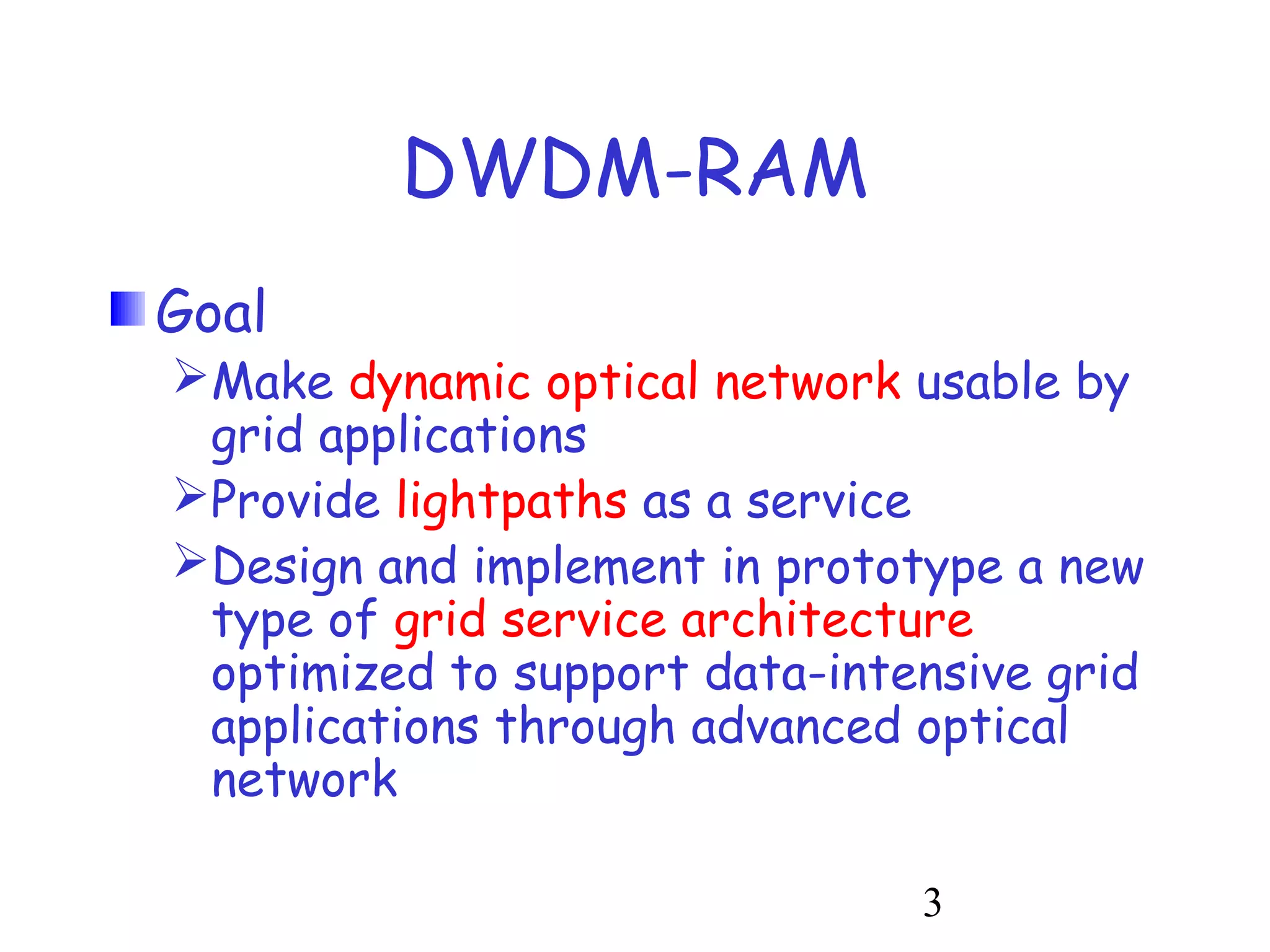
Goal 
Make dynamic optical network usable by 
grid applications 
Provide lightpaths as a service 
Design and implement in prototype a new 
type of grid service architecture 
optimized to support data-intensive grid 
applications through advanced optical 
network
Why Dynamic Optical Network? 
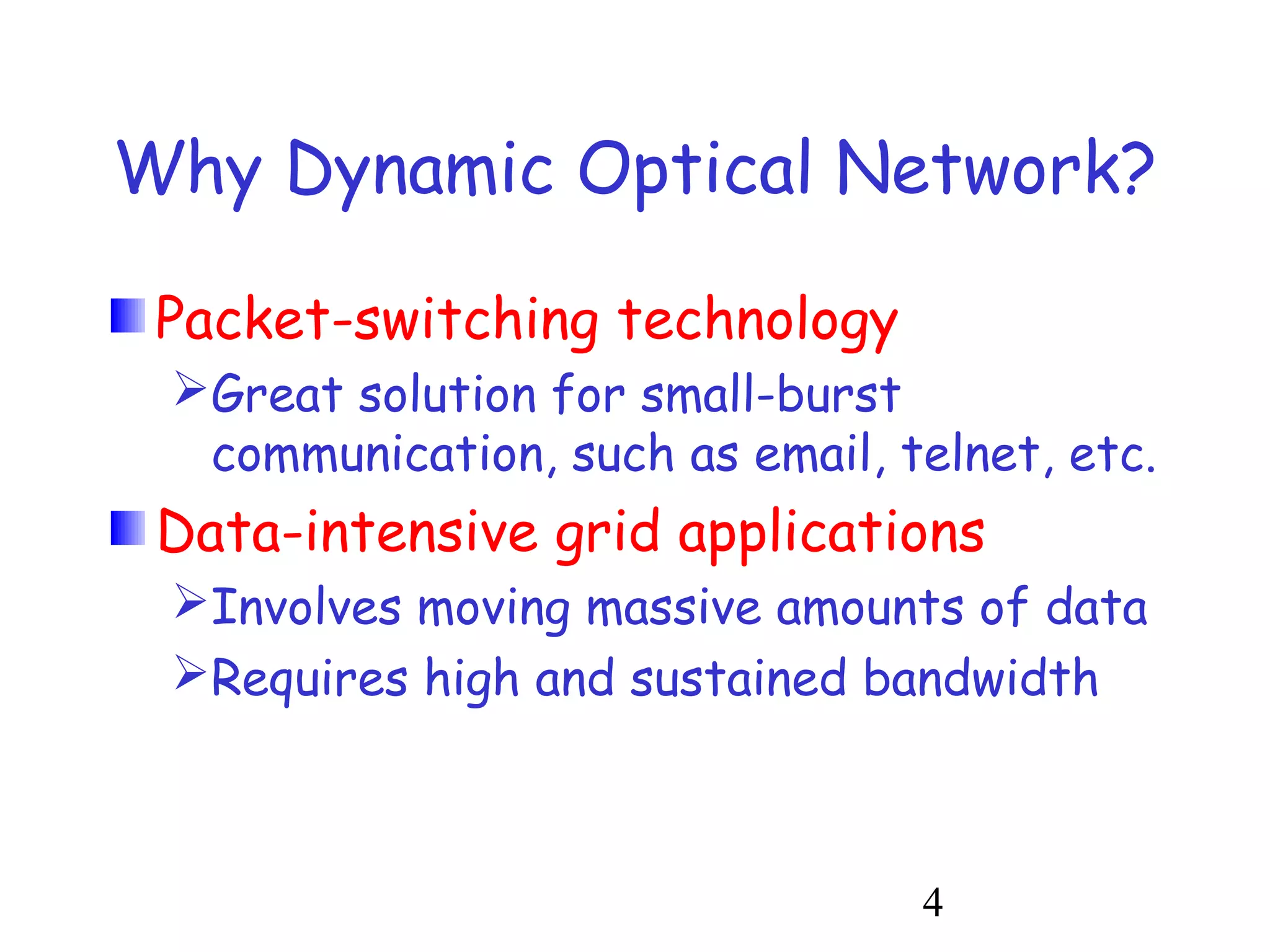
Packet-switching technology 
Great solution for small-burst 
communication, such as email, telnet, etc. 
Data-intensive grid applications 
Involves moving massive amounts of data 
Requires high and sustained bandwidth 
4
Why Dynamic Optical Network? 
DWDM 
Basically circuit switching 
Enable QoS at the Physical Layer 
Provide 
5 
High bandwidth 
Sustained bandwidth
Why Dynamic Optical Network? 
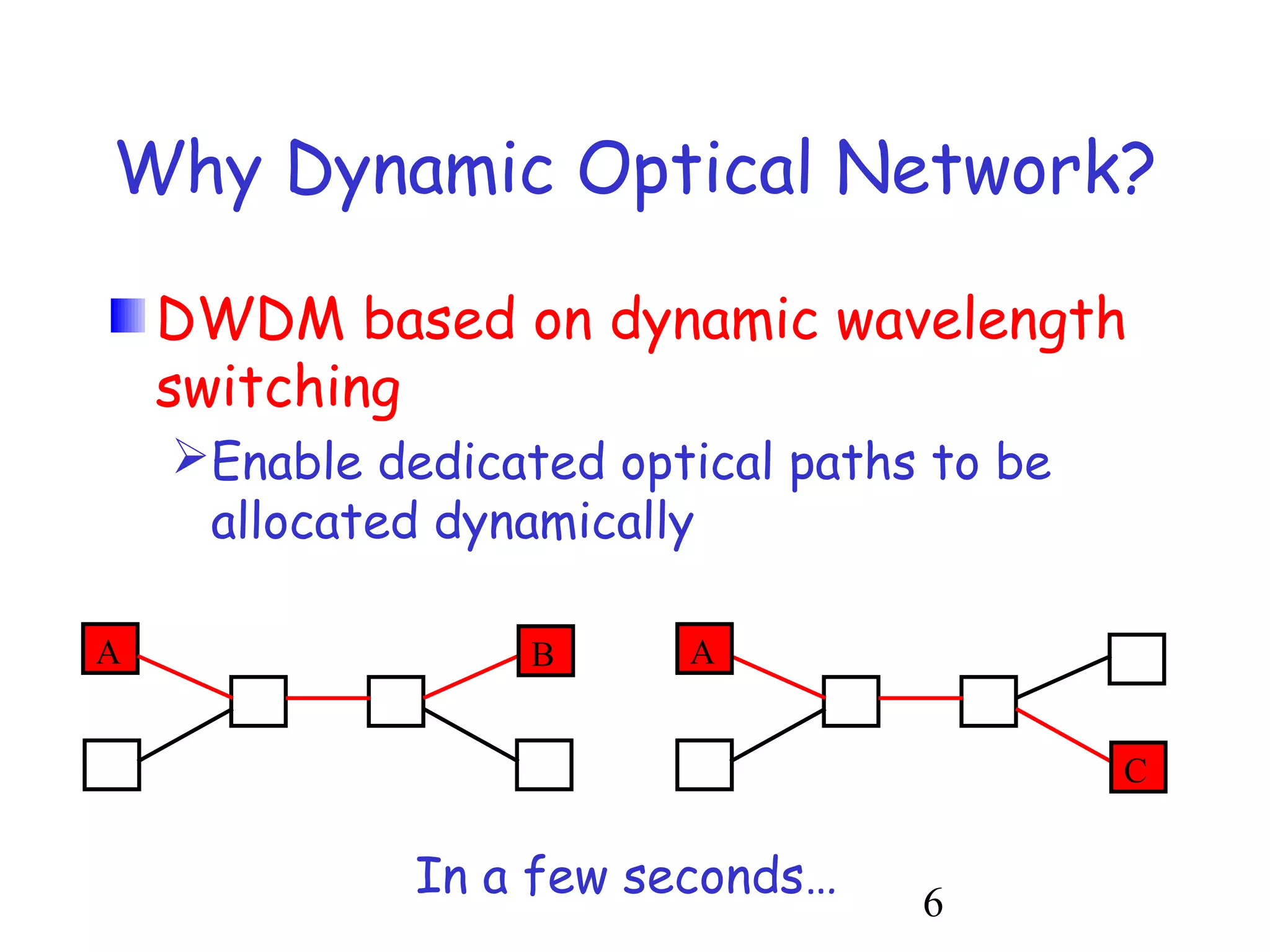
DWDM based on dynamic wavelength 
switching 
Enable dedicated optical paths to be 
6 
allocated dynamically 
A B A 
In a few seconds… 
C
Why Dynamic Optical Network? 
Any drawbacks? 
The overhead incurred during end-to-end 
7 
path setup 
Not really a problem 
The overhead is amortized by the long 
time taken to move massive amounts of 
data
Why Dynamic Optical Network? 
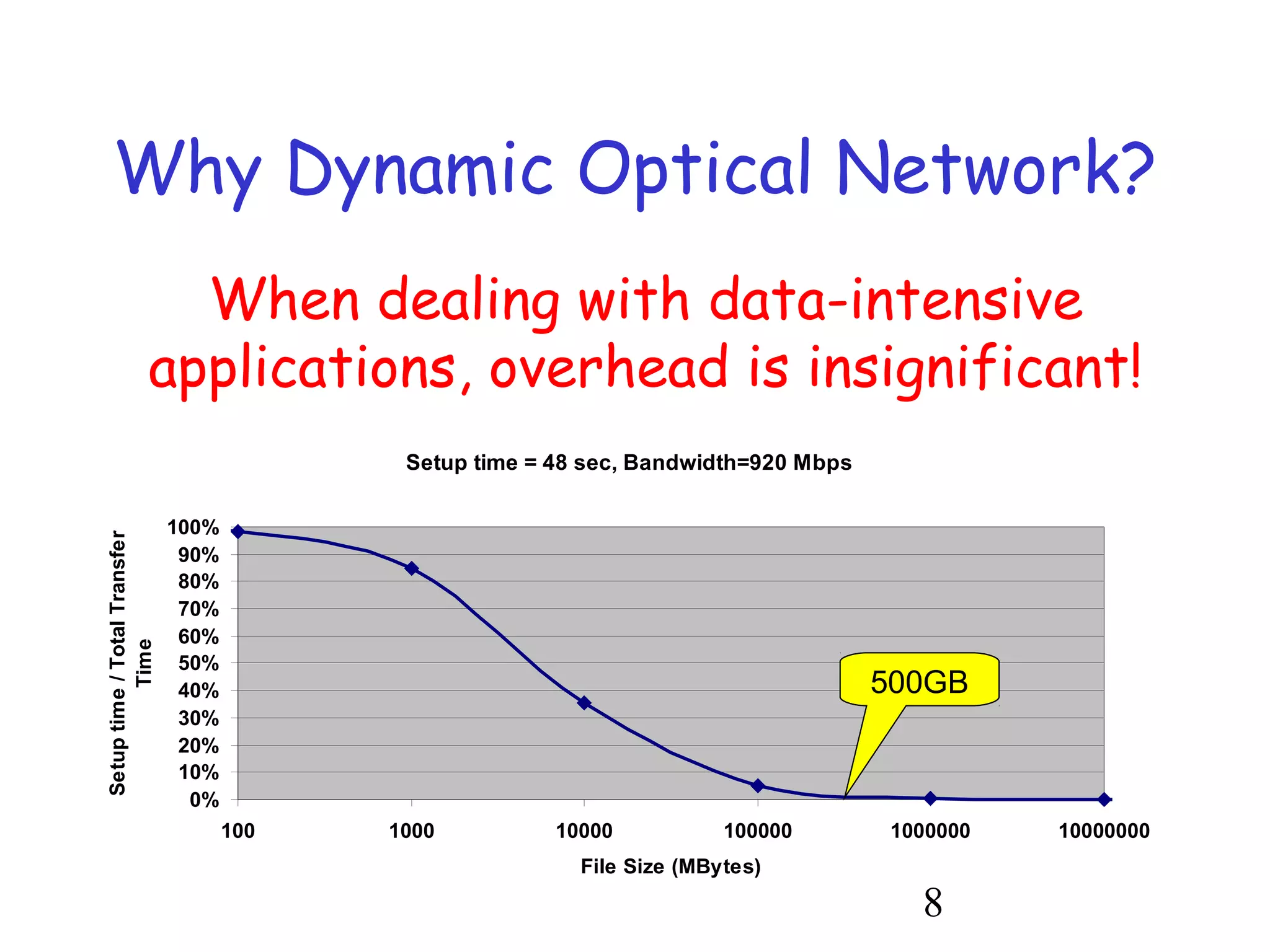
When dealing with data-intensive 
applications, overhead is insignificant! 
8 
Setup time = 48 sec, Bandwidth=920 Mbps 
100% 
90% 
80% 
70% 
60% 
50% 
40% 
30% 
20% 
10% 
0% 
100 1000 10000 100000 1000000 10000000 
File Size (MBytes) 
Setup time / Total Transfer 
Time 
500GB
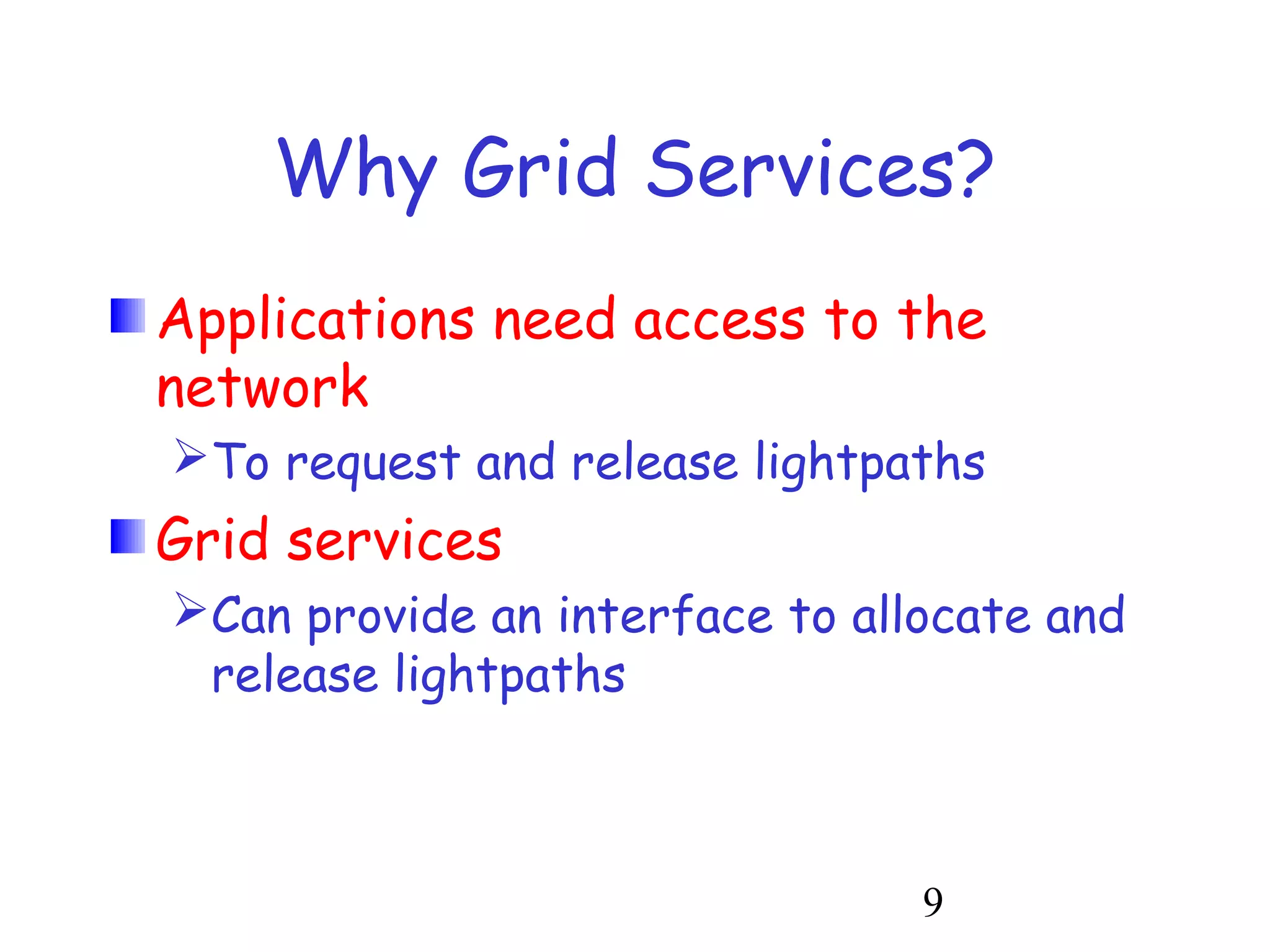
Why Grid Services? 
Applications need access to the 
network 
To request and release lightpaths 
Grid services 
Can provide an interface to allocate and 
release lightpaths 
9
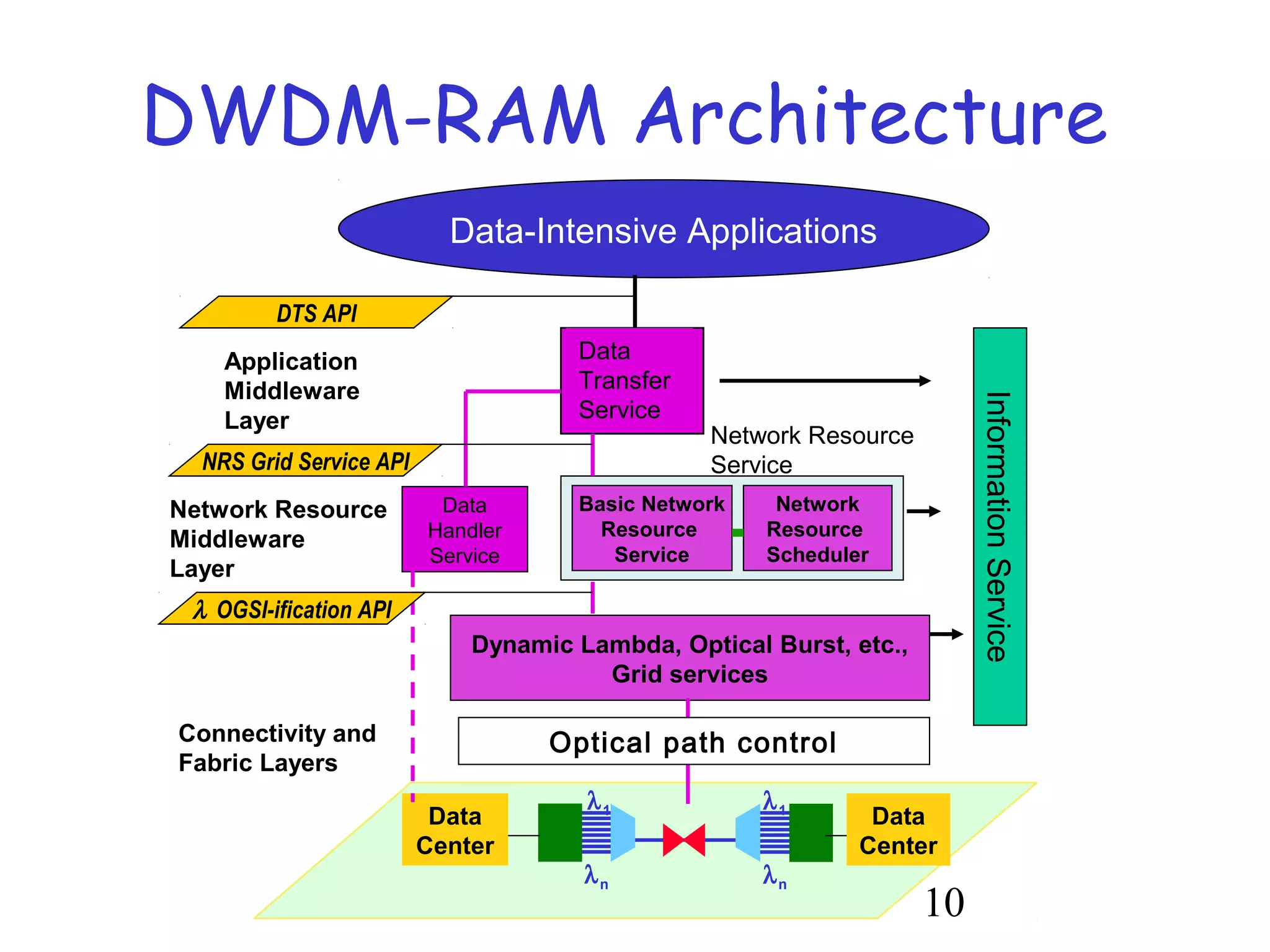
DWDM-RAM Architecture 
Data-Intensive Applications 
Data 
Transfer 
Service 
Network Resource 
Service 
Basic Network 
Resource 
Service 
Network 
Resource 
Scheduler 
Dynamic Lambda, Optical Burst, etc., 
Data 
Center 
10 
l1 
ln 
l1 
ln 
Data 
Center 
Grid services 
Data 
Handler 
Service 
Information Service 
DTS API 
Application 
Middleware 
Layer 
NRS Grid Service API 
Network Resource 
Middleware 
Layer 
l  OGSI-ification API 
Connectivity and 
Fabric Layers 
Optical path control
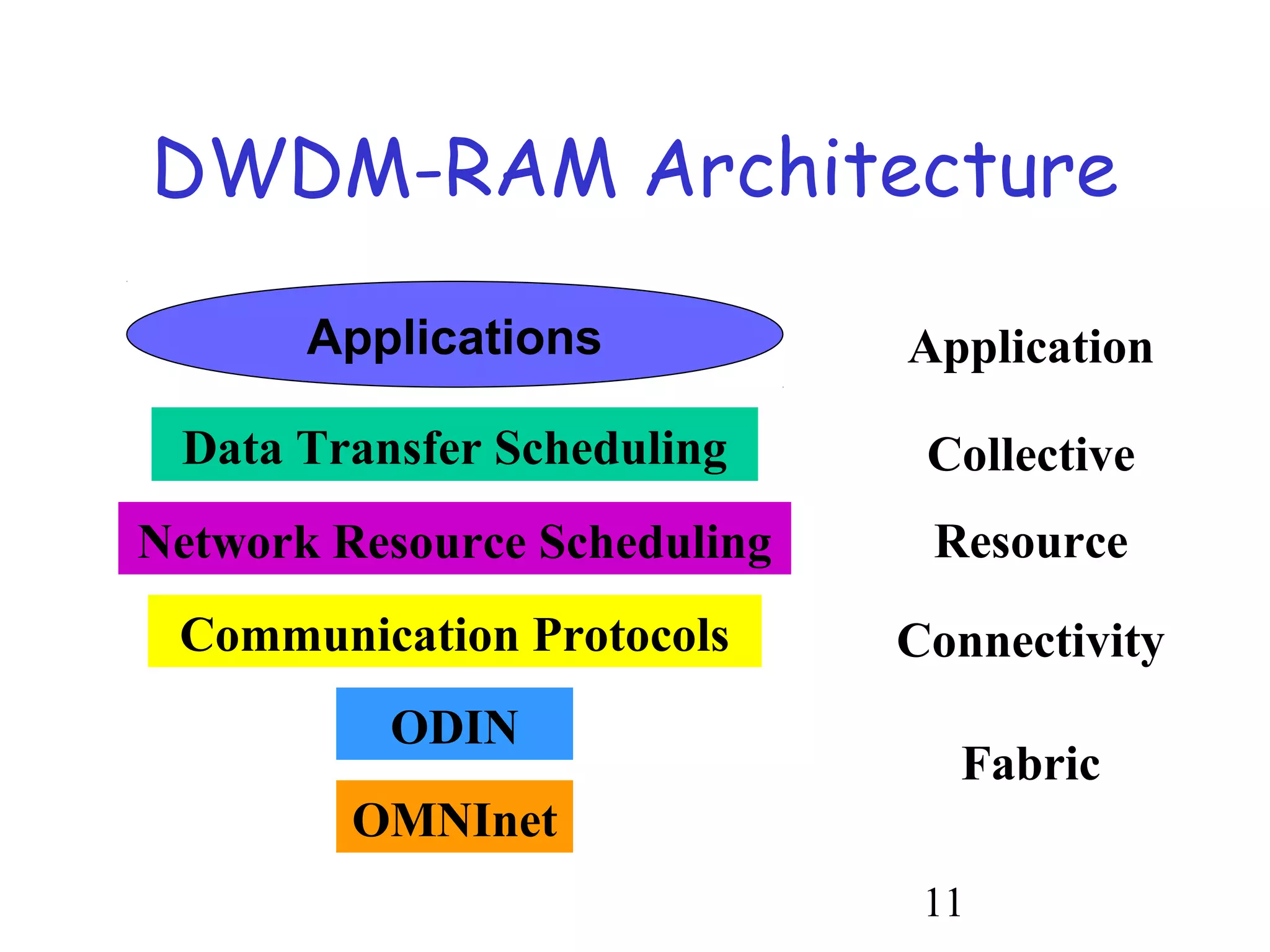
DWDM-RAM Architecture 
Application 
Collective 
Resource 
Connectivity 
11 
Applications 
Data Transfer Scheduling 
Network Resource Scheduling 
Communication Protocols 
ODIN 
OMNInet 
Fabric
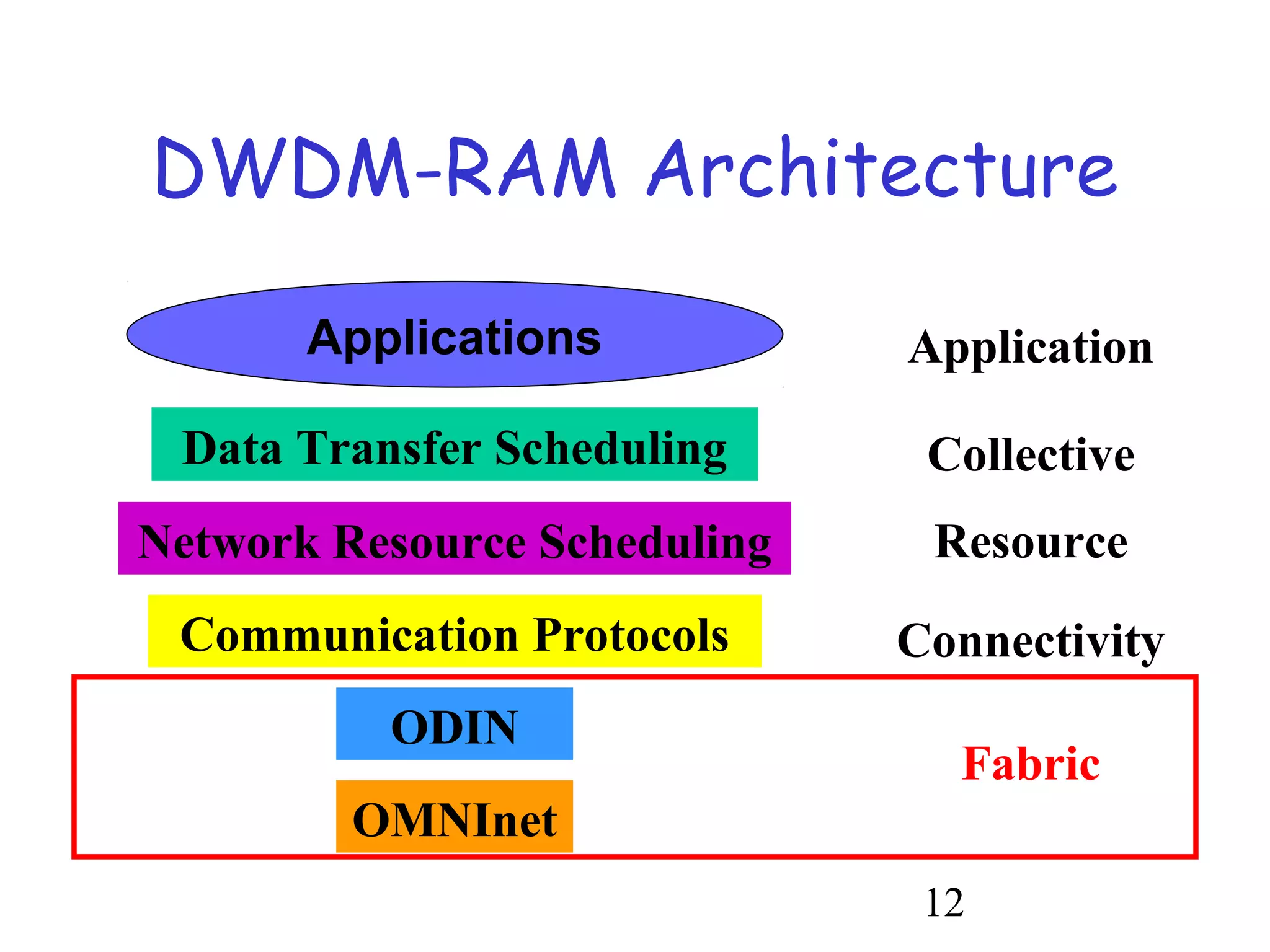
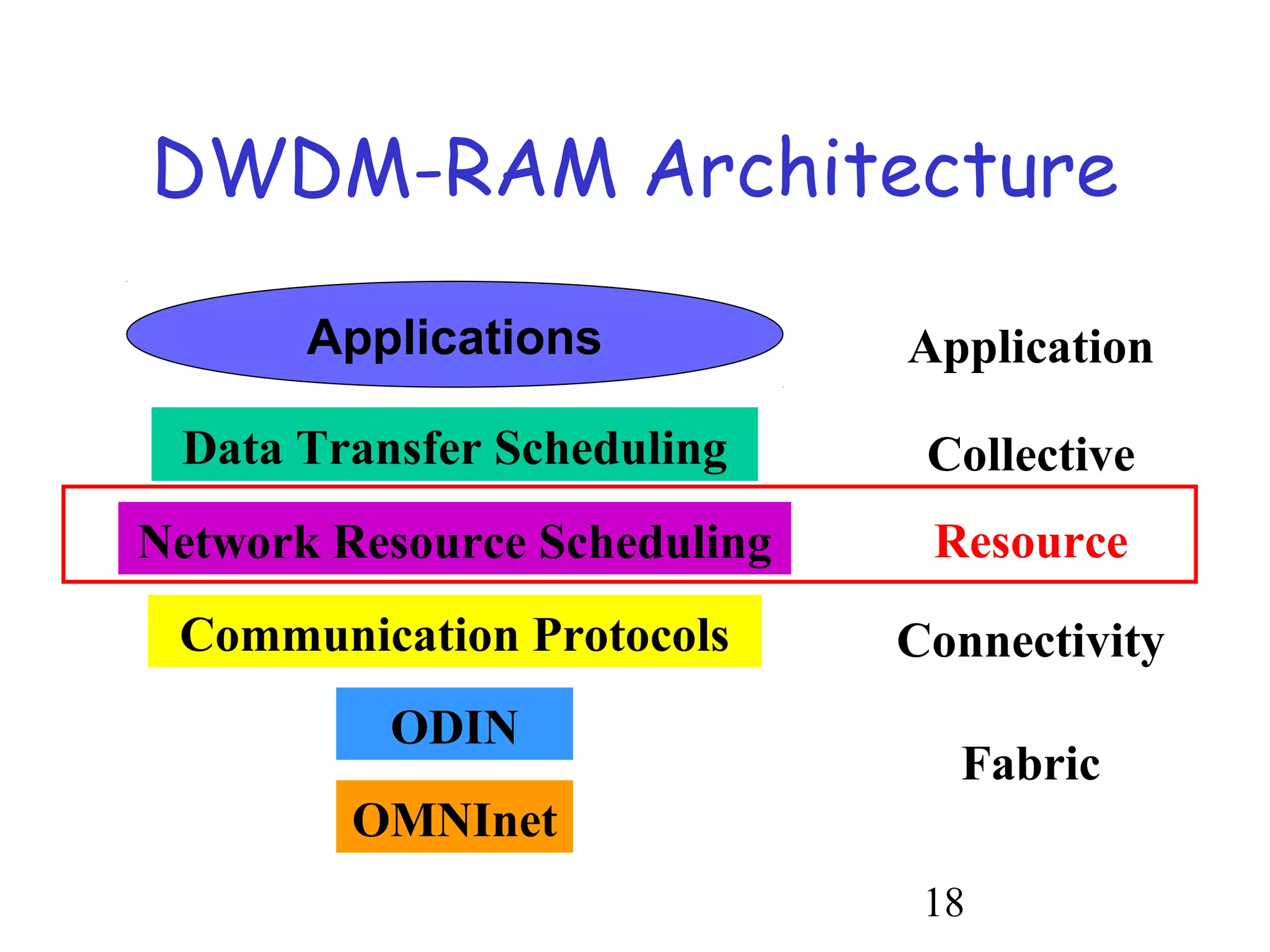
DWDM-RAM Architecture 
Application 
Collective 
Resource 
Connectivity 
12 
Applications 
Data Transfer Scheduling 
Network Resource Scheduling 
Communication Protocols 
ODIN 
OMNInet 
Fabric
DWDM-RAM Architecture 
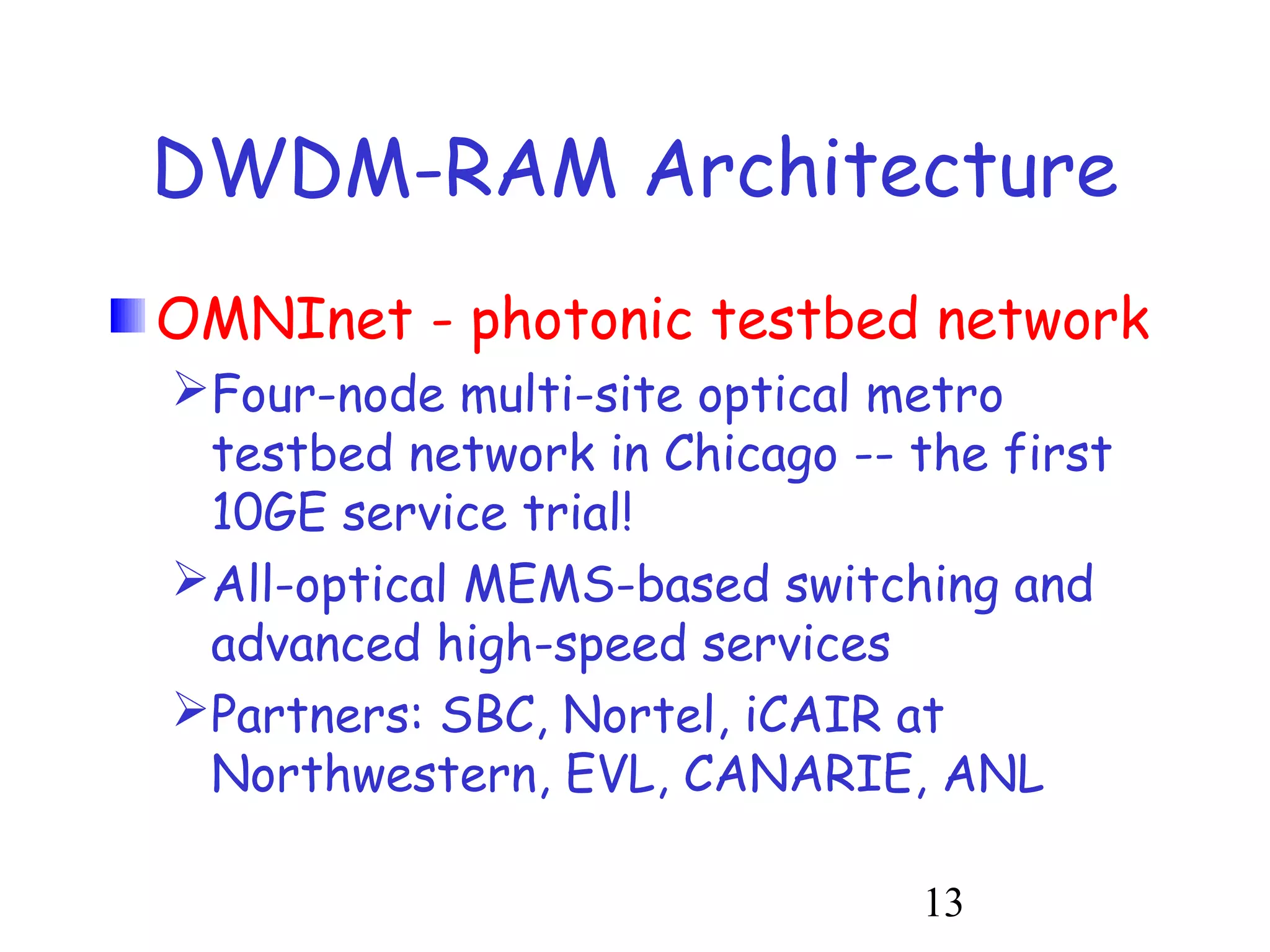
OMNInet - photonic testbed network 
Four-node multi-site optical metro 
testbed network in Chicago -- the first 
10GE service trial! 
All-optical MEMS-based switching and 
advanced high-speed services 
Partners: SBC, Nortel, iCAIR at 
Northwestern, EVL, CANARIE, ANL 
13
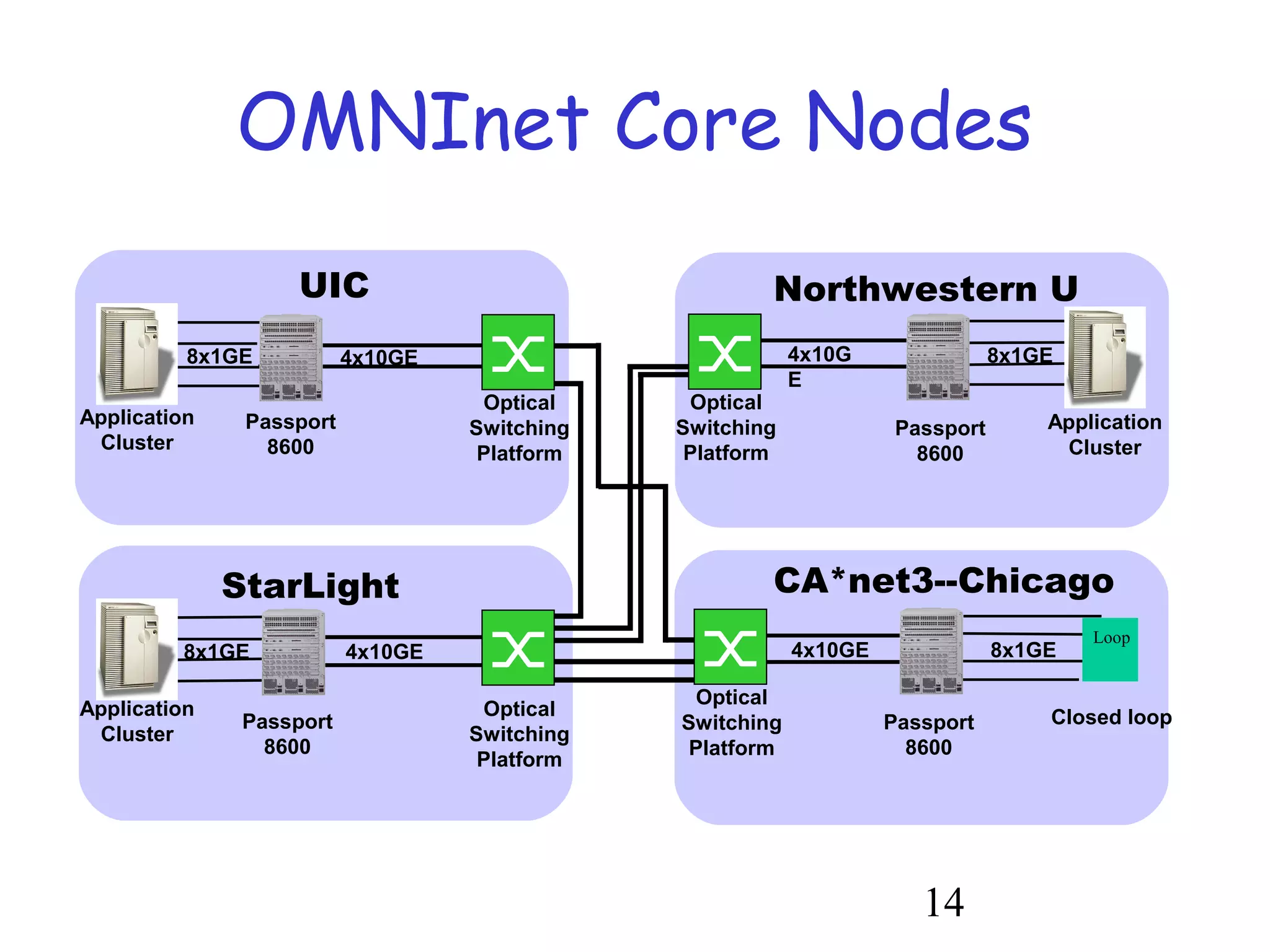
Northwestern U 
14 
4x10G 
E 
Optical 
Switching 
Platform 
Passport 
8600 
Application 
Cluster 
OMNInet Core Nodes 
UIC 
8x1GE 4x10GE 
Application 
Cluster 
Optical 
Switching 
Platform 
OPTera 
Metro 
5200 
StarLight 
Passport 
8600 
4x10GE 
Application 
Cluster 
Optical 
Switching 
Platform 
Passport 
8600 
CA*net3--Chicago 
Optical 
Switching 
Platform 
Passport 
8600 
Closed loop 
8x1GE 4x10GE 
8x1GE 
8x1GE Loop
DWDM-RAM Architecture 
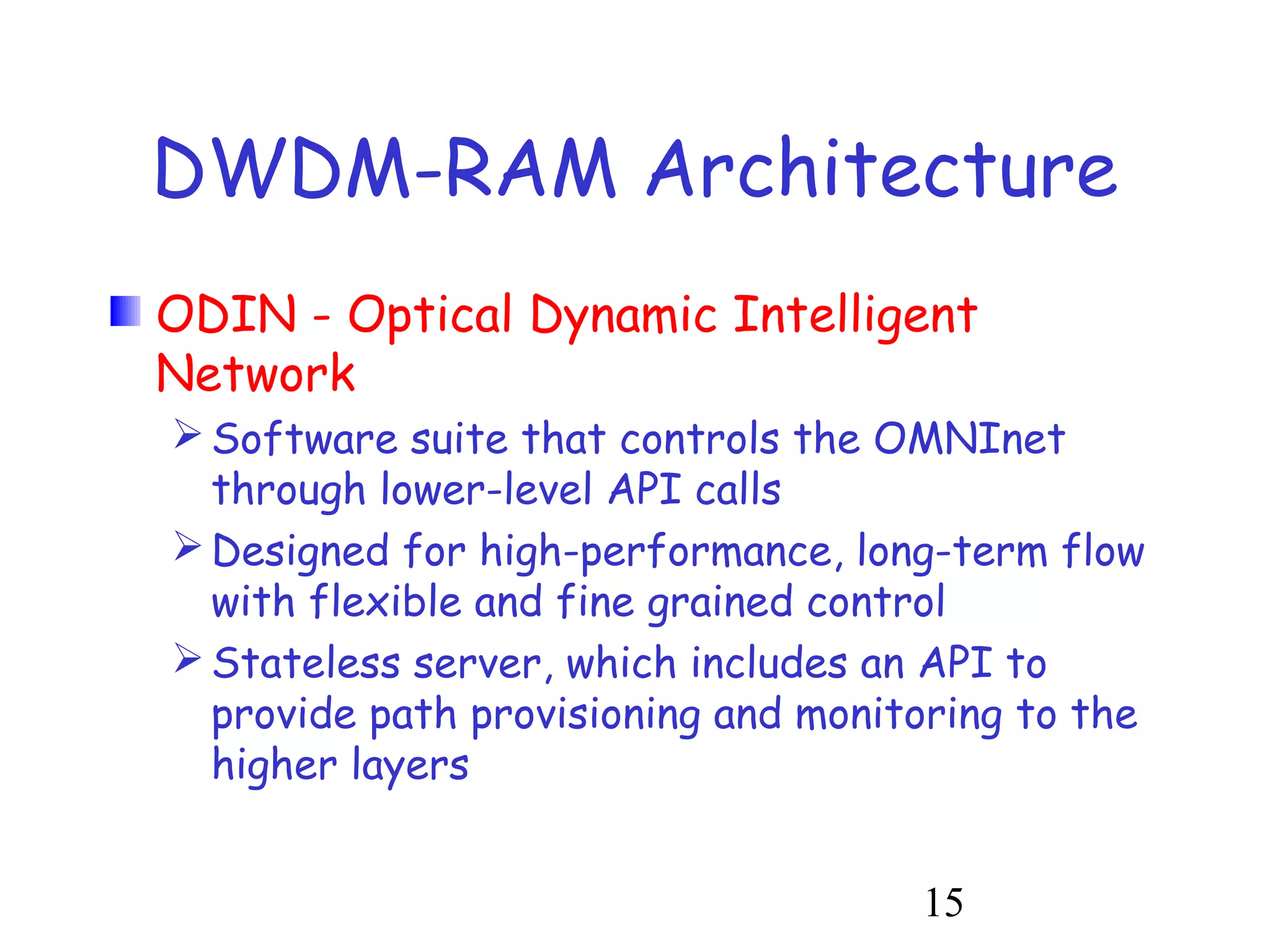
ODIN - Optical Dynamic Intelligent 
Network 
Software suite that controls the OMNInet 
through lower-level API calls 
Designed for high-performance, long-term flow 
with flexible and fine grained control 
Stateless server, which includes an API to 
provide path provisioning and monitoring to the 
higher layers 
15
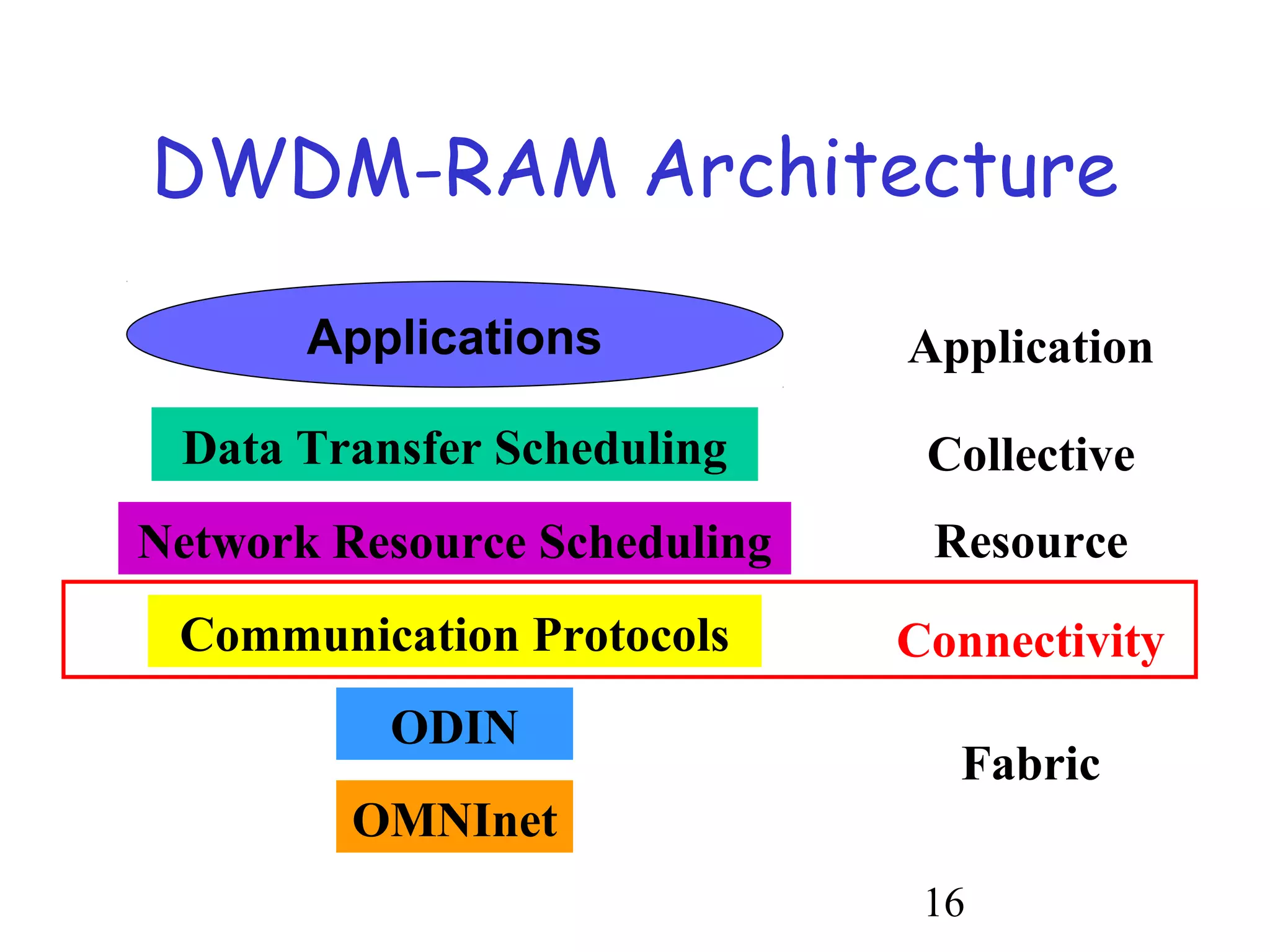
DWDM-RAM Architecture 
Application 
Collective 
Resource 
Connectivity 
16 
Applications 
Data Transfer Scheduling 
Network Resource Scheduling 
Communication Protocols 
ODIN 
OMNInet 
Fabric
DWDM-RAM Architecture 
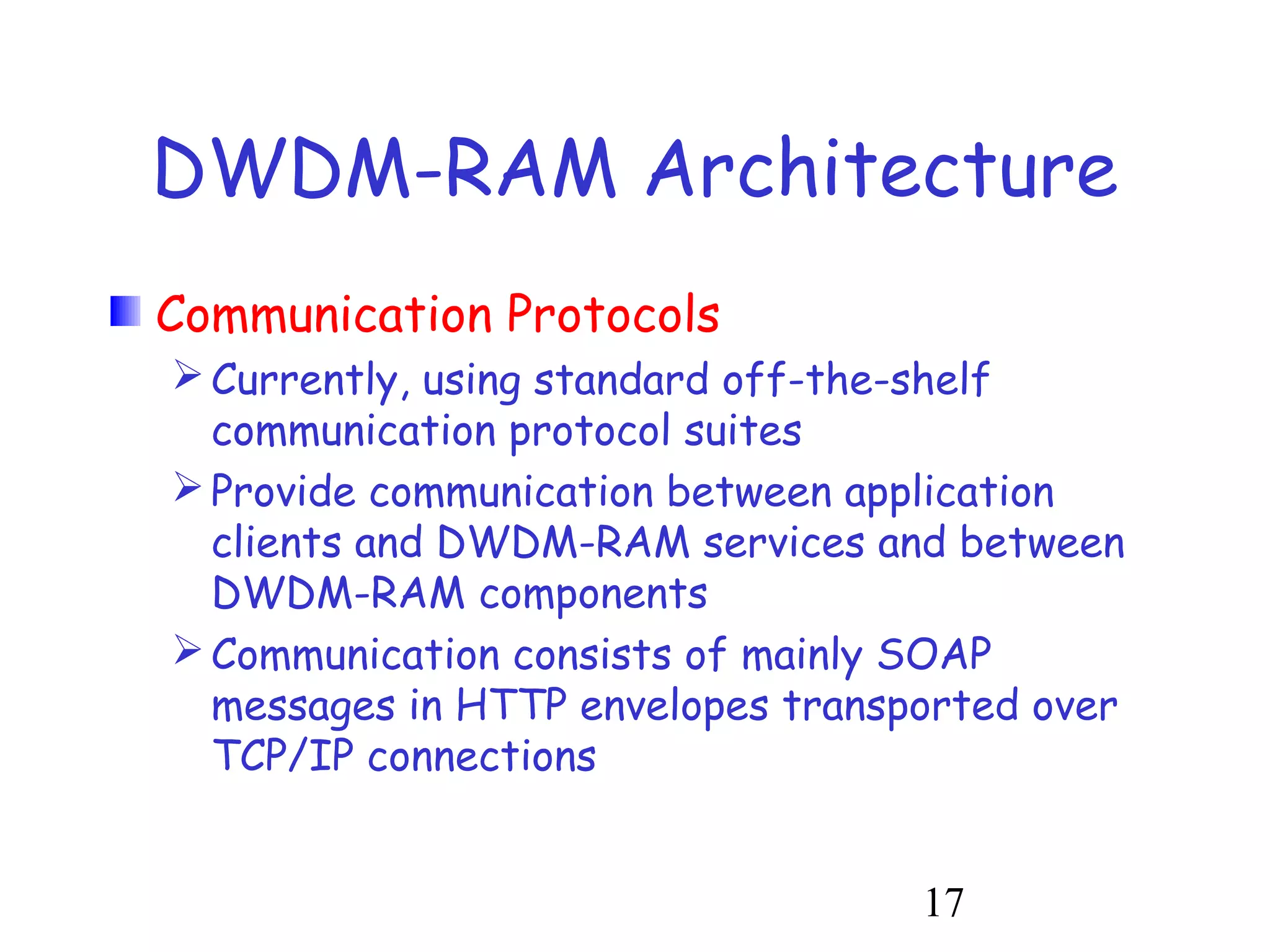
Communication Protocols 
Currently, using standard off-the-shelf 
communication protocol suites 
Provide communication between application 
clients and DWDM-RAM services and between 
DWDM-RAM components 
Communication consists of mainly SOAP 
messages in HTTP envelopes transported over 
TCP/IP connections 
17
DWDM-RAM Architecture 
Application 
Collective 
Resource 
Connectivity 
18 
Applications 
Data Transfer Scheduling 
Network Resource Scheduling 
Communication Protocols 
ODIN 
OMNInet 
Fabric
DWDM-RAM Architecture 
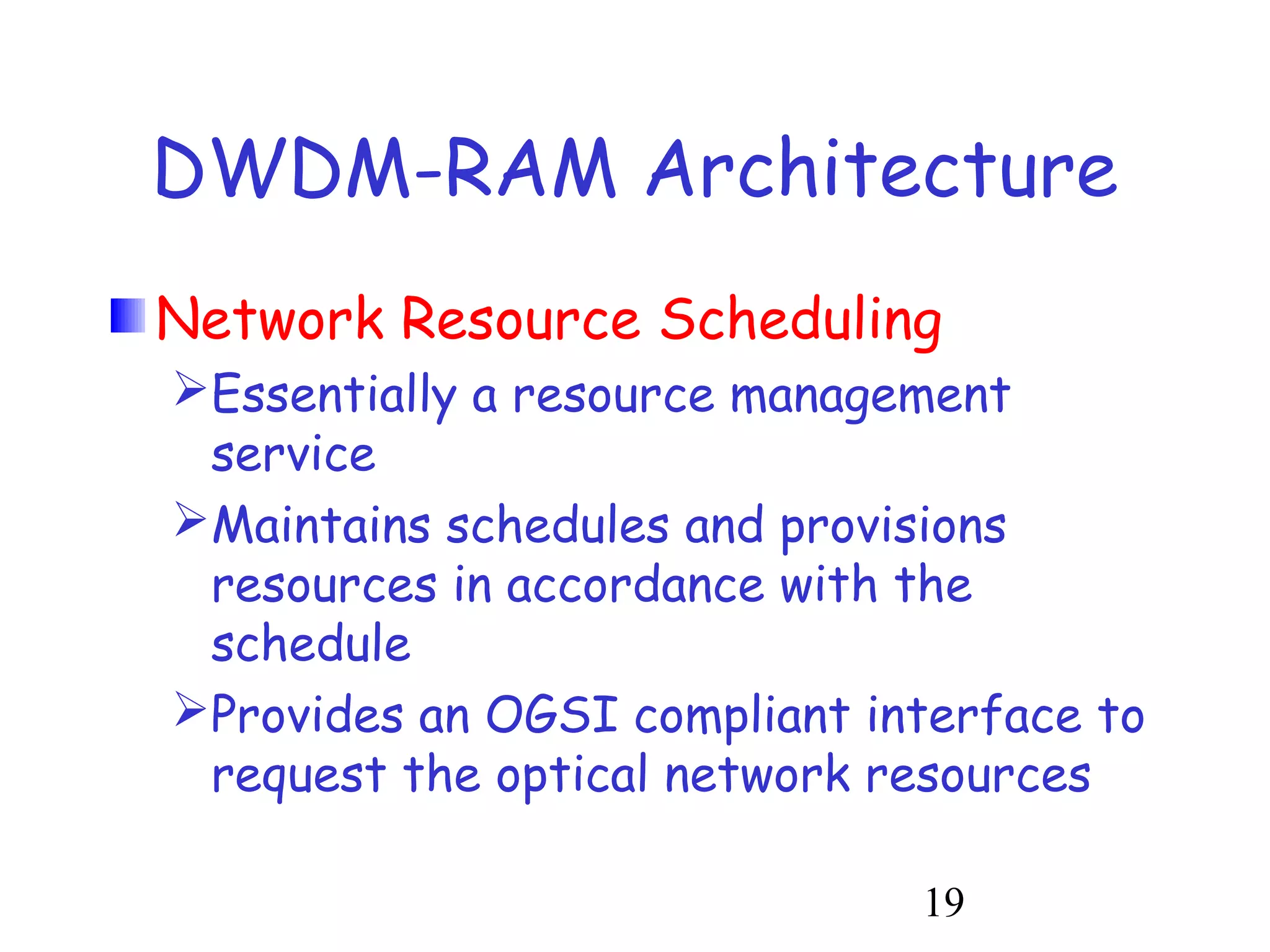
Network Resource Scheduling 
Essentially a resource management 
service 
Maintains schedules and provisions 
resources in accordance with the 
schedule 
Provides an OGSI compliant interface to 
request the optical network resources 
19
DWDM-RAM Architecture 
Application 
Collective 
Resource 
Connectivity 
20 
Applications 
Data Transfer Scheduling 
Network Resource Scheduling 
Communication Protocols 
ODIN 
OMNInet 
Fabric
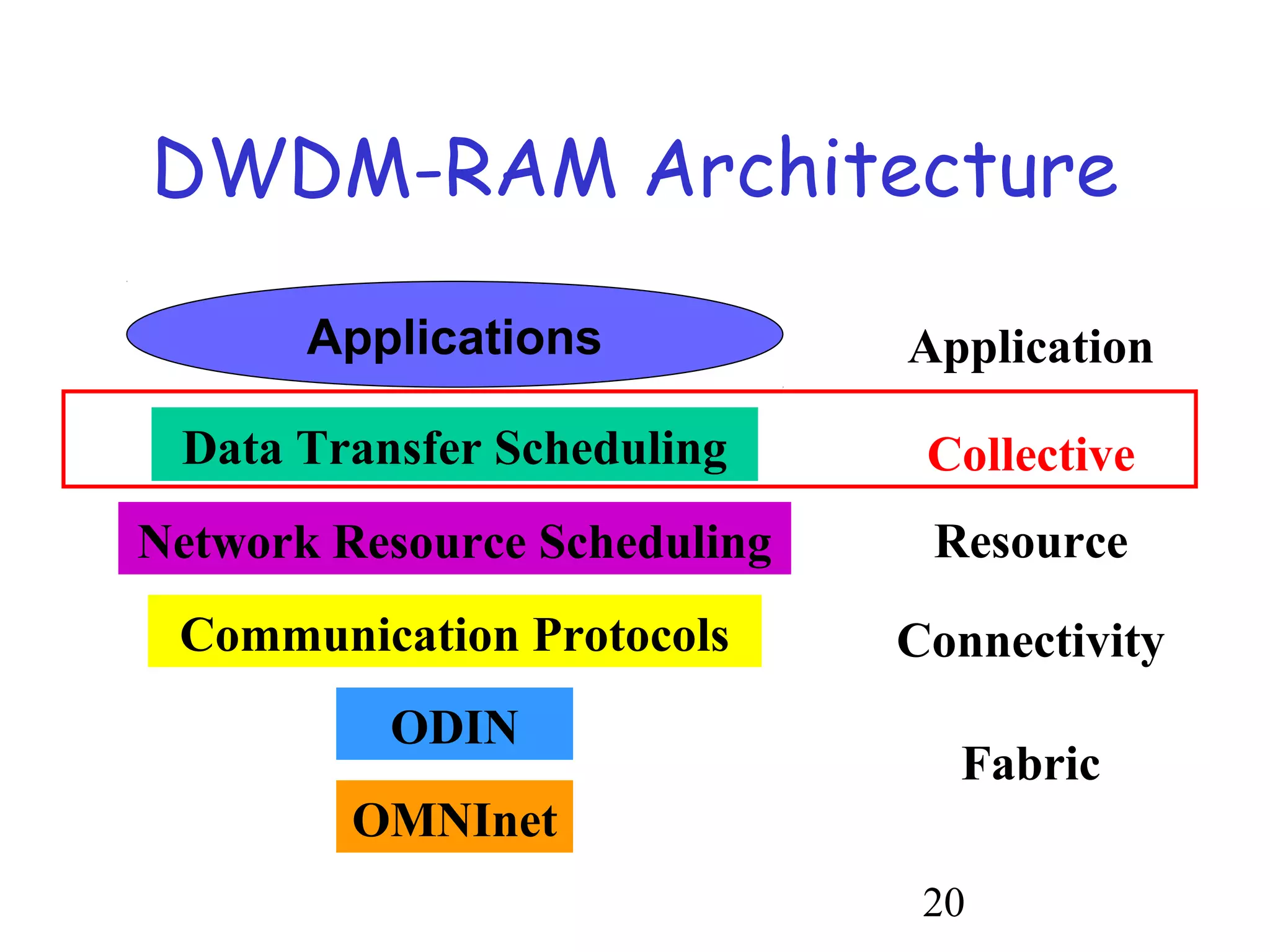
DWDM-RAM Architecture 
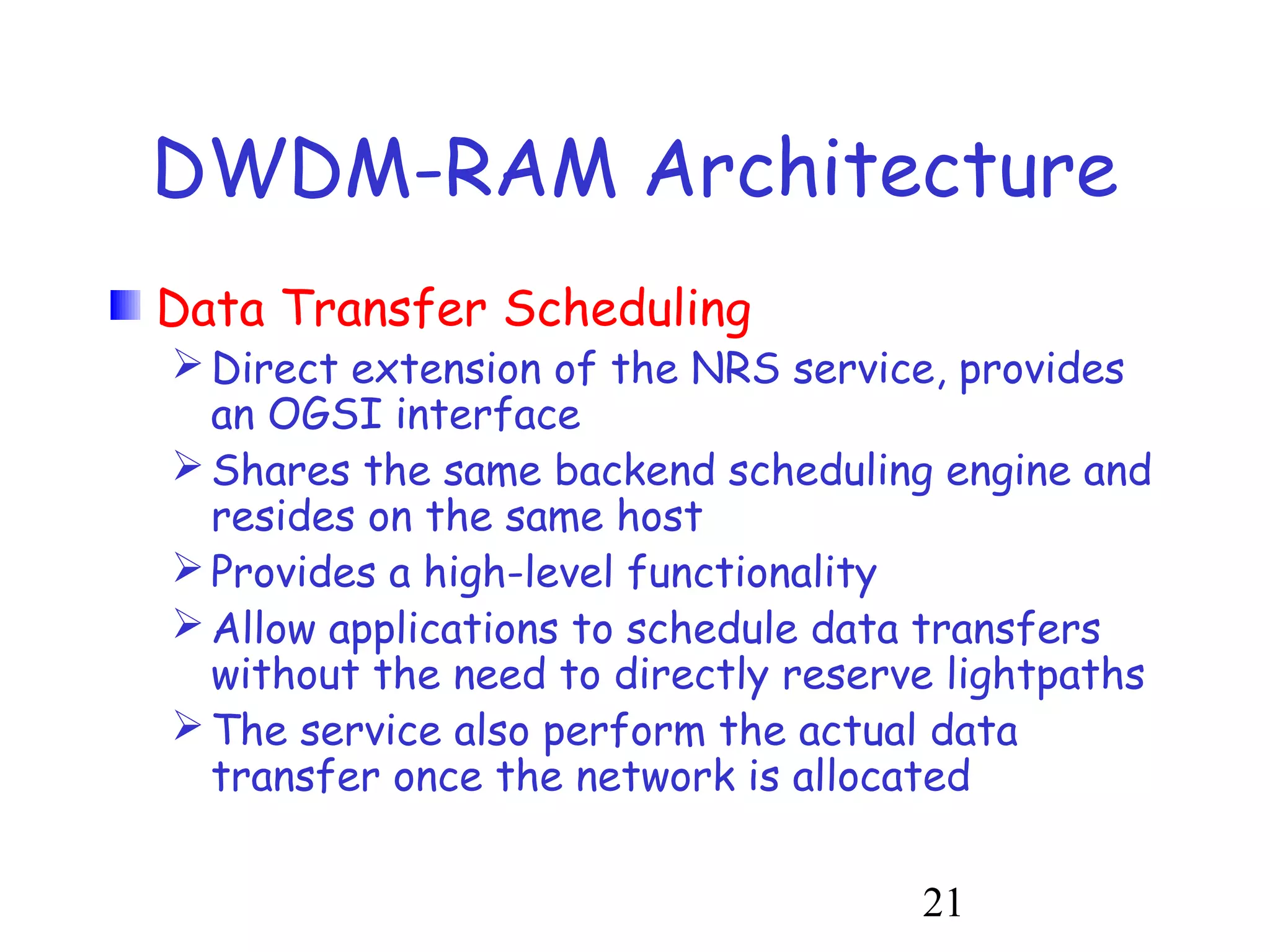
Data Transfer Scheduling 
Direct extension of the NRS service, provides 
an OGSI interface 
Shares the same backend scheduling engine and 
resides on the same host 
Provides a high-level functionality 
Allow applications to schedule data transfers 
without the need to directly reserve lightpaths 
The service also perform the actual data 
transfer once the network is allocated 
21
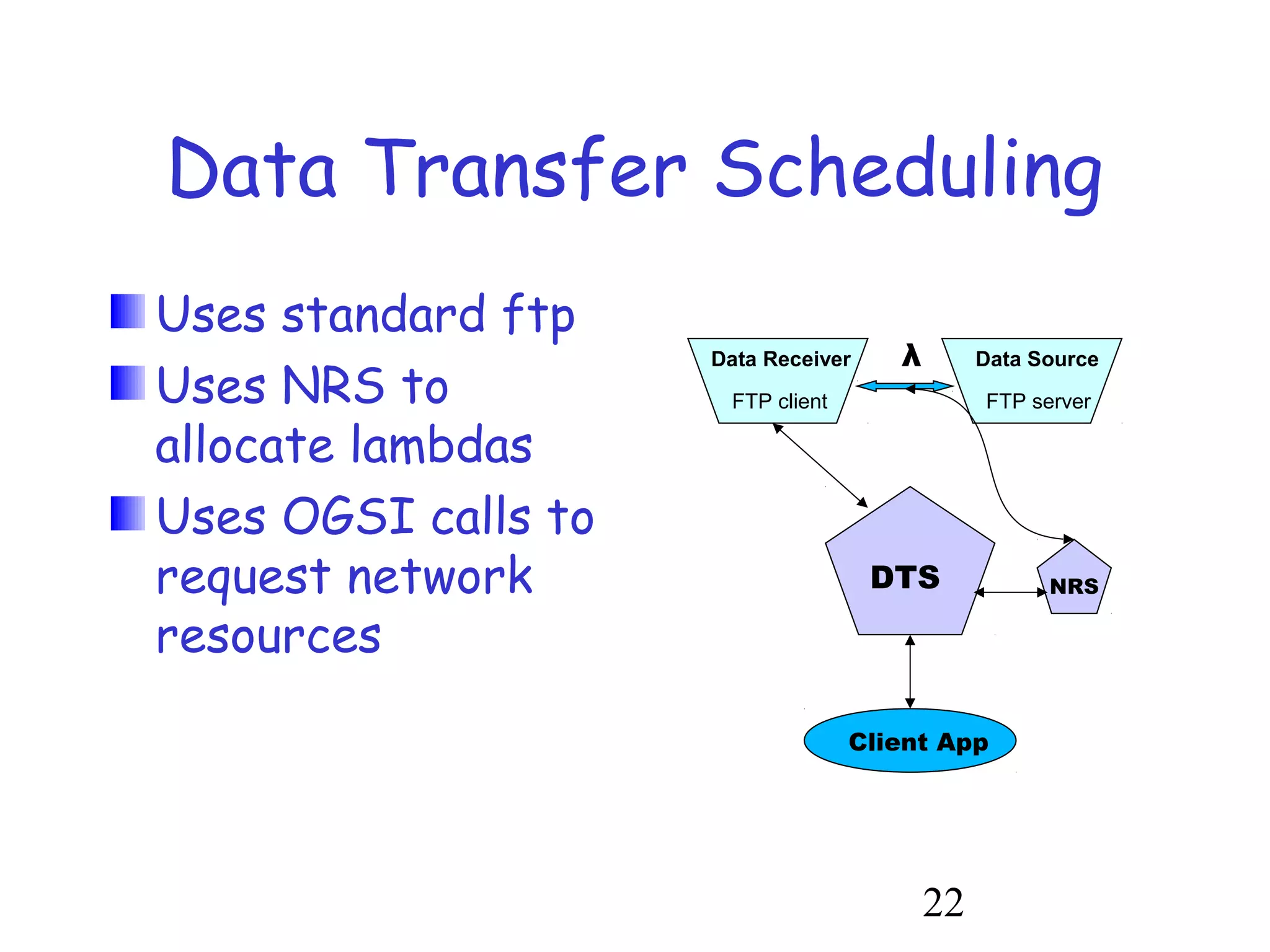
Data Transfer Scheduling 
Uses standard ftp 
Uses NRS to 
Data Receiver λ Data Source 
FTP client FTP server 
allocate lambdas 
Uses OGSI calls to 
request network 
DTS NRS 
resources 
Client App 
22
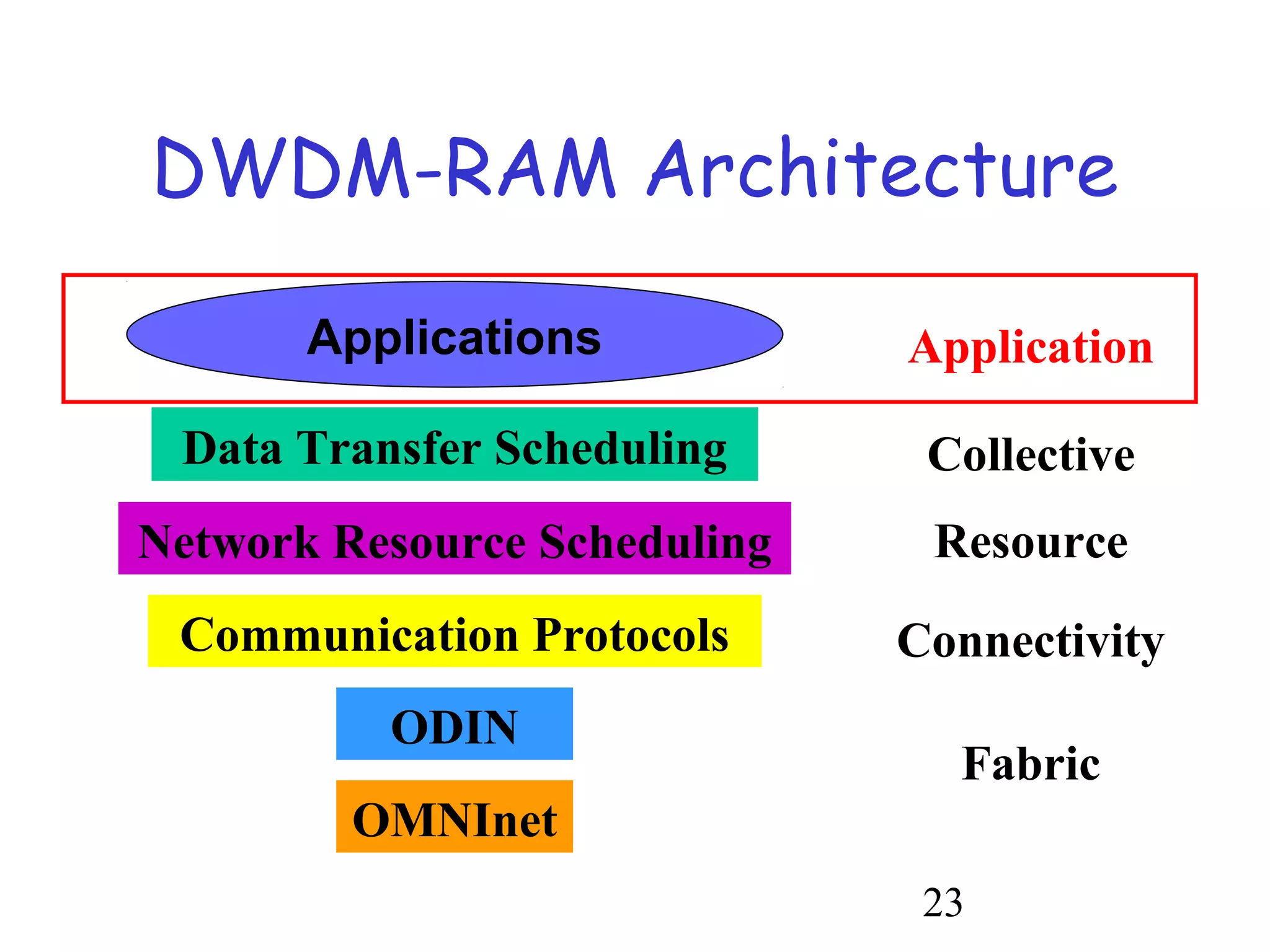
DWDM-RAM Architecture 
Application 
Collective 
Resource 
Connectivity 
23 
Applications 
Data Transfer Scheduling 
Network Resource Scheduling 
Communication Protocols 
ODIN 
OMNInet 
Fabric
DWDM-RAM Architecture 
Applications 
Target is data-intensive applications 
since their requirements make them the 
perfect costumer for DWDM networks 
24
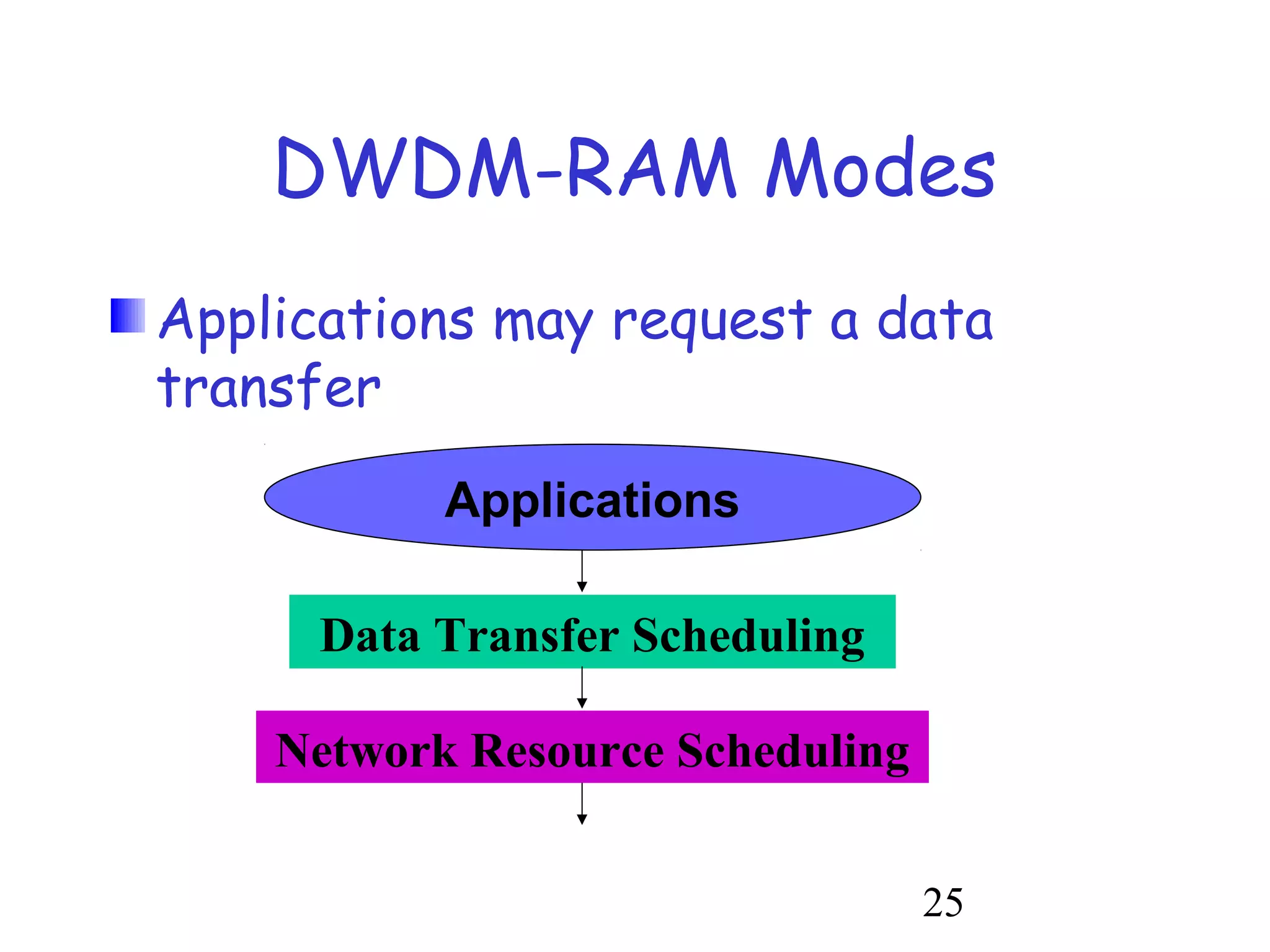
DWDM-RAM Modes 
Applications may request a data 
transfer 
25 
Applications 
Data Transfer Scheduling 
Network Resource Scheduling
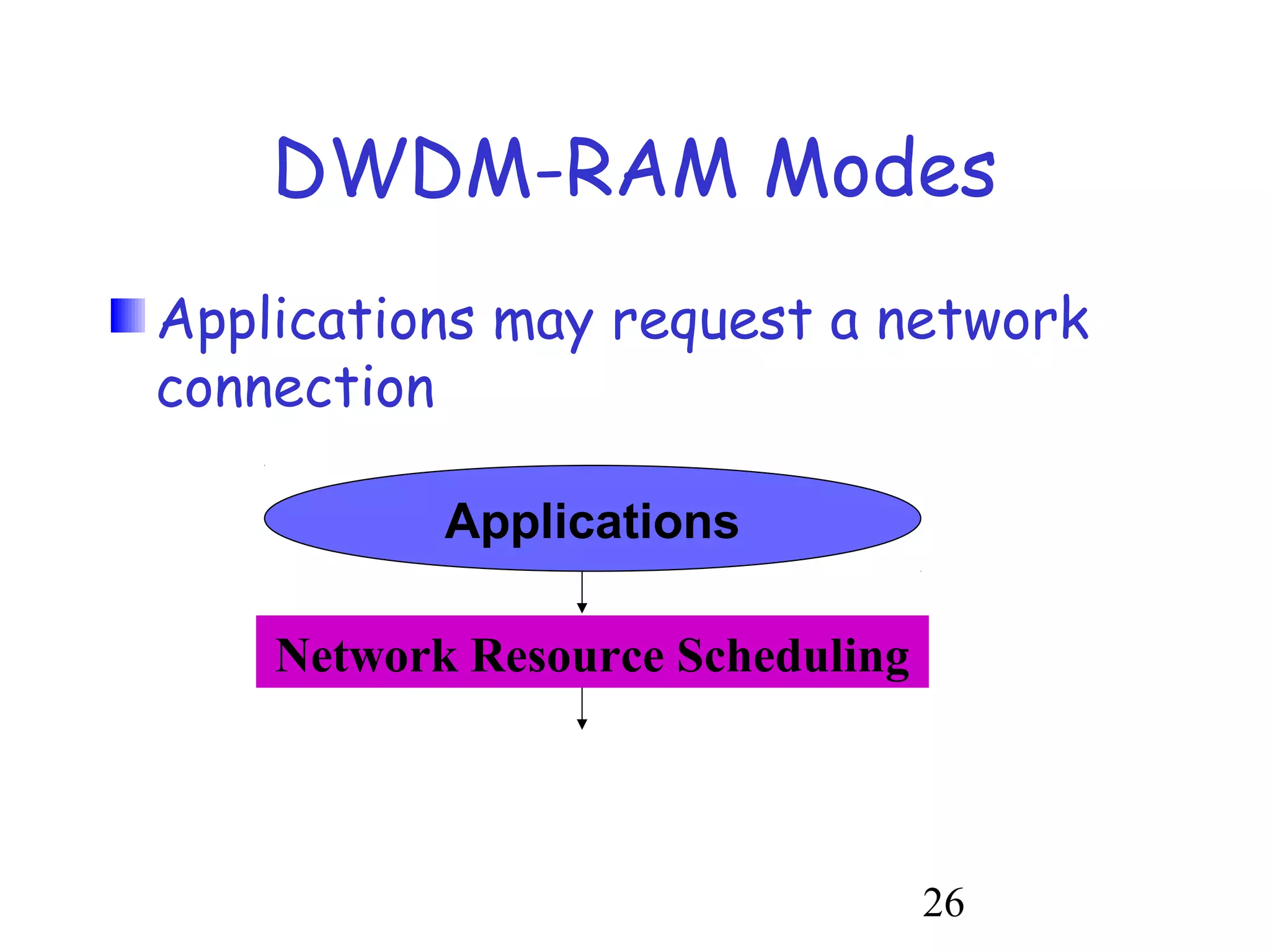
DWDM-RAM Modes 
Applications may request a network 
connection 
26 
Applications 
Network Resource Scheduling
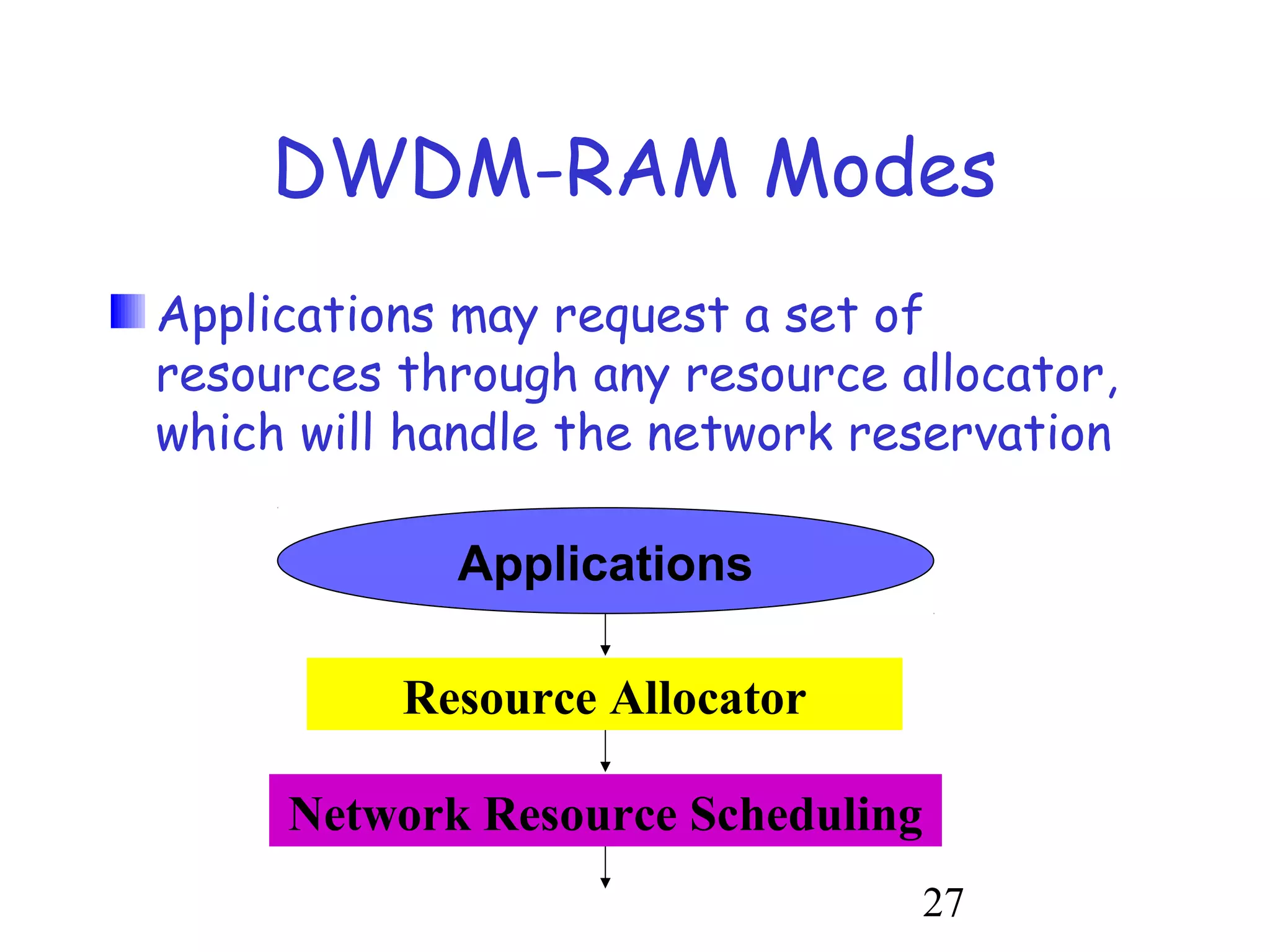
DWDM-RAM Modes 
Applications may request a set of 
resources through any resource allocator, 
which will handle the network reservation 
27 
Applications 
Resource Allocator 
Network Resource Scheduling
The Network Service 
The NRS is the key for providing 
network as a resource 
It is a service with an application-level 
interface 
Used for requesting, releasing, and 
managing the underlying network 
resources 
28
The Network Service 
NRS 
Understands the topology of the 
network 
Maintains schedules and provisions 
resources in accordance with the 
schedule 
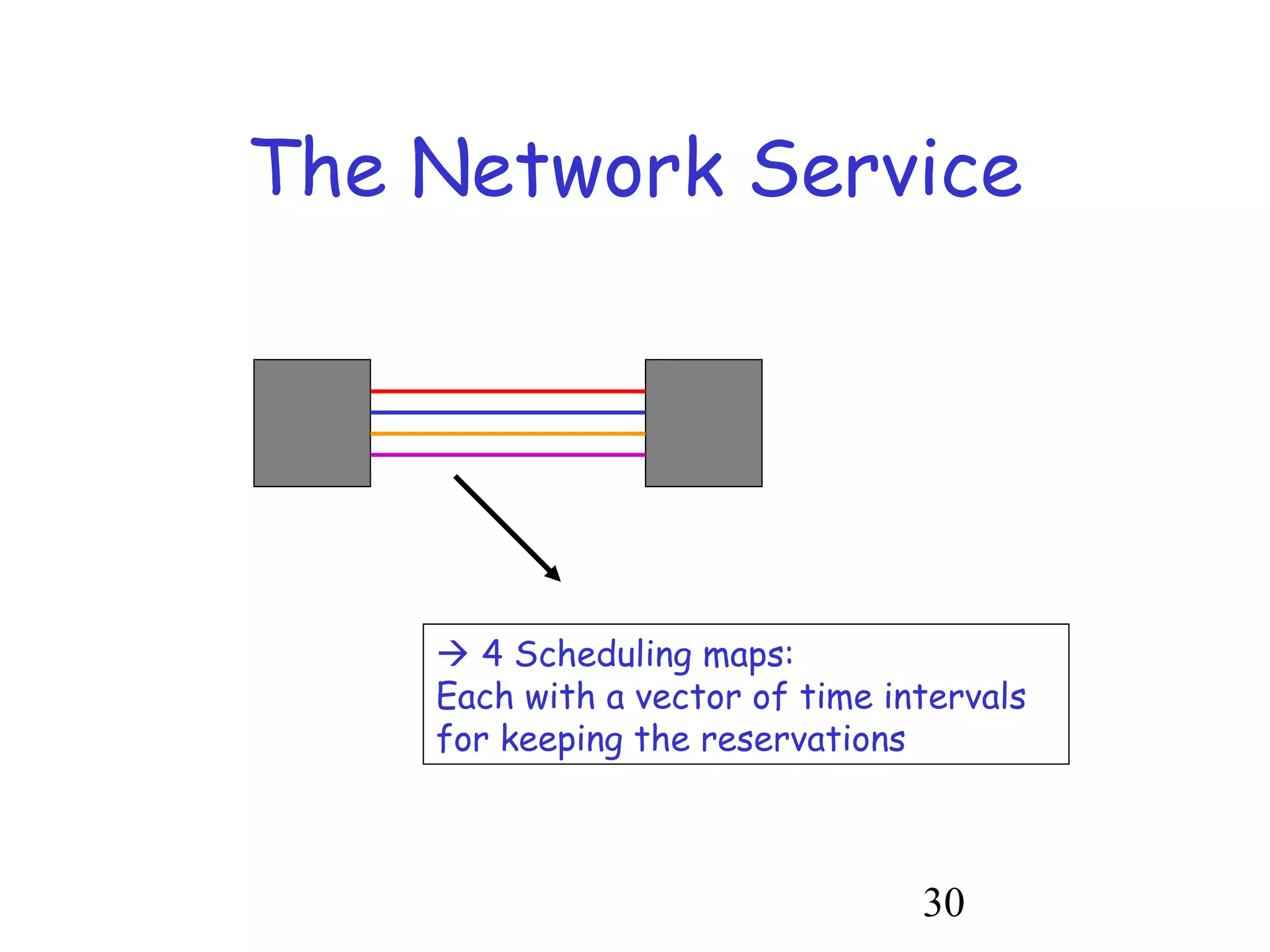
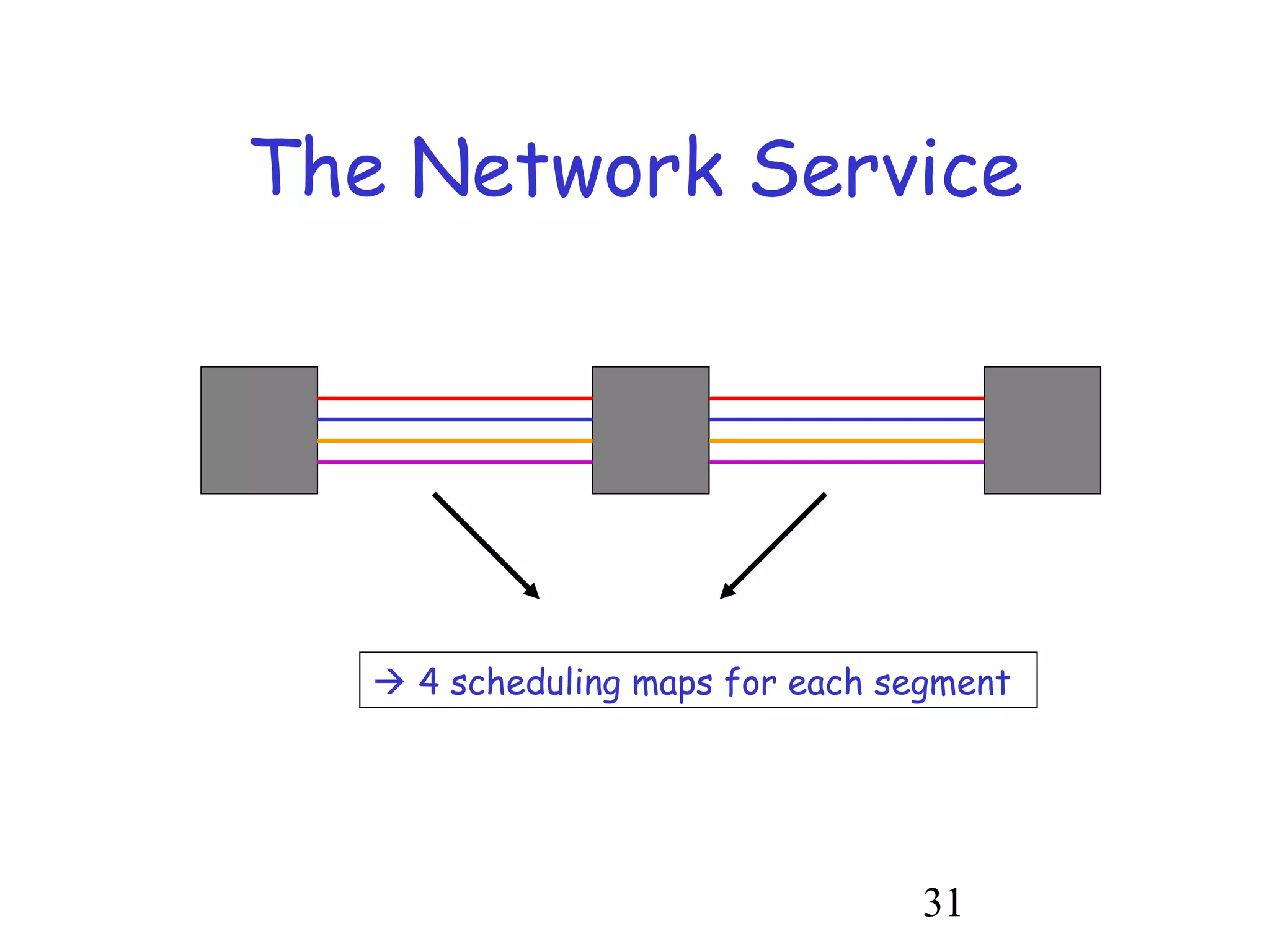
Keeps one scheduling map for each 
lambda in each segment 
29
The Network Service 
 4 Scheduling maps: 
Each with a vector of time intervals 
for keeping the reservations 
30
The Network Service 
 4 scheduling maps for each segment 
31
The Network Service 
NRS 
Provides an OGSI-based interface to network 
resources 
Request parameters 
Network addresses of the hosts to be connected 
Window of time for the allocation 
Duration of the allocation 
Minimum and maximum acceptable bandwidth (future) 
32
The Network Service 
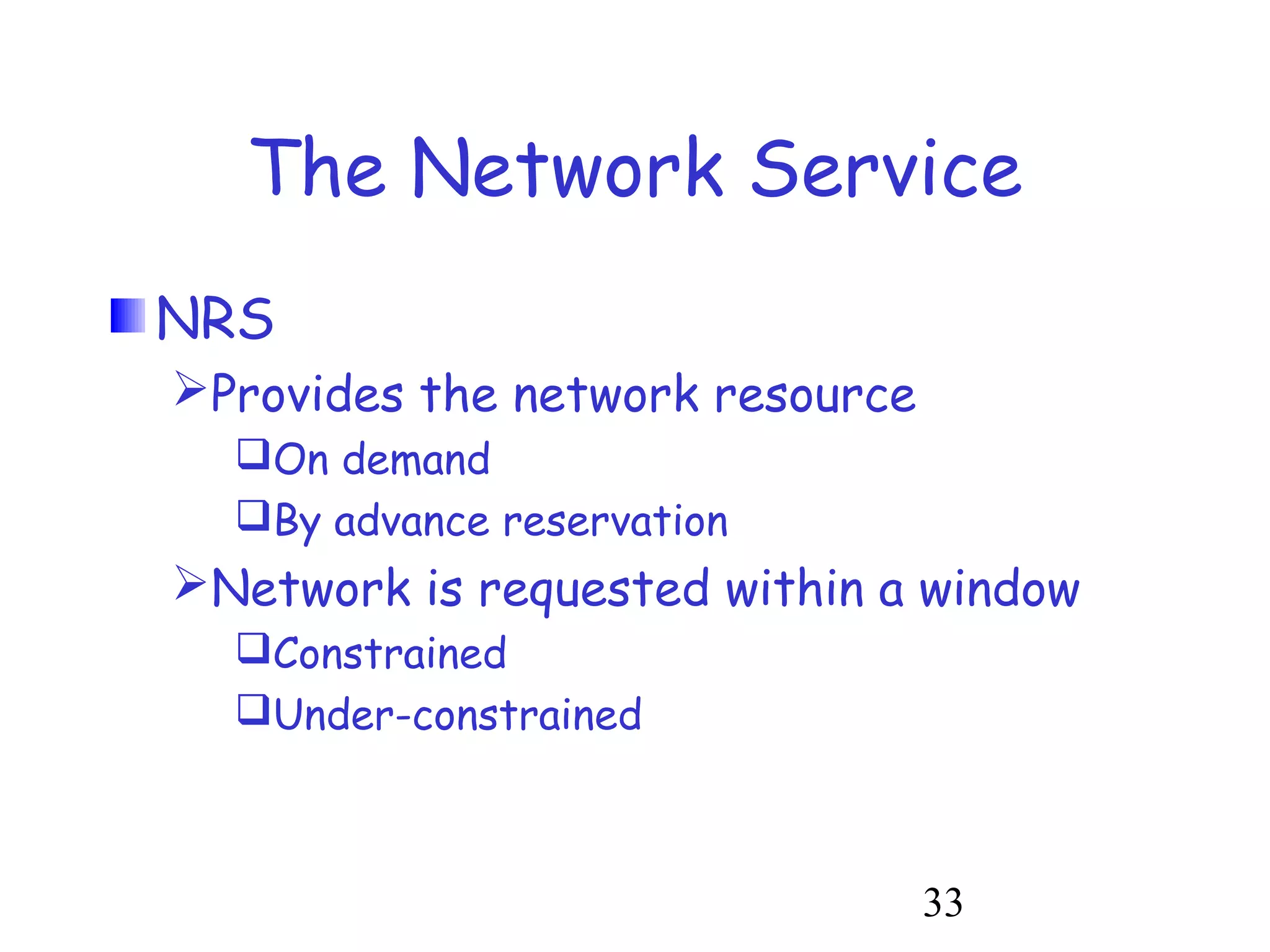
33 
NRS 
Provides the network resource 
On demand 
By advance reservation 
Network is requested within a window 
Constrained 
Under-constrained
The Network Service 
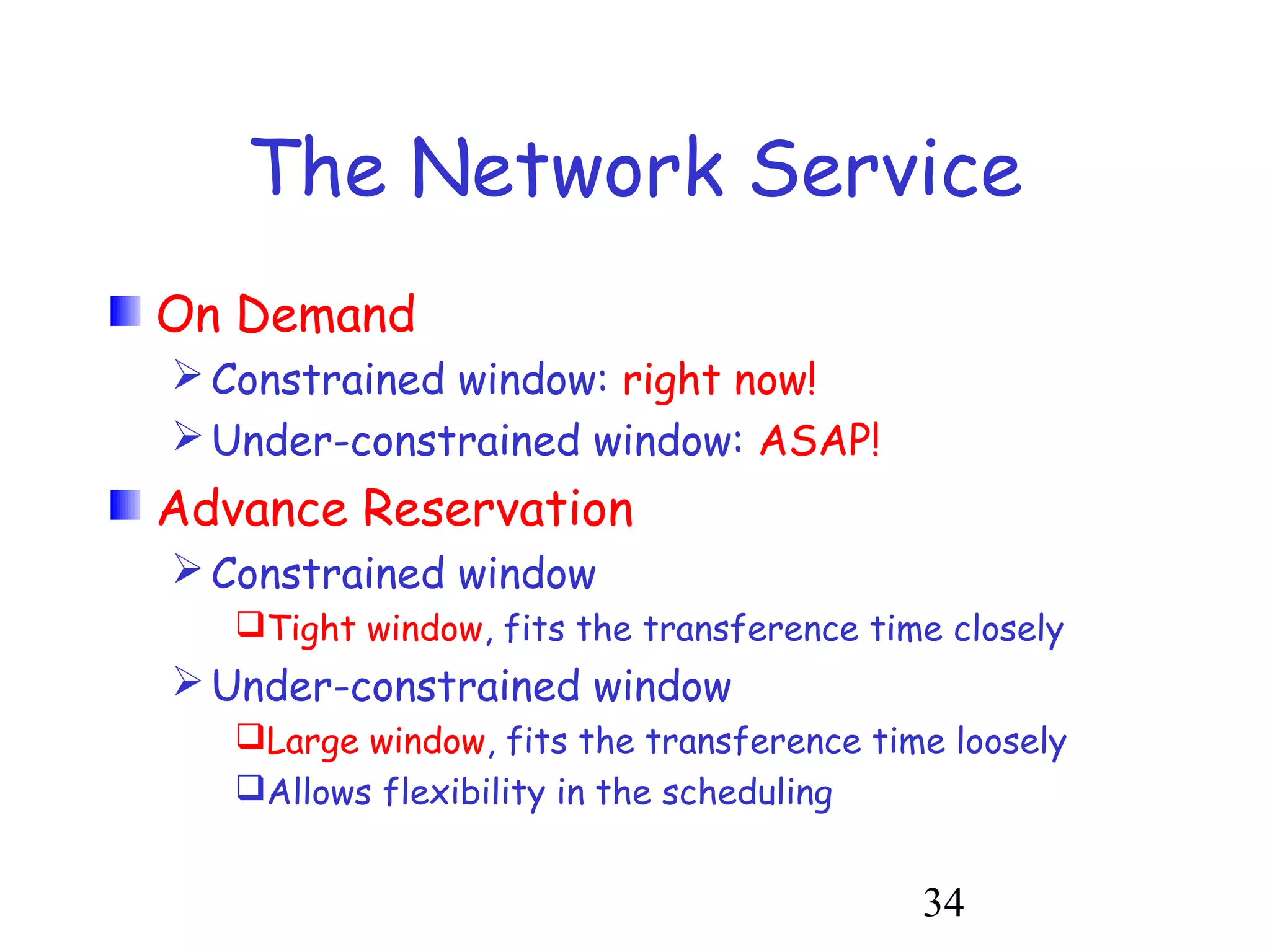
34 
On Demand 
Constrained window: right now! 
Under-constrained window: ASAP! 
Advance Reservation 
Constrained window 
Tight window, fits the transference time closely 
Under-constrained window 
Large window, fits the transference time loosely 
Allows flexibility in the scheduling
The Network Service 
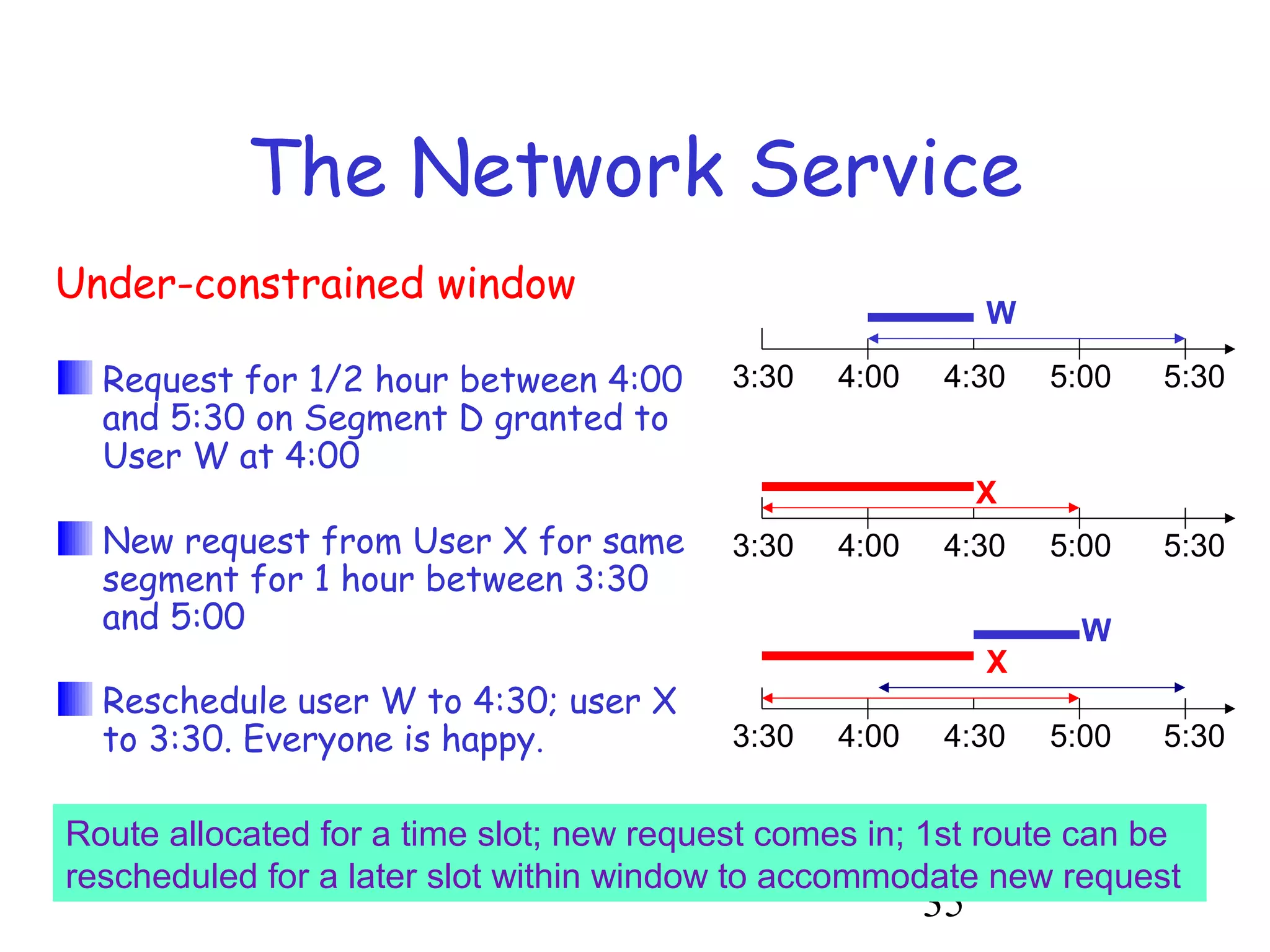
Under-constrained window 
Request for 1/2 hour between 4:00 
and 5:30 on Segment D granted to 
User W at 4:00 
New request from User X for same 
segment for 1 hour between 3:30 
and 5:00 
Reschedule user W to 4:30; user X 
to 3:30. Everyone is happy. 
Route allocated for a time slot; new request comes in; 1st route can be 
rescheduled for a later slot within window to accommodate new request 
3:30 4:00 4:30 5:00 5:30 
35 
W 
X 
3:30 4:00 4:30 5:00 5:30 
W 
X 
3:30 4:00 4:30 5:00 5:30
36 
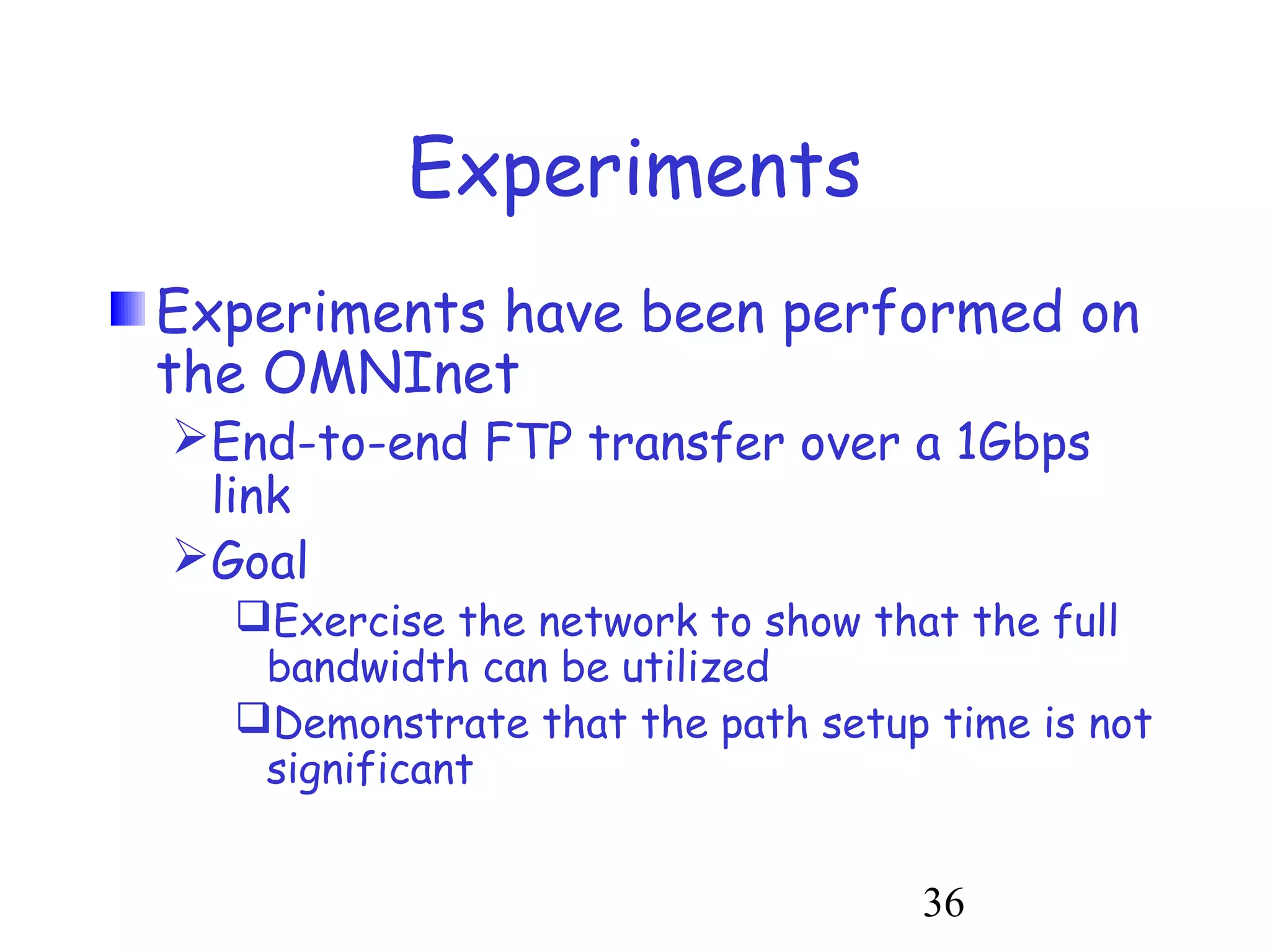
Experiments 
Experiments have been performed on 
the OMNInet 
End-to-end FTP transfer over a 1Gbps 
link 
Goal 
Exercise the network to show that the full 
bandwidth can be utilized 
Demonstrate that the path setup time is not 
significant
noit acoll A ht aP 
t seuqer 
r evr eS NI DO 
gni ssecor P 
DI ht aP 
denr ut er 
r ef snar T at aD 
37 
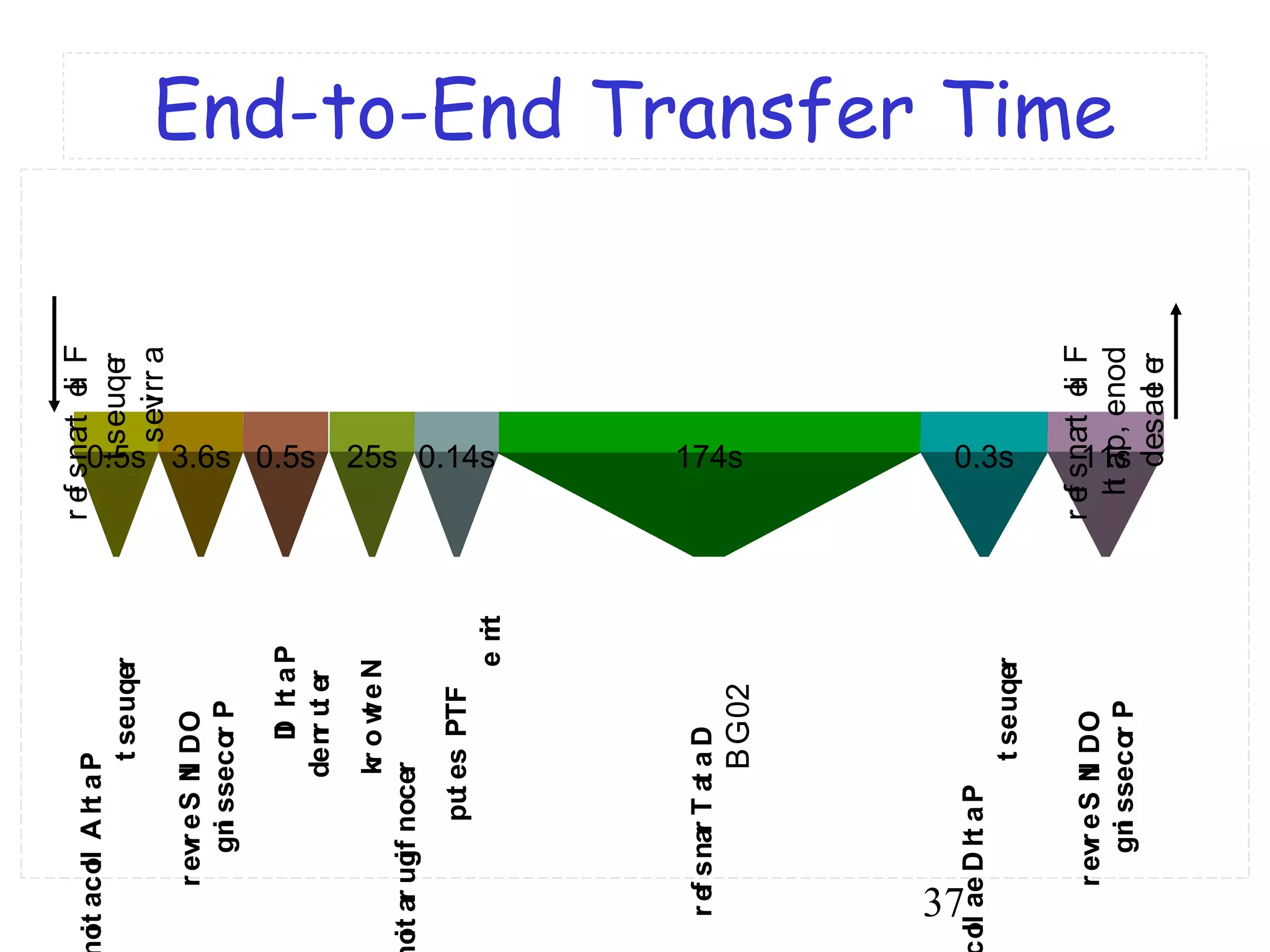
End-to-End Transfer Time 
r ef snart eli F 
0.5s 3.6s 0.5s 174s 0.3s 11s 
BG 02 
r evr eS NI DO 
gni ssecor P 
t seuqer 
sevirr a 
r ef snart eli F 
ht ap , enod 
desael er 
acoll aeD ht aP 
t seuqer 
25s 
kr owt eN 
noit ar ugif nocer 
0.14s 
put es PTF 
e mit
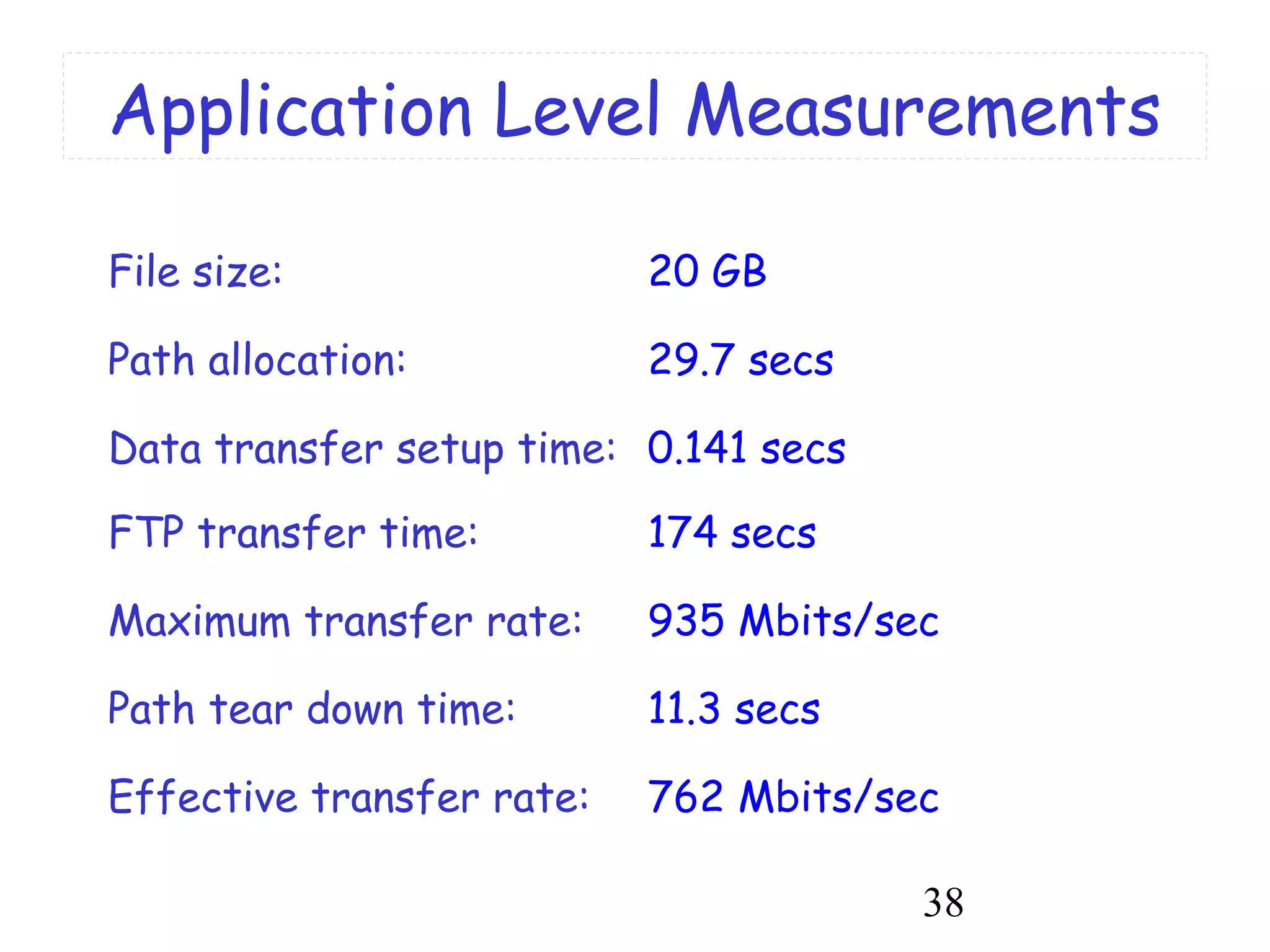
Application Level Measurements 
File size: 20 GB 
Path allocation: 29.7 secs 
Data transfer setup time: 0.141 secs 
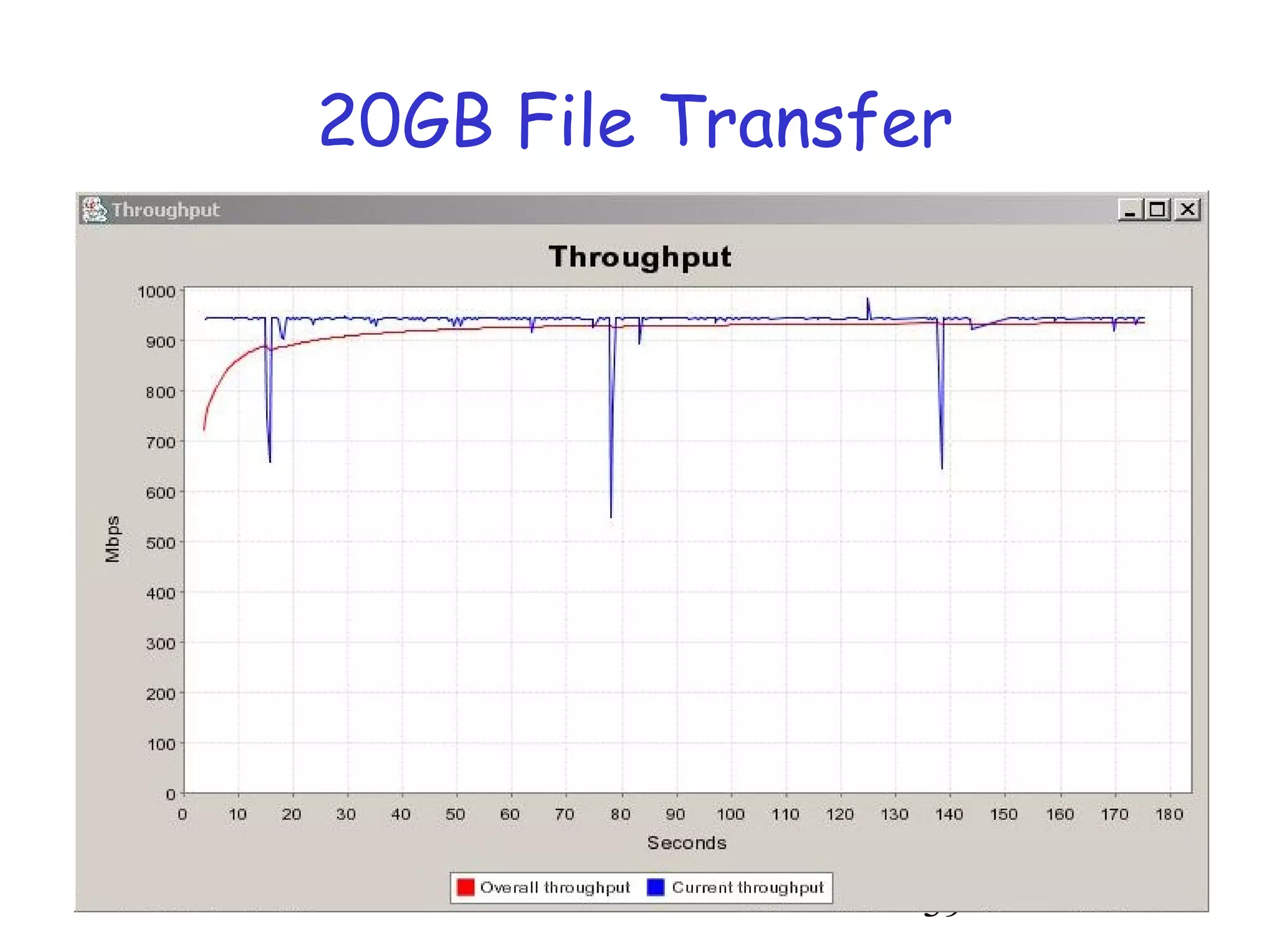
FTP transfer time: 174 secs 
Maximum transfer rate: 935 Mbits/sec 
Path tear down time: 11.3 secs 
Effective transfer rate: 762 Mbits/sec 
38
20GB File Transfer 
39
40 
Current Status 
Allocation of one-segment lightpath 
On demand allocation has been tested at 
the OMNInet 
Advance reservation has been 
implemented but not tested at the 
OMNInet
41 
Future Work 
Nortel Networks / SURFnet 
Lightpath allocation 
Multiple-segment lightpaths 
Optimized allocation when more than one path 
is available 
Scheduling in large-scale networks 
Involves different administrative and/or 
geographic domains 
Requires a distributed approach
42 
Conclusion 
Dynamic optical network is a key 
technology for data-intensive grid 
computing 
DWDM-RAM’s network service 
enables lightpaths to be provided as a 
primary resource

DWDM-RAM:Enabling Grid Services with Dynamic Optical Networks

  • 1.
    1 DWDM-RAM: EnablingGrid Services with Dynamic Optical Networks S. Figueira, S. Naiksatam, H. Cohen, D. Cutrell, P. Daspit, D. Gutierrez, D. Hoang, T. Lavian, J. Mambretti, S. Merrill, F. Travostino
  • 2.
    2 DWDM-RAM DARPA-fundedproject Santa Clara, CA Nortel Networks Santa Clara University Chicago, IL iCAIR / Northwestern University Australia University of Technology, Sydney
  • 3.
    3 DWDM-RAM Goal Make dynamic optical network usable by grid applications Provide lightpaths as a service Design and implement in prototype a new type of grid service architecture optimized to support data-intensive grid applications through advanced optical network
  • 4.
    Why Dynamic OpticalNetwork? Packet-switching technology Great solution for small-burst communication, such as email, telnet, etc. Data-intensive grid applications Involves moving massive amounts of data Requires high and sustained bandwidth 4
  • 5.
    Why Dynamic OpticalNetwork? DWDM Basically circuit switching Enable QoS at the Physical Layer Provide 5 High bandwidth Sustained bandwidth
  • 6.
    Why Dynamic OpticalNetwork? DWDM based on dynamic wavelength switching Enable dedicated optical paths to be 6 allocated dynamically A B A In a few seconds… C
  • 7.
    Why Dynamic OpticalNetwork? Any drawbacks? The overhead incurred during end-to-end 7 path setup Not really a problem The overhead is amortized by the long time taken to move massive amounts of data
  • 8.
    Why Dynamic OpticalNetwork? When dealing with data-intensive applications, overhead is insignificant! 8 Setup time = 48 sec, Bandwidth=920 Mbps 100% 90% 80% 70% 60% 50% 40% 30% 20% 10% 0% 100 1000 10000 100000 1000000 10000000 File Size (MBytes) Setup time / Total Transfer Time 500GB
  • 9.
    Why Grid Services? Applications need access to the network To request and release lightpaths Grid services Can provide an interface to allocate and release lightpaths 9
  • 10.
    DWDM-RAM Architecture Data-IntensiveApplications Data Transfer Service Network Resource Service Basic Network Resource Service Network Resource Scheduler Dynamic Lambda, Optical Burst, etc., Data Center 10 l1 ln l1 ln Data Center Grid services Data Handler Service Information Service DTS API Application Middleware Layer NRS Grid Service API Network Resource Middleware Layer l OGSI-ification API Connectivity and Fabric Layers Optical path control
  • 11.
    DWDM-RAM Architecture Application Collective Resource Connectivity 11 Applications Data Transfer Scheduling Network Resource Scheduling Communication Protocols ODIN OMNInet Fabric
  • 12.
    DWDM-RAM Architecture Application Collective Resource Connectivity 12 Applications Data Transfer Scheduling Network Resource Scheduling Communication Protocols ODIN OMNInet Fabric
  • 13.
    DWDM-RAM Architecture OMNInet- photonic testbed network Four-node multi-site optical metro testbed network in Chicago -- the first 10GE service trial! All-optical MEMS-based switching and advanced high-speed services Partners: SBC, Nortel, iCAIR at Northwestern, EVL, CANARIE, ANL 13
  • 14.
    Northwestern U 14 4x10G E Optical Switching Platform Passport 8600 Application Cluster OMNInet Core Nodes UIC 8x1GE 4x10GE Application Cluster Optical Switching Platform OPTera Metro 5200 StarLight Passport 8600 4x10GE Application Cluster Optical Switching Platform Passport 8600 CA*net3--Chicago Optical Switching Platform Passport 8600 Closed loop 8x1GE 4x10GE 8x1GE 8x1GE Loop
  • 15.
    DWDM-RAM Architecture ODIN- Optical Dynamic Intelligent Network Software suite that controls the OMNInet through lower-level API calls Designed for high-performance, long-term flow with flexible and fine grained control Stateless server, which includes an API to provide path provisioning and monitoring to the higher layers 15
  • 16.
    DWDM-RAM Architecture Application Collective Resource Connectivity 16 Applications Data Transfer Scheduling Network Resource Scheduling Communication Protocols ODIN OMNInet Fabric
  • 17.
    DWDM-RAM Architecture CommunicationProtocols Currently, using standard off-the-shelf communication protocol suites Provide communication between application clients and DWDM-RAM services and between DWDM-RAM components Communication consists of mainly SOAP messages in HTTP envelopes transported over TCP/IP connections 17
  • 18.
    DWDM-RAM Architecture Application Collective Resource Connectivity 18 Applications Data Transfer Scheduling Network Resource Scheduling Communication Protocols ODIN OMNInet Fabric
  • 19.
    DWDM-RAM Architecture NetworkResource Scheduling Essentially a resource management service Maintains schedules and provisions resources in accordance with the schedule Provides an OGSI compliant interface to request the optical network resources 19
  • 20.
    DWDM-RAM Architecture Application Collective Resource Connectivity 20 Applications Data Transfer Scheduling Network Resource Scheduling Communication Protocols ODIN OMNInet Fabric
  • 21.
    DWDM-RAM Architecture DataTransfer Scheduling Direct extension of the NRS service, provides an OGSI interface Shares the same backend scheduling engine and resides on the same host Provides a high-level functionality Allow applications to schedule data transfers without the need to directly reserve lightpaths The service also perform the actual data transfer once the network is allocated 21
  • 22.
    Data Transfer Scheduling Uses standard ftp Uses NRS to Data Receiver λ Data Source FTP client FTP server allocate lambdas Uses OGSI calls to request network DTS NRS resources Client App 22
  • 23.
    DWDM-RAM Architecture Application Collective Resource Connectivity 23 Applications Data Transfer Scheduling Network Resource Scheduling Communication Protocols ODIN OMNInet Fabric
  • 24.
    DWDM-RAM Architecture Applications Target is data-intensive applications since their requirements make them the perfect costumer for DWDM networks 24
  • 25.
    DWDM-RAM Modes Applicationsmay request a data transfer 25 Applications Data Transfer Scheduling Network Resource Scheduling
  • 26.
    DWDM-RAM Modes Applicationsmay request a network connection 26 Applications Network Resource Scheduling
  • 27.
    DWDM-RAM Modes Applicationsmay request a set of resources through any resource allocator, which will handle the network reservation 27 Applications Resource Allocator Network Resource Scheduling
  • 28.
    The Network Service The NRS is the key for providing network as a resource It is a service with an application-level interface Used for requesting, releasing, and managing the underlying network resources 28
  • 29.
    The Network Service NRS Understands the topology of the network Maintains schedules and provisions resources in accordance with the schedule Keeps one scheduling map for each lambda in each segment 29
  • 30.
    The Network Service  4 Scheduling maps: Each with a vector of time intervals for keeping the reservations 30
  • 31.
    The Network Service  4 scheduling maps for each segment 31
  • 32.
    The Network Service NRS Provides an OGSI-based interface to network resources Request parameters Network addresses of the hosts to be connected Window of time for the allocation Duration of the allocation Minimum and maximum acceptable bandwidth (future) 32
  • 33.
    The Network Service 33 NRS Provides the network resource On demand By advance reservation Network is requested within a window Constrained Under-constrained
  • 34.
    The Network Service 34 On Demand Constrained window: right now! Under-constrained window: ASAP! Advance Reservation Constrained window Tight window, fits the transference time closely Under-constrained window Large window, fits the transference time loosely Allows flexibility in the scheduling
  • 35.
    The Network Service Under-constrained window Request for 1/2 hour between 4:00 and 5:30 on Segment D granted to User W at 4:00 New request from User X for same segment for 1 hour between 3:30 and 5:00 Reschedule user W to 4:30; user X to 3:30. Everyone is happy. Route allocated for a time slot; new request comes in; 1st route can be rescheduled for a later slot within window to accommodate new request 3:30 4:00 4:30 5:00 5:30 35 W X 3:30 4:00 4:30 5:00 5:30 W X 3:30 4:00 4:30 5:00 5:30
  • 36.
    36 Experiments Experimentshave been performed on the OMNInet End-to-end FTP transfer over a 1Gbps link Goal Exercise the network to show that the full bandwidth can be utilized Demonstrate that the path setup time is not significant
  • 37.
    noit acoll Aht aP t seuqer r evr eS NI DO gni ssecor P DI ht aP denr ut er r ef snar T at aD 37 End-to-End Transfer Time r ef snart eli F 0.5s 3.6s 0.5s 174s 0.3s 11s BG 02 r evr eS NI DO gni ssecor P t seuqer sevirr a r ef snart eli F ht ap , enod desael er acoll aeD ht aP t seuqer 25s kr owt eN noit ar ugif nocer 0.14s put es PTF e mit
  • 38.
    Application Level Measurements File size: 20 GB Path allocation: 29.7 secs Data transfer setup time: 0.141 secs FTP transfer time: 174 secs Maximum transfer rate: 935 Mbits/sec Path tear down time: 11.3 secs Effective transfer rate: 762 Mbits/sec 38
  • 39.
  • 40.
    40 Current Status Allocation of one-segment lightpath On demand allocation has been tested at the OMNInet Advance reservation has been implemented but not tested at the OMNInet
  • 41.
    41 Future Work Nortel Networks / SURFnet Lightpath allocation Multiple-segment lightpaths Optimized allocation when more than one path is available Scheduling in large-scale networks Involves different administrative and/or geographic domains Requires a distributed approach
  • 42.
    42 Conclusion Dynamicoptical network is a key technology for data-intensive grid computing DWDM-RAM’s network service enables lightpaths to be provided as a primary resource