





By- Vishal Kumar Gupta
 Terabit networks support transmission rates of at least

one trillion(10^12) bits/second (Tb/s).
 It provides the capacity and bandwidth to meet Increasing customer demand for data and voice
communications.
 To

support future Internet growth of high
quality video.
 To support e-Commerce application.
 Its proper design will lead to reduce The latency for Long Haul Network (LHN) traffic.
 The time needed for new circuit provisioning.
 Overall network management complexity.
The current market and service drivers give rise to some
unique terabit network challenges and requirements.
Chief among these are Network scalability,
 Flexibility, Efficiency and transparency,
 Improved network management & operations costs,
 Multi-protocol support,
 Rapid service recovery,
 Authentication, authorization and accounting.
 Terabit network applications are characterized by

unpredictable client traffic demands along with
Quality of Service (QoS).
 Traditionally, traffic planners could consider capacity
growth in three-, five- and ten-year increments.
 Today, the rapid and explosive growth in web video,
mobile messaging, wi-fi and wi-max applications,
means time frames as short as six months must also be
considered.
Thus, graceful scalability is a prime terabit
network requirement.
 From an end-user service perspective, terabit network

platforms must be very flexible, enabling clients to
increase service velocity on demand at any time, and
from any location.
 The networks must also efficiently accommodate a
diverse set of both differentiated service offerings (e.g.,
based on priority, resiliency, etc.), and wide-ranging
traffic characteristics (e.g. real-time traffic, legacy
protocols, high peak traffic, etc.).
 Today’s users not only want more bandwidth for their

money, they demand simpler and low-cost network
management & operations procedures.
Hence
terabit
network
equipment
suppliers must offer both operational
savings and support modular deployments,
and continuous growth.
 As new services are increasing-

Terabit Network is implementing “de-layered” and
transparent network infrastructure to support all
customer services along all locations.
 Providing reduced transmission and operations
overhead for a variety of protocols.
 Supporting OSI and TCP/IP both model.
 Supports Terabit Ethernet.
Terabit Network supports Multi-Service
protocol.
 Terabit Network is using RPR (Resilient Packet Ring)

technology to define the protocols for service recovery
with SONET/SDH network providers
 IEEE 802.17 Standard are accustomed to meet to a
maximum dual-ring-topology restoration time of 50
mSec.
 There is a possibility of even faster recovery times.
New terabit network technologies must
offer at least this level of protection or
better.
A key terabit network infrastructure issue is how to
provide the servers and security mechanisms to ensure
that no single person or resource can gain network
access without proper authorization.
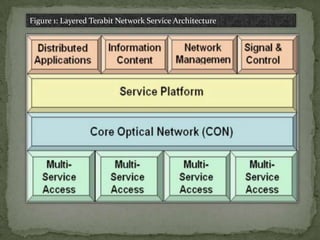
 Terabit Network supports layered architecture model.
 The lowest layer supports multi-service access for all

types of data, voice, and video over a single packet-cellbased infrastructure.
 The benefits of multi-service access are reduced
OPerating EXpenses (OPEX)2, higher performance,
greater flexibility, integration and control, and faster
service deployment.
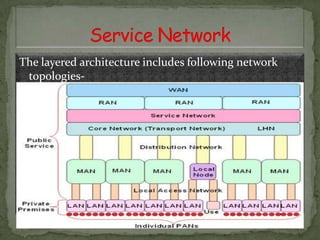
Figure 1: Layered Terabit Network Service Architecture
 CON is the heart of architecture which serves to

interconnect the multi-service access points with the
service platform.
 CON is designed with minimal complexity to reduce
costs, while still flexibly and efficiently supporting
multi-service transport because per-bit profit margins
is constrained by aggressive competition.
 CON packet forwarding overhead is greatly reduced
through use of Multi-Protocol Label Switching (MPLS)
technology.
 Internet Protocol (IP) packets have a field in their

header containing the address to which the packet is to
be routed.
 Traditional routing networks process this information at every router in a

packet's path through the network. *

But in Terabit Network When the data packet enters the first router, the
header analysis is done just once and a new label is
attached to the packet using MPLS.
 Subsequent CON MPLS routers can then forward
the packet by inspecting only the new label.
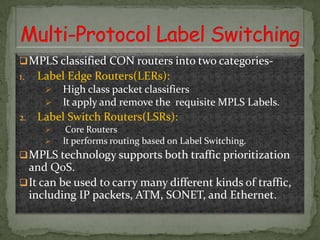
 MPLS classified CON routers into two categories1.

Label Edge Routers(LERs):



2.

High class packet classifiers
It apply and remove the requisite MPLS Labels.

Label Switch Routers(LSRs):



Core Routers
It performs routing based on Label Switching.

 MPLS technology supports both traffic prioritization

and QoS.
 It can be used to carry many different kinds of traffic,
including IP packets, ATM, SONET, and Ethernet.
The layered architecture includes following network
topologies-
 Personal Area Network (PAN)- Areas one to three

meters in extent which are serviced by wireless
technologies such as Bluetooth, Zigbee and Wireless
Universal Serial Bus (WUSB).
 Local Area Network (LAN)- It links user premises
to the first network node. In this network model LAN
will support 100Gbps.
 Metropolitan Area Network (MAN) Provide corporate connections inside the city.
 Fiber optics and Ethernet protocol is the favorite as
a MAC layer in use.
 Distribution and Transport Network (LHN) Regional Area Network (RAN) Used for localized services from a regional carrier, a

local enterprise, or a county or group of cities.
 RANs are needed for services that exceed geographic
boundaries such as those for international corporations,
national services, federal police networks, etc.
 Terabit Network is implemented using wave

transmission technology i.e. WDM.
 Wavelength Division Multiplexing (WDM) has
dominated fiber-optic transmission technology since
the development of tunable lasers.
 WDM technologies –
Dense Wavelength Division Multiplexing (DWDM) for
long haul transmission.
2. Coarse Wavelength Division Multiplexing (CWDM) for
metropolitan transmission.
1.
 Very precise and very costly.
 Supports hundreds of optical channels.
 Right technology for Distribution and Transport

Network inside the LHON (Long Haul Optical
Network).
 DWDM requires that optical channels be provisioned
on specialized nodes.
 Inexpensive and can be implemented on a variety of

physical media.
 Supports only 18 optical channels.
 Appropriate technology for PON local access
networks.
 CWDM can be easily implemented with point-topoint or point-to-multipoint topologies
Terabit Network- Tbps Network

Terabit Network- Tbps Network

  • 1.
  • 2.
     Terabit networkssupport transmission rates of at least one trillion(10^12) bits/second (Tb/s).  It provides the capacity and bandwidth to meet Increasing customer demand for data and voice communications.  To support future Internet growth of high quality video.  To support e-Commerce application.
  • 3.
     Its properdesign will lead to reduce The latency for Long Haul Network (LHN) traffic.  The time needed for new circuit provisioning.  Overall network management complexity.
  • 4.
    The current marketand service drivers give rise to some unique terabit network challenges and requirements. Chief among these are Network scalability,  Flexibility, Efficiency and transparency,  Improved network management & operations costs,  Multi-protocol support,  Rapid service recovery,  Authentication, authorization and accounting.
  • 5.
     Terabit networkapplications are characterized by unpredictable client traffic demands along with Quality of Service (QoS).  Traditionally, traffic planners could consider capacity growth in three-, five- and ten-year increments.  Today, the rapid and explosive growth in web video, mobile messaging, wi-fi and wi-max applications, means time frames as short as six months must also be considered. Thus, graceful scalability is a prime terabit network requirement.
  • 6.
     From anend-user service perspective, terabit network platforms must be very flexible, enabling clients to increase service velocity on demand at any time, and from any location.  The networks must also efficiently accommodate a diverse set of both differentiated service offerings (e.g., based on priority, resiliency, etc.), and wide-ranging traffic characteristics (e.g. real-time traffic, legacy protocols, high peak traffic, etc.).
  • 7.
     Today’s usersnot only want more bandwidth for their money, they demand simpler and low-cost network management & operations procedures. Hence terabit network equipment suppliers must offer both operational savings and support modular deployments, and continuous growth.
  • 8.
     As newservices are increasing- Terabit Network is implementing “de-layered” and transparent network infrastructure to support all customer services along all locations.  Providing reduced transmission and operations overhead for a variety of protocols.  Supporting OSI and TCP/IP both model.  Supports Terabit Ethernet. Terabit Network supports Multi-Service protocol.
  • 9.
     Terabit Networkis using RPR (Resilient Packet Ring) technology to define the protocols for service recovery with SONET/SDH network providers  IEEE 802.17 Standard are accustomed to meet to a maximum dual-ring-topology restoration time of 50 mSec.  There is a possibility of even faster recovery times. New terabit network technologies must offer at least this level of protection or better.
  • 10.
    A key terabitnetwork infrastructure issue is how to provide the servers and security mechanisms to ensure that no single person or resource can gain network access without proper authorization.
  • 11.
     Terabit Networksupports layered architecture model.  The lowest layer supports multi-service access for all types of data, voice, and video over a single packet-cellbased infrastructure.  The benefits of multi-service access are reduced OPerating EXpenses (OPEX)2, higher performance, greater flexibility, integration and control, and faster service deployment.
  • 12.
    Figure 1: LayeredTerabit Network Service Architecture
  • 13.
     CON isthe heart of architecture which serves to interconnect the multi-service access points with the service platform.  CON is designed with minimal complexity to reduce costs, while still flexibly and efficiently supporting multi-service transport because per-bit profit margins is constrained by aggressive competition.  CON packet forwarding overhead is greatly reduced through use of Multi-Protocol Label Switching (MPLS) technology.
  • 14.
     Internet Protocol(IP) packets have a field in their header containing the address to which the packet is to be routed.  Traditional routing networks process this information at every router in a packet's path through the network. * But in Terabit Network When the data packet enters the first router, the header analysis is done just once and a new label is attached to the packet using MPLS.  Subsequent CON MPLS routers can then forward the packet by inspecting only the new label.
  • 15.
     MPLS classifiedCON routers into two categories1. Label Edge Routers(LERs):   2. High class packet classifiers It apply and remove the requisite MPLS Labels. Label Switch Routers(LSRs):   Core Routers It performs routing based on Label Switching.  MPLS technology supports both traffic prioritization and QoS.  It can be used to carry many different kinds of traffic, including IP packets, ATM, SONET, and Ethernet.
  • 16.
    The layered architectureincludes following network topologies-
  • 17.
     Personal AreaNetwork (PAN)- Areas one to three meters in extent which are serviced by wireless technologies such as Bluetooth, Zigbee and Wireless Universal Serial Bus (WUSB).  Local Area Network (LAN)- It links user premises to the first network node. In this network model LAN will support 100Gbps.  Metropolitan Area Network (MAN) Provide corporate connections inside the city.  Fiber optics and Ethernet protocol is the favorite as a MAC layer in use.
  • 18.
     Distribution andTransport Network (LHN) Regional Area Network (RAN) Used for localized services from a regional carrier, a local enterprise, or a county or group of cities.  RANs are needed for services that exceed geographic boundaries such as those for international corporations, national services, federal police networks, etc.
  • 19.
     Terabit Networkis implemented using wave transmission technology i.e. WDM.  Wavelength Division Multiplexing (WDM) has dominated fiber-optic transmission technology since the development of tunable lasers.  WDM technologies – Dense Wavelength Division Multiplexing (DWDM) for long haul transmission. 2. Coarse Wavelength Division Multiplexing (CWDM) for metropolitan transmission. 1.
  • 20.
     Very preciseand very costly.  Supports hundreds of optical channels.  Right technology for Distribution and Transport Network inside the LHON (Long Haul Optical Network).  DWDM requires that optical channels be provisioned on specialized nodes.
  • 21.
     Inexpensive andcan be implemented on a variety of physical media.  Supports only 18 optical channels.  Appropriate technology for PON local access networks.  CWDM can be easily implemented with point-topoint or point-to-multipoint topologies