Wi-Vi
WIRELESS VISION TECHNOLOGY
Presented By
Dr. SK. Mastan Vali
A SEMINAR ON:
INTRODUCTION:
o Wi-Vi, Wireless Vision or Wi-Fi vision, is a see-through-
wall device that employs Wi-Fi signals in the 2.4Gz ISM
band.
o It identifies number of people, their locations and motion
in a closed room.
It can be used for gesture-based communication
without any transmitter.
PRINCIPLE:
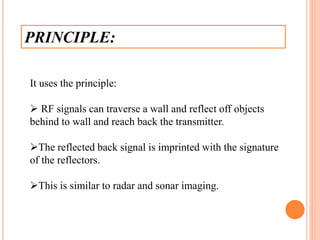
It uses the principle:
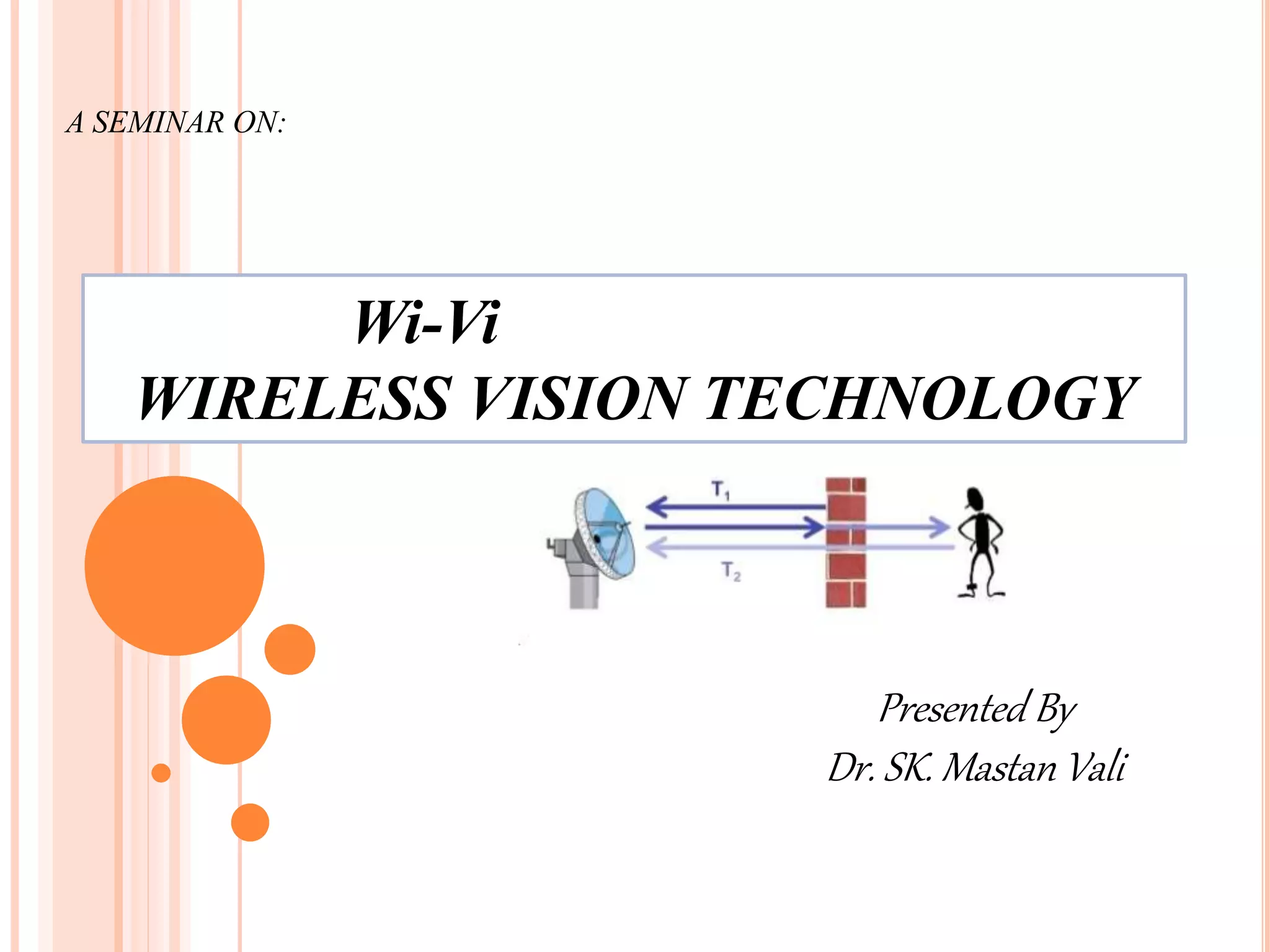
 RF signals can traverse a wall and reflect off objects
behind to wall and reach back the transmitter.
The reflected back signal is imprinted with the signature
of the reflectors.
This is similar to radar and sonar imaging.
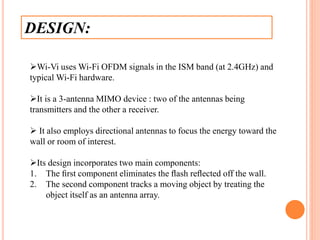
DESIGN:
Wi-Vi uses Wi-Fi OFDM signals in the ISM band (at 2.4GHz) and
typical Wi-Fi hardware.
It is a 3-antenna MIMO device : two of the antennas being
transmitters and the other a receiver.
 It also employs directional antennas to focus the energy toward the
wall or room of interest.
Its design incorporates two main components:
1. The first component eliminates the flash reflected off the wall.
2. The second component tracks a moving object by treating the
object itself as an antenna array.
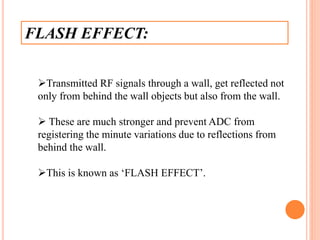
FLASH EFFECT:
Transmitted RF signals through a wall, get reflected not
only from behind the wall objects but also from the wall.
 These are much stronger and prevent ADC from
registering the minute variations due to reflections from
behind the wall.
This is known as ‘FLASH EFFECT’.
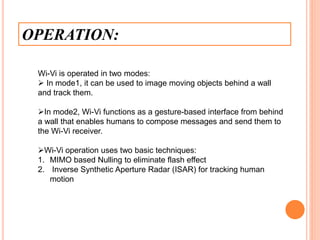
OPERATION:
Wi-Vi is operated in two modes:
 In mode1, it can be used to image moving objects behind a wall
and track them.
In mode2, Wi-Vi functions as a gesture-based interface from behind
a wall that enables humans to compose messages and send them to
the Wi-Vi receiver.
Wi-Vi operation uses two basic techniques:
1. MIMO based Nulling to eliminate flash effect
2. Inverse Synthetic Aperture Radar (ISAR) for tracking human
motion
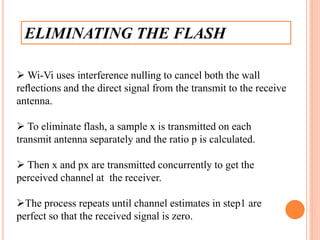
ELIMINATING THE FLASH
 Wi-Vi uses interference nulling to cancel both the wall
reflections and the direct signal from the transmit to the receive
antenna.
 To eliminate flash, a sample x is transmitted on each
transmit antenna separately and the ratio p is calculated.
 Then x and px are transmitted concurrently to get the
perceived channel at the receiver.
The process repeats until channel estimates in step1 are
perfect so that the received signal is zero.
TRACKING HUMANS:
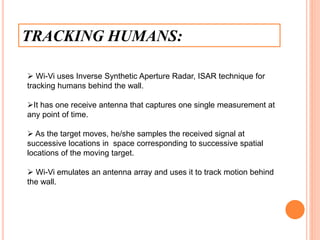
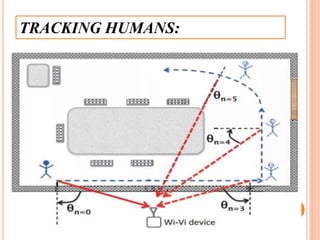
 Wi-Vi uses Inverse Synthetic Aperture Radar, ISAR technique for
tracking humans behind the wall.
It has one receive antenna that captures one single measurement at
any point of time.
 As the target moves, he/she samples the received signal at
successive locations in space corresponding to successive spatial
locations of the moving target.
 Wi-Vi emulates an antenna array and uses it to track motion behind
the wall.
TRACKING HUMANS:
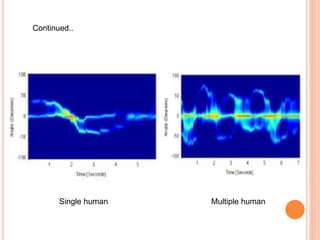
Continued..
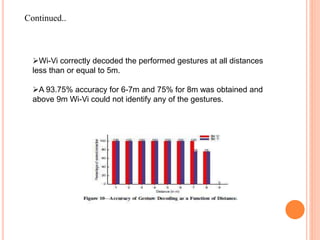
Single human Multiple human
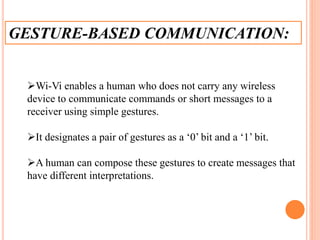
GESTURE-BASED COMMUNICATION:
Wi-Vi enables a human who does not carry any wireless
device to communicate commands or short messages to a
receiver using simple gestures.
It designates a pair of gestures as a ‘0’ bit and a ‘1’ bit.
A human can compose these gestures to create messages that
have different interpretations.
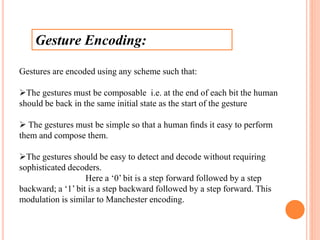
Gesture Encoding:
Gestures are encoded using any scheme such that:
The gestures must be composable i.e. at the end of each bit the human
should be back in the same initial state as the start of the gesture
 The gestures must be simple so that a human finds it easy to perform
them and compose them.
The gestures should be easy to detect and decode without requiring
sophisticated decoders.
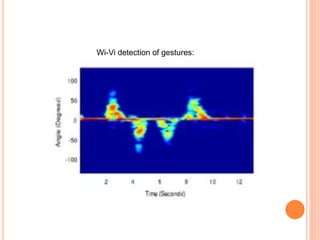
Here a ‘0’ bit is a step forward followed by a step
backward; a ‘1’ bit is a step backward followed by a step forward. This
modulation is similar to Manchester encoding.
Wi-Vi detection of gestures:
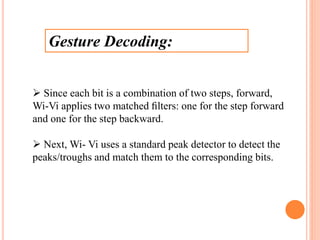
Gesture Decoding:
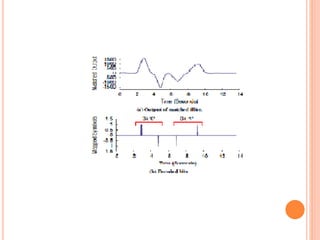
 Since each bit is a combination of two steps, forward,
Wi-Vi applies two matched filters: one for the step forward
and one for the step backward.
 Next, Wi- Vi uses a standard peak detector to detect the
peaks/troughs and match them to the corresponding bits.
Wi-Vi DESIGN MODEL:
Wi-Vi is built using USRPN210 software radios with SBX daughter boards.
The system uses LP0965 directional antennas, which provide a gain of 6 dBi.
 The system consists of three US- RPs connected to an external clock so that they
act as one MIMO system. Two of the USRPs are used for transmitting, and one for
receiving.
A standard Wi-Fi OFDM modulation is implemented, each OFDM symbol
consisting of 64 subcarriers including the DC. The nulling procedure is
performed on a subcarrier basis.
RESULTS:
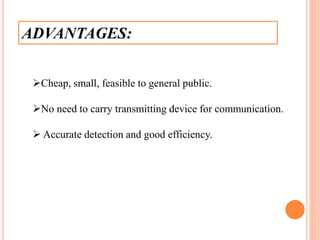
Wi-Vi correctly decoded the performed gestures at all distances
less than or equal to 5m.
A 93.75% accuracy for 6-7m and 75% for 8m was obtained and
above 9m Wi-Vi could not identify any of the gestures.
Continued..
ADVANTAGES:
Cheap, small, feasible to general public.
No need to carry transmitting device for communication.
 Accurate detection and good efficiency.
APPLICATIONS:
1. Law Enforcement
2. Emergency Situations
3. Personal Security
4. Smart Sensing
5. User Interface Design
6. Entertainment
ADVANCEMENTS:
 Can be extended for indoor localization, sensing
and control.
 It can be extended to develop virtual reality
systems.
CONCLUSION:
Wi-Vi is a new form of user interface which rely solely
on reflections of a transmitted RF signal to identify
human gestures.
It can be envisioned, promising new direction in virtual
reality.
REFERENCES:
Wi-Vi system uses Wi-Fi to see through walls Gizmag
. www.seminarsonly.com
{fadel,dk}@mit.edu
Massachusetts Institute of Technology
Wi vi

Wi vi

  • 1.
    Wi-Vi WIRELESS VISION TECHNOLOGY PresentedBy Dr. SK. Mastan Vali A SEMINAR ON:
  • 2.
    INTRODUCTION: o Wi-Vi, WirelessVision or Wi-Fi vision, is a see-through- wall device that employs Wi-Fi signals in the 2.4Gz ISM band. o It identifies number of people, their locations and motion in a closed room. It can be used for gesture-based communication without any transmitter.
  • 3.
    PRINCIPLE: It uses theprinciple:  RF signals can traverse a wall and reflect off objects behind to wall and reach back the transmitter. The reflected back signal is imprinted with the signature of the reflectors. This is similar to radar and sonar imaging.
  • 4.
    DESIGN: Wi-Vi uses Wi-FiOFDM signals in the ISM band (at 2.4GHz) and typical Wi-Fi hardware. It is a 3-antenna MIMO device : two of the antennas being transmitters and the other a receiver.  It also employs directional antennas to focus the energy toward the wall or room of interest. Its design incorporates two main components: 1. The first component eliminates the flash reflected off the wall. 2. The second component tracks a moving object by treating the object itself as an antenna array.
  • 5.
    FLASH EFFECT: Transmitted RFsignals through a wall, get reflected not only from behind the wall objects but also from the wall.  These are much stronger and prevent ADC from registering the minute variations due to reflections from behind the wall. This is known as ‘FLASH EFFECT’.
  • 6.
    OPERATION: Wi-Vi is operatedin two modes:  In mode1, it can be used to image moving objects behind a wall and track them. In mode2, Wi-Vi functions as a gesture-based interface from behind a wall that enables humans to compose messages and send them to the Wi-Vi receiver. Wi-Vi operation uses two basic techniques: 1. MIMO based Nulling to eliminate flash effect 2. Inverse Synthetic Aperture Radar (ISAR) for tracking human motion
  • 7.
    ELIMINATING THE FLASH Wi-Vi uses interference nulling to cancel both the wall reflections and the direct signal from the transmit to the receive antenna.  To eliminate flash, a sample x is transmitted on each transmit antenna separately and the ratio p is calculated.  Then x and px are transmitted concurrently to get the perceived channel at the receiver. The process repeats until channel estimates in step1 are perfect so that the received signal is zero.
  • 8.
    TRACKING HUMANS:  Wi-Viuses Inverse Synthetic Aperture Radar, ISAR technique for tracking humans behind the wall. It has one receive antenna that captures one single measurement at any point of time.  As the target moves, he/she samples the received signal at successive locations in space corresponding to successive spatial locations of the moving target.  Wi-Vi emulates an antenna array and uses it to track motion behind the wall.
  • 9.
  • 10.
  • 11.
    GESTURE-BASED COMMUNICATION: Wi-Vi enablesa human who does not carry any wireless device to communicate commands or short messages to a receiver using simple gestures. It designates a pair of gestures as a ‘0’ bit and a ‘1’ bit. A human can compose these gestures to create messages that have different interpretations.
  • 12.
    Gesture Encoding: Gestures areencoded using any scheme such that: The gestures must be composable i.e. at the end of each bit the human should be back in the same initial state as the start of the gesture  The gestures must be simple so that a human finds it easy to perform them and compose them. The gestures should be easy to detect and decode without requiring sophisticated decoders. Here a ‘0’ bit is a step forward followed by a step backward; a ‘1’ bit is a step backward followed by a step forward. This modulation is similar to Manchester encoding.
  • 13.
  • 14.
    Gesture Decoding:  Sinceeach bit is a combination of two steps, forward, Wi-Vi applies two matched filters: one for the step forward and one for the step backward.  Next, Wi- Vi uses a standard peak detector to detect the peaks/troughs and match them to the corresponding bits.
  • 16.
    Wi-Vi DESIGN MODEL: Wi-Viis built using USRPN210 software radios with SBX daughter boards. The system uses LP0965 directional antennas, which provide a gain of 6 dBi.  The system consists of three US- RPs connected to an external clock so that they act as one MIMO system. Two of the USRPs are used for transmitting, and one for receiving. A standard Wi-Fi OFDM modulation is implemented, each OFDM symbol consisting of 64 subcarriers including the DC. The nulling procedure is performed on a subcarrier basis.
  • 17.
  • 18.
    Wi-Vi correctly decodedthe performed gestures at all distances less than or equal to 5m. A 93.75% accuracy for 6-7m and 75% for 8m was obtained and above 9m Wi-Vi could not identify any of the gestures. Continued..
  • 19.
    ADVANTAGES: Cheap, small, feasibleto general public. No need to carry transmitting device for communication.  Accurate detection and good efficiency.
  • 20.
    APPLICATIONS: 1. Law Enforcement 2.Emergency Situations 3. Personal Security 4. Smart Sensing 5. User Interface Design 6. Entertainment
  • 21.
    ADVANCEMENTS:  Can beextended for indoor localization, sensing and control.  It can be extended to develop virtual reality systems.
  • 22.
    CONCLUSION: Wi-Vi is anew form of user interface which rely solely on reflections of a transmitted RF signal to identify human gestures. It can be envisioned, promising new direction in virtual reality.
  • 23.
    REFERENCES: Wi-Vi system usesWi-Fi to see through walls Gizmag . www.seminarsonly.com {fadel,dk}@mit.edu Massachusetts Institute of Technology