ASTN/ASON and GMPLS  Overview and Comparison By, Kishore Kasi Udayashankar Kaveriappa Muddiyada K
Motivations Complex process of provisioning of end-to-end transport service Heterogeneous transport networks Automation of end-to-end provisioning Ability to offer more service  Directly integrate IP clients over WDM
How? “ intelligence” into the control plane of OTN automatic and seamless circuit provisioning unified control binding technologies Benefits? cost reduction and better quality of network operation simplified and rapid network configuration switched services and dynamic bandwidth assignment
ASTN/ASON ITU-T Recommendation G.805/G.8080 Architecture that defines the components and interactions  between components Distributed control plane Task of control planes Call and connection control Path control based on network state Discovery for self configuration
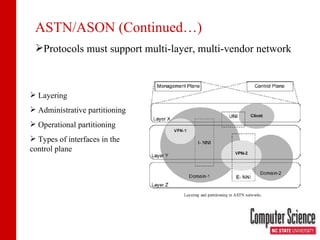
ASTN/ASON (Continued…) Protocols must support multi-layer, multi-vendor network Layering Administrative partitioning Operational partitioning Types of interfaces in the control plane
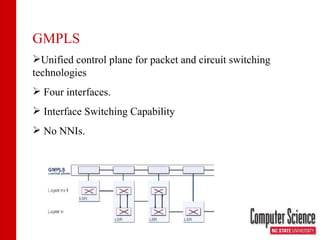
GMPLS Unified control plane for packet and circuit switching technologies Four interfaces. Interface Switching Capability No NNIs.
GMPLS (Continued…) Extension of routing protocols  OSPF-TE and ISIS-TE Signaling protocols, RSVP-TE and CR-LDP Label Switched Paths (LSP)
Multi-layer Resource Model Representation In GMPLS Basic topology abstraction is TE link Link interface can support one or more interface switching types defined Interface Switching Capability (ISC) ISC descriptor describes related TE properties A particular resource on a link is represented by a label
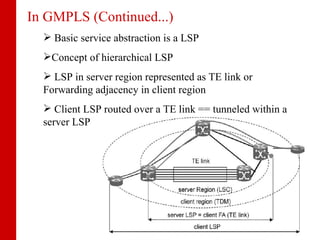
In GMPLS (Continued...) Basic service abstraction is a LSP  Concept of hierarchical LSP LSP in server region represented as TE link or Forwarding adjacency in client region Client LSP routed over a TE link == tunneled within a server LSP
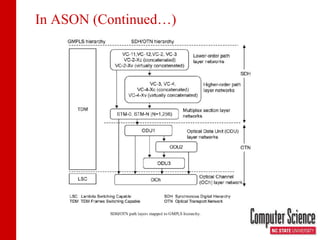
Multi-layer Resource Model Representation In ASON ISC concept has been reduced Optical part of OTN hierarchy is mapped to LSC Digital path layers of OTN and SDH hierarchy is mapped to TDM
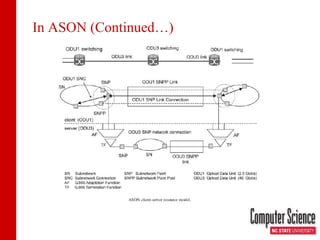
In ASON (Continued…)
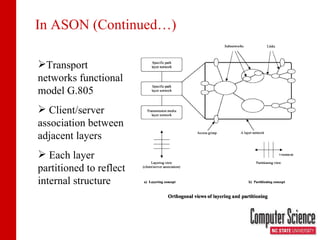
In ASON (Continued…) Transport networks functional model G.805 Client/server association between adjacent layers Each layer partitioned to reflect internal structure
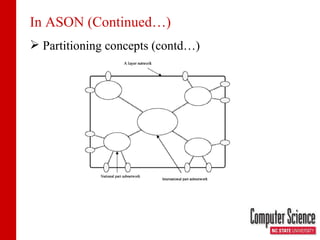
In ASON (Continued…) Partitioning concepts Starting from the smallest indivisible subnetwork Contained and containing subnetwork Contained subnetwork cannot provide connectivity not available in containing subnetwork Ports on boundary of containing subnetworks and interconnection capability are represented by contained subnetworks
In ASON (Continued…) Partitioning concepts (contd…)
In ASON (Continued…) Layering concepts  Layer networks in a client-server model Termination and Adaptation Functions  Topology and connectivity not visible to client
In ASON (Continued…)
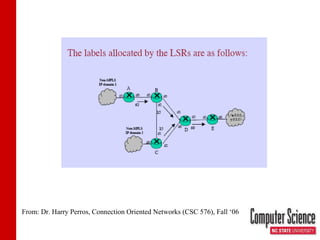
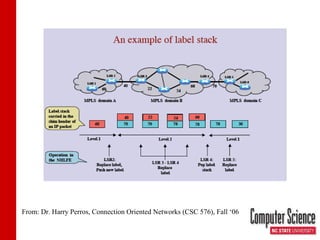
Overview of MPLS/GMPLS Concepts Forward Equivalence Class Label  LSR LSP Label allocation  Next Hop Label Forwarding Entry (NHLFE) Route selection
From: Dr. Harry Perros, Connection Oriented Networks (CSC 576), Fall ‘06
Control Plane Architecture In GMPLS Peer model Overlay model Augmented model
Control Plane Architecture In ASON Protocol neutral way Support various transport infrastructure Applicable irrespective of control plane that has been subdivided into domains
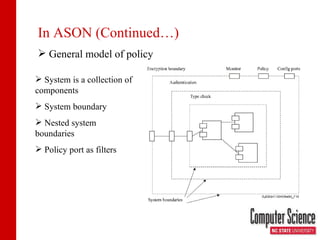
In ASON (Continued…) General model of policy System is a collection of components System boundary  Nested system boundaries Policy port as filters
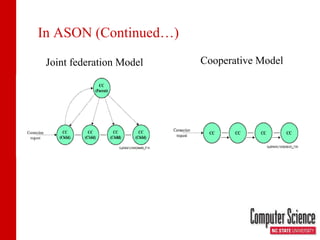
In ASON (Continued…) General model of federation Creation, deletion and maintenance of connections across multiple domains Community of domains Domains cooperate for connection management Joint Federation Model and Cooperative model
In ASON (Continued…) Joint federation Model Cooperative Model
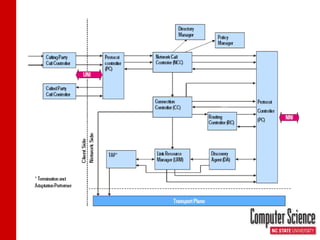
In ASON (Continued…) Architectural components Connection controller (CC) component  Routing controller (RC) component Link resource manager component Traffic policing (TP) component Call controller component Discovery agent (DA)
 
GMPLS Control Plane, Policy-based Management and Information Modeling Policy based Management (PBM) Improve collaboration between management and GMPLS control plane. Extending Policy Core Information models (PCIM) with  policy events. Diverse local and global decision logic distributed among multiple network elements and network layers.
Discussion Items Advantages and Features. Types of GMPLS policies and actions – few examples Control plane and PBM architecture. GMPLS managed entities Two uses cases to explain PBM in GMPLS
Advantages Dynamic, flexible and cooperative interworking Traffic engineering (TE) capabilities brought by GMPLS. Improve operational efficiency. New services requires complex and dynamic configurations of network resources. Avoid configuring node-by-node and consider entire network domain as a whole. Increase automation by using rule sets.
Features Standardized operational processes in multi-vendor environments. Policy rule - Network operator has control over state changes for a given network function. Adapting and changing behavior at runtime. Translating SLA, network and management areas (eg. Routing, configuration, fault management) into policies. Adding/deleting/modifying policies in policy repository.
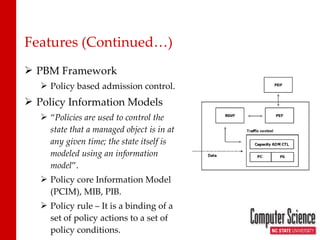
Features (Continued…) PBM Framework Policy based admission control. Policy Information Models “ Policies are used to control the state that a managed object is in at any given time; the state itself is modeled using an information model ”. Policy core Information Model (PCIM), MIB, PIB. Policy rule – It is a binding of a set of policy actions to a set of policy conditions.
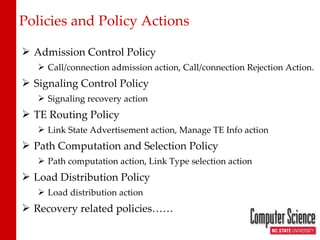
Policies and Policy Actions Admission Control Policy Call/connection admission action, Call/connection Rejection Action. Signaling Control Policy Signaling recovery action TE Routing Policy Link State Advertisement action, Manage TE Info action Path Computation and Selection Policy Path computation action, Link Type selection action Load Distribution Policy Load distribution action Recovery related policies……
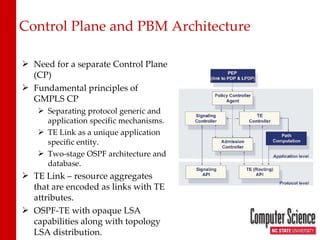
Control Plane and PBM Architecture Need for a separate Control Plane (CP) Fundamental principles of GMPLS CP Separating protocol generic and application specific mechanisms. TE Link as a unique application specific entity. Two-stage OSPF architecture and database. TE Link – resource aggregates that are encoded as links with TE attributes. OSPF-TE with opaque LSA capabilities along with topology LSA distribution.
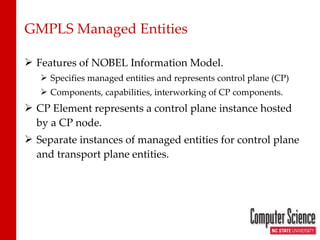
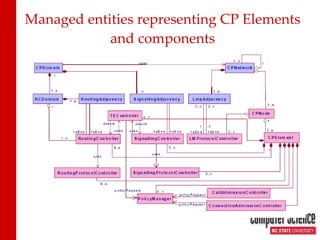
GMPLS Managed Entities Features of NOBEL Information Model. Specifies managed entities and represents control plane (CP) Components, capabilities, interworking of CP components. CP Element represents a control plane instance hosted by a CP node. Separate instances of managed entities for control plane and transport plane entities.
Managed entities representing CP Elements and components
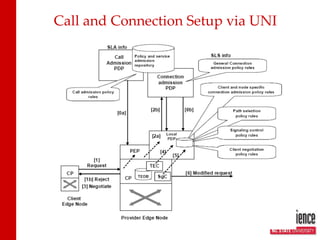
Use Case 1 Combined call and connection setup via User Network Interface (UNI). Considering circuit switch capable GMPLS network. SLA/SLS information installed in policy and service admission repository. Global call admission directives in global Call admission policy decision point (PDP) downloaded by policy execution point (PEP). Local and node specific connection admission policies in global  connection admission PDP.
Call and Connection Setup via UNI
Description [1] connection request using call setup messages over UNI [1b] comparing client id and port with call admission directives, does not match. [2a] call level parameters translate into network resource related requirements and evaluated by LPDP. [2b] requirements verified against general connection admission policy [3] May be asked to renegotiate due to network or node limitation
Continued… [4] connection setup is delegated to TEC which checks against path selection policy rules with LPDP [5] signaling controller (SgC) requests LPDP to check against signaling control policy rules. [6] ingress node signals modified call setup request.
Use Case 2 Event Driven TE Policy action for TE link utilization threshold crossing event. Emits threshold crossing alert (TSA). use case example - Predefined percentage (say 85%) of the current forwarding adjacency (FA) packet switched connection (PSC) link unreserved bandwidth is consumed. TE link utilization thresholds are set. TE Control action –  New FA PSC LSP New FA TDM LSP eg. At the server layer.
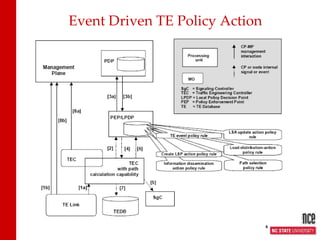
Event Driven TE Policy Action
Description [1a] TE link emits TCA to TEC, internal signal. [1b] TE link emits TCA to Management Plane (MP), CP-MP interaction notification. [2] TEC requests PEP to invoke event policy rule. [3] PEP forwards decision request to PDP (local, global or both) [3a],[3b] LPDP evaluates load-distribution action policy rule. If it does not succeed,  create LSP create action policy is evaluated with global PDP.
Continued… [4] LPDP evaluates path computation/selection policy rules and delegates TEC to enforce policy decisions. [5] TEC triggers SgC for setup of server layer. [6] If success, TEC will check LSA update policy and Information dissemination policy to initiate LSA update. [7]. TEC updated TEDB with new FA-LSP and notifies MP about result of policy decision [8a] [8b] TE Link emits state change notification to inform MP.
Bibliography G.805 ITU-T specification G.8080 ITU-T specification ASON Current status of standardization work, B. Zeuner, G. Lehr, Deutsche Telekom ASON and GMPLS – The battle of optical control plane Data connection limited. Control plane for Optical networks: The ASON Approach, Andrzej Jajszczyk, AGH University of science and technology, Krakow, Poland ASON and GMPLS – Overview and Comparision, S. Tomic, B. Statovci-Halimi, A. Halimi GMPLS Control Plane, policy based management, and information Modelling, H.Lonsethagen, et. al.

Ason gmpls

  • 1.
    ASTN/ASON and GMPLS Overview and Comparison By, Kishore Kasi Udayashankar Kaveriappa Muddiyada K
  • 2.
    Motivations Complex processof provisioning of end-to-end transport service Heterogeneous transport networks Automation of end-to-end provisioning Ability to offer more service Directly integrate IP clients over WDM
  • 3.
    How? “ intelligence”into the control plane of OTN automatic and seamless circuit provisioning unified control binding technologies Benefits? cost reduction and better quality of network operation simplified and rapid network configuration switched services and dynamic bandwidth assignment
  • 4.
    ASTN/ASON ITU-T RecommendationG.805/G.8080 Architecture that defines the components and interactions between components Distributed control plane Task of control planes Call and connection control Path control based on network state Discovery for self configuration
  • 5.
    ASTN/ASON (Continued…) Protocolsmust support multi-layer, multi-vendor network Layering Administrative partitioning Operational partitioning Types of interfaces in the control plane
  • 6.
    GMPLS Unified controlplane for packet and circuit switching technologies Four interfaces. Interface Switching Capability No NNIs.
  • 7.
    GMPLS (Continued…) Extensionof routing protocols OSPF-TE and ISIS-TE Signaling protocols, RSVP-TE and CR-LDP Label Switched Paths (LSP)
  • 8.
    Multi-layer Resource ModelRepresentation In GMPLS Basic topology abstraction is TE link Link interface can support one or more interface switching types defined Interface Switching Capability (ISC) ISC descriptor describes related TE properties A particular resource on a link is represented by a label
  • 9.
    In GMPLS (Continued...)Basic service abstraction is a LSP Concept of hierarchical LSP LSP in server region represented as TE link or Forwarding adjacency in client region Client LSP routed over a TE link == tunneled within a server LSP
  • 10.
    Multi-layer Resource ModelRepresentation In ASON ISC concept has been reduced Optical part of OTN hierarchy is mapped to LSC Digital path layers of OTN and SDH hierarchy is mapped to TDM
  • 11.
  • 12.
    In ASON (Continued…)Transport networks functional model G.805 Client/server association between adjacent layers Each layer partitioned to reflect internal structure
  • 13.
    In ASON (Continued…)Partitioning concepts Starting from the smallest indivisible subnetwork Contained and containing subnetwork Contained subnetwork cannot provide connectivity not available in containing subnetwork Ports on boundary of containing subnetworks and interconnection capability are represented by contained subnetworks
  • 14.
    In ASON (Continued…)Partitioning concepts (contd…)
  • 15.
    In ASON (Continued…)Layering concepts Layer networks in a client-server model Termination and Adaptation Functions Topology and connectivity not visible to client
  • 16.
  • 17.
    Overview of MPLS/GMPLSConcepts Forward Equivalence Class Label LSR LSP Label allocation Next Hop Label Forwarding Entry (NHLFE) Route selection
  • 18.
    From: Dr. HarryPerros, Connection Oriented Networks (CSC 576), Fall ‘06
  • 19.
    From: Dr. HarryPerros, Connection Oriented Networks (CSC 576), Fall ‘06
  • 20.
    Control Plane ArchitectureIn GMPLS Peer model Overlay model Augmented model
  • 21.
    Control Plane ArchitectureIn ASON Protocol neutral way Support various transport infrastructure Applicable irrespective of control plane that has been subdivided into domains
  • 22.
    In ASON (Continued…)General model of policy System is a collection of components System boundary Nested system boundaries Policy port as filters
  • 23.
    In ASON (Continued…)General model of federation Creation, deletion and maintenance of connections across multiple domains Community of domains Domains cooperate for connection management Joint Federation Model and Cooperative model
  • 24.
    In ASON (Continued…)Joint federation Model Cooperative Model
  • 25.
    In ASON (Continued…)Architectural components Connection controller (CC) component Routing controller (RC) component Link resource manager component Traffic policing (TP) component Call controller component Discovery agent (DA)
  • 26.
  • 27.
    GMPLS Control Plane,Policy-based Management and Information Modeling Policy based Management (PBM) Improve collaboration between management and GMPLS control plane. Extending Policy Core Information models (PCIM) with policy events. Diverse local and global decision logic distributed among multiple network elements and network layers.
  • 28.
    Discussion Items Advantagesand Features. Types of GMPLS policies and actions – few examples Control plane and PBM architecture. GMPLS managed entities Two uses cases to explain PBM in GMPLS
  • 29.
    Advantages Dynamic, flexibleand cooperative interworking Traffic engineering (TE) capabilities brought by GMPLS. Improve operational efficiency. New services requires complex and dynamic configurations of network resources. Avoid configuring node-by-node and consider entire network domain as a whole. Increase automation by using rule sets.
  • 30.
    Features Standardized operationalprocesses in multi-vendor environments. Policy rule - Network operator has control over state changes for a given network function. Adapting and changing behavior at runtime. Translating SLA, network and management areas (eg. Routing, configuration, fault management) into policies. Adding/deleting/modifying policies in policy repository.
  • 31.
    Features (Continued…) PBMFramework Policy based admission control. Policy Information Models “ Policies are used to control the state that a managed object is in at any given time; the state itself is modeled using an information model ”. Policy core Information Model (PCIM), MIB, PIB. Policy rule – It is a binding of a set of policy actions to a set of policy conditions.
  • 32.
    Policies and PolicyActions Admission Control Policy Call/connection admission action, Call/connection Rejection Action. Signaling Control Policy Signaling recovery action TE Routing Policy Link State Advertisement action, Manage TE Info action Path Computation and Selection Policy Path computation action, Link Type selection action Load Distribution Policy Load distribution action Recovery related policies……
  • 33.
    Control Plane andPBM Architecture Need for a separate Control Plane (CP) Fundamental principles of GMPLS CP Separating protocol generic and application specific mechanisms. TE Link as a unique application specific entity. Two-stage OSPF architecture and database. TE Link – resource aggregates that are encoded as links with TE attributes. OSPF-TE with opaque LSA capabilities along with topology LSA distribution.
  • 34.
    GMPLS Managed EntitiesFeatures of NOBEL Information Model. Specifies managed entities and represents control plane (CP) Components, capabilities, interworking of CP components. CP Element represents a control plane instance hosted by a CP node. Separate instances of managed entities for control plane and transport plane entities.
  • 35.
    Managed entities representingCP Elements and components
  • 36.
    Use Case 1Combined call and connection setup via User Network Interface (UNI). Considering circuit switch capable GMPLS network. SLA/SLS information installed in policy and service admission repository. Global call admission directives in global Call admission policy decision point (PDP) downloaded by policy execution point (PEP). Local and node specific connection admission policies in global connection admission PDP.
  • 37.
    Call and ConnectionSetup via UNI
  • 38.
    Description [1] connectionrequest using call setup messages over UNI [1b] comparing client id and port with call admission directives, does not match. [2a] call level parameters translate into network resource related requirements and evaluated by LPDP. [2b] requirements verified against general connection admission policy [3] May be asked to renegotiate due to network or node limitation
  • 39.
    Continued… [4] connectionsetup is delegated to TEC which checks against path selection policy rules with LPDP [5] signaling controller (SgC) requests LPDP to check against signaling control policy rules. [6] ingress node signals modified call setup request.
  • 40.
    Use Case 2Event Driven TE Policy action for TE link utilization threshold crossing event. Emits threshold crossing alert (TSA). use case example - Predefined percentage (say 85%) of the current forwarding adjacency (FA) packet switched connection (PSC) link unreserved bandwidth is consumed. TE link utilization thresholds are set. TE Control action – New FA PSC LSP New FA TDM LSP eg. At the server layer.
  • 41.
    Event Driven TEPolicy Action
  • 42.
    Description [1a] TElink emits TCA to TEC, internal signal. [1b] TE link emits TCA to Management Plane (MP), CP-MP interaction notification. [2] TEC requests PEP to invoke event policy rule. [3] PEP forwards decision request to PDP (local, global or both) [3a],[3b] LPDP evaluates load-distribution action policy rule. If it does not succeed, create LSP create action policy is evaluated with global PDP.
  • 43.
    Continued… [4] LPDPevaluates path computation/selection policy rules and delegates TEC to enforce policy decisions. [5] TEC triggers SgC for setup of server layer. [6] If success, TEC will check LSA update policy and Information dissemination policy to initiate LSA update. [7]. TEC updated TEDB with new FA-LSP and notifies MP about result of policy decision [8a] [8b] TE Link emits state change notification to inform MP.
  • 44.
    Bibliography G.805 ITU-Tspecification G.8080 ITU-T specification ASON Current status of standardization work, B. Zeuner, G. Lehr, Deutsche Telekom ASON and GMPLS – The battle of optical control plane Data connection limited. Control plane for Optical networks: The ASON Approach, Andrzej Jajszczyk, AGH University of science and technology, Krakow, Poland ASON and GMPLS – Overview and Comparision, S. Tomic, B. Statovci-Halimi, A. Halimi GMPLS Control Plane, policy based management, and information Modelling, H.Lonsethagen, et. al.