BY-
Devendra Kumar Mishra
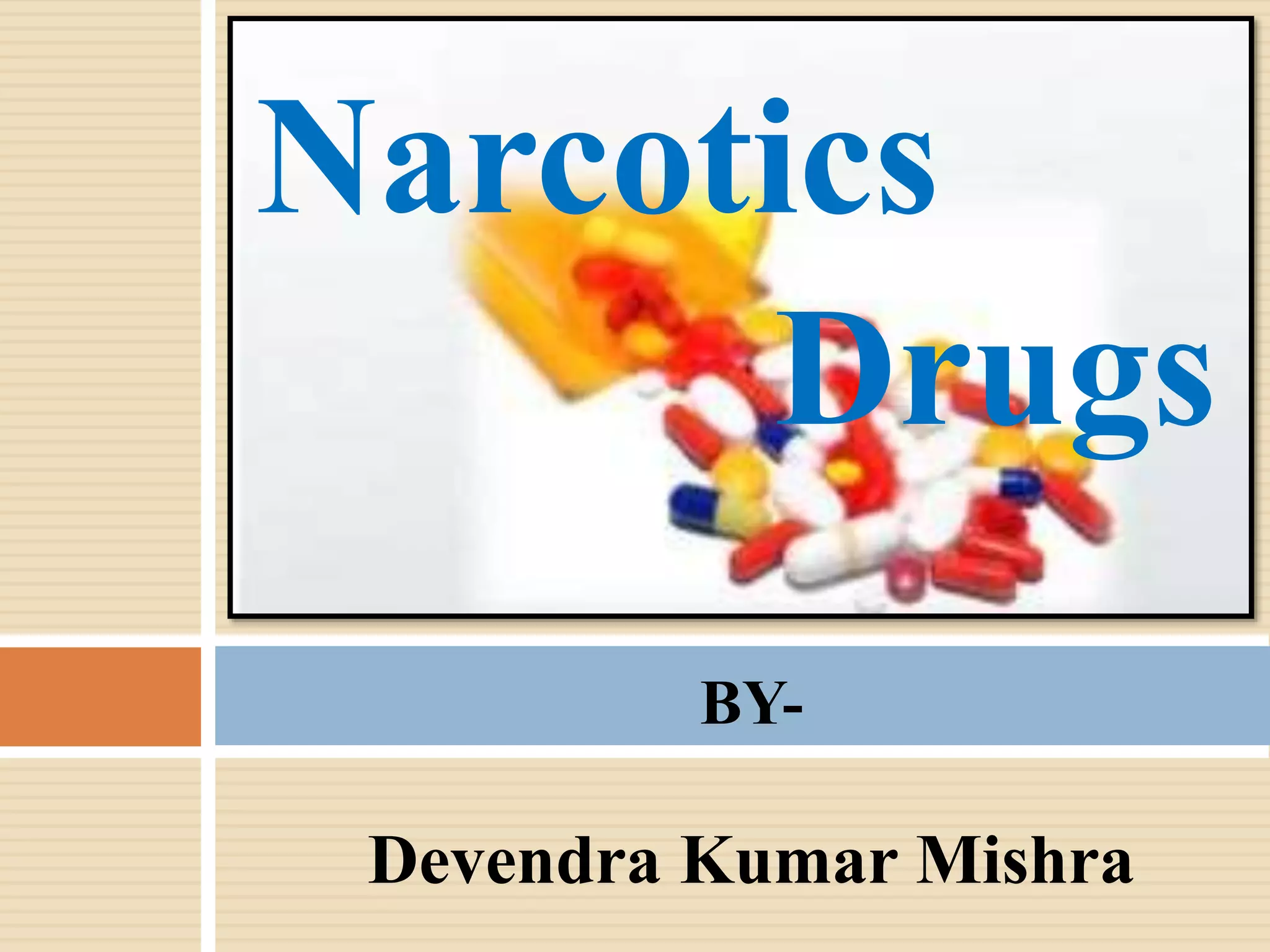
Narcotics
Drugs
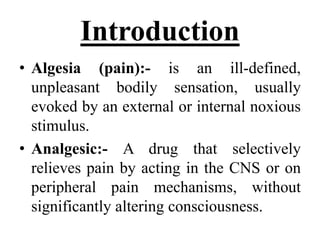
Introduction
• Algesia (pain):- is an ill-defined,
unpleasant bodily sensation, usually
evoked by an external or internal noxious
stimulus.
• Analgesic:- A drug that selectively
relieves pain by acting in the CNS or on
peripheral pain mechanisms, without
significantly altering consciousness.
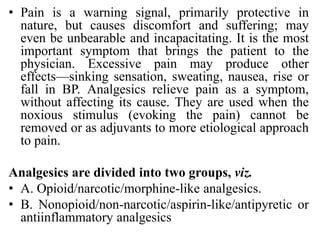
• Pain is a warning signal, primarily protective in
nature, but causes discomfort and suffering; may
even be unbearable and incapacitating. It is the most
important symptom that brings the patient to the
physician. Excessive pain may produce other
effects—sinking sensation, sweating, nausea, rise or
fall in BP. Analgesics relieve pain as a symptom,
without affecting its cause. They are used when the
noxious stimulus (evoking the pain) cannot be
removed or as adjuvants to more etiological approach
to pain.
Analgesics are divided into two groups, viz.
• A. Opioid/narcotic/morphine-like analgesics.
• B. Nonopioid/non-narcotic/aspirin-like/antipyretic or
antiinflammatory analgesics
Opioid Analgesics
• Opioid analgesics are narcotics pain
medication used to treat moderates to severe
pain with no specific organ toxicity the
analgesics effects of opioids are due to
increased perception of pain, increased
reaction to pain and pain tolerance.
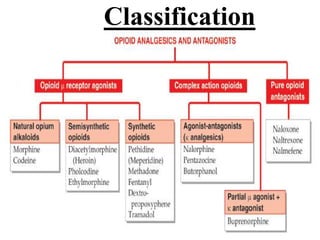
Classification
1.Morphine - Natural Opioid
• Morphine is the principal alkaloid in opium and is
widely used till today.
PHARMACOLOGICALACTIONS
1. CNS:- Morphine has site specific depressant and
stimulant actions in the CNS by interacting
primarily with the μ opioid receptor (for which it
has the highest affinity), as a full agonist. The
depressant actions are:
Analgesia:- Morphine is a strong analgesic. Pain
consists of both sensory and affective (emotional)
components. Opioid analgesics are unique in that
they can reduce both aspects of the pain experience,
especially the affective aspect. In contrast,
nonsteroidal anti-inflammatory analgesic drugs have
no significant effect on the emotional aspects of pain.
1. Morphine
 Sedation:- Drowsiness and clouding of mentation are
common effects of opioids. There is little or no amnesia.
Sleep is induced by opioids more frequently in the elderly
than in young, healthy individuals. Ordinarily, the patient can
be easily aroused from this sleep. However, the combination
of morphine with other central depressant drugs such as the
sedative-hypnotics may result in very deep sleep.
 Respiratory depression:-All of the opioid analgesics can
produce significant respiratory depression by inhibiting
brainstem respiratory mechanisms. Alveolar PCO 2 may
increase, but the most reliable indicator of this depression is a
depressed response to a carbon dioxide challenge. The
respiratory depression is dose-related and is influenced
significantly by the degree of sensory input occurring at the
time.
1. Morphine
 Cough Suppression:- It is depressed by morphine, and is
more sensitive than respiratory centre.
2. Peripheral actions
 CVS:- Morphine causes vasodilatation due to:
i. histamine release.
ii. depression of vasomotor centre.
iii. direct action decreasing tone of blood vessels.
 GIT:- The enteric plexus neurones and g.i. mucosa are rich
in opioid receptors. Morphine exerts marked effect on g.i.
motility as well as on fluid dynamics across g.i. mucosa.
Constipation is a prominent feature of morphine action.
3. ANS Morphine causes mild hyperglycaemia due to central
sympathetic stimulation. It has weak anticholinesterase action.
1. Morphine
PHARMACOKINETICS
• The oral absorption of morphine is unreliable because of high
and variable first pass metabolism; oral bioavailability is
1/6th to 1/4th of parenterally administered drug. About 30% is
bound to plasma proteins.
• Distribution is wide; concentration in liver, spleen and kidney
is higher than that in plasma. Only a small fraction enters
brain rather slowly. Morphine freely crosses placenta and can
affect the foetus more than the mother.
• Plasma t½ of morphine averages 2–3 hours. Effect of a
parenteral dose lasts 4–6 hours. Elimination is almost
complete in 24 hours and morphine is noncumulative.
However, small amounts persist in the body due to
enterohepatic circulation.
1. Morphine
Adverse Effects
• Respiratory depression
• Itching and skin rashes
• Vasodilatation and hypotension
• Difficulty in micturition
 Drug Interactions
• Morphine * Tramadol- Increases risk of seizures,
breathing problems and other side effects.
2. Codeine - Natural Opioid
• It is methyl-morphine, occurs naturally in opium, and is
partly converted in the body to morphine. It is less
potent than morphine (1/10th as analgesic), also less
efficacious; is a partial agonist at μ opioid receptor with
a low ceiling effect.
• However, codeine is more selective cough suppressant
(1/3rd as potent as morphine); subanalgesic doses (10–
30 mg) suppress cough.
• Codeine has very low affinity for opioid receptors.
• However, receptors involved in the antitussive action
appear to be distinct, because they bind codeine as well
as morphine.
2. Codeine
• Codeine has good activity by the oral route (oral:
parenteral ratio 1:2). A single oral dose acts for 4–6
hours.
• Increases pain threshold by acting through μ receptors at
spinal and supra spinal sites. It causes cough suppression
by direct central action in the medulla and also produce
generalized CNS depression.
• Constipation is a prominent side effect when it is used as
analgesic. Codeine has been used to control diarrhea.
Other side effects are milder. The abuse liability is low.
• Though codeine phosphate is water soluble and can be
injected, parenteral preparation is not available.
Adverse Effects
• Constipation
• Sedation
• Urinary Retention
• Depression
• Coughing
Drug Interactions
• Codeine * Naloxone can reverse the effects of codeine.
Cause diarrhea aches, fever, runny nose, sneezing,
nervousness, irritability, shivering and abdominal cramps.
2. Codeine
They have codeine like properties and have been used
mainly as antitussive; claimed to be less constipating. Its
as mild sedative effect as well.
Its raise threshold of cough center and suppresses the
cough reflex. It selectively and directly acts on cough
center medulla and suppresses cough.
• Adverse effects
1. Hypersensitivity reactions
2. Anaphylaxis
3. Drowsiness
4. Excitation
5. Sputum Retention
1. Pholcodeine:- Semisynthetic Opiates
2. Heroin (Diacetylmorphine) (Semisynthetic
Opiates)
• It is diacetyl derivatives of the opiate morphine, a
naturally occurring alkaloid extracted from the
seedpod of the Asian poppy.
• It is about 3 times more potent than morphine;
more lipid soluble, therefore enters the brain more
rapidly, but duration of action is similar.
• It is considered to be more euphorient (especially
on i.v. injection) and highly addicting. Because of
its high potency, it has been favoured in illicit
drug trafficking.
2. Heroin (Diacetylmorphine) (Semisynthetic
Opiates)
• It is also used as cough suppressant and as
antidiarrhoeal.
• The sedative, emetic and hypotensive actions are
said to be less prominent.
• However, it has no outstanding therapeutic
advantage over morphine and has been banned in
most countries except U.K.
1. Fentanyl – Synthetic Opioids
• It is opioid medication, used as a part of anesthesia to
help prevent pain after surgery or other medical
procedure.
• In analgesic doses it produces few cardiovascular effects.
Cardiac contractility and heart rate are only marginally
reduced, and it has less propensity to release histamine.
• Because of high lipid solubility, it enters brain rapidly
and produces peak analgesia in 5 min after i.v. injection.
• The duration of action is short: starts wearing off after
30–40 min due to redistribution, while elimination t½ is
~4 hr. In the injectable form it is almost exclusively used
in anaesthesia.
1. Fentanyl
Coupled with G-protein receptors, decreases intracellular cAMP
by inhibiting adenylate cylase thus neurotransmitters such as
GABA, dopamine, acetylcholine and noradrenaline is
inhibited.
Uses:- Used as Chronic and cancer pain.
Adverse effects
1. Chest pain
2. Convulsions
3. Decreased urine
4. Irregular heartbeat
5. Muscle pain or cramps
6. Ulcers, sores or white spots in the mouths.
2. Tramadol Synthetic Opioids
• This centrally acting analgesic is an atypical opioid
which relieves pain by opioid as well as additional
mechanisms.
• Its binds to narcotic or opioid receptors thus prevents
transmitting the sensation of pain from throughout the
body to the brain. It is a centrally acting synthetic opioid
analgesic that exerts its effect through the binding of
parent drug and O-desmethyltramadol (M1) metabolite
to mu-opioid receptors and through the weak inhibition
of norepinephrine and serotonin uptake.
• Its affinity for μ opioid receptor is low, while that for κ
and δ is very low. Unlike other opioids, it inhibits
reuptake of NA and 5-HT, increases 5-HT release, and
thus activates monoaminergic spinal inhibition of pain.
2. Tramadol
Uses:- Used to help relieve moderate to moderately
severe pain.
Adverse effects
• Dry mouth
• Head pain
• Incomplete or Infrequent Bowel Movements.
Drug Interactions
Tramadol * Paliperidone – Increases the risk of seizures.
OPIOID RECEPTORS
• μ Receptors are responsible for most of the analgesic effects of opioids, and for
some major unwanted effects (e.g. respiratory depression, euphoria, sedation and
dependence). Most of the analgesic opioids are μ-receptor agonists.
• δ Receptor activation results in analgesia but also can be proconvulsant.
• κ Receptors contribute to analgesia at the spinal level and may elicit sedation,
dysphoria and hallucinations. Some analgesics are mixed κ agonists/μ
antagonists.
• σ Receptors are not true opioid receptors but are the site of action of certain
psychotomimetic drugs, with which some opioids also interact.
• All opioid receptors are linked through Gi/Go-proteins and thus open potassium
channels (causing hyperpolarisation) and inhibit the opening of calcium channels
(inhibiting transmitter release). In addition they inhibit adenylyl cyclase and
activate the MAP kinase (ERK) pathway.
• Functional heterodimers, formed by combination of different types of opioid
receptor or with other types of G-protein-coupled receptor, may occur and give
rise to further pharmacological diversity.
1. Nalorphine:- Agonist-antagonists (κ analgesics)
• It is N-allyl-normorphine; was the first opioid antagonist
introduced in 1951 which could reverse morphine action.
• It reverses opioid – induced effects via its antagonist action at
mu opioid receptor.
• Later it was found to have agonistic action on κ receptor as
well, producing lower ceiling analgesia.
• It is not used clinically because of dysphoric and
psychotomimetic effects.
• It is κ opioid agonist and μ opoid antagonist.
Uses:- Used for reversal of opioid overdose & induced
respiratory depression (i.v; i.m).
Adverse effects:- Causes miosis, Acute respiratory,
Depression, Dysphoria.
2. Pentazocine :- Agonist-antagonists (κ analgesics)
• It is the first agonist-antagonist to be used as an
analgesic. It has weak μ antagonistic and more marked κ
agonistic actions.
• Sedation and respiratory depression is 1/3 to 1/2 of
morphine at lower doses, and has a lower ceiling, does
not increase much beyond 60 mg dose.
• Tachycardia and rise in BP are produced at higher doses
due to sympathetic stimulation. This may increase cardiac
work; better avoided in coronary ischaemia and
myocardial infarction.
• Biliary spasm and constipation are less severe.
• Vomiting is less frequent. Other side effects are sweating
and lightheadedness.
2. Pentazocine :- Agonist-antagonists (κ analgesics)
Adverse effects
• Irritation
• Itching
• Tightness in the chest
• Red and irritated eyes.
Drug Interactions
Pentazocine * Furazolidone increases the serious side
effects such as respiratory depression, low blood
pressure, fainting, coma, and even death.
Buprenorphine :- Partial/weak μ agonist + κ antagonist
• Highly lipid-soluble μ analgesic that is 25 times more
potent than morphine but with lower intrinsic activity and
ceiling effect.
• The onset of action is slower and duration longer. After a
single dose, analgesia lasts for 6–8 hours; but with
repeated dosing, duration of action increases to ~24 hours
due to accumulation in tissues. Certain other effects last
still longer.
• Sedation, vomiting, miosis, subjective and cardiovascular
effects are similar to morphine, but constipation is less
marked.
• Partial agonist activity at mu-opioid, kappa receptors
results in hyper-polarization and reduced neuronal
excitability.
Buprenorphine :- Partial/weak μ agonist + κ antagonist
Adverse effects
• Mild dizziness
• Insomnia
• Stomach pain
• Numbness or tingling
Drug Interactions
Buprenorphine * Pregabalin can lead to serious side
effects such as respiratory distress, coma or even death.
1. Naloxone:- Pure antagonists
• It is a competitive antagonist on all types of opioid
receptors.
• However, it blocks μ receptors at much lower doses than
those needed to block κ or δ receptors.
• Greatest affinity for the μ receptors.
• It is devoid of any kind of agonistic activity even at high
doses (20 times μ blocking dose).
• No subjective or autonomic effects are produced in
individuals who have not received an opioid.
• No physical/psychological dependence or abstinence
syndrome has been observed.
1. Naloxone:- Pure antagonists
Uses:- Used to treat morphine and other opioid
poisoning, Neonatal asphyxia.
Adverse effects
• Chest pain
• Fast or irregular heartbeats
• Dry cough
• Severe headache
Drug Interactions
Naloxone * Codeine- Can reverse the effects of codeine
causing nausea, vomiting, diarrhea, aches, fever, runny
nose, sneezing, shivering and abdominal cramps.
2. Naltrexone :- Pure antagonists
• It is chemically related to naloxone and is another pure
opioid antagonist, that is devoid of subjective and other
agonistic effects, but very high doses have caused
unpleasant feelings in some individuals.
• It is more potent than naloxone.
• Naltrexone differs from naloxone in being orally active
and having a long duration of action (1–2 days) which
makes it suitable for ‘opioid blockade’ therapy of
postaddicts: 50 mg/day is given orally so that if the
subject takes his/her usual shot of the opioid, no
subjective effects are produced and the craving subsides.
2. Naltrexone :- Pure antagonists
• Pure opiate antagonist (μ, κ and δ receptors) in the CNS.
• Highest affinity for the μ receptors.
Uses
Uses for Opioid blockade therapy, Alcoholism.
Adverse effects
1. Abdominal or stomach cramping or pain
2. Anxiety
3. Nervousness, restlessness or trouble sleeping
4. Joint or muscle pain
 Drug Interactions
Naltrexone * Leflunomide- May increases the risk of liver
problems.
References
• Tripathi, K.D; Essentials of Medical Pharmacology; Seventh
Edition, Jaypee Brothers Medical Publishers (P) Ltd, New
Delhi; 2013, p.p- 469-86.
• Rang, H.P, Dale, M.M, “RANG AND DALE’S
Pharmacology” Seventh Edition, Elsevier Churchill
Livingstone, China; 2012, p.p- 510-13.
• Katzung, B.G, Masters, S.B, Trevor, A.J; “Basic & Clinical
Pharmacology” 12th Edition, Mc GrawHill Lange, US; 2012,
p.p- 543-56.
• Shanker, K.R, Kiranmayi, G.V.N, “ Pharmacology: A
Companion Handbook with Illustrations” PharmaMed Press,
Hyderabad; 2018; p.p-94-99.
Narcotics Drugs- Devendra Kumar Mishra

Narcotics Drugs- Devendra Kumar Mishra

  • 1.
  • 2.
    Introduction • Algesia (pain):-is an ill-defined, unpleasant bodily sensation, usually evoked by an external or internal noxious stimulus. • Analgesic:- A drug that selectively relieves pain by acting in the CNS or on peripheral pain mechanisms, without significantly altering consciousness.
  • 3.
    • Pain isa warning signal, primarily protective in nature, but causes discomfort and suffering; may even be unbearable and incapacitating. It is the most important symptom that brings the patient to the physician. Excessive pain may produce other effects—sinking sensation, sweating, nausea, rise or fall in BP. Analgesics relieve pain as a symptom, without affecting its cause. They are used when the noxious stimulus (evoking the pain) cannot be removed or as adjuvants to more etiological approach to pain. Analgesics are divided into two groups, viz. • A. Opioid/narcotic/morphine-like analgesics. • B. Nonopioid/non-narcotic/aspirin-like/antipyretic or antiinflammatory analgesics
  • 4.
    Opioid Analgesics • Opioidanalgesics are narcotics pain medication used to treat moderates to severe pain with no specific organ toxicity the analgesics effects of opioids are due to increased perception of pain, increased reaction to pain and pain tolerance.
  • 5.
  • 6.
    1.Morphine - NaturalOpioid • Morphine is the principal alkaloid in opium and is widely used till today. PHARMACOLOGICALACTIONS 1. CNS:- Morphine has site specific depressant and stimulant actions in the CNS by interacting primarily with the μ opioid receptor (for which it has the highest affinity), as a full agonist. The depressant actions are: Analgesia:- Morphine is a strong analgesic. Pain consists of both sensory and affective (emotional) components. Opioid analgesics are unique in that they can reduce both aspects of the pain experience, especially the affective aspect. In contrast, nonsteroidal anti-inflammatory analgesic drugs have no significant effect on the emotional aspects of pain.
  • 7.
    1. Morphine  Sedation:-Drowsiness and clouding of mentation are common effects of opioids. There is little or no amnesia. Sleep is induced by opioids more frequently in the elderly than in young, healthy individuals. Ordinarily, the patient can be easily aroused from this sleep. However, the combination of morphine with other central depressant drugs such as the sedative-hypnotics may result in very deep sleep.  Respiratory depression:-All of the opioid analgesics can produce significant respiratory depression by inhibiting brainstem respiratory mechanisms. Alveolar PCO 2 may increase, but the most reliable indicator of this depression is a depressed response to a carbon dioxide challenge. The respiratory depression is dose-related and is influenced significantly by the degree of sensory input occurring at the time.
  • 8.
    1. Morphine  CoughSuppression:- It is depressed by morphine, and is more sensitive than respiratory centre. 2. Peripheral actions  CVS:- Morphine causes vasodilatation due to: i. histamine release. ii. depression of vasomotor centre. iii. direct action decreasing tone of blood vessels.  GIT:- The enteric plexus neurones and g.i. mucosa are rich in opioid receptors. Morphine exerts marked effect on g.i. motility as well as on fluid dynamics across g.i. mucosa. Constipation is a prominent feature of morphine action. 3. ANS Morphine causes mild hyperglycaemia due to central sympathetic stimulation. It has weak anticholinesterase action.
  • 9.
    1. Morphine PHARMACOKINETICS • Theoral absorption of morphine is unreliable because of high and variable first pass metabolism; oral bioavailability is 1/6th to 1/4th of parenterally administered drug. About 30% is bound to plasma proteins. • Distribution is wide; concentration in liver, spleen and kidney is higher than that in plasma. Only a small fraction enters brain rather slowly. Morphine freely crosses placenta and can affect the foetus more than the mother. • Plasma t½ of morphine averages 2–3 hours. Effect of a parenteral dose lasts 4–6 hours. Elimination is almost complete in 24 hours and morphine is noncumulative. However, small amounts persist in the body due to enterohepatic circulation.
  • 10.
    1. Morphine Adverse Effects •Respiratory depression • Itching and skin rashes • Vasodilatation and hypotension • Difficulty in micturition  Drug Interactions • Morphine * Tramadol- Increases risk of seizures, breathing problems and other side effects.
  • 11.
    2. Codeine -Natural Opioid • It is methyl-morphine, occurs naturally in opium, and is partly converted in the body to morphine. It is less potent than morphine (1/10th as analgesic), also less efficacious; is a partial agonist at μ opioid receptor with a low ceiling effect. • However, codeine is more selective cough suppressant (1/3rd as potent as morphine); subanalgesic doses (10– 30 mg) suppress cough. • Codeine has very low affinity for opioid receptors. • However, receptors involved in the antitussive action appear to be distinct, because they bind codeine as well as morphine.
  • 12.
    2. Codeine • Codeinehas good activity by the oral route (oral: parenteral ratio 1:2). A single oral dose acts for 4–6 hours. • Increases pain threshold by acting through μ receptors at spinal and supra spinal sites. It causes cough suppression by direct central action in the medulla and also produce generalized CNS depression. • Constipation is a prominent side effect when it is used as analgesic. Codeine has been used to control diarrhea. Other side effects are milder. The abuse liability is low. • Though codeine phosphate is water soluble and can be injected, parenteral preparation is not available.
  • 13.
    Adverse Effects • Constipation •Sedation • Urinary Retention • Depression • Coughing Drug Interactions • Codeine * Naloxone can reverse the effects of codeine. Cause diarrhea aches, fever, runny nose, sneezing, nervousness, irritability, shivering and abdominal cramps. 2. Codeine
  • 14.
    They have codeinelike properties and have been used mainly as antitussive; claimed to be less constipating. Its as mild sedative effect as well. Its raise threshold of cough center and suppresses the cough reflex. It selectively and directly acts on cough center medulla and suppresses cough. • Adverse effects 1. Hypersensitivity reactions 2. Anaphylaxis 3. Drowsiness 4. Excitation 5. Sputum Retention 1. Pholcodeine:- Semisynthetic Opiates
  • 15.
    2. Heroin (Diacetylmorphine)(Semisynthetic Opiates) • It is diacetyl derivatives of the opiate morphine, a naturally occurring alkaloid extracted from the seedpod of the Asian poppy. • It is about 3 times more potent than morphine; more lipid soluble, therefore enters the brain more rapidly, but duration of action is similar. • It is considered to be more euphorient (especially on i.v. injection) and highly addicting. Because of its high potency, it has been favoured in illicit drug trafficking.
  • 16.
    2. Heroin (Diacetylmorphine)(Semisynthetic Opiates) • It is also used as cough suppressant and as antidiarrhoeal. • The sedative, emetic and hypotensive actions are said to be less prominent. • However, it has no outstanding therapeutic advantage over morphine and has been banned in most countries except U.K.
  • 17.
    1. Fentanyl –Synthetic Opioids • It is opioid medication, used as a part of anesthesia to help prevent pain after surgery or other medical procedure. • In analgesic doses it produces few cardiovascular effects. Cardiac contractility and heart rate are only marginally reduced, and it has less propensity to release histamine. • Because of high lipid solubility, it enters brain rapidly and produces peak analgesia in 5 min after i.v. injection. • The duration of action is short: starts wearing off after 30–40 min due to redistribution, while elimination t½ is ~4 hr. In the injectable form it is almost exclusively used in anaesthesia.
  • 18.
    1. Fentanyl Coupled withG-protein receptors, decreases intracellular cAMP by inhibiting adenylate cylase thus neurotransmitters such as GABA, dopamine, acetylcholine and noradrenaline is inhibited. Uses:- Used as Chronic and cancer pain. Adverse effects 1. Chest pain 2. Convulsions 3. Decreased urine 4. Irregular heartbeat 5. Muscle pain or cramps 6. Ulcers, sores or white spots in the mouths.
  • 19.
    2. Tramadol SyntheticOpioids • This centrally acting analgesic is an atypical opioid which relieves pain by opioid as well as additional mechanisms. • Its binds to narcotic or opioid receptors thus prevents transmitting the sensation of pain from throughout the body to the brain. It is a centrally acting synthetic opioid analgesic that exerts its effect through the binding of parent drug and O-desmethyltramadol (M1) metabolite to mu-opioid receptors and through the weak inhibition of norepinephrine and serotonin uptake. • Its affinity for μ opioid receptor is low, while that for κ and δ is very low. Unlike other opioids, it inhibits reuptake of NA and 5-HT, increases 5-HT release, and thus activates monoaminergic spinal inhibition of pain.
  • 20.
    2. Tramadol Uses:- Usedto help relieve moderate to moderately severe pain. Adverse effects • Dry mouth • Head pain • Incomplete or Infrequent Bowel Movements. Drug Interactions Tramadol * Paliperidone – Increases the risk of seizures.
  • 21.
    OPIOID RECEPTORS • μReceptors are responsible for most of the analgesic effects of opioids, and for some major unwanted effects (e.g. respiratory depression, euphoria, sedation and dependence). Most of the analgesic opioids are μ-receptor agonists. • δ Receptor activation results in analgesia but also can be proconvulsant. • κ Receptors contribute to analgesia at the spinal level and may elicit sedation, dysphoria and hallucinations. Some analgesics are mixed κ agonists/μ antagonists. • σ Receptors are not true opioid receptors but are the site of action of certain psychotomimetic drugs, with which some opioids also interact. • All opioid receptors are linked through Gi/Go-proteins and thus open potassium channels (causing hyperpolarisation) and inhibit the opening of calcium channels (inhibiting transmitter release). In addition they inhibit adenylyl cyclase and activate the MAP kinase (ERK) pathway. • Functional heterodimers, formed by combination of different types of opioid receptor or with other types of G-protein-coupled receptor, may occur and give rise to further pharmacological diversity.
  • 22.
    1. Nalorphine:- Agonist-antagonists(κ analgesics) • It is N-allyl-normorphine; was the first opioid antagonist introduced in 1951 which could reverse morphine action. • It reverses opioid – induced effects via its antagonist action at mu opioid receptor. • Later it was found to have agonistic action on κ receptor as well, producing lower ceiling analgesia. • It is not used clinically because of dysphoric and psychotomimetic effects. • It is κ opioid agonist and μ opoid antagonist. Uses:- Used for reversal of opioid overdose & induced respiratory depression (i.v; i.m). Adverse effects:- Causes miosis, Acute respiratory, Depression, Dysphoria.
  • 23.
    2. Pentazocine :-Agonist-antagonists (κ analgesics) • It is the first agonist-antagonist to be used as an analgesic. It has weak μ antagonistic and more marked κ agonistic actions. • Sedation and respiratory depression is 1/3 to 1/2 of morphine at lower doses, and has a lower ceiling, does not increase much beyond 60 mg dose. • Tachycardia and rise in BP are produced at higher doses due to sympathetic stimulation. This may increase cardiac work; better avoided in coronary ischaemia and myocardial infarction. • Biliary spasm and constipation are less severe. • Vomiting is less frequent. Other side effects are sweating and lightheadedness.
  • 24.
    2. Pentazocine :-Agonist-antagonists (κ analgesics) Adverse effects • Irritation • Itching • Tightness in the chest • Red and irritated eyes. Drug Interactions Pentazocine * Furazolidone increases the serious side effects such as respiratory depression, low blood pressure, fainting, coma, and even death.
  • 25.
    Buprenorphine :- Partial/weakμ agonist + κ antagonist • Highly lipid-soluble μ analgesic that is 25 times more potent than morphine but with lower intrinsic activity and ceiling effect. • The onset of action is slower and duration longer. After a single dose, analgesia lasts for 6–8 hours; but with repeated dosing, duration of action increases to ~24 hours due to accumulation in tissues. Certain other effects last still longer. • Sedation, vomiting, miosis, subjective and cardiovascular effects are similar to morphine, but constipation is less marked. • Partial agonist activity at mu-opioid, kappa receptors results in hyper-polarization and reduced neuronal excitability.
  • 26.
    Buprenorphine :- Partial/weakμ agonist + κ antagonist Adverse effects • Mild dizziness • Insomnia • Stomach pain • Numbness or tingling Drug Interactions Buprenorphine * Pregabalin can lead to serious side effects such as respiratory distress, coma or even death.
  • 27.
    1. Naloxone:- Pureantagonists • It is a competitive antagonist on all types of opioid receptors. • However, it blocks μ receptors at much lower doses than those needed to block κ or δ receptors. • Greatest affinity for the μ receptors. • It is devoid of any kind of agonistic activity even at high doses (20 times μ blocking dose). • No subjective or autonomic effects are produced in individuals who have not received an opioid. • No physical/psychological dependence or abstinence syndrome has been observed.
  • 28.
    1. Naloxone:- Pureantagonists Uses:- Used to treat morphine and other opioid poisoning, Neonatal asphyxia. Adverse effects • Chest pain • Fast or irregular heartbeats • Dry cough • Severe headache Drug Interactions Naloxone * Codeine- Can reverse the effects of codeine causing nausea, vomiting, diarrhea, aches, fever, runny nose, sneezing, shivering and abdominal cramps.
  • 29.
    2. Naltrexone :-Pure antagonists • It is chemically related to naloxone and is another pure opioid antagonist, that is devoid of subjective and other agonistic effects, but very high doses have caused unpleasant feelings in some individuals. • It is more potent than naloxone. • Naltrexone differs from naloxone in being orally active and having a long duration of action (1–2 days) which makes it suitable for ‘opioid blockade’ therapy of postaddicts: 50 mg/day is given orally so that if the subject takes his/her usual shot of the opioid, no subjective effects are produced and the craving subsides.
  • 30.
    2. Naltrexone :-Pure antagonists • Pure opiate antagonist (μ, κ and δ receptors) in the CNS. • Highest affinity for the μ receptors. Uses Uses for Opioid blockade therapy, Alcoholism. Adverse effects 1. Abdominal or stomach cramping or pain 2. Anxiety 3. Nervousness, restlessness or trouble sleeping 4. Joint or muscle pain  Drug Interactions Naltrexone * Leflunomide- May increases the risk of liver problems.
  • 31.
    References • Tripathi, K.D;Essentials of Medical Pharmacology; Seventh Edition, Jaypee Brothers Medical Publishers (P) Ltd, New Delhi; 2013, p.p- 469-86. • Rang, H.P, Dale, M.M, “RANG AND DALE’S Pharmacology” Seventh Edition, Elsevier Churchill Livingstone, China; 2012, p.p- 510-13. • Katzung, B.G, Masters, S.B, Trevor, A.J; “Basic & Clinical Pharmacology” 12th Edition, Mc GrawHill Lange, US; 2012, p.p- 543-56. • Shanker, K.R, Kiranmayi, G.V.N, “ Pharmacology: A Companion Handbook with Illustrations” PharmaMed Press, Hyderabad; 2018; p.p-94-99.