Opioids Analgesics & antagonists
By: Kirankumar Solanki
Opioids
 These are the substances obtained from the crude
extract of Papaver somniferum (poppy plant).
 They are used to produce:
 Euphoria
 Analgesia
 Sedation
 Relief from diarrhea
 Cough suppression
 Morphine is the prototype opioid and acts by
agonistic activity on μ(mu), k(kappa) and d(delta)
receptors.
 Certain endogenous peptides (endorphins,
dynorphins and enkephalins) act on these opioid
receptors to produce analgesic effects.
Opioid Receptors:
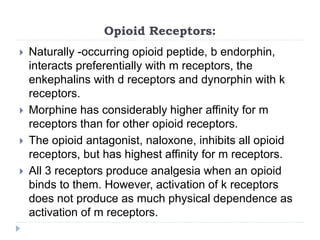
 Opioids exert their major effects by interacting with
opioid receptors in the CNS and in other anatomic
structures, such as the gastrointestinal tract and the
urinary bladder.
 There are three Opioid Receptors
 All three opioid receptors are members of the G
protein coupled receptor family and inhibit adenyl
cyclase.
 Mu (m), Kappa (k), Delta (d)
 They are also associated with ion channels,
increasing postsynaptic K+ efflux (hyperpolarization)
or reducing presynaptic Ca2+ influx, thus impeding
neuronal firing and transmitter release.
Opioid Receptors:
 Naturally -occurring opioid peptide, b endorphin,
interacts preferentially with m receptors, the
enkephalins with d receptors and dynorphin with k
receptors.
 Morphine has considerably higher affinity for m
receptors than for other opioid receptors.
 The opioid antagonist, naloxone, inhibits all opioid
receptors, but has highest affinity for m receptors.
 All 3 receptors produce analgesia when an opioid
binds to them. However, activation of k receptors
does not produce as much physical dependence as
activation of m receptors.
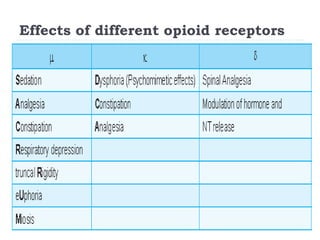
Effects of different opioid receptors
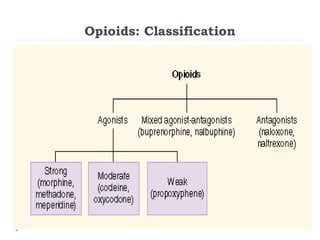
Opioids: Classification
Opioids Agonists : MOA
 Activation of peripheral nociceptive fibers causes release
of substance P and other pain-signaling
neurotransmitters from nerve terminals in the dorsal horn
of the spinal cord.
 Release of pain-signaling neurotransmitters is regulated
by endogenous endorphins or by exogenous opioid
agonists by acting pre-synaptically to inhibit substance P
release, causing analgesia.
 Reduction or inhibition of neurotransmission, due largely
to opioid-induced pre-synaptic inhibition of
neurotransmitter release
 Involves changes in transmembrane ion conductance
 Increase potassium conductance (hyperpolarization)
 Inactivation of calcium channels
Opioids Agonists : Pharmacological
Actions
 CNS Actions
 Morphine produces spinal and supraspinal analgesia by acting
on μ, κ and δ receptors.
 μ receptor opioids have dependence producing actions due to
euphoric action. Κ receptors mediate psychomimetic effects
(dysphoria). Tolerance develops to all actions of opioids except
3C (Constipation, convulsions and constriction of pupil)
 Opioids produce marked sedation but chances of sedation are
less with pethidine and fentanyl.
 Opioids can produce respiratory depression and cough
suppression.
 Miosis can occur with morphine use and pin point pupil is a
valuable sign in diagnosis of opioid poisoning.
 Highly lipid soluble drugs like fentanyl, alfentanyl and sufentanil
can result in truncal rigidity on rapid i.v. infusion.
 By stimulating CTZ, opioids can result in nausea and vomiting.
Opioids Agonists : Pharmacological
Actions
 Peripheral Effects
 Opioids have no direct effect on heart except pethidine and
pentazocine (that increase heart rate). Blood pressure may
decrease due to depression of vasomotor system and release
of histamine.
 Constipation can result due to decreased motility and increased
tone of GIT.
 Alvimopan is a peripheral opioid antagonist developed for
paralytic ileus.
 Opioids increase intrabiliary pressure by constricting biliary
smooth muscle. (C/I in biliary colic).
 These may aggravate bronchoconstriction in asthmatics by
releasing histamine. (C/I in asthmatics).
 Spinal or epidural administration of opioids may result in
intense pruritus over lips and torso (due to histamine release).
Opioids Agonists : Clinical uses
 These are used as analgesic agents. Visceral, dull and
constant pain is relieved more effectively than inflammatory
pain. Opioids are however contraindicated in biliary colic.
 Morphine (i.v.) is useful in myocardial infarction as well as in
acute pulmonary edema.
 Codeine, pholcodeine, dextromethorphan and noscapine are
effective cough suppressants. Dextromethorphan is devoid of
constipating action unlike other drugs in this group.
 Loperamide and diphenoxylate can be used for the treatment
of non-infective diarrhea.
 Morphine is useful as a pre-anaesthetic medication whereas
highly lipid soluble drugs (like fentanyl, alfentanil, sufentanil
etc) are used as adjuncts to other anaesthetic agents.
 Pethidine is used to reduce shivering after anaesthesia [by its
action on a2 receptor]
Opioids Agonists : Adverse effects
 Respiratory depression, nausea, vomiting, constipation,
urinary retention, itching and dysphoria are important
adverse effects of opioids.
 Tolerance develops to most of the actions of opioids
except miosis, constipation and convulsions.
 Opioids are highly addictive substances and can lead to
development of psychological as well as physical
dependence.
 Sudden discontinuation of these drugs in a dependent
subject may lead to withdrawal syndrome characterized
by rhinorrhoea, lacrimation, yawning, chills, mydriasis,
vomiting, diarrhea and anxiety. Most of these symptoms
are opposite to the normal actions of opioids.
Opioid agonists: Important Points about Individual
drugs
 Morphine, hydromorphone and oxymorphone are strong opioid
agonists useful as analgesics.
 Heroin (diacetylmorphine) is a potent and fast acting opioid but
carries high risk of abuse potential.
 Methadone is a long acting opioid analgesic that can be
administered by oral, i.v., s.c. and rectal routes. Apart from potent
agonistic actions at μ receptors, it also blocks NMDA receptors and
reuptake of monoamines. These properties explain its ability to
relieve neuropathic and cancer pain that are not controlled with
morphine. Due to its long t1/2, development of dependence and
tolerance is very slow, making it useful for the treatment of opioid
abuse. It is also useful for opioid rotation therapy.
 Pethidine and pentazocine possess anticholinergic activity (can
result in tachycardia).These drugs are therefore C/I in MI. Because of
anticholinergic properties, these are relatively safer in biliary colic as
compared to other agents.
 Accumulation of active metabolite of pethidine (norpethidine) can
Opioid agonists: Important Points about
Individual drugs
 Levorphanol is similar to morphine in its actions.
 Propoxyphene is a least potent and least efficacious analgesic
agent.
 Diphenoxylate and its active metabolite difenoxin, as well as
loperamide are useful for diarrhea.
 Nalbuphine exhibits ceiling effect to its respiratory depressant action.
 Buprenorphine dissociates slowly from μ receptors and is thus
resistant to naloxone reversal.
 Butorphanol, pentazocine and dezocine possess psychomimetic
effects due to κ agonistic activity.
 Ziconotide is approved for intrathecal analgesia. It acts by blocking
voltage-gated N type Ca2+ channels.
 Tramadol is a weak m receptor agonist. It also inhibits reuptake of
NA and 5-HT. These effects are responsible for its analgesic action,
which can be abolished by 5-HT3 antagonists like ondansetron. At
high doses, it can lead to seizures.
 Tapentadol is a new analgesic drug with μ-receptor agonistic action
and NA reuptake inhibiting action.
Mixed Agonists-antagonists
 Buprenorphine is partial agonist at m receptor with k and
d antagonistic property.
 It is useful as an analgesic and as an alternative to
methadone for the management of opioid withdrawal.
 Nalbuphine, pentazocine and dezocine are k agonists
and μ receptor antagonists.
 These drugs can produce psychomimetic effects with
hallucinations, nightmares and anxiety.
 Butorphanol is a predominant k agonist that produces
equivalent analgesia but more sedation than morphine.
 Nalbuphine, pentazocine and dezocine are k agonists
and μ receptor antagonists.
 These drugs can produce psychomimetic effects with
hallucinations, nightmares and anxiety.
Opioid Antagonists
 Naloxone, naltrexone and nalmefene are potent m
receptor antagonists with significant blocking action
at k and d receptors also.
 Alvimopan and methylnaltrexone are peripheral
opioid antagonists.
 Naloxone is given parenterally (ineffective orally) and
is a very short acting drug.
 Nalmefene is also given parenterally but has a
longer half life.
 Naltrexone is long acting orally effective opioid
antagonist.
Opioid Antagonists : Actions & Uses
 These have no action in the absence of agonists but
promptly reverses the opioid effects when administered
i.v. They can precipitate withdrawal symptoms in opioid
dependent subjects.
 Uses
 Naloxone
 Acute opioid poisoning
 Neonatal resuscitation
 With opioids (oral)
 Naltrexone
 Maintenance drug is opioid poisoninig
 To prevent relapse in opioid de-addiction
 To decrease craving inalcoholics.
Opioid Antagonists : Uses
 Naloxone is also used in neonatal resuscitation to
reverse the effects of opioids (if used during labour).
However, it should not be used for this purpose if mother
is dependent on opioids. (Baby is also dependent in utero
and naloxone can precipitate withdrawal).
 Naloxone is being added to opioids meant for oral use to
minimize their addictive potential. If the patient takes the
combination orally, only opiod is absorbed not naloxone.
Thus, it will produce the desired action. However, if the
person takes it by i.v. route for addiction, naloxone also
reaches the blood and stops euphoria.
 Methylnaltrexone and alvimopan are peripheral opioid
antagonists indicated for opioid-induced constipation.
Naloxegol is a new drug recently approved for same
indications.
Opioid Antagonists : Uses
 Naloxone is the drug of choice for acute opioid
poisoning but it has to be repeated frequently.
 Naltrexone is used as a maintenance drug for opioid
poisoning. It is also used to prevent relapse after
opioid de-addition. It is also used to decrease
craving in chronic alcoholics.
 Naltrexone plus bupropion has recently been
approved for treatment of obesity.
Individual Drugs: Morphine
 It is major analgesic drug contained in crude opium and is the
prototype strong agonist.
 Pharmocological action:
 Analgesia: relief of pain without the loss of consciousness by
raising the pain threshold at the spinal cord level and, more
importantly, by altering the brain's perception of pain.
 Euphoria: may be caused by disinhibition of the ventral
tegmentum
 Respiration depression :by reduction of the sensitivity of
respiratory center neurons to carbon dioxide. Respiratory
depression is the most common cause of death in acute opioid
overdose.
 Depression of cough reflex:Both morphine and codeine
have antitussive properties.
 Miosis:stimulation of m and k receptors by stimulationg the
Edinger-Westphal nucleus of the oculomotor nerve, which
causes enhanced parasympathetic stimulation to the eye.
Morphine:Pharmocological action:
 Emesis:stimulates the chemoreceptor trigger zone in the area
postrema that causes vomiting.
 Gastrointestinal tract:relieves diarrhea and dysentery by
decreasing the motility and increasing the tone of the intestinal
circular smooth muscle.
 Cardiovascular: no major effects on the blood pressure or heart
rate except at large doses, when hypotension and bradycardia may
occur.
 Hormonal actions:inhibits release of gonadotropin-releasing
hormone and corticotropin-releasing hormone, luteinizing hormone,
follicle-stimulating hormone, adrenocorticotropic hormone, and k-
endorphin. Testosterone and cortisol levels decrease. It increases
growth hormone release and enhances prolactin secretion.
 Labor:prolong the second stage of labor by transiently decreasing
the strength, duration, and frequency of uterine contractions
 Histamine release:from mast cells, causing urticaria, sweating, and
vasodilation. Because it can cause bronchoconstriction, asthmatics
Morphine: Uses
 Analgesia
 Treatment of diarrhea
 Relief of cough
 Treatment of acute pulmonary edema
 Pre-anesthetic medication
Morphine: Side effects
 Respiratory depression occurs and can result in death
from acute opioid poisoning.
 Vomiting, dysphoria, and allergy-enhanced hypotensive
effects
 Elevation of intracranial pressure, particularly in head
injury, can be serious.
 Enhances cerebral and spinal ischemia.
 In benign prostatic hyperplasia, it may cause acute
urinary retention.
 Patients with adrenal insufficiency or myxedema may
experience extended and increased effects from the
opioids.
 It should be used with cautiously in patients with
bronchial asthma or liver failure

Opioid analgesics and antagonists

  • 1.
    Opioids Analgesics &antagonists By: Kirankumar Solanki
  • 2.
    Opioids  These arethe substances obtained from the crude extract of Papaver somniferum (poppy plant).  They are used to produce:  Euphoria  Analgesia  Sedation  Relief from diarrhea  Cough suppression  Morphine is the prototype opioid and acts by agonistic activity on μ(mu), k(kappa) and d(delta) receptors.  Certain endogenous peptides (endorphins, dynorphins and enkephalins) act on these opioid receptors to produce analgesic effects.
  • 3.
    Opioid Receptors:  Opioidsexert their major effects by interacting with opioid receptors in the CNS and in other anatomic structures, such as the gastrointestinal tract and the urinary bladder.  There are three Opioid Receptors  All three opioid receptors are members of the G protein coupled receptor family and inhibit adenyl cyclase.  Mu (m), Kappa (k), Delta (d)  They are also associated with ion channels, increasing postsynaptic K+ efflux (hyperpolarization) or reducing presynaptic Ca2+ influx, thus impeding neuronal firing and transmitter release.
  • 4.
    Opioid Receptors:  Naturally-occurring opioid peptide, b endorphin, interacts preferentially with m receptors, the enkephalins with d receptors and dynorphin with k receptors.  Morphine has considerably higher affinity for m receptors than for other opioid receptors.  The opioid antagonist, naloxone, inhibits all opioid receptors, but has highest affinity for m receptors.  All 3 receptors produce analgesia when an opioid binds to them. However, activation of k receptors does not produce as much physical dependence as activation of m receptors.
  • 5.
    Effects of differentopioid receptors
  • 6.
  • 7.
    Opioids Agonists :MOA  Activation of peripheral nociceptive fibers causes release of substance P and other pain-signaling neurotransmitters from nerve terminals in the dorsal horn of the spinal cord.  Release of pain-signaling neurotransmitters is regulated by endogenous endorphins or by exogenous opioid agonists by acting pre-synaptically to inhibit substance P release, causing analgesia.  Reduction or inhibition of neurotransmission, due largely to opioid-induced pre-synaptic inhibition of neurotransmitter release  Involves changes in transmembrane ion conductance  Increase potassium conductance (hyperpolarization)  Inactivation of calcium channels
  • 8.
    Opioids Agonists :Pharmacological Actions  CNS Actions  Morphine produces spinal and supraspinal analgesia by acting on μ, κ and δ receptors.  μ receptor opioids have dependence producing actions due to euphoric action. Κ receptors mediate psychomimetic effects (dysphoria). Tolerance develops to all actions of opioids except 3C (Constipation, convulsions and constriction of pupil)  Opioids produce marked sedation but chances of sedation are less with pethidine and fentanyl.  Opioids can produce respiratory depression and cough suppression.  Miosis can occur with morphine use and pin point pupil is a valuable sign in diagnosis of opioid poisoning.  Highly lipid soluble drugs like fentanyl, alfentanyl and sufentanil can result in truncal rigidity on rapid i.v. infusion.  By stimulating CTZ, opioids can result in nausea and vomiting.
  • 9.
    Opioids Agonists :Pharmacological Actions  Peripheral Effects  Opioids have no direct effect on heart except pethidine and pentazocine (that increase heart rate). Blood pressure may decrease due to depression of vasomotor system and release of histamine.  Constipation can result due to decreased motility and increased tone of GIT.  Alvimopan is a peripheral opioid antagonist developed for paralytic ileus.  Opioids increase intrabiliary pressure by constricting biliary smooth muscle. (C/I in biliary colic).  These may aggravate bronchoconstriction in asthmatics by releasing histamine. (C/I in asthmatics).  Spinal or epidural administration of opioids may result in intense pruritus over lips and torso (due to histamine release).
  • 10.
    Opioids Agonists :Clinical uses  These are used as analgesic agents. Visceral, dull and constant pain is relieved more effectively than inflammatory pain. Opioids are however contraindicated in biliary colic.  Morphine (i.v.) is useful in myocardial infarction as well as in acute pulmonary edema.  Codeine, pholcodeine, dextromethorphan and noscapine are effective cough suppressants. Dextromethorphan is devoid of constipating action unlike other drugs in this group.  Loperamide and diphenoxylate can be used for the treatment of non-infective diarrhea.  Morphine is useful as a pre-anaesthetic medication whereas highly lipid soluble drugs (like fentanyl, alfentanil, sufentanil etc) are used as adjuncts to other anaesthetic agents.  Pethidine is used to reduce shivering after anaesthesia [by its action on a2 receptor]
  • 11.
    Opioids Agonists :Adverse effects  Respiratory depression, nausea, vomiting, constipation, urinary retention, itching and dysphoria are important adverse effects of opioids.  Tolerance develops to most of the actions of opioids except miosis, constipation and convulsions.  Opioids are highly addictive substances and can lead to development of psychological as well as physical dependence.  Sudden discontinuation of these drugs in a dependent subject may lead to withdrawal syndrome characterized by rhinorrhoea, lacrimation, yawning, chills, mydriasis, vomiting, diarrhea and anxiety. Most of these symptoms are opposite to the normal actions of opioids.
  • 12.
    Opioid agonists: ImportantPoints about Individual drugs  Morphine, hydromorphone and oxymorphone are strong opioid agonists useful as analgesics.  Heroin (diacetylmorphine) is a potent and fast acting opioid but carries high risk of abuse potential.  Methadone is a long acting opioid analgesic that can be administered by oral, i.v., s.c. and rectal routes. Apart from potent agonistic actions at μ receptors, it also blocks NMDA receptors and reuptake of monoamines. These properties explain its ability to relieve neuropathic and cancer pain that are not controlled with morphine. Due to its long t1/2, development of dependence and tolerance is very slow, making it useful for the treatment of opioid abuse. It is also useful for opioid rotation therapy.  Pethidine and pentazocine possess anticholinergic activity (can result in tachycardia).These drugs are therefore C/I in MI. Because of anticholinergic properties, these are relatively safer in biliary colic as compared to other agents.  Accumulation of active metabolite of pethidine (norpethidine) can
  • 13.
    Opioid agonists: ImportantPoints about Individual drugs  Levorphanol is similar to morphine in its actions.  Propoxyphene is a least potent and least efficacious analgesic agent.  Diphenoxylate and its active metabolite difenoxin, as well as loperamide are useful for diarrhea.  Nalbuphine exhibits ceiling effect to its respiratory depressant action.  Buprenorphine dissociates slowly from μ receptors and is thus resistant to naloxone reversal.  Butorphanol, pentazocine and dezocine possess psychomimetic effects due to κ agonistic activity.  Ziconotide is approved for intrathecal analgesia. It acts by blocking voltage-gated N type Ca2+ channels.  Tramadol is a weak m receptor agonist. It also inhibits reuptake of NA and 5-HT. These effects are responsible for its analgesic action, which can be abolished by 5-HT3 antagonists like ondansetron. At high doses, it can lead to seizures.  Tapentadol is a new analgesic drug with μ-receptor agonistic action and NA reuptake inhibiting action.
  • 14.
    Mixed Agonists-antagonists  Buprenorphineis partial agonist at m receptor with k and d antagonistic property.  It is useful as an analgesic and as an alternative to methadone for the management of opioid withdrawal.  Nalbuphine, pentazocine and dezocine are k agonists and μ receptor antagonists.  These drugs can produce psychomimetic effects with hallucinations, nightmares and anxiety.  Butorphanol is a predominant k agonist that produces equivalent analgesia but more sedation than morphine.  Nalbuphine, pentazocine and dezocine are k agonists and μ receptor antagonists.  These drugs can produce psychomimetic effects with hallucinations, nightmares and anxiety.
  • 15.
    Opioid Antagonists  Naloxone,naltrexone and nalmefene are potent m receptor antagonists with significant blocking action at k and d receptors also.  Alvimopan and methylnaltrexone are peripheral opioid antagonists.  Naloxone is given parenterally (ineffective orally) and is a very short acting drug.  Nalmefene is also given parenterally but has a longer half life.  Naltrexone is long acting orally effective opioid antagonist.
  • 16.
    Opioid Antagonists :Actions & Uses  These have no action in the absence of agonists but promptly reverses the opioid effects when administered i.v. They can precipitate withdrawal symptoms in opioid dependent subjects.  Uses  Naloxone  Acute opioid poisoning  Neonatal resuscitation  With opioids (oral)  Naltrexone  Maintenance drug is opioid poisoninig  To prevent relapse in opioid de-addiction  To decrease craving inalcoholics.
  • 17.
    Opioid Antagonists :Uses  Naloxone is also used in neonatal resuscitation to reverse the effects of opioids (if used during labour). However, it should not be used for this purpose if mother is dependent on opioids. (Baby is also dependent in utero and naloxone can precipitate withdrawal).  Naloxone is being added to opioids meant for oral use to minimize their addictive potential. If the patient takes the combination orally, only opiod is absorbed not naloxone. Thus, it will produce the desired action. However, if the person takes it by i.v. route for addiction, naloxone also reaches the blood and stops euphoria.  Methylnaltrexone and alvimopan are peripheral opioid antagonists indicated for opioid-induced constipation. Naloxegol is a new drug recently approved for same indications.
  • 18.
    Opioid Antagonists :Uses  Naloxone is the drug of choice for acute opioid poisoning but it has to be repeated frequently.  Naltrexone is used as a maintenance drug for opioid poisoning. It is also used to prevent relapse after opioid de-addition. It is also used to decrease craving in chronic alcoholics.  Naltrexone plus bupropion has recently been approved for treatment of obesity.
  • 19.
    Individual Drugs: Morphine It is major analgesic drug contained in crude opium and is the prototype strong agonist.  Pharmocological action:  Analgesia: relief of pain without the loss of consciousness by raising the pain threshold at the spinal cord level and, more importantly, by altering the brain's perception of pain.  Euphoria: may be caused by disinhibition of the ventral tegmentum  Respiration depression :by reduction of the sensitivity of respiratory center neurons to carbon dioxide. Respiratory depression is the most common cause of death in acute opioid overdose.  Depression of cough reflex:Both morphine and codeine have antitussive properties.  Miosis:stimulation of m and k receptors by stimulationg the Edinger-Westphal nucleus of the oculomotor nerve, which causes enhanced parasympathetic stimulation to the eye.
  • 20.
    Morphine:Pharmocological action:  Emesis:stimulatesthe chemoreceptor trigger zone in the area postrema that causes vomiting.  Gastrointestinal tract:relieves diarrhea and dysentery by decreasing the motility and increasing the tone of the intestinal circular smooth muscle.  Cardiovascular: no major effects on the blood pressure or heart rate except at large doses, when hypotension and bradycardia may occur.  Hormonal actions:inhibits release of gonadotropin-releasing hormone and corticotropin-releasing hormone, luteinizing hormone, follicle-stimulating hormone, adrenocorticotropic hormone, and k- endorphin. Testosterone and cortisol levels decrease. It increases growth hormone release and enhances prolactin secretion.  Labor:prolong the second stage of labor by transiently decreasing the strength, duration, and frequency of uterine contractions  Histamine release:from mast cells, causing urticaria, sweating, and vasodilation. Because it can cause bronchoconstriction, asthmatics
  • 21.
    Morphine: Uses  Analgesia Treatment of diarrhea  Relief of cough  Treatment of acute pulmonary edema  Pre-anesthetic medication
  • 22.
    Morphine: Side effects Respiratory depression occurs and can result in death from acute opioid poisoning.  Vomiting, dysphoria, and allergy-enhanced hypotensive effects  Elevation of intracranial pressure, particularly in head injury, can be serious.  Enhances cerebral and spinal ischemia.  In benign prostatic hyperplasia, it may cause acute urinary retention.  Patients with adrenal insufficiency or myxedema may experience extended and increased effects from the opioids.  It should be used with cautiously in patients with bronchial asthma or liver failure