 Pain is an unpleasant sensation that can be acute or
chronic and involves complex neurochemical processes
in the peripheral and central nervous system
 Pain is subjective, and the physician must rely on the
patients’ perception and description of their pain
 For mild to moderate pain NSAIDs like ibuprofen are
used
 Neurogenic pain responds best to anticonvulsants (e.g
pregabalin), tricyclic antidepressants (amitriptyline), or
SNRI (duloxetine)
 For severe or chronic pain opioids are the drug of
choice
 Opioids are natural or synthetic compounds that
produce morphine like effects
 “Opiate” is the term used for drugs obtained from
opium poppy such as morphine and codeine
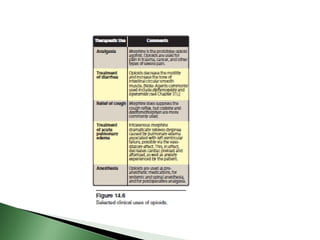
 Opioids are used to relieve intense pain, like post-
surgery pain or pain caused by diseases like cancer
 Opioids with euphoric effects have abuse potential
 Mechanism of action:
◦ Bind to μ opioid receptors relieving pain
◦ Mimic the action of endogenous peptide neurotransmitters
(endorphins, enkephalins, and dynorphins)
 Three major receptor families μ (mu), κ (kappa), and δ
(delta)
 G protein–coupled receptor family and inhibit adenylyl
cyclase
 Also associated with ion channels, increasing postsynaptic
K+ efflux (hyperpolarization) or reducing presynaptic Ca2+
influx, thus slowing neuronal firing and transmitter release
 The analgesic properties of the opioids are mediated by the
μ receptors
 κ receptors in the dorsal horn also contribute (e.g
butorphanol and nalbuphine owe their analgesic effect to κ-
receptor activation)
 Enkephalins interact more selectively with the δ receptors in
the periphery
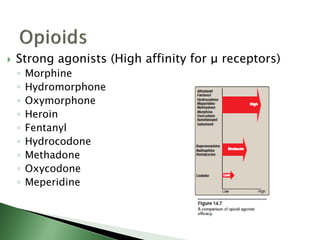
 Strong agonists (High affinity for μ receptors)
◦ Morphine
◦ Hydromorphone
◦ Oxymorphone
◦ Heroin
◦ Fentanyl
◦ Hydrocodone
◦ Methadone
◦ Oxycodone
◦ Meperidine
 Moderate/low agonists
◦ Codeine
 Mixed agonist-antagonists and partial agonists
◦ Pentazocine
◦ Butorphanol
◦ Buprenorphine
◦ Nalbuphine
 Antagonists
◦ Naloxone
◦ Naltrexone
 Other analgesics
◦ Tramadol
◦ Tapentadol
Morphine:
 The major analgesic drug contained in crude opium
 Has high affinity for μ receptors
 Mechanism of action:
◦ μ-Receptor agonist
◦ Opioids cause hyperpolarization of nerve cells, inhibition of
nerve firing, and presynaptic inhibition of transmitter release
◦ Morphine acts at κ receptors in the dorsal horn of the spinal
cord, and decreases the release of substance P, which
modulates pain perception in the spinal cord
◦ Morphine inhibits the release of many excitatory transmitters
from nerve terminals carrying nociceptive (painful) stimuli
 Actions:
◦ Analgesia (relief of pain without loss of consciousness)
◦ Euphoria: powerful sense of contentment and well being
◦ Respiratory depression by reduction of the sensitivity of
respiratory center neurons to carbon dioxide
(main cause of death in overdose)
 Tolerance to this effect develops quickly with repeated
dosing, which allows the safe use of morphine for the
treatment of pain
◦ Depression of cough reflex (antitussive effects)
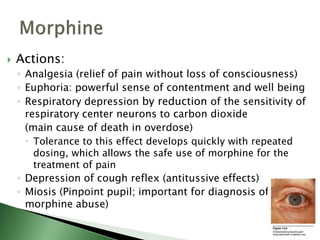
◦ Miosis (Pinpoint pupil; important for diagnosis of
morphine abuse)
 Actions
◦ Emesis: due to triggering of chemoreceptor zone
◦ GI effects: constipation
◦ Cardiovascular: at large doses hypotension and
bradycardia may occur
◦ Histamine release: Morphine releases histamine from mast
cells, causing urticaria, sweating, and vasodilation, can
cause bronchoconstriction
◦ Hormonal actions: Morphine increases growth hormone
release and enhances prolactin secretion, and ADH
 Therapeutic uses:
◦ Analgesia
◦ Treatment of acute pulmonary edema: IV morphine
relieves dyspnea by its vasodilatory effect
 Administered IM, SC, IV
(significant first pass effect)
 In case of chronic neoplastic pain, morphine can be
administered as extended release tablets or pumps that
allow the patient to control pain through self
administration
 Not used for analgesia during labor
 Infants born of addicted mothers show physical
dependence and exhibit withdrawal symptoms if
opioids are not administered
 Adverse effects
◦ Respiratory depression
◦ Hypotension
◦ Vomiting
◦ Tolerance and physical dependence: Repeated morphine use
causes tolerance to respiratory depressant, analgesic and
euphoric effects
 Detoxification of morphine-dependent individuals is
accomplished through the oral administration of
methadone, buprenorphine or clonidine
 Morphine should be used cautiously in patients with
bronchial asthma, liver failure, or impaired renal
function
 A synthetic opioid used for acute pain
 Mechanism of action: Meperidine binds to opioid
receptors, particularly μ receptors providing
analgesia
 Adverse effects
◦ Respiratory depression
◦ Repeated administration can cause anxiety,
tremors, muscle twitches, and rarely convulsions,
due to the accumulation of the neurotoxic
metabolite normeperidin
 μ-Receptor agonist
 NMDA receptor antagonist, useful in treatment of
neurogenic pain
 Causes less euphoria and less dependence than
morphine
 Uses:
◦ Analgesia
◦ Controlling withdrawal symptoms of dependent abusers
of morphine and heroin
 μ-Receptor agonist
 Has 100-fold the analgesic potency of morphine
 Used in anesthesia
 Administered IV, epidurally or intrathecally
 Epidural fentanyl is used to induce anesthesia and
for analgesia post-operatively and during labor
 Can cause hypoventilation
 Sufentanil, alfentanil, and remifentanil are related
to fentanyl
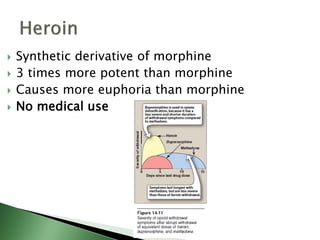
 Synthetic derivative of morphine
 3 times more potent than morphine
 Causes more euphoria than morphine
 No medical use
 Oxycodone
◦ Orally active and is sometimes formulated with aspirin or
acetaminophen
◦ Used to treat moderate to severe pain Oxymorphone
 Oxymorphone
◦ Narcotic analgesic
 Hydromorphone
◦ Oral hydromorphone is 8-10 times more potent than oral morphine as
an analgesic and is used most often to treat severe pain
 Hydrocodone
◦ Analgesic potency of oral hydrocodone is approximately that of
morphine
◦ Hydrocodone is often combined with acetaminophen or ibuprofen to
treat moderate-to-severe pain
 Moderate/low agonist
 Good antitussive activity at doses that do not cause
analgesia
 Metabolized to morphine in the body by CYP2D6
causing analgesic effects (30% that of morphine)
 Causes euphoria
 Lower abuse potential than morphine at commonly
used doses
 Mixed agonist-antagonists: Drugs that stimulate
one receptor but block another
 The effects of these drugs depend on previous
exposure to opioids
◦ In individuals who have not recently received opioids
(naïve patients), mixed agonist-antagonists show
agonist activity and are used to relieve pain
◦ In patient with opioid dependence, the agonist-
antagonist drugs may show primarily blocking effects
and produce withdrawal symptoms
 Acts as an agonist on κ receptors and a weak antagonist at
μ and δ receptors
 Pentazocine promotes analgesia by activating receptors in
the spinal cord, and it is used to relieve moderate pain
 Produces less euphoria than morphine
 Causes respiratory depression at higher doses
 High doses increase blood pressure and can cause
hallucinations, nightmares, dysphoria, tachycardia, and
dizziness
 In angina, pentazocine increases the mean aortic pressure
and pulmonary arterial pressure increasing the work of the
heart
 Does not antagonize the respiratory depression of
morphine
 Tolerance and dependence develop on repeated use
 Partial μ receptor agonist
 Acts like morphine in naive patients
 Can precipitate withdrawal in morphine users
 Used in opiate detoxification, has less severe and
shorter duration of withdrawal symptoms compared to
methadone
 Has a long duration of action because of its tight
binding to the μ receptor
 Adverse effects
◦ Respiratory depression that cannot easily be reversed by
naloxone
◦ Nausea
◦ Dizziness
Tramadol
 Centrally acting analgesic that binds to μ-opioid receptor
 Weakly inhibits reuptake of norepinephrine and serotonin
 Used to manage moderate to moderately severe pain
 Less respiratory depression than morphine
 Anaphylactoid reactions have been reported
 Toxicity through drug-drug interactions with medications, such
as SSRIs and TCAs or in overdose leads to CNS excitation and
seizures
 Tramadol should be avoided in patients taking MAOIs
Tapentadol
 Centrally acting analgesic that binds the μ-opioid receptor and is
also a norepinephrine reuptake inhibitor
 Used to manage moderate to severe pain
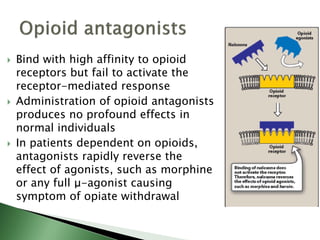
 Bind with high affinity to opioid
receptors but fail to activate the
receptor-mediated response
 Administration of opioid antagonists
produces no profound effects in
normal individuals
 In patients dependent on opioids,
antagonists rapidly reverse the
effect of agonists, such as morphine
or any full μ-agonist causing
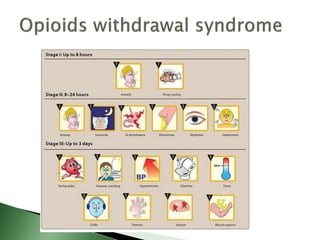
symptom of opiate withdrawal
 Used to reverse the coma and respiratory depression of
opioid overdose
 Rapidly displaces all receptor-bound opioid molecules
reversing their effects
 Within 30 seconds of IV injection of naloxone the
respiratory depression and coma characteristic of high
doses of morphine are reversed causing the patient to
be revived and alert
 Naloxone is a competitive antagonist at μ, κ, and δ,
receptors
 Short half life (30-80 min)
 Can cause withdrawal symptoms in opioid abusers
 Similar effects to naloxone with a longer
duration of action
 A single oral dose can block Heroin effects for
up to 48 hours
 Can cause hepatotoxicity

Opioids Drugs

  • 2.
     Pain isan unpleasant sensation that can be acute or chronic and involves complex neurochemical processes in the peripheral and central nervous system  Pain is subjective, and the physician must rely on the patients’ perception and description of their pain  For mild to moderate pain NSAIDs like ibuprofen are used  Neurogenic pain responds best to anticonvulsants (e.g pregabalin), tricyclic antidepressants (amitriptyline), or SNRI (duloxetine)  For severe or chronic pain opioids are the drug of choice
  • 3.
     Opioids arenatural or synthetic compounds that produce morphine like effects  “Opiate” is the term used for drugs obtained from opium poppy such as morphine and codeine  Opioids are used to relieve intense pain, like post- surgery pain or pain caused by diseases like cancer  Opioids with euphoric effects have abuse potential  Mechanism of action: ◦ Bind to μ opioid receptors relieving pain ◦ Mimic the action of endogenous peptide neurotransmitters (endorphins, enkephalins, and dynorphins)
  • 5.
     Three majorreceptor families μ (mu), κ (kappa), and δ (delta)  G protein–coupled receptor family and inhibit adenylyl cyclase  Also associated with ion channels, increasing postsynaptic K+ efflux (hyperpolarization) or reducing presynaptic Ca2+ influx, thus slowing neuronal firing and transmitter release  The analgesic properties of the opioids are mediated by the μ receptors  κ receptors in the dorsal horn also contribute (e.g butorphanol and nalbuphine owe their analgesic effect to κ- receptor activation)  Enkephalins interact more selectively with the δ receptors in the periphery
  • 6.
     Strong agonists(High affinity for μ receptors) ◦ Morphine ◦ Hydromorphone ◦ Oxymorphone ◦ Heroin ◦ Fentanyl ◦ Hydrocodone ◦ Methadone ◦ Oxycodone ◦ Meperidine
  • 7.
     Moderate/low agonists ◦Codeine  Mixed agonist-antagonists and partial agonists ◦ Pentazocine ◦ Butorphanol ◦ Buprenorphine ◦ Nalbuphine  Antagonists ◦ Naloxone ◦ Naltrexone  Other analgesics ◦ Tramadol ◦ Tapentadol
  • 8.
    Morphine:  The majoranalgesic drug contained in crude opium  Has high affinity for μ receptors  Mechanism of action: ◦ μ-Receptor agonist ◦ Opioids cause hyperpolarization of nerve cells, inhibition of nerve firing, and presynaptic inhibition of transmitter release ◦ Morphine acts at κ receptors in the dorsal horn of the spinal cord, and decreases the release of substance P, which modulates pain perception in the spinal cord ◦ Morphine inhibits the release of many excitatory transmitters from nerve terminals carrying nociceptive (painful) stimuli
  • 9.
     Actions: ◦ Analgesia(relief of pain without loss of consciousness) ◦ Euphoria: powerful sense of contentment and well being ◦ Respiratory depression by reduction of the sensitivity of respiratory center neurons to carbon dioxide (main cause of death in overdose)  Tolerance to this effect develops quickly with repeated dosing, which allows the safe use of morphine for the treatment of pain ◦ Depression of cough reflex (antitussive effects) ◦ Miosis (Pinpoint pupil; important for diagnosis of morphine abuse)
  • 10.
     Actions ◦ Emesis:due to triggering of chemoreceptor zone ◦ GI effects: constipation ◦ Cardiovascular: at large doses hypotension and bradycardia may occur ◦ Histamine release: Morphine releases histamine from mast cells, causing urticaria, sweating, and vasodilation, can cause bronchoconstriction ◦ Hormonal actions: Morphine increases growth hormone release and enhances prolactin secretion, and ADH
  • 11.
     Therapeutic uses: ◦Analgesia ◦ Treatment of acute pulmonary edema: IV morphine relieves dyspnea by its vasodilatory effect  Administered IM, SC, IV (significant first pass effect)  In case of chronic neoplastic pain, morphine can be administered as extended release tablets or pumps that allow the patient to control pain through self administration
  • 12.
     Not usedfor analgesia during labor  Infants born of addicted mothers show physical dependence and exhibit withdrawal symptoms if opioids are not administered
  • 13.
     Adverse effects ◦Respiratory depression ◦ Hypotension ◦ Vomiting ◦ Tolerance and physical dependence: Repeated morphine use causes tolerance to respiratory depressant, analgesic and euphoric effects  Detoxification of morphine-dependent individuals is accomplished through the oral administration of methadone, buprenorphine or clonidine  Morphine should be used cautiously in patients with bronchial asthma, liver failure, or impaired renal function
  • 15.
     A syntheticopioid used for acute pain  Mechanism of action: Meperidine binds to opioid receptors, particularly μ receptors providing analgesia  Adverse effects ◦ Respiratory depression ◦ Repeated administration can cause anxiety, tremors, muscle twitches, and rarely convulsions, due to the accumulation of the neurotoxic metabolite normeperidin
  • 16.
     μ-Receptor agonist NMDA receptor antagonist, useful in treatment of neurogenic pain  Causes less euphoria and less dependence than morphine  Uses: ◦ Analgesia ◦ Controlling withdrawal symptoms of dependent abusers of morphine and heroin
  • 18.
     μ-Receptor agonist Has 100-fold the analgesic potency of morphine  Used in anesthesia  Administered IV, epidurally or intrathecally  Epidural fentanyl is used to induce anesthesia and for analgesia post-operatively and during labor  Can cause hypoventilation  Sufentanil, alfentanil, and remifentanil are related to fentanyl
  • 19.
     Synthetic derivativeof morphine  3 times more potent than morphine  Causes more euphoria than morphine  No medical use
  • 20.
     Oxycodone ◦ Orallyactive and is sometimes formulated with aspirin or acetaminophen ◦ Used to treat moderate to severe pain Oxymorphone  Oxymorphone ◦ Narcotic analgesic  Hydromorphone ◦ Oral hydromorphone is 8-10 times more potent than oral morphine as an analgesic and is used most often to treat severe pain  Hydrocodone ◦ Analgesic potency of oral hydrocodone is approximately that of morphine ◦ Hydrocodone is often combined with acetaminophen or ibuprofen to treat moderate-to-severe pain
  • 21.
     Moderate/low agonist Good antitussive activity at doses that do not cause analgesia  Metabolized to morphine in the body by CYP2D6 causing analgesic effects (30% that of morphine)  Causes euphoria  Lower abuse potential than morphine at commonly used doses
  • 22.
     Mixed agonist-antagonists:Drugs that stimulate one receptor but block another  The effects of these drugs depend on previous exposure to opioids ◦ In individuals who have not recently received opioids (naïve patients), mixed agonist-antagonists show agonist activity and are used to relieve pain ◦ In patient with opioid dependence, the agonist- antagonist drugs may show primarily blocking effects and produce withdrawal symptoms
  • 23.
     Acts asan agonist on κ receptors and a weak antagonist at μ and δ receptors  Pentazocine promotes analgesia by activating receptors in the spinal cord, and it is used to relieve moderate pain  Produces less euphoria than morphine  Causes respiratory depression at higher doses  High doses increase blood pressure and can cause hallucinations, nightmares, dysphoria, tachycardia, and dizziness  In angina, pentazocine increases the mean aortic pressure and pulmonary arterial pressure increasing the work of the heart  Does not antagonize the respiratory depression of morphine  Tolerance and dependence develop on repeated use
  • 24.
     Partial μreceptor agonist  Acts like morphine in naive patients  Can precipitate withdrawal in morphine users  Used in opiate detoxification, has less severe and shorter duration of withdrawal symptoms compared to methadone  Has a long duration of action because of its tight binding to the μ receptor  Adverse effects ◦ Respiratory depression that cannot easily be reversed by naloxone ◦ Nausea ◦ Dizziness
  • 25.
    Tramadol  Centrally actinganalgesic that binds to μ-opioid receptor  Weakly inhibits reuptake of norepinephrine and serotonin  Used to manage moderate to moderately severe pain  Less respiratory depression than morphine  Anaphylactoid reactions have been reported  Toxicity through drug-drug interactions with medications, such as SSRIs and TCAs or in overdose leads to CNS excitation and seizures  Tramadol should be avoided in patients taking MAOIs Tapentadol  Centrally acting analgesic that binds the μ-opioid receptor and is also a norepinephrine reuptake inhibitor  Used to manage moderate to severe pain
  • 26.
     Bind withhigh affinity to opioid receptors but fail to activate the receptor-mediated response  Administration of opioid antagonists produces no profound effects in normal individuals  In patients dependent on opioids, antagonists rapidly reverse the effect of agonists, such as morphine or any full μ-agonist causing symptom of opiate withdrawal
  • 27.
     Used toreverse the coma and respiratory depression of opioid overdose  Rapidly displaces all receptor-bound opioid molecules reversing their effects  Within 30 seconds of IV injection of naloxone the respiratory depression and coma characteristic of high doses of morphine are reversed causing the patient to be revived and alert  Naloxone is a competitive antagonist at μ, κ, and δ, receptors  Short half life (30-80 min)  Can cause withdrawal symptoms in opioid abusers
  • 28.
     Similar effectsto naloxone with a longer duration of action  A single oral dose can block Heroin effects for up to 48 hours  Can cause hepatotoxicity