Antipsychotic Drugs
Medicinal Chemistry III / 4th Stage/ 1st Semester
Lecture 9
Dr.Narmin Hamaamin Hussen
College of Pharmacy/University of Sulaimani
Psychosis
▪ The psychoses affect approximately 1% of the population in all cultures.
▪ They are psychogenic mental disorders involving a loss of contact with reality.
▪ The psychotic disorders include schizophrenia and the manic phase of bipolar (manic–depressive) illness.
▪ The psychoses (eg: schizophrenia) are among the most severe mental illnesses.
Schizophrenia (Split-Mind)
▪ The most common is schizophrenia, in which perception, thinking, communication, social functioning, and attention are
altered.
▪ Schizophrenia is defective dopamine neurotransmission relative excess of central dopaminergic activity.
Symptoms
Positive (HDBS)(e.g. hallucination (false perception) and delusions (false belief),behavior(disorganization),
speech (disturbances)
Negative (e.g., lack of motivation, social withdrawal, lack of interest in fun activity, doesn’t respond to questions);
Cognitive dysfunction (disorganization) may occur.
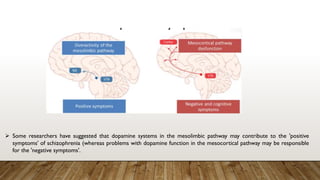
➢ Some researchers have suggested that dopamine systems in the mesolimbic pathway may contribute to the 'positive
symptoms' of schizophrenia (whereas problems with dopamine function in the mesocortical pathway may be responsible
for the 'negative symptoms'.
Dopamine and EPS
▪ Studied in Parkinson indicated that Dopamine is a Neurotransmitter (NT) involved in movement (in balance
with acetylcholine)
▪ When dopamine levels decreases, due to action of antipsychotic drugs in all Dopamine pathways,
movement related disorders called Extra Pyramidal symptoms (EPS) arise which includes
– akinesia (inability to initiate movement)
– akathisia (inability to remain motionless)
– acute dystonia (twisting of muscles)
Mechanism of action
➢ The antipsychotic mechanism of action of neuroleptics involves modulation of dopamine neurotransmission in
the mesolimbic- mesocortical pathway.
➢ This may achieve via direct D2 receptor interaction and include functional spectrum antagonism, inverse agonism
and/or partial agonism.
➢ These drugs clinical efficacy however not only depends on D2 receptor interaction , other CNS system
receptors are also involved (ach, histamine, norepinephrine and serotonin) appears to be involved , specially for
the atypical drugs.
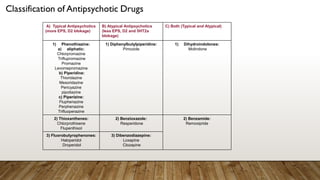
A) Typical Antipsychotics
(more EPS, D2 blokage)
B) Atypical Antipsychotics
(less EPS, D2 and 5HT2a
blokage)
C) Both (Typical and Atypical)
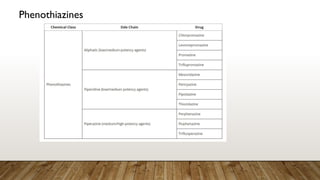
1) Phenothiazine:
a) aliphatic:
Chlorpromazine
Triflupromazine
Promazine
Levomepromazine
b) Piperidine:
Thioridazine
Mesoridazine
Pericyazine
pipotiazine
c) Piperizine:
Fluphenazine
Perphenazine
Trifluoperazine
1) Diphenylbutylpiperidine:
Pimozide
1) Dihydroindolones:
Molindone
2) Thioxanthenes:
Chlorprothixene
Flupenthixol
2) Benzioxazole:
Resperidone
2) Benzamide:
Remoxipride
3) Fluorobutyrophenones:
Haloperidol
Droperidol
3) Dibenzodiazepine:
Loxapine
Clozapine
• Typical antipsychotics (e.g., chlorpromazine, haloperidol) are better for treating positive signs than negative
signs. For treating negative signs, the newer (atypical) antipsychotic drugs (e.g., clozapine, risperidone)
target D2 receptor and other receptors.
• The bases of the atypical group’s activity against negative symptoms may be serotonin-2A receptor (5-
HT2A) block, block at receptors yet to be determined, and possibly decreased striatal D2 block.
• The conventional typical antipsychotics (neuroleptics) are characterized by the production of
EPS(Extrapyramidal Symptoms), roughly approximating the symptoms of Parkinson disease. Atypical
antipsychotics date from the discovery of clozapine, its antipsychotic properties, and its much lower
production of EPS. It has reduced EPS, has increased activity against negative symptoms, and, in addition to
its DA-blocking ability, is a 5-HT2A antagonist
Phenothiazines
SARs of phenothiazines
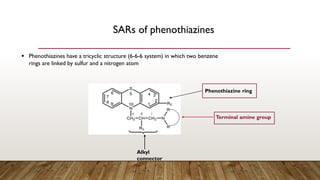
▪ Phenothiazines have a tricyclic structure (6-6-6 system) in which two benzene
rings are linked by sulfur and a nitrogen atom
Phenothiazine ring
Terminal amine group
Alkyl
connector
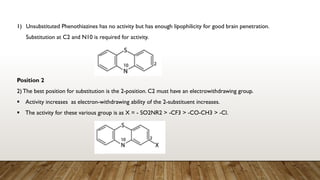
1) Unsubstituted Phenothiazines has no activity but has enough lipophilicity for good brain penetration.
Substitution at C2 and N10 is required for activity.
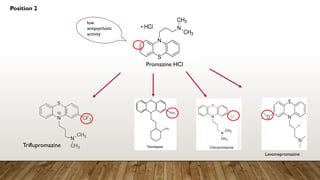
Position 2
2) The best position for substitution is the 2-position. C2 must have an electrowithdrawing group.
▪ Activity increases as electron-withdrawing ability of the 2-substituent increases.
▪ The activity for these various group is as X = - SO2NR2 > -CF3 > -CO-CH3 > -Cl.
Promazine HCl
Triflupromazine
Position 2
Levomepromazine
low
antipsychotic
activity
Position 10
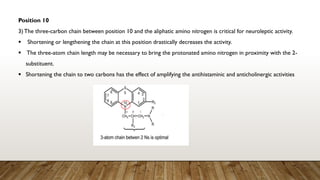
3) The three-carbon chain between position 10 and the aliphatic amino nitrogen is critical for neuroleptic activity.
▪ Shortening or lengthening the chain at this position drastically decreases the activity.
▪ The three-atom chain length may be necessary to bring the protonated amino nitrogen in proximity with the 2-
substituent.
▪ Shortening the chain to two carbons has the effect of amplifying the antihistaminic and anticholinergic activities
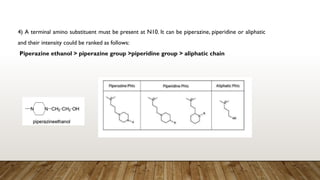
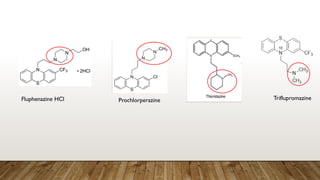
4) A terminal amino substituent must be present at N10. It can be piperazine, piperidine or aliphatic
and their intensity could be ranked as follows:
Piperazine ethanol > piperazine group >piperidine group > aliphatic chain
Fluphenazine HCl Triflupromazine
Prochlorperazine
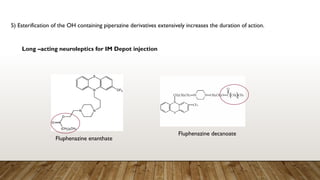
5) Esterification of the OH containing piperazine derivatives extensively increases the duration of action.
Long –acting neuroleptics for IM Depot injection
Fluphenazine decanoate
Fluphenazine enanthate
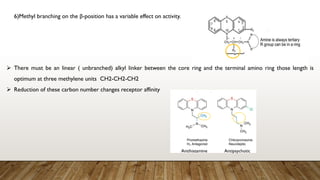
6)Methyl branching on the β-position has a variable effect on activity.
➢ There must be an linear ( unbranched) alkyl linker between the core ring and the terminal amino ring those length is
optimum at three methylene units CH2-CH2-CH2
➢ Reduction of these carbon number changes receptor affinity
Antihistamine Antipsychotic
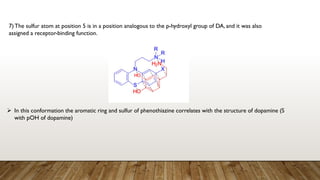
7) The sulfur atom at position 5 is in a position analogous to the p-hydroxyl group of DA, and it was also
assigned a receptor-binding function.
➢ In this conformation the aromatic ring and sulfur of phenothiazine correlates with the structure of dopamine (S
with pOH of dopamine)
Pharmacokinetic of Phenothiazine:
▪ Most phenothiazines undergo significant first-pass metabolism. Chlorpromazine and other
phenothiazines are metabolized extensively by CYP2D6.
▪ A major route is 7-hydroxylation of the tricyclic system. Because electron-withdrawing 2-Cl substituent
blocks the hydroxylation on chlorophenyl ring, the hydroxylation occurs at 7-position rather than 2-
position.
▪ Thus, the major initial metabolite is frequently the 7-hydroxy compound (active metabolite). This
compound is further metabolized by conjugation with glucuronic acid.
Chlorpromazine Hydrochloride:
▪ Chlorpromazine was the first phenothiazine compound used in treatment of schizophrenia.
▪ It is still useful as an antipsychotic
▪ Other uses as antiemetic agent and against hiccups
▪ Has high incidence of Extra Pyramidal side effects .
▪ Oral doses of chlorpromazine and thioridazine have systemic availability of 25% to 35% because of significant first-pass
metabolism.
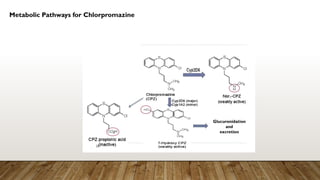
▪ Chlorpromazine and other phenothiazines are metabolized extensively by CYP2D6.
▪ In contrast, bioavailability of chlorpromazine may be increased up to 10-fold with injections, but the clinical dose usually is
decreased by only threefold to fourfold.
▪ It’s metabolite has strong antiadrenergic, weak anticholinergic and slight antihistaminergic and antiserotonergic properties
(not parent molecule).
MOA:
▪ It antagonizes Dopamine D2 in the Mesocortical and Mesolimbic pathway
Metabolic Pathways for Chlorpromazine
Thioridazine Hydrochloride:
▪ The drug has high anticholinergic activity, and this activity in the striatum, counterbalancing a striatal DA block,
may be responsible for the low EPS.
▪ The drug has sedative and hypotensive activity in common with chlorpromazine and less antiemetic activity.
▪ At high doses, pigmentary retinopathy has been observed.
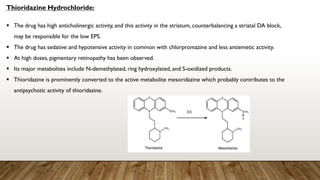
▪ Its major metabolites include N-demethylated, ring hydroxylated, and S-oxidized products.
▪ Thioridazine is prominently converted to the active metabolite mesoridazine which probably contributes to the
antipsychotic activity of thioridazine.
Thiothixene:
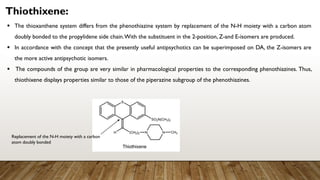
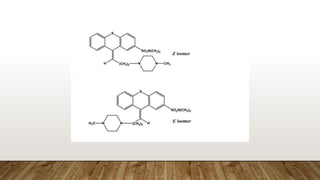
▪ The thioxanthene system differs from the phenothiazine system by replacement of the N-H moiety with a carbon atom
doubly bonded to the propylidene side chain.With the substituent in the 2-position, Z-and E-isomers are produced.
▪ In accordance with the concept that the presently useful antipsychotics can be superimposed on DA, the Z-isomers are
the more active antipsychotic isomers.
▪ The compounds of the group are very similar in pharmacological properties to the corresponding phenothiazines. Thus,
thiothixene displays properties similar to those of the piperazine subgroup of the phenothiazines.
Replacement of the N-H moiety with a carbon
atom doubly bonded
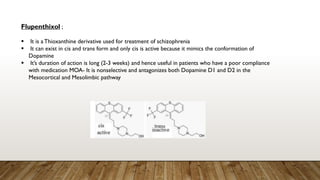
Flupenthixol ;
▪ It is a Thioxanthine derivative used for treatment of schizophrenia
▪ It can exist in cis and trans form and only cis is active because it mimics the conformation of
Dopamine
▪ It’s duration of action is long (2-3 weeks) and hence useful in patients who have a poor compliance
with medication MOA- It is nonselective and antagonizes both Dopamine D1 and D2 in the
Mesocortical and Mesolimbic pathway
Fluorobutyrophenones
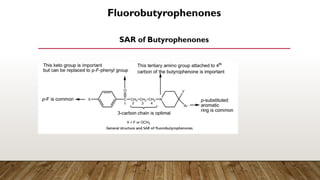
SAR of Butyrophenones
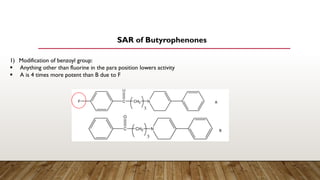
1) Modification of benzoyl group:
▪ Anything other than fluorine in the para position lowers activity
▪ A is 4 times more potent than B due to F
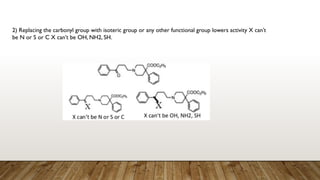
2) Replacing the carbonyl group with isoteric group or any other functional group lowers activity X can’t
be N or S or C X can’t be OH, NH2, SH.
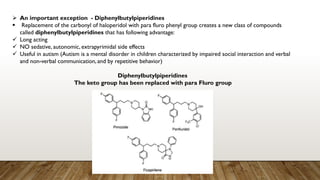
➢ An important exception - Diphenylbutylpiperidines
▪ Replacement of the carbonyl of haloperidol with para fluro phenyl group creates a new class of compounds
called diphenylbutylpiperidines that has following advantage:
✓ Long acting
✓ NO sedative, autonomic, extrapyrimidal side effects
✓ Useful in autism (Autism is a mental disorder in children characterized by impaired social interaction and verbal
and non-verbal communication, and by repetitive behavior)
Diphenylbutylpiperidines
The keto group has been replaced with para Fluro group
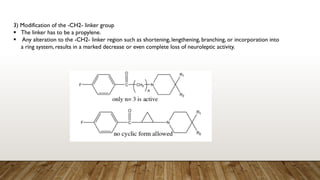
3) Modification of the -CH2- linker group
▪ The linker has to be a propylene.
▪ Any alteration to the -CH2- linker region such as shortening, lengthening, branching, or incorporation into
a ring system, results in a marked decrease or even complete loss of neuroleptic activity.
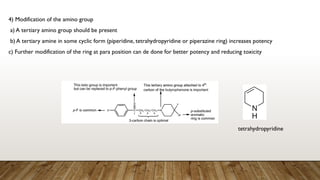
4) Modification of the amino group
a) A tertiary amino group should be present
b) A tertiary amine in some cyclic form (piperidine, tetrahydropyridine or piperazine ring) increases potency
c) Further modification of the ring at para position can de done for better potency and reducing toxicity
tetrahydropyridine
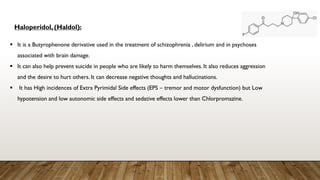
Haloperidol, (Haldol):
▪ It is a Butyrophenone derivative used in the treatment of schizophrenia , delirium and in psychoses
associated with brain damage.
▪ It can also help prevent suicide in people who are likely to harm themselves. It also reduces aggression
and the desire to hurt others. It can decrease negative thoughts and hallucinations.
▪ It has High incidences of Extra Pyrimidal Side effects (EPS – tremor and motor dysfunction) but Low
hypotension and low autonomic side effects and sedative effects lower than Chlorpromazine.
Metabolism
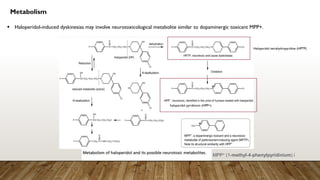
▪ Haloperidol-induced dyskinesias may involve neurotoxicological metabolite similar to dopaminergic toxicant MPP+.
Haloperidol tetrahydropyridine (HPTP)
haloperidol pyridinium (HPP+)
MPP+ (1-methyl-4-phenylpyridinium) i
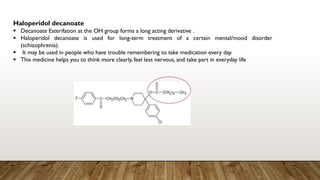
Haloperidol decanoate
▪ Decanoate Esterifation at the OH group forms a long acting derivative .
▪ Haloperidol decanoate is used for long-term treatment of a certain mental/mood disorder
(schizophrenia).
▪ It may be used in people who have trouble remembering to take medication every day.
▪ This medicine helps you to think more clearly, feel less nervous, and take part in everyday life
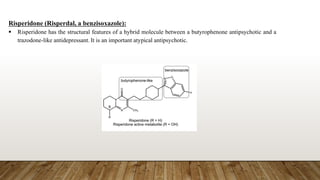
Risperidone (Risperdal, a benzisoxazole):
▪ Risperidone has the structural features of a hybrid molecule between a butyrophenone antipsychotic and a
trazodone-like antidepressant. It is an important atypical antipsychotic.
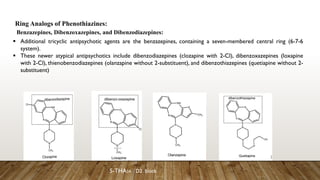
Ring Analogs of Phenothiazines:
Benzazepines, Dibenzoxazepines, and Dibenzodiazepines:
▪ Additional tricyclic antipsychotic agents are the benzazepines, containing a seven-membered central ring (6-7-6
system).
▪ These newer atypical antipsychotics include dibenzodiazepines (clozapine with 2-Cl), dibenzoxazepines (loxapine
with 2-Cl), thienobenzodiazepines (olanzapine without 2-substituent), and dibenzothiazepines (quetiapine without 2-
substituent)
5-THA2A – D2 block
Both (Typical and Atypical):
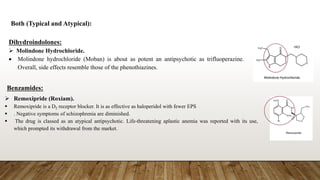
Dihydroindolones:
➢ Molindone Hydrochloride.
• Molindone hydrochloride (Moban) is about as potent an antipsychotic as trifluoperazine.
Overall, side effects resemble those of the phenothiazines.
Benzamides:
➢ Remoxipride (Roxiam).
▪ Remoxipride is a D2 receptor blocker. It is as effective as haloperidol with fewer EPS
▪ . Negative symptoms of schizophrenia are diminished.
▪ The drug is classed as an atypical antipsychotic. Life-threatening aplastic anemia was reported with its use,
which prompted its withdrawal from the market.
Antimanic Agents:
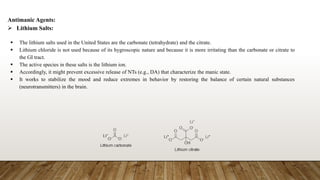
➢ Lithium Salts:
▪ The lithium salts used in the United States are the carbonate (tetrahydrate) and the citrate.
▪ Lithium chloride is not used because of its hygroscopic nature and because it is more irritating than the carbonate or citrate to
the GI tract.
▪ The active species in these salts is the lithium ion.
▪ Accordingly, it might prevent excessive release of NTs (e.g., DA) that characterize the manic state.
▪ It works to stabilize the mood and reduce extremes in behavior by restoring the balance of certain natural substances
(neurotransmitters) in the brain.
Antipsychotic Drugs/Medicinal Chemistry