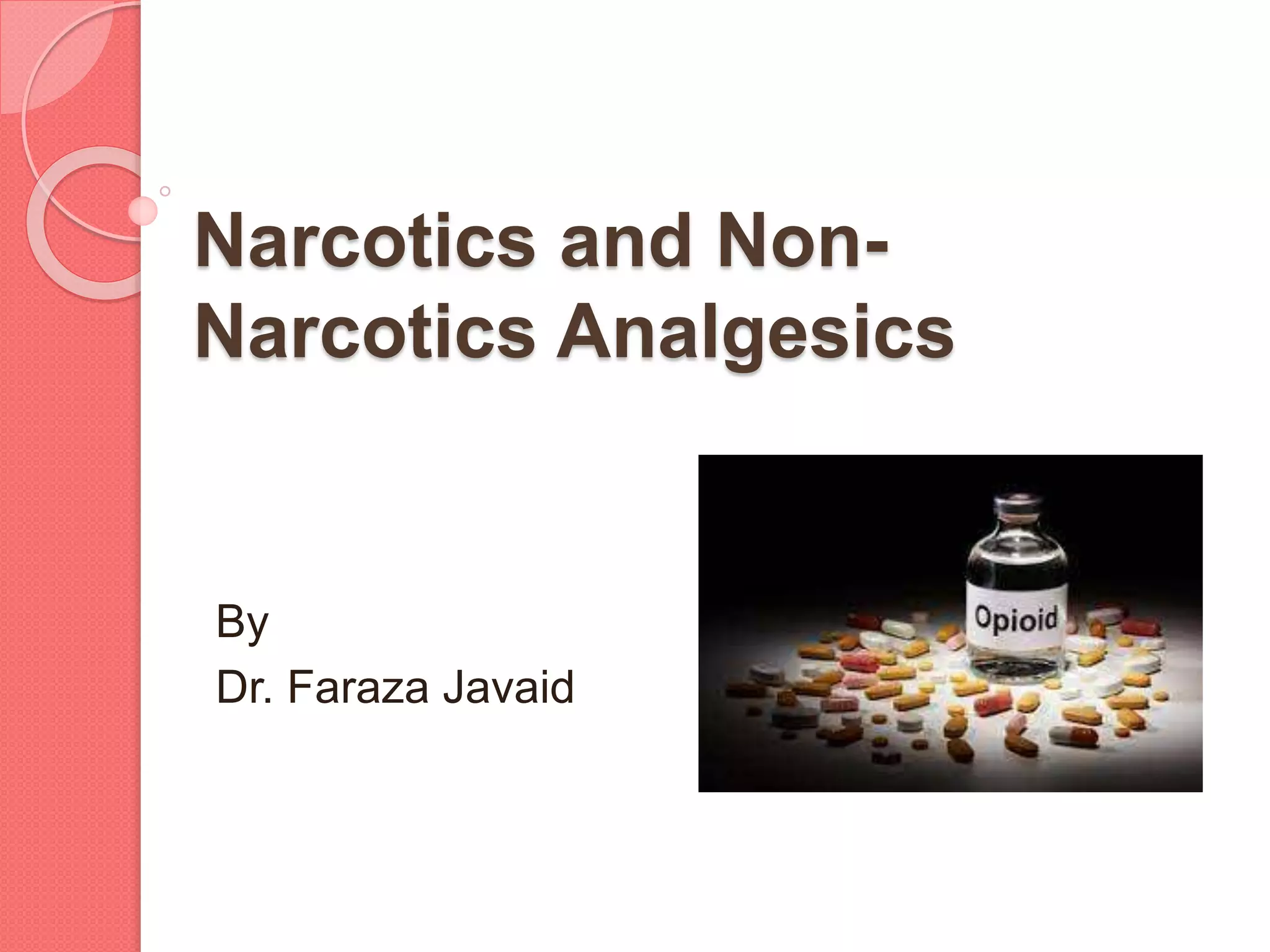
Narcotics and Non-
Narcotics Analgesics
By
Dr. Faraza Javaid
Analgesics
An analgesic, or painkiller, is any member of the group
of drugs used to achieve analgesia — relief from pain.
Major classes of Analgesic Drugs include:
 Opioids
 NSAIDs
 Acetaminophen/ PCM
 Flupirtine
 Ziconotide
Narcotics Analgesic/Opioids
Narcotic analgesics are drugs that relieve pain,
by binding to opioid receptors, which are
present in the central and peripheral
nervous system, can cause numbness and
induce a state of unconsciousness.
Classified into:
Natural Compounds: Morphine, Codeine, Papaverine
Semi-Synthetic: Diacetylmorphine (Heroin),
benzylmorphine and ethylmorphine
Synthetic Derivatives: Fentanyl, Pethidine, Methadone,
Tramadol and Propoxyphene
Loperamide, an opiate that does not enter the brain and
therefore lacks analgesic activity.
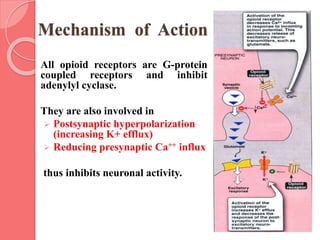
Mechanism of Action
All opioid receptors are G-protein
coupled receptors and inhibit
adenylyl cyclase.
They are also involved in
 Postsynaptic hyperpolarization
(increasing K+ efflux)
 Reducing presynaptic Ca++ influx
thus inhibits neuronal activity.
Opioid Receptors
All opioid receptors are linked through G-proteins to
inhibition of adenylate cyclase. They also facilitate
opening of potassium channels (causing
hyperpolarization) and inhibit opening of calcium
channels (inhibiting transmitter release).
They are of 4 types:
 μ receptor
 σ receptor
 δ receptor
 Κ receptor
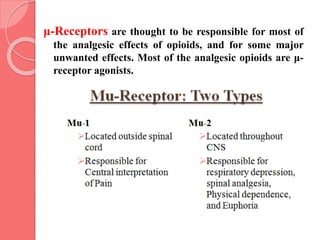
μ-Receptors are thought to be responsible for most of
the analgesic effects of opioids, and for some major
unwanted effects. Most of the analgesic opioids are μ-
receptor agonists.
 κ-Receptors contribute to analgesia at the spinal
level and may elicit sedation and dysphoria, but
produce relatively few unwanted effects and do not
contribute to dependence.
 δ-Receptors are probably more important in the
periphery and may also contribute to analgesia.
 σ-Receptors are not true opioid receptors and it is
unclear that what delta actually responsible for but
may regulate mu receptor activity.
Agonist and Antagonist
Opiates vary not only in their receptor specificity but
also in their efficacy at the different types of receptor.
Thus some agents act as agonists on one type of
receptor, and antagonists or partial agonists at
another, producing a very complicated
pharmacological picture.
Pure Agonists
This group includes most of the typical morphine-like
drugs. They all have high affinity for μ receptors and
generally lower affinity for δ and κ sites. Some drugs
of this type, notably codeine, methadone are
sometimes referred to as weak agonists because their
maximal effects, both analgesic and unwanted, are
less than those of morphine, and they do not cause
dependence. Whether they are truly partial agonists
is not established.
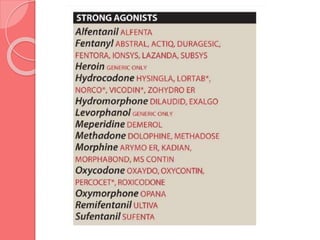
Pure agonist drugs include Morphine, Heroin,
Methadone, Fentanyl, Codeine.
Morphine
Morphine is the major analgesic drug contained in crude
opium and is the prototype strong agonist.
Morphine may be given by injection (intravenous or
intramuscular) or by mouth, often as slow-release
tablets. It is metabolized to morphine-6-glucuronide,
which is more potent as an analgesic.
Actions of Morphine:
Analgesia
Euphoria and sedation
Respiratory depression and suppression of cough
Reduced gastrointestinal motility, causing
constipation
Histamine release, causing bronchoconstriction.
 Morphine rapidly enters all body tissues, including
the fetuses of pregnant women. It should not be used
for analgesia during labor. Infants born to addicted
mothers show physical dependence on opioids and
exhibit withdrawal symptoms if opioids are not
administered.
 Morphine is conjugated with glucuronic acid in the
liver to two active metabolites (morphine-6-
glucuronide [M6G] and morphine-3-glucuronide
[M3G]), which are renally excreted.
Side Effects:
 Drug of addiction due to euphoric effect
 Over dose causes poisoning i.e. Coma and
Respiratory Depression.
 Opioid induced constipation
 Cause dryness of mouth, mental clouding,
vomiting, headache, fatigue, constipation etc.
 Morphine should be used with caution in patients
with liver disease and renal dysfunction.
Tolerance and physical dependence
Repeated use produces tolerance to the respiratory
depressant, analgesic, euphoric, emetic, and sedative effects
of morphine. Withdrawal produces a series of autonomic,
motor, and psychological responses that can be severe,
although it is rare that withdrawal effects cause death.
Drug interactions
The depressant actions of morphine are enhanced by
coadministration with CNS depressant medications such as
phenothiazines, MAOIs, and benzodiazepines. A black box
warning also has been included on the labeling of both
opioids and benzodiazepines to alert prescribers of this
dangerous combination.
Methadone
Methadone is a synthetic, orally effective opioid that is
approximately equal in potency to morphine but
induces less euphoria and has somewhat longer
duration of action.
Methadone is readily absorbed following oral
administration. The drug is biotransformed in the
liver and is excreted in the urine, mainly as inactive
metabolites.
Adverse effects: Methadone can produce physical
dependence like that of morphine.
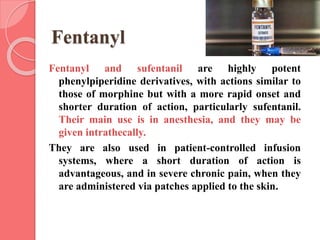
Fentanyl
Fentanyl and sufentanil are highly potent
phenylpiperidine derivatives, with actions similar to
those of morphine but with a more rapid onset and
shorter duration of action, particularly sufentanil.
Their main use is in anesthesia, and they may be
given intrathecally.
They are also used in patient-controlled infusion
systems, where a short duration of action is
advantageous, and in severe chronic pain, when they
are administered via patches applied to the skin.
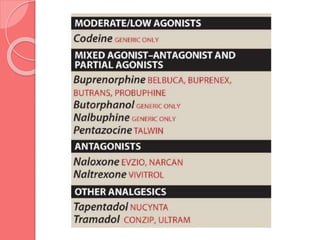
Partial Agonist and Mixed
Agonist-Antagonists
These drugs, nalorphine and pentazocine, combine a
degree of agonist and antagonist activity on
different receptors.
Pentazocine and cyclazocine, are antagonists at μ-
receptors but partial agonists on δ and κ-receptors.
Most of the drugs in this group tend to cause
dysphoria rather than euphoria, probably by
acting on the κ-receptor.
Others include Buprenorphine, Nalbuphine,
Pentazocine.
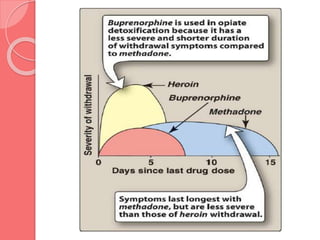
Buprenorphine
 Acts as a potent partial agonist at the μ receptor
and an antagonist at the κ receptors.
 Because of the partial μ agonist activity,
buprenorphine provides a “ceiling effect,” causing
less euphoric effects and a lower abuse potential
than that of full agonists. Additionally, the risk of
opioid-induced respiratory depression may be
lower when compared with full agonists, except
when combined with CNS depressants such as
benzodiazepines.
Approved for use in medication-assisted treatment of
opioid addiction due to its ability to provide prolonged
suppression of opioid withdrawal, the ability to block
other μ agonists, and less frequent dosing
requirements.
In contrast to methadone, which is available only at
specialized clinics when used for opioid detoxification
or maintenance, buprenorphine is approved for office-
based treatment of opioid dependence.
Nalorphine
Nalorphine is closely related in structure to morphine
and has a more complicated action. In low doses, it is a
competitive antagonist and blocks most actions of
morphine.
Higher doses, are analgesic and mimic the effects of
morphine. These effects probably reflect an antagonist
action on μ-receptors, coupled with a partial agonist
action on δ and κ-receptors, the latter causing
dysphoria, which makes it unsuitable for use as an
analgesic.
 Pentazocine is a mixed agonist-antagonist with
analgesic properties similar to those of morphine.
However, it causes marked dysphoria, with
nightmares and hallucinations, rather than euphoria,
and is now rarely used.
Tapentadol
Agonist at the μ opioid receptor and an inhibitor of
norepinephrine reuptake. It is used to manage moderate to
severe acute and chronic pain, including neuropathic pain
associated with diabetic peripheral neuropathy. Tapentadol is
mainly metabolized to inactive metabolites via
glucuronidation, and it does not inhibit or induce the CYP450
enzyme system.
Tramadol
Binds to the μ opioid receptor. It undergoes extensive
metabolism via CYP2D6, leading to an active metabolite,
which has a much higher affinity for the mu receptor than the
parent compound. In addition, it weakly inhibits reuptake of
norepinephrine and serotonin. It is used to manage moderate
to severe pain. Of note, tramadol has less respiratory-
depressant activity compared to morphine.
Antagonist
These drugs produce very little effect when
given on their own but block the effects of
opiates.
The most important examples are:
 Naloxone
 Naltrexone
Naloxone
Naloxone was the first pure opioid antagonist, with
affinity for all three opioid receptors.
The main clinical uses of naloxone are to treat respiratory
depression caused by opiate over dosage. It is usually
given intravenously, and its effects are produced
immediately. It is rapidly metabolized by the liver, and
its effect lasts only 2-4 hours, which is considerably
shorter than that of most morphine-like drugs.
Therefore it may have to be given repeatedly.
Naloxone has no important unwanted effects of its own
and can be used to detect opiate addiction.
Naltrexone
Naltrexone is very similar to naloxone but with the
advantage of a much longer duration of action (half-life
about 10 hours).
Specific antagonists at μ, δ and κ-receptors are available
for experimental use but not yet for clinical purposes.
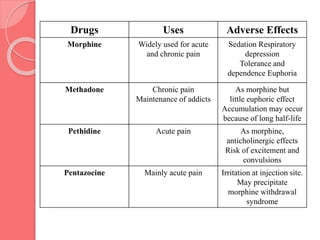
Drugs Uses Adverse Effects
Morphine Widely used for acute
and chronic pain
Sedation Respiratory
depression
Tolerance and
dependence Euphoria
Methadone Chronic pain
Maintenance of addicts
As morphine but
little euphoric effect
Accumulation may occur
because of long half-life
Pethidine Acute pain As morphine,
anticholinergic effects
Risk of excitement and
convulsions
Pentazocine Mainly acute pain Irritation at injection site.
May precipitate
morphine withdrawal
syndrome
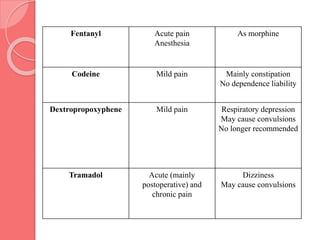
Fentanyl Acute pain
Anesthesia
As morphine
Codeine Mild pain Mainly constipation
No dependence liability
Dextropropoxyphene Mild pain Respiratory depression
May cause convulsions
No longer recommended
Tramadol Acute (mainly
postoperative) and
chronic pain
Dizziness
May cause convulsions
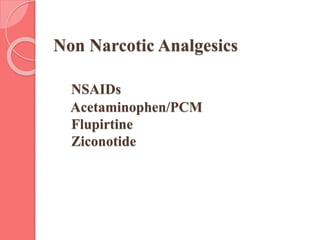
Non Narcotic Analgesics
NSAIDs
Acetaminophen/PCM
Flupirtine
Ziconotide
Acetaminophen
 Popular, safer alternate to Aspirin (as anti-pyretic and
analgesic)
 Domestic analgesic
 Used in both adults and children
 Over the counter drug (OTC)
 Rapidly absorbed, mostly metabolized by conjugation
and excreted by kidney
 Very less adverse effect in there therapeutic dose
Mechanism of Action
Paracetamol has no significant action on COX-1 and
COX-2, which left its mode of action a mystery but did
explain its lack of anti-inflammatory action and also,
more importantly, its freedom from gastrointestinal
side effects typical of NSAIDs.
Now, recent research has shown the presence of a new,
previously unknown cyclooxygenase enzyme COX-3,
found in the brain and spinal cord, which is selectively
inhibited by paracetamol, and is distinct from the two
already known cyclooxygenase enzymes COX-1 and
COX-2.
It is now believed that this selective inhibition of the
enzyme COX-3 in the brain and spinal cord explains
the effectiveness of paracetamol in relieving pain and
reducing fever without having unwanted
gastrointestinal side effects.
The action of paracetamol at a molecular level is unclear
but there is considerable evidence that the analgesic
effect of paracetamol is central and is due to activation
of descending serotonergic pathways, but its primary
site of action may still be inhibition of PG synthesis.
Uses
 Useful in mild to moderate pain like headache,
pyrexia, myalgia etc
 In case of patients allergic to Aspirin
 Patient with hemophilia.
 Patient with PUD (peptic ulcer disease)
 Patients who are taking other uricosuric drugs
(salicylate competes with the uric acid in tubular
secretion)
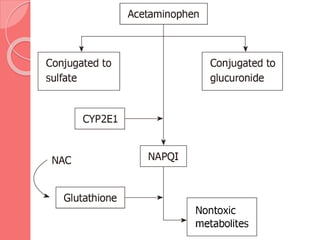
Acetaminophen is rapidly absorbed from the GI tract and
undergoes significant first-pass metabolism. It is conjugated
in the liver to form inactive glucuronidated or sulfated
metabolites.
A portion of acetaminophen is hydroxylated to form N-
acetyl-p-benzoquinoneimine, or NAPQI, a highly reactive
metabolite that can react with sulfhydryl groups and cause
liver damage. At normal doses of acetaminophen, NAPQI
reacts with the sulfhydryl group of glutathione produced by
the liver, forming a nontoxic substance.
Acetaminophen and its metabolites are excreted in urine. The
drug is also available in intravenous and rectal formulations.
Adverse effects
 At normal therapeutic doses, acetaminophen has few
significant adverse effects. With large doses of
acetaminophen, the available glutathione in the liver
becomes depleted, and NAPQI reacts with the sulfhydryl
groups of hepatic proteins.
 Hepatic necrosis, a serious and potentially life-
threatening condition, can result. Patients with hepatic
disease, viral hepatitis, or a history of alcoholism are at
higher risk of acetaminophen-induced hepatotoxicity.
 N-acetylcysteine is an antidote in cases of overdose.
Acetaminophen should be avoided in patients with severe
hepatic impairment.
Flupirtine
Flupirtine is a centrally acting, non-opioid analgesic that is
available in a number of European countries for the
treatment of a variety of pain states.
Flupirtine acts indirectly as NMDA receptor antagonist by
activation of K+ channels.
Ziconotide
Ziconotide (Prialt) is a non-narcotic pain reliever that is
used to treat severe chronic pain in people who cannot
use or do not respond to standard pain-relieving
medications.
Mechanism: Ziconotide acts as a voltage-gated calcium
channel blocker.
This action inhibits the release of nociceptive
neurochemicals like glutamate and substance P in the
brain and spinal cord, resulting in pain relief.
In humans, spinal infusion of Prialt produces significant
pain relief in patients with intractable pain associated
with cancer, AIDS and in some neuropathic pain
conditions.
Assignment????
THANK YOU

Narcotics and Non-Narcotics Analgesics.pptx

  • 1.
    Narcotics and Non- NarcoticsAnalgesics By Dr. Faraza Javaid
  • 2.
    Analgesics An analgesic, orpainkiller, is any member of the group of drugs used to achieve analgesia — relief from pain. Major classes of Analgesic Drugs include:  Opioids  NSAIDs  Acetaminophen/ PCM  Flupirtine  Ziconotide
  • 3.
    Narcotics Analgesic/Opioids Narcotic analgesicsare drugs that relieve pain, by binding to opioid receptors, which are present in the central and peripheral nervous system, can cause numbness and induce a state of unconsciousness.
  • 4.
    Classified into: Natural Compounds:Morphine, Codeine, Papaverine Semi-Synthetic: Diacetylmorphine (Heroin), benzylmorphine and ethylmorphine Synthetic Derivatives: Fentanyl, Pethidine, Methadone, Tramadol and Propoxyphene Loperamide, an opiate that does not enter the brain and therefore lacks analgesic activity.
  • 7.
    Mechanism of Action Allopioid receptors are G-protein coupled receptors and inhibit adenylyl cyclase. They are also involved in  Postsynaptic hyperpolarization (increasing K+ efflux)  Reducing presynaptic Ca++ influx thus inhibits neuronal activity.
  • 8.
    Opioid Receptors All opioidreceptors are linked through G-proteins to inhibition of adenylate cyclase. They also facilitate opening of potassium channels (causing hyperpolarization) and inhibit opening of calcium channels (inhibiting transmitter release). They are of 4 types:  μ receptor  σ receptor  δ receptor  Κ receptor
  • 9.
    μ-Receptors are thoughtto be responsible for most of the analgesic effects of opioids, and for some major unwanted effects. Most of the analgesic opioids are μ- receptor agonists.
  • 10.
     κ-Receptors contributeto analgesia at the spinal level and may elicit sedation and dysphoria, but produce relatively few unwanted effects and do not contribute to dependence.  δ-Receptors are probably more important in the periphery and may also contribute to analgesia.  σ-Receptors are not true opioid receptors and it is unclear that what delta actually responsible for but may regulate mu receptor activity.
  • 11.
    Agonist and Antagonist Opiatesvary not only in their receptor specificity but also in their efficacy at the different types of receptor. Thus some agents act as agonists on one type of receptor, and antagonists or partial agonists at another, producing a very complicated pharmacological picture.
  • 12.
    Pure Agonists This groupincludes most of the typical morphine-like drugs. They all have high affinity for μ receptors and generally lower affinity for δ and κ sites. Some drugs of this type, notably codeine, methadone are sometimes referred to as weak agonists because their maximal effects, both analgesic and unwanted, are less than those of morphine, and they do not cause dependence. Whether they are truly partial agonists is not established. Pure agonist drugs include Morphine, Heroin, Methadone, Fentanyl, Codeine.
  • 13.
    Morphine Morphine is themajor analgesic drug contained in crude opium and is the prototype strong agonist. Morphine may be given by injection (intravenous or intramuscular) or by mouth, often as slow-release tablets. It is metabolized to morphine-6-glucuronide, which is more potent as an analgesic. Actions of Morphine: Analgesia Euphoria and sedation Respiratory depression and suppression of cough Reduced gastrointestinal motility, causing constipation Histamine release, causing bronchoconstriction.
  • 14.
     Morphine rapidlyenters all body tissues, including the fetuses of pregnant women. It should not be used for analgesia during labor. Infants born to addicted mothers show physical dependence on opioids and exhibit withdrawal symptoms if opioids are not administered.  Morphine is conjugated with glucuronic acid in the liver to two active metabolites (morphine-6- glucuronide [M6G] and morphine-3-glucuronide [M3G]), which are renally excreted.
  • 15.
    Side Effects:  Drugof addiction due to euphoric effect  Over dose causes poisoning i.e. Coma and Respiratory Depression.  Opioid induced constipation  Cause dryness of mouth, mental clouding, vomiting, headache, fatigue, constipation etc.  Morphine should be used with caution in patients with liver disease and renal dysfunction.
  • 16.
    Tolerance and physicaldependence Repeated use produces tolerance to the respiratory depressant, analgesic, euphoric, emetic, and sedative effects of morphine. Withdrawal produces a series of autonomic, motor, and psychological responses that can be severe, although it is rare that withdrawal effects cause death. Drug interactions The depressant actions of morphine are enhanced by coadministration with CNS depressant medications such as phenothiazines, MAOIs, and benzodiazepines. A black box warning also has been included on the labeling of both opioids and benzodiazepines to alert prescribers of this dangerous combination.
  • 18.
    Methadone Methadone is asynthetic, orally effective opioid that is approximately equal in potency to morphine but induces less euphoria and has somewhat longer duration of action. Methadone is readily absorbed following oral administration. The drug is biotransformed in the liver and is excreted in the urine, mainly as inactive metabolites. Adverse effects: Methadone can produce physical dependence like that of morphine.
  • 19.
    Fentanyl Fentanyl and sufentanilare highly potent phenylpiperidine derivatives, with actions similar to those of morphine but with a more rapid onset and shorter duration of action, particularly sufentanil. Their main use is in anesthesia, and they may be given intrathecally. They are also used in patient-controlled infusion systems, where a short duration of action is advantageous, and in severe chronic pain, when they are administered via patches applied to the skin.
  • 20.
    Partial Agonist andMixed Agonist-Antagonists These drugs, nalorphine and pentazocine, combine a degree of agonist and antagonist activity on different receptors. Pentazocine and cyclazocine, are antagonists at μ- receptors but partial agonists on δ and κ-receptors. Most of the drugs in this group tend to cause dysphoria rather than euphoria, probably by acting on the κ-receptor. Others include Buprenorphine, Nalbuphine, Pentazocine.
  • 21.
    Buprenorphine  Acts asa potent partial agonist at the μ receptor and an antagonist at the κ receptors.  Because of the partial μ agonist activity, buprenorphine provides a “ceiling effect,” causing less euphoric effects and a lower abuse potential than that of full agonists. Additionally, the risk of opioid-induced respiratory depression may be lower when compared with full agonists, except when combined with CNS depressants such as benzodiazepines.
  • 22.
    Approved for usein medication-assisted treatment of opioid addiction due to its ability to provide prolonged suppression of opioid withdrawal, the ability to block other μ agonists, and less frequent dosing requirements. In contrast to methadone, which is available only at specialized clinics when used for opioid detoxification or maintenance, buprenorphine is approved for office- based treatment of opioid dependence.
  • 24.
    Nalorphine Nalorphine is closelyrelated in structure to morphine and has a more complicated action. In low doses, it is a competitive antagonist and blocks most actions of morphine. Higher doses, are analgesic and mimic the effects of morphine. These effects probably reflect an antagonist action on μ-receptors, coupled with a partial agonist action on δ and κ-receptors, the latter causing dysphoria, which makes it unsuitable for use as an analgesic.
  • 25.
     Pentazocine isa mixed agonist-antagonist with analgesic properties similar to those of morphine. However, it causes marked dysphoria, with nightmares and hallucinations, rather than euphoria, and is now rarely used.
  • 26.
    Tapentadol Agonist at theμ opioid receptor and an inhibitor of norepinephrine reuptake. It is used to manage moderate to severe acute and chronic pain, including neuropathic pain associated with diabetic peripheral neuropathy. Tapentadol is mainly metabolized to inactive metabolites via glucuronidation, and it does not inhibit or induce the CYP450 enzyme system. Tramadol Binds to the μ opioid receptor. It undergoes extensive metabolism via CYP2D6, leading to an active metabolite, which has a much higher affinity for the mu receptor than the parent compound. In addition, it weakly inhibits reuptake of norepinephrine and serotonin. It is used to manage moderate to severe pain. Of note, tramadol has less respiratory- depressant activity compared to morphine.
  • 27.
    Antagonist These drugs producevery little effect when given on their own but block the effects of opiates. The most important examples are:  Naloxone  Naltrexone
  • 28.
    Naloxone Naloxone was thefirst pure opioid antagonist, with affinity for all three opioid receptors. The main clinical uses of naloxone are to treat respiratory depression caused by opiate over dosage. It is usually given intravenously, and its effects are produced immediately. It is rapidly metabolized by the liver, and its effect lasts only 2-4 hours, which is considerably shorter than that of most morphine-like drugs. Therefore it may have to be given repeatedly. Naloxone has no important unwanted effects of its own and can be used to detect opiate addiction.
  • 29.
    Naltrexone Naltrexone is verysimilar to naloxone but with the advantage of a much longer duration of action (half-life about 10 hours). Specific antagonists at μ, δ and κ-receptors are available for experimental use but not yet for clinical purposes.
  • 30.
    Drugs Uses AdverseEffects Morphine Widely used for acute and chronic pain Sedation Respiratory depression Tolerance and dependence Euphoria Methadone Chronic pain Maintenance of addicts As morphine but little euphoric effect Accumulation may occur because of long half-life Pethidine Acute pain As morphine, anticholinergic effects Risk of excitement and convulsions Pentazocine Mainly acute pain Irritation at injection site. May precipitate morphine withdrawal syndrome
  • 31.
    Fentanyl Acute pain Anesthesia Asmorphine Codeine Mild pain Mainly constipation No dependence liability Dextropropoxyphene Mild pain Respiratory depression May cause convulsions No longer recommended Tramadol Acute (mainly postoperative) and chronic pain Dizziness May cause convulsions
  • 34.
  • 35.
    Acetaminophen  Popular, saferalternate to Aspirin (as anti-pyretic and analgesic)  Domestic analgesic  Used in both adults and children  Over the counter drug (OTC)  Rapidly absorbed, mostly metabolized by conjugation and excreted by kidney  Very less adverse effect in there therapeutic dose
  • 36.
    Mechanism of Action Paracetamolhas no significant action on COX-1 and COX-2, which left its mode of action a mystery but did explain its lack of anti-inflammatory action and also, more importantly, its freedom from gastrointestinal side effects typical of NSAIDs. Now, recent research has shown the presence of a new, previously unknown cyclooxygenase enzyme COX-3, found in the brain and spinal cord, which is selectively inhibited by paracetamol, and is distinct from the two already known cyclooxygenase enzymes COX-1 and COX-2.
  • 37.
    It is nowbelieved that this selective inhibition of the enzyme COX-3 in the brain and spinal cord explains the effectiveness of paracetamol in relieving pain and reducing fever without having unwanted gastrointestinal side effects. The action of paracetamol at a molecular level is unclear but there is considerable evidence that the analgesic effect of paracetamol is central and is due to activation of descending serotonergic pathways, but its primary site of action may still be inhibition of PG synthesis.
  • 38.
    Uses  Useful inmild to moderate pain like headache, pyrexia, myalgia etc  In case of patients allergic to Aspirin  Patient with hemophilia.  Patient with PUD (peptic ulcer disease)  Patients who are taking other uricosuric drugs (salicylate competes with the uric acid in tubular secretion)
  • 39.
    Acetaminophen is rapidlyabsorbed from the GI tract and undergoes significant first-pass metabolism. It is conjugated in the liver to form inactive glucuronidated or sulfated metabolites. A portion of acetaminophen is hydroxylated to form N- acetyl-p-benzoquinoneimine, or NAPQI, a highly reactive metabolite that can react with sulfhydryl groups and cause liver damage. At normal doses of acetaminophen, NAPQI reacts with the sulfhydryl group of glutathione produced by the liver, forming a nontoxic substance. Acetaminophen and its metabolites are excreted in urine. The drug is also available in intravenous and rectal formulations.
  • 41.
    Adverse effects  Atnormal therapeutic doses, acetaminophen has few significant adverse effects. With large doses of acetaminophen, the available glutathione in the liver becomes depleted, and NAPQI reacts with the sulfhydryl groups of hepatic proteins.  Hepatic necrosis, a serious and potentially life- threatening condition, can result. Patients with hepatic disease, viral hepatitis, or a history of alcoholism are at higher risk of acetaminophen-induced hepatotoxicity.  N-acetylcysteine is an antidote in cases of overdose. Acetaminophen should be avoided in patients with severe hepatic impairment.
  • 44.
    Flupirtine Flupirtine is acentrally acting, non-opioid analgesic that is available in a number of European countries for the treatment of a variety of pain states. Flupirtine acts indirectly as NMDA receptor antagonist by activation of K+ channels.
  • 45.
    Ziconotide Ziconotide (Prialt) isa non-narcotic pain reliever that is used to treat severe chronic pain in people who cannot use or do not respond to standard pain-relieving medications. Mechanism: Ziconotide acts as a voltage-gated calcium channel blocker. This action inhibits the release of nociceptive neurochemicals like glutamate and substance P in the brain and spinal cord, resulting in pain relief. In humans, spinal infusion of Prialt produces significant pain relief in patients with intractable pain associated with cancer, AIDS and in some neuropathic pain conditions.
  • 46.
  • 47.