TOTAL QUALITY
MANAGEMENT
By: Kirankumar Solanki
CONTENTS
 Introduction
 Objectives
 Principles of TQM
 Significance of TQM
 Elements of TQM
 Tools of TQM
 Reasons for failure
 Advantages
 Disadvantages
INTRODUCTION
 Total quality management increases the
customer satisfaction by boosting the
quality.
 It does by motivating the work force and
improving the way the company operates.
 In an increasing competitive market firms
with a continuous improvement culture and
external focus are more likely to survive and
prosper.
 TQM is consider an important catalyst in this
context.
WHAT IS TQM?
 TQM is a management approach for long term
success through customer satisfaction.
 TQM is an approach to improving the
effectiveness and flexibilities of business as a
whole.
 It is essentially a way of organizing and
involving the whole organization every
department, every activity and every single
person at every level.
 TQM ensures that the management adopts a
strategic overview of the quality and focuses on
prevention rather than inspection.
OBJECTIVES OF TQM
 To provide high quality drug product to
patients.
 Process improvement.
 Defects prevention.
 Helping teams to make better decisions.
 Continuous improvement to process
systems, people suppliers, partners,
products and services.
PRINCIPLES OF TQM
Management commitment.
Employee empowerment.
Fact based decision making.
Continuous improvement.
SIGNIFICANCE OF TQM
 The importance of TQM lies in the fact that it
encourages innovation, make the
organization adaptable to change , motivate
people for better quality ,and integrates the
business arising out of the common purpose
and all those provide the organization with a
valuable and distinctive competitive edge.
ELEMENTS OF TQM
 Be customer focused.
 Do it right the first time.
 Constantly improve.
 Quality is an attitude.
 Telling staff what is going on.
 Educate and train people.
 Measure the work.
 Top management must be involved.
 Make it a good place to work.
 Introduce the team work.
 Organize by process , not by function.
TOOLS OF TQM
- HOW CAN WE ACHIEVE PRODUCT QUALITY?
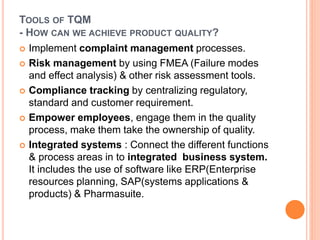
 Implement complaint management processes.
 Risk management by using FMEA (Failure modes
and effect analysis) & other risk assessment tools.
 Compliance tracking by centralizing regulatory,
standard and customer requirement.
 Empower employees, engage them in the quality
process, make them take the ownership of quality.
 Integrated systems : Connect the different functions
& process areas in to integrated business system.
It includes the use of software like ERP(Enterprise
resources planning, SAP(systems applications &
products) & Pharmasuite.
TOOLS OF TQM
- HOW CAN WE ACHIEVE PRODUCT QUALITY?
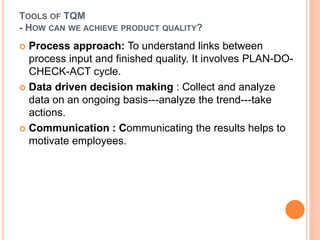
 Process approach: To understand links between
process input and finished quality. It involves PLAN-DO-
CHECK-ACT cycle.
 Data driven decision making : Collect and analyze
data on an ongoing basis---analyze the trend---take
actions.
 Communication : Communicating the results helps to
motivate employees.
REASONS FOR TQM FAILURE.
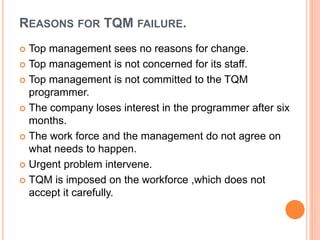
 Top management sees no reasons for change.
 Top management is not concerned for its staff.
 Top management is not committed to the TQM
programmer.
 The company loses interest in the programmer after six
months.
 The work force and the management do not agree on
what needs to happen.
 Urgent problem intervene.
 TQM is imposed on the workforce ,which does not
accept it carefully.
ADVANTAGES OF TQM.
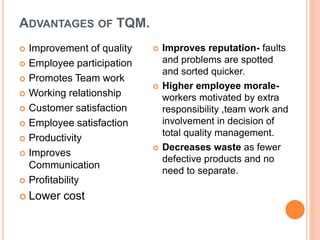
 Improvement of quality
 Employee participation
 Promotes Team work
 Working relationship
 Customer satisfaction
 Employee satisfaction
 Productivity
 Improves
Communication
 Profitability
 Lower cost
 Improves reputation- faults
and problems are spotted
and sorted quicker.
 Higher employee morale-
workers motivated by extra
responsibility ,team work and
involvement in decision of
total quality management.
 Decreases waste as fewer
defective products and no
need to separate.
DISADVANTAGES OF TQM
 Initial introduction cost.
 It takes several years for its beneficial effects to
be visible.
 Workers may be resistant to change.
 It require more management and staff.
 It is not a quick fix, TQM takes time to
implement .

Total quality management

  • 1.
  • 2.
    CONTENTS  Introduction  Objectives Principles of TQM  Significance of TQM  Elements of TQM  Tools of TQM  Reasons for failure  Advantages  Disadvantages
  • 3.
    INTRODUCTION  Total qualitymanagement increases the customer satisfaction by boosting the quality.  It does by motivating the work force and improving the way the company operates.  In an increasing competitive market firms with a continuous improvement culture and external focus are more likely to survive and prosper.  TQM is consider an important catalyst in this context.
  • 4.
    WHAT IS TQM? TQM is a management approach for long term success through customer satisfaction.  TQM is an approach to improving the effectiveness and flexibilities of business as a whole.  It is essentially a way of organizing and involving the whole organization every department, every activity and every single person at every level.  TQM ensures that the management adopts a strategic overview of the quality and focuses on prevention rather than inspection.
  • 5.
    OBJECTIVES OF TQM To provide high quality drug product to patients.  Process improvement.  Defects prevention.  Helping teams to make better decisions.  Continuous improvement to process systems, people suppliers, partners, products and services.
  • 6.
    PRINCIPLES OF TQM Managementcommitment. Employee empowerment. Fact based decision making. Continuous improvement.
  • 7.
    SIGNIFICANCE OF TQM The importance of TQM lies in the fact that it encourages innovation, make the organization adaptable to change , motivate people for better quality ,and integrates the business arising out of the common purpose and all those provide the organization with a valuable and distinctive competitive edge.
  • 8.
    ELEMENTS OF TQM Be customer focused.  Do it right the first time.  Constantly improve.  Quality is an attitude.  Telling staff what is going on.  Educate and train people.  Measure the work.  Top management must be involved.  Make it a good place to work.  Introduce the team work.  Organize by process , not by function.
  • 9.
    TOOLS OF TQM -HOW CAN WE ACHIEVE PRODUCT QUALITY?  Implement complaint management processes.  Risk management by using FMEA (Failure modes and effect analysis) & other risk assessment tools.  Compliance tracking by centralizing regulatory, standard and customer requirement.  Empower employees, engage them in the quality process, make them take the ownership of quality.  Integrated systems : Connect the different functions & process areas in to integrated business system. It includes the use of software like ERP(Enterprise resources planning, SAP(systems applications & products) & Pharmasuite.
  • 10.
    TOOLS OF TQM -HOW CAN WE ACHIEVE PRODUCT QUALITY?  Process approach: To understand links between process input and finished quality. It involves PLAN-DO- CHECK-ACT cycle.  Data driven decision making : Collect and analyze data on an ongoing basis---analyze the trend---take actions.  Communication : Communicating the results helps to motivate employees.
  • 11.
    REASONS FOR TQMFAILURE.  Top management sees no reasons for change.  Top management is not concerned for its staff.  Top management is not committed to the TQM programmer.  The company loses interest in the programmer after six months.  The work force and the management do not agree on what needs to happen.  Urgent problem intervene.  TQM is imposed on the workforce ,which does not accept it carefully.
  • 12.
    ADVANTAGES OF TQM. Improvement of quality  Employee participation  Promotes Team work  Working relationship  Customer satisfaction  Employee satisfaction  Productivity  Improves Communication  Profitability  Lower cost  Improves reputation- faults and problems are spotted and sorted quicker.  Higher employee morale- workers motivated by extra responsibility ,team work and involvement in decision of total quality management.  Decreases waste as fewer defective products and no need to separate.
  • 13.
    DISADVANTAGES OF TQM Initial introduction cost.  It takes several years for its beneficial effects to be visible.  Workers may be resistant to change.  It require more management and staff.  It is not a quick fix, TQM takes time to implement .