Subject –
Operations Research
Topic –
Simplex Method(Problem)
Class –
FY MMS
Presented By-
Taslima Bashir Mujawar
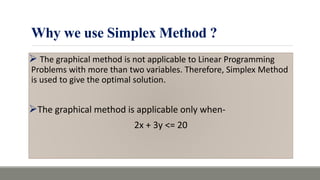
Why we use Simplex Method ?
 The graphical method is not applicable to Linear Programming
Problems with more than two variables. Therefore, Simplex Method
is used to give the optimal solution.
The graphical method is applicable only when-
2x + 3y <= 20
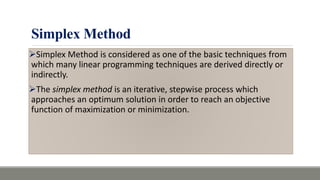
Simplex Method
Simplex Method is considered as one of the basic techniques from
which many linear programming techniques are derived directly or
indirectly.
The simplex method is an iterative, stepwise process which
approaches an optimum solution in order to reach an objective
function of maximization or minimization.
Important Condition
For Maximization Case :
= Cj – Zj <= 0 …[ 0 or negative no.]
For Minimization Case :
= Cj – Zj >= 0 …[ 0 or positive no.]
Example
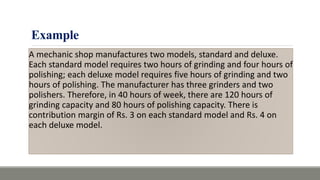
A mechanic shop manufactures two models, standard and deluxe.
Each standard model requires two hours of grinding and four hours of
polishing; each deluxe model requires five hours of grinding and two
hours of polishing. The manufacturer has three grinders and two
polishers. Therefore, in 40 hours of week, there are 120 hours of
grinding capacity and 80 hours of polishing capacity. There is
contribution margin of Rs. 3 on each standard model and Rs. 4 on
each deluxe model.
Solution
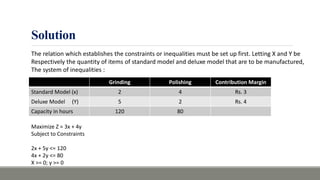
Grinding Polishing Contribution Margin
Standard Model (x) 2 4 Rs. 3
Deluxe Model (Y) 5 2 Rs. 4
Capacity in hours 120 80
Maximize Z = 3x + 4y
Subject to Constraints
2x + 5y <= 120
4x + 2y <= 80
X >= 0; y >= 0
The relation which establishes the constraints or inequalities must be set up first. Letting X and Y be
Respectively the quantity of items of standard model and deluxe model that are to be manufactured,
The system of inequalities :
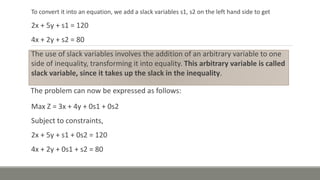
To convert it into an equation, we add a slack variables s1, s2 on the left hand side to get
2x + 5y + s1 = 120
4x + 2y + s2 = 80
The use of slack variables involves the addition of an arbitrary variable to one
side of inequality, transforming it into equality. This arbitrary variable is called
slack variable, since it takes up the slack in the inequality.
The problem can now be expressed as follows:
Max Z = 3x + 4y + 0s1 + 0s2
Subject to constraints,
2x + 5y + s1 + 0s2 = 120
4x + 2y + 0s1 + s2 = 80
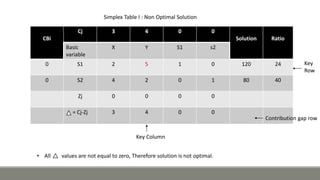
CBi
Cj 3 4 0 0
Solution Ratio
Basic
variable
X Y S1 s2
0 S1 2 5 1 0 120 24
0 S2 4 2 0 1 80 40
Zj 0 0 0 0
= Cj-Zj 3 4 0 0
Key Column
Key
Row
Contribution gap row
Simplex Table I : Non Optimal Solution
• All values are not equal to zero, Therefore solution is not optimal.
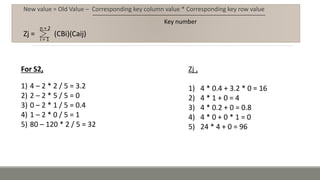
New value = Old Value – Corresponding key column value * Corresponding key row value
Key number
For S2,
1) 4 – 2 * 2 / 5 = 3.2
2) 2 – 2 * 5 / 5 = 0
3) 0 – 2 * 1 / 5 = 0.4
4) 1 – 2 * 0 / 5 = 1
5) 80 – 120 * 2 / 5 = 32
Zj ,
1) 4 * 0.4 + 3.2 * 0 = 16
2) 4 * 1 + 0 = 4
3) 4 * 0.2 + 0 = 0.8
4) 4 * 0 + 0 * 1 = 0
5) 24 * 4 + 0 = 96
Zj = (CBi)(Caij)
i = 1
n = 2
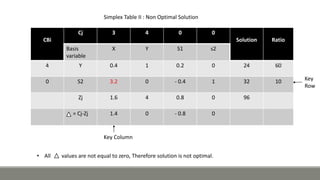
CBi
Cj 3 4 0 0
Solution Ratio
Basis
variable
X Y S1 s2
4 Y 0.4 1 0.2 0 24 60
0 S2 3.2 0 - 0.4 1 32 10
Zj 1.6 4 0.8 0 96
= Cj-Zj 1.4 0 - 0.8 0
Simplex Table II : Non Optimal Solution
Key Column
Key
Row
• All values are not equal to zero, Therefore solution is not optimal.
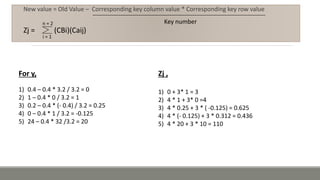
New value = Old Value – Corresponding key column value * Corresponding key row value
Key number
For y,
1) 0.4 – 0.4 * 3.2 / 3.2 = 0
2) 1 – 0.4 * 0 / 3.2 = 1
3) 0.2 – 0.4 * (- 0.4) / 3.2 = 0.25
4) 0 – 0.4 * 1 / 3.2 = -0.125
5) 24 – 0.4 * 32 /3.2 = 20
Zj ,
1) 0 + 3* 1 = 3
2) 4 * 1 + 3* 0 =4
3) 4 * 0.25 + 3 * ( -0.125) = 0.625
4) 4 * (- 0.125) + 3 * 0.312 = 0.436
5) 4 * 20 + 3 * 10 = 110
Zj = (CBi)(Caij)
i = 1
n = 2
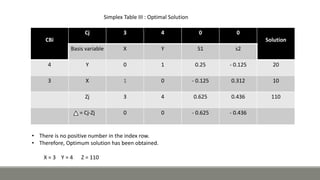
CBi
Cj 3 4 0 0
Solution
Basis variable X Y S1 s2
4 Y 0 1 0.25 - 0.125 20
3 X 1 0 - 0.125 0.312 10
Zj 3 4 0.625 0.436 110
= Cj-Zj 0 0 - 0.625 - 0.436
Simplex Table III : Optimal Solution
• There is no positive number in the index row.
• Therefore, Optimum solution has been obtained.
X = 3 Y = 4 Z = 110
Any Queries…??

Operations Research Problem

  • 1.
    Subject – Operations Research Topic– Simplex Method(Problem) Class – FY MMS Presented By- Taslima Bashir Mujawar
  • 2.
    Why we useSimplex Method ?  The graphical method is not applicable to Linear Programming Problems with more than two variables. Therefore, Simplex Method is used to give the optimal solution. The graphical method is applicable only when- 2x + 3y <= 20
  • 3.
    Simplex Method Simplex Methodis considered as one of the basic techniques from which many linear programming techniques are derived directly or indirectly. The simplex method is an iterative, stepwise process which approaches an optimum solution in order to reach an objective function of maximization or minimization.
  • 4.
    Important Condition For MaximizationCase : = Cj – Zj <= 0 …[ 0 or negative no.] For Minimization Case : = Cj – Zj >= 0 …[ 0 or positive no.]
  • 5.
    Example A mechanic shopmanufactures two models, standard and deluxe. Each standard model requires two hours of grinding and four hours of polishing; each deluxe model requires five hours of grinding and two hours of polishing. The manufacturer has three grinders and two polishers. Therefore, in 40 hours of week, there are 120 hours of grinding capacity and 80 hours of polishing capacity. There is contribution margin of Rs. 3 on each standard model and Rs. 4 on each deluxe model.
  • 6.
    Solution Grinding Polishing ContributionMargin Standard Model (x) 2 4 Rs. 3 Deluxe Model (Y) 5 2 Rs. 4 Capacity in hours 120 80 Maximize Z = 3x + 4y Subject to Constraints 2x + 5y <= 120 4x + 2y <= 80 X >= 0; y >= 0 The relation which establishes the constraints or inequalities must be set up first. Letting X and Y be Respectively the quantity of items of standard model and deluxe model that are to be manufactured, The system of inequalities :
  • 7.
    To convert itinto an equation, we add a slack variables s1, s2 on the left hand side to get 2x + 5y + s1 = 120 4x + 2y + s2 = 80 The use of slack variables involves the addition of an arbitrary variable to one side of inequality, transforming it into equality. This arbitrary variable is called slack variable, since it takes up the slack in the inequality. The problem can now be expressed as follows: Max Z = 3x + 4y + 0s1 + 0s2 Subject to constraints, 2x + 5y + s1 + 0s2 = 120 4x + 2y + 0s1 + s2 = 80
  • 8.
    CBi Cj 3 40 0 Solution Ratio Basic variable X Y S1 s2 0 S1 2 5 1 0 120 24 0 S2 4 2 0 1 80 40 Zj 0 0 0 0 = Cj-Zj 3 4 0 0 Key Column Key Row Contribution gap row Simplex Table I : Non Optimal Solution • All values are not equal to zero, Therefore solution is not optimal.
  • 9.
    New value =Old Value – Corresponding key column value * Corresponding key row value Key number For S2, 1) 4 – 2 * 2 / 5 = 3.2 2) 2 – 2 * 5 / 5 = 0 3) 0 – 2 * 1 / 5 = 0.4 4) 1 – 2 * 0 / 5 = 1 5) 80 – 120 * 2 / 5 = 32 Zj , 1) 4 * 0.4 + 3.2 * 0 = 16 2) 4 * 1 + 0 = 4 3) 4 * 0.2 + 0 = 0.8 4) 4 * 0 + 0 * 1 = 0 5) 24 * 4 + 0 = 96 Zj = (CBi)(Caij) i = 1 n = 2
  • 10.
    CBi Cj 3 40 0 Solution Ratio Basis variable X Y S1 s2 4 Y 0.4 1 0.2 0 24 60 0 S2 3.2 0 - 0.4 1 32 10 Zj 1.6 4 0.8 0 96 = Cj-Zj 1.4 0 - 0.8 0 Simplex Table II : Non Optimal Solution Key Column Key Row • All values are not equal to zero, Therefore solution is not optimal.
  • 11.
    New value =Old Value – Corresponding key column value * Corresponding key row value Key number For y, 1) 0.4 – 0.4 * 3.2 / 3.2 = 0 2) 1 – 0.4 * 0 / 3.2 = 1 3) 0.2 – 0.4 * (- 0.4) / 3.2 = 0.25 4) 0 – 0.4 * 1 / 3.2 = -0.125 5) 24 – 0.4 * 32 /3.2 = 20 Zj , 1) 0 + 3* 1 = 3 2) 4 * 1 + 3* 0 =4 3) 4 * 0.25 + 3 * ( -0.125) = 0.625 4) 4 * (- 0.125) + 3 * 0.312 = 0.436 5) 4 * 20 + 3 * 10 = 110 Zj = (CBi)(Caij) i = 1 n = 2
  • 12.
    CBi Cj 3 40 0 Solution Basis variable X Y S1 s2 4 Y 0 1 0.25 - 0.125 20 3 X 1 0 - 0.125 0.312 10 Zj 3 4 0.625 0.436 110 = Cj-Zj 0 0 - 0.625 - 0.436 Simplex Table III : Optimal Solution • There is no positive number in the index row. • Therefore, Optimum solution has been obtained. X = 3 Y = 4 Z = 110
  • 14.

Editor's Notes

  • #6 Before the simplex method can be applied, the relationship which establishes the constraints or inequalities must be set up first. Letting X and Y be respect. The quantity of iems off the standard model and deluxe model that are to be manufactured.
  • #8 Slack variable is a variable that is added to an inequality constraint to transform it to an equality. Z= objective Function. Now the simplex method can be applied and the first matrix can be set up.
  • #9 Now, Select highest column to calculate the ratio. Select row where the ratio is least. Key element = 5