

Cost function may be defined as
the relationship between costs of a
product and output.

C = F [Q]
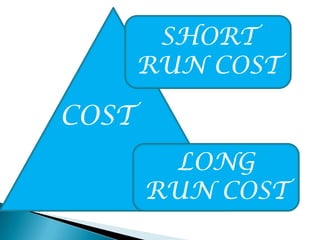
SHORT
RUN COST

COST
LONG
RUN COST




An analysis in which certain factors are
assumed to be fixed during the period
analyzed.
In short run output can be increased or
decreased by changing only the variable
factors.
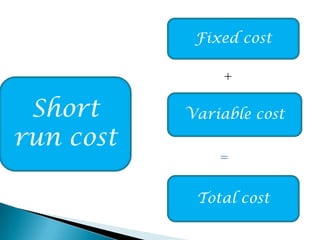
Fixed cost
+

Short
run cost

Variable cost
=

Total cost




Fixed cost are those cost which do not
change with changes in output.
Fixed cost are otherwise called
‘supplementary cost’ or ‘over head costs’.

Eg ; Rent on land and building , Insurance
charges, Interest on fixed capital, Salary
of permanent employees.




Variable cost are those costs which
changes with changes in output.
Variable cost are also called ‘prime cost’.

Eg; cost of raw materials, cost of power in
production, wages of workers.




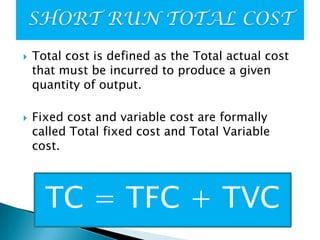
Total cost is defined as the Total actual cost
that must be incurred to produce a given
quantity of output.
Fixed cost and variable cost are formally
called Total fixed cost and Total Variable
cost.

TC = TFC + TVC
UNITS OF OUTPUT

TFC
[Rs.]

TVC
[Rs.]

TC
[Rs.]

0

60

60 -60 = 0

60

1

60

100 -60 = 40

100

2

60

120 – 60 = 60

120

3

60

70

130

4

60

100

160

5

60

160

220

6

60

300

360
.............






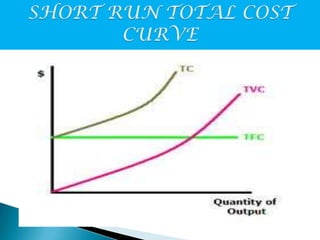
TFC being fixed at Rs.60, remains the same
at all levels of output . Thus, the TFC- curve
is a straight line parallel to the x-axis.
TVC – curve starts from the origin at zero
output . It move upwards from left to right.
The shape of TC –curve is the same as TVCcurve.
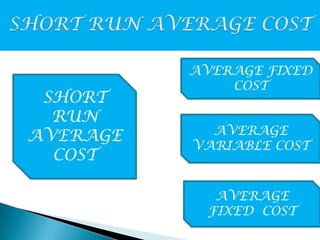
SHORT
RUN
AVERAGE
COST

AVERAGE FIXED
COST
AVERAGE
VARIABLE COST

AVERAGE
FIXED COST


AFC is the per unit fixed cost of
producing a commodity. It is obtained by
dividing the total fixed cost by the
quantity of output [Q].

AFC =

TFC
Q


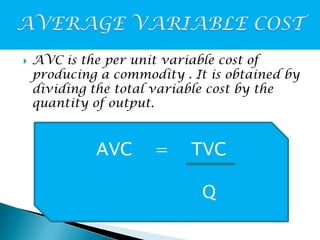
AVC is the per unit variable cost of
producing a commodity . It is obtained by
dividing the total variable cost by the
quantity of output.

AVC

=

TVC

Q


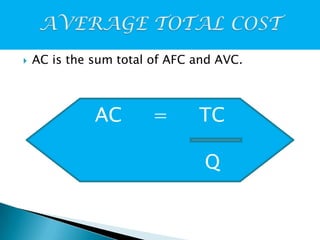
AC is the sum total of AFC and AVC.

AC

=

TC
Q


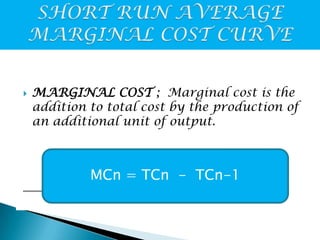
MARGINAL COST ; Marginal cost is the
addition to total cost by the production of
an additional unit of output.

;w

MCn = TCn - TCn-1
Units of TFC
producti [Rs]
on

TVC
[Rs]

TC
[Rs]

AFC
[Rs]

AVC
[Rs]

ATC
[Rs]

MC
[Rs]

O

60

0

60

-

-

-

-

1

60

40

10

60

40

100

40

2

60

60

120

30

30

60

20

3

60

70

130

20

23.3

43.3

10

4

60

100

160

15

25

40

30

5

60

160

220

12

32

44

60

6

60

300

360

10

50

60

140








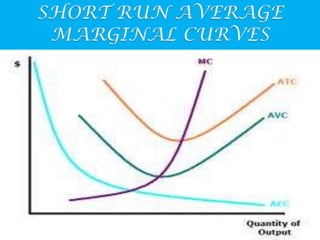
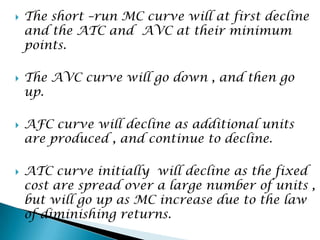
The short –run MC curve will at first decline
and the ATC and AVC at their minimum
points.
The AVC curve will go down , and then go
up.
AFC curve will decline as additional units
are produced , and continue to decline.
ATC curve initially will decline as the fixed
cost are spread over a large number of units ,
but will go up as MC increase due to the law
of diminishing returns.
Cost function Managerial Economics

Cost function Managerial Economics

  • 2.
     Cost function maybe defined as the relationship between costs of a product and output. C = F [Q]
  • 3.
  • 4.
      An analysis inwhich certain factors are assumed to be fixed during the period analyzed. In short run output can be increased or decreased by changing only the variable factors.
  • 5.
  • 6.
      Fixed cost arethose cost which do not change with changes in output. Fixed cost are otherwise called ‘supplementary cost’ or ‘over head costs’. Eg ; Rent on land and building , Insurance charges, Interest on fixed capital, Salary of permanent employees.
  • 7.
      Variable cost arethose costs which changes with changes in output. Variable cost are also called ‘prime cost’. Eg; cost of raw materials, cost of power in production, wages of workers.
  • 8.
      Total cost isdefined as the Total actual cost that must be incurred to produce a given quantity of output. Fixed cost and variable cost are formally called Total fixed cost and Total Variable cost. TC = TFC + TVC
  • 9.
    UNITS OF OUTPUT TFC [Rs.] TVC [Rs.] TC [Rs.] 0 60 60-60 = 0 60 1 60 100 -60 = 40 100 2 60 120 – 60 = 60 120 3 60 70 130 4 60 100 160 5 60 160 220 6 60 300 360
  • 11.
    .............    TFC being fixedat Rs.60, remains the same at all levels of output . Thus, the TFC- curve is a straight line parallel to the x-axis. TVC – curve starts from the origin at zero output . It move upwards from left to right. The shape of TC –curve is the same as TVCcurve.
  • 12.
  • 13.
     AFC is theper unit fixed cost of producing a commodity. It is obtained by dividing the total fixed cost by the quantity of output [Q]. AFC = TFC Q
  • 14.
     AVC is theper unit variable cost of producing a commodity . It is obtained by dividing the total variable cost by the quantity of output. AVC = TVC Q
  • 15.
     AC is thesum total of AFC and AVC. AC = TC Q
  • 16.
     MARGINAL COST ;Marginal cost is the addition to total cost by the production of an additional unit of output. ;w MCn = TCn - TCn-1
  • 17.
    Units of TFC producti[Rs] on TVC [Rs] TC [Rs] AFC [Rs] AVC [Rs] ATC [Rs] MC [Rs] O 60 0 60 - - - - 1 60 40 10 60 40 100 40 2 60 60 120 30 30 60 20 3 60 70 130 20 23.3 43.3 10 4 60 100 160 15 25 40 30 5 60 160 220 12 32 44 60 6 60 300 360 10 50 60 140
  • 19.
        The short –runMC curve will at first decline and the ATC and AVC at their minimum points. The AVC curve will go down , and then go up. AFC curve will decline as additional units are produced , and continue to decline. ATC curve initially will decline as the fixed cost are spread over a large number of units , but will go up as MC increase due to the law of diminishing returns.