E.Q. AND LEADERSHIP
PRESENTED BYDYUTINATH BANERJEE
RANITA DE
MITSU BISWAS
ANUPRIYA CHAKRABORTY
WHAT IS EQ?
EQ is a leader’s ability to recognize
and understand emotions in
him/herself and in others.
 All emotions are derivations of five
core senses: happiness, sadness,
anger, fear and shame.
 EQ is the ability to use this awareness
to manage behaviour and
relationships.

What are the essential factors for
leaders?
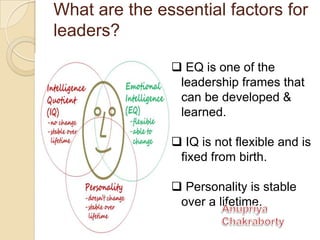
 EQ is one of the
leadership frames that
can be developed &
learned.

 IQ is not flexible and is
fixed from birth.
 Personality is stable
over a lifetime.
FRAMEWORK


According to Bradberry the four key
skills that a leader should master:

Dyutinath Banerjee
EQ SIGNAL SOURCE

Dyutinath Banerjee
TEST OF EQ:

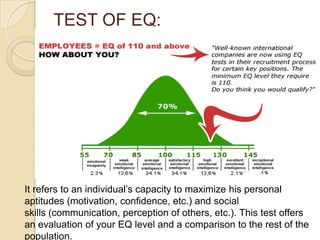
It refers to an individual’s capacity to maximize his personal
aptitudes (motivation, confidence, etc.) and social
skills (communication, perception of others, etc.). This test offers
an evaluation of your EQ level and a comparison to the rest of the
population.
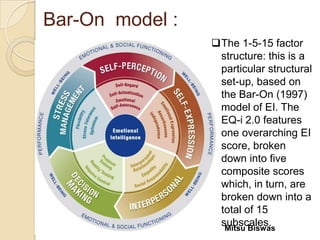
Bar-On model :
The 1-5-15 factor
structure: this is a
particular structural
set-up, based on
the Bar-On (1997)
model of EI. The
EQ-i 2.0 features
one overarching EI
score, broken
down into five
composite scores
which, in turn, are
broken down into a
total of 15
subscales.
Mitsu Biswas
ANALYSIS OF VIDEO:


IQ gets you the job, EQ gets you
promoted! Great leaders display high
levels of emotional intelligence yet many
managers don't even know what it is.
Great leaders can read and regulate their
own moods, emotions and behaviors and
work in a synchronized way with those of
others.
Ranita De
CONCLUSION
Leaders with Emotional Intelligence
inspire performance beyond the global
commodities of obedience and
diligence to an impassioned
momentum to innovate, and create
intangible assets.
 To energize and service an asset that
is characterized by emotions,
memories and its own volition, leaders
must master their own emotional
intelligence and inspire initiative,
Ranita De
creativity and passion.

THANK YOU

Eq & leadership

  • 1.
    E.Q. AND LEADERSHIP PRESENTEDBYDYUTINATH BANERJEE RANITA DE MITSU BISWAS ANUPRIYA CHAKRABORTY
  • 2.
    WHAT IS EQ? EQis a leader’s ability to recognize and understand emotions in him/herself and in others.  All emotions are derivations of five core senses: happiness, sadness, anger, fear and shame.  EQ is the ability to use this awareness to manage behaviour and relationships. 
  • 3.
    What are theessential factors for leaders?  EQ is one of the leadership frames that can be developed & learned.  IQ is not flexible and is fixed from birth.  Personality is stable over a lifetime.
  • 4.
    FRAMEWORK  According to Bradberrythe four key skills that a leader should master: Dyutinath Banerjee
  • 5.
  • 6.
    TEST OF EQ: Itrefers to an individual’s capacity to maximize his personal aptitudes (motivation, confidence, etc.) and social skills (communication, perception of others, etc.). This test offers an evaluation of your EQ level and a comparison to the rest of the population.
  • 7.
    Bar-On model : The1-5-15 factor structure: this is a particular structural set-up, based on the Bar-On (1997) model of EI. The EQ-i 2.0 features one overarching EI score, broken down into five composite scores which, in turn, are broken down into a total of 15 subscales. Mitsu Biswas
  • 9.
    ANALYSIS OF VIDEO:  IQgets you the job, EQ gets you promoted! Great leaders display high levels of emotional intelligence yet many managers don't even know what it is. Great leaders can read and regulate their own moods, emotions and behaviors and work in a synchronized way with those of others. Ranita De
  • 10.
    CONCLUSION Leaders with EmotionalIntelligence inspire performance beyond the global commodities of obedience and diligence to an impassioned momentum to innovate, and create intangible assets.  To energize and service an asset that is characterized by emotions, memories and its own volition, leaders must master their own emotional intelligence and inspire initiative, Ranita De creativity and passion. 
  • 11.