UNIT II
OPERATIONS
MANAGEMENT
PLANT LOCATION
NEED FOR SELECTION
 Business is newly started
 The existing business expansion
 Establishment of branches
 Land lease expires
Plant location involves two
major activities
1. To select a proper geographic region
2. Selecting a specific site with in the region
PLANT LOCATION
Meaning-the establishment of an industry at a
particular place. It is of 2 types-
1. Localization / centralization-means concentration
of similar type of industries at some particular
place. E.g. textile in Mumbai.
2. Delocalization /Decentralization-means spreading
of similar type of industries at different places. E.g.
banking industries.
Factors affecting
location & site decisions
1. Availability of raw materials
2. Proximity to market
3. Integration with other parts of organization
4. Availability of labor and skills
5. Availability of Amenities
6. Transport & communication facilities
Factors affecting location & site decisions
(contd…)
7. Suitability of climate
8. Availability of services
9. Regional regulations
10. Room for expansion
11. Safety requirements
12. Others like low interest on loans, special
grants, living standards
Plantlayout
Plant layout
• Meaning-
Plant layout is the physical arrangement of
industrial facilities. It involves the allocation
of space & the arrangement of equipment in
such a manner that overall operating costs are
minimized.
Factors affecting plant layout
1. Management Policy
2. Manufacturing process
3. Nature of product
4. Volume of production
5. Type of Equipment
6. Type of building
7. Availability of Total floor area
8. Arrangement of Material Handling Equipment
9. Service facilities
10. Possibility of future expansion
METHODS OF PRODUCTION
The methods of production can be of the
following types:
1. Intermittent or interrupted production
a. Job Production
b. Batch Production
2. Mass and flow line production
JOB PRODUCTION
In this type of production, every job is
different from the other in terms of type,
cost, efforts, consumption of materials or
specifications.
• ADVANTAGES
 Reaching the target customer’s requirements
 Special training to labor
 Best suitable for pull system of demand
• DISADVANTAGES
XTime taking
X Large scale economies cannot be realized
X Costliest
X Division of labor is not possible
BATCH PRODUCTION
All the products manufactured under a batch
are similar in terms of type, cost, efforts,
consumption of materials or specifications.
• ADVANTAGES
 cost of product design per unit is low
 Economies of production
 Flow of materials can be continuous
 Automation and mechanization
• DISADVANTAGES
X Varying customer demands
X Not appropriate for pull system
MASS PRODUCTION
This is also called flow production.
The production can be undertaken on large
and specialized machines and processes.
• ADVANTAGES
 Mechanization and division of labour
 Large – scale economies
 Minimum material handling costs
• DISADVANTAGES
X Special care
X Idle machinery may result in wastage of
resources
X Bottle necks
Types of plant layout
1. Product layout
2. Process layout
3. Fixed Position/ Stationary layout
4. Combination lay out
Product Layout
▫ Layout that uses standardized processing
operations to achieve smooth, rapid, high-
volume flow
▫ Here machines are arranged acc. to the needs
of product & in the same sequence as the
operations are necessary for manufacture. E.g.
‘back office’ of services such as banks and
insurance companies.
Raw
materials
or customer
Finished
item
Station
2
Station
2
Station
3
Station
3
Station
4
Station
4
Material
and/or
labor
Station
1
Material
and/or
labor
Material
and/or
labor
Material
and/or
labor
Used for Repetitive or Continuous Processing
Product Layout (contd…)
Work
Station 1
Work
Station 2
Work
Station 3
Product Layout
(sequential)
Used for Repetitive Processing
Repetitive or Continuous
Product Layout (contd…)
Advantages of Product Layout
1. High rate of output
2. Low unit cost
3. Labor specialization
4. Low material handling cost
5. High utilization of labor and equipment
6. Established routing and scheduling
7. Short processing time
Disadvantages of Product Layout
1. Creates dull, repetitive jobs
2. Poorly skilled workers may not maintain
equipment or quality of output
3. Fairly inflexible to changes in volume
4. Highly susceptible to shutdowns
5. Needs preventive maintenance
6. Require large capital investment
Process layout
▫ Layout that can handle varied processing
requirements
▫ Here all machines performing similar type of
operations are grouped together at one location in
the process layout. Thus here facilities are grouped
together acc. To their functions. E.g. all drilling
machines are located at one place known as drilling
section.
Dept. A
Dept. B Dept. D
Dept. C
Dept. F
Dept. E
Used for Intermittent processing
Job Shop or Batch
Process Layout
(functional)
Advantages of Process Layouts
1. Can handle a variety of processing requirements
2. Machines breakdown doesn’t result in shutdown.
3. Equipment used is less costly
4. Wide flexibility in production facilities.
5. Each production unit of system works
independently.
6. High utilization of facilities
7. Variety makes the job interesting.
Disadvantages of Process
Layouts
1. In-process inventory costs can be high
2. Challenging routing and scheduling
3. Equipment utilization rates are low
4. Material handling is slow and inefficient
& is more.
5. More space is required
6. Longer processing time
7. Back tracking may occur.
Comparison of product & process layout
factors Product layout Process layout
1. nature Sequence of facilities Similar aregp2gether
2. Machines utilization Not to full capacity Better utilization
3. product standardized diversified
4. Processing time less more
5. Material handling less more
6. inventory High WIP Low WIP
7. breakdown Can’t tolerate Can tolerate
8. Production centre simple complex
9.flexibilty low high
10. floor space Requires less more
11. investment high low
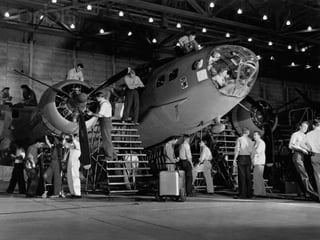
FIXED POSITION LAYOUT
• Layout by fixed position of
the product is inherent in
ship building, aircraft
manufacture .
ADVANTAGES
• It is possible to assign one or more skilled
workers to a project from start to finish in
order to ensure continuity of work
• It involves least movement of materials
• A number of quite different projects can be
taken with the same layout
DISADVANTAGES
There appears to be low utilization of
labor and equipment
It involves high equipment handling
costs
COMBINATION LAYOUT
• A combination of process and product layouts
combines the advantages of the both types of
layouts.
• A combination layout is possible where an
item is being made in different types and
sizes.
• examples: wood saws, files etc
WORK STUDY
Work study is defined as that
body of knowledge concerned with the
analysis of the work methods and the
equipment used in performing a job, the
design of an optimum work method and
the standardization of proposed work
methods.
Objectives of Work Study
1. To analyze the present method of doing a job,
systematically in order to develop a new and
better method.
2. To measure the work content of a job by
measuring the time required to do the job for a
qualified worker and hence to establish standard
time.
3. To increase the productivity by ensuring the best
possible use of human, machine and material
resources and to achieve best quality
product/service at minimum possible cost.
4. To improve operational efficiency.
WORK STUDY
METHOD STUDY
WORK
MEASUREMENT
MOTION STUDY TIME STUDY
BASIC WORK STUDY PROCEDURE
1. Select the job or process or the operation to be
studied.
2. Record all relevant facts about the job or process or
operation using suitable charting techniques.
3. Examine critically all the recorded facts,
questioning the purpose, place, sequence, person
and the means of doing the job/process/operation.
4. Develop the new method.
RECORDING SYMBOLS
Standard Symbol Name of Activity
Operation
Transportation/Movement
Inspection
Delay/ Temporary storage
Storage
Combined Activity
PROCESS CHARTS
 Outline Process Chart
 Operation Process Chart
 Flow Process Chart
 Two handed Process Chart
 Multiple Activity Chart
 Man – Machine Chart
 Flow Diagram
 String Diagram
 SIMO Chart
PRIMARY QUESTIONS
The PURPOSE for which
The PLACE at which
The SEQUENCE in which
The PERSON by
whom
The MEANS by which
ELIMINIATING
COMBINING
REARRANGING
OR
SIMPLIFING
those activitiesWith a view to
SECONDARY QUESTIONS
The secondary questions cover the second
stage of the questioning technique, during
which the answers to the primary questions
are subjected to further query to determine
whether possible alternatives of place,
sequence, persons and means are practicable
and preferred as a means of improvement
upon the existing method.
PURPOSE: what is done?
why is it done?
what else might be done?
what should be done?
PLACE: where is it done?
Why is it done there?
Where else might it is done?
Where should it be done?
SEQUENCE: When is it done?
Why is it done?
When might it be done?
When should it be done?
PERSON: who does it?
Why does that person do it?
Who else might do it?
Who should do it?
MEANS: How is it done?
Why is it done that way?
How else might it be done?
How should it be done ?
Procedure (contd…)
5. Measure the work content and establish the
standard time using an appropriate work
measurement technique.
6. Define the new method.
7. Install the new method as standard practice.
8. Maintain the new method for the
job/process/operation
THE TECHNIQUES OF
WORK MEASUREMENT
1. Direct Time study
2. Synthesis Method
3. Analytical Estimating
4. Predetermined Motion Time System (PMTS)
5. Work Sampling / Activity Sampling / Ratio Delay
Method
METHOD STUDY
Work methods analysis or Method
Study is a scientific technique of observing,
recording and critically examining the
present method of performing a task or job
or operation with the aim of improving the
present method and developing a new and
cheaper method.
MOTION STUDY
Motion Study is the science of eliminating
wastefulness, resulting from using unnecessary; ill –
directed and inefficient motion.
The aim of motion study is to find and
perpetuate the scheme of the least waste methods of
labor.
OBJECTIVES OF MOTION STUDY
 To study the existing method
 To develop an improved method
 To reduce excessive materials handling
 To improve utilization of resources
 To eliminate wasteful and inefficient motions
 To standardize work methods or processes.
TYPES OF MOTION STUDY
1. Micro motion Study
 Take motion picture of the operations
 Analyze the film
The film is analyzed by breaking the job cycle into
micro motions or therbligs.
Therbligs indicate the basic motions consisting of three
parts
i) When the motion begins
ii) The nature of the motion
iii) When the motion ends.
Ex: Search – Sr; Select – St; Transport empty – TE etc
 Prepare a SIMO chart
TYPES OF MOTION STUDY
2. Memomotion Study
It is a special form of motion study in
which motion pictures are taken at slow speed
using a motion picture camera.
WORK MEASUREMENT
It is defined as the application of
techniques designed to establish the work
content of a specified task by determining the
time required for carrying out the task at a
defined standard of performance by a
qualified worker.
THE QUALIFIED WORKER
A qualified worker is one who is accepted as having
the necessary physical attributes, who possess the
required intelligence and education and who has
acquired the necessary skill and knowledge to carry
out the work in hand to satisfactory standards of
safety, quantity and quality.
OBJECTIVES OF WORK MEASUREMENT
1. Improved planning and control of activities or
operations.
2. More efficient manning of the plant
3. Reliable ideas for labor performance
4. Reliable basis for labor cost control
5. Basis for sound incentive schemes
WORK MEASUREMENT PROCEDURE
 Break the job into elements
 Record the observed time for each element
 Establish elemental time values by extending
observed time into normal time by applying a rating
factor
 Assess relaxation allowances
 Determine the frequency of occurrences of each
element in the job, multiply the work content by its
frequency to arrive at work content of the job
THE TECHNIQUES OF
WORK MEASUREMENT
1. Direct Time study
2. Synthesis Method
3. Analytical Estimating
4. Predetermined Motion Time System (PMTS)
5. Work Sampling / Activity Sampling / Ratio Delay
method
DIRECT TIME STUDY
Time study is concerned with the determination
of the amount of time required to perform a unit of
work.
The main objective is to determine by direct
observation, the quantity of human work in a
specified task and hence to establish the standard
time, within which an average worker working at a
normal pace should complete the task using a
specified method.
PROCEDURE OF TIME STUDY
a. Obtaining and recording all available information
about the job, operator and the surrounding
conditions likely to affect the execution of the work
b. Recording the complete description of the method,
breaking down the operation into 'elements'
c. Measuring with a stopwatch and recording the time
taken by the operator to perform each 'element' of the
operation.
i) Non – fly back ii) Fly Back iii) Split hand
d. Assessing the rating using rating scale
e. Extending observed time to ‘basic times’
= Observed time * Rating factor
Where,
RF = Rating of observed worker/Rating of
Qualified Worker
f. Determining the allowances to be made over
and above the basic time for the operation
g. Determining the 'standard time' for the
operation.
SYNTHESIS METHOD
Synthesis is a technique of work
measurement for building up the time
required to do a job at a defined level of
performance by synthesizing or totaling
elemental time values obtained from
previous time studies on other jobs
containing similar job elements or from
standard data.
ANALYTICAL ESTIMATING
It is used to determine the time values for
jobs having long and non- repetitive
operations.
Procedure:
1. Find the job
2. Break the job into elements
3. Select time value from standard data catalogue
4. Estimate time values for remaining elements
5. Add 3 and 4
6. Add Relaxation allowances
PREDETERMINED MOTION TIME
SYSTEM (PMTS)It is defined as a work measurement technique by
which normal or basic times are established for basic
human motions and these time values are used to
buildup the time for a job at a defined level of
performance.
Predetermined time standards are standard data
for wide variety of basic body motions which are
common in many industrial operations.

Operations management

  • 1.
  • 2.
  • 3.
    NEED FOR SELECTION Business is newly started  The existing business expansion  Establishment of branches  Land lease expires
  • 4.
    Plant location involvestwo major activities 1. To select a proper geographic region 2. Selecting a specific site with in the region
  • 5.
    PLANT LOCATION Meaning-the establishmentof an industry at a particular place. It is of 2 types- 1. Localization / centralization-means concentration of similar type of industries at some particular place. E.g. textile in Mumbai. 2. Delocalization /Decentralization-means spreading of similar type of industries at different places. E.g. banking industries.
  • 6.
    Factors affecting location &site decisions 1. Availability of raw materials 2. Proximity to market 3. Integration with other parts of organization 4. Availability of labor and skills 5. Availability of Amenities 6. Transport & communication facilities
  • 7.
    Factors affecting location& site decisions (contd…) 7. Suitability of climate 8. Availability of services 9. Regional regulations 10. Room for expansion 11. Safety requirements 12. Others like low interest on loans, special grants, living standards
  • 12.
  • 13.
    Plant layout • Meaning- Plantlayout is the physical arrangement of industrial facilities. It involves the allocation of space & the arrangement of equipment in such a manner that overall operating costs are minimized.
  • 14.
    Factors affecting plantlayout 1. Management Policy 2. Manufacturing process 3. Nature of product 4. Volume of production 5. Type of Equipment 6. Type of building 7. Availability of Total floor area 8. Arrangement of Material Handling Equipment 9. Service facilities 10. Possibility of future expansion
  • 15.
    METHODS OF PRODUCTION Themethods of production can be of the following types: 1. Intermittent or interrupted production a. Job Production b. Batch Production 2. Mass and flow line production
  • 16.
    JOB PRODUCTION In thistype of production, every job is different from the other in terms of type, cost, efforts, consumption of materials or specifications.
  • 17.
    • ADVANTAGES  Reachingthe target customer’s requirements  Special training to labor  Best suitable for pull system of demand • DISADVANTAGES XTime taking X Large scale economies cannot be realized X Costliest X Division of labor is not possible
  • 18.
    BATCH PRODUCTION All theproducts manufactured under a batch are similar in terms of type, cost, efforts, consumption of materials or specifications.
  • 19.
    • ADVANTAGES  costof product design per unit is low  Economies of production  Flow of materials can be continuous  Automation and mechanization • DISADVANTAGES X Varying customer demands X Not appropriate for pull system
  • 20.
    MASS PRODUCTION This isalso called flow production. The production can be undertaken on large and specialized machines and processes.
  • 21.
    • ADVANTAGES  Mechanizationand division of labour  Large – scale economies  Minimum material handling costs • DISADVANTAGES X Special care X Idle machinery may result in wastage of resources X Bottle necks
  • 22.
    Types of plantlayout 1. Product layout 2. Process layout 3. Fixed Position/ Stationary layout 4. Combination lay out
  • 23.
    Product Layout ▫ Layoutthat uses standardized processing operations to achieve smooth, rapid, high- volume flow ▫ Here machines are arranged acc. to the needs of product & in the same sequence as the operations are necessary for manufacture. E.g. ‘back office’ of services such as banks and insurance companies.
  • 24.
  • 25.
    Work Station 1 Work Station 2 Work Station3 Product Layout (sequential) Used for Repetitive Processing Repetitive or Continuous Product Layout (contd…)
  • 26.
    Advantages of ProductLayout 1. High rate of output 2. Low unit cost 3. Labor specialization 4. Low material handling cost 5. High utilization of labor and equipment 6. Established routing and scheduling 7. Short processing time
  • 27.
    Disadvantages of ProductLayout 1. Creates dull, repetitive jobs 2. Poorly skilled workers may not maintain equipment or quality of output 3. Fairly inflexible to changes in volume 4. Highly susceptible to shutdowns 5. Needs preventive maintenance 6. Require large capital investment
  • 28.
    Process layout ▫ Layoutthat can handle varied processing requirements ▫ Here all machines performing similar type of operations are grouped together at one location in the process layout. Thus here facilities are grouped together acc. To their functions. E.g. all drilling machines are located at one place known as drilling section.
  • 29.
    Dept. A Dept. BDept. D Dept. C Dept. F Dept. E Used for Intermittent processing Job Shop or Batch Process Layout (functional)
  • 30.
    Advantages of ProcessLayouts 1. Can handle a variety of processing requirements 2. Machines breakdown doesn’t result in shutdown. 3. Equipment used is less costly 4. Wide flexibility in production facilities. 5. Each production unit of system works independently. 6. High utilization of facilities 7. Variety makes the job interesting.
  • 31.
    Disadvantages of Process Layouts 1.In-process inventory costs can be high 2. Challenging routing and scheduling 3. Equipment utilization rates are low 4. Material handling is slow and inefficient & is more. 5. More space is required 6. Longer processing time 7. Back tracking may occur.
  • 32.
    Comparison of product& process layout factors Product layout Process layout 1. nature Sequence of facilities Similar aregp2gether 2. Machines utilization Not to full capacity Better utilization 3. product standardized diversified 4. Processing time less more 5. Material handling less more 6. inventory High WIP Low WIP 7. breakdown Can’t tolerate Can tolerate 8. Production centre simple complex 9.flexibilty low high 10. floor space Requires less more 11. investment high low
  • 33.
    FIXED POSITION LAYOUT •Layout by fixed position of the product is inherent in ship building, aircraft manufacture .
  • 35.
    ADVANTAGES • It ispossible to assign one or more skilled workers to a project from start to finish in order to ensure continuity of work • It involves least movement of materials • A number of quite different projects can be taken with the same layout
  • 36.
    DISADVANTAGES There appears tobe low utilization of labor and equipment It involves high equipment handling costs
  • 37.
    COMBINATION LAYOUT • Acombination of process and product layouts combines the advantages of the both types of layouts. • A combination layout is possible where an item is being made in different types and sizes. • examples: wood saws, files etc
  • 38.
    WORK STUDY Work studyis defined as that body of knowledge concerned with the analysis of the work methods and the equipment used in performing a job, the design of an optimum work method and the standardization of proposed work methods.
  • 39.
    Objectives of WorkStudy 1. To analyze the present method of doing a job, systematically in order to develop a new and better method. 2. To measure the work content of a job by measuring the time required to do the job for a qualified worker and hence to establish standard time. 3. To increase the productivity by ensuring the best possible use of human, machine and material resources and to achieve best quality product/service at minimum possible cost. 4. To improve operational efficiency.
  • 40.
  • 41.
    BASIC WORK STUDYPROCEDURE 1. Select the job or process or the operation to be studied. 2. Record all relevant facts about the job or process or operation using suitable charting techniques. 3. Examine critically all the recorded facts, questioning the purpose, place, sequence, person and the means of doing the job/process/operation. 4. Develop the new method.
  • 42.
    RECORDING SYMBOLS Standard SymbolName of Activity Operation Transportation/Movement Inspection Delay/ Temporary storage Storage Combined Activity
  • 43.
    PROCESS CHARTS  OutlineProcess Chart  Operation Process Chart  Flow Process Chart  Two handed Process Chart  Multiple Activity Chart  Man – Machine Chart  Flow Diagram  String Diagram  SIMO Chart
  • 44.
    PRIMARY QUESTIONS The PURPOSEfor which The PLACE at which The SEQUENCE in which The PERSON by whom The MEANS by which
  • 45.
  • 46.
    SECONDARY QUESTIONS The secondaryquestions cover the second stage of the questioning technique, during which the answers to the primary questions are subjected to further query to determine whether possible alternatives of place, sequence, persons and means are practicable and preferred as a means of improvement upon the existing method.
  • 47.
    PURPOSE: what isdone? why is it done? what else might be done? what should be done? PLACE: where is it done? Why is it done there? Where else might it is done? Where should it be done?
  • 48.
    SEQUENCE: When isit done? Why is it done? When might it be done? When should it be done? PERSON: who does it? Why does that person do it? Who else might do it? Who should do it? MEANS: How is it done? Why is it done that way? How else might it be done? How should it be done ?
  • 49.
    Procedure (contd…) 5. Measurethe work content and establish the standard time using an appropriate work measurement technique. 6. Define the new method. 7. Install the new method as standard practice. 8. Maintain the new method for the job/process/operation
  • 50.
    THE TECHNIQUES OF WORKMEASUREMENT 1. Direct Time study 2. Synthesis Method 3. Analytical Estimating 4. Predetermined Motion Time System (PMTS) 5. Work Sampling / Activity Sampling / Ratio Delay Method
  • 51.
    METHOD STUDY Work methodsanalysis or Method Study is a scientific technique of observing, recording and critically examining the present method of performing a task or job or operation with the aim of improving the present method and developing a new and cheaper method.
  • 52.
    MOTION STUDY Motion Studyis the science of eliminating wastefulness, resulting from using unnecessary; ill – directed and inefficient motion. The aim of motion study is to find and perpetuate the scheme of the least waste methods of labor.
  • 53.
    OBJECTIVES OF MOTIONSTUDY  To study the existing method  To develop an improved method  To reduce excessive materials handling  To improve utilization of resources  To eliminate wasteful and inefficient motions  To standardize work methods or processes.
  • 54.
    TYPES OF MOTIONSTUDY 1. Micro motion Study  Take motion picture of the operations  Analyze the film The film is analyzed by breaking the job cycle into micro motions or therbligs. Therbligs indicate the basic motions consisting of three parts i) When the motion begins ii) The nature of the motion iii) When the motion ends. Ex: Search – Sr; Select – St; Transport empty – TE etc  Prepare a SIMO chart
  • 55.
    TYPES OF MOTIONSTUDY 2. Memomotion Study It is a special form of motion study in which motion pictures are taken at slow speed using a motion picture camera.
  • 56.
    WORK MEASUREMENT It isdefined as the application of techniques designed to establish the work content of a specified task by determining the time required for carrying out the task at a defined standard of performance by a qualified worker.
  • 57.
    THE QUALIFIED WORKER Aqualified worker is one who is accepted as having the necessary physical attributes, who possess the required intelligence and education and who has acquired the necessary skill and knowledge to carry out the work in hand to satisfactory standards of safety, quantity and quality.
  • 58.
    OBJECTIVES OF WORKMEASUREMENT 1. Improved planning and control of activities or operations. 2. More efficient manning of the plant 3. Reliable ideas for labor performance 4. Reliable basis for labor cost control 5. Basis for sound incentive schemes
  • 59.
    WORK MEASUREMENT PROCEDURE Break the job into elements  Record the observed time for each element  Establish elemental time values by extending observed time into normal time by applying a rating factor  Assess relaxation allowances  Determine the frequency of occurrences of each element in the job, multiply the work content by its frequency to arrive at work content of the job
  • 60.
    THE TECHNIQUES OF WORKMEASUREMENT 1. Direct Time study 2. Synthesis Method 3. Analytical Estimating 4. Predetermined Motion Time System (PMTS) 5. Work Sampling / Activity Sampling / Ratio Delay method
  • 61.
    DIRECT TIME STUDY Timestudy is concerned with the determination of the amount of time required to perform a unit of work. The main objective is to determine by direct observation, the quantity of human work in a specified task and hence to establish the standard time, within which an average worker working at a normal pace should complete the task using a specified method.
  • 62.
    PROCEDURE OF TIMESTUDY a. Obtaining and recording all available information about the job, operator and the surrounding conditions likely to affect the execution of the work b. Recording the complete description of the method, breaking down the operation into 'elements' c. Measuring with a stopwatch and recording the time taken by the operator to perform each 'element' of the operation. i) Non – fly back ii) Fly Back iii) Split hand
  • 63.
    d. Assessing therating using rating scale e. Extending observed time to ‘basic times’ = Observed time * Rating factor Where, RF = Rating of observed worker/Rating of Qualified Worker f. Determining the allowances to be made over and above the basic time for the operation g. Determining the 'standard time' for the operation.
  • 64.
    SYNTHESIS METHOD Synthesis isa technique of work measurement for building up the time required to do a job at a defined level of performance by synthesizing or totaling elemental time values obtained from previous time studies on other jobs containing similar job elements or from standard data.
  • 65.
    ANALYTICAL ESTIMATING It isused to determine the time values for jobs having long and non- repetitive operations.
  • 66.
    Procedure: 1. Find thejob 2. Break the job into elements 3. Select time value from standard data catalogue 4. Estimate time values for remaining elements 5. Add 3 and 4 6. Add Relaxation allowances
  • 67.
    PREDETERMINED MOTION TIME SYSTEM(PMTS)It is defined as a work measurement technique by which normal or basic times are established for basic human motions and these time values are used to buildup the time for a job at a defined level of performance. Predetermined time standards are standard data for wide variety of basic body motions which are common in many industrial operations.