UNIT-IV
PLANT LOCATION AND PLANT LAYOUT
FACTORS AFFECTING PLANT LOCATION
Principles and types of Plant Layout
Plant Layout:- is physical arrangements,
either existing or in industrial facilities.
Mainly plant layout begins with plant location.
Objectives:
• Economics in handling materials, semi-finished and finished
goods.
• Proper and efficient utilization of available floor space.
• Provision for better supervision and control.
• Careful planning
• To provide adequate safety
• To meet the quality and capacity requirements.
• Provision for medical and cafeteria at suitable and convenient
places.
Advantages of good layout:-
• Economies in handling.
• Effective use of available area.
• Minimizes production delays.
• Improves quality control.
• Avoids bottlenecks.
• Controls production in a better way.
• Better supervision.
• Improved utilization of labour
• Improves employee morale.
• Avoids unnecessary and costly changes.
Types of layouts:-
1. PRODUCT LAYOUT
2. PROCESS OR FUNCTIONAL LAYOUT
3. GROUP OR CELLULAR LAYOUT
4. FIXED LAYOUT
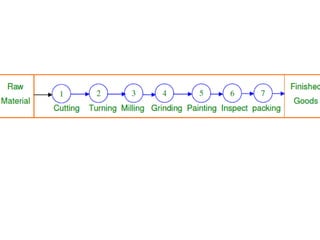
Product layout:-
• This layout is followed by only by such
industries where the product decisions are
finalized and may not change at least in the
near future. It is because a change in the
product will call for a change in the plant
layout.
Advantages:-
• Faster and cheaper production.
• Lower cost of material handling.
• Effective utilization of floor space.
• Easy monitoring.
• Team work benefits.
Disadvantages:-
• Threat of duplication.
• Huge capital outlay.
• Little flexibility.
• Discontinuity in production likely.
• Monitoring each worker made difficult.
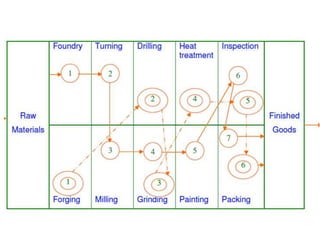
Process or functional layout:-
• The equipment is arranged as per the nature
or types of the given set of products
operations major it is called process layout.
Advantages:-
• Optimum utilization of resources.
• Flexibility.
• Continuity.
• Interesting to workers.
• Monitoring.
Disadvantages:-
• Higher material handling costs.
• Larger production cycle.
• Monitoring may be complex.
• Higher inspection costs.
• Higher wage bill.
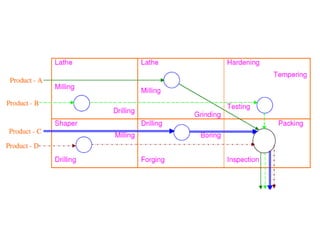
CELLULAR OR GROUP LAYOUT
• MASS PRODUCTION
• GRuOP Technology
• Scienfitic
Fixed layout:-
• The manufacturing facilities are fixed in their
position. They cannot be shifted from one
place to another place. This type of layout is
used in case of large projects.
Advantages:-
• Does not involve large investments.
• High degree of flexibility.
• Job enlargement.
Disadvantages:-
• Material handling costs will be very high.
• Resources may be under utilized.
Methods of production:-
Production:-is an act of transformation
i.e inputs are processed and transformed into
some output.
Methods of production:-2 types
1. Intermittent or interrupted production
2. Continuous production
Intermittent or interrupted
production:-
• The goods are manufactured specially to
fulfill the order made by the customers
rather than for stock.
• This is of two types
1. Job production
2. Batch production
Job production:-
• This is the production of single complete unit by one
operator or group of operators.
Ex:-Construction of a bridge, construction of dam, ship
building etc
• In this process goods are produced to definite
customers orders.
• Each production is a class by itself and requires a
distinct and separate job for production purposes.
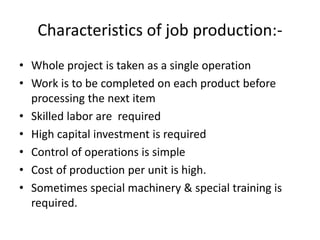
Characteristics of job production:-
• Whole project is taken as a single operation
• Work is to be completed on each product before
processing the next item
• Skilled labor are required
• High capital investment is required
• Control of operations is simple
• Cost of production per unit is high.
• Sometimes special machinery & special training is
required.
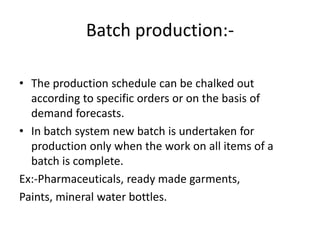
Batch production:-
• The production schedule can be chalked out
according to specific orders or on the basis of
demand forecasts.
• In batch system new batch is undertaken for
production only when the work on all items of a
batch is complete.
Ex:-Pharmaceuticals, ready made garments,
Paints, mineral water bottles.
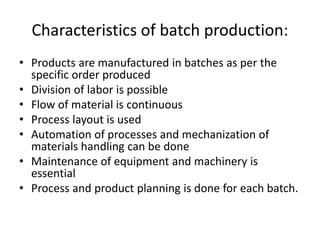
Characteristics of batch production:
• Products are manufactured in batches as per the
specific order produced
• Division of labor is possible
• Flow of material is continuous
• Process layout is used
• Automation of processes and mechanization of
materials handling can be done
• Maintenance of equipment and machinery is
essential
• Process and product planning is done for each batch.
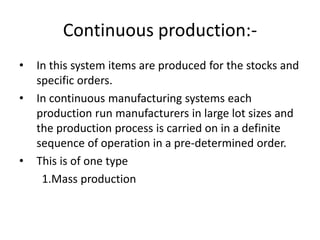
Continuous production:-
• In this system items are produced for the stocks and
specific orders.
• In continuous manufacturing systems each
production run manufacturers in large lot sizes and
the production process is carried on in a definite
sequence of operation in a pre-determined order.
• This is of one type
1.Mass production
Mass production:-
• Also called as flow production
• The production can be undertaken on large and
specialized machines and processes.
Characteristics:-
• Mechanization and division of labor
• Large-scale economies
• Sophisticated material handling systems to minimize
the cost
• Work study techniques
• ISO 9000 like sophisticated quality control
techniques.
Work study:-
• According to British Standard (BS 3138), work
study refers to the method study and work
measurement which are used to examine
human work in all its contexts by
systematically investigating into all factors
affecting its efficiency and economy to bring
forth the desired improvement.
Benefits:-
• Directly leads to standardization of the job processes
• Determines cost of the work performed
• It saves the time
• Contributes to cost savings
• Enhances the employee morale
• Facilitates the organization to plan and achieve work
targets
• Enhances the productivity of all workers and machines
• Helps to evaluate the department performance
Components of work study:-
• Method study
• Work measurement
Method study:-
Is also called as Motion study.
Method study is the systematic recording and
critical examination of the existing and
proposed ways of doing work.
Basic procedure of method study:-
• Aim: to develop better working methods
• Select: the task to be studied
• Record: all related facts
• Examine: the critical facts should be examined
• Develop: the best possible method
• Define: the best method so developed
• Install: the new method
• Maintain: the installed method
• Result: increased efficiency, cost effectiveness and
good productivity
Work measurement:-
• Also called Time study, establishes the time
taken by a qualified worker to complete a
specified job at a defined level of
performance.
• Time measuring devices:-
1. Stop watch
2. Motion picture camera
3. Time recording machine
4. Electronic timer
Statistical Quality Control:-
• Quality is some prescribed or desired characteristics
present in raw material, semi-finished or finished
goods.
• Control is the process of verification or correction of
the product when the deviations in the quality are
found to be more than expected.
• Quality control is of great value to both producer and
customer
• SQC is applied by taking samples and drawing
conclusions by means of some mathematical
analysis.

IEM UNIT 4 PLANT LOCATION.ppt

  • 1.
  • 2.
  • 3.
    Principles and typesof Plant Layout Plant Layout:- is physical arrangements, either existing or in industrial facilities. Mainly plant layout begins with plant location. Objectives: • Economics in handling materials, semi-finished and finished goods. • Proper and efficient utilization of available floor space. • Provision for better supervision and control. • Careful planning • To provide adequate safety • To meet the quality and capacity requirements. • Provision for medical and cafeteria at suitable and convenient places.
  • 4.
    Advantages of goodlayout:- • Economies in handling. • Effective use of available area. • Minimizes production delays. • Improves quality control. • Avoids bottlenecks. • Controls production in a better way. • Better supervision. • Improved utilization of labour • Improves employee morale. • Avoids unnecessary and costly changes.
  • 5.
    Types of layouts:- 1.PRODUCT LAYOUT 2. PROCESS OR FUNCTIONAL LAYOUT 3. GROUP OR CELLULAR LAYOUT 4. FIXED LAYOUT
  • 6.
    Product layout:- • Thislayout is followed by only by such industries where the product decisions are finalized and may not change at least in the near future. It is because a change in the product will call for a change in the plant layout.
  • 8.
    Advantages:- • Faster andcheaper production. • Lower cost of material handling. • Effective utilization of floor space. • Easy monitoring. • Team work benefits.
  • 9.
    Disadvantages:- • Threat ofduplication. • Huge capital outlay. • Little flexibility. • Discontinuity in production likely. • Monitoring each worker made difficult.
  • 10.
    Process or functionallayout:- • The equipment is arranged as per the nature or types of the given set of products operations major it is called process layout.
  • 12.
    Advantages:- • Optimum utilizationof resources. • Flexibility. • Continuity. • Interesting to workers. • Monitoring.
  • 13.
    Disadvantages:- • Higher materialhandling costs. • Larger production cycle. • Monitoring may be complex. • Higher inspection costs. • Higher wage bill.
  • 14.
    CELLULAR OR GROUPLAYOUT • MASS PRODUCTION • GRuOP Technology • Scienfitic
  • 16.
    Fixed layout:- • Themanufacturing facilities are fixed in their position. They cannot be shifted from one place to another place. This type of layout is used in case of large projects.
  • 17.
    Advantages:- • Does notinvolve large investments. • High degree of flexibility. • Job enlargement. Disadvantages:- • Material handling costs will be very high. • Resources may be under utilized.
  • 18.
    Methods of production:- Production:-isan act of transformation i.e inputs are processed and transformed into some output. Methods of production:-2 types 1. Intermittent or interrupted production 2. Continuous production
  • 19.
    Intermittent or interrupted production:- •The goods are manufactured specially to fulfill the order made by the customers rather than for stock. • This is of two types 1. Job production 2. Batch production
  • 20.
    Job production:- • Thisis the production of single complete unit by one operator or group of operators. Ex:-Construction of a bridge, construction of dam, ship building etc • In this process goods are produced to definite customers orders. • Each production is a class by itself and requires a distinct and separate job for production purposes.
  • 21.
    Characteristics of jobproduction:- • Whole project is taken as a single operation • Work is to be completed on each product before processing the next item • Skilled labor are required • High capital investment is required • Control of operations is simple • Cost of production per unit is high. • Sometimes special machinery & special training is required.
  • 22.
    Batch production:- • Theproduction schedule can be chalked out according to specific orders or on the basis of demand forecasts. • In batch system new batch is undertaken for production only when the work on all items of a batch is complete. Ex:-Pharmaceuticals, ready made garments, Paints, mineral water bottles.
  • 23.
    Characteristics of batchproduction: • Products are manufactured in batches as per the specific order produced • Division of labor is possible • Flow of material is continuous • Process layout is used • Automation of processes and mechanization of materials handling can be done • Maintenance of equipment and machinery is essential • Process and product planning is done for each batch.
  • 24.
    Continuous production:- • Inthis system items are produced for the stocks and specific orders. • In continuous manufacturing systems each production run manufacturers in large lot sizes and the production process is carried on in a definite sequence of operation in a pre-determined order. • This is of one type 1.Mass production
  • 25.
    Mass production:- • Alsocalled as flow production • The production can be undertaken on large and specialized machines and processes. Characteristics:- • Mechanization and division of labor • Large-scale economies • Sophisticated material handling systems to minimize the cost • Work study techniques • ISO 9000 like sophisticated quality control techniques.
  • 26.
    Work study:- • Accordingto British Standard (BS 3138), work study refers to the method study and work measurement which are used to examine human work in all its contexts by systematically investigating into all factors affecting its efficiency and economy to bring forth the desired improvement.
  • 27.
    Benefits:- • Directly leadsto standardization of the job processes • Determines cost of the work performed • It saves the time • Contributes to cost savings • Enhances the employee morale • Facilitates the organization to plan and achieve work targets • Enhances the productivity of all workers and machines • Helps to evaluate the department performance
  • 28.
    Components of workstudy:- • Method study • Work measurement Method study:- Is also called as Motion study. Method study is the systematic recording and critical examination of the existing and proposed ways of doing work.
  • 29.
    Basic procedure ofmethod study:- • Aim: to develop better working methods • Select: the task to be studied • Record: all related facts • Examine: the critical facts should be examined • Develop: the best possible method • Define: the best method so developed • Install: the new method • Maintain: the installed method • Result: increased efficiency, cost effectiveness and good productivity
  • 30.
    Work measurement:- • Alsocalled Time study, establishes the time taken by a qualified worker to complete a specified job at a defined level of performance. • Time measuring devices:- 1. Stop watch 2. Motion picture camera 3. Time recording machine 4. Electronic timer
  • 31.
    Statistical Quality Control:- •Quality is some prescribed or desired characteristics present in raw material, semi-finished or finished goods. • Control is the process of verification or correction of the product when the deviations in the quality are found to be more than expected. • Quality control is of great value to both producer and customer • SQC is applied by taking samples and drawing conclusions by means of some mathematical analysis.