McGraw-Hill/Irwin
Copyright © 2012 by The McGraw-Hill Companies, Inc. All rights reserved.
OPERATION
STATEGY AND
COMPETITIVENESS
ď‚— The role of operations strategy is to provide a plan
for the operations function so that it can make the
best use of its resources.
ď‚— Operations strategy specifies the policies and
plans for using the organization’s resources to
support its long-term competitive strategy.
ď‚— This includes the location, size, and type of
facilities available; worker skills and talents
required; use of technology, special processes
needed, special equipment; and quality control
methods
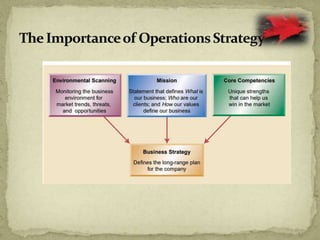
A company’s business strategy is developed after its managers have
considered many factors and have made some strategic decisions.
These include developing an understanding of what business the company is
in (the company’s mission), analyzing and developing an understanding of the
market (environmental scanning), and identifying the company’s strengths
(core competencies)
1. Mission
The mission is a statement that answers three overriding questions:
• What business will the company be in (“selling personal computers,”
“operating an Italian restaurant”)?
• Who will the customers be, and what are the expected customer
attributes (“homeowners,”“college graduates”)?
• How will the company’s basic beliefs define the business (“gives the
highest customer service,”“stresses family values”)?
Eg: Dell Computer Corporation: “to be the most successful computer
company in the world”
IBM: “translate advanced technologies into values for our customers as
the world’s largest information service company”
2. Environmental Scanning
This includes trends in the market, in the economic and political
environment, and in society.
These trends must be analyzed to determine business opportunities and
threats.
Environmental scanning is the process of monitoring the external
environment.
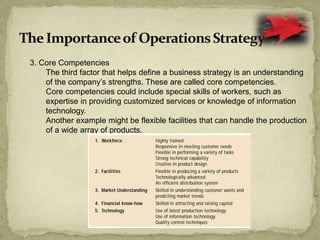
3. Core Competencies
The third factor that helps define a business strategy is an understanding
of the company’s strengths. These are called core competencies.
Core competencies could include special skills of workers, such as
expertise in providing customized services or knowledge of information
technology.
Another example might be flexible facilities that can handle the production
of a wide array of products.
Corporate Mission
Business Strategy
Product/Service Plans
Competitive Priorities
Operations Strategy
Assessment
of Global
Business
Conditions
Distinctive
Competencies
or
Weaknesses
l A corporate mission is a set of long-range goals
and including statements about:
l the kind of business the company wants to be in
l who its customers are
l its basic beliefs about business
l its goals of survival, growth, and profitability
l Business strategy is a long-range game plan of an
organization and provides a road map of how to
achieve the corporate mission.
l Inputs to the business strategy are
l Assessment of global business conditions - social,
economic, political, technological, competitive
l Distinctive competencies or weaknesses - workers, sales
force, R&D, technology, management
As a product is designed, all the detailed
characteristics of the product are established.
Each product characteristic directly
affects how the product can be made.
How the product is made determines
the design of the production system.
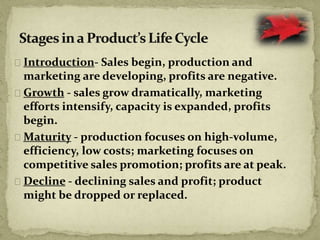
Introduction- Sales begin, production and
marketing are developing, profits are negative.
Growth - sales grow dramatically, marketing
efforts intensify, capacity is expanded, profits
begin.
Maturity - production focuses on high-volume,
efficiency, low costs; marketing focuses on
competitive sales promotion; profits are at peak.
Decline - declining sales and profit; product
might be dropped or replaced.
Once a business strategy has been developed, an operations strategy must
be formulated.
It focuses on specific capabilities of the operation that give the company a
competitive edge. These capabilities are called competitive priorities.
There are four broad categories of competitive priorities
1. Cost
Competing based on cost means offering a product at a low price
relative to the prices of competing products.To develop this competitive
priority, the operations function must focus primarily on cutting costs in the
system, such as costs of labor, materials, and facilities.
2. Quality
Many companies claim that quality is their top priority, and many
customers say that they look for quality in the products they buy.
3. Time
Time or speed is one of the most important competitive priorities today.
Companies in all industries are competing to deliver high-quality products
in as short a time as possible.
4. Flexibility
As a company’s environment changes rapidly, including customer needs
and expectations, the ability to readily accommodate these changes can
be a winning strategy.
There are two dimensions of flexibility. One is the ability to offer a
wide variety of goods or services and customize them to the unique needs
of clients. This is called product flexibility.
Another aspect of flexibility is the ability to rapidly increase or
decrease the amount produced in order to accommodate changes in the
demand. This is called volume flexibility.
Once the competitive priorities have been identified, a plan is
developed to support those priorities. The operations strategy will specify
the design and use of the organization’s resources. There are two
categories.
1. Structure— Operations decisions related to the design of the production
process, such as characteristics of facilities used, selection of appropriate
technology, and the flow of goods and services through the facility.
2. Infrastructure— Operations decisions related to the planning and control
systems of the operation, such as the organization of the operations
function, the skills and pay of workers, and quality control approaches.
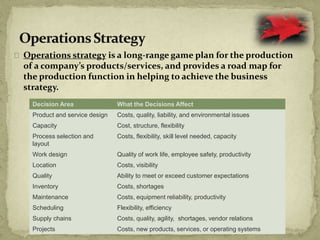
Operations strategy is a long-range game plan for the production
of a company’s products/services, and provides a road map for
the production function in helping to achieve the business
strategy.
Decision Area What the Decisions Affect
Product and service design Costs, quality, liability, and environmental issues
Capacity Cost, structure, flexibility
Process selection and
layout
Costs, flexibility, skill level needed, capacity
Work design Quality of work life, employee safety, productivity
Location Costs, visibility
Quality Ability to meet or exceed customer expectations
Inventory Costs, shortages
Maintenance Costs, equipment reliability, productivity
Scheduling Flexibility, efficiency
Supply chains Costs, quality, agility, shortages, vendor relations
Projects Costs, new products, services, or operating systems
Companies can use technology to help them gain an advantage over
their competitors. For this reason technology has become a critical factor
for companies in achieving a competitive advantage.
There are three primary types of technologies
The first type is product technology, which is any new technology
developed by a firm. An example of this would include Teflon®, the
material used in no-stick fry pans. Teflon became an emerging technology
in the 1970s.
A second type of technology is process technology. It is the
technology used to improve the process of creating goods and services.
Examples of this would include computer aided design (CAD) and
computer-aided manufacturing (CAM). These are technologies that use
computers to assist engineers in the way they design and manufacture
products
The last type of technology is information technology, which enables
communication, processing, and storage of information. Information
technology has grown rapidly over recent years and has had a profound
impact on business.
Another example of information technology is enterprise resource
planning (ERP), which functions via large software programs used for
planning and coordinating all resources throughout the entire enterprise.
ERP systems have enabled companies to reduce costs and improve
responsiveness, but are highly expensive to purchase and implement.
Positioning the production system
Product/service plans
Outsourcing plans
Process and technology plans
Strategic allocation of resources
Facility plans: capacity, location, and layout
Select the type of product design
Standard
Custom
Select the type of production processing system
Product focused
Process focused
Select the type of finished-goods inventory policy
Produce-to-stock
Produce-to-order
Outsourcing refers to hiring out or
subcontracting some of the work that a company
needs to do.
This strategy is being used more and more as
companies strive to operate more efficiently.
Outsourcing has many advantages and
disadvantages.
Companies try to determine the best level of out-
sourcing to achieve their operations & business
goals.
More outsourcing requires a company to have less
equipment, fewer employees, and a smaller
facility.
A company might outsource any of the following
manufacturing related functions:
Designing the product
Purchasing the basic raw materials
Processing the subcomponents, subassemblies, major
assemblies, and finished product
Distributing the product
Many companies even outsource some service
functions such as:
Payroll
Billing
Order processing
Developing/maintaining a website
Employee recruitment
Facility maintenance
An essential part of operations strategy is the
determination of how products/services will be
produced.
The range of technologies available to produce
products/services is great and is continually
changing.
For most companies, the vast majority of the
firm’s resources are used in
production/operations.
Some or all of these resources are limited.
The resources must be allocated to products,
services, projects, or profit opportunities in ways
that maximize the achievement of the operations
objectives.
How to provide the long-range capacity to
produce the firm’s products/services is a critical
strategic decision.
The location of a new facility may need to be
decided.
The internal arrangement (layout) of workers,
equipment, and functional areas within a facility
affects the ability to provide the desired volume,
quality, and cost of products/services.
The competitive priorities listed earlier for
manufacturers apply to service firms as well
Low production costs
Fast and on-time delivery
High-quality products/services
Customer service and flexibility
Providing all the priorities simultaneously to
customers is seldom possible.
Type of Service Design
Standard or custom products
Amount of customer contact
Mix of physical goods and intangible services
Type of Production Process
Quasi manufacturing
Customer-as-participant
Customer-as-product
Example: McDonald’s
Highly standardized service design
Low amount of customer contact
Physical goods dominating intangible services
Quasi-manufacturing approach to back-room
production process
Support the product plans and competitive
priorities defined in the business strategy.
Adjust to the evolving positioning strategies.
Link to the marketing strategies.
Look at alternative operations strategies.
The characteristics of production systems tend to
evolve as products move through their product
life cycles.
Operations strategies must include plan for
modifying production systems to a changing set
of competitive priorities as products mature.
The capital and production technology required
to support these changes must be provided.
ď‚— Productivity
ď‚— A measure of the effective use of resources, usually
expressed as the ratio of output to input
ď‚— Productivity measures are useful for
 Tracking an operating unit’s performance over time
ď‚— Judging the performance of an entire industry or
country
Capital
Process &
Methods
Technology Management
Quality
Product Design
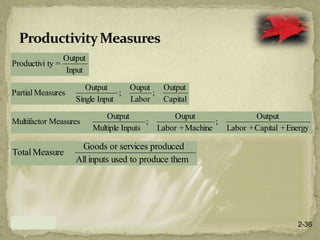
Partial Measures
Output
Single Input
;
Ouput
Labor
;
Output
Capital
Multifactor Measures
Output
Multiple Inputs
;
Ouput
Labor +Machine
;
Output
Labor +Capital +Energy
Total Measure
Goods or services produced
All inputs used to produce them
Input
Output
=
ty
Productivi
Student Slides 2-36

Operation strategy and competitiveness.pptx

  • 1.
    McGraw-Hill/Irwin Copyright © 2012by The McGraw-Hill Companies, Inc. All rights reserved. OPERATION STATEGY AND COMPETITIVENESS
  • 2.
     The roleof operations strategy is to provide a plan for the operations function so that it can make the best use of its resources.  Operations strategy specifies the policies and plans for using the organization’s resources to support its long-term competitive strategy.  This includes the location, size, and type of facilities available; worker skills and talents required; use of technology, special processes needed, special equipment; and quality control methods
  • 4.
    A company’s businessstrategy is developed after its managers have considered many factors and have made some strategic decisions. These include developing an understanding of what business the company is in (the company’s mission), analyzing and developing an understanding of the market (environmental scanning), and identifying the company’s strengths (core competencies)
  • 5.
    1. Mission The missionis a statement that answers three overriding questions: • What business will the company be in (“selling personal computers,” “operating an Italian restaurant”)? • Who will the customers be, and what are the expected customer attributes (“homeowners,”“college graduates”)? • How will the company’s basic beliefs define the business (“gives the highest customer service,”“stresses family values”)? Eg: Dell Computer Corporation: “to be the most successful computer company in the world” IBM: “translate advanced technologies into values for our customers as the world’s largest information service company”
  • 6.
    2. Environmental Scanning Thisincludes trends in the market, in the economic and political environment, and in society. These trends must be analyzed to determine business opportunities and threats. Environmental scanning is the process of monitoring the external environment.
  • 7.
    3. Core Competencies Thethird factor that helps define a business strategy is an understanding of the company’s strengths. These are called core competencies. Core competencies could include special skills of workers, such as expertise in providing customized services or knowledge of information technology. Another example might be flexible facilities that can handle the production of a wide array of products.
  • 9.
    Corporate Mission Business Strategy Product/ServicePlans Competitive Priorities Operations Strategy Assessment of Global Business Conditions Distinctive Competencies or Weaknesses
  • 10.
    l A corporatemission is a set of long-range goals and including statements about: l the kind of business the company wants to be in l who its customers are l its basic beliefs about business l its goals of survival, growth, and profitability
  • 11.
    l Business strategyis a long-range game plan of an organization and provides a road map of how to achieve the corporate mission. l Inputs to the business strategy are l Assessment of global business conditions - social, economic, political, technological, competitive l Distinctive competencies or weaknesses - workers, sales force, R&D, technology, management
  • 12.
    As a productis designed, all the detailed characteristics of the product are established. Each product characteristic directly affects how the product can be made. How the product is made determines the design of the production system.
  • 13.
    Introduction- Sales begin,production and marketing are developing, profits are negative. Growth - sales grow dramatically, marketing efforts intensify, capacity is expanded, profits begin. Maturity - production focuses on high-volume, efficiency, low costs; marketing focuses on competitive sales promotion; profits are at peak. Decline - declining sales and profit; product might be dropped or replaced.
  • 15.
    Once a businessstrategy has been developed, an operations strategy must be formulated. It focuses on specific capabilities of the operation that give the company a competitive edge. These capabilities are called competitive priorities. There are four broad categories of competitive priorities 1. Cost Competing based on cost means offering a product at a low price relative to the prices of competing products.To develop this competitive priority, the operations function must focus primarily on cutting costs in the system, such as costs of labor, materials, and facilities.
  • 16.
    2. Quality Many companiesclaim that quality is their top priority, and many customers say that they look for quality in the products they buy. 3. Time Time or speed is one of the most important competitive priorities today. Companies in all industries are competing to deliver high-quality products in as short a time as possible. 4. Flexibility As a company’s environment changes rapidly, including customer needs and expectations, the ability to readily accommodate these changes can be a winning strategy. There are two dimensions of flexibility. One is the ability to offer a wide variety of goods or services and customize them to the unique needs of clients. This is called product flexibility. Another aspect of flexibility is the ability to rapidly increase or decrease the amount produced in order to accommodate changes in the demand. This is called volume flexibility.
  • 17.
    Once the competitivepriorities have been identified, a plan is developed to support those priorities. The operations strategy will specify the design and use of the organization’s resources. There are two categories. 1. Structure— Operations decisions related to the design of the production process, such as characteristics of facilities used, selection of appropriate technology, and the flow of goods and services through the facility. 2. Infrastructure— Operations decisions related to the planning and control systems of the operation, such as the organization of the operations function, the skills and pay of workers, and quality control approaches.
  • 18.
    Operations strategy isa long-range game plan for the production of a company’s products/services, and provides a road map for the production function in helping to achieve the business strategy. Decision Area What the Decisions Affect Product and service design Costs, quality, liability, and environmental issues Capacity Cost, structure, flexibility Process selection and layout Costs, flexibility, skill level needed, capacity Work design Quality of work life, employee safety, productivity Location Costs, visibility Quality Ability to meet or exceed customer expectations Inventory Costs, shortages Maintenance Costs, equipment reliability, productivity Scheduling Flexibility, efficiency Supply chains Costs, quality, agility, shortages, vendor relations Projects Costs, new products, services, or operating systems
  • 19.
    Companies can usetechnology to help them gain an advantage over their competitors. For this reason technology has become a critical factor for companies in achieving a competitive advantage. There are three primary types of technologies The first type is product technology, which is any new technology developed by a firm. An example of this would include Teflon®, the material used in no-stick fry pans. Teflon became an emerging technology in the 1970s. A second type of technology is process technology. It is the technology used to improve the process of creating goods and services. Examples of this would include computer aided design (CAD) and computer-aided manufacturing (CAM). These are technologies that use computers to assist engineers in the way they design and manufacture products
  • 20.
    The last typeof technology is information technology, which enables communication, processing, and storage of information. Information technology has grown rapidly over recent years and has had a profound impact on business. Another example of information technology is enterprise resource planning (ERP), which functions via large software programs used for planning and coordinating all resources throughout the entire enterprise. ERP systems have enabled companies to reduce costs and improve responsiveness, but are highly expensive to purchase and implement.
  • 21.
    Positioning the productionsystem Product/service plans Outsourcing plans Process and technology plans Strategic allocation of resources Facility plans: capacity, location, and layout
  • 22.
    Select the typeof product design Standard Custom Select the type of production processing system Product focused Process focused Select the type of finished-goods inventory policy Produce-to-stock Produce-to-order
  • 23.
    Outsourcing refers tohiring out or subcontracting some of the work that a company needs to do. This strategy is being used more and more as companies strive to operate more efficiently. Outsourcing has many advantages and disadvantages. Companies try to determine the best level of out- sourcing to achieve their operations & business goals. More outsourcing requires a company to have less equipment, fewer employees, and a smaller facility.
  • 24.
    A company mightoutsource any of the following manufacturing related functions: Designing the product Purchasing the basic raw materials Processing the subcomponents, subassemblies, major assemblies, and finished product Distributing the product
  • 25.
    Many companies evenoutsource some service functions such as: Payroll Billing Order processing Developing/maintaining a website Employee recruitment Facility maintenance
  • 26.
    An essential partof operations strategy is the determination of how products/services will be produced. The range of technologies available to produce products/services is great and is continually changing.
  • 27.
    For most companies,the vast majority of the firm’s resources are used in production/operations. Some or all of these resources are limited. The resources must be allocated to products, services, projects, or profit opportunities in ways that maximize the achievement of the operations objectives.
  • 28.
    How to providethe long-range capacity to produce the firm’s products/services is a critical strategic decision. The location of a new facility may need to be decided. The internal arrangement (layout) of workers, equipment, and functional areas within a facility affects the ability to provide the desired volume, quality, and cost of products/services.
  • 29.
    The competitive prioritieslisted earlier for manufacturers apply to service firms as well Low production costs Fast and on-time delivery High-quality products/services Customer service and flexibility Providing all the priorities simultaneously to customers is seldom possible.
  • 30.
    Type of ServiceDesign Standard or custom products Amount of customer contact Mix of physical goods and intangible services Type of Production Process Quasi manufacturing Customer-as-participant Customer-as-product
  • 31.
    Example: McDonald’s Highly standardizedservice design Low amount of customer contact Physical goods dominating intangible services Quasi-manufacturing approach to back-room production process
  • 32.
    Support the productplans and competitive priorities defined in the business strategy. Adjust to the evolving positioning strategies. Link to the marketing strategies. Look at alternative operations strategies.
  • 33.
    The characteristics ofproduction systems tend to evolve as products move through their product life cycles. Operations strategies must include plan for modifying production systems to a changing set of competitive priorities as products mature. The capital and production technology required to support these changes must be provided.
  • 34.
     Productivity  Ameasure of the effective use of resources, usually expressed as the ratio of output to input  Productivity measures are useful for  Tracking an operating unit’s performance over time  Judging the performance of an entire industry or country
  • 35.
  • 36.
    Partial Measures Output Single Input ; Ouput Labor ; Output Capital MultifactorMeasures Output Multiple Inputs ; Ouput Labor +Machine ; Output Labor +Capital +Energy Total Measure Goods or services produced All inputs used to produce them Input Output = ty Productivi Student Slides 2-36