Operational Strategies


                  G.VENKATAKRISHNAN
 OPERATIONS deals with the functions and
 procedures involved in the day-to-day processes of
 manufacturing goods and products,

 STRATEGY deals with the direction and scope of an
 organisation over a long period of time on how they
 deliver to their clients.
Operational Priorities- The Edge

 Four Important Operations Questions: Will you
 compete on –

 Cost?
         Quality?
                    Time?
                            Flexibility?
Competing on Cost?
 Offering product at a low price relative to competition
    Typically high volume products

    Often limit product range & offer little customization

    May invest in automation to reduce unit costs

    Can use lower skill labor

    Probably use product focused layouts

    Low cost does not mean low quality
Competing on Quality?
 Quality is often subjective
 Quality is defined differently depending on who is
  defining it
 Two major quality dimensions include
   High performance design:
       Superior features, high durability, & excellent customer service

   Product & service consistency:
       Meets design specifications
       Close tolerances
       Error free delivery
 Quality needs to address
   Product design quality – product/service meets requirements
   Process quality – error free products
Competing on Time?
 Time/speed one of most important competition
  priorities
 First that can deliver often wins the race
 Time related issues involve
   Rapid delivery:
       Focused on shorter time between order placement and delivery
   On-time delivery:
       Deliver product exactly when needed every time
Competing on Flexibility?
 Company environment changes rapidly


 Company must accommodate change by being flexible
   Product flexibility:
       Easily switch production from one item to another
       Easily customize product/service to meet specific requirements of a
        customer


   Volume flexibility:
       Ability to ramp production up and down to match market demands
DEVELOPMENT OF
OPERATION STRATEGY
Importance of Operations Strategy
 Companies often do not understand the differences
 between operational efficiency and strategy
   Operational efficiency is performing tasks well, even
    better than competitors
   Strategy is a plan for competing in the marketplace
 Operations strategy is to ensure all tasks performed
 are the right tasks
Develop an Operations Strategy
 -What products can be produced in which facility and
  how much?
 -Which products are going to be produced internally,
  and which ones will be purchased?
 -How many facilities are needed?
Develop an Operations Strategy
 -Where will the facilities be located, with how much
  capacity?
 -What type of processes will be utilized to produce
  products?
 -How much flexibility is required from each process
  and each product?
Develop an Operations Strategy
 -What level of technology (automation, etc.) will be
  used?
 -Are the resources going to be owned or bought?
 -How will the products be distributed to the end
  customers?
Develop an Operations Strategy
 -Which suppliers will provide materials, and how
  much?
 -What kind of human skills are needed?
 -And so on.
Develop an Operations Strategy
 Operations decisions given regarding these issues
  must be consistent with the firm’s corporate strategy.
 These decisions made by operations managers are
  going to be viewed in detail throughout this course.
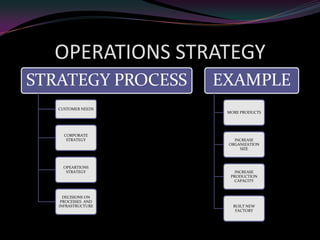
OPERATIONS STRATEGY
STRATEGY PROCESS    EXAMPLE
   CUSTOMER NEEDS
                     MORE PRODUCTS


     CORPORATE
      STRATEGY         INCREASE
                     ORGANIZATION
                         SIZE


     OPEARTIONS
      STRATEGY          INCREASE
                      PRODUCTION
                        CAPACITY


     DECISIONS ON
    PROCESSES AND
   INFRASTRUCTURE      BUILT NEW
                        FACTORY
ROLE OF OPERATION
    STRATEGY
Operations’ Role in Corporate
Strategy

   Operations provides support for a
    differentiated strategy
   Operations serves as a firm’s distinctive
    competence in executing similar strategies
    better than competitors
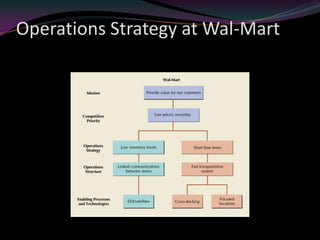
Operations Strategy at Wal-Mart
Operations Strategy:
  Products and Services
 Make-to-Order
   products and services are made to customer
    specifications after an order has been received
 Make-to-Stock
   products and services are made in anticipation of
    demand
 Assemble-to-Order
   products and services add options according to customer
    specifications
Operations Strategy:
    Human Resources
 What are the skill levels and degree of autonomy
    required to operate production system?
   What are the training requirements and selection
    criteria?
   What are the policies on performance evaluations,
    compensation, and incentives?
   Will workers be salaried, paid an hourly rate, or
    paid a piece rate?
   Will profit sharing be allowed, and if so, on what
    criteria?
Operations Strategy:
    Human Resources (cont.)
 Will workers perform individual tasks or work
    in teams?
   Will they have supervisors or work in self-
    managed work groups?
   How many levels of management will be
    required?
   Will extensive worker training be necessary?
   Should workforce be cross-trained?
   What efforts will be made in terms of
    retention?
Operations Strategy:
 Quality
 What is the target level of quality for our
  products and services?
 How will it be measured?
 How will employees be involved with
  quality?
 What will the responsibilities of the
  quality department be?
Operations Strategy:
     Quality (cont.)
 What types of systems will be set up to ensure
    quality?
   How will quality awareness be maintained?
   How will quality efforts be evaluated?
   How will customer perceptions of quality be
    determined?
   How will decisions in other functional areas
    affect quality?
Operations Strategy:
    Sourcing
 Vertical Integration
   degree to which a firm produces parts that go
    into its products
 Strategic Decisions
   How much work should be done outside the
    firm?
   On what basis should particular items be made
    in-house?
   When should items be outsourced?
   How should suppliers be selected?
Operations Strategy:
Sourcing (cont.)
  What type of relationship should be
     maintained with suppliers?
    What is expected from suppliers?
    How many suppliers should be used?
    How can quality and dependability of
     suppliers be ensured?
    How can suppliers be encouraged to
     collaborate?
Operation strategyppt

Operation strategyppt

  • 1.
    Operational Strategies G.VENKATAKRISHNAN
  • 2.
     OPERATIONS dealswith the functions and procedures involved in the day-to-day processes of manufacturing goods and products,  STRATEGY deals with the direction and scope of an organisation over a long period of time on how they deliver to their clients.
  • 3.
    Operational Priorities- TheEdge  Four Important Operations Questions: Will you compete on – Cost? Quality? Time? Flexibility?
  • 4.
    Competing on Cost? Offering product at a low price relative to competition  Typically high volume products  Often limit product range & offer little customization  May invest in automation to reduce unit costs  Can use lower skill labor  Probably use product focused layouts  Low cost does not mean low quality
  • 5.
    Competing on Quality? Quality is often subjective  Quality is defined differently depending on who is defining it  Two major quality dimensions include  High performance design:  Superior features, high durability, & excellent customer service  Product & service consistency:  Meets design specifications  Close tolerances  Error free delivery  Quality needs to address  Product design quality – product/service meets requirements  Process quality – error free products
  • 6.
    Competing on Time? Time/speed one of most important competition priorities  First that can deliver often wins the race  Time related issues involve  Rapid delivery:  Focused on shorter time between order placement and delivery  On-time delivery:  Deliver product exactly when needed every time
  • 7.
    Competing on Flexibility? Company environment changes rapidly  Company must accommodate change by being flexible  Product flexibility:  Easily switch production from one item to another  Easily customize product/service to meet specific requirements of a customer  Volume flexibility:  Ability to ramp production up and down to match market demands
  • 8.
  • 9.
    Importance of OperationsStrategy  Companies often do not understand the differences between operational efficiency and strategy  Operational efficiency is performing tasks well, even better than competitors  Strategy is a plan for competing in the marketplace  Operations strategy is to ensure all tasks performed are the right tasks
  • 10.
    Develop an OperationsStrategy  -What products can be produced in which facility and how much?  -Which products are going to be produced internally, and which ones will be purchased?  -How many facilities are needed?
  • 11.
    Develop an OperationsStrategy  -Where will the facilities be located, with how much capacity?  -What type of processes will be utilized to produce products?  -How much flexibility is required from each process and each product?
  • 12.
    Develop an OperationsStrategy  -What level of technology (automation, etc.) will be used?  -Are the resources going to be owned or bought?  -How will the products be distributed to the end customers?
  • 13.
    Develop an OperationsStrategy  -Which suppliers will provide materials, and how much?  -What kind of human skills are needed?  -And so on.
  • 14.
    Develop an OperationsStrategy  Operations decisions given regarding these issues must be consistent with the firm’s corporate strategy.  These decisions made by operations managers are going to be viewed in detail throughout this course.
  • 15.
    OPERATIONS STRATEGY STRATEGY PROCESS EXAMPLE CUSTOMER NEEDS MORE PRODUCTS CORPORATE STRATEGY INCREASE ORGANIZATION SIZE OPEARTIONS STRATEGY INCREASE PRODUCTION CAPACITY DECISIONS ON PROCESSES AND INFRASTRUCTURE BUILT NEW FACTORY
  • 16.
  • 17.
    Operations’ Role inCorporate Strategy  Operations provides support for a differentiated strategy  Operations serves as a firm’s distinctive competence in executing similar strategies better than competitors
  • 18.
  • 19.
    Operations Strategy: Products and Services  Make-to-Order  products and services are made to customer specifications after an order has been received  Make-to-Stock  products and services are made in anticipation of demand  Assemble-to-Order  products and services add options according to customer specifications
  • 20.
    Operations Strategy: Human Resources  What are the skill levels and degree of autonomy required to operate production system?  What are the training requirements and selection criteria?  What are the policies on performance evaluations, compensation, and incentives?  Will workers be salaried, paid an hourly rate, or paid a piece rate?  Will profit sharing be allowed, and if so, on what criteria?
  • 21.
    Operations Strategy: Human Resources (cont.)  Will workers perform individual tasks or work in teams?  Will they have supervisors or work in self- managed work groups?  How many levels of management will be required?  Will extensive worker training be necessary?  Should workforce be cross-trained?  What efforts will be made in terms of retention?
  • 22.
    Operations Strategy: Quality What is the target level of quality for our products and services?  How will it be measured?  How will employees be involved with quality?  What will the responsibilities of the quality department be?
  • 23.
    Operations Strategy: Quality (cont.)  What types of systems will be set up to ensure quality?  How will quality awareness be maintained?  How will quality efforts be evaluated?  How will customer perceptions of quality be determined?  How will decisions in other functional areas affect quality?
  • 24.
    Operations Strategy: Sourcing  Vertical Integration  degree to which a firm produces parts that go into its products  Strategic Decisions  How much work should be done outside the firm?  On what basis should particular items be made in-house?  When should items be outsourced?  How should suppliers be selected?
  • 25.
    Operations Strategy: Sourcing (cont.)  What type of relationship should be maintained with suppliers?  What is expected from suppliers?  How many suppliers should be used?  How can quality and dependability of suppliers be ensured?  How can suppliers be encouraged to collaborate?