Class 12
Business Studies
Business
Environment
Chapter - 3
Business Environment
Environment refers to the surroundings in
which a person or organization operates
Business environment means the political, social,
economic, technological and cultural forces outside
a business firm with which the entity deals
Business Environment
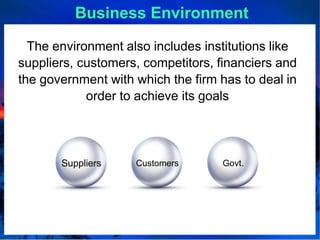
The environment also includes institutions like
suppliers, customers, competitors, financiers and
the government with which the firm has to deal in
order to achieve its goals
Suppliers Customers Govt.
Business Environment
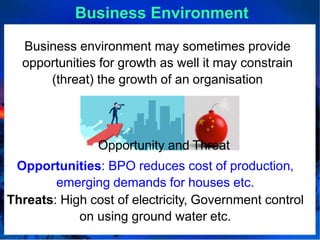
Business environment may sometimes provide
opportunities for growth as well it may constrain
(threat) the growth of an organisation
Opportunity and Threat
Opportunities: BPO reduces cost of production,
emerging demands for houses etc.
Threats: High cost of electricity, Government control
on using ground water etc.
Features of Business Environment
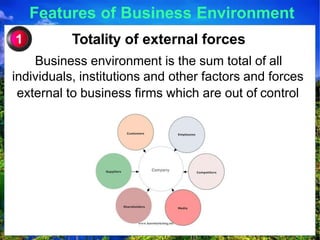
Totality of external forces
Business environment is the sum total of all
individuals, institutions and other factors and forces
external to business firms which are out of control
1
Features of Business Environment
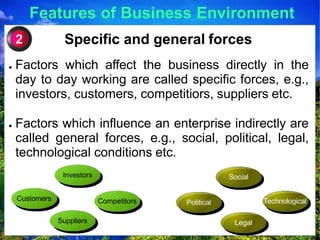
Specific and general forces
● Factors which affect the business directly in the
day to day working are called specific forces, e.g.,
investors, customers, competitiors, suppliers etc.
● Factors which influence an enterprise indirectly are
called general forces, e.g., social, political, legal,
technological conditions etc.
2
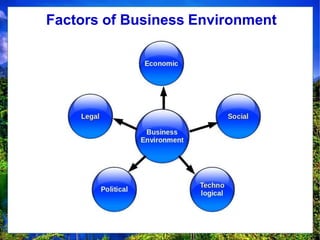
Legal
Political
Competitors
Investors
Customers
Social
Suppliers
Technological
Features of Business Environment
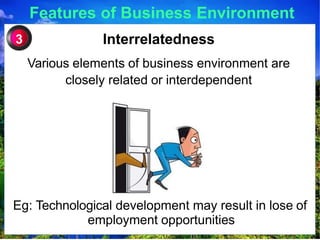
Interrelatedness
Various elements of business environment are
closely related or interdependent
3
Eg: Technological development may result in lose of
employment opportunities
Features of Business Environment
Dynamic Nature
The business environment is always changing
4
Eg: Technological improvement, entry of new
competitors, govt. policy etc.
Features of Business Environment
Uncertainty
Business environment is uncertain as nobody can
predict what will happen in future
5
This is more true in case of information technology
and fashion industries where changes are occurring
too frequently.
Features of Business Environment
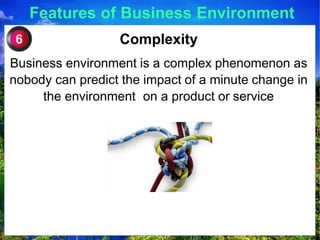
Complexity
Business environment is a complex phenomenon as
nobody can predict the impact of a minute change in
the environment on a product or service
6
Features of Business Environment
Relativity
Business environment is relative since it differs from
country to country or even from region to region
7
Importance of Business Environment
Identification of business
opportunities and getting the first
mover advantage
Identification of opportunities at an early stage helps
the firm to be able to exploit them without losing
them to competitors
1
E.g., Maruthi Udyog Ltd. became the leader in the
segment of small car market.
Importance of Business Environment
Identifying threats and early warning
signals
Environmental awareness helps the managers to
identify various threats; it provides the business early
warning signals to plan its future course of action
2
Eg: Entry of multinational companies in Indian market gave
a warning signals for the domestic industries to make some
preparations like cost reduction, improving quality, reducing
wastages etc.
Importance of Business Environment
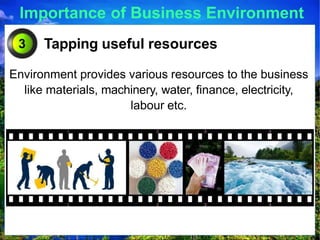
Tapping useful resources
Environment provides various resources to the business
like materials, machinery, water, finance, electricity,
labour etc.
3
Importance of Business Environment
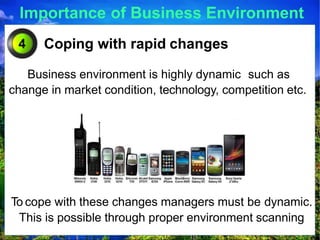
Coping with rapid changes
Business environment is highly dynamic such as
change in market condition, technology, competition etc.
4
To cope with these changes managers must be dynamic.
This is possible through proper environment scanning
Importance of Business Environment
Assisting in planning and policy
formulation
Environment scanning gives vital information which can
be taken as the basis for deciding future course of
action (planning) or framing guidelines for decision
making (policy formulation)
5
Importance of Business Environment
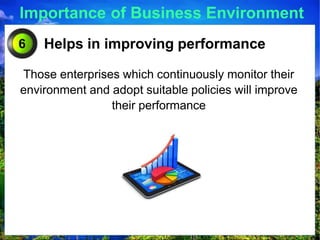
Helps in improving performance
Those enterprises which continuously monitor their
environment and adopt suitable policies will improve
their performance
6
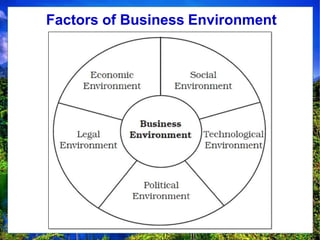
Factors of Business Environment
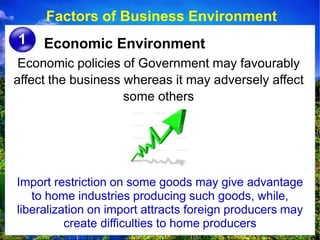
Economic Environment
Economic policies of Government may favourably
affect the business whereas it may adversely affect
some others
1
Import restriction on some goods may give advantage
to home industries producing such goods, while,
liberalization on import attracts foreign producers may
create difficulties to home producers
Factors of Business Environment
Social Environment
A business gets its inputs from society and returns the
output again to the society according to its needs
2
The social environment is made up of population
trends, individual needs and cultural factors
The business should adopt a strategy which should
be suitable for social and cultural environment
Factors of Business Environment
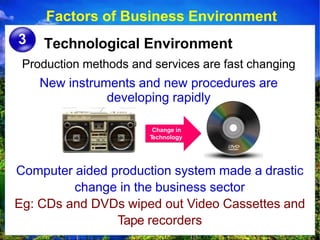
Technological Environment
Production methods and services are fast changing
New instruments and new procedures are
developing rapidly
3
Computer aided production system made a drastic
change in the business sector
Eg: CDs and DVDs wiped out Video Cassettes and
Tape recorders
Change in
T
echnology
Factors of Business Environment
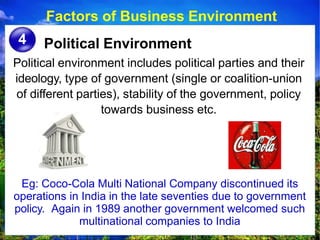
Political Environment
Political environment includes political parties and their
ideology, type of government (single or coalition-union
of different parties), stability of the government, policy
towards business etc.
4
Eg: Coco-Cola Multi National Company discontinued its
operations in India in the late seventies due to government
policy. Again in 1989 another government welcomed such
multinational companies to India
Factors of Business Environment
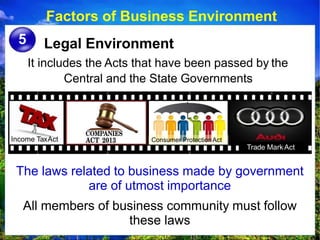
Legal Environment
It includes the Acts that have been passed by the
Central and the State Governments
5
The laws related to business made by government
are of utmost importance
All members of business community must follow
these laws
Income TaxAct Consumer ProtectionAct
Trade Mark Act
Factors of Business Environment
Economic Environment in India
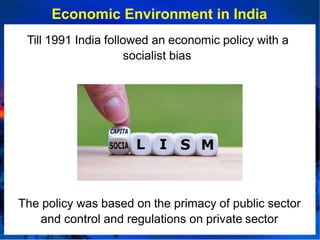
Till 1991 India followed an economic policy with a
socialist bias
The policy was based on the primacy of public sector
and control and regulations on private sector
Economic Environment in India
From 1991 onwards the Government started
implementing sweeping economic reforms
As part of economic reforms, the government of India
announced a new industrial policy in 1991
Industrial policy 1991
Features of Industrial Policy
a.Reduced the number of industries to 6 which
require compulsory licensing.
b.De-reserved many industries which were earlier
reserved for the public sector.
c.Carried out disinvestment process in case of many
public sector companies.
Features of Industrial Policy
d.Liberalized foreign capital policy – 100% Foreign
Direct Investment (FDI) in many segments.
e. Granted permission for technology agreement
with foreign companies.
f. Set up Foreign Investment Promotion Board
(FIPB) to promote foreign investment in India.
Major Programs of
Industrial Policy 1991
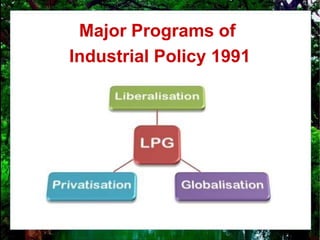
Major Programs of
Industrial Policy 1991
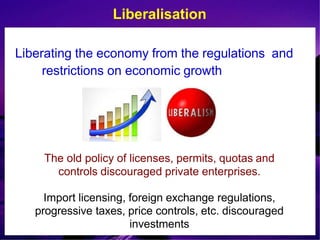
Liberalisation
Liberating the economy from the regulations and
restrictions on economic growth
The old policy of licenses, permits, quotas and
controls discouraged private enterprises.
Import licensing, foreign exchange regulations,
progressive taxes, price controls, etc. discouraged
investments
Liberalisation
Acts like MRTP Act prevented large business
houses from fresh investment, expansion and
modernization
All these policies adversely affected
industrialization and economic growth
The new policy of liberalization through de- licensing
and de-controls frees the economy from restrictions.
Licenses and permits have been replaced by broad
guidelines.
Privatisation
Privatization is a trend all over the world now, in India
the priority given to the public sector is gradually
being reduced and the role of private sector is being
encouraged
Main Features of Privatisation
Disinvestment
Passing of ownership, control and management of
Public Sector Undertakings to the private sector
De-reservation
This allows the private sector to enter into
new areas
The government is withdrawing from many economic
activities like running business and is concentrating
more on areas like primary and secondary education,
provision of basic health care, development of
infrastructure etc.
Globalisation
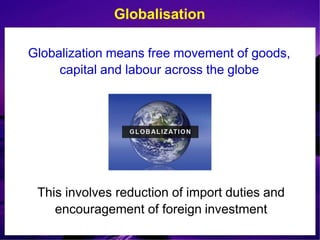
Globalization means free movement of goods,
capital and labour across the globe
This involves reduction of import duties and
encouragement of foreign investment
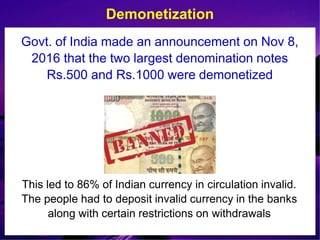
Govt. of India made an announcement on Nov 8,
2016 that the two largest denomination notes
Rs.500 and Rs.1000 were demonetized
Demonetization
This led to 86% of Indian currency in circulation invalid.
The people had to deposit invalid currency in the banks
along with certain restrictions on withdrawals
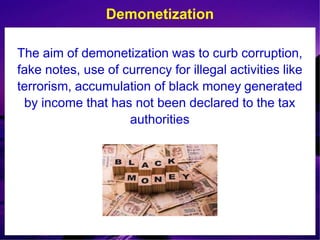
The aim of demonetization was to curb corruption,
fake notes, use of currency for illegal activities like
terrorism, accumulation of black money generated
by income that has not been declared to the tax
authorities
Demonetization
Aims and Features of
Demonetization
A tax administration tool
Aims and Features of Demonetization
1
The people who have black money had to declare their
unaccounted wealth and pay taxes at a penalty rate
To stop tax evasion
Aims and Features of Demonetization
2
The Govt. implemented this policy to control tax
evasion
To channelize the savings
Aims and Features of Demonetization
3
It was implemented to channelize the savings into
formal financial system by encouraging bank
deposits
Cash less economy
Aims and Features of Demonetization
4
Govt. announced demonetization with an aim of
creating a digital economy with the support of formal
financial system / banks. (Internet banking, e-wallets,
PoS [Point of Sale] etc.)
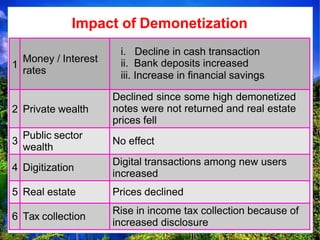
1
Money / Interest
rates
i. Decline in cash transaction
ii. Bank deposits increased
iii. Increase in financial savings
2 Private wealth
Declined since some high demonetized
notes were not returned and real estate
prices fell
3
Public sector
wealth
No effect
4 Digitization
Digital transactions among new users
increased
5 Real estate Prices declined
6 Tax collection
Rise in income tax collection because of
increased disclosure
Impact of Demonetization
Impact of changes in
government policy
on business and
industry
Impact of changes in government policy on business and industry
The policy of liberalisation, privatisation and
globalisation ofthe Government has made a
significant impact on the working of
enterprises in business and industry
Impact of changes in government policy on business and industry
1 Increasing competition
Liberal licensing and entry of foreign firms
made competition for Indian industries
Impact of changes in government policy on business and industry
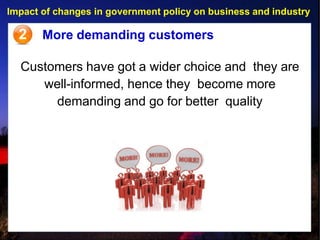
2 More demanding customers
Customers have got a wider choice and they are
well-informed, hence they become more
demanding and go for better quality
Impact of changes in government policy on business and industry
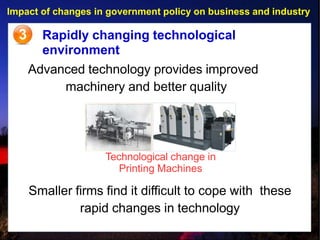
Advanced technology provides improved
machinery and better quality
3 Rapidly changing technological
environment
Technological change in
Printing Machines
Smaller firms find it difficult to cope with these
rapid changes in technology
Impact of changes in government policy on business and industry
4 Necessity for change
Because of economic reforms in 1991 and
introduction of LPG, market forces become
turbulent (unstable) which necessitated firms to
change or modify their operations continuously
Impact of changes in government policy on business and industry
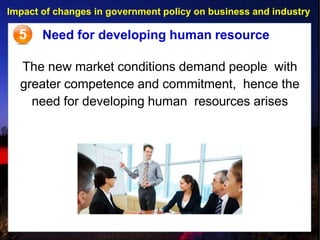
5 Need for developing human resource
The new market conditions demand people with
greater competence and commitment, hence the
need for developing human resources arises
Impact of changes in government policy on business and industry
6 Market orientation
Earlier “production first and then go to market”
was the strategy, but in this fast
changing business world first we should study
about the market and then produce the goods
accordingly
Impact of changes in government policy on business and industry
7 Loss of budgetary support to the public
sector
Fund allotment from government revenue has
declined over the years
This made the public sector undertakings to
become more efficient in the market
Grade 12 BS - Chapter 3 Business Environment.pptx

Grade 12 BS - Chapter 3 Business Environment.pptx

  • 1.
  • 2.
  • 3.
    Business Environment Environment refersto the surroundings in which a person or organization operates Business environment means the political, social, economic, technological and cultural forces outside a business firm with which the entity deals
  • 4.
    Business Environment The environmentalso includes institutions like suppliers, customers, competitors, financiers and the government with which the firm has to deal in order to achieve its goals Suppliers Customers Govt.
  • 5.
    Business Environment Business environmentmay sometimes provide opportunities for growth as well it may constrain (threat) the growth of an organisation Opportunity and Threat Opportunities: BPO reduces cost of production, emerging demands for houses etc. Threats: High cost of electricity, Government control on using ground water etc.
  • 6.
    Features of BusinessEnvironment Totality of external forces Business environment is the sum total of all individuals, institutions and other factors and forces external to business firms which are out of control 1
  • 7.
    Features of BusinessEnvironment Specific and general forces ● Factors which affect the business directly in the day to day working are called specific forces, e.g., investors, customers, competitiors, suppliers etc. ● Factors which influence an enterprise indirectly are called general forces, e.g., social, political, legal, technological conditions etc. 2 Legal Political Competitors Investors Customers Social Suppliers Technological
  • 8.
    Features of BusinessEnvironment Interrelatedness Various elements of business environment are closely related or interdependent 3 Eg: Technological development may result in lose of employment opportunities
  • 9.
    Features of BusinessEnvironment Dynamic Nature The business environment is always changing 4 Eg: Technological improvement, entry of new competitors, govt. policy etc.
  • 10.
    Features of BusinessEnvironment Uncertainty Business environment is uncertain as nobody can predict what will happen in future 5 This is more true in case of information technology and fashion industries where changes are occurring too frequently.
  • 11.
    Features of BusinessEnvironment Complexity Business environment is a complex phenomenon as nobody can predict the impact of a minute change in the environment on a product or service 6
  • 12.
    Features of BusinessEnvironment Relativity Business environment is relative since it differs from country to country or even from region to region 7
  • 13.
    Importance of BusinessEnvironment Identification of business opportunities and getting the first mover advantage Identification of opportunities at an early stage helps the firm to be able to exploit them without losing them to competitors 1 E.g., Maruthi Udyog Ltd. became the leader in the segment of small car market.
  • 14.
    Importance of BusinessEnvironment Identifying threats and early warning signals Environmental awareness helps the managers to identify various threats; it provides the business early warning signals to plan its future course of action 2 Eg: Entry of multinational companies in Indian market gave a warning signals for the domestic industries to make some preparations like cost reduction, improving quality, reducing wastages etc.
  • 15.
    Importance of BusinessEnvironment Tapping useful resources Environment provides various resources to the business like materials, machinery, water, finance, electricity, labour etc. 3
  • 16.
    Importance of BusinessEnvironment Coping with rapid changes Business environment is highly dynamic such as change in market condition, technology, competition etc. 4 To cope with these changes managers must be dynamic. This is possible through proper environment scanning
  • 17.
    Importance of BusinessEnvironment Assisting in planning and policy formulation Environment scanning gives vital information which can be taken as the basis for deciding future course of action (planning) or framing guidelines for decision making (policy formulation) 5
  • 18.
    Importance of BusinessEnvironment Helps in improving performance Those enterprises which continuously monitor their environment and adopt suitable policies will improve their performance 6
  • 19.
  • 20.
    Factors of BusinessEnvironment Economic Environment Economic policies of Government may favourably affect the business whereas it may adversely affect some others 1 Import restriction on some goods may give advantage to home industries producing such goods, while, liberalization on import attracts foreign producers may create difficulties to home producers
  • 21.
    Factors of BusinessEnvironment Social Environment A business gets its inputs from society and returns the output again to the society according to its needs 2 The social environment is made up of population trends, individual needs and cultural factors The business should adopt a strategy which should be suitable for social and cultural environment
  • 22.
    Factors of BusinessEnvironment Technological Environment Production methods and services are fast changing New instruments and new procedures are developing rapidly 3 Computer aided production system made a drastic change in the business sector Eg: CDs and DVDs wiped out Video Cassettes and Tape recorders Change in T echnology
  • 23.
    Factors of BusinessEnvironment Political Environment Political environment includes political parties and their ideology, type of government (single or coalition-union of different parties), stability of the government, policy towards business etc. 4 Eg: Coco-Cola Multi National Company discontinued its operations in India in the late seventies due to government policy. Again in 1989 another government welcomed such multinational companies to India
  • 24.
    Factors of BusinessEnvironment Legal Environment It includes the Acts that have been passed by the Central and the State Governments 5 The laws related to business made by government are of utmost importance All members of business community must follow these laws Income TaxAct Consumer ProtectionAct Trade Mark Act
  • 25.
  • 26.
  • 27.
    Till 1991 Indiafollowed an economic policy with a socialist bias The policy was based on the primacy of public sector and control and regulations on private sector Economic Environment in India
  • 28.
    Economic Environment inIndia From 1991 onwards the Government started implementing sweeping economic reforms As part of economic reforms, the government of India announced a new industrial policy in 1991 Industrial policy 1991
  • 29.
  • 30.
    Features of IndustrialPolicy a.Reduced the number of industries to 6 which require compulsory licensing. b.De-reserved many industries which were earlier reserved for the public sector. c.Carried out disinvestment process in case of many public sector companies.
  • 31.
    Features of IndustrialPolicy d.Liberalized foreign capital policy – 100% Foreign Direct Investment (FDI) in many segments. e. Granted permission for technology agreement with foreign companies. f. Set up Foreign Investment Promotion Board (FIPB) to promote foreign investment in India.
  • 32.
  • 33.
  • 34.
    Liberalisation Liberating the economyfrom the regulations and restrictions on economic growth The old policy of licenses, permits, quotas and controls discouraged private enterprises. Import licensing, foreign exchange regulations, progressive taxes, price controls, etc. discouraged investments
  • 35.
    Liberalisation Acts like MRTPAct prevented large business houses from fresh investment, expansion and modernization All these policies adversely affected industrialization and economic growth The new policy of liberalization through de- licensing and de-controls frees the economy from restrictions. Licenses and permits have been replaced by broad guidelines.
  • 36.
    Privatisation Privatization is atrend all over the world now, in India the priority given to the public sector is gradually being reduced and the role of private sector is being encouraged
  • 37.
    Main Features ofPrivatisation
  • 38.
    Disinvestment Passing of ownership,control and management of Public Sector Undertakings to the private sector
  • 39.
    De-reservation This allows theprivate sector to enter into new areas The government is withdrawing from many economic activities like running business and is concentrating more on areas like primary and secondary education, provision of basic health care, development of infrastructure etc.
  • 40.
    Globalisation Globalization means freemovement of goods, capital and labour across the globe This involves reduction of import duties and encouragement of foreign investment
  • 41.
    Govt. of Indiamade an announcement on Nov 8, 2016 that the two largest denomination notes Rs.500 and Rs.1000 were demonetized Demonetization This led to 86% of Indian currency in circulation invalid. The people had to deposit invalid currency in the banks along with certain restrictions on withdrawals
  • 42.
    The aim ofdemonetization was to curb corruption, fake notes, use of currency for illegal activities like terrorism, accumulation of black money generated by income that has not been declared to the tax authorities Demonetization
  • 43.
    Aims and Featuresof Demonetization
  • 44.
    A tax administrationtool Aims and Features of Demonetization 1 The people who have black money had to declare their unaccounted wealth and pay taxes at a penalty rate
  • 45.
    To stop taxevasion Aims and Features of Demonetization 2 The Govt. implemented this policy to control tax evasion
  • 46.
    To channelize thesavings Aims and Features of Demonetization 3 It was implemented to channelize the savings into formal financial system by encouraging bank deposits
  • 47.
    Cash less economy Aimsand Features of Demonetization 4 Govt. announced demonetization with an aim of creating a digital economy with the support of formal financial system / banks. (Internet banking, e-wallets, PoS [Point of Sale] etc.)
  • 48.
    1 Money / Interest rates i.Decline in cash transaction ii. Bank deposits increased iii. Increase in financial savings 2 Private wealth Declined since some high demonetized notes were not returned and real estate prices fell 3 Public sector wealth No effect 4 Digitization Digital transactions among new users increased 5 Real estate Prices declined 6 Tax collection Rise in income tax collection because of increased disclosure Impact of Demonetization
  • 49.
    Impact of changesin government policy on business and industry
  • 50.
    Impact of changesin government policy on business and industry The policy of liberalisation, privatisation and globalisation ofthe Government has made a significant impact on the working of enterprises in business and industry
  • 51.
    Impact of changesin government policy on business and industry 1 Increasing competition Liberal licensing and entry of foreign firms made competition for Indian industries
  • 52.
    Impact of changesin government policy on business and industry 2 More demanding customers Customers have got a wider choice and they are well-informed, hence they become more demanding and go for better quality
  • 53.
    Impact of changesin government policy on business and industry Advanced technology provides improved machinery and better quality 3 Rapidly changing technological environment Technological change in Printing Machines Smaller firms find it difficult to cope with these rapid changes in technology
  • 54.
    Impact of changesin government policy on business and industry 4 Necessity for change Because of economic reforms in 1991 and introduction of LPG, market forces become turbulent (unstable) which necessitated firms to change or modify their operations continuously
  • 55.
    Impact of changesin government policy on business and industry 5 Need for developing human resource The new market conditions demand people with greater competence and commitment, hence the need for developing human resources arises
  • 56.
    Impact of changesin government policy on business and industry 6 Market orientation Earlier “production first and then go to market” was the strategy, but in this fast changing business world first we should study about the market and then produce the goods accordingly
  • 57.
    Impact of changesin government policy on business and industry 7 Loss of budgetary support to the public sector Fund allotment from government revenue has declined over the years This made the public sector undertakings to become more efficient in the market