Production and Operation Management
Instructor: Dr. Iftikhar Ali
Production and Operations Management
• Production and Operations Management
(POM) refers to the process of planning,
organizing, directing, and controlling the
activities involved in the production of goods
and services.
• POM is primarily concerned with managing
resources efficiently to produce outputs that
meet customer requirements and add value to
the organization
Scope of POM
 The scope of Production and Operations Management is
broad and includes various:-
• Functions
• Activities
• Decision-making areas
to ensure efficient production and service delivery.
 POM is primarily concerned with:-
• Managing resources efficiently to produce outputs that meet
customer requirements
• Add value to the organization
Scope of POM
 Key areas within the scope of POM include:-
• Product and Service Design
• Process Design and Selection
• Capacity Planning
• Supply Chain Management
• Inventory Management
• Production Planning and Scheduling
• Quality Management and Control
• Project Management
• Lean Operations and Continuous Improvement
• Emerging Trends and Sustainability
Objectives of POM
 Production and Operations Management (POM) encompasses
several key objectives that are essential for achieving efficiency,
quality, and customer satisfaction within manufacturing and
service industries :-
• Optimization of Resource Utilization
• Minimization of Costs
• Ensuring Timely Delivery
• Enhancing Product Quality
• Continuous Improvement
• Flexibility and Adaptability
• Sustainability and Social Responsibility
Types of Production Systems
Production systems can be broadly
categorized into manufacturing and service
operations based on their purpose, output,
and processes.
Manufacturing
Service Operations
Types of Production Systems
Manufacturing Systems
• Manufacturing systems focus on the
production of tangible goods and involve
physical transformation processes.
• They are characterized by a focus on efficiency,
quality, and cost control.
Types of Production Systems
Service Systems
• Service systems focus on delivering intangible
outputs (services) and involve direct
interaction with customers.
• They emphasize customer satisfaction, quality
of service, and responsiveness.
Types of Production Systems
 Types of Manufacturing System
• Job Shop Production
Features: Highly customized products, low volume, high variety.
Examples: Custom furniture, specialty machinery.
Advantages: High flexibility, capable of producing unique products.
Challenges: High production costs, longer lead times.
• Batch Production
Features: Production in batches or lots; moderate volume and variety.
Examples: Bakery goods, apparel.
Advantages: Balances customization and efficiency.
Challenges: Downtime between batches, potential for inventory build-up.
Types of Production Systems
Types of Manufacturing System
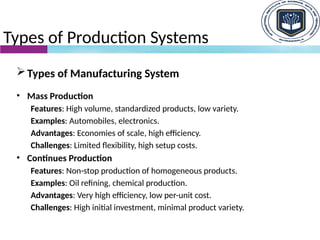
• Mass Production
Features: High volume, standardized products, low variety.
Examples: Automobiles, electronics.
Advantages: Economies of scale, high efficiency.
Challenges: Limited flexibility, high setup costs.
• Continues Production
Features: Non-stop production of homogeneous products.
Examples: Oil refining, chemical production.
Advantages: Very high efficiency, low per-unit cost.
Challenges: High initial investment, minimal product variety.
Types of Production Systems
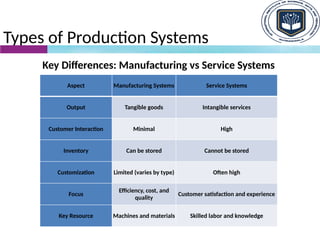
Key Differences: Manufacturing vs Service Systems
Aspect Manufacturing Systems Service Systems
Output Tangible goods Intangible services
Customer Interaction Minimal High
Inventory Can be stored Cannot be stored
Customization Limited (varies by type) Often high
Focus
Efficiency, cost, and
quality
Customer satisfaction and experience
Key Resource Machines and materials Skilled labor and knowledge
Role of Operations in Competitive Advantage
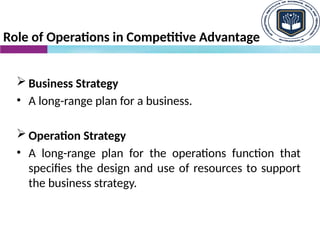
 Business Strategy
• A long-range plan for a business.
 Operation Strategy
• A long-range plan for the operations function that
specifies the design and use of resources to support
the business strategy.
Role of Operations in Competitive Advantage
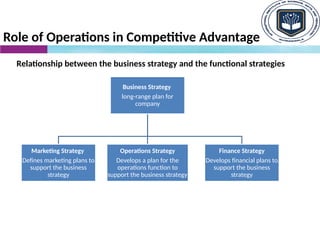
Relationship between the business strategy and the functional strategies
Business Strategy
long-range plan for
company
Marketing Strategy
Defines marketing plans to
support the business
strategy
Operations Strategy
Develops a plan for the
operations function to
support the business strategy
Finance Strategy
Develops financial plans to
support the business
strategy
Role of Operations in Competitive Advantage
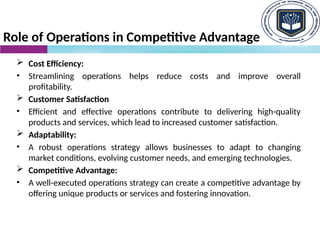
 Cost Efficiency:
• Streamlining operations helps reduce costs and improve overall
profitability.
 Customer Satisfaction
• Efficient and effective operations contribute to delivering high-quality
products and services, which lead to increased customer satisfaction.
 Adaptability:
• A robust operations strategy allows businesses to adapt to changing
market conditions, evolving customer needs, and emerging technologies.
 Competitive Advantage:
• A well-executed operations strategy can create a competitive advantage by
offering unique products or services and fostering innovation.
Role of Operations in Competitive Advantage
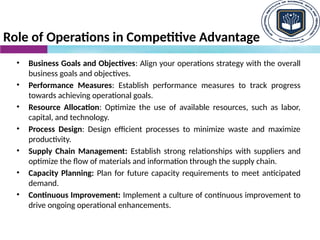
• Business Goals and Objectives: Align your operations strategy with the overall
business goals and objectives.
• Performance Measures: Establish performance measures to track progress
towards achieving operational goals.
• Resource Allocation: Optimize the use of available resources, such as labor,
capital, and technology.
• Process Design: Design efficient processes to minimize waste and maximize
productivity.
• Supply Chain Management: Establish strong relationships with suppliers and
optimize the flow of materials and information through the supply chain.
• Capacity Planning: Plan for future capacity requirements to meet anticipated
demand.
• Continuous Improvement: Implement a culture of continuous improvement to
drive ongoing operational enhancements.
Developing and Implementing an Operations Strategy
The proposed steps for formulation and execution of an operations strategy are as
follows:-
• Assess the Current Situation: Start by evaluating your current operations,
identifying strengths, weaknesses, opportunities, and threats (SWOT analysis).
• Define Objectives: Establish clear, measurable, and achievable operational
objectives that align with your business goals.
• Develop the Strategy: Identify the key initiatives and tactics needed to achieve
your operational objectives.
• Allocate Resources: Assign the necessary resources, including personnel,
equipment, and finances, to support your operations strategy.
• Execute the Plan: Implement the strategy by executing the identified initiatives
and tactics.
• Monitor and Adjust: Regularly review your operation's strategy performance
against established objectives and make adjustments as needed.
Examples of successful operations strategies
Here are a few examples of successful operations strategies in the technology
sector:-
• Amazon's Automated Warehousing: Amazon has been a leader in operations
strategy with its use of automation in warehousing and distribution. By using
robots to assist with picking and packing orders, Amazon has greatly increased
the efficiency and accuracy of its order fulfillment process. This has helped
them to minimize costs, improve customer satisfaction with quick delivery
times, and scale their operations rapidly.
• Apple's Supply Chain Management: Apple Inc. is renowned for its effective and
efficient supply chain management. The company's operations strategy
includes a combination of in-house manufacturing, off-shore production, and
strategic partnerships. This hybrid model allows Apple to maintain high-quality
standards, control over its products, and the ability to bring new products to
market quickly. Furthermore, Apple's strategic component purchasing allows it
to secure favorable pricing and ensure the availability of necessary parts.
Examples of successful operations strategies
Here are a few examples of successful operations strategies in the technology
sector:-
• Netflix's Use of Big Data: Netflix has revolutionized the streaming industry
by using big data to drive decisions about what content to produce and
promote. By collecting and analyzing data on viewing habits, ratings, and
other user behavior, Netflix can predict what types of shows and movies
are likely to be popular. This data-driven strategy has led to the production
of highly successful original content and a personalized user experience
that drives customer loyalty and retention.
• Google's Scalability: Google's operations strategy has been built around
scalability. From its powerful search engine to its multitude of other
services like Gmail, Google Maps, and Google Drive, the company has
designed its operations to handle enormous amounts of data and traffic.
Google's powerful, scalable infrastructure allows it to deliver quick &
reliable service to billions of users worldwide.
Examples of successful operations strategies
Here are a few examples of successful operations strategies in the technology
sector:-
• Microsoft's Transition to Software as a Service (SaaS): In recent years,
Microsoft has successfully transitioned from a traditional software business
model to a Software as a Service (SaaS) model with its Office 365 suite and
other products. This required significant changes to the company's operations,
including the development of new capabilities for delivering software updates
over the internet, managing customer subscriptions, and handling customer
data securely in the cloud. This transition has allowed Microsoft to generate a
stable & recurring revenue, and stay competitive in a changing technology
landscape.
• Tesla's Vertical Integration: Tesla's operations strategy is based on vertical
integration, which involves controlling multiple stages of the supply chain. By
manufacturing many of its components in-house, Tesla is able to maintain
control over the quality, cost, and availability of the parts it uses to build its
electric vehicles. This has enabled Tesla to innovate faster than traditional auto
manufacturers, though it does come with its own set of challenges.
Examples of successful operations strategies
Here are a few examples of successful operations strategies in the technology
sector:-
• Microsoft's Transition to Software as a Service (SaaS): In recent years,
Microsoft has successfully transitioned from a traditional software business
model to a Software as a Service (SaaS) model with its Office 365 suite and
other products. This required significant changes to the company's operations,
including the development of new capabilities for delivering software updates
over the internet, managing customer subscriptions, and handling customer
data securely in the cloud. This transition has allowed Microsoft to generate a
stable & recurring revenue, and stay competitive in a changing technology
landscape.
• Tesla's Vertical Integration: Tesla's operations strategy is based on vertical
integration, which involves controlling multiple stages of the supply chain. By
manufacturing many of its components in-house, Tesla is able to maintain
control over the quality, cost, and availability of the parts it uses to build its
electric vehicles. This has enabled Tesla to innovate faster than traditional auto
manufacturers, though it does come with its own set of challenges.
Decision-making in operations management
• Involves selecting the best course of action to optimize an
organization's resources and achieve its operational goals.
• Operations managers use decision-making to address
challenges, improve efficiency.
Decision-making in operations management
Types of Decisions in Operations Management
• Strategic Decisions
Long-term decisions that define the overall direction of operations.
Examples:
• Facility location and capacity planning
• Product design and process selection
• Supply chain strategy
• Tactical Decisions
Medium-term decisions that focus on resource allocation and operational efficiency.
Examples:
• Workforce scheduling
• Inventory management
• Quality control systems
• Operational Decisions
Short-term, day-to-day decisions aimed at ensuring smooth operations.
Examples:
• Scheduling production runs
• Addressing equipment breakdowns
• Managing order fulfillment
Decision-making in operations management
Key Factors Influencing Decision-Making
• Data and Information
Real-time data from ERP systems, forecasting tools, or market analytics.
Accurate data ensures informed decisions and reduces risks.
• Business Objectives
Decisions must align with strategic goals, such as cost reduction, quality improvement,
or customer satisfaction.
• Resource Availability
Decisions depend on the availability of financial, human, and technological resources.
• Market and Environmental Factors
Customer demand, competition, and external economic factors can shape decisions.
• Risk Management
Weighing potential risks versus rewards is crucial, especially in volatile environments.
• Technology and Innovation
Leveraging automation, AI, and machine learning can improve decision-making
accuracy and efficiency.
Decision-making in operations management
Steps in the Decision-Making Process
• Identify the Problem
Define the operational issue or opportunity clearly.
• Gather and Analyze Information
Collect relevant data and evaluate the current situation.
• Generate Alternatives
Brainstorm multiple solutions to the problem.
• Evaluate Alternatives
Use criteria like cost, feasibility, and alignment with strategy to assess options.
• Choose the Best Alternative
Select the option that best meets operational and strategic goals.
• Implement the Decision
Develop a plan and execute the chosen solution.
• Monitor and Review
Evaluate the results and make adjustments if necessary.
Decision-making in operations management
Challenges in Operations Decision-Making
• Uncertainty and Risk
Market volatility, supply chain disruptions, or economic changes can
impact decisions.
• Data Overload
Sorting through large volumes of data can delay decision-making.
• Conflicting Objectives
Balancing cost, quality, and speed may involve trade-offs.
• Resistance to Change
Employees or stakeholders may resist decisions that disrupt the status
quo.
Decision-making in operations management
Tools for Enhancing Decision-Making
• Decision Support Systems (DSS)
Interactive software that aids complex decision-making.
• ERP and Data Analytics
Provide insights for making informed decisions.
• Machine Learning Algorithms
Predict trends and automate routine decision-making tasks.
• Scenario Planning
Anticipates possible future conditions and prepares for them.
Aligning Operations with Business Strategy
to achieve their long-term goals
maintain competitive advantage
deliver value to stakeholders
day-to-day operations contribute directly
to the strategic objectives of the
company
Aligning Operations with Business Strategy
Key Steps for Aligning Operations with Business Strategy
 Understand the Business Strategy:
• Identify the organization's vision, mission, and strategic goals.
• Analyze the core values, customer needs, and competitive
environment.
• Ensure operational leaders understand strategic priorities such as cost
leadership, differentiation, or focus strategies.
 Define Operational Goals and Metrics:
• Translate strategic goals into clear operational objectives.
• Develop Key Performance Indicators (KPIs) to measure progress (e.g.,
productivity, quality, speed, and cost metrics).
• Ensure metrics are specific, measurable, achievable, relevant, and
time-bound (SMART).
Aligning Operations with Business Strategy
Key Steps for Aligning Operations with Business Strategy
 Streamline Processes:
• Evaluate existing workflows and eliminate inefficiencies.
• Implement process improvements using methodologies like Lean, Six
Sigma, or Total Quality Management (TQM).
• Automate repetitive tasks to focus on high-value activities.
 Ensure Resource Alignment:
• Allocate resources (capital, labor, technology) in line with strategic
priorities.
• Invest in the right tools, technology, and training to support operational
goals.
 Develop a Collaborative Culture:
• Encourage communication and collaboration across departments to align
operations with strategy.
• Foster a culture of accountability where employees understand their roles
in achieving strategic goals.
Aligning Operations with Business Strategy
Key Steps for Aligning Operations with Business Strategy
 Leverage Technology:
• Use Enterprise Resource Planning (ERP) systems to integrate data and
ensure operational decisions align with strategy.
• Implement analytics to track performance and predict trends.
 Adapt to Market Changes:
• Monitor external factors like customer behavior, competition, and
regulations.
• Maintain operational flexibility to adjust processes and priorities as
strategies evolve.
 Evaluate and Improve Continuously:
• Conduct regular reviews to assess alignment between operations and
strategy.
• Use feedback loops to make iterative improvements.
• Benchmark against industry standards to identify gaps and opportunities.
Aligning Operations with Business Strategy
 Benefits of Alignment
• Improved efficiency and cost-effectiveness.
• Greater ability to meet customer expectations
• Enhanced agility and responsiveness to market changes
• Strengthened competitive position in the industry.
Aligning Operations with Business Strategy
 Benefits of Alignment
• Improved efficiency and cost-effectiveness.
• Greater ability to meet customer expectations
• Enhanced agility and responsiveness to market changes
• Strengthened competitive position in the industry.
Aligning Operations with Business Strategy
 Challenges in Aligning Operations and Strategy
• Resistance to Change: Employees may resist new processes or
priorities
• Resource Constraints: Limited budgets or skills may hinder
alignment efforts
• Inconsistent Communication: Misalignment occurs if
departments don’t share a unified understanding of strategic
goals
• Rapid Market Changes: Shifting external conditions may
necessitate frequent adjustments.

Production and Operations Management Slides.pptx

  • 1.
    Production and OperationManagement Instructor: Dr. Iftikhar Ali
  • 2.
    Production and OperationsManagement • Production and Operations Management (POM) refers to the process of planning, organizing, directing, and controlling the activities involved in the production of goods and services. • POM is primarily concerned with managing resources efficiently to produce outputs that meet customer requirements and add value to the organization
  • 3.
    Scope of POM The scope of Production and Operations Management is broad and includes various:- • Functions • Activities • Decision-making areas to ensure efficient production and service delivery.  POM is primarily concerned with:- • Managing resources efficiently to produce outputs that meet customer requirements • Add value to the organization
  • 4.
    Scope of POM Key areas within the scope of POM include:- • Product and Service Design • Process Design and Selection • Capacity Planning • Supply Chain Management • Inventory Management • Production Planning and Scheduling • Quality Management and Control • Project Management • Lean Operations and Continuous Improvement • Emerging Trends and Sustainability
  • 5.
    Objectives of POM Production and Operations Management (POM) encompasses several key objectives that are essential for achieving efficiency, quality, and customer satisfaction within manufacturing and service industries :- • Optimization of Resource Utilization • Minimization of Costs • Ensuring Timely Delivery • Enhancing Product Quality • Continuous Improvement • Flexibility and Adaptability • Sustainability and Social Responsibility
  • 6.
    Types of ProductionSystems Production systems can be broadly categorized into manufacturing and service operations based on their purpose, output, and processes. Manufacturing Service Operations
  • 7.
    Types of ProductionSystems Manufacturing Systems • Manufacturing systems focus on the production of tangible goods and involve physical transformation processes. • They are characterized by a focus on efficiency, quality, and cost control.
  • 8.
    Types of ProductionSystems Service Systems • Service systems focus on delivering intangible outputs (services) and involve direct interaction with customers. • They emphasize customer satisfaction, quality of service, and responsiveness.
  • 9.
    Types of ProductionSystems  Types of Manufacturing System • Job Shop Production Features: Highly customized products, low volume, high variety. Examples: Custom furniture, specialty machinery. Advantages: High flexibility, capable of producing unique products. Challenges: High production costs, longer lead times. • Batch Production Features: Production in batches or lots; moderate volume and variety. Examples: Bakery goods, apparel. Advantages: Balances customization and efficiency. Challenges: Downtime between batches, potential for inventory build-up.
  • 10.
    Types of ProductionSystems Types of Manufacturing System • Mass Production Features: High volume, standardized products, low variety. Examples: Automobiles, electronics. Advantages: Economies of scale, high efficiency. Challenges: Limited flexibility, high setup costs. • Continues Production Features: Non-stop production of homogeneous products. Examples: Oil refining, chemical production. Advantages: Very high efficiency, low per-unit cost. Challenges: High initial investment, minimal product variety.
  • 11.
    Types of ProductionSystems Key Differences: Manufacturing vs Service Systems Aspect Manufacturing Systems Service Systems Output Tangible goods Intangible services Customer Interaction Minimal High Inventory Can be stored Cannot be stored Customization Limited (varies by type) Often high Focus Efficiency, cost, and quality Customer satisfaction and experience Key Resource Machines and materials Skilled labor and knowledge
  • 12.
    Role of Operationsin Competitive Advantage  Business Strategy • A long-range plan for a business.  Operation Strategy • A long-range plan for the operations function that specifies the design and use of resources to support the business strategy.
  • 13.
    Role of Operationsin Competitive Advantage Relationship between the business strategy and the functional strategies Business Strategy long-range plan for company Marketing Strategy Defines marketing plans to support the business strategy Operations Strategy Develops a plan for the operations function to support the business strategy Finance Strategy Develops financial plans to support the business strategy
  • 14.
    Role of Operationsin Competitive Advantage
  • 15.
    Role of Operationsin Competitive Advantage  Cost Efficiency: • Streamlining operations helps reduce costs and improve overall profitability.  Customer Satisfaction • Efficient and effective operations contribute to delivering high-quality products and services, which lead to increased customer satisfaction.  Adaptability: • A robust operations strategy allows businesses to adapt to changing market conditions, evolving customer needs, and emerging technologies.  Competitive Advantage: • A well-executed operations strategy can create a competitive advantage by offering unique products or services and fostering innovation.
  • 16.
    Role of Operationsin Competitive Advantage
  • 17.
    Role of Operationsin Competitive Advantage • Business Goals and Objectives: Align your operations strategy with the overall business goals and objectives. • Performance Measures: Establish performance measures to track progress towards achieving operational goals. • Resource Allocation: Optimize the use of available resources, such as labor, capital, and technology. • Process Design: Design efficient processes to minimize waste and maximize productivity. • Supply Chain Management: Establish strong relationships with suppliers and optimize the flow of materials and information through the supply chain. • Capacity Planning: Plan for future capacity requirements to meet anticipated demand. • Continuous Improvement: Implement a culture of continuous improvement to drive ongoing operational enhancements.
  • 18.
    Developing and Implementingan Operations Strategy The proposed steps for formulation and execution of an operations strategy are as follows:- • Assess the Current Situation: Start by evaluating your current operations, identifying strengths, weaknesses, opportunities, and threats (SWOT analysis). • Define Objectives: Establish clear, measurable, and achievable operational objectives that align with your business goals. • Develop the Strategy: Identify the key initiatives and tactics needed to achieve your operational objectives. • Allocate Resources: Assign the necessary resources, including personnel, equipment, and finances, to support your operations strategy. • Execute the Plan: Implement the strategy by executing the identified initiatives and tactics. • Monitor and Adjust: Regularly review your operation's strategy performance against established objectives and make adjustments as needed.
  • 19.
    Examples of successfuloperations strategies Here are a few examples of successful operations strategies in the technology sector:- • Amazon's Automated Warehousing: Amazon has been a leader in operations strategy with its use of automation in warehousing and distribution. By using robots to assist with picking and packing orders, Amazon has greatly increased the efficiency and accuracy of its order fulfillment process. This has helped them to minimize costs, improve customer satisfaction with quick delivery times, and scale their operations rapidly. • Apple's Supply Chain Management: Apple Inc. is renowned for its effective and efficient supply chain management. The company's operations strategy includes a combination of in-house manufacturing, off-shore production, and strategic partnerships. This hybrid model allows Apple to maintain high-quality standards, control over its products, and the ability to bring new products to market quickly. Furthermore, Apple's strategic component purchasing allows it to secure favorable pricing and ensure the availability of necessary parts.
  • 20.
    Examples of successfuloperations strategies Here are a few examples of successful operations strategies in the technology sector:- • Netflix's Use of Big Data: Netflix has revolutionized the streaming industry by using big data to drive decisions about what content to produce and promote. By collecting and analyzing data on viewing habits, ratings, and other user behavior, Netflix can predict what types of shows and movies are likely to be popular. This data-driven strategy has led to the production of highly successful original content and a personalized user experience that drives customer loyalty and retention. • Google's Scalability: Google's operations strategy has been built around scalability. From its powerful search engine to its multitude of other services like Gmail, Google Maps, and Google Drive, the company has designed its operations to handle enormous amounts of data and traffic. Google's powerful, scalable infrastructure allows it to deliver quick & reliable service to billions of users worldwide.
  • 21.
    Examples of successfuloperations strategies Here are a few examples of successful operations strategies in the technology sector:- • Microsoft's Transition to Software as a Service (SaaS): In recent years, Microsoft has successfully transitioned from a traditional software business model to a Software as a Service (SaaS) model with its Office 365 suite and other products. This required significant changes to the company's operations, including the development of new capabilities for delivering software updates over the internet, managing customer subscriptions, and handling customer data securely in the cloud. This transition has allowed Microsoft to generate a stable & recurring revenue, and stay competitive in a changing technology landscape. • Tesla's Vertical Integration: Tesla's operations strategy is based on vertical integration, which involves controlling multiple stages of the supply chain. By manufacturing many of its components in-house, Tesla is able to maintain control over the quality, cost, and availability of the parts it uses to build its electric vehicles. This has enabled Tesla to innovate faster than traditional auto manufacturers, though it does come with its own set of challenges.
  • 22.
    Examples of successfuloperations strategies Here are a few examples of successful operations strategies in the technology sector:- • Microsoft's Transition to Software as a Service (SaaS): In recent years, Microsoft has successfully transitioned from a traditional software business model to a Software as a Service (SaaS) model with its Office 365 suite and other products. This required significant changes to the company's operations, including the development of new capabilities for delivering software updates over the internet, managing customer subscriptions, and handling customer data securely in the cloud. This transition has allowed Microsoft to generate a stable & recurring revenue, and stay competitive in a changing technology landscape. • Tesla's Vertical Integration: Tesla's operations strategy is based on vertical integration, which involves controlling multiple stages of the supply chain. By manufacturing many of its components in-house, Tesla is able to maintain control over the quality, cost, and availability of the parts it uses to build its electric vehicles. This has enabled Tesla to innovate faster than traditional auto manufacturers, though it does come with its own set of challenges.
  • 23.
    Decision-making in operationsmanagement • Involves selecting the best course of action to optimize an organization's resources and achieve its operational goals. • Operations managers use decision-making to address challenges, improve efficiency.
  • 24.
    Decision-making in operationsmanagement Types of Decisions in Operations Management • Strategic Decisions Long-term decisions that define the overall direction of operations. Examples: • Facility location and capacity planning • Product design and process selection • Supply chain strategy • Tactical Decisions Medium-term decisions that focus on resource allocation and operational efficiency. Examples: • Workforce scheduling • Inventory management • Quality control systems • Operational Decisions Short-term, day-to-day decisions aimed at ensuring smooth operations. Examples: • Scheduling production runs • Addressing equipment breakdowns • Managing order fulfillment
  • 25.
    Decision-making in operationsmanagement Key Factors Influencing Decision-Making • Data and Information Real-time data from ERP systems, forecasting tools, or market analytics. Accurate data ensures informed decisions and reduces risks. • Business Objectives Decisions must align with strategic goals, such as cost reduction, quality improvement, or customer satisfaction. • Resource Availability Decisions depend on the availability of financial, human, and technological resources. • Market and Environmental Factors Customer demand, competition, and external economic factors can shape decisions. • Risk Management Weighing potential risks versus rewards is crucial, especially in volatile environments. • Technology and Innovation Leveraging automation, AI, and machine learning can improve decision-making accuracy and efficiency.
  • 26.
    Decision-making in operationsmanagement Steps in the Decision-Making Process • Identify the Problem Define the operational issue or opportunity clearly. • Gather and Analyze Information Collect relevant data and evaluate the current situation. • Generate Alternatives Brainstorm multiple solutions to the problem. • Evaluate Alternatives Use criteria like cost, feasibility, and alignment with strategy to assess options. • Choose the Best Alternative Select the option that best meets operational and strategic goals. • Implement the Decision Develop a plan and execute the chosen solution. • Monitor and Review Evaluate the results and make adjustments if necessary.
  • 27.
    Decision-making in operationsmanagement Challenges in Operations Decision-Making • Uncertainty and Risk Market volatility, supply chain disruptions, or economic changes can impact decisions. • Data Overload Sorting through large volumes of data can delay decision-making. • Conflicting Objectives Balancing cost, quality, and speed may involve trade-offs. • Resistance to Change Employees or stakeholders may resist decisions that disrupt the status quo.
  • 28.
    Decision-making in operationsmanagement Tools for Enhancing Decision-Making • Decision Support Systems (DSS) Interactive software that aids complex decision-making. • ERP and Data Analytics Provide insights for making informed decisions. • Machine Learning Algorithms Predict trends and automate routine decision-making tasks. • Scenario Planning Anticipates possible future conditions and prepares for them.
  • 29.
    Aligning Operations withBusiness Strategy to achieve their long-term goals maintain competitive advantage deliver value to stakeholders day-to-day operations contribute directly to the strategic objectives of the company
  • 30.
    Aligning Operations withBusiness Strategy Key Steps for Aligning Operations with Business Strategy  Understand the Business Strategy: • Identify the organization's vision, mission, and strategic goals. • Analyze the core values, customer needs, and competitive environment. • Ensure operational leaders understand strategic priorities such as cost leadership, differentiation, or focus strategies.  Define Operational Goals and Metrics: • Translate strategic goals into clear operational objectives. • Develop Key Performance Indicators (KPIs) to measure progress (e.g., productivity, quality, speed, and cost metrics). • Ensure metrics are specific, measurable, achievable, relevant, and time-bound (SMART).
  • 31.
    Aligning Operations withBusiness Strategy Key Steps for Aligning Operations with Business Strategy  Streamline Processes: • Evaluate existing workflows and eliminate inefficiencies. • Implement process improvements using methodologies like Lean, Six Sigma, or Total Quality Management (TQM). • Automate repetitive tasks to focus on high-value activities.  Ensure Resource Alignment: • Allocate resources (capital, labor, technology) in line with strategic priorities. • Invest in the right tools, technology, and training to support operational goals.  Develop a Collaborative Culture: • Encourage communication and collaboration across departments to align operations with strategy. • Foster a culture of accountability where employees understand their roles in achieving strategic goals.
  • 32.
    Aligning Operations withBusiness Strategy Key Steps for Aligning Operations with Business Strategy  Leverage Technology: • Use Enterprise Resource Planning (ERP) systems to integrate data and ensure operational decisions align with strategy. • Implement analytics to track performance and predict trends.  Adapt to Market Changes: • Monitor external factors like customer behavior, competition, and regulations. • Maintain operational flexibility to adjust processes and priorities as strategies evolve.  Evaluate and Improve Continuously: • Conduct regular reviews to assess alignment between operations and strategy. • Use feedback loops to make iterative improvements. • Benchmark against industry standards to identify gaps and opportunities.
  • 33.
    Aligning Operations withBusiness Strategy  Benefits of Alignment • Improved efficiency and cost-effectiveness. • Greater ability to meet customer expectations • Enhanced agility and responsiveness to market changes • Strengthened competitive position in the industry.
  • 34.
    Aligning Operations withBusiness Strategy  Benefits of Alignment • Improved efficiency and cost-effectiveness. • Greater ability to meet customer expectations • Enhanced agility and responsiveness to market changes • Strengthened competitive position in the industry.
  • 35.
    Aligning Operations withBusiness Strategy  Challenges in Aligning Operations and Strategy • Resistance to Change: Employees may resist new processes or priorities • Resource Constraints: Limited budgets or skills may hinder alignment efforts • Inconsistent Communication: Misalignment occurs if departments don’t share a unified understanding of strategic goals • Rapid Market Changes: Shifting external conditions may necessitate frequent adjustments.