SK MOHAMED KASIM
Operating system
Given topic
 DISTRIBUTED OS
 Multiprocessor OS
 Database
 STRUCTURE
 DESIGN ISSUE
What is a Distributed System?
“A collection of independent
computers that appears to its users as
a single coherent system”
Distributed Systems
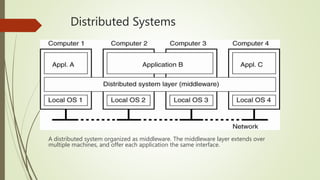
A distributed system organized as middleware. The middleware layer extends over
multiple machines, and offer each application the same interface.
Distributed Systems
Distributed Systems
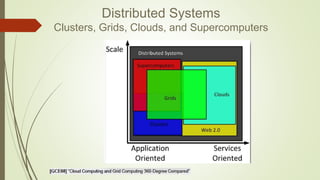
Clusters, Grids, Clouds, and Supercomputers
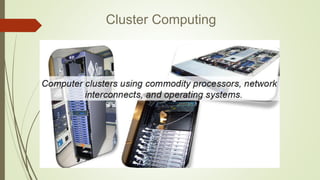
Cluster Computing
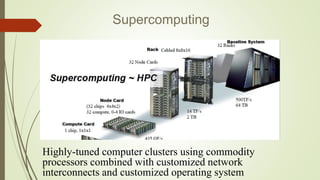
Supercomputing
Highly-tuned computer clusters using commodity
processors combined with customized network
interconnects and customized operating system
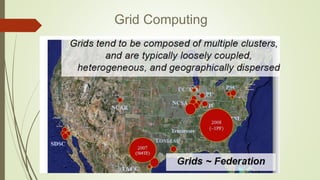
Grid Computing
MULTI-PROCESSOR OS
Multiprocessors
Definition:
A computer system in which two or more
CPUs share full access to a common RAM
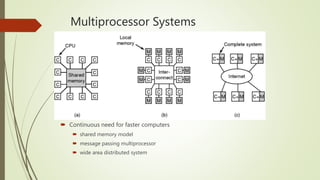
Multiprocessor Systems
 Continuous need for faster computers
 shared memory model
 message passing multiprocessor
 wide area distributed system
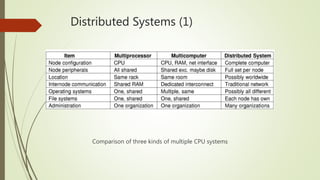
Distributed Systems (1)
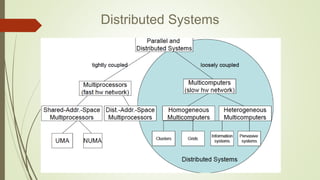
Comparison of three kinds of multiple CPU systems
DATABASE
 File Management vs Database Management (why do we need
database?)
 Advantages of Database systems: storage persistence,
programming interface, transaction management
 Data Model (What is Data?)
 Database Language (How to manipulate data?)
 DBMS Architecture and Database System Components (How can
you build a billion-dollar software, like Oracle? Or you can get it
free, mySQL?)
 Users classification (What you can do and what you cannot do?)
Where are databases?
 You cannot avoid it and it’s everywhere!
 You can say it actually makes the current society and your life work!
 Banking/Credit card /Social Security Info…
 Online shopping/booking…
STRUCTURE
OS Structure
 monolithic approach
 the whole OS is one large program
 often used under resource constraints (processing power, memory space)
 example: PC DOS
 layered approach
 functionalities are grouped into layers from hardware to user programs
 better separation of functions
 example: OS
Kernel
 core part of the operating system comprising the minimal set of functionalities
 process dispatching
 basic memory management
 interprocess communication
 protection
 is always kept in main memory
 porting is made easier
OS Structure Examples
 MS-DOS & Windows
 Windows NT
 Unix
MS-DOS & Windows Structure
 originally (DOS 1) monolithic due to space and processing power restrictions (Intel
8086, 8 KBytes main memory)
 slow incorporation of advanced concepts
 hard disk, hierarchical file systems, I/O redirection, background printing, networking, ...
 fresh start with Windows NT
 single-user, multitasking
 designed for 32-bit microprocessors (Intel Pentium)
Windows NT Structure
 hardware abstraction layer (HAL)
 provides adaptation to the underlying hardware through a generic hardware interface
 microkernel
 thread scheduling, process switching, exception handling (interrupts), multiprocessor
synchronization
 executive services
 modules for system functions
 I/O manager, object manager, process manager, virtual memory manager, security reference
monitor, windows modules
 system services
 interface to software running in user mode
Windows NT StructureMicrokernel OS
Users and
User Programs
[Stallings 98]
Hardware
Micro-Kernel
System Services
WindowsNT
Executive
Applicationsand
UserInterface
Hardware Abstraction Layer (HAL)
I/O
Manager
Object
Manager
Security
Reference
Monitor
Process
Manager
Local
Procedure
Call
Facility
Virtual
Memory
Manager
Window
Manager
Graphic
Device
Drivers
Device
Drivers
Network
Drivers
File System
Drivers
POSIX
Subsystem
Win32
Subsystem
OS/2
Subsystem
Security
Subsystem
Cache
Manager
DESIGN ISSUE
 The distributed information system is defined as “a number of interdependent
computers linked by a network for sharing information among them”. A distributed
information system consists of multiple autonomous computers that communicate
or exchange information through a computer network.
Design issues of distributed system
 Transparency
 flexibility
 reliability
 performance
 Scalability
 Naming
 replication
 synchronization
 security
Structure issue

Operating system

  • 1.
  • 2.
    Given topic  DISTRIBUTEDOS  Multiprocessor OS  Database  STRUCTURE  DESIGN ISSUE
  • 3.
    What is aDistributed System?
  • 4.
    “A collection ofindependent computers that appears to its users as a single coherent system”
  • 5.
    Distributed Systems A distributedsystem organized as middleware. The middleware layer extends over multiple machines, and offer each application the same interface.
  • 6.
  • 7.
    Distributed Systems Clusters, Grids,Clouds, and Supercomputers
  • 8.
  • 9.
    Supercomputing Highly-tuned computer clustersusing commodity processors combined with customized network interconnects and customized operating system
  • 10.
  • 11.
  • 12.
    Multiprocessors Definition: A computer systemin which two or more CPUs share full access to a common RAM
  • 13.
    Multiprocessor Systems  Continuousneed for faster computers  shared memory model  message passing multiprocessor  wide area distributed system
  • 14.
    Distributed Systems (1) Comparisonof three kinds of multiple CPU systems
  • 15.
  • 16.
     File Managementvs Database Management (why do we need database?)  Advantages of Database systems: storage persistence, programming interface, transaction management  Data Model (What is Data?)  Database Language (How to manipulate data?)  DBMS Architecture and Database System Components (How can you build a billion-dollar software, like Oracle? Or you can get it free, mySQL?)  Users classification (What you can do and what you cannot do?)
  • 17.
    Where are databases? You cannot avoid it and it’s everywhere!  You can say it actually makes the current society and your life work!  Banking/Credit card /Social Security Info…  Online shopping/booking…
  • 18.
  • 19.
    OS Structure  monolithicapproach  the whole OS is one large program  often used under resource constraints (processing power, memory space)  example: PC DOS  layered approach  functionalities are grouped into layers from hardware to user programs  better separation of functions  example: OS
  • 20.
    Kernel  core partof the operating system comprising the minimal set of functionalities  process dispatching  basic memory management  interprocess communication  protection  is always kept in main memory  porting is made easier
  • 21.
    OS Structure Examples MS-DOS & Windows  Windows NT  Unix
  • 22.
    MS-DOS & WindowsStructure  originally (DOS 1) monolithic due to space and processing power restrictions (Intel 8086, 8 KBytes main memory)  slow incorporation of advanced concepts  hard disk, hierarchical file systems, I/O redirection, background printing, networking, ...  fresh start with Windows NT  single-user, multitasking  designed for 32-bit microprocessors (Intel Pentium)
  • 23.
    Windows NT Structure hardware abstraction layer (HAL)  provides adaptation to the underlying hardware through a generic hardware interface  microkernel  thread scheduling, process switching, exception handling (interrupts), multiprocessor synchronization  executive services  modules for system functions  I/O manager, object manager, process manager, virtual memory manager, security reference monitor, windows modules  system services  interface to software running in user mode
  • 24.
    Windows NT StructureMicrokernelOS Users and User Programs [Stallings 98] Hardware Micro-Kernel System Services WindowsNT Executive Applicationsand UserInterface Hardware Abstraction Layer (HAL) I/O Manager Object Manager Security Reference Monitor Process Manager Local Procedure Call Facility Virtual Memory Manager Window Manager Graphic Device Drivers Device Drivers Network Drivers File System Drivers POSIX Subsystem Win32 Subsystem OS/2 Subsystem Security Subsystem Cache Manager
  • 25.
    DESIGN ISSUE  Thedistributed information system is defined as “a number of interdependent computers linked by a network for sharing information among them”. A distributed information system consists of multiple autonomous computers that communicate or exchange information through a computer network.
  • 26.
    Design issues ofdistributed system  Transparency  flexibility  reliability  performance  Scalability  Naming  replication  synchronization  security
  • 27.