Distributed Operating System
By
Muhammad Adeel Rajput
Scientist/Instector
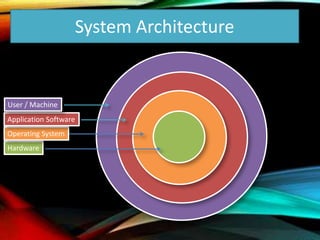
System Architecture
Hardware
Operating System
Application Software
User / Machine
Hardware
• Can be
• Input Device
• Processing Device
• Memory / Storage Device
• Output Device
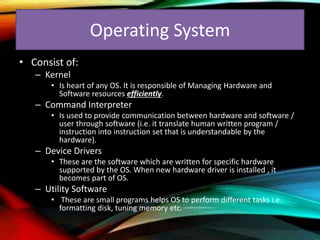
Operating System
• Consist of:
– Kernel
• Is heart of any OS. It is responsible of Managing Hardware and
Software resources efficiently.
– Command Interpreter
• Is used to provide communication between hardware and software /
user through software (i.e. it translate human written program /
instruction into instruction set that is understandable by the
hardware).
– Device Drivers
• These are the software which are written for specific hardware
supported by the OS. When new hardware driver is installed , it
becomes part of OS.
– Utility Software
• These are small programs helps OS to perform different tasks i.e.
formatting disk, tuning memory etc.
User / Machine
• User of system can be machine or human both
can directly or indirectly (through application
software) communicate with the operating
system.
Application Software
• Theses are software which are used to take input from user /
machine and provide output after processing by the
hardware.
• For instance a CD ROM reads data(i.e. Pictures) from optical
disk and showed onto screen. Or play a movie etc.
• Application Software can not run without operating system.
• Common examples are
– Word Processing Software
– Spread Sheets Software
– Graphics Designing Software
– Database Software etc
Types of Operating System
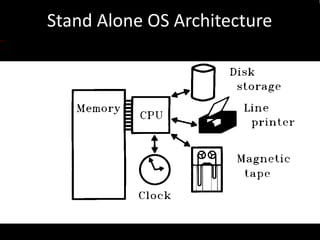
• Standalone
– Is a type of OS which is not connected to any other
computer in the network hence there is no concept of
resource sharing.
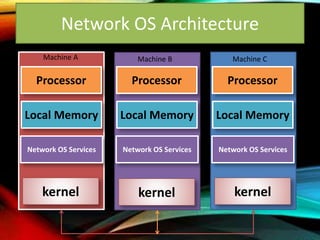
• Networked
– Is a type of OS in which two or more computers /
peripherals are connected in a network for resource
sharing (i.e. peripherals, Disk space)
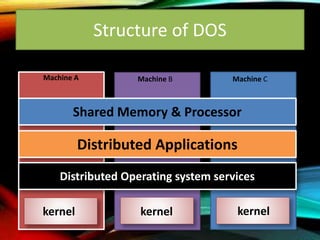
• Distributed
– Is a type of Network OS in which not only devices are
connected with each other but also shares (memory &
processor) with each other.
Stand Alone OS Architecture
Network OS Architecture
Processor
Network OS Services
kernel
Machine A Machine B Machine C
kernel kernel
Local Memory
Processor
Network OS Services
Local Memory
Processor
Network OS Services
Local Memory
Kernel
Processor
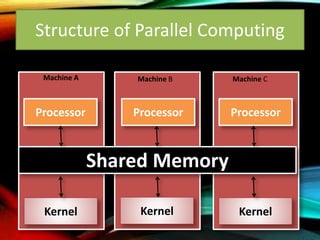
Structure of Parallel Computing
Shared Memory
Kernel
Machine A Machine B Machine C
Processor
Kernel
Processor
Structure of DOS
Distributed Applications
Distributed Operating system services
Machine A Machine B Machine C
kernel kernel kernel
Shared Memory & Processor
Distributed Applications
Distributed applications (distributed apps) are applications or software that runs
on multiple computers within a network at the same time and can be stored on
servers or with cloud computing. Unlike traditional applications that run on a
single system, distributed applications run on multiple systems simultaneously
for a single task or job.
Software that executes on two or more computers in a network. In a client-server
environment, distributed applications have two parts: (1) the 'front end' that
requires minimal computer resources and runs on the client computer(s), and (2)
the 'back end' that requires large amounts of data crunching power and/or
specialized hardware, and runs on a suitably equipped server computer.
Parallel Processing
• It is type of distributed computing in which a
process is divided into lightweight processes
called threads.
• All threads run concurrently on different
computing machines with sharing memory.
Parallel Computing
• It is type of distributed computing in which a
process is divided into lightweight processes
called threads.
• All threads run concurrently on different
computing machines without sharing memory.
Distributed Memory System
• In distributed memory system each system
has its own memory commutations are done
locally however if remote data is required
then it can be done through communication
with one or more computers.
Shared Memory System
• In Shared memory system multiple processors
shares single memory. Processor dos not
needs to know where the data is being saved.
But whenever there are performance
penalties and race conditions then processor
has to track data location to avoid such
conditions.
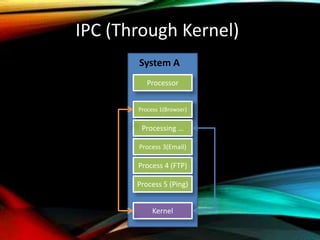
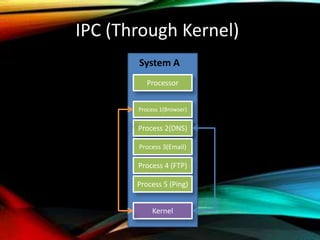
Inter-process communication (IPC)
• Is a mechanism that provides communication
between two or more processes
– With-in single system memory.
– With-in a network having shared or separate
memory.
– Between two processes reside on different
networks.
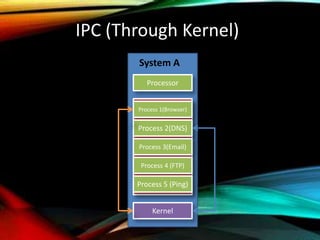
IPC (Through Kernel)
System A
Processor
Kernel
Process 1(Browser)
Process 2(DNS)
Process 3(Email)
Process 4 (FTP)
Process 5 (Ping)
www.yahoo.com
what is IP ?
IPC (Through Kernel)
System A
Processor
Kernel
Process 1(Browser)
Process 2(DNS)
Process 3(Email)
Process 4 (FTP)
Process 5 (Ping)
www.yahoo.com
what is IP ?
IPC (Through Kernel)
System A
Processor
Kernel
Process 1(Browser)
Processing …
Process 3(Email)
Process 4 (FTP)
Process 5 (Ping)
IP is
202.154.11.91
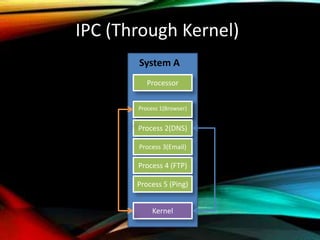
IPC (Through Kernel)
System A
Processor
Kernel
Process 1(Browser)
Process 2(DNS)
Process 3(Email)
Process 4 (FTP)
Process 5 (Ping)
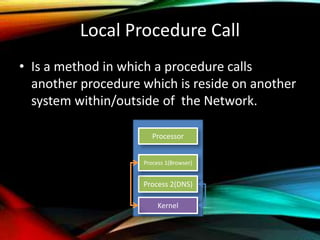
Local Procedure Call
• Is a method in which a procedure calls
another procedure which is reside on another
system within/outside of the Network.
Processor
Kernel
Process 1(Browser)
Process 2(DNS)
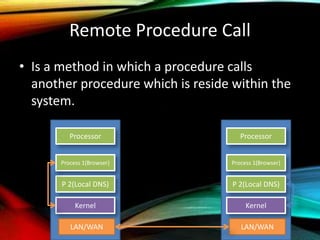
Remote Procedure Call
• Is a method in which a procedure calls
another procedure which is reside within the
system.
Processor
Kernel
Process 1(Browser)
P 2(Local DNS)
Processor
Kernel
Process 1(Browser)
P 2(Local DNS)
LAN/WAN LAN/WAN

Distributive operating system

  • 1.
    Distributed Operating System By MuhammadAdeel Rajput Scientist/Instector
  • 2.
  • 3.
    Hardware • Can be •Input Device • Processing Device • Memory / Storage Device • Output Device
  • 4.
    Operating System • Consistof: – Kernel • Is heart of any OS. It is responsible of Managing Hardware and Software resources efficiently. – Command Interpreter • Is used to provide communication between hardware and software / user through software (i.e. it translate human written program / instruction into instruction set that is understandable by the hardware). – Device Drivers • These are the software which are written for specific hardware supported by the OS. When new hardware driver is installed , it becomes part of OS. – Utility Software • These are small programs helps OS to perform different tasks i.e. formatting disk, tuning memory etc.
  • 5.
    User / Machine •User of system can be machine or human both can directly or indirectly (through application software) communicate with the operating system.
  • 6.
    Application Software • Thesesare software which are used to take input from user / machine and provide output after processing by the hardware. • For instance a CD ROM reads data(i.e. Pictures) from optical disk and showed onto screen. Or play a movie etc. • Application Software can not run without operating system. • Common examples are – Word Processing Software – Spread Sheets Software – Graphics Designing Software – Database Software etc
  • 7.
    Types of OperatingSystem • Standalone – Is a type of OS which is not connected to any other computer in the network hence there is no concept of resource sharing. • Networked – Is a type of OS in which two or more computers / peripherals are connected in a network for resource sharing (i.e. peripherals, Disk space) • Distributed – Is a type of Network OS in which not only devices are connected with each other but also shares (memory & processor) with each other.
  • 8.
    Stand Alone OSArchitecture
  • 9.
    Network OS Architecture Processor NetworkOS Services kernel Machine A Machine B Machine C kernel kernel Local Memory Processor Network OS Services Local Memory Processor Network OS Services Local Memory
  • 10.
    Kernel Processor Structure of ParallelComputing Shared Memory Kernel Machine A Machine B Machine C Processor Kernel Processor
  • 11.
    Structure of DOS DistributedApplications Distributed Operating system services Machine A Machine B Machine C kernel kernel kernel Shared Memory & Processor
  • 12.
    Distributed Applications Distributed applications(distributed apps) are applications or software that runs on multiple computers within a network at the same time and can be stored on servers or with cloud computing. Unlike traditional applications that run on a single system, distributed applications run on multiple systems simultaneously for a single task or job. Software that executes on two or more computers in a network. In a client-server environment, distributed applications have two parts: (1) the 'front end' that requires minimal computer resources and runs on the client computer(s), and (2) the 'back end' that requires large amounts of data crunching power and/or specialized hardware, and runs on a suitably equipped server computer.
  • 13.
    Parallel Processing • Itis type of distributed computing in which a process is divided into lightweight processes called threads. • All threads run concurrently on different computing machines with sharing memory.
  • 14.
    Parallel Computing • Itis type of distributed computing in which a process is divided into lightweight processes called threads. • All threads run concurrently on different computing machines without sharing memory.
  • 15.
    Distributed Memory System •In distributed memory system each system has its own memory commutations are done locally however if remote data is required then it can be done through communication with one or more computers.
  • 16.
    Shared Memory System •In Shared memory system multiple processors shares single memory. Processor dos not needs to know where the data is being saved. But whenever there are performance penalties and race conditions then processor has to track data location to avoid such conditions.
  • 17.
    Inter-process communication (IPC) •Is a mechanism that provides communication between two or more processes – With-in single system memory. – With-in a network having shared or separate memory. – Between two processes reside on different networks.
  • 18.
    IPC (Through Kernel) SystemA Processor Kernel Process 1(Browser) Process 2(DNS) Process 3(Email) Process 4 (FTP) Process 5 (Ping)
  • 19.
    www.yahoo.com what is IP? IPC (Through Kernel) System A Processor Kernel Process 1(Browser) Process 2(DNS) Process 3(Email) Process 4 (FTP) Process 5 (Ping)
  • 20.
    www.yahoo.com what is IP? IPC (Through Kernel) System A Processor Kernel Process 1(Browser) Processing … Process 3(Email) Process 4 (FTP) Process 5 (Ping)
  • 21.
    IP is 202.154.11.91 IPC (ThroughKernel) System A Processor Kernel Process 1(Browser) Process 2(DNS) Process 3(Email) Process 4 (FTP) Process 5 (Ping)
  • 22.
    Local Procedure Call •Is a method in which a procedure calls another procedure which is reside on another system within/outside of the Network. Processor Kernel Process 1(Browser) Process 2(DNS)
  • 23.
    Remote Procedure Call •Is a method in which a procedure calls another procedure which is reside within the system. Processor Kernel Process 1(Browser) P 2(Local DNS) Processor Kernel Process 1(Browser) P 2(Local DNS) LAN/WAN LAN/WAN