





Windows XP
034-11404412
Abhishek Gupta
Architecture
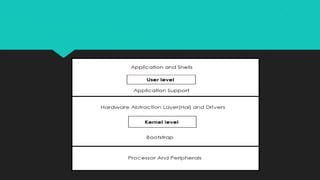
 Windows XP support Layered approach…
User mode – layer closest to the person
Applications that you run (like Word)
Support programs for applications - the Windows XP Subsystems
Kernel mode – layer closest to hardware
Programs that help software running on our system use the computer’s hardware
Device drivers (software interfaces to hardware)
 Hardware Abstraction Layer (HAL) - allow programmers to write device-independent, high
performance applications by providing standard Operating System (OS) calls to
hardware.
Inter-process Communication
 Use shared memory and message passing both.
 Message-passing via local procedure call (LPC) facility
 Local Procedure Call - is an internal, inter-process communication facility provided by
the Microsoft for lightweight IPC between processes on the same computer.
 Mailboxes are created for communication for the messages of up to 256 bytes.
 Message larger than 256 byte can be sent using Section Object (shared memory).
Threads
 Implements the one-to-one mapping, kernel-level
 Each thread contains a
- thread id
- Register set
- Private data storage area
 The register set, stacks, and private storage area are known as the context of the threads.
Primary Data Structure of Threads
 Kernel level
- ETHREAD (executive thread block)
- KTHREAD (kernel thread block)
 User level
- TEB (thread environment block)
Scheduling
 Windows uses priority-based preemptive scheduling
 Highest-priority thread runs next
 Thread runs until (1) blocks, (2) uses time slice, (3) preempted by higher-priority thread
 Real-time threads can preempt non-real-time
Memory Management
 Uses demand paging with clustering. Clustering brings in pages surrounding the faulting page
 Processes are assigned working set minimum and working set maximum
 Working set minimum is the minimum number of pages the process is guaranteed to have in
memory
 A process may be assigned as many pages up to its working set maximum
 When the amount of free memory in the system falls below a threshold, automatic working set
trimming is performed to restore the amount of free memory
 Working set trimming removes pages from processes that have pages in excess of their working
set minimum

Windows XP

  • 1.
  • 2.
    Architecture  Windows XPsupport Layered approach… User mode – layer closest to the person Applications that you run (like Word) Support programs for applications - the Windows XP Subsystems Kernel mode – layer closest to hardware Programs that help software running on our system use the computer’s hardware Device drivers (software interfaces to hardware)
  • 3.
     Hardware AbstractionLayer (HAL) - allow programmers to write device-independent, high performance applications by providing standard Operating System (OS) calls to hardware.
  • 5.
    Inter-process Communication  Useshared memory and message passing both.  Message-passing via local procedure call (LPC) facility  Local Procedure Call - is an internal, inter-process communication facility provided by the Microsoft for lightweight IPC between processes on the same computer.  Mailboxes are created for communication for the messages of up to 256 bytes.  Message larger than 256 byte can be sent using Section Object (shared memory).
  • 6.
    Threads  Implements theone-to-one mapping, kernel-level  Each thread contains a - thread id - Register set - Private data storage area  The register set, stacks, and private storage area are known as the context of the threads.
  • 7.
    Primary Data Structureof Threads  Kernel level - ETHREAD (executive thread block) - KTHREAD (kernel thread block)  User level - TEB (thread environment block)
  • 8.
    Scheduling  Windows usespriority-based preemptive scheduling  Highest-priority thread runs next  Thread runs until (1) blocks, (2) uses time slice, (3) preempted by higher-priority thread  Real-time threads can preempt non-real-time
  • 9.
    Memory Management  Usesdemand paging with clustering. Clustering brings in pages surrounding the faulting page  Processes are assigned working set minimum and working set maximum  Working set minimum is the minimum number of pages the process is guaranteed to have in memory  A process may be assigned as many pages up to its working set maximum  When the amount of free memory in the system falls below a threshold, automatic working set trimming is performed to restore the amount of free memory  Working set trimming removes pages from processes that have pages in excess of their working set minimum