TYPES OF TESTING
SK MOHAMED KASIM
UNIT TESTING - ADVANTAGES:
 Reduces Defects in the Newly developed features or reduces bugs when changing the
existing functionality.
 Reduces Cost of Testing as defects are captured in very early phase.
 Improves design and allows better refactoring of code.
 Unit Tests, when integrated with build gives the quality of the build as well.
UNIT TESTING TECHNIQUES:
 Black Box Testing
 White Box Testing
 Gray Box Testing
BLACK BOX TESTING
 Black box testing is defined as a testing technique in which functionality of the Application
Under Test (AUT) is tested without looking at the internal code structure, implementation
details and knowledge of internal paths of the software.
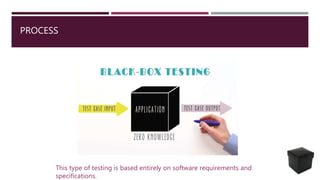
PROCESS
This type of testing is based entirely on software requirements and
specifications.
TYPES OF BLACK BOX TESTING
 Functional testing - This black box testing type is related to the functional requirements of a
system; it is done by software testers.
 Non-functional testing - This type of black box testing is not related to testing of specific
functionality, but non-functional requirements such as performance, scalability, usability.
 Regression testing - Regression Testing is done after code fixes, upgrades or any other
system maintenance to check the new code has not affected the existing code.
BLACK BOX TESTING TECHNIQUES
 Equivalence Class Testing: It is used to minimize the number of possible test cases to
an optimum level while maintains reasonable test coverage.
 Boundary Value Testing: Boundary value testing is focused on the values at
boundaries. This technique determines whether a certain range of values are
acceptable by the system or not. It is very useful in reducing the number of test cases.
It is most suitable for the systems where an input is within certain ranges.
 Decision Table Testing: A decision table puts causes and their effects in a matrix.
There is a unique combination in each column.
TOOLS USED FOR BLACK BOX TESTING:
 Functional/ Regression Tests you can use
 QTP
 Selenium
 Non-Functional Tests, you can use
 LoadRunner
 Meter
GLASS BOX TESTING
 Glass box testing is a testing technique that examines the program structure and
derives test data from the program logic/code. The other names of glass box
testing are clear box testing, white box ,open box testing, logic driven testing or
path driven testing or structural testing.
 The aim is to attack the code from several angles to expose security threats
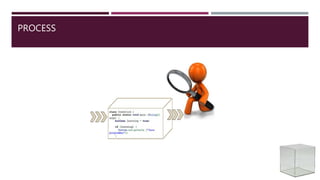
PROCESS
TYPES OF GLASS BOX TESTING
 Testing for Memory Leaks: Memory leaks are leading causes of slower running applications.
 White Box Penetration Testing: In this testing, the tester/developer has full information of
the application's source code, detailed network information, IP addresses involved and all
server information the application runs on.
 White Box Mutation Testing: Mutation testing is often used to discover the best coding
techniques to use for expanding a software solution.
GLASS BOX TESTING TECHNIQUES:
 Statement Coverage - This technique is aimed at exercising all programming statements
with minimal tests.
 Branch Coverage - This technique is running a series of tests to ensure that all branches are
tested at least once.
 Path Coverage - This technique corresponds to testing all possible paths which means that
each statement and branch is covered.
ADVANTAGES OF GLASS BOX TESTING:
 Forces test developer to reason carefully about implementation.
 Reveals errors in "hidden" code.
 Spots the Dead Code or other issues with respect to best programming practices.
DISADVANTAGES OF GLASS BOX TESTING:
 Expensive as one has to spend both time and money to perform white box testing.
 Every possibility that few lines of code is missed accidentally.
 In-depth knowledge about the programming language is necessary to perform white box
testing.
WHITE BOX TESTING TOOLS
Below is a list of top white box testing tools.
 Veracode
 EclEmma
 RCUNIT
 NUnit
 JSUnit
 JUnit
 CppUnit
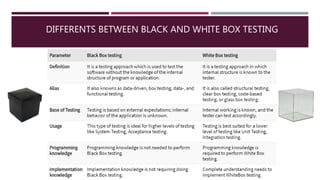
DIFFERENTS BETWEEN BLACK AND WHITE BOX TESTING
THANK YOU ……ANY QURIES ?
 https://www.tutorialspoint.com/software_testing_dictionary/unit_testing.htm
 https://www.guru99.com/black-box-testing.html
Reference:

UNIT testing

  • 1.
    TYPES OF TESTING SKMOHAMED KASIM
  • 2.
    UNIT TESTING -ADVANTAGES:  Reduces Defects in the Newly developed features or reduces bugs when changing the existing functionality.  Reduces Cost of Testing as defects are captured in very early phase.  Improves design and allows better refactoring of code.  Unit Tests, when integrated with build gives the quality of the build as well.
  • 3.
    UNIT TESTING TECHNIQUES: Black Box Testing  White Box Testing  Gray Box Testing
  • 4.
    BLACK BOX TESTING Black box testing is defined as a testing technique in which functionality of the Application Under Test (AUT) is tested without looking at the internal code structure, implementation details and knowledge of internal paths of the software.
  • 5.
    PROCESS This type oftesting is based entirely on software requirements and specifications.
  • 6.
    TYPES OF BLACKBOX TESTING  Functional testing - This black box testing type is related to the functional requirements of a system; it is done by software testers.  Non-functional testing - This type of black box testing is not related to testing of specific functionality, but non-functional requirements such as performance, scalability, usability.  Regression testing - Regression Testing is done after code fixes, upgrades or any other system maintenance to check the new code has not affected the existing code.
  • 7.
    BLACK BOX TESTINGTECHNIQUES  Equivalence Class Testing: It is used to minimize the number of possible test cases to an optimum level while maintains reasonable test coverage.  Boundary Value Testing: Boundary value testing is focused on the values at boundaries. This technique determines whether a certain range of values are acceptable by the system or not. It is very useful in reducing the number of test cases. It is most suitable for the systems where an input is within certain ranges.  Decision Table Testing: A decision table puts causes and their effects in a matrix. There is a unique combination in each column.
  • 8.
    TOOLS USED FORBLACK BOX TESTING:  Functional/ Regression Tests you can use  QTP  Selenium  Non-Functional Tests, you can use  LoadRunner  Meter
  • 9.
    GLASS BOX TESTING Glass box testing is a testing technique that examines the program structure and derives test data from the program logic/code. The other names of glass box testing are clear box testing, white box ,open box testing, logic driven testing or path driven testing or structural testing.  The aim is to attack the code from several angles to expose security threats
  • 10.
  • 11.
    TYPES OF GLASSBOX TESTING  Testing for Memory Leaks: Memory leaks are leading causes of slower running applications.  White Box Penetration Testing: In this testing, the tester/developer has full information of the application's source code, detailed network information, IP addresses involved and all server information the application runs on.  White Box Mutation Testing: Mutation testing is often used to discover the best coding techniques to use for expanding a software solution.
  • 12.
    GLASS BOX TESTINGTECHNIQUES:  Statement Coverage - This technique is aimed at exercising all programming statements with minimal tests.  Branch Coverage - This technique is running a series of tests to ensure that all branches are tested at least once.  Path Coverage - This technique corresponds to testing all possible paths which means that each statement and branch is covered.
  • 13.
    ADVANTAGES OF GLASSBOX TESTING:  Forces test developer to reason carefully about implementation.  Reveals errors in "hidden" code.  Spots the Dead Code or other issues with respect to best programming practices.
  • 14.
    DISADVANTAGES OF GLASSBOX TESTING:  Expensive as one has to spend both time and money to perform white box testing.  Every possibility that few lines of code is missed accidentally.  In-depth knowledge about the programming language is necessary to perform white box testing.
  • 15.
    WHITE BOX TESTINGTOOLS Below is a list of top white box testing tools.  Veracode  EclEmma  RCUNIT  NUnit  JSUnit  JUnit  CppUnit
  • 16.
    DIFFERENTS BETWEEN BLACKAND WHITE BOX TESTING
  • 17.
    THANK YOU ……ANYQURIES ?  https://www.tutorialspoint.com/software_testing_dictionary/unit_testing.htm  https://www.guru99.com/black-box-testing.html Reference: