Submitted by:
Name – Mayank Garg
Roll No. – 47
Batch - Morning
Submitted to:
Miss Priyanka Kapoor
2
File
Management:
File Access
File Operation
Time
Sharing:
Requirement
Advantages & Disadvantages
OS
Structure:
LayeredStructure
Kernel
Mono LithicKernel
MicroLithicKernel
Difference
OperatingSystemModule
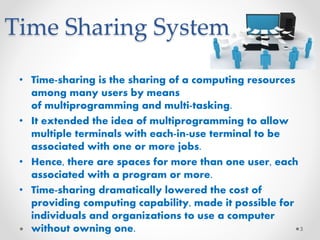
Time Sharing System
• Time-sharing is the sharing of a computing resources
among many users by means
of multiprogramming and multi-tasking.
• It extended the idea of multiprogramming to allow
multiple terminals with each-in-use terminal to be
associated with one or more jobs.
• Hence, there are spaces for more than one user, each
associated with a program or more.
• Time-sharing dramatically lowered the cost of
providing computing capability, made it possible for
individuals and organizations to use a computer
without owning one. 3
4
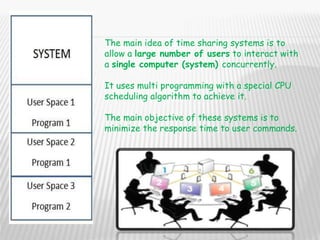
The main idea of time sharing systems is to
allow a large number of users to interact with
a single computer (system) concurrently.
It uses multi programming with a special CPU
scheduling algorithm to achieve it.
The main objective of these systems is to
minimize the response time to user commands.
 Connection of several terminals with the system
so that multi user can interact in interactive
mode.
 Large memory to support multiprogramming.
 Memory protection mechanism to prevent
interaction/accessing of multi users in
multiprogramming environment.
 An alarm clock mechanism to send an interrupt
signals to the CPU after every time interval.
 Job status preservation mechanism.
 Special CPU scheduling algorithm. 5
6
Reduce CPU idle time.
Offer good computing
facility to small users.
Provides advantages of
quick response.
CPU is used most
effectively of the time.
Time delay as it might get
over loaded as many
users are working on
single system and output
will be displayed late.
 Data stored in secondary storage disk is in form of file which provides
long term storage.
 A file is collection of related information defined by its creator.
 E.g. – magnetic tapes/disk, optical disk, etc.
 File management module of an operating system takes care of file
related activities such as structuring, accessing, naming, sharing, and
protecting.
 Major activities are-
creation & deletion of files & directories, mapping of file, backup of files
on stable storage media, support primitives for manipulating files &
directories.
7
8
An access method is a function of
a mainframe open rating
system that enables access to
data on disk, tape or other
external devices.
It is supported by sequential
access and random access.
9
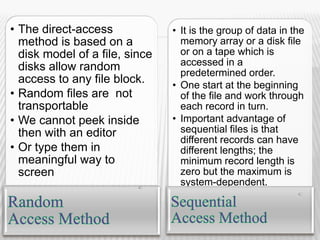
• The direct-access
method is based on a
disk model of a file, since
disks allow random
access to any file block.
• Random files are not
transportable
• We cannot peek inside
then with an editor
• Or type them in
meaningful way to
screen
• It is the group of data in the
memory array or a disk file
or on a tape which is
accessed in a
predetermined order.
• One start at the beginning
of the file and work through
each record in turn.
• Important advantage of
sequential files is that
different records can have
different lengths; the
minimum record length is
zero but the maximum is
system-dependent.
 It helps in dealing with files and its content.
 Create
 Delete
 Open
 Close
 Read
 Write
 Seek
 Rename
 Copy
 Get & Set Attributes
10Attributes like read-only hidden system and archive.
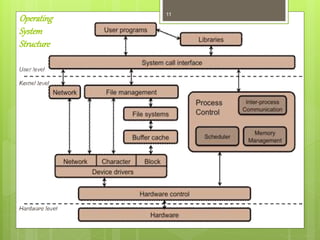
Operating
System
Structure
11
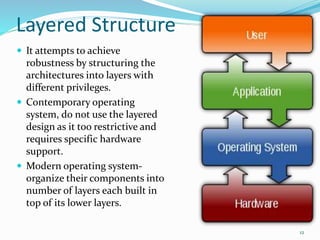
Layered Structure
 It attempts to achieve
robustness by structuring the
architectures into layers with
different privileges.
 Contemporary operating
system, do not use the layered
design as it too restrictive and
requires specific hardware
support.
 Modern operating system-
organize their components into
number of layers each built in
top of its lower layers.
12
13
 The layer is selected such that each layer uses the
functions and services provided by its intermediate
lower layers.
 Bottom layer is the hardware.
 Top layer is the user interface.
 The main advantage is modularity.
 This approach greatly signifies the design and
implementation of the system because each layer is
implemented using only those operations provided by
its immediate lower level layers.
KERNEL
 The kernel is the main component of
most computer operating systems.
 It is a bridge
between applications and the
actual data processing done at the
hardware level.
 The kernel's responsibilities include
managing the system's resources.
14
1. The kernel takes responsibility for deciding at any time
which of the many running programs should be allocated to
the processor or processors.
2. The kernel is responsible for deciding which memory each
process can use, and determining what to do when not
enough is available.
3. The kernel allocates requests from applications to perform
Input/output to an appropriate device and provides
convenient methods for using the device.
4. Key aspects necessary in resource managements are the
definition of an execution domain and the protection
mechanism used to mediate the accesses to the resources
within a domain. 15
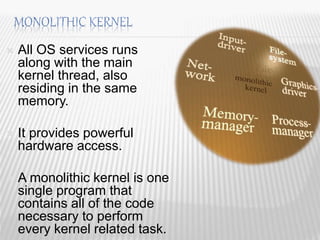
 All OS services runs
along with the main
kernel thread, also
residing in the same
memory.
 It provides powerful
hardware access.
 A monolithic kernel is one
single program that
contains all of the code
necessary to perform
every kernel related task. 16
17
Advantages:
 Since there is less software involved it is faster.
 As it is one single piece of software it should be smaller both in
source and compiled forms.
 Less code generally means fewer bugs which can translate to
fewer security problems.
Limitations:
 Coding in kernel can be challenging,
 Rebooting the computer is often needed.
 A bug in one function can corrupt data structure, part of the kernel, or
running programs.
 Difficult to maintain.
 Even if the modules servicing these operations are separate from the
whole, the code integration is tight and difficult to do correctly.
 Since the modules run in the same address space, a bug can bring
down the entire system.
 They are not portable; that is, they must be rewritten for each new
operating system.
 A microkernel that is designed for a specific
platform or device is only ever going to have
what it needs to operate.
 The microkernel approach consists of
defining a simple abstraction over the
hardware, with a set of primitives or system
calls to implement minimal OS services such
as memory management, multitasking,
and inter-process communication.
18
19
Advantages:
 Maintenance is easier.
 Patches can be tested in a separate instance, and then swapped in to
take over a production instance.
 Rapid development time and new software can be tested without
rebooting the kernel.
 More persistence.
 Most micro kernels use a message passing system of some sort to
handle requests from one server to another.
Disadvantages:
 Larger running memory footprint
 More software for interfacing is required, there is a potential for
performance loss.
 Messaging bugs can be harder to fix due to the longer trip they have to
take versus the one off copy in a monolithic kernel.
 Process management is very complicated.
 They are extremely context based.
20
21
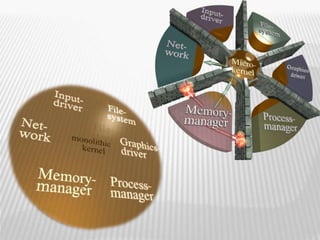
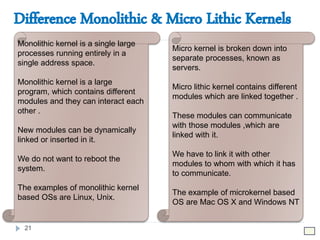
Monolithic kernel is a single large
processes running entirely in a
single address space.
Monolithic kernel is a large
program, which contains different
modules and they can interact each
other .
New modules can be dynamically
linked or inserted in it.
We do not want to reboot the
system.
The examples of monolithic kernel
based OSs are Linux, Unix.
Micro kernel is broken down into
separate processes, known as
servers.
Micro lithic kernel contains different
modules which are linked together .
These modules can communicate
with those modules ,which are
linked with it.
We have to link it with other
modules to whom with which it has
to communicate.
The example of microkernel based
OS are Mac OS X and Windows NT
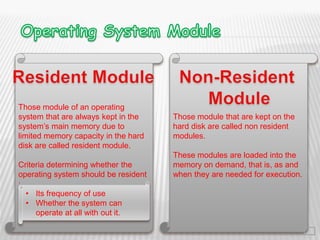
Those module of an operating
system that are always kept in the
system’s main memory due to
limited memory capacity in the hard
disk are called resident module.
Criteria determining whether the
operating system should be resident
:
Those module that are kept on the
hard disk are called non resident
modules.
These modules are loaded into the
memory on demand, that is, as and
when they are needed for execution.
• Its frequency of use
• Whether the system can
operate at all with out it.
Bibliography
• http://www.wikipedia.com/
• ICAI ITT Module-1, page no.: 55 – 59, August 2011
edition
• http://en.wikipedia.org/wiki/Kernel_(computing)#Monolithi
c_kernels
• http://wiki.answers.com/Q/Difference_between_monolithi
c_and_microlithic_kernel
23

ITT Project Information Technology Basic

  • 1.
    Submitted by: Name –Mayank Garg Roll No. – 47 Batch - Morning Submitted to: Miss Priyanka Kapoor
  • 2.
    2 File Management: File Access File Operation Time Sharing: Requirement Advantages& Disadvantages OS Structure: LayeredStructure Kernel Mono LithicKernel MicroLithicKernel Difference OperatingSystemModule
  • 3.
    Time Sharing System •Time-sharing is the sharing of a computing resources among many users by means of multiprogramming and multi-tasking. • It extended the idea of multiprogramming to allow multiple terminals with each-in-use terminal to be associated with one or more jobs. • Hence, there are spaces for more than one user, each associated with a program or more. • Time-sharing dramatically lowered the cost of providing computing capability, made it possible for individuals and organizations to use a computer without owning one. 3
  • 4.
    4 The main ideaof time sharing systems is to allow a large number of users to interact with a single computer (system) concurrently. It uses multi programming with a special CPU scheduling algorithm to achieve it. The main objective of these systems is to minimize the response time to user commands.
  • 5.
     Connection ofseveral terminals with the system so that multi user can interact in interactive mode.  Large memory to support multiprogramming.  Memory protection mechanism to prevent interaction/accessing of multi users in multiprogramming environment.  An alarm clock mechanism to send an interrupt signals to the CPU after every time interval.  Job status preservation mechanism.  Special CPU scheduling algorithm. 5
  • 6.
    6 Reduce CPU idletime. Offer good computing facility to small users. Provides advantages of quick response. CPU is used most effectively of the time. Time delay as it might get over loaded as many users are working on single system and output will be displayed late.
  • 7.
     Data storedin secondary storage disk is in form of file which provides long term storage.  A file is collection of related information defined by its creator.  E.g. – magnetic tapes/disk, optical disk, etc.  File management module of an operating system takes care of file related activities such as structuring, accessing, naming, sharing, and protecting.  Major activities are- creation & deletion of files & directories, mapping of file, backup of files on stable storage media, support primitives for manipulating files & directories. 7
  • 8.
    8 An access methodis a function of a mainframe open rating system that enables access to data on disk, tape or other external devices. It is supported by sequential access and random access.
  • 9.
    9 • The direct-access methodis based on a disk model of a file, since disks allow random access to any file block. • Random files are not transportable • We cannot peek inside then with an editor • Or type them in meaningful way to screen • It is the group of data in the memory array or a disk file or on a tape which is accessed in a predetermined order. • One start at the beginning of the file and work through each record in turn. • Important advantage of sequential files is that different records can have different lengths; the minimum record length is zero but the maximum is system-dependent.
  • 10.
     It helpsin dealing with files and its content.  Create  Delete  Open  Close  Read  Write  Seek  Rename  Copy  Get & Set Attributes 10Attributes like read-only hidden system and archive.
  • 11.
  • 12.
    Layered Structure  Itattempts to achieve robustness by structuring the architectures into layers with different privileges.  Contemporary operating system, do not use the layered design as it too restrictive and requires specific hardware support.  Modern operating system- organize their components into number of layers each built in top of its lower layers. 12
  • 13.
    13  The layeris selected such that each layer uses the functions and services provided by its intermediate lower layers.  Bottom layer is the hardware.  Top layer is the user interface.  The main advantage is modularity.  This approach greatly signifies the design and implementation of the system because each layer is implemented using only those operations provided by its immediate lower level layers.
  • 14.
    KERNEL  The kernelis the main component of most computer operating systems.  It is a bridge between applications and the actual data processing done at the hardware level.  The kernel's responsibilities include managing the system's resources. 14
  • 15.
    1. The kerneltakes responsibility for deciding at any time which of the many running programs should be allocated to the processor or processors. 2. The kernel is responsible for deciding which memory each process can use, and determining what to do when not enough is available. 3. The kernel allocates requests from applications to perform Input/output to an appropriate device and provides convenient methods for using the device. 4. Key aspects necessary in resource managements are the definition of an execution domain and the protection mechanism used to mediate the accesses to the resources within a domain. 15
  • 16.
     All OSservices runs along with the main kernel thread, also residing in the same memory.  It provides powerful hardware access.  A monolithic kernel is one single program that contains all of the code necessary to perform every kernel related task. 16
  • 17.
    17 Advantages:  Since thereis less software involved it is faster.  As it is one single piece of software it should be smaller both in source and compiled forms.  Less code generally means fewer bugs which can translate to fewer security problems. Limitations:  Coding in kernel can be challenging,  Rebooting the computer is often needed.  A bug in one function can corrupt data structure, part of the kernel, or running programs.  Difficult to maintain.  Even if the modules servicing these operations are separate from the whole, the code integration is tight and difficult to do correctly.  Since the modules run in the same address space, a bug can bring down the entire system.  They are not portable; that is, they must be rewritten for each new operating system.
  • 18.
     A microkernelthat is designed for a specific platform or device is only ever going to have what it needs to operate.  The microkernel approach consists of defining a simple abstraction over the hardware, with a set of primitives or system calls to implement minimal OS services such as memory management, multitasking, and inter-process communication. 18
  • 19.
    19 Advantages:  Maintenance iseasier.  Patches can be tested in a separate instance, and then swapped in to take over a production instance.  Rapid development time and new software can be tested without rebooting the kernel.  More persistence.  Most micro kernels use a message passing system of some sort to handle requests from one server to another. Disadvantages:  Larger running memory footprint  More software for interfacing is required, there is a potential for performance loss.  Messaging bugs can be harder to fix due to the longer trip they have to take versus the one off copy in a monolithic kernel.  Process management is very complicated.  They are extremely context based.
  • 20.
  • 21.
    21 Monolithic kernel isa single large processes running entirely in a single address space. Monolithic kernel is a large program, which contains different modules and they can interact each other . New modules can be dynamically linked or inserted in it. We do not want to reboot the system. The examples of monolithic kernel based OSs are Linux, Unix. Micro kernel is broken down into separate processes, known as servers. Micro lithic kernel contains different modules which are linked together . These modules can communicate with those modules ,which are linked with it. We have to link it with other modules to whom with which it has to communicate. The example of microkernel based OS are Mac OS X and Windows NT
  • 22.
    Those module ofan operating system that are always kept in the system’s main memory due to limited memory capacity in the hard disk are called resident module. Criteria determining whether the operating system should be resident : Those module that are kept on the hard disk are called non resident modules. These modules are loaded into the memory on demand, that is, as and when they are needed for execution. • Its frequency of use • Whether the system can operate at all with out it.
  • 23.
    Bibliography • http://www.wikipedia.com/ • ICAIITT Module-1, page no.: 55 – 59, August 2011 edition • http://en.wikipedia.org/wiki/Kernel_(computing)#Monolithi c_kernels • http://wiki.answers.com/Q/Difference_between_monolithi c_and_microlithic_kernel 23