Distributed Systems:
Principles and Paradigms

By Andrew S. Tanenbaum
and Maarten van Steen
Outline
1. Introduction
2. Communication
3. Processes
4. Naming
5. Synchronization
6. Consistency and Replication
7. Fault Tolerance
8. Security
9. Distributed Object-based Systems
10. Distributed File Systems
11. Distributed Document-based systems
12. Distributed Coordination-based Systems
Introduction
Chapter 1
Definition of a Distributed System (1)
A distributed system is:
A collection of independent
computers that appears to
its users as a single
coherent system
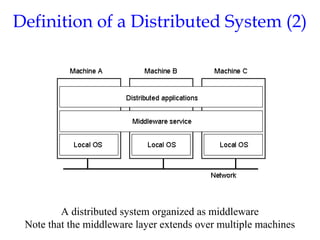
Definition of a Distributed System (2)
A distributed system organized as middleware
Note that the middleware layer extends over multiple machines
1.1
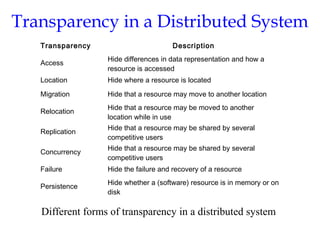
Transparency in a Distributed System
Different forms of transparency in a distributed system
Transparency Description
Access
Hide differences in data representation and how a
resource is accessed
Location Hide where a resource is located
Migration Hide that a resource may move to another location
Relocation
Hide that a resource may be moved to another
location while in use
Replication
Hide that a resource may be shared by several
competitive users
Concurrency
Hide that a resource may be shared by several
competitive users
Failure Hide the failure and recovery of a resource
Persistence
Hide whether a (software) resource is in memory or on
disk
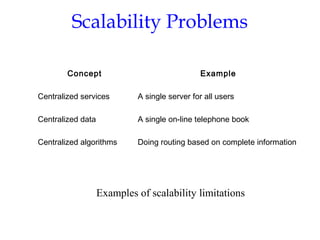
Scalability Problems
Examples of scalability limitations
Concept Example
Centralized services A single server for all users
Centralized data A single on-line telephone book
Centralized algorithms Doing routing based on complete information
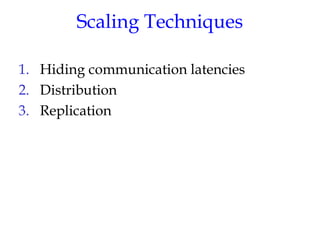
Scaling Techniques
1. Hiding communication latencies
2. Distribution
3. Replication
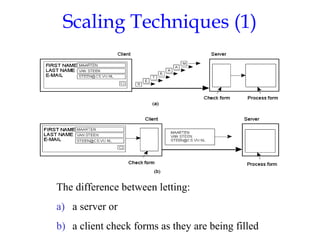
Scaling Techniques (1)
1.4
The difference between letting:
a) a server or
b) a client check forms as they are being filled
Scaling Techniques (2)
1.5
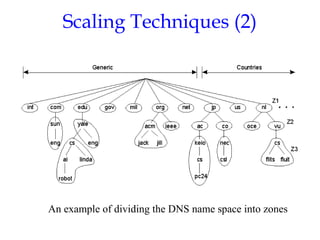
An example of dividing the DNS name space into zones
Hardware Concepts
1.6
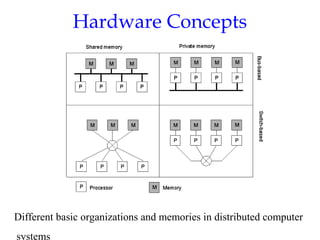
Different basic organizations and memories in distributed computer
systems
Multiprocessors (1)
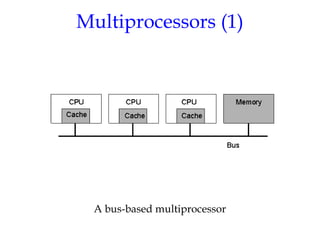
A bus-based multiprocessor
1.7
Multiprocessors (2)
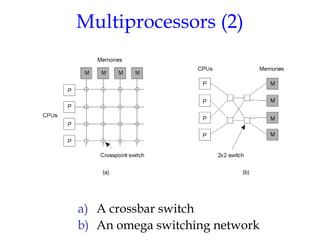
a) A crossbar switch
b) An omega switching network
1.8
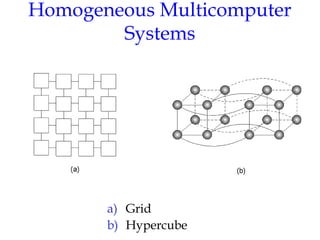
Homogeneous Multicomputer
Systems
a) Grid
b) Hypercube
1-9
Software Concepts
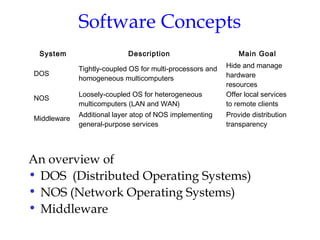
An overview of
• DOS (Distributed Operating Systems)
• NOS (Network Operating Systems)
• Middleware
System Description Main Goal
DOS
Tightly-coupled OS for multi-processors and
homogeneous multicomputers
Hide and manage
hardware
resources
NOS
Loosely-coupled OS for heterogeneous
multicomputers (LAN and WAN)
Offer local services
to remote clients
Middleware
Additional layer atop of NOS implementing
general-purpose services
Provide distribution
transparency
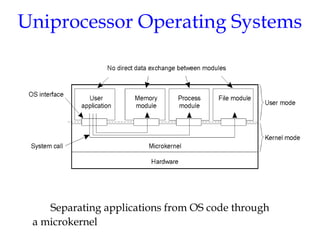
Uniprocessor Operating Systems
Separating applications from OS code through
a microkernel
1.11
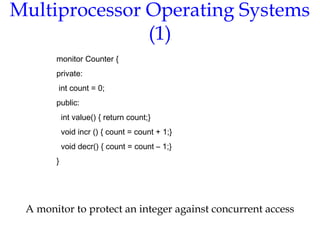
Multiprocessor Operating Systems
(1)
A monitor to protect an integer against concurrent access
monitor Counter {
private:
int count = 0;
public:
int value() { return count;}
void incr () { count = count + 1;}
void decr() { count = count – 1;}
}
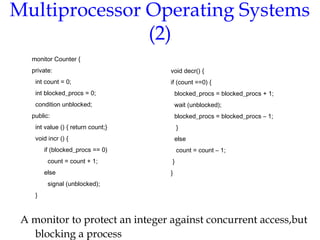
Multiprocessor Operating Systems
(2)
A monitor to protect an integer against concurrent access,but
blocking a process
monitor Counter {
private:
int count = 0;
int blocked_procs = 0;
condition unblocked;
public:
int value () { return count;}
void incr () {
if (blocked_procs == 0)
count = count + 1;
else
signal (unblocked);
}
void decr() {
if (count ==0) {
blocked_procs = blocked_procs + 1;
wait (unblocked);
blocked_procs = blocked_procs – 1;
}
else
count = count – 1;
}
}
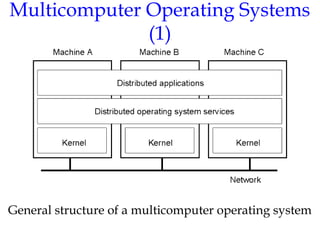
Multicomputer Operating Systems
(1)
General structure of a multicomputer operating system
1.14
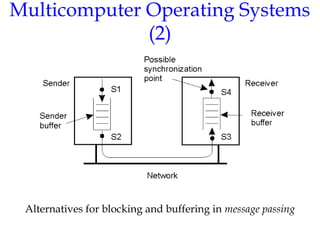
Multicomputer Operating Systems
(2)
Alternatives for blocking and buffering in message passing
1.15
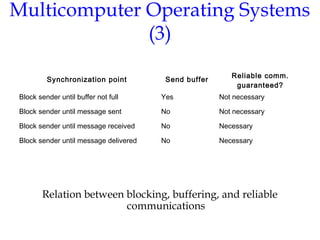
Multicomputer Operating Systems
(3)
Relation between blocking, buffering, and reliable
communications
Synchronization point Send buffer
Reliable comm.
guaranteed?
Block sender until buffer not full Yes Not necessary
Block sender until message sent No Not necessary
Block sender until message received No Necessary
Block sender until message delivered No Necessary
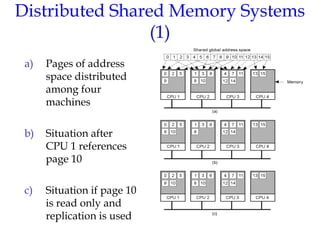
Distributed Shared Memory Systems
(1)
a) Pages of address
space distributed
among four
machines
b) Situation after
CPU 1 references
page 10
c) Situation if page 10
is read only and
replication is used
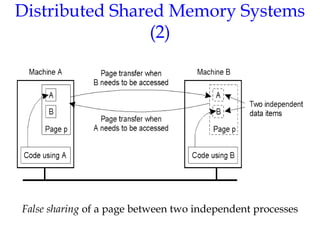
Distributed Shared Memory Systems
(2)
False sharing of a page between two independent processes
1.18
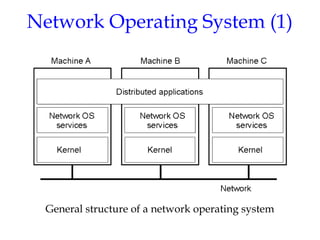
Network Operating System (1)
General structure of a network operating system
1-19
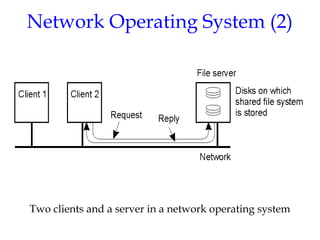
Network Operating System (2)
Two clients and a server in a network operating system
1-20
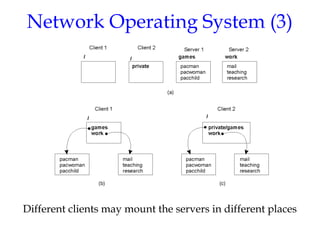
Network Operating System (3)
Different clients may mount the servers in different places
1.21
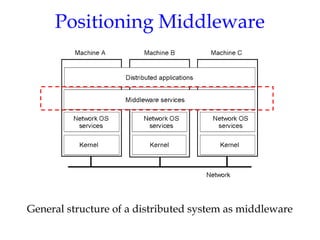
Positioning Middleware
General structure of a distributed system as middleware
1-22
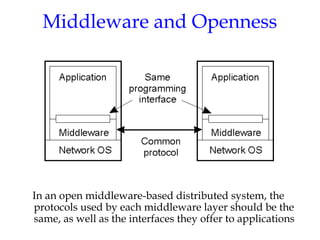
Middleware and Openness
In an open middleware-based distributed system, the
protocols used by each middleware layer should be the
same, as well as the interfaces they offer to applications
1.23
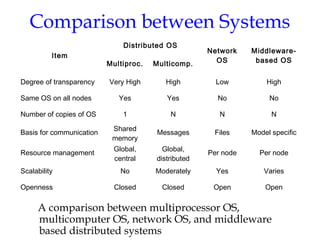
Comparison between Systems
A comparison between multiprocessor OS,
multicomputer OS, network OS, and middleware
based distributed systems
Item
Distributed OS
Network
OS
Middleware-
based OSMultiproc. Multicomp.
Degree of transparency Very High High Low High
Same OS on all nodes Yes Yes No No
Number of copies of OS 1 N N N
Basis for communication
Shared
memory
Messages Files Model specific
Resource management
Global,
central
Global,
distributed
Per node Per node
Scalability No Moderately Yes Varies
Openness Closed Closed Open Open
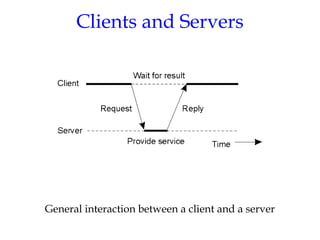
Clients and Servers
General interaction between a client and a server
1.25
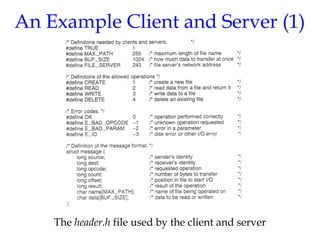
An Example Client and Server (1)
The header.h file used by the client and server
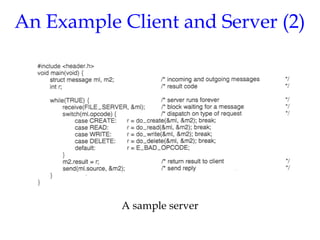
An Example Client and Server (2)
A sample server
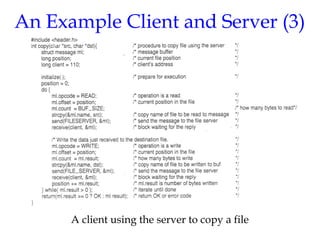
An Example Client and Server (3)
A client using the server to copy a file
1-27 b
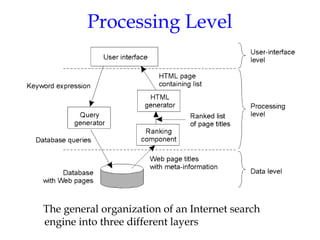
Processing Level
The general organization of an Internet search
engine into three different layers
1-28
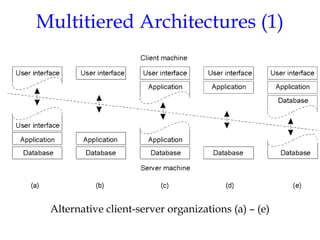
Multitiered Architectures (1)
Alternative client-server organizations (a) – (e)
1-29
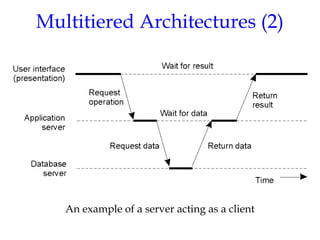
Multitiered Architectures (2)
An example of a server acting as a client
1-30
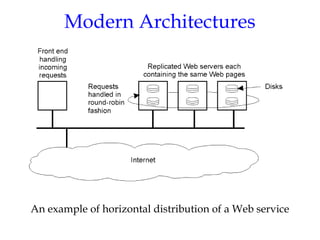
Modern Architectures
An example of horizontal distribution of a Web service
1-31
Thanks for Your Attention!

Distributed OS - An Introduction

  • 1.
    Distributed Systems: Principles andParadigms By Andrew S. Tanenbaum and Maarten van Steen
  • 2.
    Outline 1. Introduction 2. Communication 3.Processes 4. Naming 5. Synchronization 6. Consistency and Replication 7. Fault Tolerance 8. Security 9. Distributed Object-based Systems 10. Distributed File Systems 11. Distributed Document-based systems 12. Distributed Coordination-based Systems
  • 3.
  • 4.
    Definition of aDistributed System (1) A distributed system is: A collection of independent computers that appears to its users as a single coherent system
  • 5.
    Definition of aDistributed System (2) A distributed system organized as middleware Note that the middleware layer extends over multiple machines 1.1
  • 6.
    Transparency in aDistributed System Different forms of transparency in a distributed system Transparency Description Access Hide differences in data representation and how a resource is accessed Location Hide where a resource is located Migration Hide that a resource may move to another location Relocation Hide that a resource may be moved to another location while in use Replication Hide that a resource may be shared by several competitive users Concurrency Hide that a resource may be shared by several competitive users Failure Hide the failure and recovery of a resource Persistence Hide whether a (software) resource is in memory or on disk
  • 7.
    Scalability Problems Examples ofscalability limitations Concept Example Centralized services A single server for all users Centralized data A single on-line telephone book Centralized algorithms Doing routing based on complete information
  • 8.
    Scaling Techniques 1. Hidingcommunication latencies 2. Distribution 3. Replication
  • 9.
    Scaling Techniques (1) 1.4 Thedifference between letting: a) a server or b) a client check forms as they are being filled
  • 10.
    Scaling Techniques (2) 1.5 Anexample of dividing the DNS name space into zones
  • 11.
    Hardware Concepts 1.6 Different basicorganizations and memories in distributed computer systems
  • 12.
  • 13.
    Multiprocessors (2) a) Acrossbar switch b) An omega switching network 1.8
  • 14.
  • 15.
    Software Concepts An overviewof • DOS (Distributed Operating Systems) • NOS (Network Operating Systems) • Middleware System Description Main Goal DOS Tightly-coupled OS for multi-processors and homogeneous multicomputers Hide and manage hardware resources NOS Loosely-coupled OS for heterogeneous multicomputers (LAN and WAN) Offer local services to remote clients Middleware Additional layer atop of NOS implementing general-purpose services Provide distribution transparency
  • 16.
    Uniprocessor Operating Systems Separatingapplications from OS code through a microkernel 1.11
  • 17.
    Multiprocessor Operating Systems (1) Amonitor to protect an integer against concurrent access monitor Counter { private: int count = 0; public: int value() { return count;} void incr () { count = count + 1;} void decr() { count = count – 1;} }
  • 18.
    Multiprocessor Operating Systems (2) Amonitor to protect an integer against concurrent access,but blocking a process monitor Counter { private: int count = 0; int blocked_procs = 0; condition unblocked; public: int value () { return count;} void incr () { if (blocked_procs == 0) count = count + 1; else signal (unblocked); } void decr() { if (count ==0) { blocked_procs = blocked_procs + 1; wait (unblocked); blocked_procs = blocked_procs – 1; } else count = count – 1; } }
  • 19.
    Multicomputer Operating Systems (1) Generalstructure of a multicomputer operating system 1.14
  • 20.
    Multicomputer Operating Systems (2) Alternativesfor blocking and buffering in message passing 1.15
  • 21.
    Multicomputer Operating Systems (3) Relationbetween blocking, buffering, and reliable communications Synchronization point Send buffer Reliable comm. guaranteed? Block sender until buffer not full Yes Not necessary Block sender until message sent No Not necessary Block sender until message received No Necessary Block sender until message delivered No Necessary
  • 22.
    Distributed Shared MemorySystems (1) a) Pages of address space distributed among four machines b) Situation after CPU 1 references page 10 c) Situation if page 10 is read only and replication is used
  • 23.
    Distributed Shared MemorySystems (2) False sharing of a page between two independent processes 1.18
  • 24.
    Network Operating System(1) General structure of a network operating system 1-19
  • 25.
    Network Operating System(2) Two clients and a server in a network operating system 1-20
  • 26.
    Network Operating System(3) Different clients may mount the servers in different places 1.21
  • 27.
    Positioning Middleware General structureof a distributed system as middleware 1-22
  • 28.
    Middleware and Openness Inan open middleware-based distributed system, the protocols used by each middleware layer should be the same, as well as the interfaces they offer to applications 1.23
  • 29.
    Comparison between Systems Acomparison between multiprocessor OS, multicomputer OS, network OS, and middleware based distributed systems Item Distributed OS Network OS Middleware- based OSMultiproc. Multicomp. Degree of transparency Very High High Low High Same OS on all nodes Yes Yes No No Number of copies of OS 1 N N N Basis for communication Shared memory Messages Files Model specific Resource management Global, central Global, distributed Per node Per node Scalability No Moderately Yes Varies Openness Closed Closed Open Open
  • 30.
    Clients and Servers Generalinteraction between a client and a server 1.25
  • 31.
    An Example Clientand Server (1) The header.h file used by the client and server
  • 32.
    An Example Clientand Server (2) A sample server
  • 33.
    An Example Clientand Server (3) A client using the server to copy a file 1-27 b
  • 34.
    Processing Level The generalorganization of an Internet search engine into three different layers 1-28
  • 35.
    Multitiered Architectures (1) Alternativeclient-server organizations (a) – (e) 1-29
  • 36.
    Multitiered Architectures (2) Anexample of a server acting as a client 1-30
  • 37.
    Modern Architectures An exampleof horizontal distribution of a Web service 1-31
  • 38.
    Thanks for YourAttention!