INSTRUMENTAL
LEARNING
It is a type of associative learning process
through which the strength of a behavior is
modified by reinforcement or punishment.
In other words we can say that in operant
conditioning, an association is made between
a behavior and a consequence (whether
negative or positive) for that behavior.
INSTRUMENTAL LEARNING/
OPERANT CONDITIONING
B.F Skinner is regarded as
the father of operant
conditioning, but his work
was based on
E.L.Thorndike’s
“Law of Effect”
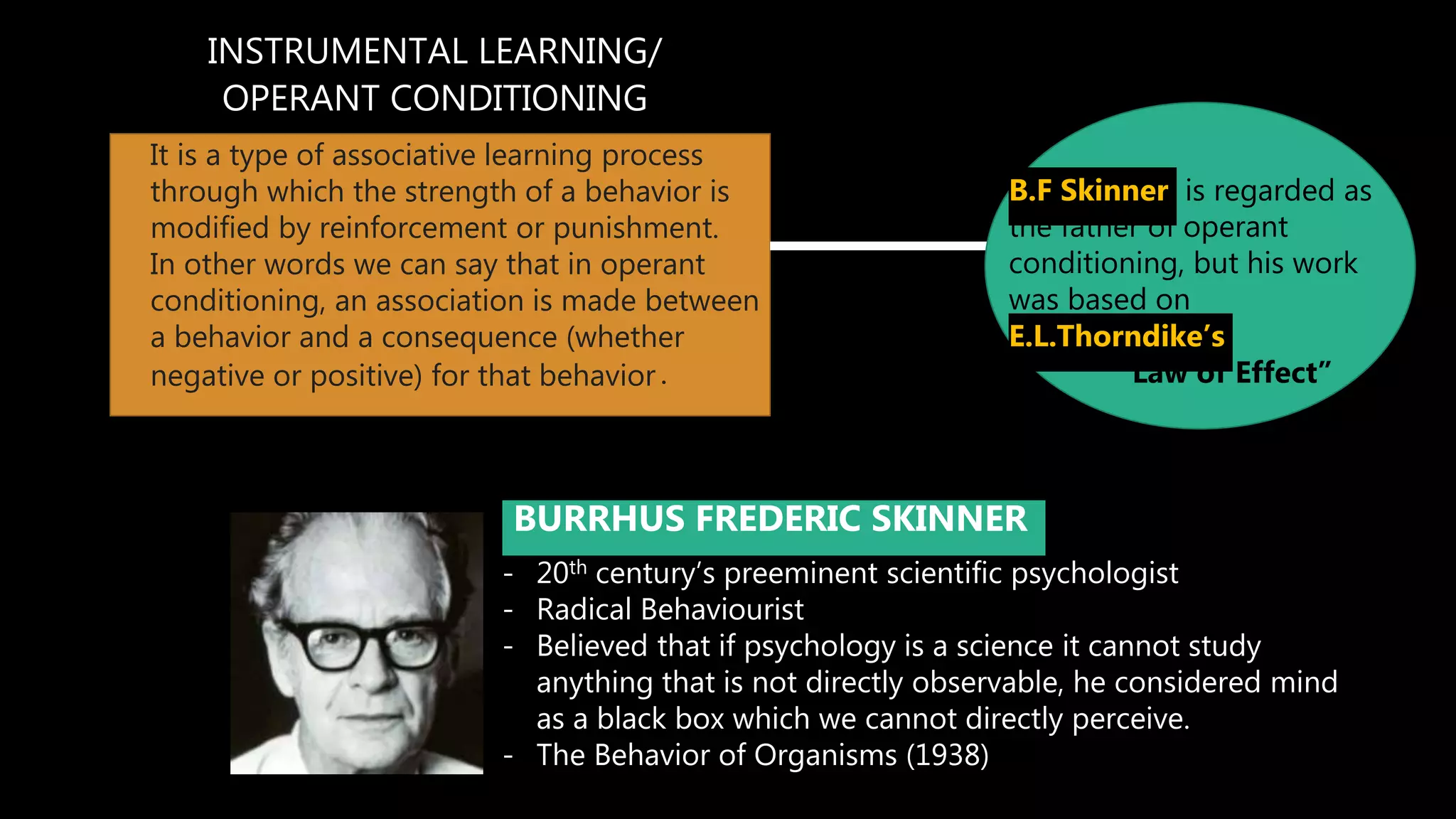
- 20th century’s preeminent scientific psychologist
- Radical Behaviourist
- Believed that if psychology is a science it cannot study
anything that is not directly observable, he considered mind
as a black box which we cannot directly perceive.
- The Behavior of Organisms (1938)
BURRHUS FREDERIC SKINNER
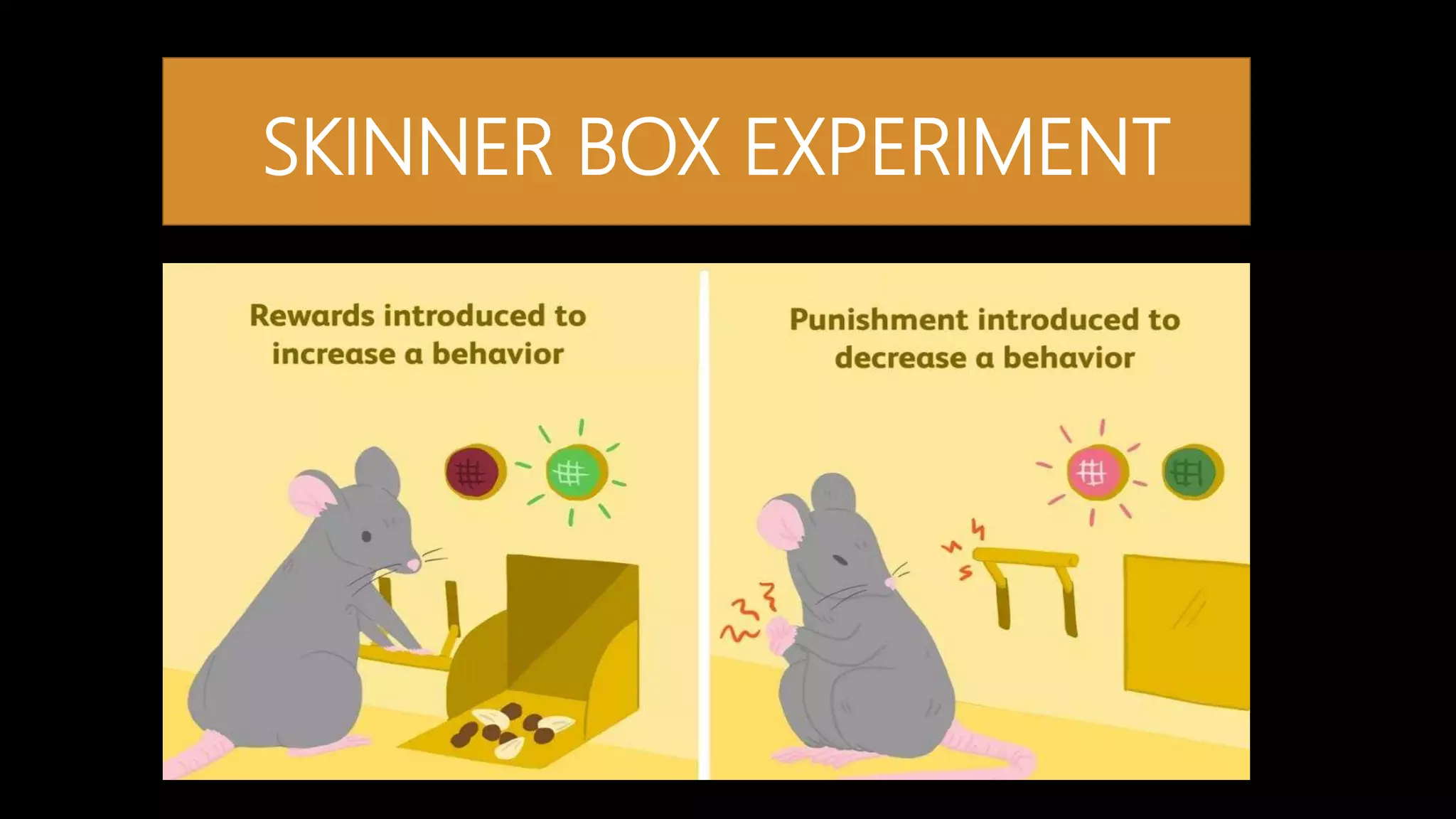
SKINNER BOX EXPERIMENT
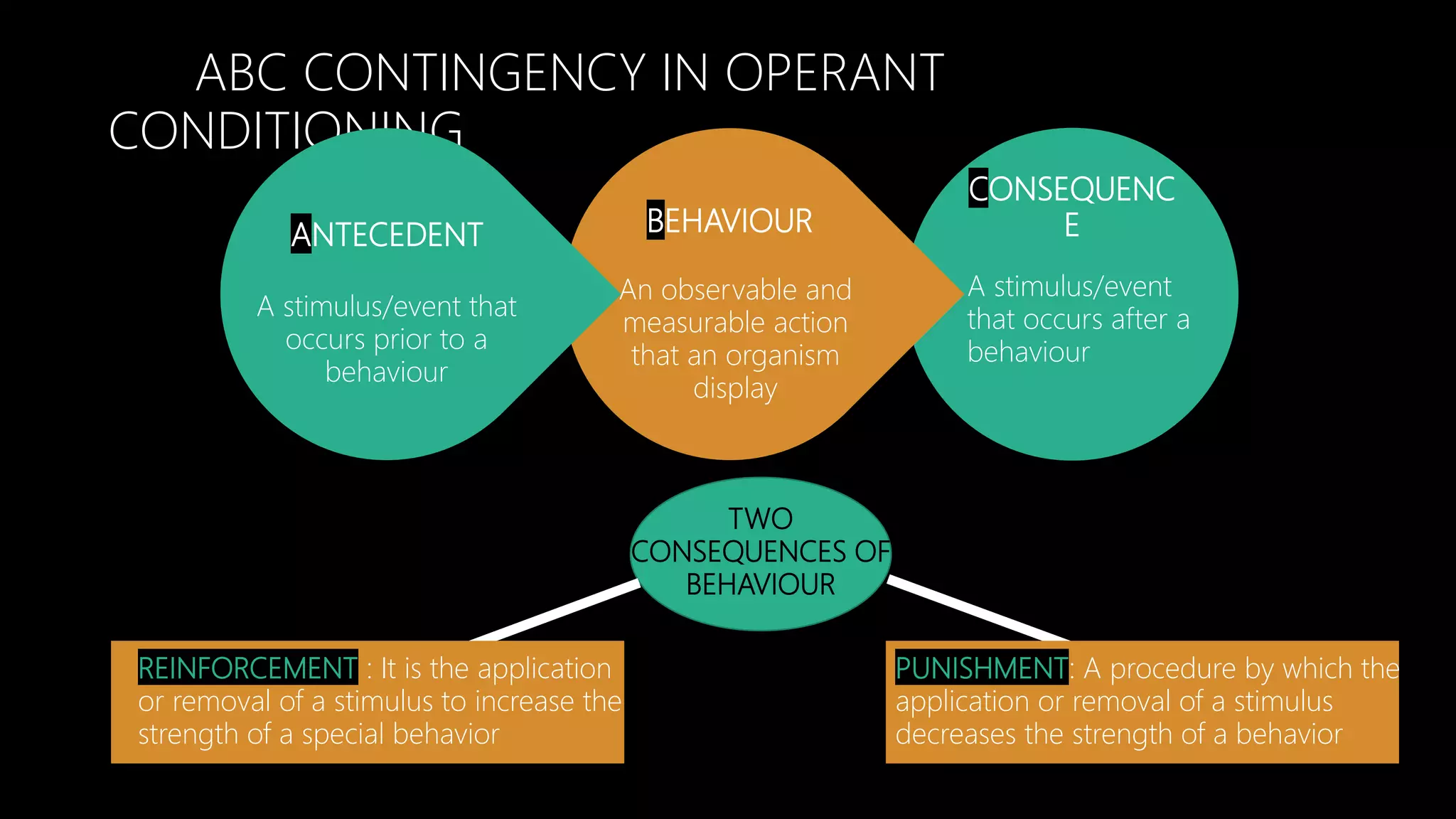
TWO
CONSEQUENCES OF
BEHAVIOUR
REINFORCEMENT : It is the application
or removal of a stimulus to increase the
strength of a special behavior
PUNISHMENT: A procedure by which the
application or removal of a stimulus
decreases the strength of a behavior
ABC CONTINGENCY IN OPERANT
CONDITIONING
CONSEQUENC
E
BEHAVIOUR
ANTECEDENT
A stimulus/event that
occurs prior to a
behaviour
An observable and
measurable action
that an organism
display
A stimulus/event
that occurs after a
behaviour
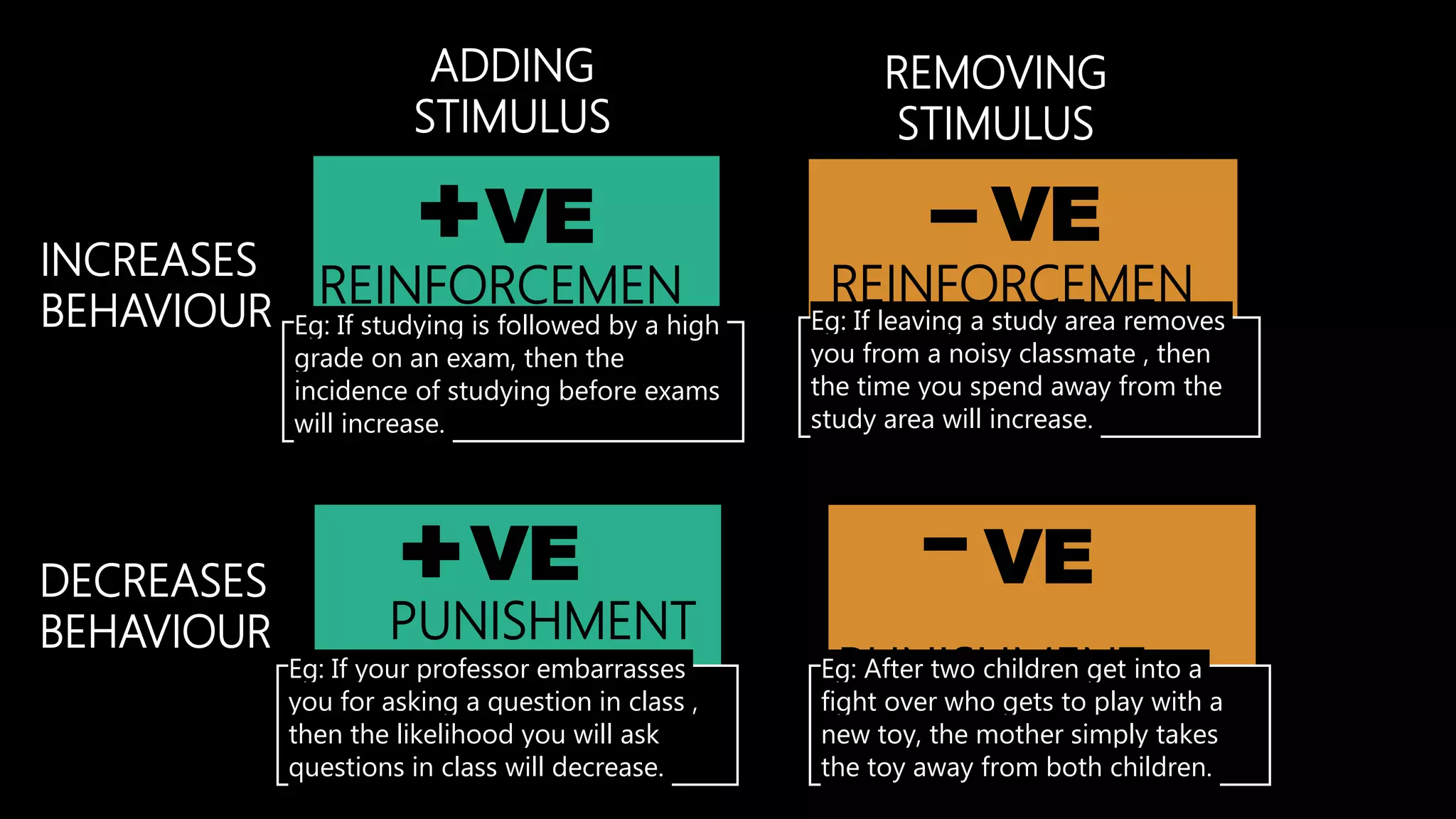
VE
VE
VE
VE
REINFORCEMEN
T
REINFORCEMEN
T
PUNISHMENT
PUNISHMENT
ADDING
STIMULUS
REMOVING
STIMULUS
INCREASES
BEHAVIOUR
DECREASES
BEHAVIOUR
Eg: If studying is followed by a high
grade on an exam, then the
incidence of studying before exams
will increase.
Eg: If leaving a study area removes
you from a noisy classmate , then
the time you spend away from the
study area will increase.
Eg: If your professor embarrasses
you for asking a question in class ,
then the likelihood you will ask
questions in class will decrease.
Eg: After two children get into a
fight over who gets to play with a
new toy, the mother simply takes
the toy away from both children.
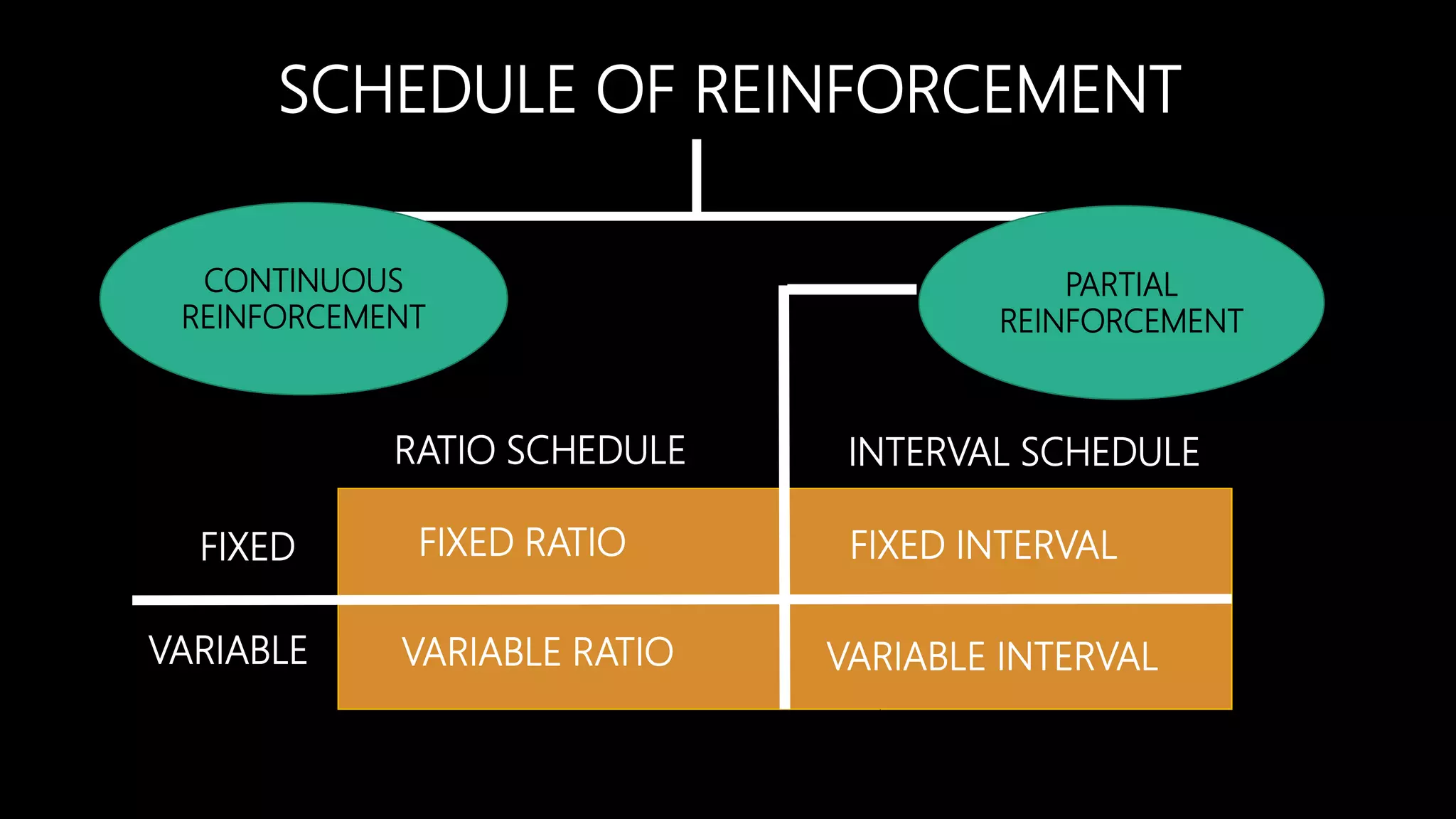
SCHEDULE OF REINFORCEMENT
CONTINUOUS
REINFORCEMENT
PARTIAL
REINFORCEMENT
FIXED RATIO
VARIABLE RATIO
FIXED INTERVAL
VARIABLE INTERVAL
INTERVAL SCHEDULE
RATIO SCHEDULE
FIXED
VARIABLE
CONCLUSION
- Operant conditioning fails to take into account the role of
inherited and cognitive factors in learning, and thus is an
incomplete explanation of the learning process in humans and
animals. But still it can be applied in child rearing, classrooms,
prisons and psychiatric hospitals. Operant conditioning can also
be used to explain a wide variety of behaviors, from the process
of learning to addiction and language acquisition.
- Understanding the principles of operant conditioning are
important to identify faulty learning and to provide an
opportunity to learn normative behavior by unlearning criminal
behavior.
THANK YOU
Submitted by: Anjana S Kumar
Course: M.A./M.Sc. in Applied Criminology and Police Studies
Semester: 2
Paper: Criminal and Forensic Psychology
Submitted to: Dr. Abhishek Sharma

Instrumental Learning Theory

  • 1.
  • 2.
    It is atype of associative learning process through which the strength of a behavior is modified by reinforcement or punishment. In other words we can say that in operant conditioning, an association is made between a behavior and a consequence (whether negative or positive) for that behavior. INSTRUMENTAL LEARNING/ OPERANT CONDITIONING B.F Skinner is regarded as the father of operant conditioning, but his work was based on E.L.Thorndike’s “Law of Effect” - 20th century’s preeminent scientific psychologist - Radical Behaviourist - Believed that if psychology is a science it cannot study anything that is not directly observable, he considered mind as a black box which we cannot directly perceive. - The Behavior of Organisms (1938) BURRHUS FREDERIC SKINNER
  • 3.
  • 4.
    TWO CONSEQUENCES OF BEHAVIOUR REINFORCEMENT :It is the application or removal of a stimulus to increase the strength of a special behavior PUNISHMENT: A procedure by which the application or removal of a stimulus decreases the strength of a behavior ABC CONTINGENCY IN OPERANT CONDITIONING CONSEQUENC E BEHAVIOUR ANTECEDENT A stimulus/event that occurs prior to a behaviour An observable and measurable action that an organism display A stimulus/event that occurs after a behaviour
  • 5.
    VE VE VE VE REINFORCEMEN T REINFORCEMEN T PUNISHMENT PUNISHMENT ADDING STIMULUS REMOVING STIMULUS INCREASES BEHAVIOUR DECREASES BEHAVIOUR Eg: If studyingis followed by a high grade on an exam, then the incidence of studying before exams will increase. Eg: If leaving a study area removes you from a noisy classmate , then the time you spend away from the study area will increase. Eg: If your professor embarrasses you for asking a question in class , then the likelihood you will ask questions in class will decrease. Eg: After two children get into a fight over who gets to play with a new toy, the mother simply takes the toy away from both children.
  • 6.
    SCHEDULE OF REINFORCEMENT CONTINUOUS REINFORCEMENT PARTIAL REINFORCEMENT FIXEDRATIO VARIABLE RATIO FIXED INTERVAL VARIABLE INTERVAL INTERVAL SCHEDULE RATIO SCHEDULE FIXED VARIABLE
  • 7.
    CONCLUSION - Operant conditioningfails to take into account the role of inherited and cognitive factors in learning, and thus is an incomplete explanation of the learning process in humans and animals. But still it can be applied in child rearing, classrooms, prisons and psychiatric hospitals. Operant conditioning can also be used to explain a wide variety of behaviors, from the process of learning to addiction and language acquisition. - Understanding the principles of operant conditioning are important to identify faulty learning and to provide an opportunity to learn normative behavior by unlearning criminal behavior.
  • 8.
    THANK YOU Submitted by:Anjana S Kumar Course: M.A./M.Sc. in Applied Criminology and Police Studies Semester: 2 Paper: Criminal and Forensic Psychology Submitted to: Dr. Abhishek Sharma