MEH652a
High Performance Compact Inverters
Ha Noi Office:
No. 95 - TT4, My Dinh Urban Area,
My Dinh, Nam Tu Liem, Hanoi.
Tel: (84 4) 3568 3740
Fax: (84 4) 3568 3741
Cambodia Office:
#140, Room 1-B, St430, Sangkat Toul
Tompuong II, Khan Chamkamon, PP.
Tel: 855 2322 3635
Fax: 855 2322 3645
Head Office:
No 88, Vinh Phu 40, Hoa Long,
Vinh Phu, Thuan An, Binh Duong.
Tel: (84 650) 37 37 619
Fax: (84 650) 37 37 620
1800 6547
THINK TOGETHER
Nhà phân phối thiết bị điện công nghiệp
hàng đầu Việt Nam
T
Rotational
speed
Run
command
DC link
bus voltage
Current
Time
ON OFF
400ms
1500r/min
540V
20A
50V
Time
Rotational
speed
Current
2s
10A
600r/min
Holding torque generation
Variations according to load
Creep speed
Rotational
speed
Current
Time
Speed
Conveying distance
Load
torque
200ms
500r/min
200%
0
■ With speed feedback
Load: Small
Load: Large
The speed just before positioning
varies, so positioning accuracy drops.
The speed just before positioning is
stabilized, and so positioning accuracy
is improved.
Speed
Conveying distance
0
Gentler on the environment
Expanded capacity range and abundant model variation
These inverters are gentle on the environment.
Use of 6 hazardous substances is limited. (Products
manufactured beginning in the autumn of 2005 will
comply with European regulations (except for interior
soldering in the power module.))
<Six Hazardous Substances>
Lead, Mercury, Cadmium, Hexavalent Chromium,
Polybrominated biphenyl (PBB), Polybrominated
diphenyl ether (PBDE)
<About RoHS>
The Directive 2002/95/EC, promulgated by the
European Parliament and European Council, limits
the use of specific hazardous substances included in
electrical and electronic devices.
Through "slip compensation control" + "voltage tuning," speed
control accuracy at low speeds is improved. This minimizes
variations in speed control accuracy at times when the load
varies, and since the time at creep speeds is shortened,
single cycle tact times can be shortened.
The inverter controls the
energy level generated
and the deceleration time,
and so deceleration stop
can be accomplished
without tripping due to
overvoltage.
●CPU speed comparison
The highest standards of control and performance in its class
The highest level CPU of any inverter is used. Computation
and processing capacity is doubled over the previous
inverter, improving speed control accuracy.
64MHz
32MHz
Equipped with the highest level CPU for its class!
Shortened setting time in slip compensation control Compatible with PG feedback control
Tripless deceleration by automatic deceleration control
ComplieswithEuropeanregulationsthatlimittheuseofspecifichazardoussubstances(RoHS).
Long-life design!
Use of a built-in EMC filter that reduces noise generated by
the inverter makes it possible to reduce the effect on
peripheral equipment.
The design life of each
internal component with
limited life has been
extended to 10 years.
This helps to extend the
maintenance cycle for
your equipment.
Noise is reduced by the built-in EMC filter.
has doubled processing
capacity compared with
the previous model.
! !
Optimumfortheoperationsspecifictoverticalandhorizontalconveyance!
!
Impacts are detected mechanically and not only can the
inverter's operation pattern be set on coast-to-stop or
deceleration stop, but switching from torque limitation to
current limitation and generating a holding torque (hit-and-
stop control) can be selected, making it easy to adjust brake
application and
release timing.
Hit-and-stop control is realized more easily!
■ At brake release time
After the motor operates, torque generation is detected and
signals are output.
■ At brake application time
Brake application that matches the timing can be done,
and so mechanical brake wear is reduced.
Inclusion of a brake signal makes it even more convenient.
Inverters are equipped with two limit operations, "torque
limitation" and "current limitation," so either can be selected to
match the equipment you are using the inverter with.
■ Torque limitation
In order to protect mechanical systems, this function
accurately limits the torque generated by the motor.
(Instantaneous torque cannot be limited.)
■ Current limitation
This function limits the current flowing to the motor to
protect the motor thermally or to provide rough load
limitation. (Instantaneous current cannot be limited. Auto
tuning is not required.)
Limit operations can be selected to match your equipment!
■ Without speed feedback<Example of conveyor operation pattern>
●Semi-Standard type
 ●
EMC filter built-in type
●Option card
 ●
PG interface card (5V type)(12V type)
 ●
RS-485 communication card
 ●
Synchronized operation card
3-phase
200V
3-phase
400V
1-phase
200V
Input power
supply
Nominal applied motor (kW)
0.1 0.2 0.4 0.75 2.21.5 7.55.53.7 11 15
Capacity
expanded
to 15kW
●Standard Series
Limited Life Component Service Life
Main circuit capacitors 10 years
Electrolytic capacitors
on the printed circuit board
10 years
Cooling fan 10 years
Conditions: Ambient temperature is 40°C and load factor is
80% of the inverter's rated current.
With advanced technology built in, these new inverters can be used for multiple purposes!
■ Improved speed control accuracy
improves conveyor positioning
accuracy.
■ Positioning time can be shortened.
■ Improves measuring accuracy on a
scale.
Specifications
Functions
Settings
Keypad
Operations
Basic
WiringDiagram
Terminal
Functions
Protective
FunctionsOptions
PeripheralEquipment
ConnectionDiagrams
Guidelinefor
SuppressingHarmonicsWarrantyVariation
External
Dimensions
Simple operation, simple wiring
The keypad can be
easily removed and
reset, making remote
operation possible. If the
back cover packed with
the inverter is installed and
a LAN cable is used, the
keypad can be easily mounted
on the equipment's control
panel.
A multi-function keypad is available as an
option. This keypad features a large 7-segment
LED with five digits and large back-lighted liquid
crystal panel. Its view-ability is high, and
guidance is displayed on the liquid crystal panel,
therefore operations can be conducted simply. (A
copy function is included.)
Windows compatible loader software is available to simplify
the setting and management of function codes.
USB/RS-485 converter
(made by System
Sacom Sales Corp.)
RS-485 communications
USB cable
(supplied with the converter)
(RJ-45 connector)
Personal computer
The inverter has the function for outputting dummy alarm
signals, enabling simple checking of sequence operations of
peripheral devices from the control panel where the inverter is
used.
Wiring is quite easy
because the interface card
can be attached and
detached as a terminal
base for control signals.
A removable keypad is standard equipment. Amulti-functionkeypadwhichenablesawidevarietyofoperationsisavailable.
Simulatedfailureenablesperipheraldeviceoperationchecks.
A removable interface card is adapted.
Inverter support loader software is available. (On sale soon)
!
Simple and thorough maintenance
Construction is simple, enabling quick removal of the top
cover and making it easy to replace the cooling fan. (5.5kW or
higher models)
Simple cooling fan replacement!
In addition to inverter maintenance information, data that also
take equipment maintenance into consideration are displayed.
Informationthatcontributestoequipmentmaintenanceisdisplayed!
Detailed information can be checked for the four most recent
alarms.
The alarm history records the latest four incidents.
Item Purpose
Motor
cumulative
running
time (hr)
Number
of starts
(times)
The actual cumulative running time of the equipment (motor) the
inverter is being used with is calculated.
<Example of use>
If the inverter is used to control a fan, this information is an indication
of the timing for replacing the belt that is used on the pulleys.
The number of times the inverter starts and stops can be counted.
<Example of use>
The number of equipment starts and stops is recorded, and so this
information can be used as a guideline for parts replacement timing
in equipment in which starting and stopping puts a heavy load on the
machinery.
Main circuit capacitor capacity
Cumulative running time of the electrolytic
capacitor on the printed circuit board.
Inverter cumulative running time
Cooling fan cumulative running time
The life information on each of the inverter's limited life components is displayed.
!
Cooling fan replacement procedure
The cover on top of the inverter can
be quickly removed.
Simply disconnect the power
connector and replace the cooling
fan.
Option card names Installation method
Built in the inverter (replaced with the standard interface card)
Front installation type
Front installation type (Available soon)
RS-485 communication card
PG interface card (for 5V)
PG interface card (for 12V)
CC-Link card
DeviceNet card
DIO card
SY (synchronized operation) card
PROFIBUS-DP card
The following option cards
are available.
Note) The inverter that can be used with the SY card includes special
specifications. When ordering the SY card, please order together
with the inverter in a set.
0
0
Detection
level
Deceleration stop Coast-to-stop
Operation
frequency
Timer
Load
Time
Load state
Inverter temperature
Output frequency
0
OH trip
(The 3-phase 200V, 0.75kW
model is shown here.)
120
80 80 80
Rotational
speed
Output
frequency
Power
supply
voltage
Current
1500r/min
500ms
Instantaneous power cut
50Hz
20A
Considerationofperipheralequipment,andafullrangeofprotectivefunctions!!
You can use an inverter equipped with functions like these!
If your control panel is designed to use multiple inverters,
these inverters make it possible to save space through their
horizontal side-by-side installation. (3.7kW or smaller models)
Previous energy saving operation functions worked only to
control the motor's loss to keep it at a minimum in accordance
with the load condition. In the newly developed FRENIC-Multi
Series, the focus has been switched away from the motor
alone to both the motor and the inverter as electrical products.
As a result, we incorporated a new control system (optimum
and minimum power control) that minimizes the power
consumed by the inverter itself (inverter loss) and the loss of
the motor.
When FRENIC-Multi Series (including FRENIC-Mini Series,
FRENIC-Eco Series and 11 Series) is used, the built-in resistor
suppresses the inrush current generated when the motor starts.
Therefore, it is possible to select peripheral equipment with
lower capacity when designing your system than the equipment
needed for direct connection to the motor.
Side-by-side mounting saves space! Resistors for suppressing inrush current are built in, making it
possible to reduce the capacity of peripheral equipment.
The mounting adapter for external cooling (option) can be
installed easily as an outside panel cooling system. This
function is standard on 5.5kW or higher models.
Outside panel cooling is also made possible using
the mounting adapter for external cooling (option).
Smooth starts through the pick-up function!
In the case where a fan is not
being run by the inverter but
is turning free, the fan's
speed is checked, regardless
of its rotational direction, and
operation of the fan is picked
up to start the fan smoothly.
This function is convenient in
such cases as when
switching instantaneously
from commercial power
supply to the inverter.
Equipped with a full range of PID control functions!
Differential alarm and absolute value alarm outputs have been
added for PID adjusters which carry out process controls such as
temperature, pressure and flow volume control. In addition, an
anti-reset windup function to prevent PID control overshoot and
other PID control functions which can be adjusted easily through
PID output limiter, integral hold/reset signals are provided. The
PID output limiter and integral hold/reset signals can also be
used in cases where the inverter is used for dancer control.
Continuousequipmentoperationwithoverloadavoidancecontrol!
If foreign matter gets wrapped around a fan or pulley and the
load increases, resulting in a sudden temperature rise in the
inverter or an abnormal rise in the ambient temperature, etc.
and the inverter becomes overloaded, it reduces the motor's
speed, reducing the load and continuing operation.
Anoverloadstopfunctionprotectsequipmentfromover-operation!
If the load on equipment
suddenly becomes great
while controlled by the
inverter, the inverter can
be switched to
deceleration stop or to
coast-to-stop operation to
prevent damage to the
equipment.
Operatingsignaltroubleisavoidedbythecommandlossdetectionfunction!New system for more energy-efficient operation!
If frequency signals connected to the inverter (0 to 10V, 4 to
20mA, Multi-speed signals, communications, etc.) are
interrupted, the missing frequency commands are detected as a
"command loss." Further, the frequency that is output when
command loss occurs
can be set in
advance, so operation
can be continued
even in cases where
the frequency signal
lines are cut due to
mechanical vibrations
of the equipment, etc.
New control system (FRENIC-Multi)
Way of thinking concerning power used
Previous
First time in
the industry
Power
supply
Power
supply
Optimum
control of the
entire system
Optimum
motor
control
f1 x E65
ON
f1 x 0.1
Analog frequency
command
Output frequency
Command loss
detection
"REF OFF"
f1 x E65
f1 x 0.1
f1
400ms
Correct frequency setting
f1
0 Time
Fully compatible with network operation!
Global compatibility!
Europe North America/Canada
UL Standard (cUL Certified)EC Directives (CE Mark)
RS-485 communications (connector) is standard!
Complies with optional networks using option cards.
Installation of special interface cards (option) makes it possible
to connect to the following networks.
Wiring is easy with the RS-485 communications card (optional)!
■ Important Points
(1) A separate branch adaptor is
not required because of two
ports.
(2) The built-in terminal ting resistor
makes provision of a separate
terminal ting resistor unnecessary.
●
DeviceNet
●
PROFIBUS-DP(Available soon)
●
CC-Link (Available soon)
RJ-45 Connector
POD
■ Example of connection configuration with peripheral equipment
A connector (RJ-45) that is compatible with RS-485
communications is standard equipment (1 port, also used for
keypad communications), so the inverter can be connected
easily using a LAN cable (10BASE).
The RS-485 communications card is also available as an
option. When it is installed, you can add a branch connection
that is separate from the communications port provided as
standard equipment (RJ-45 connector), and have two
communications ports.
● Complies with standards
● Sink/Source switchable
● Wide voltage range
● The multi-function keypad displays multiple languages (Japanese,
English, German, French, Spanish, Italian, Chinese, Korean).
* This product supports multiple languages such as Japanese, English, German,
French, Spanish and Italian. Another multiple language version is also available,
which supports Japanese, English, Chinese, Korean and simplified Chinese.
(Contact us for the detail separately.)
Safety
Precautions
1. Use the contents of this catalog only for selecting product types and models. When using a product, read the
Instruction Manual beforehand to use the product correctly.
2. Products introduced in this catalog have not been designed or manufactured for such applications in a system
or equipment that will affect human bodies or lives. Customers, who want to use the products introduced in this
catalog for special systems or devices such as for atomic-energy control, aerospace use, medical use, and
traffic control, are requested to consult the Fuji's Sales Division. Customers are requested to prepare safety
measures when they apply the products introduced in this catalog to such systems or facilities that will affect
human lives or cause severe damage to property if the products become faulty.
0.1
0.2
0.4
0.75
1.5
2.2
3.7
5.5
7.5
11
15
FRN0.1E1S-2□
FRN0.2E1S-2□
FRN0.4E1S-2□
FRN0.75E1S-2□
FRN1.5E1S-2□
FRN2.2E1S-2□
FRN3.7E1S-2□
FRN5.5E1S-2□
FRN7.5E1S-2□
FRN11E1S-2□
FRN15E1S-2□
FRN0.4E1S-4□
FRN0.75E1S-4□
FRN1.5E1S-4□
FRN2.2E1S-4□
FRN3.7E1S-4□
FRN5.5E1S-4□
FRN7.5E1S-4□
FRN11E1S-4□
FRN15E1S-4□
Standard type
FRN0.1E1S-7□
FRN0.2E1S-7□
FRN0.4E1S-7□
FRN0.75E1S-7□
FRN1.5E1S-7□
FRN2.2E1S-7□
Applicable motor
rating (kW)
Variation
Three-phase
200V series
Three-phase
400V series
Single-phase
200V series
FRN0.1E1E-2□
FRN0.2E1E-2□
FRN0.4E1E-2□
FRN0.75E1E-2□
FRN1.5E1E-2□
FRN2.2E1E-2□
FRN3.7E1E-2□
FRN5.5E1E-2□
FRN7.5E1E-2□
FRN11E1E-2□
FRN15E1E-2□
FRN0.4E1E-4□
FRN0.75E1E-4□
FRN1.5E1E-4□
FRN2.2E1E-4□
FRN3.7E1E-4□
FRN5.5E1E-4□
FRN7.5E1E-4□
FRN11E1E-4□
FRN15E1E-4□
Semi-standard type
EMC filter built-in type
FRN0.1E1E-7□
FRN0.2E1E-7□
FRN0.4E1E-7□
FRN0.75E1E-7□
FRN1.5E1E-7□
FRN2.2E1E-7□
Three-phase
200V series
Three-phase
400V series
Single-phase
200V series
Model List
How to read the inverter model
Caution The contents of this catalog are provided to help you select the product model that is best for you. Before actual use, be sure to read the User's Manual
thoroughly to assure correct operation.
FRN 0.75 E 1 S - 2 A
Code
FRN
Series name
FRENIC series
Code
A
K
C
Destination, Instruction manuals
Asia, English
Koria, Taiwan
China
Code Applicable motor rating
0.1
0.2
0.4
0.75
7.5
11
15
0.1kW
0.2kW
0.4kW
0.75kW
7.5kW
11kW
15kW
Code
2
4
7
Input power source
Three-phase 200V
Three-phase 400V
Single-phase 200V
Code
1
Developed inverter series
Series
Code
E
Application range
High performance/Compact
~
~
Code
S
E
Enclosure
Standard type (IP20)
EMC filter built-in type
* The code in □ represents followings; A(Asia), K(Korea, Taiwan) , C(China)
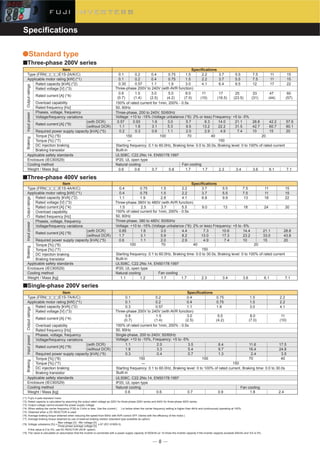
Specifications
Type (FRN E1S-2A/K/C)
Applicable motor rating [kW] (*1)
0.1
0.1
0.30
0.8
0.6
1.1 1.2 1.7 1.7 2.3 3.4 3.6 6.1 7.1
0.6 0.7 0.8 1.7 1.7 2.3 3.4 3.6 6.1 7.1
0.2
0.2
0.57
1.5
0.4
0.4
1.1
3.0
1.5
1.5
3.0
8.0
0.75
0.75
1.9
5.0
2.2
2.2
4.1
11
3.7
3.7
6.4
17
5.5
5.5
9.5
25
7.5
7.5
12
33
15
15
22
60
11
11
17
47
Applicable safety standards
Enclosure (IEC60529)
Cooling method
Weight / Mass [kg]
Rated capacity [kVA] (*2)
Rated voltage [V] (*3)
Rated current [A] (*4)
Overload capability
Rated frequency [Hz]
Phases, voltage, frequency
Voltage/frequency variations
Rated current [A] (*9)
(with DCR)
(without DCR)
Required power supply capacity [kVA] (*5)
Torque [%] (*6)
Torque [%] (*7)
DC injection braking
Braking transistor
Item Specifications
Type (FRN E1S-4A/K/C)
Applicable motor rating [kW] (*1)
0.4
0.4
1.1
0.75
0.75
1.9
1.5
1.5
2.8
2.2
2.2
4.1
3.7
3.7
6.8
5.5
5.5
9.9
7.5
7.5
13
11
11
18
15
15
22
0.85
1.7
0.6
1.6
3.1
1.1
3.0
5.9
2.0
4.4
8.2
2.9
7.3
13.0
4.9
10.6
17.3
7.4
14.4
23.2
10
21.1
33.0
15
28.8
43.8
20
1.5 2.5 3.7 5.5 13 18 24 30
204070100
9.0
Applicable safety standards
Enclosure (IEC60529)
Cooling method
Weight / Mass [kg]
Rated capacity [kVA] (*2)
Rated voltage [V] (*3)
Rated current [A] (*4)
Overload capability
Rated frequency [Hz]
Phases, voltage, frequency
Voltage/frequency variations
Rated current [A] (*9)
(with DCR)
(without DCR)
Required power supply capacity [kVA] (*5)
Torque [%] (*6)
Torque [%] (*7)
DC injection braking
Braking transistor
Item Specifications
(1.4)(0.7)
0.57
1.1
0.2
0.93
1.8
0.3
1.6
3.1
0.6
3.0
5.3
1.1
5.7
9.5
2.0
8.3
13.2
2.9
14.0
22.2
4.9
21.1
31.5
7.4
28.8
42.7
10
42.2
60.7
15
57.6
80.1
20
(4.2)
150 100 70 2040
(2.5) (10)(7.0) (23.5)(16.5) (31) (57)(44)
150% of rated current for 1min, 200% - 0.5s
50, 60Hz
Three-phase, 200 to 240V, 50/60Hz
Voltage: +10 to -15% (Voltage unbalance (*8): 2% or less) Frequency: +5 to -5%
Three-phase, 380 to 480V, 50/60Hz
Voltage: +10 to -15% (Voltage unbalance (*8): 2% or less) Frequency: +5 to -5%
Built-in
UL508C, C22.2No.14, EN50178:1997
IP20, UL open type
Natural cooling Fan cooling
Starting frequency: 0.1 to 60.0Hz, Braking time: 0.0 to 30.0s, Braking level: 0 to 100% of rated current
150-
UL508C, C22.2No.14, EN50178:1997
IP20, UL open type
Natural cooling Fan cooling
Starting frequency: 0.1 to 60.0Hz, Braking time: 0.0 to 30.0s, Braking level: 0 to 100% of rated current
150
Built-in
■Three-phase 200V series
■Three-phase 400V series
●Standard type
(*1) Fuji's 4-pole standard motor
(*2) Rated capacity is calculated by assuming the output rated voltage as 220V for three-phase 200V series and 440V for three-phase 400V series.
(*3) Output voltage cannot exceed the power supply voltage.
(*4) When setting the carrier frequency (F26) to 3 kHz or less. Use the current ( ) or below when the carrier frequency setting is higher than 4kHz and continuously operating at 100%.
(*5) Obtained when a DC REACTOR is used.
(*6) Average braking torque obtained when reducing the speed from 60Hz with AVR control OFF (Varies with the efficiency of the motor.)
(*7) Average braking torque obtained by use of external braking resistor (standard type available as option)
(*8) Voltage unbalance [%] =
Max voltage [V] - Min voltage [V]
x 67 (IEC 61800-3)
Three-phase average voltage [V]
If this value is 2 to 3%, use AC REACTOR (ACR: option).
(*9) The value is calculated on assumption that the inverter is connected with a power supply capacity of 500kVA (or 10 times the inverter capacity if the inverter capacity exceeds 50kVA) and %X is 5%.
Three-phase 380V to 480V (with AVR function)
150% of rated current for 1min, 200% - 0.5s
50, 60Hz
Three-phase 200V to 240V (with AVR function)
OutputratingsInputpowerBrakingOutputratingsInputpowerBraking
-
Type (FRN E1S-7A/K/C)
Applicable motor rating [kW] (*1)
0.1
0.1
0.3
0.6 0.6 0.7 0.9 1.8 2.4
1.1
1.8
0.3
2.0
3.3
0.4
3.5
5.4
0.7
6.4
9.7
1.3
11.6
16.4
2.4
17.5
24.8
3.5
0.8
(0.7) (1.4) (2.5) (4.2) (7.0) (10)
1.5
150 100
Built-in
Fan cooling
70 40
8.0 113.0 5.0
0.2
0.2
0.57
0.4
0.4
1.1
0.75
0.75
1.9
1.5
1.5
3.0
2.2
2.2
4.1
Applicable safety standards
Enclosure (IEC60529)
Cooling method
Weight / Mass [kg]
Rated capacity [kVA] (*2)
Rated voltage [V] (*3)
Rated current [A] (*4)
Overload capability
Rated frequency [Hz]
Phases, voltage, frequency
Voltage/frequency variations
Rated current [A] (*9)
(with DCR)
(without DCR)
Required power supply capacity [kVA] (*5)
Torque [%] (*6)
Torque [%] (*7)
DC injection braking
Braking transistor
Item Specifications
■Single-phase 200V series
150% of rated current for 1min, 200% - 0.5s
50, 60Hz
Single-phase, 200 to 240V, 50/60Hz
Voltage: +10 to -10%, Frequency: +5 to -5%
UL508C, C22.2No.14, EN50178:1997
IP20, UL open type
Natural cooling
Starting frequency: 0.1 to 60.0Hz, Braking level: 0 to 100% of rated current, Braking time: 0.0 to 30.0s
150
Three-phase 200V to 240V (with AVR function)
OutputratingsInputpowerBraking
Type (FRN E1E-7A/K/C)
Nominal applied motor [kW] (*1)
0.1
0.1
0.3
0.7 0.7 0.8 1.3 2.5 3.0
1.1
1.8
0.3
2.0
3.3
0.4
3.5
5.4
0.7
6.4
9.7
1.3
11.6
16.4
2.4
17.5
24.8
3.5
0.8
(0.7) (1.4) (2.5) (4.2) (7.0) (10)
1.5
150 100
Built-in
Fan cooling
70 40
8.0 113.0 5.0
0.2
0.2
0.57
0.4
0.4
1.1
0.75
0.75
1.9
1.5
1.5
3.0
2.2
2.2
4.1
Applicable safety standards
Enclosure
Cooling method
EMC standard Emission
compliance Immunity
Weight / Mass [kg]
Rated capacity [kVA] (*2)
Rated voltage [V] (*3)
Rated current [A] (*4)
Overload capability
Rated frequency [Hz]
Phases, voltage, frequency
Voltage/frequency variations
Rated current [A] (*8)
(with DCR)
(without DCR)
Required power supply capacity [kVA] (*5)
Torque [%] (*6)
DC injection braking
Braking transistor
Item Specifications
■Single-phase 200V series(0.1 to 2.2kW)
150% of rated current for 1min or 200% of rated current for 0.5s
50, 60Hz
Single-phase, 200 to 240V, 50/60Hz
Voltage: +10 to -10%, Frequency: +5 to -5%
UL508C, C22.2No.14 (pending),EN50178:1997
IP20 (IEC60529)/UL open type (UL50)
Natural cooling
Class 1A (EN55011:1998/A1:1999)
2nd Env. (EN61800-3:1996/A11:2000)
Starting frequency: 0.0 to 60.0Hz, Braking time: 0.0 to 30.0s, Braking level: 0 to 100%
Three-phase 200 to 240V (with AVR)
OutputratingsInputratingsBraking
Type (FRN E1E-2A/K/C)
Nominal applied motor [kW] (*1)
0.1
0.1
0.30
0.8
0.7
1.5 1.6 2.5 2.5 3.0 TBD TBD TBD TBD
0.7 0.8 0.9 2.4 2.4 2.9 TBD TBD TBD TBD
0.2
0.2
0.57
1.5
0.4
0.4
1.1
3.0
1.5
1.5
3.0
8.0
0.75
0.75
1.9
5.0
2.2
2.2
4.1
11
3.7
3.7
6.4
17
5.5
5.5
9.5
25
7.5
7.5
12
33
15
15
22
60
11
11
17
47
Applicable safety standards
Enclosure
Cooling method
EMC standard Emission
compliance Immunity
Weight / Mass [kg]
Rated capacity [kVA] (*2)
Rated voltage [V] (*3)
Rated current [A] (*4)
Overload capability
Rated frequency [Hz]
Phases, voltage, frequency
Voltage/frequency variations
Rated current [A] (*8)
(with DCR)
(without DCR)
Required power supply capacity [kVA] (*5)
Torque [%] (*6)
DC injection braking
Braking transistor
Item Specifications
Type (FRN E1E-4A/K/C)
Nominal applied motor [kW] (*1)
0.4
0.4
1.1
0.75
0.75
1.9
1.5
1.5
2.8
2.2
2.2
4.1
3.7
3.7
6.8
5.5
5.5
9.9
7.5
7.5
13
11
11
18
15
15
22
0.85
1.7
0.6
1.6
3.1
1.1
3.0
5.9
2.0
4.4
8.2
2.9
7.3
13.0
4.9
10.6
17.3
7.4
14.4
23.2
10
21.1
33.0
15
28.8
43.8
20
1.5 2.5 3.7 5.5 13 18 24 30
204070100
9.0
Applicable safety standards
Enclosure
Cooling method
EMC standard Emission
compliance Immunity
Weight / Mass [kg]
Rated capacity [kVA] (*2)
Rated voltage [V] (*3)
Rated current [A] (*4)
Overload capability
Rated frequency [Hz]
Phases, voltage, frequency
Voltage/frequency variations
Rated current [A] (*8)
(with DCR)
(without DCR)
Required power supply capacity [kVA] (*5)
Torque [%] (*6)
DC injection braking
Braking transistor
Item Specifications
(1.4)(0.7)
0.57
1.1
0.2
0.93
1.80
0.30
1.6
3.1
0.6
3.0
5.3
1.1
5.7
9.5
2.0
8.3
13.2
2.9
14.0
22.2
4.9
21.1
31.5
7.4
28.8
42.7
10
42.2
60.7
15
57.6
80.1
20
(4.2)
150 100 70 2040
(2.5) (10)(7.0) (23.5)(16.5) (31) (57)(44)
150% of rated current for 1min or 200% of rated current for 0.5s
50, 60Hz
Three-phase, 200 to 240V, 50/60Hz
Voltage: +10 to -15% (Voltage unbalance : 2% or less (*7)) Frequency: +5 to -5%
Three-phase, 380 to 480V, 50/60Hz
Voltage:+10 to -15% (Voltage unbalance: 2% or less (*7)), Frequency: +5 to -5%
Built-in
UL508C, C22.2No.14(pending), EN50178:1997
IP20(IEC60529)/UL open type(UL50)
Natural cooling
Class 1A (EN55011:1998/A1:1999)
2nd Env. (EN61800-3:1996/A11:2000)
Fan cooling
2nd Env. (EN61800-3:1996+A11:2000)
Starting frequency: 0.0 to 60.0Hz, Braking time: 0.0 to 30.0s, Braking level: 0 to 100%
UL508C, C22.2No.14 (pending), EN50178:1997
IP20 (IEC60529)/UL open type (UL50)
Natural cooling
Class 1A (EN55011:1998/A1:1999)
2nd Env. (EN61800-3:1996/A11:2000)
Fan cooling
2nd Env. (EN61800-3:1996+A11:2000)
Starting frequency: 0.0 to 60.0Hz, Braking time: 0.0 to 30.0s, Braking level: 0 to 100%
Built-in
EMC filter built-in type
■Three-phase 200V series(0.1 to 15kW)
■Three-phase 400V series (0.4 to 15kW)
●Semi-standard type
*1) Fuji's 4-pole standard motor
*2) Rated capacity is calculated by regarding the output rated voltage as 220V for three-phase 200V series.
*3) Output voltage cannot exceed the power supply voltage.
*4) The load shall be reduced so that the continuous operating current is the rated current in parenthesis or less if the carrier frequency is set to 4kHz or above.
*5) Obtained when a DC REACTOR is used.
*6) Average braking torque when a motor of no load decelerates.(Varies with the efficiency of the motor.)
*7) Voltage unbalance [%] =
Max. voltage [V] - Min. voltage [V]
x 67 (IEC61800-3(5.2.3))
Three-phase average voltage [V]
If this value is 2 to 3%, use an AC REACTOR.
*8) The currents are calculated on the condition that the inverters are connected to power supply of 500kVA, %X=5%.
Three-phase 380 to 480V (with AVR)
150% of rated current for 1min or 200% of rated current for 0.5s
50, 60Hz
Three-phase 200 to 240V (with AVR)
OutputratingsInputratingsBrakingOutputratingsInputratingsBraking
Specifications
Specifications
●Common specifications
Maximum frequency
Base frequency
Starting frequency
Carrier frequency
Item Explanation Related
function codeRemarks
25 to 400Hz variable setting
0.1 to 60.0Hz variable setting, Duration: 0.0 to 10.0s
• Analog setting: ±0.2% of maximum frequency (at 25±10˚C)
• Keypad setting: ±0.01% of maximum frequency (at -10 to +50˚C)
• V/f control • Dynamic torque-vector control (magnetic flux estimator) • V/f control (with sensor, when the PG interface card (option) is installed)
2 points (Desired voltage and frequency can be set.)
Torque boost can be set with the function code F09. Set when 0, 1, 3, or 4 is selected at F37.
200% or over (Auto torque boost in 0.5Hz operation, slip compensation and auto torque boost)
Select application load type with the function code F37.
0: Squared variable torque load
1: Constant torque load
2: Auto torque boost
3: Auto energy-save operation (variable torque load in deceleration)
4: Auto energy-save operation (constant torque load)
5: Auto energy-save operation (auto torque boost)
0.75 to 15kHz variable setting Frequency may drop automatically to protect the
inverter depending on environmental
temperature and output current.This protective
operation can be canceled by function code H98.
Setting with and keys
• Analog setting: 1/3000 of maximum frequency (ex. 0.02Hz at 60Hz, 0.4Hz at 120Hz)
• Keypad setting: 0.01Hz (99.99Hz or less), 0.1Hz (100.0Hz or more)
• Link setting: Selectable from 2 types
• 1/2000 of maximum frequency (ex. 0.003Hz at 60Hz, 0.006Hz at 120Hz)
• 0.01Hz (fixed)
Possible to set output voltage at base frequency and at maximum output frequency (common spec).
AVR control can be turned ON or OFF (Factory setting: OFF).
Three-phase 200V, single-phase 200V: 80 to 240V
Three-phase 400V: 160 to 500V
Three-phase and single-phase 200V: 0 to 240V/0 to 400Hz
Three-phase 400V: 0 to 500V/0 to 400Hz
Keypad
operation
Key operation: Can be set with and keys
Start and stop with and keys
Start and stop with / and keys
External signals (7digital inputs): FWD (REV), RUN, STOP commands (3 wire operation possible),
coast-to-stop, external alarm, alarm reset, etc.
Linked operation: Operation through RS-485 or field buss (option) communications
Switching operation command: Link switching, switching between communication and inverter (keypad or external signals)
Keypad (standard)
Multi-function keypad
With data protection
Connected to analog input terminals 13, 12,
and 11. Potentiometer must be provided.
Multistep frequency: Selectable from 16 steps (step 0 to 15)
UP/DOWN operation: Frequency can be increased or decreased while the digital input signal is ON.
Linked operation: Frequency can be set through RS485 or field buss (optional) communications.
Switching frequency setting: Frequency setting can be switched (2 settings) with external signal (digital input).
Switching to frequency setting via communication and multi-frequency setting are available.
Auxiliary frequency setting: Terminal 12 input and terminal C1 input (terminal V2 input) can be added
to main setting as auxiliary frequency.
Inverse operation: Normal/inverse operation can be set or switched with digital input signal and
function code setting.
• +10 to 0V DC /0 to 100% (terminal 12, C1 (V2))
• +20 to +4mA DC/0 to 100% (terminal C1)
0.00 to 3600s
*If 0.00s is set, the time setting is cancelled and acceleration and deceleration is made
according to the pattern given with an external signal.
Acceleration and deceleration time can be independently set with 2 types and selected with digital input signal (1 point).
Acceleration and deceleration pattern can be selected from 4 types:
Linear, S-curve (weak), S-curve (strong), Non-linear
Deceleration with coasting can be stopped with operation stop command.
Pulse train input: 30kHz (max.)/ Maximum output frequency When the PG interface card (optional) is installed.
If the set frequency is lower than lower limit, continuous
motor running or stop running motor can be selected.
External volume: Can be set with external potentiometer (1 to 5kΩ1/2W)
Analog input Analog input can be set with external voltage/current input
• 0 to ±10V DC (0 to ±5V DC)/0 to ±100% (terminal 12, C1 (V2))
• +4 to +20mA DC/0 to 100% (terminal C1)
Accuracy (Stability)
Setting resolution
Control method
Voltage/freq. characteristic
Torque boost
Starting torque
Start/stop
Frequency setting
Acceleration/deceleration time
Frequency limiter
(Upper limit and lower limit frequencies)
Bias
Gain
Jump frequency
(Non-linear V/f setting)
(Load selection)
(Curve)
High and Low limiters can be set. (Setting range: 0 to 400Hz)
Bias of set frequency and PID command can be independently set (setting range: 0 to ±100%).
Analog input gain can be set between 0 and 200%.
Three operation points and their common jump width (0 to 30.0Hz) can be set.
Timer operation The inverter operates and stops for the time set with the keypad (1-cycle operation).
Jogging operation
Auto-restart after momentary
power failure
Current limit
Slip compensation
• Can be operated using digital input signal or keypad.
• Acceleration and deceleration time (same duration used only for jogging) can be set.
• Jogging frequency: 0.00 to 400.0Hz
• Restarts the inverter without stopping the motor after instantaneous power failure.
• Select "Continuous motor mode" to wait for the power recovering with low output frequency.
• Restart at 0Hz, restart from the frequency used before momentary power failure, restart at the set frequency can be selected.
• Motor speed at restart can be searched and restarted.
Voltage signal from terminal 12, C1 (V2) and current
signal (from terminal C1) can be set independently.
F03
F04
F23,F24
F03 to F06
H50 to H53
F09, F37
F09, F37
H68, F37
F02
F02
E01 to E05
E98, E99
H30, y98
F01, C30
F18, C50,
C32 to C34,
C37 to C39,
C42 to C44
C05 to C19
F01, C30
H30, y98
F01, C30
E61 to E63
C53
F07, F08
E10,E11
H07
H11
F15, F16
H63
F18, C50 to C52
C32, C34, C37
C39, C42, C44
C01 to C04
C21
H54
C20
F14
H13 to H16
H92, H93
F26
F27
H98
Keeps the current under the preset value during operation.
Torque limit • Controls the output torque lower than the set limit value.
• Can be switched to the second torque limit with digital input signal.
• Soft start (filter function) is available when switching the torque control to 1/2.
F43, F44
F40, F41
E16, E17
H76
H68
P09 to P12
H28
• Compensates for decrease in speed according to the load, enabling stable operation.
• Time constant can be changed. Possible to enable or disable slip compensation during
acceleration/deceleration or in constant output range.
Droop control H28Decrease the speed according to the load torque.
Settingrange
OutputfrequencyControl
• 0 to +5V DC can be used depending on the
analog input gain (200%). +1 to +5V DC can
be adjusted with bias and analog input gain.
• Voltage can be input (terminal V2) to the
terminal 1.
Displays the cause of trip by codes.
• (Overcurrent during acceleration) • (Overcurrent during deceleration) • (Overcurrent at constant speed)
• (Input phase loss) • (Undervoltage) • (Output phase loss)
• (Overvoltage during acceleration) • (Overvoltage during deceleration) • (Overvoltage at constant speed)
• (Overheating of the heat sink) • (External alarm) • (Inverter overheat)
• (Motor protection (PTC thermistor)) • (Motor 1 overload) • (Motor 2 overload)
• (Inverter overload) • (Overheating of braking resistor) • (PG disconnection)
• (Memory error) • (Keypad communication error) • (CPU error)
• (Optional communication error) • (Option error) • (Operation error)
• (Tuning error) • (RS-485 communication error) • (Data save error due to undervoltage)
• (RS485 communication error (option))• (Power LSI error) • (Simulation error)
Altitude [m]
Lower than 1,000
1,001 to 2,000
2,001 to 3,000
Output decrease
None
Decreases
Decreases*
■ Feedback value
• Analog input from terminal 12, C1 (V2) : 0 to ±10V DC/0 to ±100%
• Analog input (terminal C1) : 4 to 20mA DC/0 to 100%
■ Accessory functions
• Alarm output (absolute value alarm, deviation alarm) • Normal operation/inverse operation
• PID output limiter • Anti-reset wind-up function • Integration reset/hold
Operation begins at a preset pick-up frequency to search for the motor speed to start an idling motor without stopping it.
The output voltage is controlled to minimize the total sum of the motor loss and inverter loss at a constant speed.
The motor parameters are automatically tuned.
Detects inverter internal temperature and stops cooling fan when the temperature is low.
The motor loss increases during deceleration to reduce the load energy regenerating at the inverter
to avoid an trip upon mode selection.
When the torque calculation value exceeds the limit level set for the inverter during deceleration, the output
frequency is automatically controlled and the deceleration time automatically extends to avoid an trip.
Trip may occur due to load conditions.
An external output is issued in a transistor output signal.
Waiting time before resetting and the number
of retry times can be set.
-10 to 40˚C when inverters are installed side by side without clearance.
* If the altitude exceeds 2,000m, insulate
the interface circuit from the main power
supply to conform to the Low Voltage
Directives.
Mode that the motor rotates and mode that the motor does not rotate can be selected.
PID control
Pick-up
Automatic deceleration
Deceleration characteristic
Automatic energy-saving operation
Overload Prevention Control
Auto-tuning
Cooling fan ON/OFF control
Secondary motor setting
Universal DI
Universal AO
Speed control
Positioning control
Rotation direction control
Running/stopping
Life early warning
Cumulative run hours
I/O check
Power monitor
Trip mode
Running or trip mode
Overcurrent protection
Short circuit protection
Grounding fault protection
Overvoltage protection
Undervoltage
Input phase loss
Output phase loss
Overheating
Overload
Stall prevention
Momentary power failure
protection
Retry function
Command loss detection
Installation location
Ambient temperature
Ambient humidity
Altitude
Vibration
Electronic thermal
PTC thermistor
Overload early warning
Ambient temp.
Ambient humidity
The output frequency is automatically reduced to suppress the overload protection trip o inverter
caused by an increase in the ambient temperature, operation frequency, motor load or the like.
• One inverter can be used to control two motors by switching (switching is not available while a motor is running). Base
frequency, rated current, torque boost, electronic thermal, slip compensation can be set as data for the secondary motor.
• The second motor constants can be set in the inverter. (Auto-tuning possible)
The presence of digital signal in a device externally connected to the set terminal can be sent to the master controller.
The output from the master controller can be output from the terminal FM.
The motor speed can be detected with the pulse encoder and speed can be controlled.
Only one program can be executed by setting the number of pulses to the stop position and deceleration point.
Select either of reverse prevention or forward rotation prevention.
The life early warning of the main circuit capacitors, capacitors on the PC boards and the cooling fan can be displayed.
The cumulative motor running hours, cumulative inverter running hours and cumulative watt-hours can be displayed.
Displays the input signal status of the inverter.
Displays input power (momentary), accumulated power, electricity cost (accumulated power x displayed coefficient).
Trip history: Saves and displays the last 4 trip codes and their detailed description.
The inverter is stopped upon an overcurrent caused by an overload.
The inverter is stopped upon an overcurrent caused by a short circuit in the output circuit.
The inverter is stopped upon an overcurrent caused by a grounding fault in the output circuit.
An excessive DC link circuit voltage is detected to stop the inverter.
Stops the inverter by detecting voltage drop in DC link circuit.
Stops or protects the inverter against input phase loss.
Detects breaks in inverter output wiring at the start of running and during running, stopping the inverter output.
The inverter is stopped upon the temperature of the heat sink of the inverter or the temperature of the
switching element calculated from the output current.
The temperature of the heat sink of the inverter or that inside the inverter unit is detected to stop the inverter, upon a failure or overload of the cooling fan.
The inverter is stopped upon an electronic thermal function setting to protect the motor.
A PTC thermistor input stops the inverter to protect the motor.
Warning signal can be output based on the set level before the inverter trips.
The output frequency decreases upon an output current exceeding the limit during acceleration or constant speed operation, to avoid overcurrent trip.
• A protective function (inverter stoppage) is activated upon a momentary power failure for 15msec or longer.
• If restart upon momentary power failure is selected, the inverter restarts upon recovery of the voltage within the set time.
A loss (broken wire, etc.) of the frequency command is detected to output an alarm and continue
operation at the preset frequency (set at a ratio to the frequency before detection).
Shall be free from corrosive gases, flammable gases, oil mist, dusts, and direct sunlight.
(Pollution degree 2 (IEC60664-1)). Indoor use only.
-10 to +50˚C
5 to 95% RH (without condensation)
When the motor is tripped and stopped, this function automatically resets the tripping state and
restarts operation.
• Speed monitor, output current [A], output voltage [V], torque calculation value, input power [kW],
PID reference value, PID feedback value, PID output, load factor, motor output, period for timer operation [s]
◆Select the speed monitor to be displayed from the following:
Output frequency [Hz], Output frequency 1 [Hz] (before slip compensation),
Output frequency 2 (after slip compensation) [Hz],
Motor speed (set value) [r/min],
Motor speed [r/min], Load shaft speed (set value) [r/min],
Load shaft speed (r/min),
Line speed (set value), Line speed (r/min)
3mm (vibration width): 2 to less than 9Hz, 9.8m/s2
: 9 to less than 20Hz, 2m/s2
: 20 to less than 55Hz, 1m/s2
: 55 to less than 200Hz
-25 to +65˚C
5 to 95%RH (without condensation)
3-phase 200V / 400V DC, Single-phase 200V/400V DC
3-phase 400V / 800V D
3-phase 200V / 200V DC, Single-phase 200V/400V DC
3-phase 400V / 400V DC
The protective function can be canceled with function code 99.
Thermal time constant can be adjusted (0.5 to 75.0min.)
E61 to E63
J01 to J06
J10 to J19
H09, H13, H17
H69, F08
H71
F37, F09
H70
P04
E43
E48
E52
F14
H98
H98
H43
F10 to F12, P99
H26, H27
H12
H13 to H16
F14
H04, H05
E65
F10, F12, E34,
E35, P99
■ Process command
• Key operation ( and keys) : 0 to 100%
• Analog input (terminal 12, C1 (V2)) : 0 to ±10V DC/0 to ±100%
• Analog input (terminal C1) : 4 to 20mA DC/0 to 100%
• UP/DOWN (digital input) : 0 to 100%
• Communication (RS-485, bus option) : 0 to 20000/0 to 100%
Control with PID regulator or dancer controller.
H06
When the PG interface card (optional) Is installed.
Item Explanation Related
function codeRemarks
IndicationControlProtection
MotorprotectionStorage
Environment
Specifications
External Dimensions
●Inverter main body (standard type)
4-5x6(C)
(elongated hole)
Name plate
6
5
5110(H1)5
120(H)
67(W1)6.5 6.5
80(W) D
D1 D2
Name plate
97(W1)6.5
7
6.5
110(W) D
D1 D2
4-5x7(C)
(elongated hole)
5
6118(H1)6
130(H)
Name plate
97(W1)6.5
7
6.5
110(W) D
D1 D2
4-5x6(C)
(elongated hole)
5
6118(H1)6
130(H)
2-φ5(C)
Name plate
128(W1)6 6
140(W)
168(H1)66
180(H)
5 5
64(D2)87(D1)
151(D)
2-φ6(C)
Name plate
164(W1)8 8
180(W)
205(H1)87
220(H)
2-R3
6
1648 8
6
77(D2)81(D1)
5
158(D)
2-φ10(C)
2-R5
Name plate
11238(H1)11
260(H)
196(W1)12 12
220(W)
96.5(D2)98.5(D1)
11.2
195(D)
10
19612 12
10
Fig. a Fig.b
Fig. c Fig. d
Fig. e Fig. f
●Keypad
(51.44)
79.2
(79.2)68.8
68.8
5.25.2
(5.2)
16.6 10
(4.25)17.1
4.1 17 45
15.08(51.05)
(22.46)15.24
4.7
(4.7)
4.7
(2.7)
32.4
32.4
36.5
2
41.8
(41.8)
13.5
* Dimensions when installing the supplied rear cover
Note: For the inverter type FRN0.1E1S-2 ■, the symbol ■ is replaced with either of the following alphabets.
■ A(Asia), K(Koria, Taiwan), C(China)
Panel cutout dimensional drawing (arrow direction A)
A
2xM3
Panel
cutout
FRN0.1E1S-2■
FRN0.2E1S-2■
FRN0.4E1S-2■
FRN0.75E1S-2■
FRN1.5E1S-2■
FRN2.2E1S-2■
FRN3.7E1S-2■
FRN5.5E1S-2■
FRN7.5E1S-2■
FRN11E1S-2■
FRN15E1S-2■
FRN0.4E1S-4■
FRN0.75E1S-4■
FRN1.5E1S-4■
FRN2.2E1S-4■
FRN3.7E1S-4■
FRN5.5E1S-4■
FRN7.5E1S-4■
FRN11E1S-4■
FRN15E1S-4■
FRN0.1E1S-7■
FRN0.2E1S-7■
FRN0.4E1S-7■
FRN0.75E1S-7■
FRN1.5E1S-7■
FRN2.2E1S-7■
a
b
d
e
f
c
b
d
e
f
a
b
d
80
110
140
180
220
110
110
140
180
220
80
110
140
67
97
128
164
196
97
97
128
164
196
67
97
128
120
130
180
220
260
130
130
180
220
260
120
130
180
110
118
168
205
238
118
118
168
205
238
110
118
168
92
107
132
150
151
158
195
126
150
150
151
158
195
92
107
152
150
151
82
86
87
81
98.5
86
86
87
81
98.5
102
86
87
10
25
50
64
64
77
96.5
40
64
64
64
77
96.5
10
25
50
64
64
5x6(elongated hole)
5x7(elongated hole)
φ5
φ6
φ10
5x6(elongated hole)
5x7(elongated hole)
φ5
φ6
φ10
5x6(elongated hole)
5x7(elongated hole)
φ5
Three-phase
200V
Three-phase
400V
Single-phase
200V
Power supply
voltage
Inverter type Fig.
W W1 H H1 D D1 D2 C
Dimension (mm)
External
Dimensions
External Dimensions
●Inverter main body (EMC filter built-in type)
9
10302.5
250 (D)
55
8.3
27.5
Detailed drawing A
332(H)
302.510
220 (W)
180
A
2x8.3
8.3
14
Fig. g Fig. h
Fig. i Fig. j
Fig. k Fig. l
67
4-5x6
(elongated hole)
6.5 6.5
80(W)
60 D310
D
D1 D2
120(H)
170(H1)
11055
976.5 6.5
110(W) D
D1 D2
130(H)
180(H1)
11866
89 D310.5
4-5x7
(elongated hole)
92
5
85.5(D3)2710.5
140(W)
168
180(H)
245(H1)
190
1286
6
6
6
2- 5
194(D)
130(D1) 64(D2)
357(H)
12.5
325
325
12.5
220(W) 260(D)
65
8.4
32.5
180
A
9
Detailed drawing A
2x8.4
8.4
14
256.5
256.5
285(H)
7
7
181.5(W) D
55
27.5
150
8.5
Detailed drawing A
A
6.52x6.5
6.5
12
FRN0.1E1E-2■
FRN0.2E1E-2■
FRN0.4E1E-2■
FRN0.75E1E-2■
FRN1.5E1E-2■
FRN2.2E1E-2■
FRN3.7E1E-2■
FRN5.5E1E-2■
FRN7.5E1E-2■
FRN11E1E-2■
FRN15E1E-2■
FRN0.4E1E-4■
FRN0.75E1E-4■
FRN1.5E1E-4■
FRN2.2E1E-4■
FRN3.7E1E-4■
FRN5.5E1E-4■
FRN7.5E1E-4■
FRN11E1E-4■
FRN15E1E-4■
FRN0.1E1E-7■
FRN0.2E1E-7■
FRN0.4E1E-7■
FRN0.75E1E-7■
FRN1.5E1E-7■
FRN2.2E1E-7■
Note: For the inverter type FRN0.1E1S-2 ■ the symbol ■ is replaced with either of the following alphabets.
■ A(Asia), K(Koria, Taiwan), C(China)
g
i
j
k
h
i
j
l
g
h
i
Three-phase 200V
Three-phase 400V
Single-phase 200V
Power supplyvoltage Inverter type Fig.
80
140
181.5
220
110
140
181.5
220
80
110
140
W
120
180
285
357
130
180
285
332
120
130
180
H H1
170
245
180
245
170
180
245
112
127
152
194
213
260
169
193
194
208
250
112
127
150
194
D
102
130
129
130
102
110
130
D1
10
25
50
64
40
64
64
10
25
40
64
D2
21.2
36.2
61.2
85.5
61.5
85.5
85.5
21.2
36.2
55.2
85.5
D3
Dimension (mm)
-
-
-
-
-
-
-
-
-
-
-
-
-
-
-
-
External
Dimensions
Operation mode display
During keypad operation:
When function code is, ,
or (keypad operation), the green KEYPAD
CONTROL LED lights up.
Keypad Operations
■Keypad switches and functions
■Monitor display and key operation
Monitor, keys
Programming mode Running mode
STOP
MonitorKeys
RUN STOP RUN
Alarm mode
Operation mode
Function
Function
FunctionKEYPAD
CONTROL
RUN
Lit in keypad operation mode
Operation selection (keypad operation/terminal operation) is displayed.
Display
Display
Display
Function
Display
Displays the function code and data. Displays the output frequency, set frequency, loaded motor
speed, power consumption, output current, and output voltage.
Displays the alarm description
and alarm history.
Function
Function
Function
Function
Function
Switches to running mode Switches to programming mode
Digit shift (cursor movement) in data setting
Releases the trip and
switches to stop mode
or running mode.
Invalid
Starts running (switches
to running mode (RUN)).
Invalid Invalid
Invalid
Deceleration stop (switches to
programming mode (STOP)).
Invalid
Deceleration stop (switches
to running mode (STOP)).
Invalid
Increases/decreases the function code
and data.
Increases/decreases the frequency, motor speed
and other settings.
Displays the alarm
history.
Determines the function code, stores and
updates data.
Switches the LED monitor display. Displays the operation
information.
Lighting Blinking Lighting Blinking/Lighting
OFF
Indicates that the program mode is selected. Displays the units of frequency, output current,
power consumption, and rotation speed.
None
Indicatesabsenceofoperationcommands. Indicates absence of operation commands. Indicates presence of operation commands.Indicatespresenceofoperationcommands. Indicates that the operation is trip-stopped.
RUN unlit RUN unlit RUN litRUN lit
If an alarm occurs during
operation, the lamp is unlit during
keypad operation and lit during
terminal block operation.
LED monitor
When the motor is running or stopped:
The monitor displays speeds, such as output frequency, set
frequency, motor speed and load shaft speed, output voltage,
output current, and power consumption.
Alarm mode:
The monitor shows the alarm description with a fault code.
Program/Reset key
Used to change the mode.
Programming mode:
Used to shift the digit (cursor movement)
to set data.
Alarm mode:
Resets trip prevention mode.
Function/Data select key
Used to change the LED monitor and to store the
function code and data.
Up/Down keys
During operation: Used to increase or decrease the
frequency or motor speed.
In data setting: Used to indicate the function code number
or to change data set value.
Run key
While the motor is stopped:
Used to start the operation.
This key is invalid if the function code
(operation by external signals) is
set to .
During operation:
The green RUN LED lights up.
Unit display
The unit of the data displayed at the LED monitor is indicated.
Use the key to switch the displayed data.
ON
Frequency
display
ON
Current
display
blinks
or lit
Capacity
or
Current
indication
ON
Speed
displayPRG.MODE
Hz
r/min
m/min
A
kW PRG.MODE ON
Hz
r/min
m/min
A
kW
PRG.MODE
PRG.MODE
Hz
r/min
m/min
A
kW
Hz
r/min
m/min
A
kW
PRG.MODE
PRG.MODE
Hz
r/min
m/min
A
kW
Hz
r/min
m/min
A
kW
Stop key
Used to stop the operation.
During operation:
This key is invalid if the function code (operation by
external signals) is set to .
The inverter stops when the function code is set to
or .
The keypad modes are classified into the following 3 modes.
This keypad supports the full menu mode that allows you to set or display the following information. Indication and setting change of changed function code,
drive monitor, I/O check, maintenance information, and alarm information. For the actual operation methods, refer to the FRENIC-Multi Instruction Manual
or User's Manual.
Main circuit
Basic Wiring Diagram
●Wiring diagram
M
MCCB
or
ELCB
(Note 2)
(Note 3)
Power
Three-phase/
single-phase
200 to 240V,
50/60Hz
or three-phase
390 to 480V,
50/60Hz
MC
MCCB
or
ELCB
(Note 2)
(Note 3)
Power
Three-phase/
single-phase
200 to 240V,
50/60Hz
or three-phase
390 to 480V,
50/60Hz
MC
DCR
P1
DBR
(Note 4)
Motor
L1/R
P1
U
V
W
Grounding terminal
MCCB: Molded-case circuit breaker
ELCB: Earth-leakage circuit breaker
MC: Magnetic contactor
DCR: DC reactor
DBR: Braking resistor
C1
C1
SW8
SW8
FMA
FMA
FMP
FMP
SW6
SW6
SW1
SW1
V2
V2
SW7
SW7
PTC
SW3
SW3
30A
30B
30C
30
SINK
SOURCE
RS485 port
(option)
(Note 1)
P DB
(CM)
(THR)
P(+)
P(+)
N(-)DB
[12]
[13]
[11]
[11]
[FM]
[C1]
<Y1>
<Y2>
<CMY>
(FWD)
(REV)
(CM)
(X1)
(X2)
(X3)
(X4)
(X5)
(CM)
(PLC)
Alarm output
(for any fault)
Transistor input
L2/S
L3/T
GGGrounding terminal
Control circuit
Main circuit
M
DCR
P1
DBR
(Note 4)
Motor
L1/R
P1
U
V
W
Grounding terminal
MCCB: Molded-case circuit breaker
ELCB: Earth-leakage circuit breaker
MC: Magnetic contactor
DCR: DC reactor
DBR: Braking resistor
PTC
Meter
Analog
input
Digital input
30A
30B
30C
30
SINK
SOURCE
RS485 port
(option)
(Note 1)
P DB
(CM)
(THR)
P(+)
P(+)
N(-)DB
[12]
[13]
[11]
[11]
[FM]
[C1]
<Y1>
<Y2>
<CMY>
(FWD)
(REV)
(CM)
(X1)
(X2)
(X3)
(X4)
(X5)
(CM)
(PLC)
Alarm output
(for any fault)
Transistor input
L2/S
L3/T
GGGrounding terminal
Potentiometer power supply
Voltage input for setting
DC0 to ±10V
Current/voltage input
for setting
DC +4 to 20 mA/DC0 to 10V
(Note 5)
1
2
3
(Note 6)
(+)
(-)
■Keypad operation
■Run/Stop operation and frequency setting on the keypad
[Wiring procedure]
(1) Wire the inverter main power circuit.
[Operation method]
(1) Run/Stop: Press or key.
(2) Setting frequency: Set the frequency with and keys.
Note1: When connecting a DC REACTOR (DCR option), remove the
jumper bar from across the terminals [P1] and [P (+)].
Note2: Install a recommended molded-case circuit breaker (MCCB) or an
earth-leakage circuit-breaker (ELCB) (with an overcurrent
protection function) in the primary circuit of the inverter to protect
wiring. At this time, ensure that the circuit breaker capacity is
equivalent to or lower than the recommended capacity.
Note3: Install a magnetic contactor (MC) for each inverter to separate the
inverter from the power supply, apart from the MCCB or ELCB,
when necessary.
Connect a surge killer in parallel when installing a coil such as the
MC or solenoid near the inverter.
Note4: (THR) function can be used by assigning code "9" (external alarm)
to any of the terminals X1 to X5, FWD or REV (function code; E01
to E05, E98, or E99).
■Operation by external signal inputs
■Run/Stop operation and frequency setting through external signals
[Wiring procedure]
(1) Wire both the inverter main power circuit and control circuit.
(2) Set (external signal) at function code . Next, set (voltage input
(terminal 12) (0 to +10V DC)), (current input (terminal C1) (+4 to
20mA DC)), or other value at function code .
[Operation method]
(1) Run/Stop: Operate the inverter across terminals FDW and CM short-
circuited, and stop with open terminals.
(2) Frequency setting: Voltage input (0 to +10V DC), current input (+4 to
20mA DC)
Note1: When connecting a DC REACTOR (DCR option), remove the
jumper bar from across the terminals [P1] and [P (+)].
Note2: Install a recommended molded-case circuit breaker (MCCB) or an
earth-leakage circuit-breaker (ELCB) (with an overcurrent
protection function) in the primary circuit of the inverter to protect
wiring. At this time, ensure that the circuit breaker capacity is
equivalent to or lower than the recommended capacity.
Note3: Install a magnetic contactor (MC) for each inverter to separate the
inverter from the power supply, apart from the MCCB or ELCB,
when necessary.
Connect a surge killer in parallel when installing a coil such as the
MC or solenoid near the inverter.
Note4: (THR) function can be used by assigning code "9" (external alarm)
to any of the terminals X1 to X5, FWD or REV (function code; E01
to E05, E98, or E99).
Note5: Frequency can be set by connecting a frequency-setting device
(external potentiometer) between the terminals 11, 12 and 13
instead of inputting a voltage signal (0 to +10V DC, 0 to +5V DC
or +1 to +5V DC) between the terminals 12 and 11.
Note 6: For the control signal wires, use shielded or twisted wires.
Ground the shielded wires. To prevent malfunction due to noise,
keep the control circuit wiring away from the main circuit wiring as
far as possible (recommended: 10cm or more). Never install them
in the same wire duct.
When crossing the control circuit wiring with the main circuit wiring,
set them at right angles.
The following diagram is for reference only. For detailed wiring diagrams, refer to the instruction manual.
Control circuit
Keypad
Operations
Basic
WiringDiagram
Two terminals are provided.
Connect the potentiometer with
higher than 1/2W.
Input impedance: 22kΩ
Maximum input: +15V DC
However, the current larger than
±20mA DC is handled as ±20mA
DC.
Input impedance: 250Ω
Maximum input: 30mA DC
However, the voltage higher than
±10V DC is handled as ±0V DC.
Input impedance: 22kΩ
Maximum input:+15V DC
However, the voltage higher than
±10V DC is handled as ±10V DC.
Two terminals are provided. Isolated
from terminals CM and CMY.
ON state
Source current: 2.5 to 5mA
Voltage level: 2V
Allowable leakage current: Smaller
than 0.5mA
Voltage: 22 to 27V
This function can be set only for the
terminals FWD and REV.
No alarm signal will be output.
Alarm reset signal width: 0.1(s) or more
Alarm signal will be output.
+24V (22 to 27V) 50mA max.
Isolated from terminals 11 and
CMY. Two terminals are provided.
Terminal Functions
■Terminal Functions
L1/R,L2/S,L3/T
U,V,W
P1,P (+)
P (+),DB
P (+),N (-)
G
13
12
C1
11
X1
X2
X3
X4
X5
FWD
REV
(FWD)
(REV)
(SS1)
(SS2)
(SS4)
(SS8)
(RT1)
(HLD)
(BX)
(RST)
(THR)
(Hz2/Hz1)
(M2/M1)
(DCBRK)
(TL2/TL1)
(UP)
(DOWN)
(WE-KP)
(Hz/PID)
(IVS)
(LE)
(U-DI)
(STM)
(STOP)
(PID-RST)
(PID-HLD)
(JOG)
PLC
CM
Connect a three-phase power supply.
Connect a three-phase motor.
Connect the DC reactor (DCR).
Connect the braking resistor (option).
Used for DC bus connection.
Terminal for inverter chassis (case) and motor grounding
Used for frequency setting device power supply (variable resistance: 1 to 5kΩ)
(10V DC 10mA DC max.)
Used as a frequency setting voltage input.0 to ±10V DC/0 to 100% (0 to ±5V
DC/0 to 100%)
±10 to 0V DC/0 to ±100%
Used for setting signal (PID process command value) or feedback signal.
Used as additional auxiliary setting to various frequency settings.
Used as a frequency setting current input.4 to 20mA DC/0 to 100%
20 to 4mA DC/0 to 100%
Used for setting signal (PID process command value) or feedback signal.
Used as additional auxiliary setting to various frequency settings.
Used as a frequency setting voltage input.0 to +10V DC/0 to 100% (0 to +5V
DC/0 to 100%)
+10 to 0V DC/0 to 100%
Used for setting signal (PID process command value) or feedback signal.
Used as additional auxiliary setting to various frequency settings.
Connect the thermistor used to protect the motor.
Common terminal for frequency setting signals (13, 12, C1, FM)
The following functions can be set at terminals X1 to X5, FWD and REV for
signal input.
<Common function>
• Sink and source are changeable using the built-in sliding switch.
• ON timing can be changed between short-circuit of terminals X1 and CM and
open circuits of them. The same setting is possible between CM and any of
the terminals among X2, X3, X4, X5, FWD, and REV.
The motor runs in the forward direction upon ON across (FWD) and CM. The motor decelerates and stops upon OFF.
The motor runs in the reverse direction upon ON across (REV) and CM. The motor decelerates and stops upon OFF.
16-step operation can be conducted with ON/OFF signals at (SS1) to (SS8).
ON across (RT1) and CM: The acceleration time 2 setting is available.
OFF across (RT1) and CM: The acceleration time 1 setting is available.
Used for 3-wire operation.
ON across (HLD) and CM: The inverter self-holds FWD or REV signal.
OFF across (HLD) and CM: The inverter releases self-holding.
ON across (BX) and CM: The inverter output is shut off immediately and the motor coasts to a stop.
ON across (RST) and CM: Faults are reset.
OFF across (THR) and CM: The inverter output is shut off immediately and the motor coasts-to-stop.
ON across (Hz2/Hz1) and CM: Freq. set 2 is effective.
ON across (M2/M1) and CM: The motor 2 setting is available.
OFF across (M2/M1) and CM: The motor 1 setting is available.
ON across (DCBRK) and CM: Starts DC braking action.
ON across (TL2/TL1) and CM: The torque limit 2 setting is available.
OFF across (TL2/TL1) and CM: The torque limit 1 setting is available.
The output frequency rises while the circuit across (UP) and CM is connected.
The output frequency drops while the circuit across (DOWN) and CM is connected.
The function code data can be changed from the keypad only when (WE-KP)
is ON.
PID control can be canceled when the circuit across (Hz/PID) and CM is connected. (Operation proceeds
according to the selected frequency setting method such as the multi-step frequency, keypad and analog input.)
The frequency setting or PID control output signal (frequency setting) action mode switches
between normal and inverse actions when the circuit across (IVS) and CM is connected.
Operation proceeds according to commands sent via RS485 communication or
field bus (option) when the circuit across (LE) and CM are connected.
An arbitrary digital input signal is transmitted to the host controller.
ON across (STM) and CM: Starting at the pick-up frequency becomes valid.
OFF across (STOP) and CM: The inverter is forcibly stopped in the special deceleration time.
ON across (PID-RST) and CM: Resets differentiation and integration values of PID.
ON across (PID-HLD) and CM: Holds integration values of PID.
ON across (JOG) and CM: The operation node enters jogging mode and frequency setting
switches to jogging frequency and acceleration and deceleration time for jogging operation.
Connect to PLC output signal power supply. Common for 24V power.
Common terminal for digital input signal
F18
C32 to
C35
E61
F18
C37 to
C39
E62
F18
C42 to
C44
E63
H26, H27
E01
E02
E03
E04
E05
E98
E99
C05 to
C19
E10, E11
F07, F08
F01, F30
A01 toA46
P01 to P99
F20 to F22
E16, E17
F40, F41
F01, C30
J02
F00
J01 to J06
J10 to J19
C50, J01
H30, y98
H17, H09
H56
J01 to J06
J10 to J19
C20
H54
Power input
Inverter output
For DC REACTOR
For braking resistor
For DC bus connection
Grounding
Potentiometer power
supply
Analog setting voltage
input
(Inverse operation)
(PID control)
(Frequency aux. setting)
Analog setting current
input
(Inverse operation)
(PID control)
(Frequency aux. setting)
Analog setting voltage
input
(Inverse operation)
(PID control)
(Frequency aux. setting)
(PTC thermistor)
Analog common
Digital input 1
Digital input 2
Digital input 3
Digital input 4
Digital input 5
Forward operation command
Reverse operation command
Forward operation command
Reverse operation command
Multistep
freq. selection
Acceleration time
selection command
3-wire operation stop
command
Coast-to-stop command
Alarm (error) reset
Trip command (External fault)
Freq. set 2/Freq. set 1
Motor2/Motor1
DC braking command
Torque limit 2/Torque limit 1
UP command
DOWN command
Write enable for KEYPAD
(Changing data is available.)
PID cancel
Inverse mode
changeover
Link enable
Universal DI
Starting characteristic selection
Forcible stop
PID differentiation / integration reset
PID integral hold
Jogging operation
PLC terminal
Digital common
(SS1)
Digital input
(SS4)
(SS8)
Multistep frequency
(SS2)
0
-
-
-
1
ON
-
-
2
-
-
ON
3
ON
-
ON
4
-
ON
-
5
ON
ON
-
6
-
ON
ON
7
ON
ON
ON
8
-
-
-
9
ON
-
-
10
-
-
ON
11
ON
-
ON
12
-
ON
-
13
ON
ON
-
14
-
ON
ON
15
ON
ON
- - - - - - - - ON ON ON ON ON ON ON ON
ON
(V2)
(PTC)
Symbol Terminal name Functions Remark
Related
function
code
DivisionMaincircuitFrequencysettingDigitalinput
■Terminal Functions
Symbol Terminal name Functions Remark
Related
function
code
(FMA)
(FMP)
Connectable impedance (Minimum
impedance: 5kW In the (0 to +10V DC)
In case of voltage output, up to two analog
voltmeters (0 to 10V DC, input impedance:
10kW) can be connected.Gain adjustment
range: 0 to 300%
Up to two analog voltmeters
(0 to10V DC, input impedance:
10kΩ) can be connected.
(Driven at average voltage)
Max. voltage: 27V DC
Max. current: 50mA
Leak current: 0.1mA max.
ON voltage: within 2V (at 50mA)
• Short circuit across terminals CM and CMY to use.
• Same terminal as digital input PLC terminal
Detection width: 0 to 10.0 [Hz]
Operation level: 0.0 to 400.0 [Hz]
Hysteresis width: 0.0 to 400.0 [Hz]
The terminal is isolated from terminals 11 and CM.
Contact capacity: 250V AC,0.3A,
cosφ=0.3, +48V DC, 0.5A
Power (+5V) is supplied to the
keypad.
A monitor signal of analog DC voltage between 0 to +10V DC) can be output
for the item selected from the following:
• Output frequency 1 (before slip compensation) • Output frequency 2 (after slip
compensation) • Output current • Output voltage • Output torque • Load factor. •
Power consumption • PID feedback value (PV) • DC link circuit voltage • Universal
AO. • Motor output • Analog output test. • PID command (SV) • PID output (MV)
One of the following items can be output in a pulse frequency.
• Output frequency 1 (before slip compensation) • Output frequency 2 (after slip
compensation) • Output current • Output voltage • Output torque • Load factor.o
Power consumption • PID feedback value (PV) • DC link circuit voltage • Universal
AO • Motor output • Analog output test • PID command (SV) • PID output (MV)
The following functions can be set at terminals Y1 or Y2 for signal output.
• The setting of "short circuit upon active signal output" or "open upon active
signal output" is possible.
• Sink/source support (switching unnecessary)
An ON signal is output at output frequencies above a preset detection level.
The signal is deactivated if the output frequency falls below the detection level.
The OFF signal is output when the inverter is running in drive mode and the
ON signal is output in the braking mode or stopped state.
If more than 20ms elapse while one of the following operations is operating:
current limiter for the inverter, automatic deceleration operation or torque limiter.
• A no-voltage contact signal (1c) is issued when the inverter is stopped due to an alarm.
• Multi-purpose relay output; signals similar to above-mentioned signals Y1 to Y2 can be selected.
• An alarm output is issued upon either excitation or no excitation according to selection.
One of the following protocols can be selected.
• Protocol exclusively for keypad (default selection)
• Modbus RTU
• Fuji's special inverter protocol
• SX protocol for PC loader
Analog monitor
Pulse monitor
Transistor output
power
Transistor output 1
Transistor output 2
Inverter running
Inverter output on
Speed/freq. arrival
Speed/freq. detection
Undervoltage detection
Torque polarity
detection
Inverter output limit (limit on current)
Auto-restarting
Overload early warning (motor)
Operation ready output
Motor 2 switching
Retry in action
Heat sink overheat early warning
Frequency arrival 2
Inverter output limit
Lifetime alarm
Command loss detection
Overload preventive control
Current detection
Current detection 2
PID alarm output
Brake signal
Alarm relay output (for any fault)
Transistor output common
Alarm relay output
(for any fault)
RJ-45 connector for
connection of keypad
Power supply for a transistor output load. (24V DC 50mA DC Max)
An ON signal is output when the inverter runs at higher than the starting frequency.
A signal is issued when the inverter runs at smaller than the starting frequency or when DC braking is in action.
An active signal is issued when the output frequency reaches the set frequency.
The signal is output when the inverter stops because of undervoltage.
The signal is output when the inverter is limiting the current.
The signal is output during auto restart operation (after momentary power failure and until completion of restart).
The signal is output when the electronic thermal relay value is higher than the preset alarm level.
A signal is issued if preparation for inverter operation is completed.
The motor switching signal (M2/M1) is input and the ON signal is output when the motor 2 is selected.
The signal is output during an active retry.
An early warning signal is issued before the heat sink trips due to overheat.
The signal is output when the time set in E29 elapses after the frequency arrival signal (FAR) is output.
Outputs alarm signal according to the preset lifetime level.
A loss of the frequency command is detected.
The signal is output when the overload control is activated.
The signal is output when a current larger than the set value has been detected for the timer-set time.
The signal is output when a current larger than the set value 2 has been detected for the timer-set time.
An absolute value alarm or deviation alarm under PID control is issued as a signal.
The signal for enabling or releasing the brake is output.
An alarm relay output (for any fault) signal is issued as a transistor output signal.
Common terminal for transistor output
F29 to
F31
F29,
F31,
F33
E20
E21
E22
E30
E31
E32
F43, F44
F14
F10 to F12
H04, H05
E29
F41 to F44
H69
H42,H43,H98
E65
H70
E34, E35
E37, E38
J11 to J13
J68 to J72
E27
FM
(PLC)
Y1
Y2
CMY
30A,30B,30C
-
(RUN)
(RUN2)
(FAR)
(FDT)
(LV)
(B/D)
(IOL)
(IPF)
(OL)
(RDY)
(SWM2)
(TRY)
(OH)
(FAR2)
(IOL2)
(LIFE)
(REF OFF)
(OLP)
(ID)
(ID2)
(PID-ALM)
(BRKS)
(ALM)
H30
y01 to y20
y98,y99
DivisionAnalogoutputPulseoutputTransistoroutputContactoutputCommunication
Terminal
Functions
■Terminal Arrangement
Terminal size: M3
●Main circuit terminals
0.1
0.2
0.4
0.75
1.5
2.2
3.7
5.5
7.5
11
15
0.4
0.75
1.5
2.2
3.7
5.5
7.5
11
15
0.1
0.2
0.4
0.75
1.5
2.2
FRN0.1E1□-2■
FRN0.2E1□-2■
FRN0.4E1□-2■
FRN0.75E1□-2■
FRN1.5E1□-2■
FRN2.2E1□-2■
FRN3.7E1□-2■
FRN5.5E1□-2■
FRN7.5E1□-2■
FRN11E1□-2■
FRN15E1□-2■
FRN0.4E1□-4■
FRN0.75E1□-4■
FRN1.5E1□-4■
FRN2.2E1□-4■
FRN3.7E1□-4■
FRN5.5E1□-4■
FRN7.5E1□-4■
FRN11E1□-4■
FRN15E1□-4■
FRN0.1E1□-7■
FRN0.2E1□-7■
FRN0.4E1□-7■
FRN0.75E1□-7■
FRN1.5E1□-7■
FRN2.2E1□-7■
Fig. A
Fig. B
Fig. B
Fig. C
Fig. C
Fig. D
Fig. E
Three-
phase
200V
Single-
phase
200V
Three-
phase
400V
Power
source
Applied
motor [kW] Inverter type Fig.
●Control circuit terminals (common to all the inverter models)
L1/R L2/S L3/T P1 P(+) N(-)
UDB V W
G
G
Fig. A
Fig. B
Fig. C
Fig. D
Fig. E
L1/R L2/S
DB
L3/T
P1 P(+) N(-)
U V WG
G
L2/S DBL1/R L3/T P1 P(+) N(-) U V W
G
G
L1/L L2/N P1 P(+) N(-)
UDB V W
G
G
L1/L
DB
L2/N
P1 P(+) N(-)
U V WG
G
CMY Y1 PLCY2 C1 11 FM CM X1 X2 X3 X4 X5
REV11 12 13 CM FWD
30A 30B 30C
Terminal Functions
Note : For the inverter type FRN0.1E1□-2■, the
symbol □ and ■ is replaced with either of
the following alphabets.
□ S (standard type), E (EMC filter built-in type)
■ A (Asia), K (Koria, Taiwan), C (china)
Protective Functions
Protective
Functions
Overcurrent protection
Short circuit protection
Grounding fault
protection
Overvoltage
protection
Undervoltage
protection
Input phase loss
protection
Overload protection
Electronic
thermal
Motorprotection
Overload early
warning
STOP key priority:
Start check:
External alarm input
Alarm relay output
(for any fault)
Memory error
Keypad
communication error
Option error When each option card is used, the option card detects a fault to stop the inverter.
Option communication error When each option card is used, a fault of communication with the inverter main body is detected to stop the inverter.
CPU error
Operation error
Output phase loss protection
Overheating
protection
Tuning error When tuning failure, interruption, or any fault as a result of turning is detected while tuning for motor constant.
RS-485 communication
error (optional)
When an optional RS-485 communication card is used to configure the network, a fault of communication with the inverter main body
is detected to stop the inverter.
RS-485
communication error
The inverter is stopped for protection against overcurrent.
The inverter is stopped for protection against overcurrent caused by a short circuit in the output circuit.
The inverter is stopped upon start-up for protection against overcurrent caused by a grounding fault in the output circuit.
If the power supply is turned on with the grounding fault, the inverter and the controlled equipment may not be protected.
An excessive voltage (3-phase and Single-phase 200V series: 400V DC, 3-phase 400V series: 800V DC)
in the DC link circuit is detected and the inverter is stopped. If an excessive voltage is applied by mistake,
the protection cannot be guaranteed.
Stops the inverter output upon detecting excess heat sink temperature in case of cooling fan failure or overload.
Discharging and inverter operation are stopped due to overheating of an external braking resistor.
* Function codes must be set corresponding to the braking resistor.
The temperature inside the IGBT is calculated from the detection of output current and internal temperature, to shut off the inverter output.
The inverter is stopped with an electronic thermal function set to protect the motor.
• The standard motor is protected at all the frequencies.
• The inverter motor is protected at all the frequencies.
*The operation level and thermal time constant can be set.
With the digital input signal (THR) opened, the inverter is stopped with an alarm.
Detects a CPU error or LSI error caused by noise.
When the connection port of the keypad connected via RS485 communication port to detect a communication error, the inverter is
stopped and displays an error.
Command loss
detection
PG disconnection
A loss (broken wire, etc.) of the frequency command is detected to output an alarm and continue operation at the preset frequency
(set at a ratio to the frequency before detection).
-
Momentary power
failure protection
• A protective function (inverter stoppage) is activated upon a momentary power failure for 15msec or longer.
• If restart upon momentary power failure is selected, the inverter restarts upon recovery of the voltage within the set time.
-
Overload avoidance
control
Hardware error
Simulation error
The inverter output frequency is reduced to avoid tripping before heat sink overheating or tripping due to an overload
(alarm indication: or .
The inverter is stopped when poor connection between the control board and power source board or interface board, or short-circuit
between terminals between 13 and 11 is detected.
Simulated alarm is output to check the fault sequence.
-
Surge protection The inverter is protected against surge voltage intruding between the main circuit power line and ground.
An error displays when the signal line for PG is disconnected while the PG feedback card is installed.
When the inverter is tripped and stopped, this function automatically resets the tripping state and restarts operation.
(The number of retries and the length of wait before resetting can be set.)
Detects breaks in inverter output wiring at the start of operation and during running, to shut off the inverter output.
Data is checked upon power-on and data writing to detect any fault in the memory and to stop the inverter if any.
The keypad (standard) or multi-function keypad (optional) is used to detect a communication fault between the keypad and inverter
main body during operation and to stop the inverter.
The relay signal is output when the inverter stops upon an alarm.
<Alarm reset>
The key or digital input signal (RST) is used to reset the alarm stop state.
<Storage of alarm history and detailed data>
Up to the last 4 alarms can be stored and displayed.
Warning signal is output at the predetermined level before stopping the inverter with the electronic thermal function to protect the
motor.
Stall prevention This is protected when the instantaneous overcurrent limit works.
• Instantaneous overcurrent limit: Operates when the inverter output current goes beyond the instantaneous overcurrent limiting level,
and avoids tripping (during acceleration and constant speed operation).
PTC thermistor A PTC thermistor input stops the inverter to protect the motor.
• The PTC thermistor is connected between terminals C1 and 11 to set switches and function codes on the control PC board.
The voltage drop (3-phase 200V series: 200V DC, 3-phase 400V series: 400V DC) in the DC link circuit is detected to stop the inverter.
However, when "F14: 3, 4 or 5" is selected, an alarm is not issued even upon a voltage drop in the DC link circuit.
During acceleration
During deceleration
During constant
speed operation
●
●
●
●
●
●
●
●
●
●
●
-
-
-
-
-
-
▲
During acceleration
During deceleration
During constant speed operation
-
-
●
●
●
●
●
●
●
●
●
●
-
-
-
-
-
●
-
Description LED
indication
Alarm output
(30A, B, C) Note)
F14
H98
H43, H98
H26,H27
E34,E35
H12
F02
H96
P04
H04,H05
H70
H45
E65
F14
H13 to H16
E01 to E05
E98, E99
E20,E21,E27
E01 to E05
E98,E99
H98
Related
function code
DatasaveerroruponUndervoltage When the undervoltage protection works, an error is displayed if data cannot be stored.
F10,A06
F11,F12,A07,A08
Note: The item indicated with ▲ in the alarm output (30A, B, C) column may not be issued according to some function code settings.
Pressing the key on the keypad or entering the digital input signal will forcibly decelerate and stop the
motor even if the operation command through signal input or communication is selected.
Start check: If the operation command is entered in the following cases, will be displayed on the
LED monitor to prohibit operation.
• Power-on
• Alarm reset ( key ON or alarm (error) reset [RST] is reset.)
• The link operation selection "LE" is used to switch operation.
The input phase loss is detected to shut off the inverter output. This function protects the inverter from being damaged by adding
extreme stress caused by a power phase loss or imbalance between phases. When the load to be connected is small or
DC REACTOR is connected a phase loss is not detected.
Retry
Terminal
Functions
Protective
Functions
0: Disable both data protection and digital reference protection
1: Enable data protection and disable digital reference protection
2: Disable data protection and enable digital reference protection
3: Enable both data protection and digital reference protection
25.0 to 400.0
25.0 to 400.0
0: Output a voltage in proportion to input voltage
80 to 240: Output an AVR-controlled voltage (for 200 V class series)
160 to 500: Output an AVR-controlled voltage (for 400 V class series)
80 to 240: Output an AVR-controlled voltage (for 200 V class series)
160 to 500: Output an AVR-controlled voltage (for 400 V class series)
0.00 to 3600 Note: Entering 0.00 cancels the acceleration time, requiring external soft-start.
0.00 to 3600 Note: Entering 0.00 cancels the deceleration time, requiring external soft-start.
0.0 to 20.0 (percentage with respect to "F05: Rated Voltage at Base Frequency 1")
Note: This setting takes effect when F37 = 0, 1, 3, or 4.
1: For a general-purpose motor with shaft-driven cooling fan
2: For an inverter-driven motor, non-ventilated motor, or motor with separately powered cooling fan
0: Disable restart (Trip immediately)
1: Disable restart (Trip after a recovery from power failure)
4: Enable restart (Restart at the frequency at which the power failure occurred, for general loads)
5: Enable restart (Restart at the starting frequency, for low-inertia load)
0.0 to 400.0
0.0 to 400.0
-100.00 to 100.00 *1
0 : Level 0 (Inactive)
1 : Level 1
2 : Level 2
3 : Level 3
0 : Output in voltage (0 to 10 VDC) [FMA]
2 : Output in pulse (0 to 6000p/s) [FMP]
0 to 300 [FMA]
25 to 6000 (FMP, Pulse rate at 100% output)
0.00 to 10.00
20 to 200 999 : Disable
0: V/f control with slip compensation inactive
1: Dynamic torque vector control
2: V/f control with slip compensation active
3: V/f control with PG
4: Dynamic torque vector control with PG
0: Variable torque load
1: Constant torque load
2: Auto-torque boost
3: Auto-energy saving operation (Variable torque load during ACC/DEC)
4: Auto-energy saving operation (Constant torque load during ACC/DEC)
5: Auto-energy saving operation (Auto-torque boost during ACC/DEC)
Select a function to be monitored from the followings.
0: Output frequency 1 (before slip compensation)
1: Output frequency 2 (after slip compensation)
2: Output current
3: Output voltage
4: Output torque
5: Load factor
6: Input power
7: PID feedback amount (PV)
8: PG feedback value
9: DC link bus voltage
10: Universal AO
13: Motor output
14: Calibration
15: PID command (SV)
16: PID output (MV)
0.0 to 60.0
0 to 100
0.00 : Disable 0.01 to 30.00
0.1 to 60.0
0.01 to 10.00
0.1 to 60.0
0.75 to 15
0.00: Disable1 to 135% of the rated current (allowable continuous drive current) of the motor
0.5 to 75.0
0: RUN/STOP keys on keypad (Motor rotational direction specified by terminal command FWD/REV )
1: Terminal command FWD or REV
2: RUN/STOP keys on keypad (forward)
3: RUN/STOP keys on keypad (reverse)
0 : / keys on keypad
1: Voltage input to terminal [12] (-10 to +10 VDC)
2: Current input to terminal [C1] (C1 function) (4 to 20 mA DC)
3: Sum of voltage and current inputs to terminals [12] and [C1] (C1 function)
5: Voltage input to terminal [C1] (V2 function) (0 to 10 VDC)
7: Terminal command UP /DOWN control
11: Digital input (option)
12: Pulse input (option)
Function Settings
Func.
Code
Data
copy*2Name Data setting range Default
setting
Min. Unit
■Function Settings
Data Protection
Frequency Command 1
Maximum Output Voltage 1
Acceleration Time 1
Deceleration Time 1
Torque Boost 1
Electronic Thermal Overload Protection for Motor 1
Restart Mode
after Momentary
Power Failure
Frequency Limiter
Bias (Frequency command 1)
DC
Braking 1
Starting Frequency 1
Stop Frequency
Motor Sound
Analog Output [FM]
Load Selection/
Auto Torque Boost /
Auto Energy Saving Operation 1
Stop Frequency
Torque
Limiter 1
Control Mode Selection 1
Operation Method
Maximum Frequency 1
Base Frequency 1
Rated Voltage at Base
Frequency 1
-
-
-
0.1
0.1
1
1
0.01
0.01
0.1
-
0.01
0.1
-
0.1
0.1
0.01
0.1
1
0.01
0.1
0.01
0.1
1
-
-
1
-
1
-
0.01
1
1
-
-
-
-
Hz
Hz
V
V
s
s
%
-
A
min
-
Hz
Hz
%
Hz
%
s
Hz
s
Hz
kHz
-
-
%
-
p/s
-
s
%
%
-
Y
Y
Y
Y
Y
Y2
Y2
Y
Y
Y
Y
Y1Y2
Y
Y
Y
Y
Y
Y
Y
Y
Y
Y
Y
Y
Y
Y
Y
Y
Y
Y
Y
Y
Y
Y
0
0
2
60.0
60.0
220
380
6.00
6.00
Depending on the
inverter capacity
1
100%ofthemotorratedcurrent
5.0
1
70.0
0.0
0.00
0.0
0
0.00
0.5
0.00
0.2
2
0
0
100
0
1440
1
0.00
999
999
0
●F codes: Fundamental Functions
(Select motor characteristics)
(Overload detection level)
(Thermal time constant)
(High)
(Low)
(Holding time)
(Carrier frequency)
(Tone)
(Mode selection)
(Voltage adjustment)
(Function)
(Pulse rate)
(Holding Time)
(Limiting Level for driving)
(Limiting Level for braking)
(Braking starting frequency)
(Braking level)
(Braking time)
(Mode selection)
●F codes: Fundamental Functions
●E codes: Extension Terminal Functions
Terminal X1 function
Terminal X2 function
Terminal X3 function
Terminal X4 function
Terminal X5 function
Selecting function code data assigns the corresponding function to
terminals [X1] to [X5] as listed below.
0 (1000) : Select multi-frequency [SS1]
1 (1001) : Select multi-frequency [SS2]
2 (1002) : Select multi-frequency [SS4]
3 (1003) : Select multi-frequency [SS8]
4 (1004) : Select ACC/DEC time [RT1]
6 (1006) : Enable 3-wire operation [HLD]
7 (1007) : Coast to a stop [BX]
8 (1008) : Reset alarm [RST]
9 (1009) : Enable external alarm trip [THR]
10 (1010) : Ready for jogging [JOG]
11 (1011) : Select frequency command 2/1 [Hz2/Hz1]
12 (1012) : Select motor 2/motor 1 [M2/M1]
13 : Enable DC braking [DCBRK]
14 (1014) : Select torque limiter level [TL2/TL1]
17 (1017) : UP (Increase output frequency) [UP]
18 (1018) : DOWN (Decrease output frequency) [DOWN]
19 (1019) : Enable data change with keypad [WE-KP]
20 (1020) : Cancel PID control [Hz/PID]
21 (1021) : Switch normal/inverse operation [IVS]
24 (1024) : Enable communications link via RS-485 or field bus [LE]
25 (1025) : Universal DI [U-DI]
26 (1026) : Enable auto search for idling motor speed at starting [STM]
27 (1027) : Speed feedback control switch [PG/Hz]
30 (1030) : Force to stop [STOP]
33 (1033) : Reset PID integral and differential components [PID-RST]
34 (1034) : Hold PID integral component [PID-HLD]
42 (1042) : Position control limit switch [LS]
43 (1043) : Position control start/reset command [S/R]
44 (1044) : Serial pulse Receive mode [SPRM]
45 (1045) : Position Control return mode [RTN]
46 (1046) : Overload stopping effective command [OLS]
Setting the value of 1000s in parentheses ( ) shown above assigns a negative logic input to a terminal.
Note: In the case of THR and STOP , data (1009) and (1030) are for normal logic, and "9" and "30" are
for negative logic, respectively.
-
-
-
-
-
-
-
-
-
-
Y
Y
Y
Y
Y
0
1
2
7
8
Current Limiter
Electronic Thermal
Overload Protection
for braking resistor
(Mode selection)
(Level)
(Discharging capability)
(Allowable average loss)
0: Disable (No current limiter works.)
1: Enable at constant speed (Disable during ACC/DEC)
2: Enable during ACC/constant speed operation
20 to 200 (The data is interpreted as the rated output current of the inverter for 100%.)
1 to 900 999: Disable
0: Reserved
0.001 to 50.000 0.000: Reserved
0
200
999
0.000
(Limiting Level for driving)
(Limiting Level for braking)
20 to 200 999 : Disable
Selecting function code data assigns the corresponding function to terminals [Y1], [Y2], and [30A/B/C] as listed below.
0 (1000) : Inverter running [RUN]
1 (1001) : Frequency arrival signal [FAR]
2 (1002) : Frequency detected [FDT]
3 (1003) : Undervoltage detected (Inverter stopped) [LU]
4 (1004) : Torque polarity detected [B/D]
5 (1005) : Inverter output limiting [IOL]
6 (1006) : Auto-restarting after momentary power failure [IPF]
7 (1007) : Motor overload early warning [OL]
10 (1010) : Inverter ready to run [RDY]
21 (1021) : Frequency arrival signal 2 [FAR2]
22 (1022) : Inverter output limiting with delay [IOL2]
26 (1026) : Auto-resetting [TRY]
28 (1028) : Heat sink overheat early warning [OH]
30 (1030) : Service lifetime alarm [LIFE]
33 (1033) : Reference loss detected [REF OFF]
35 (1035) : Inverter output on [RUN2]
36 (1036) : Overload prevention control [OLP]
37 (1037) : Current detected [ID]
38 (1038) : Current detected 2 [ID2]
42 (1042) : PID alarm [PID-ALM]
49 (1049) : Switched to motor 2 [SWM2]
57 (1057) : Brake signal [BRKS]
76 (1076) : PG error signal [PG-ERR]
80 (1080) : Over traveling [OT]
81 (1081) : Time up of the start timer or the end timer [TO]
82 (1082) : Completion of positioning [PSET]
83 (1083) : Current position pulse overflow [POF]
99 (1099) : Alarm output (for any alarm) [ALM]
Setting the value of 1000s in parentheses ( ) shown above assigns a negative logic input to a terminal.
1
1
-
-
-
%
%
-
-
-
Y
Y
Y
Y
Y
999
999
0
7
99
0.01
0.01
Y
Y
10.0
10.0
s
s
0.00 to 3600 Note: Entering 0.00 cancels the acceleration time, requiring external soft-start.
Acceleration Time 2
Deceleration Time 2
Torque
Limiter 2
Terminal [Y1] Function
Terminal [Y2] Function
Terminal [30A/B/C] Function
Func.
Code
Data
copy*2Name Data setting range Default
setting
Min. Unit
Func.
Code
Data
copy*2Name Data setting range Default
setting
Min. Unit
-
1
1
0.001
-
%
kWs
kW
Y
Y
Y
Y
*1 When you make settings from the keypad, the incremental unit is restricted by the number of
digits that the LED monitor can display.
(Example) If the setting range is from -200.00 to 200.00, the incremental unit is as follows:
"1" for -200 to -100, "0.1" for -99.9 to -10.0, "0.01" for -9.99 to -0.01, "0.01" for 0.00 to 99.99,
and "0.1" for 100.0 to 200.0
*2 Symbols in the "Data copy" column
Y: Will be copied unconditionally.
Y1: Will not be copied if the rated capacity differs from the source inverter.
Y2: Will not be copied if the rated input voltage differs from the source inverter.
N: Will not be copied.
*3 Reserved for the maker. Do not set any data.
<Changing, validating, and saving function code data when the motor is running>
: Impossible, : Possible (Change data with keys and then
save/validate it with key), : Possible (Change and validate data with
keys and then save it with key)
Function
Settings
Frequency Arrival Delay Time
Frequency Arrival
Frequency Detection (FDT)
OverloadEarlyWarning/CurrentDetection
Current detection 2
Coefficient for Constant Feeding Rate Time
PID Display Coefficient A
B
LED Display filter
LED Monitor
LCD Monitor *3
LED Monitor
Coefficient for Speed Indication
Display Coefficient for Input Watt-hour Data
Keypad (Menu display mode)
Terminal [C1] Signal Definition
Terminal [12] Extended Function
Terminal [C1] Extended Function (C1 function)
Terminal [C1] Extended Function (V2 function)
Reference Loss Detection (Continuous running frequency)
Terminal [FWD] Function
Terminal [REV] Function
(hysteresis width)
(Detection level)
(hysteresis width)
(Level)
(Timer)
(Level)
(Timer)
(Item selection)
(Item selection)
(Language selection)
(Contrast control)
(Speed monitor item)
(C1/V2 Function)
0.01 to 10.00
0.0 to 10.0
0.0 to 400.0
0.0 to 400.0
0.00 : Disable Current value of 1 to 200% of the inverter rated current
0.01 to 600.00 *1
0.00 : Disable Current value of 1 to 200% of the inverter rated current
0.01 to 600.00 *1
0.000 to 9.999
-999 to 0.00 to 9990 *1
0.0 to 5.0
0: Speed monitor (select by E48)
3: Output current
4: Output voltage
8: Calculated torque
9: Input power
10: PID command
12: PID feedback amount
13: Timer
14: PID output
15: Load factor
16: Motor output
21: Present pulse position
22: Deviation of pulse position
0: Running status, rotational direction and operation guide
1: Bar charts for output frequency, current and calculated torque
0 : Japanese
1 : English
2 : German
3 : French
4 : Spanish
5 : Italian
0 (Low) to 10 (High)
0: Output frequency (Before slip compensation)
1: Output frequency (After slip compensation)
2: Reference frequency
3: Motor speed in r/min
4: Load shaft speed in r/min
5: Line speed in m/min
6: Constant feeding rate time
0.01 to 200.00 *1
0.000 (Cancel/reset) 0.001 to 9999
0: Function code data editing mode (Menus #0 and #1)
1: Function code data check mode (Menu #2)
2: Full-menu mode (Menus #0 through #6)
0: Current input (C1 function), 4 to 20 mADC
1: Voltage input (V2 function), 0 to +10 VDC
Selecting function code data assigns the corresponding function to terminals [12] and [C1] (C1/V2 function) as listed below.
0: None
1: Auxiliary frequency command 1
2: Auxiliary frequency command 2
3: PID command 1
5: PID feedback amount
0: Decelerate to stop 20 to 120 999: Disable
Selecting function code data assigns the corresponding function to terminals [FWD] and [REV] as listed below.
0 (1000) : Select multi-frequency [SS1]
1 (1001) : Select multi-frequency [SS2]
2 (1002) : Select multi-frequency [SS4]
3 (1003) : Select multi-frequency [SS8]
4 (1004) : Select ACC/DEC time [RT1]
6 (1006) : Enable 3-wire operation [HLD]
7 (1007) : Coast to a stop [BX]
8 (1008) : Reset alarm [RST]
9 (1009) : Enable external alarm trip [THR]
10 (1010) : Ready for jogging [JOG]
11 (1011) : Select frequency command 2/1 [Hz2/Hz1]
12 (1012) : Select motor 2/motor 1 [M2/M1]
13 : Enable DC braking [DCBRK]
14 (1014) : Select torque limiter level [TL2/TL1]
17 (1017) : UP (Increase output frequency) [UP]
18 (1018) : DOWN (Decrease output frequency) [DOWN]
19 (1019) : Enable data change with keypad [WE-KP]
20 (1020) : Cancel PID control [Hz/PID]
21 (1021) : Switch normal/inverse operation [IVS]
24 (1024) : Enable communications link via RS-485 or field bus [LE]
25 (1025) : Universal DI [U-DI]
26 (1026) : Enable auto search for idling motor speed at starting [STM]
27 (1027) : Speed feedback control switch [PG/Hz]
30 (1030) : Force to stop [STOP]
33 (1033) : Reset PID integral and differential components [PID-RST]
34 (1034) : Hold PID integral component [PID-HLD]
0.01
0.1
0.1
0.1
0.01
0.01
0.01
0.01
0.001
0.01
0.01
0.1
-
-
-
1
-
0.01
0.001
-
-
-
-
-
1
-
-
s
Hz
Hz
Hz
A
s
A
s
-
-
-
s
-
-
-
-
-
-
-
-
-
-
-
-
%
-
-
Y
Y
Y
Y
Y1Y2
Y
Y1Y2
Y
Y
Y
Y
Y
Y
Y
Y
Y
Y
Y
Y
Y
Y
Y
Y
Y
Y
Y
Y
0.10
2.5
60.0
1.0
100%ofthemotorratedcurrent
10.00
100%ofthemotorratedcurrent
10.00
0.000
100
0.00
0.5
0
0
1
5
0
30.00
0.010
0
0
0
0
0
999
98
99
■Functions Settings
●E codes: Extension Terminal Functions
Functions Settings
Func.
Code
Data
copy*2
Name Data setting range Default settingMin. Unit
42 (1042) : Position control limit switch [LS]
43 (1043) : Position control start/reset command [S/R]
44 (1044) : Serial pulse Receive mode [SPRM]
45 (1045) : Position Control return mode [RTN]
46 (1046) : Overload stopping effective command [OLS]
98 : Run forward [FWD]
99 : Run reverse [REV]
Jump Frequency 1
2
3
Multi-Frequency 1
2
3
4
5
6
7
8
9
10
11
12
13
14
15
Jogging Frequency
Timer Operation
Frequency Command 2
Analog Input Adjustment
for [12]
Analog Input Adjustment
for [C1] (C1 function)
Analog Input Adjustment
for [C1] (V2 function)
Bias (Frequency command 1)
Bias (PID command 1)
SelectionofNormal/InverseOperation
0.0 to 400.0
0.0 to 30.0
0.00 to 400.00
0.00 to 400.00
0 : Disable
1 : Enable
0 : / keys on keypad
1: Voltage input to terminal [12] (-10 to +10 VDC)
2: Current input to terminal [C1] (C1 function) (4 to 20 mA DC)
3: Sum of voltage and current inputs to terminals [12] and [C1] (C1 function)
5: Voltage input to terminal [C1] (V2 function) (0 to 10 VDC)
7: Terminal command UP / DOWN control
11: Didital input (option)
12: Pulse input (option)
-5.0 to 5.0
0.00 to 200.00 *1
0.00 to 5.00
0.00 to 100.00 *1
0 : Bipolar
1 : Unipolar
-5.0 to 5.0
0.00 to 200.00 *1
0.00 to 5.00
0.00 to 100.00 *1
-5.0 to 5.0
0.00 to 200.00 *1
0.00 to 5.00
0.00 to 100.00 *1
0.00 to 100.00 *1
-100.00 to 100.00
0.00 to 100.00 *1
0 : Normal operation
1 : Inverse operation
0.1
0.1
0.01
0.01
-
-
0.1
0.01
0.01
0.01
-
0.1
0.01
0.01
0.01
0.1
0.01
0.01
0.01
0.01
0.01
0.01
-
Hz
Hz
Hz
Hz
-
-
%
%
s
%
-
%
%
s
%
%
%
s
%
%
%
%
-
Y
Y
Y
Y
Y
Y
Y
Y
Y
Y
Y
Y
Y
Y
Y
Y
Y
Y
Y
Y
Y
Y
Y
Y
Y
Y
Y
Y
Y
Y
Y
Y
Y
Y
Y
Y
Y
Y
Y
0.00
0.00
0.00
3.0
0.00
0.00
0.00
0.00
0.00
0.00
0.00
0.00
0.00
0.00
0.00
0.00
0.00
0.00
0.00
0.00
0
2
0.0
100.0
0.05
100.0
1
0.0
100.0
0.05
100.0
0.0
100.0
0.05
100.0
0.00
0.00
0.00
0
(Hysteresis width)
(offset)
(Gain)
(Filter time constant)
(Gain base point)
(Polarity)
(offset)
(Gain)
(Filter time constant)
(Gain base point)
(offset)
(Gain)
(Filter time constant)
(Gain base point)
(Bias base point)
(Bias value)
(Bias base point)
(Frequencycommand1)
Setting the value of 1000s in parentheses ( ) shown above assigns a
negative logic input to a terminal.
Note: In the case of THR and STOP , data (1009) and (1030) are for
normal logic, and "9" and "30" are for negative logic, respectively.
*3 Reserved for the maker. Do not set any data.
*4 Use these functions by connection with the multi-tasking keypad (optional).
<Changing, validating, and saving function code data when the motor is running>
: Impossible, : Possible (Change data with keys and then
save/validate it with key), : Possible (Change and validate data with
keys and then save it with key)
●E codes: Extension Terminal Functions
●C codes: Control Functions
Func.
Code
Data
copy*2
Name Data setting range Default settingMin. Unit
Func.
Code
Data
copy*2
Name Data setting range Default settingMin. Unit
*1 When you make settings from the keypad, the incremental unit is restricted by the number of
digits that the LED monitor can display.
(Example) If the setting range is from -200.00 to 200.00, the incremental unit is as follows:
"1" for -200 to -100, "0.1" for -99.9 to -10.0, "0.01" for -9.99 to -0.01, "0.01" for 0.00 to 99.99,
and "0.1" for 100.0 to 200.0
*2 Symbols in the "Data copy" column
Y: Will be copied unconditionally.
Y1: Will not be copied if the rated capacity differs from the source inverter.
Y2: Will not be copied if the rated input voltage differs from the source inverter.
N: Will not be copied.
Functions
Settings
2 to 22
0.01 to 30.00 (where, P99 data is 0, 3, or 4.)
0.01 to 30.00 (where, P99 data is 1.)
0.00 to 100.0
0: Disable
1: Enable (Tune %R1 and %X while the motor is stopped.)
2: Enable (Tune %R1, %X and rated slip while the motor is stopped, and no-load current while running.)
0 : Disable
1 : Enable
0.00 to 50.00
0.00 to 50.00
0.00 to 50.00
0.0 to 200.0
0.00 to 10.00
0.0 to 200.0
0.00 to 15.00
0: Motor characteristics 0 (Fuji standard motors, 8-series)
1: Motor characteristics 1 (HP rating motors)
3: Motor characteristics 3 (Fuji standard motors, 6-series)
4: Other motors
2
0.01
0.01
0.01
-
-
0.01
0.01
0.01
0.01
0.01
0.01
0.01
-
Pole
kW
HP
A
-
-
A
%
%
%
s
%
Hz
-
Y1Y2
Y1Y2
Y1Y2
N
Y
Y1Y2
Y1Y2
Y1Y2
Y
Y1Y2
Y
Y1Y2
Y1Y2
(No. of poles)
(Rated capacity)
(Rated current)
(Auto-tuning)
(Online tuning)
(No-load current)
(%R1)
(%X)
(Slip compensation gain for driving)
(Slip compensation response time)
(Slip compensation gain for braking)
(Rated slip frequency)
4
Rated capacity
of motor
RatedvalueofFujistandardmotor
0
0
RatedvalueofFujistandardmotor
100.0
0.50
100.0
RatedvalueofFujistandardmotor
0
Data Initialization
Auto-reset
Cooling Fan ON/OFF Control
Acceleration/Deceleration Pattern
Limiting the direction of the motor rotation
Starting Mode
Deceleration Mode
Instantaneous Overcurrent Limiting
RestartModeafterMomentaryPowerFailure
Thermistor
Droop control
Communications Link Function
Capacitance of DC Link Bus Capacitor
Cumulative Run Time of Cooling Fan
Startup Times of Motor 1
Mock Alarm
Initial Capacitance of DC Link Bus Capacitor
CumulativeRunTimeofCapacitorsonPrintedCircuitBoards
Starting Mode
Non-linear V/f Pattern‚1
Non-linear V/f Pattern‚2
ACC/DEC time
Deceleration Time for Forced Stop
(Times)
(Reset interval)
(Auto search)
(Mode selection)
(Restart time)
(Frequency fall rate)
(Allowable momentary power failure time)
(Mode selection)
(Level)
(Mode selection)
(Delay time)
(Frequency)
(Voltage)
(Frequency)
(Voltage)
(Jogging operation)
0: Disable initialization
1: Initialize all function code data to the factory defaults
2: Initialize motor 1 parameters
3: Initialize motor 2 parameters
0: Disable 1 to 10
0.5 to 20.0
0: Disable (Always in operation)
1: Enable (ON/OFF controllable)
0: Linear
1: S-curve (Weak)
2: S-curve (Strong)
3: Curvilinear
0: Disable
1: Enable (Reverse rotation inhibited)
2: Enable (Forward rotation inhibited)
0: Disable
1: Enable (At restart after momentary power failure)
2: Enable (At restart after momentary power failure and at normal start)
0: Normal deceleration
1: Coast-to-stop
0 : Disable
1 : Enable
0.1 to 10.0
0.00 : FSelected deceleration time 0.01 to 100.00
999: Follow the current limit command
0.0 to 30.0 999 : Automatically determined by inverter
0: Disable
1: Enable (With PTC, the inverter immediately trips with displayed.)0.00 to 5.00V
0.00 to 5.00
-60.0 to 0.0
Frequency command Run command
0: F01/C30 F02
1: RS-485 F02
2: F01/C30 RS-485
3: RS-485 RS-485
4: RS-485 (option) F02
5: RS-485 (option) RS-485
6: F01/C30 RS-485 (option)
7: RS-485 RS-485 (option)
8: RS-485 (option) RS-485 (option)
Indication for replacing DC link bus capacitor (0000 to FFFF: Hexadecimal)
Indication of cumulative run time of cooling fan for replacement
Indication of cumulative startup times
0: Disable 1: Enable (Once a mock alarm occurs, the data automatically returns to 0.)
Indication for replacing DC link bus capacitor (0000 to FFFF: Hexadecimal)
Indication for replacing capacitors on printed circuit boards (0000 to FFFF: Hexadecimal). Resettable.
0.0 to 10.0
0.0 : Cancel 0.1 to 400.0
0 to 240 : Output an AVR-controlled voltage (for 200 V class series)
0 to 500 : Output an AVR-controlled voltage (for 400 V class series)
0.0 : Cancel 0.1 to 400.0
0 to 240: Output an AVR-controlled voltage (for 200 V class series)
0 to 500: Output an AVR-controlled voltage (for 400 V class series)
0.00 to 3600 *ACC time and DEC time are common.
0.00 to 3600
-
1
0.1
-
-
-
-
-
-
0.1
0.01
0.1
-
0.01
0.1
-
1
-
-
-
-
-
0.1
0.1
1
0.1
1
0.01
0.01
-
Times
s
-
-
-
-
-
-
s
Hz/s
s
-
V
Hz
-
-
-
-
-
-
-
s
Hz
V
Hz
V
s
s
N
Y
Y
Y
Y
Y
Y
Y
Y
Y1Y2
Y
Y
Y
Y
Y
Y
N
N
N
N
N
N
Y
Y
Y2
Y
Y2
Y
Y
0
0
5.0
0
0
0
0
0
1
Dependingontheinvertercapacity
999
999
0
1.60
0.0
0
-
-
-
0
Set at factory shipping
-
0.0
0.0
0
0.0
0
6.00
6.00
Motor 1
Motor 1 Selection
■Functions Settings
●H codes: High Performance Functions
●P codes: Motor Parameters
Functions Settings
Func.
Code
Data
copy*2
Name Data setting range Default settingMin. Unit
Func.
Code
Data
copy*2
Name Data setting range Default settingMin. Unit
UP/DOWN Control
Low Limiter
Slip Compensation 1
Automatic Deceleration
Overload Prevention Control
Deceleration Characteristics
Torque Limiter
(Frequency increment limit for braking)
Output Current Fluctuation Damping Gain for Motor 1
Reserved. *3
Cumulative Motor Run Time 1
DC Braking
STOP Key Priority/
Start Check Function
Clear Alarm Data
Protection/Maintenance Function
0 : 0.00
1 : Last UP /DOWN command value on releasing run command
0 : Limit by F16 (Frequency limiter: Low) and continue to run
1 : If the output frequency lowers less than the one limited by F16 (Frequency limiter: Low), decelerate to stop the motor.
0.0 (Depends on F16 (Frequency limiter: Low))
0.1 to 60.0
0 : Enable during ACC/DEC and enable at base frequency or above
1 : Disable during ACC/DEC and enable at base frequency or above
2 : Enable during ACC/DEC and disable at base frequency or above
3 : Disable during ACC/DEC and disable at base frequency or above
0 : Disable
2 : Enable (Canceled if actual deceleration time exceeds three times the one specified by F08/E11.)
4 : Enable (Not canceled if actual deceleration time exceeds three times the one specified by F08/E11.)
0.00 : Follow deceleration time specified by F08/E11 0.01 to 100.0
999: Disable
0 : Disable
1 : Enable
0.0 to 400.0
0.00 to 0.40
Change or reset the cumulative data
0 : Slow
1 : Quick
Setting H97 data to "1" clears alarm data and then returns to zero.
0 to 31: Display data on the keypad's LED monitor in decimal format (In each bit, "0" for disabled, "1" for enabled.)
Bit 0 : Lower the carrier frequency automatically
Bit 1 : Detect input phase loss
Bit 2 : Detect output phase loss
Bit 3 : Select life judgment threshold of DC link bus capacitor
Bit 4 : Judge the life of DC link bus capacitor
-
-
0.1
-
-
0.01
-
0.1
0.01
-
-
-
-
-
-
-
Hz
-
-
Hz/s
-
Hz
-
-
-
-
-
-
1
0
1.6
0
0
999
0
5.0
0.20
-
1
0
0
19
(bit 4,1,0=1)
25.0 to 400.0
25.0 to 400.0
0: Output a voltage in proportion to input voltage
80 to 240: Output an AVR-controlled voltage (for 200 V class series)
160 to 500: Output an AVR-controlled voltage (for 400 V class series)
80 to 240V: Output an AVR-controlled voltage (for 200 V class series)
160 to 500V: Output an AVR-controlled voltage (for 400 V class series)
0.0 to 20.0(percentage with respect to "A03: Rated Voltage at Base Frequency 2")
Note: This setting takes effect when A13 = 0, 1, 3, or 4.
1 : For a general-purpose motor with shaft-driven cooling fan
2 : For an inverter-driven motor, non-ventilated motor, or motor with separately powered cooling fan
0.00 : Disable 1 to 135% of the rated current (allowable continuous drive current) of the motor
0.5 to 75.0
0.0 to 60.0 Hz
0 to 100
0.00 : Disable 0.01 to 30.00
0.1 to 60.0
0 : Variable torque load
1 : Constant torque load
2 : Auto-torque boost
3 : Auto-energy saving operation (Variable torque load during ACC/DEC)
4 : Auto-energy saving operation (Constant torque load during ACC/DEC)
5 : Auto-energy saving operation (Auto-torque boost during ACC/DEC)
0 : V/f operation with slip compensation inactive
1 : Dynamic torque vector operation
2 : V/f operation with slip compensation active
3 : V/f operation with PG
4 : Dynamic torque vector operation with PG
0.1
0.1
1
1
0.1
-
0.01
0.1
0.1
1
0.01
0.1
-
-
Hz
Hz
V
V
%
-
A
min
Hz
%
s
Hz
-
-
Y
Y
Y2
Y2
Y
Y
Y1Y2
Y
Y
Y
Y
Y
Y
Y
60.0
60.0
220
380
Depending on
the inverter capacity
1
100%ofthemotorratedcurrent
5.0
0.0
0
0.00
0.5
1
0
(Initial frequency setting)
(Mode selection)
(Lower limiting frequency)
(Operating conditions)
(Mode selection)
(Braking response mode)
(Mode selection)
Y
Y
Y
Y
Y
Y
Y
Y
Y
N
Y
Y
N
Y
STOP key priority
Start check function
Item Data 0
Disable
Disable
1
Enable
Disable
2
Disable
Enable
3
Enable
Enable
Maximum Frequency 2
Base Frequency 2
Rated Voltage at Base
Frequency 2
Maximum output Voltage 2
Torque Boost 2
Electronic Thermal Overload Protection for Motor 2
DC
Braking 2
Starting Frequency 2
Load Selection/
Auto Torque Boost /
Auto Energy Saving Operation 2
Control Mode Selection 2
(Select motor characteristics)
(Overload detection level)
(Thermal time constant)
(Braking starting frequency)
(Braking level)
(Braking time)
*3 Reserved for the maker. Do not set any data.
<Changing, validating, and saving function code data when the motor is running>
: Impossible, : Possible (Change data with keys and then
save/validate it with key), : Possible (Change and validate data with
keys and then save it with key)
●A codes: Motor 2 Parameters
●H codes: High Performance Functions
Func.
Code
Data
copy*2
Name Data setting range Default settingMin. Unit
Func.
Code
Data
copy*2
Name Data setting range Default settingMin. Unit
*1 When you make settings from the keypad, the incremental unit is restricted by the number of
digits that the LED monitor can display.
(Example) If the setting range is from -200.00 to 200.00, the incremental unit is as follows:
"1" for -200 to -100, "0.1" for -99.9 to -10.0, "0.01" for -9.99 to -0.01, "0.01" for 0.00 to 99.99,
and "0.1" for 100.0 to 200.0
*2 Symbols in the "Data copy" column
Y: Will be copied unconditionally.
Y1: Will not be copied if the rated capacity differs from the source inverter.
Y2: Will not be copied if the rated input voltage differs from the source inverter.
N: Will not be copied.
~
Functions
Settings
(Mode selection)
(Remote command SV)
P (Gain)
I (Integral time)
D (Differential time)
(Feedback filter)
(Anti reset windup)
(Select alarm output)
(Upper level alarm (AH))
(Lower level alarm (AL))
(Upper limit of PID process output)
(Lower limit of PID process output)
(Speed command filter)
(Dancer reference position)
(Detection width of Dancer position deviation )
P (gain) 2
I (Integration time) 2
D (Derivative time) 2
(Selection PID control block)
(PID control block Selection)
(Detection value)
(Detection level)
(Mode selection )
(Operation condition)
(Timer)
(Released current)
(Brake OFF frequency)
(Brake OFF timer)
(Brake ON frequency)
(Brake ON timer)
0 : Disable
1 : Enable (Process control, normal operation)
2 : Enable (Process control, inverse operation)
3 : Enable (Dancer control)
0 : UP/DOWN keys on keypad
1 : PID command 1
3 : Terminal command UP /DOWN control
4 : Command via communications link
0.000 to 30.000 *1
0.0 to 3600.0 *1
0.0 to 600.00 *1
0.0 to 900.0
0 to 200
0 : Absolute-value alarm
1 : Absolute-value alarm (with Hold)
2 : Absolute-value alarm (with Latch)
3 : Absolute-value alarm (with Hold and Latch)
4 : Deviation alarm
5 : Deviation alarm (with Hold)
6 : Deviation alarm (with Latch)
7 : Deviation alarm (with Hold and Latch)
-100 to 100
-100 to 100
-150 to 150 999 : F Disable
0.00 to 5.00
-100 to 100
0 : Disable switching PID constant
1 to 100
0.000 to 30.00 *1
0.0 to 3600.0 *1
0.00 to 600.00 *1
Bit 0 : PID output pole 0 = addition, 1 = subtraction
Bit 1 : Select compensation of output ratio 0 = speed command, 1 = ratio
0 : Torque
1 : Current
20 to 200
0 : Disable
1 : Decelerate to stop
2 : Coast to a stop
3 : Hit mechanical stop
0 : Enable at constant speed and during deceleration
1 : Enable at constant speed
2 : Enable anytime
0.00 to 600.00
0 to 200
0.0 to 25.0
0.0 to 5.0
0.0 to 25.0
0.0 to 5.0
-
-
0.001
0.1
0.01
0.1
1
-
1
1
1
1
0.01
1
1
0.001
0.1
0.01
1
-
0.1
-
-
0.01
1
0.1
0.1
0.1
0.1
-
-
Times
s
s
s
%
-
%
%
%
%
s
%
%
times
s
s
-
-
%
-
-
s
%
Hz
s
Hz
s
Y
Y
Y
Y
Y
Y
Y
Y
Y
Y
Y
Y
Y
Y
Y
Y
Y
Y
Y
Y
Y
Y
Y
Y
Y
Y
Y
Y
Y
0
0
0.100
0.0
0.00
0.5
200
0
100
0
999
999
0.10
0
0
0.100
0.0
0.00
0
0
100
0
0
0
100
1.0
1.0
1.0
1.0
Pole
kW
HP
A
-
-
A
%
%
%
s
%
Hz
-
-
-
-
-
2
0.01
0.01
0.01
-
-
0.01
0.01
0.01
0.01
0.01
0.01
0.01
-
-
0.01
-
-
Y1Y2
Y1Y2
Y1Y2
N
Y
Y1Y2
Y1Y2
Y1Y2
Y
Y1Y2
Y
Y1Y2
Y1Y2
Y
Y
N
N
4
Rated capacity
of motor
RatedvalueofFujistandardmotor
0
0
RatedvalueofFujistandardmotor
100.0
0.50
100.0
RatedvalueofFujistandardmotor
0
0
0.20
-
-
Motor 2
Motor 2 Selection
Slip compensation 2
Output Current Fluctuation Damping Gain for Motor 2
Cumulative Motor Run Time 2
Startup Times of Motor 2
(No. of poles)
(Rated capacity)
(Rated current)
(Auto-tuning)
(ON-Line tuning)
(No-load current)
(%R1)
(%X)
(Slip compensation gain for driving)
(Slip compensation response time)
(Slip compensation gain for braking)
(Rated slip frequency)
(Operating conditions)
2 to 22
0.01 to 30.00 (where, P99 data is 0, 3, or 4.)
0.01 to 30.00 (where, P99 data is 1.)
0.00 to 100.0
0: Disable
1 : Enable (Tune %R1 and %X while the motor is stopped.)
2 : Enable (Tune %R1, %X and rated slip while the motor is stopped, and no-load current while running.)
0 : Disable
1 : Enable
0.00 to 50.00
0.00 to 50.00
0.00 to 50.00
0.0 to 200.0
0.00 to 10.00
0.0 to 10.00
0.00 to 15.00
0 : Motor characteristics 0 (Fuji standard motors, 8-series)
1 : Motor characteristics 1 (HP rating motors)
3 : Motor characteristics 3 (Fuji standard motors, 6-series)
4 : Other motors
0 : Enable during ACC/DEC and enable at base frequency or above
1 : Disable during ACC/DEC and enable at base frequency or above
2 : Enable during ACC/DEC and disable at base frequency or above
3 : Disable during ACC/DEC and disable at base frequency or above
0.00 to 0.40
Change or reset the cumulative data
Indication of cumulative startup times
PID Control
PID Control
Overload stop
Braking signal
Functions Settings
■Functions Settings
●J codes: Application Functions
●A codes: Motor 2 Parameters
Func.
Code
Data
copy*2
Name Data setting range Default settingMin. Unit
Func.
Code
Data
copy*2
Name Data setting range Default settingMin. Unit
(Station address)
(Communications error processing)
(Timer)
(Baud rate)
(Data length)
(Parity check)
(Stop bits)
(No-response error detection time)
(Response interval)
(Protocol selection)
(Station address)
(Communications error processing)
(Timer)
(Baud rate)
(Data length)
(Parity check)
(Stop bits)
(No-response error detection time)
(Response interval)
(Protocol selection)
(Mode selection)
(Mode selection)
RS-485 Communication (Standard)
RS-485 Communication (Option)
Bus Link Function
Loader Link Function
1 to 255
0 : Immediately trip with alarm
1 : Trip with alarm after running for the period specified by timer y03
2 : Retry during the period specified by timer y13.If the retry fails,
trip with alarm . If it succeeds, continue to run.
3 : Continue to run
0.0 to 60.0
0 : 2400 bps
1 : 4800 bps
2 : 9600 bps
3 : 19200 bps
4 : 38400 bps
0 : 8 bits
1 : 7 bits
0 : None (2 stop bits for Modbus RTU)
1 : Even parity (1 stop bit for Modbus RTU)
2 : Odd parity (1 stop bit for Modbus RTU)
3 : None (1 stop bit for Modbus RTU)
0 : 2 bits
1 : 1 bit
0 : No detection
1 to 60
0.00 to 1.00
0 : Modbus RTU protocol
1 : FRENIC Loader protocol (SX protocol)
2: Fuji general-purpose inverter protocol
1 to 255
0 : Immediately trip with alarm
1 : Trip with alarm after running for the period specified by timer y13
2 : Retry during the period specified by timer y13. If the retry fails,
trip with alarm . If it succeeds, continue to run.
3 Continue to run
0.0 to 60.0
0 : 2400 bps
1 : 4800 bps
2 : 9600 bps
3 : 19200 bps
4 : 38400 bps
0 : 8 bits
1 : 7 bits
0 : None (2 stop bits for Modbus RTU)
1 : Even parity (1 stop bit for Modbus RTU)
2 : Odd parity (1 stop bit for Modbus RTU)
3 : None (1 stop bit for Modbus RTU)
0 : 2 bits
1 : 1 bit
0 : No detection
1 to 60
0.00 to 1.00
0 : Modbus RTU protocol
2 : Fuji general-purpose inverter protocol
Frequency command Run command
0 : Follow H30 data Follow H30 data
1 : Via field bus option Follow H30 data
2 : Follow H30 data Via field bus option
3 : Via field bus option Via field bus option
Frequency command Run command
0 : Follow H30 and y98 data Follow H30 and y98 data
1 : Via RS-485 link (Loader) Follow H30 and y98 data
2 : Follow H30 and y98 data Via RS-485 link (Loader)
3 : Via RS-485 link (Loader) Via RS-485 link (Loader)
1
-
0.1
-
-
-
-
1
0.01
-
1
-
0.1
-
-
-
-
1
0.01
-
-
-
-
-
s
-
-
-
-
s
s
-
-
-
s
-
-
-
-
s
s
-
-
-
Y
Y
Y
Y
Y
Y
Y
Y
Y
Y
Y
Y
Y
Y
Y
Y
Y
Y
Y
Y
Y
N
1
0
2.0
3
0
0
0
0
0.01
1
1
0
2.0
3
0
0
0
0
0.01
0
0
0
Position control
Overload stopping, torque limit P
Function, torque limit I
Current control level
0.0 to 1000.0
-999 to 999
[P], 0 to 9999
-999 to 999
[P], 0 to 9999
0 to 999
0 to 9999
0 to 400
-999 to 999
0 to 9999
0 to 9999
0.0 to 1000.0
0 to 9999
0, 1
0, 1, 2
0, 1
0.000 to 2.000, 999
0.001 to 9.999, 999
50.0 to 150.0
(the start timer)
(Start point: MSD)
(Start point: LSD)
(Position preset: MSD)
(Position preset: LSD)
(Creep speed switch point: MSD)
(Creep speed switch point: LSD)
(Creep speed)
(Stopping position: MSD)
(Stopping position: LSD)
(Completion width)
(End timer)
(Coasting compensation)
(Stopping position specifying method)
(Position pre-set condition)
(Position detecting direction)
(Gain)
(Integral time)
0.1
1
1
1
1
1
1
1
1
1
1
0.1
1
-
-
-
0.001
0.001
0.1
Y
Y
Y
Y
Y
Y
Y
Y
Y
Y
Y
Y
Y
Y
Y
Y
Y
Y
Y
0.0
0
0
0
0
0
0
0
0
0
0
0.0
0
0
0
0
999
999
100.0
s
p
p
p
p
p
p
Hz
p
p
p
s
p
-
-
-
-
s
%
Y2: Will not be copied if the rated input voltage differs from the source inverter.
N: Will not be copied.
*3 Reserved for the maker. Do not set any data.
<Changing, validating, and saving function code data when the motor is running>
: Impossible, : Possible (Change data with keys and then
save/validate it with key), : Possible (Change and validate data with
keys and then save it with key)
●J codes: Application Functions
●y codes: Link Functions
Func.
Code
Data
copy*2
Name Data setting range Default settingMin. Unit
Func.
Code
Data
copy*2
Name Data setting range Default settingMin. Unit
*1 When you make settings from the keypad, the incremental unit is restricted by the number of
digits that the LED monitor can display.
(Example) If the setting range is from -200.00 to 200.00, the incremental unit is as follows:
"1" for -200 to -100, "0.1" for -99.9 to -10.0, "0.01" for -9.99 to -0.01, "0.01" for 0.00 to 99.99,
and "0.1" for 100.0 to 200.0
*2 Symbols in the "Data copy" column
Y: Will be copied unconditionally.
Y1: Will not be copied if the rated capacity differs from the source inverter.
Functions
Settings
Functions Settings
Y2: Will not be copied if the rated input voltage differs from the source inverter.
N: Will not be copied.
*3 Reserved for the maker. Do not set any data.
<Changing, validating, and saving function code data when the motor is running>
: Impossible, : Possible (Change data with keys and then
save/validate it with key), : Possible (Change and validate data with
keys and then save it with key)
*1 When you make settings from the keypad, the incremental unit is restricted by the number of
digits that the LED monitor can display.
(Example) If the setting range is from -200.00 to 200.00, the incremental unit is as follows:
"1" for -200 to -100, "0.1" for -99.9 to -10.0, "0.01" for -9.99 to -0.01, "0.01" for 0.00 to 99.99,
and "0.1" for 100.0 to 200.0
*2 Symbols in the "Data copy" column
Y: Will be copied unconditionally.
Y1: Will not be copied if the rated capacity differs from the source inverter.
-
-
s
s
-
s
-
-
-
s
-
-
%
%
s
-
-
-
-
s
-
-
-
-
-
-
-
-
-
-
-
-
-
-
-
-
-
-
-
-
-
-
-
-
-
-
-
-
-
-
1
0.01
0.001
0.001
1
0.001
1
1
1
0.001
1
1
0.01
1
0.1
1
-
-
1
0.1
1
1
1
1
1
1
1
1
1
1
1
1
1
1
1
1
1
1
1
1
1
1
1
1
1
1
1
1
1
1
Y
Y
Y
Y
Y
Y
Y
Y
Y
Y
Y
Y
Y
Y
Y
Y
Y
Y
Y
Y
Y
Y
Y
Y
Y
Y
Y
Y
Y
Y
Y
Y
Y
Y
Y
Y
Y
Y
Y
Y
Y
Y
Y
Y
Y
Y
Y
Y
Y
Y
0
10.00
0.100
0.020
1024
0.005
1
1
1024
0.005
1
1
100.00
10
0.5
2
0
0
0
0.0
0
0
0
0
0
0
0
0
0
0
0000H
0000H
0000H
0000H
0000H
0000H
0000H
0000H
0000H
0000H
0000H
0000H
0000H
0000H
0000H
0000H
0000H
0000H
0000H
0000H
Command/feedback input
Speed control
(Pulse line input)
Feedback
Speed control
Reserved *3
Reserved *3
Reserved *3
Excessive speed deviation
PG abnormal error selection
DIO option
Transmission error
Bus setting parameter 1
Bus setting parameter 2
Bus setting parameter 3
Bus setting parameter 4
Bus setting parameter 5
Bus setting parameter 6
Bus setting parameter 7
Bus setting parameter 8
Bus setting parameter 9
Bus setting parameter 10
Writing function code allocation 1
Writing function code allocation 2
Writing function code allocation 3
Writing function code allocation 4
Writing function code allocation 5
Writing function code allocation 6
Writing function code allocation 7
Writing function code allocation 8
Read function code allocation 1
Read function code allocation 2
Read function code allocation 3
Read function code allocation 4
Read function code allocation 5
Read function code allocation 6
Read function code allocation 7
Read function code allocation 8
Read function code allocation 9
Read function code allocation 10
Read function code allocation 11
Read function code allocation 12
0, 1, 2, 10, 11, 12, 20, 21, 22
0.01 to 200.00
0.000 to 5.000
0.000 to 5.000
20 to 3600
0.000 to 5.000
1 to 9999
1 to 9999
20 to 3600
0.000 to 5.000
1 to 9999
1 to 9999
0. 00 to 100.00
0 to 50
0.0 to 10.0
0, 1, 2
0: 8 bit binary setting
1: 12 bit binary setting
4: BCD 3-digit setting 0 to 99.9
5: BCD 3-digit setting 0 to 999
0: Output frequency (befor slip compensation)
1: Out put frequency (after slip compensation)
2: Output current
3: Output voltage
4: Output torque
5: Overload rate
6: Power consumption
7: PID feedback amount
9: DC link circuit voltage
13: Motor output
15: PID command (SV)
16: PID command (MV)
99: Individual signal output
0 to 15
0.0 to 60.0
0 to 255
0 to 255
0 to 255
0 to 255
0 to 255
0 to 255
0 to 255
0 to 255
0 to 255
0 to 255
0000H to FFFFH
0000H to FFFFH
0000H to FFFFH
0000H to FFFFH
0000H to FFFFH
0000H to FFFFH
0000H to FFFFH
0000H to FFFFH
0000H to FFFFH
0000H to FFFFH
0000H to FFFFH
0000H to FFFFH
0000H to FFFFH
0000H to FFFFH
0000H to FFFFH
0000H to FFFFH
0000H to FFFFH
0000H to FFFFH
0000H to FFFFH
0000H to FFFFH
■Functions Settings
●o codes: Option Functions
Func.
Code
Data
copy*2
Name Data setting range Default settingMin. Unit
(Input form selection)
(P item)
(I item)
(Filter time constant)
(Encode pulse number)
(Filter time constant)
(Pulse compensation coefficient 1)
(Pulse compensation coefficient 2)
(Feedback input)
(Encoder pulse number)
(Filter time constant)
(Pulse compensation coefficient 1)
(Pulse compensation coefficient 2)
(Output limiter)
(Level)
(Timer)
(DI mode selection)
(DO mode selection)
(Operation selection)
(Timer selection)
Braking Resistor
DB -
Used to improve the braking capacity
in cases where there is frequent
starting and stopping or when the load
is great from the inertial moment, etc.
MCCB
or
ELCB
Power
supply
Magnetic
Contactor
Motor
GG
L1/R L2/S L3/T P1DB P(+) N(-) U V W
Interface board
Other
Inverters
Keypad connector
V WU
S TR
L2' L3'L1'
L2 L3L1
Y2 Z2X2
Y1 Z1X1
S TR G
V WU
S TR
■Interface card (available soon)
PG feedback card
OPC-E1-PG
Carries out frequency setting, speed control and position control
through input of pulse strings in accordance with PG feedback.
Applicable PG specifications
• Power supply: 50V, 100mA max
• Output Signal: Open collector or complementary
• Maximum output pulse frequency: 30 kHz or lower
DIO card
OPC-E1-DIO
Used in cases where you desire to add more DI and
DO signals to the FRENIC-Multi unit.
RS485 communications card (for branching)
OPC-E1-RS
Connects to a host device (master) such as a personal computer or
PLC for controlling FRENIC-Multi as a subordinate device (slave).
(This board is in addition to the RS485 communications
function built into the FRENIC-Multi.)
Caution: This optional card cannot be connected to
the key pad or assistance loader.
• Connected units: 1 host device, 31 inverters.
• Electrical specifications: EIARS485
• Synchronization method: Start-stop system
• Communications method: Half-duplex
• Communications rates (bps): 2400, 4800, 9600, 19200, 38400
• Maximum communications distance: 500 m
• Terminal resistor: Built-in
DeviceNet Board
OPC-E1-DEV
Used to set, change and check the function codes
necessary for operation commands, frequency setting,
monitoring and operation from the DeviceNet master.
• Connection Nodes: Max. 64 units (including the master)
• MAC ID: 0 to 63
• Insulation: 500V DC (photo coupler insulation)
• Communications rates (kbps): 500, 250, 125
• Network power consumption: Max 50mA, 24V DC
Model
CB-5S
CB-3S
CB-1S
Length (m)
5
3
1
Arrestor
CN232
Used to absorb lightning surges that come in from
the power supply to protect all the equipment that is
connected to the power supply.
[Handled by Fuji Electric Technica Co., Ltd.]
Radio noise reducing zero phase reactor
ACL-40B, ACL-74B
This is used to reduce noise. For the most part, control effects can
be obtained in frequency band of 1MHz or higher. Since the
frequency band where effects can be obtained is broad, it is effective
as a simple countermeasure against noise. If the wiring distance
between a motor and the inverter is short (20m is a good guideline),
it is recommended that it be connected to the power supply side,
and if the distance exceeds 20m, connect it to the output side.
EMC compliant filter
EFL-
This is an exclusive filter used to comply with European
regulations in the EMC Directives (emissions). For details,
make connections in accordance with the "Installation Manual."
Filter capacitor for radio noise reduction
NFM M315KPD
Used to reduce noise.
It is effective in the AM radio frequency band.
* Do not use this in the inverter output side.
[Made by NIPPON CHEMI-CON, handled by
Fuji Electric Technica Co., Ltd.]
Power filter
RNF -
This filter can be used for the same purpose as the
"EMC compliant filter" described above, but it does
not comply with the EMC Directives.
DC Reactor
DCR -
(For power supply coordination)
1) Used when the power supply's transformer
capacity is 500kVA or higher and is 10 or more
times the rated capacity of the inverter.
2) Used in cases where a thyristors transformer is
connected as a load on the same transformer.
* If a commutating reactor is not used in the thyristors
transformer, it is necessary to connect an AC reactor on the
inverter's input side, and so be sure to verify that this is done.
3) Used to prevent tripping in cases where an
inverter overvoltage trip is caused by opening and
closing of the phase advancing capacitor in the
power supply system
4) Used when there is a phase unbalance of 2% or
greater in the power supply voltage.
(For improving supplied power factor, reducing harmonics)
• Used to reduce the supplied harmonics current (or
improve power factor).
* Concerning reduction effects, please refer to the accompanying guidelines.
Output circuit filter
OFL- -
This filter is connected to the output circuits of low noise type
inverters (carrier frequency 8kHz to 15kHz, 6kHz or greater in
30kW or higher circuits) and is used for the following purposes.
• Suppresses fluctuation of motor terminal voltages.
Prevents damage to motor insulation due to surge
voltage in 400V series inverters.
• Suppresses leak current in output side wiring.
Reduces leak current when multiple motors are run
side by side or when there is long distance wiring.
• Suppresses radiation noise and induction noise
from output side wiring.
If the wiring length in a plant, etc. is long, it is
effective as a countermeasure for noise reduction.
* When this filter is connected, be sure to set the carrier
frequency (F26) at 8kHz or higher (6kHz or higher for 30kW or
larger model).
OFL- -4A
This filter is connected to the inverter output circuit for the
following purposes.
• Suppresses fluctuation of motor terminal voltages.
Prevents damage to motor insulation due to surge
voltage in 400V serried inverters.
• Suppresses radiation noise and induction noise
from output side wiring.
If the wiring length in a plant, etc. is long, it is
effective as a noise reduction countermeasure.
*This filter is not limited by carrier frequency. Also, motor tuning
can be carried out with this option in the installed state.
Surge absorber
S2-A-O: For electromagnetic contactors
S1-B-O: For mini control relays, timers
Absorbs surges and noise generated from other electrical devices to prevent
other equipment from malfunctioning.
[Handled by Fuji Electric Technica Co., Ltd.]
Surge killer
FLS-323
Absorbs external surges and noise, preventing malfunction of electronic devices used in
control panels, etc.
Analog frequency meter (45, 60 angle)
TRM-45, FM-60
[Handled by Fuji Electric Technica Co., Ltd.]
Frequency setting volume
RJ-13, WAR3W-1kΩ
[Handled by Fuji Electric Technica Co., Ltd.]
Inverter loader software for Windows
This software is used to set function codes in the
inverter from a personal computer, to manage data, etc.
USB/RS-485 converter, USB cable
[Handled by System Sacom Sales Corp.].
Extension cable for
remote operation
This cable is used if
remote operation is to
be performed.
* Connector type: RJ-45
USB/RS-485
converter
Personal computer
External cooling fan attachment (available soon)
PB-E1-
This is an attachment for relocating the inverter's
cooling fan to the outside of the control panel.
Interchangeability attachment (available soon)
MA-E1-
This attachment makes the latest inverters interchangeable
with older inverter models manufactured by Fuji Electric.
M
3
3
Remote keypad (Standard equipment)
If the back cover packed with the inverter is mounted
and the extension cable is used, remote operation
can be performed.
Multi-function keypad (to be announced soon)
TP-G1
This multi-function keypad has a large 5-digit 7-
segment LED with backlit LCD. (It cannot be
mounted on the inverter body.)
Surge suppression unit
SSU- - TA-NS
Prevents the motor insulation from being damaged by the
surge current of the inverter.
Peripheral Equipment Connection Diagrams
PeripheralEquipment
ConnectionDiagrams
Functions
Settings
Type, specifications and external dimensions [Unit: mm]
[Standard type] (DB -2) (DB -4)
[10% ED type] (DB -2C) (DB -4C)
[Compact type] (TK80W120Ω)
Braking resistor
Mass
[kg]200V series 400V series W H H1 D
DB0.75-2
DB2.2-2
-
DB3.7-2
-
DB5.5-2
-
DB7.5-2
-
DB11-2
-
DB15-2
-
DB0.75-2C
DB2.2-2C
DB3.7-2C
DB5.5-2C
DB7.5-2C
DB11-2C
DB15-2C
DB0.75-4
-
DB2.2-4
-
DB3.7-4
-
DB5.5-4
-
DB7.5-4
-
DB11-4
-
DB15-4
DB0.75-4C
DB2.2-4C
DB3.7-4C
DB5.5-4C
DB7.5-4C
DB11-4C
DB15-4C
A
A
A
A
A
B
B
B
B
C
C
C
C
D
E
E
E
E
F
F
64
76
64
76
64
90
74
90
74
142
142
142
142
43
67
67
-
-
80
80
310
345
470
345
470
450
470
390
520
430
430
430
430
221
188
328
378
418
460
580
W1
-
-
-
-
-
90
74
90
74
74
74
74
74
-
-
-
-
-
50
50
295
332
455
332
455
430
455
370
495
415
415
415
415
215
172
312
362
402
440
440
67
94
67
94
67
67.5
67
90
67
160
160
160
160
30.5
55
55
78
78
140
140
1.3
2.0
2.0
2.0
1.7
4.5
4.5
5.0
5.0
6.9
6.9
6.9
6.9
0.5
0.8
1.6
2.9
3.3
4.3
5.6
Standard
type
10%ED
type
Voltage
Fig
Dimensions [mm]
500
400
125±1.5
140±1.5
150±1.5
34±1
4.5
φ4.5
Protection tube
1.25-4
20±1
1
Three-
phase
200V
Power source
voltage
Resistance
Applicable inverter
Applied motor output [kW]
Average braking torque [%]
Allowable
limits
Type TK80W120Ω
0.08
120
FRN0.4
E1□-2■
0.4
150
15
15s
FRN0.75
E1□-2■
0.75
130
5
15s
FRN1.5
E1□-2■
1.5
100
5
10s
FRN2.2
E1□-2■
2.2
65
5
10s
FRN3.7
E1□-2■
3.7
45
5
10s
Capacity [kW]
Resistance [Ω]
Allowable duty cycle [%]
Continuousallowablebrakingtime
NOTE: This resistor is not applicable to three-phase 400V series and single-phase 200V series.
DB0.75-2 1 100
150
3.32
6.25
12.4
18.2
30.5
40.5
61.6
89.5
122
3.32
6.25
12.4
18.2
30.5
45.0
61.6
89.5
122
3.32
6.25
12.4
18.2
3.32
6.25
12.4
18.2
30.5
40.5
61.6
89.5
122
3.32
6.25
12.4
18.2
30.5
45.0
61.6
89.5
122
3.32
6.25
12.4
18.2
9
17
34
33
37
55
37
55
75
9
17
34
33
37
55
38
55
75
9
17
34
33
50
55
140
55
37
55
75
50
55
140
55
38
55
75
50
55
45
30
20
20
10
45
30
20
20
10
45
30
250
133
73
50
75
20
10
250
133
73
50
75
20
10
250
133
73
50
0.044
0.068
0.075
0.077
0.093
0.138
0.188
0.275
0.375
0.044
0.068
0.075
0.077
0.093
1.138
0.188
0.275
0.375
0.044
0.068
0.075
0.077
0.075
0.110
0.185
0.275
0.375
0.55
0.75
5
0.110
0.185
0.275
0.375
0.55
0.75
0.075
0.110
22
18
10
7
5
5
5
5
5
22
18
10
7
5
5
5
5
5
22
18
10
7
37
20
14
10
10
10
10
10
10
37
20
14
10
10
10
10
10
10
37
20
14
10
FRN0.4E1□-2■
FRN0.75E1□-2■
FRN1.5E1□-2■
FRN2.2E1□-2■
FRN3.7E1□-2■
FRN5.5E1□-2■
FRN7.5E1□-2■
FRN11E1□-2■
FRN15E1□-2■
FRN0.4E1□-4■
FRN0.75E1□-4■
FRN1.5E1□-4■
FRN2.2E1□-4■
FRN3.7E1□-4■
FRN5.5E1□-4■
FRN7.5E1□-4■
FRN11E1□-4■
FRN15E1□-4■
FRN0.4E1□-7■
FRN0.75E1□-7■
FRN1.5E1□-7■
FRN2.2E1□-7■
FRN0.4E1□-2■
FRN0.75E1□-2■
FRN1.5E1□-2■
FRN2.2E1□-2■
FRN3.7E1□-2■
FRN5.5E1□-2■
FRN7.5E1□-2■
FRN11E1□-2■
FRN15E1□-2■
FRN0.4E1□-4■
FRN0.75E1□-4■
FRN1.5E1□-4■
FRN2.2E1□-4■
FRN3.7E1□-4■
FRN5.5E1□-4■
FRN7.5E1□-4■
FRN11E1□-4■
FRN15E1□-4■
FRN0.4E1□-7■
FRN0.75E1□-7■
FRN1.5E1□-7■
FRN2.2E1□-7■
4.02
7.57
15.0
22.0
37.1
54.3
74.4
108
147
4.02
7.57
15.0
22.0
37.1
54.3
73.6
108
147
4.02
7.57
15.0
22.0
4.02
7.57
15.0
22.0
37.1
54.3
74.4
108
147
4.02
7.57
15.0
22.0
37.1
54.3
73.5
108
147
4.02
7.57
15.0
22.0
Three-
phase
200V
Three-
phase
400V
Single-
phase
200V
Single-
phase
200V
Three-
phase
200V
Three-
phase
400V
DB2.2-2 1 40
DB3.7-2
DB5.5-2
DB7.5-2
DB11-2
DB15-2
DB5.5-2C
DB7.5-2C
DB11-2C
DB15-2C
DB5.5-4
DB7.5-4
DB11-4
DB15-4
DB5.5-4C
DB7.5-4C
DB11-4C
DB15-4C
1
1
1
1
1
20
15
10
8.6
80
60
40
34.4
20
15
10
8.6
80
60
40
34.4
1
1
1
1
1
1
1
1
1
1
1
1
33
DB0.75-4 1 200
Standard
type
DB2.2-4 1 160
150
150
150
DB3.7-4 1 130
DB0.75-2 1 100
150
DB2.2-2 1 40
DB0.75-2C 1 100
150
DB2.2-2C 1 40
DB3.7-2C 1 33
DB0.75-4C 1
10%ED
type
DB2.2-4C 1 160 150
150
150
DB3.7-4C 1 130
200
DB0.75-2C 1 100
150
DB2.2-2C 1 40
Braking
resistor
type
Power
supply
voltage
Inverter type Type
Qty. Resistance
[Ω]
Max braking torque [%] Continuous braking
(100% torque conversion value)50 [Hz] 60 [Hz]
[N • m] [N • m] Discharging
capacity [kWs]
Braking time
[s]
Repetitive braking
[Each cycle is less than 100[s].]
Average allowable
loss [kW]
Duty cycle
[%ED]
Options
■Options
W
H
H1
7
W
H
H1
5
W
W1
7
H
H1
D
1.6
D
1.6
D
1.2
W
H
H1
7
D
1.6
Fig. A Fig. B Fig. D Fig. EFig. C Fig. F
7
H1
H
W1
W
D
1.6
7
W
W1
R3.5
φ15
1.6
DH
H1
DC REACTOR
D2
D1
D
W1
W
H
4xG mounting hole
Power
supply
voltage
Applicable
motor rating
[kW]
Three-
phase
200V
Three-
phase
400V
Single-
phase
200V
0.1
0.2
0.4
0.75
1.5
2.2
3.7
5.5
7.5
11
15
0.4
0.75
1.5
2.2
3.7
5.5
7.5
11
15
0.1
0.2
0.4
0.75
1.5
2.2
W
Dimensions [mm]
66
66
66
86
86
111
111
111
146
66
66
66
86
86
86
111
111
146
66
66
66
66
86
86
W1
56
56
56
71
71
95
95
95
124
56
56
56
71
71
71
95
95
124
56
56
56
56
71
71
D
90
90
90
100
100
100
100
100
120
90
90
90
100
100
100
100
100
120
90
90
90
90
100
100
D1
72
72
72
80
80
80
80
80
96
72
72
72
80
80
80
80
80
96
72
72
72
72
80
80
D2
15
20
20
10
20
20
23
24
15
15
20
20
15
20
20
24
24
15
5
15
20
20
10
20
H
94
94
94
110
110
130
130
137
171
94
94
94
110
110
110
130
130
171
94
94
94
94
110
110
Terminal hole
M4
M4
M4
M4
M4
M5
M5
M6
M6
M4
M4
M4
M4
M4
M4
M5
M5
M5
M4
M4
M4
M4
M4
M4
Mass
[kg]
1.0
1.4
1.6
1.8
2.6
3.6
3.8
4.3
5.9
1.0
1.4
1.6
2
2.6
2.6
4.2
4.3
5.9
0.8
1.0
1.4
1.6
1.8
2.6
Mountinghole
5.2 x8
5.2 x8
5.2 x8
6 x 11
6 x 11
6 x 11
7 x 11
7 x 11
7 x 11
5.2 x8
5.2 x8
5.2 x8
6 x 9
6 x 9
6 x 9
7 x 11
7 x 11
7 x 11
5.2 x8
5.2 x8
5.2 x8
5.2 x8
6 x 11
6 x 11
Inverter type
FRN0.1E1□-2■
FRN0.2E1□-2■
FRN0.4E1□-2■
FRN0.75E1□-2■
FRN1.5E1□-2■
FRN2.2E1□-2■
FRN3.7E1□-2■
FRN5.5E1□-2■
FRN7.5E1□-2■
FRN11E1□-2■
FRN15E1□-2■
FRN0.4E1□-4■
FRN0.75E1□-4■
FRN1.5E1□-4■
FRN2.2E1□-4■
FRN3.7E1□-4■
FRN5.5E1□-4■
FRN7.5E1□-4■
FRN11E1□-4■
FRN15E1□-4■
FRN0.1E1□-7■
FRN0.2E1□-7■
FRN0.4E1□-7■
FRN0.75E1□-7■
FRN1.5E1□-7■
FRN2.2E1□-7■
REACTOR
type
DCR2-0.4
DCR2-0.75
DCR2-1.5
DCR2-2.2
DCR2-3.7
DCR2-5.5
DCR2-7.5
DCR2-11
DCR2-15
DCR4-0.4
DCR4-0.75
DCR4-1.5
DCR4-2.2
DCR4-3.7
DCR4-5.5
DCR4-7.5
DCR4-11
DCR4-15
DCR2-0.2
DCR2-0.4
DCR2-0.75
DCR2-1.5
DCR2-2.2
DCR2-3.7
DCR2-0.2 66 56 90 72 5 94 5.2x 8 M4 0.8
L
8
1
Optional type
CB-5S
CB-3S
CB-1S
Length (m)
5
3
1
Connector type: RJ-45
18.2 61 9.5
2×M3
(13.775)8.17
10.5104.6
Backside view
15.08(14.615)
Panel cut part
(10.5)
(128.5)
23
1
104.6
4.558
(80)
(9.5)61
2 4
80
128.5
(16.98)
8.1
11.68
(53.8) 15.24
11.4
[Unit: mm]
■Multi-function keypad (TP-G1) ■ Extension cable for remote operation(CB-□s)
This is used to connect the inverter and the remote keypad.Connection with FRENIC-Multi using an extension cable for remote
operation (optional) enables remote operation, function code data
setting, monitoring, etc. from the keypad keys and panel.
The keypad is equipped with an LCD panel (with backlight) and the
copy function (for three inverter data).
The code in □ represents followings; S: standard model, E: EMC filter built-in type
The code in ■ represents followings; A(Asia), K(Korea, Taiwan) , C(China)
Options
Options
■Interface card
■Front installation type External dimensions
●OPC-E1-CCL,OPC-E1-DEV ●OPC-E1-DIO
(8.4)127
79.6 47.5 (11)
4
127
79.6 47.5 (11)
PG interface card (OPC-E1-PG) for 5V
When this card is built in the inverter, positioning accuracy will
improve, resulting in reduced positioning time and improved
measuring accuracy by the measuring instrument.
DeviceNet card (OPC-E1=DEV)
Connection with the DeviceNet master unit permits application to
the system that requires operation commands and frequency
settings.
Note1) An external power supply of 24V is needed to use a separately sold
option card.
Note2) The inverter that can be used with the SY card includes special
specifications. When ordering the SY card, please order together
with the inverter in a set.
DIO card (OPC-E1-DIO)
This card allows frequency setting or status monitoring by
exchanging digital signal data with the host controller.
SY card (synchronized operation) NOTE2)
Using this card allows synchronized operation of the two motors
having a pulse generator (PG).
RS-485 communication card (OPC-F1-RS)
Connection with a host (master) device such as PC or PLC allows you
to control FRENIC-Multi as a subordinate (slave) device. (The card is
added to the RS-485 communication devices for FRENIC-Multi.)
NOTE: This option card cannot be connected with the keypad or a
support loader.
●Number of connectable devices: 1 host device and 31 inverters
●Number of ports: 2 ports
●Electric specifications: EIA RS-485
●Synchronization method: Start/stop
●Communication method: Half-duplex
●Transmission speed (bps): 2400, 4800, 9600, 19200 and 38400
●Maximum communication distance: 500m
●Terminating resistor: Built-in
Built-in type Front installation type
Front installation type
Built-in type
Built-in type
PG interface card (OPC-E1-PG3) for 12V
Incorporating the interface card in the inverter permits accurate
speed control and position control.The interface card can be used
simultaneously with the communication bus for FRENIC-Multi series,
optional DeviceNet card (OPC-E1-DEV), CC-Link card (OPC-E1-
CCL), and PROFIBUS-DP card (OPC-E1-PDP).
Built-in type
4
■External cooling attachment
4×M5
2 6
2 M5
174
151
233.5
251.5
47.5
31.57
236.5
19410.5
5
(29)
164
182
236.5
164
192 81
1.2
76.3
14 14
Panel installation surface
4×M8214
174
273
21321(39)
2757.5
196
222
98.5
2
96.5
2×M8
275
196
262
33 33
296
60.5
3710
Panel installation surface
Optional type
PB-E1-7.5
Applicable inverter type
FRN5.5E1S-2/4
FRN7.5E1S-2/4
Optional type
PB-F1-15
Applicable inverter type
FRN11E1S-2/4
FRN15E1S-2/4Panel machining drawing
Panel machining drawing
External cooling attachment (PB-E1-7.5/PB-F1-15)
This attachment allows installation of the inverter heat sink outside the panel. With this attachment, it is possible to improve the cooling
effect and to make the panel more compact.
11.3
7.8
75
128
1807
170
Optional type Applicable inverter type Previous inverter type
FRN0.1E1S-2J
FRN0.2E1S-2J
FRN0.4E1S-2J
FRN0.75E1S-2J
FRN0.1E1S-7J
FRN0.2E1S-7J
FRN0.4E1S-7J
FRN3.7E1S-2J
FRN3.7E1S-4J
FRN2.2E1S-7J
・MA-E1-0.75
・MA-E1-3.7
FVR0.1E11S-2
FVR0.2E11S-2
FVR0.4E11S-2
FVR0.75E11S-2
FVR0.1E11S-7
FVR0.2E11S-7
FVR0.4E11S-7
FVR3.7E11S-2
FVR3.7E11S-4
FVR2.2E11S-7
*The table below shows the previous and new inverters with are
compatible and do not need attachment for replacement.
Applicable inverter type Previous inverter type
FRN1.5E1S-2J
FRN2.2E1S-2J
FRN0.4E1S-4J
FRN0.75E1S-4J
FRN1.5E1S-4J
FRN2.2E1S-4J
FRN1.5E1S-7J
FRN2.2E1S-7J
FRN5.5E1S-2J
FRN5.5E1S-4J
FRN7.5E1S-2J
FRN7.5E1S-4J
FVR1.5E11S-2
FVR2.2E11S-2
FVR0.4E11S-4
FVR0.75E11S-4
FVR1.5E11S-4
FVR2.2E11S-4
FVR1.5E11S-7
FVR2.2E11S-7
FVR5.5E11S-2
FVR5.5E11S-4
FVR7.5E11S-2
FVR7.5E11S-4
MA-E1-0.75 MA-E1-3.7
Compatible attachment (MA-E1-□□)
This attachment allows replacing our previous model with the new one without machining.
■Compatible attachment
Options
Options
0.1
0.2
0.4
0.75
1.5
2.2
3.7
5.5
7.5
11
15
0.4
0.75
1.5
2.2
3.7
5.5
7.5
11
15
0.1
0.2
0.4
0.75
1.5
2.2
2.0
2.0
2.0
2.0
2.0
2.0
2.0
2.0
3.5
5.5
14.0
2.0
2.0
2.0
2.0
2.0
2.0
2.0
2.0
3.5
2.0
2.0
2.0
2.0
2.0
2.0
2.0
2.0
2.0
2.0
2.0
2.0
2.0
3.5
5.5
14.0
22.0
2.0
2.0
2.0
2.0
2.0
2.0
2.0
3.5
5.5
2.0
2.0
2.0
2.0
2.0
3.5
2.0
2.0
2.0
2.0
2.0
2.0
2.0
3.5
3.5
8.0
14.0
2.0
2.0
2.0
2.0
2.0
2.0
2.0
2.0
3.5
2.0
2.0
2.0
2.0
2.0
2.0
2.0
2.0
2.0
2.0
2.0
2.0
2.0
3.5
5.5
8.0
14.0
2.0
2.0
2.0
2.0
2.0
2.0
2.0
3.5
5.5
2.0
2.0
2.0
2.0
2.0
2.0
2.0
2.0
2.0
2.0
2.0
2.0
2.0
2.0
2.0
2.0
2.0
2.0
2.0
2.0
2.0
2.0
2.0
2.0
2.0
2.0
2.0
2.0
2.0
2.0
2.0
2.0
2.0
3.5
2.0
2.0
3.5
5.5
8.0
FRN0.1E1□-2■
FRN0.2E1□-2■
FRN0.4E1□-2■
FRN0.75E1□-2■
FRN1.5E1□-2■
FRN2.2E1□-2■
FRN3.7E1□-2■
FRN5.5E1□-2■
FRN7.5E1□-2■
FRN11E1□-2■
FRN15E1□-2■
FRN0.4E1□-4■
FRN0.75E1□-4■
FRN1.5E1□-4■
FRN2.2E1□-4■
FRN3.7E1□-4■
FRN5.5E1□-4■
FRN7.5E1□-4■
FRN11E1□-4■
FRN15E1□-4■
FRN0.1E1□-7■
FRN0.2E1□-7■
FRN0.4E1□-7■
FRN0.75E1□-7■
FRN1.5E1□-7■
FRN2.2E1□-7■
5
10
5
SC-05
SC-05
SC-05
SC-4-0
SC-5-1
SC-N1
SC-N2
SC-05
SC-05
SC-05
SC-5-1
SC-4-0
SC-5-1
SC-N1
SC-N2S
SC-N3
SC-05
SC-05
SC-05
SC-4-0
SC-5-1
SC-N1
SC-N2
SC-4-0
SC-5-1
SC-4-0
SC-N1
SC-4-0
SC-5-1
5
5
10
15
20
30
50
75
100
125
10
15
20
30
40
50
60
10
15
20
30
20
30
40
50
75
5
5
10
15
20
30
40
10
15
20
■Devices requiring wiring
Power
supply
voltage
Applicable
motor rating
(kW)
Inverter type
With DCR Without DCR With DCR Without DCR With DCR Without DCR
Output
circuit
MCCB, ELCB
rated current (A)
Magnetic contactor (MC)
Input circuit Inverter
output
[U, V, W]
DC Reactor
[P1, P (+)]
DC Reactor
[P (+), DB
For
control
circuit
Three-
phase
200V
Three-
phase
400V
Single-
phase
200V
Main power input
(L1/R, L2/S, L3/T)
Recommended cable size (mm2) *1
0.75
to
1.25
0.75
to
1.25
0.75
to
1.25
For connection
with Inverter
[ G]
Note1) An external power supply of 24V is needed to use a separately sold option card.
Note2) The inverter that can be used with the SY card includes special specifications. When ordering the SY card, please order together with the inverter in a set.
• The frame and series of the MCCB and ELCB models vary according to the transformer capacity and so on of the equipment. Choose the optimum ones according to the catalog and technical data of the
circuit breaker and others.
• Choose the optimum rated sensitive current of the ELCB according to technical data, too. The rated currents of the MCCB and ELCB specified in this table indicate those of SA B/ and SA R/ models.
• Description in the above table may vary for different ambient temperatures, power supply voltages or other conditions.
*1: Use crimp terminals equipped with insulation sheath or those equipped with an insulation tube or the like.
The cable to be used is 600V-insulated cable with an allowable temperature of 75˚C. The ambient temperature is assumed to be 50˚C.
Guideline for Suppressing Harmonics
■Application to "Guideline for Suppressing Harmonics by the Users Who Receive High Voltage or Special High Voltage"
In principle, the guideline applies to the customers that meet the following two conditions:
• The customer receives high voltage or special high voltage.
• The "equivalent capacity" of the converter load exceeds the standard value
for the receiving voltage (50kVA at a receiving voltage of 6.6kV).
(4) Degree of harmonics to be calculated
Calculate only the "5th and 7th" harmonic currents
• ACR: 3%
• DCR: Accumulated energy equal to 0.08 to 0.15ms (100% load conversion)
• Smoothing capacitor: Accumulated energy equal to 15 to 30ms (100% load conversion)
• Load: 100%
Calculate the harmonic current of each degree using the following equation:
Our FRENIC-Multi series are the products specified in the "Guideline for Suppressing Harmonics by Customers Receiving High Voltage or Special High Voltage." When you
enter into a new contract with an electric power company or update a contract, you are requested by the electric power company to submit an accounting statement form.
Receivingvoltage
6.6kV
22kV
5th
3.5
1.8
7th
2.5
1.3
11th
1.6
0.82
13th
1.3
0.69
17th
1.0
0.53
19th
0.90
0.47
23th
0.76
0.39
Over 25th
0.70
0.36
Degree
Without a reactor
5th
65
7th
41
11th
8.5
13th
7.7
17th
4.3
19th
3.1
23th
2.6
25th
1.8
With a reactor (ACR) 38 14.5 7.4 3.4 3.2 1.9 1.7 1.3
With a reactor (DCR) 30 13 8.4 5.0 4.7 3.2 3.0 2.2
With reactors (ACR and DCR) 28 9.1 7.2 4.1 3.2 2.4 1.6 1.4
Table 1 Upper limits of harmonic outflow current per kW of contract demand [mA/kW]
Circuitcategory Circuit type Conversion factor Ki
Three-phase bridge 3
(capacitor smoothing)
Without a reactor
With a reactor (DCR)
3
With a reactor (ACR)
K31=3.4
K33=1.8
With reactors (ACR and DCR) K34=1.4
K32=1.8
Main applications
•General-purposeinverters
• Elevators
•Refrigerators,
airconditioningsystems
•Othergeneralappliances
Table 3 "Conversion factors Ki" for general-purpose inverters determined by reactors
Equipment type Inverter capacity category Single inverter availability factor
200kW or less
Air conditioning system
Sanitary pump
Over 200kW
0.55
0.60
--- 0.30
Elevator --- 0.25
Refrigerator, freezer 50kW or less 0.60
UPS (6-pulse) 200kVA 0.60
Table 6 Availability factors of inverters, etc. for building equipment (standard values)
Contract demand [kW] Correction coefficient β
300 1.00
500 0.90
1000 0.85
2000 0.80
Table 7 Correction coefficient according to the building scale
(2) Calculation of harmonic current
Table 5 Generated harmonic current [%], 3-phase bridge (capacitor smoothing)
■ nth harmonic current [A] = Fundamental current [A] x
Generated nth harmonic current [%]
100
*If the contract demand is between two specified values
shown in Table 7, calculate the value by interpolation.
(1) Scope of regulation
The level (calculated value) of the harmonic current that flows from the customer's receiving
point out to the system is subjected to the regulation. The regulation value is proportional to
the contract demand. The regulation values specified in the guideline are shown in Table 1.
(2) Regulation method
(1) "Inverter rated capacity" corresponding to "Pi"
• For a load for elevators, which provides intermittent operation, or a load with a sufficient designed motor
rating, reduce the current by multiplying the equation by the "maximum availability factor" of the load.
• The "maximum availability factor of an appliance" means the ratio of the capacity of the harmonic generator in operation at which the
availability reaches the maximum, to its total capacity, and the capacity of the generator in operation is an average for 30 minutes.
• In general, the maximum availability factor is calculated according to this definition, but the standard values
shown in Table 6 are recommended for inverters for building equipment.
(3) Maximum availability factor
• Since the total availability factor decreases with increase in the building scale, calculating
reduced harmonics with the correction coefficient s defined in Table 7 below is permitted.
[Correction coefficient according to contract demand level]
• Depending on whether an optional ACR (AC REACTOR) or DCR (DC REACTOR) is used, apply the appropriate
conversion factor specified in the appendix to the guideline. The values of the converter factor are shown in Table 3.
(2) Values of "Ki (conversion factor)"
• Apply the appropriate value shown in Table 4 based on the kW rating of the
motor, irrespective of the inverter type or whether a reactor is used.
* If the input voltage is different, calculate the input fundamental current in inverse proportion to the voltage.
(1) Value of "input fundamental current"
Although the equivalent capacity (Pi) is calculated using the equation of (input rated
capacity) x (conversion factor), catalog of conventional inverters do not contain
input rated capacities. A description of the input rated capacity is shown below:
1. Calculation of Equivalent Capacity (Pi)
• Calculate the input fundamental current l1 from the kW rating and efficiency of the load motor,
as well as the efficiency of the inverter. Then, calculate the input rated capacity as shown below:
Input rated capacity = 3 x (power supply voltage) x I1 x 1.0228/1000[kVA]
Where 1.0228 is the 6-pulse converter's value obtained by (effective current) /
(fundamental current).
• When a general-purpose motor or inverter motor is used, the appropriate value shown in Table 2 can
be used. Select a value based on the kW rating of the motor used, irrespective of the inverter type.
Table 2 "Input rated capacities" of general-purpose inverters determined by the nominal applied motors
Nominalappliedmotor[kW] 0.4
0.57
0.57
200V
400V
0.75
0.97
0.97
1.95
1.95
1.5 2.2
2.81
2.81
3.7
4.61
4.61
5.5
6.77
6.77
7.5
9.07
9.07
11
13.1
13.1
15
17.6
17.6
18.5
21.8
21.8
Table 4 "Input fundamental currents" of general-purpose inverters determined by the nominal applied motors
Nominalappliedmotor[kW]
Input
fundamental
current[A]
0.4
1.62
0.81
49
200V
400V
0.75
2.74
1.37
83
5.50
2.75
167
1.5 2.2
7.92
3.96
240
3.7
13.0
6.50
394
5.5
19.1
9.55
579
7.5
25.6
12.8
776
11
36.9
18.5
1121
15
49.8
24.9
1509
18.5
61.4
30.7
18606.6kVconvertedvalue[mA]
Pi
[kVA]
2. Calculation of Harmonic Current
Options
Guidelinefor
SuppressingHarmonics
Warranty
To all our customers who purchase
Fuji Electric FA Components & Systems' products:
Please take the following items into consideration when placing your order.
(1) The product warranty period is ''1 year from the date of purchase'' or 24 months from the manufacturing date imprinted on
the name place, whichever date is earlier.
(2) However, in cases where the use environment, conditions of use, use frequency and times used, etc., have an effect on
product life, this warranty period may not apply.
(3) Furthermore, the warranty period for parts restored by Fuji Electric's Service Department is ''6 months from the date that
repairs are completed.''
As a rule, the customer is requested to carry out a preliminary trouble diagnosis. However, at the customer's request, this
company or its service network can perform the trouble diagnosis on a chargeable basis. In this case, the customer is asked
to assume the burden for charges levied in accordance with this company's fee schedule.
Regardless of whether a breakdown occurs during or after the free of charge warranty period, this company shall not be
liable for any loss of opportunity, loss of profits, or damages arising from special circumstances, secondary damages,
accident compensation to another company, or damages to products other than this company's products, whether foreseen
or not by this company, which this company is not be responsible for causing.
When requesting an estimate and placing your orders for the products included in these materials, please be aware that any
items such as specifications which are not specifically mentioned in the contract, catalog, specifications or other materials will
be as mentioned below.
In addition, the products included in these materials are limited in the use they are put to and the place where they can be used,
etc., and may require periodic inspection. Please confirm these points with your sales representative or directly with this
company.
Furthermore, regarding purchased products and delivered products, we request that you take adequate consideration of the
necessity of rapid receiving inspections and of product management and maintenance even before receiving your products.
1. Free of Charge Warranty Period and Warranty Range
2. Exclusion of Liability for Loss of Opportunity, etc.
Concerning models (products) which have gone out of production, this company will perform repairs for a period of 7 years
after production stop, counting from the month and year when the production stop occurs. In addition, we will continue to
supply the spare parts required for repairs for a period of 7 years, counting from the month and year when the production
stop occurs. However, if it is estimated that the life cycle of certain electronic and other parts is short and it will be difficult to
procure or produce those parts, there may be cases where it is difficult to provide repairs or supply spare parts even within
this 7-year period. For details, please confirm at our company's business office or our service office.
3. Repair Period after Production Stop, Spare Parts Supply Period (Holding Period)
In the case of standard products which do not include settings or adjustments in an application program, the products shall
be transported to and transferred to the customer and this company shall not be responsible for local adjustments or trial
operation.
4. Transfer Rights
The cost of purchased and delivered products does not include the cost of dispatching engineers or service costs.
Depending on the request, these can be discussed separately.
5. Service Contents
Above contents shall be assumed to apply to transactions and use of the country where you purchased the products.
Consult the local supplier or Fuji for the detail separately.
6. Applicable Scope of Service
1-1 Free of charge warranty period
(1) In the event that breakdown occurs during the product's warranty period which is the responsibility of Fuji Electric, Fuji
Electric will replace or repair the part of the product that has broken down free of charge at the place where the product
was purchased or where it was delivered. However, if the following cases are applicable, the terms of this warranty may
not apply.
1) The breakdown was caused by inappropriate conditions, environment, handling or use methods, etc. which are not
specified in the catalog, operation manual, specifications or other relevant documents.
2) The breakdown was caused by the product other than the purchased or delivered Fuji's product.
3) The breakdown was caused by the product other than Fuji's product, such as the customer's equipment or software
design, etc.
4) Concerning the Fuji's programmable products, the breakdown was caused by a program other than a program
supplied by this company, or the results from using such a program.
5) The breakdown was caused by modifications or repairs affected by a party other than Fuji Electric.
6) The breakdown was caused by improper maintenance or replacement using consumables, etc. specified in the
operation manual or catalog, etc.
7) The breakdown was caused by a chemical or technical problem that was not foreseen when making practical
application of the product at the time it was purchased or delivered.
8) The product was not used in the manner the product was originally intended to be used.
9) The breakdown was caused by a reason which is not this company's responsibility, such as lightning or other disaster.
(2) Furthermore, the warranty specified herein shall be limited to the purchased or delivered product alone.
(3) The upper limit for the warranty range shall be as specified in item (1) above and any damages (damage to or loss of
machinery or equipment, or lost profits from the same, etc.) consequent to or resulting from breakdown of the purchased
or delivered product shall be excluded from coverage by this warranty.
1-2 Warranty range
1-3. Trouble diagnosis
Variation
●The rich lineup of the active Fuji inverter family
FeaturesSeries Name (Catalog No.)Applications
FRENIC5000G11S
(MEH403 for JE)
(MEH413 for EN)
FRENIC5000P11S
(MEH403)
FRENIC-Eco
(MEH442)
FRENIC-Mini
(MEH451 for EN)
FRENIC5000VG7S
(MEH405)
FRENIC5000MG5
FRENIC5000H11S
FRENIC5000MS5
(MEH391)
High-performance, multi-function inverter
(Three-phase 200V: 0.2 to 90kW, Three-phase 400V: 0.4 to 630kW)
Fuji's original dynamic torque vector control system delivers a starting torque of 200% at 0.5Hz.
These inverters are packed with a full range of convenient functions, beginning with an auto
tuning function.
Compact, fully enclosed (22kW and below), and with a wide range of variations, from 0.2 to 400kW.
Fan, pump inverter (for variable torque load)
(Three-phase 200V: 0.75 to 110kW, Three-phase 400V: 0.75 to 560kW)
Developed exclusively for controlling variable torque load like fans and pumps.
Full of new functions such as auto energy saving, PID control, life warning, and switching
sequence to the commercial power supply.
Ideal for air conditioners, fans, pumps, etc. which were difficult to use with conventional
general-purpose inverters because of cost or functions.
Compact inverter
(Three-phase 200V: 0.1 to 3.7kW, Three-phase 400V: 0.4 to 3.7kW, Single-phase 200V: 0.1 to 2.2kW,
Single-phase 100V: 0.1 to 0.75kW)
A frequency setting device is standard-equipped, making operation simple.
Loaded with auto torque boost, current limiting, and slip compensation functions, all of which
are ideal for controlling traverse conveyors.
Loaded with the functions for auto energy saving operation and PID control, which are ideal for
controlling fans and pumps.
High performance, vector control inverter
(Three-phase 200V: 0.75 to 90kW, Three-phase 400V: 3.7 to 630kW)
A high precision inverter with rapid control response and stable torque characteristics.
Abundant functions and a full range of options make this inverter ideal for a broad range of
general industrial systems.
The auto tuning function makes vector control operation possible even for general-purpose
motors.
High frequency inverter
(Three-phase 200V: 2.2 to18.5kW)
Fuji's original sine wave PWM control system delivers stable operation from the low speed
range to the high speed range.
Capable of handling output frequencies from 1 to 1667Hz.
The desired V/f pattern can be set and polygonal line frequency can be set to match the motor
characteristics.
Machine tool spindle drive system
(Three-phase 200V: 0.75 to 45kW)
The separated converter allows you to configure a multi-axis system.
Free combinations are made possible such as torque vector/high performance vector control
and dynamic braking/power regeneration.
Abundant option functions enable multitasking machining with a machine tool.
Inverter with the power supply regeneration function
(Three-phase 200V: 3.7 to 45kW)
A separate converter is used, and up to 2 drive units can be connected to a single converter unit.
The power regeneration function is standard-equipped in the converter unit.
These inverters can be used for general-purpose motors.
Fan, pump inverter
(Three-phase 200V: 5.5 to110kW, Three-phase 400V: 5.5 to 710kW)
Suitable for fans and pumps.
The built-in automatic energy-saving function makes energy saving operation easy.
An interactive keypad is standard-equipped for ease of operation.
General
Industrial
equipment
High frequency
operation
Controlling
machine tool
Capacity range expanded
FRENIC-Multi
High performance, compact inverter
(Three-phase 200V: 0.1 to 15kW, Single-phase 200V: 0.1 to 2.2kW, Three-phase 400V: 0.4 to 15kW)
The inverter featuring environment-friendly and long life design (10 years) complies with R0HS
Directives (products manufactured beginning in the autumn of 2005).
With expanded capacity range, abundant model variation, and simple and thorough maintenance,
the Multi is usable for a wide range of applications.
Equipped with the functions optimum for the operations specific to vertical and horizontal
conveyance, such as hit-and-stop control, brake signal, torque limit, and current limit.
(MEH652 for JE)
(MEH653 for EN)
WarrantyVariation
NOTES
When running general-purpose motors
• Driving a 400V general-purpose motor
When driving a 400V general-purpose motor with
an inverter using extremely long cables, damage to
the insulation of the motor may occur. Use an
output circuit filter (OFL) if necessary after checking
with the motor manufacturer. Fuji's motors do not
require the use of output circuit filters because of
their reinforced insulation.
• Torque characteristics and temperature rise
When the inverter is used to run a general-purpose
motor, the temperature of the motor becomes
higher than when it is operated using a commercial
power supply. In the low-speed range, the cooling
effect will be weakened, so decrease the output
torque of the motor. If constant torque is required in
the low-speed range, use a Fuji inverter motor or a
motor equipped with an externally powered
ventilating fan.
• Vibration
When the motor is mounted to a machine,
resonance may be caused by the natural
frequencies, including that of the machine.
Operation of a 2-pole motor at 60Hz or more may
cause abnormal vibration.
* Study use of tier coupling or dampening rubber.
* It is also recommended to use the inverter jump
frequency control to avoid resonance points.
• Noise
When an inverter is used with a general-purpose
motor, the motor noise level is higher than that with
a commercial power supply. To reduce noise, raise
carrier frequency of the inverter. High-speed
operation at 60Hz or more can also result in more
noise.
When running special motors
• High-speed motors
When driving a high-speed motor while setting the
frequency higher than 120Hz, test the combination
with another motor to confirm the safety of high-
speed motors.
• Explosion-proof motors
When driving an explosion-proof motor with an
inverter, use a combination of a motor and an
inverter that has been approved in advance.
• Submersible motors and pumps
These motors have a larger rated current than
general-purpose motors. Select an inverter whose
rated output current is greater than that of the
motor.
These motors differ from general-purpose motors in
thermal characteristics. Set a low value in the
thermal time constant of the motor when setting the
electronic thermal facility.
• Brake motors
For motors equipped with parallel-connected
brakes, their braking power must be supplied from
the primary circuit (commercial power supply). If the
brake power is connected to the inverter power
output circuit (secondary circuit) by mistake,
problems may occur.
Do not use inverters for driving motors equipped
with series-connected brakes.
• Geared motors
If the power transmission mechanism uses an oil-
lubricated gearbox or speed changer/reducer, then
continuous motor operation at low speed may
cause poor lubrication. Avoid such operation.
• Synchronous motors
It is necessary to use software suitable for this
motor type. Contact Fuji for details.
• Single-phase motors
Single-phase motors are not suitable for inverter-
driven variable speed operation. Use three-phase
motors.
* Even if a single-phase power supply is available,
use a three-phase motor as the inverter provides
three-phase output.
Environmental conditions
• Installation location
Use the inverter in a location with an ambient
temperature range of -10 to 50˚C.
The inverter and braking resistor surfaces become
hot under certain operating conditions. Install the
inverter on nonflammable material such as metal.
Ensure that the installation location meets the
environmental conditions specified in "Environment"
in inverter specifications.
Combination with peripheral devices
• Installing a molded case circuit
breaker (MCCB)
Install a recommended molded case circuit breaker
(MCCB) or an earth leakage circuit breaker (ELCB)
in the primary circuit of each inverter to protect the
wiring. Ensure that the circuit breaker capacity is
equivalent to or lower than the recommended
capacity.
• Installing a magnetic contactor (MC)
in the output (secondary) circuit
If a magnetic contactor (MC) is mounted in the
inverter's secondary circuit for switching the motor
to commercial power or for any other purpose,
ensure that both the inverter and the motor are fully
stopped before you turn the MC on or off. Remove
the surge killer integrated with the MC.
• Installing a magnetic contactor (MC)
in the input (primary) circuit
Do not turn the magnetic contactor (MC) in the
primary circuit on or off more than once an hour as
an inverter fault may result. If frequent starts or
stops are required during motor operation, use
FWD/REV signals.
• Protecting the motor
The electronic thermal facility of the inverter can
protect the motor. The operation level and the motor
type (general-purpose motor, inverter motor) should
be set. For high-speed motors or water-cooled
motors, set a small value for the thermal time
constant to protect the motor.
If you connect the motor thermal relay to the motor
with a long cable, a high-frequency current may
flow into the wiring stray capacitance. This may
cause the relay to trip at a current lower than the
set value for the thermal relay. If this happens,
lower the carrier frequency or use the output circuit
filter (OFL).
• Discontinuance of power-factor correcting capacitor
Do not mount power factor correcting capacitors in
the inverter (primary) circuit. (Use the DC
REACTOR to improve the inverter power factor.) Do
not use power factor correcting capacitors in the
inverter output circuit (secondary). An overcurrent
trip will occur, disabling motor operation.
• Discontinuance of surge killer
Do not mount surge killers in the inverter output
(secondary) circuit.
• Reducing noise
Use of a filter and shielded wires are typical
measures against noise to ensure that EMC
Directives are met. Refer to "Inverter design
technical document (MHT221)" for details.
• Measures against surge currents
If an overvoltage trip occurs while the inverter is
stopped or operated under a light load, it is
assumed that the surge current is generated by
open/close of the phase-advancing capacitor in the
power system.
We recommend connecting a DC REACTOR to the
inverter.
• Megger test
When checking the insulation resistance of the
inverter, use a 500V megger and follow the
instructions contained in the Instruction Manual.
Wiring
• Wiring distance of control circuit
When performing remote operation, use the twisted
shield wire and limit the distance between the
inverter and the control box to 20m.
• Wiring length between inverter and motor
If long wiring is used between the inverter and the
motor, the inverter will overheat or trip as a result of
overcurrent (high-frequency current flowing into the
stray capacitance) in the wires connected to the
phases. Ensure that the wiring is shorter than 50m.
If this length must be exceeded, lower the carrier
frequency or mount an output circuit filter (OFL).
• Wiring size
Select cables with a sufficient capacity by referring
to the current value or recommended wire size.
• Wiring type
Do not use multicore cables that are normally used
for connecting several inverters and motors.
• Grounding
Securely ground the inverter using the grounding
terminal.
Selecting inverter capacity
• Driving general-purpose motor
Select an inverter according to the applicable motor
ratings listed in the standard specifications table for
the inverter. When high starting torque is required
or quick acceleration or deceleration is required,
select an inverter with a capacity one size greater
than the standard.
• Driving special motors
Select an inverter that meets the following condition:
Inverter rated current > Motor rated current.
Transportation and storage
When transporting or storing inverters, follow the
procedures and select locations that meet the
environmental conditions that agree with the
inverter specifications.
Mitsui Sumitomo Bank Ningyo-cho Bldg.,
5-7,Nihonbashi Odemma-cho,Chuo-ku,Tokyo 103-0011,Japan
Phone: +81-3-5847-8011 Fax: +81-3-5847-8172
Information in this catalog is subject to change without notice. Printed in Japan 2006-8 (H06a/H05) CM 30 FIS
Printed on 100% recycled paper

Catalog Frenic MULTI - www.haophuong.com

  • 1.
  • 2.
    Ha Noi Office: No.95 - TT4, My Dinh Urban Area, My Dinh, Nam Tu Liem, Hanoi. Tel: (84 4) 3568 3740 Fax: (84 4) 3568 3741 Cambodia Office: #140, Room 1-B, St430, Sangkat Toul Tompuong II, Khan Chamkamon, PP. Tel: 855 2322 3635 Fax: 855 2322 3645 Head Office: No 88, Vinh Phu 40, Hoa Long, Vinh Phu, Thuan An, Binh Duong. Tel: (84 650) 37 37 619 Fax: (84 650) 37 37 620 1800 6547 THINK TOGETHER Nhà phân phối thiết bị điện công nghiệp hàng đầu Việt Nam T
  • 3.
    Rotational speed Run command DC link bus voltage Current Time ONOFF 400ms 1500r/min 540V 20A 50V Time Rotational speed Current 2s 10A 600r/min Holding torque generation Variations according to load Creep speed Rotational speed Current Time Speed Conveying distance Load torque 200ms 500r/min 200% 0 ■ With speed feedback Load: Small Load: Large The speed just before positioning varies, so positioning accuracy drops. The speed just before positioning is stabilized, and so positioning accuracy is improved. Speed Conveying distance 0 Gentler on the environment Expanded capacity range and abundant model variation These inverters are gentle on the environment. Use of 6 hazardous substances is limited. (Products manufactured beginning in the autumn of 2005 will comply with European regulations (except for interior soldering in the power module.)) <Six Hazardous Substances> Lead, Mercury, Cadmium, Hexavalent Chromium, Polybrominated biphenyl (PBB), Polybrominated diphenyl ether (PBDE) <About RoHS> The Directive 2002/95/EC, promulgated by the European Parliament and European Council, limits the use of specific hazardous substances included in electrical and electronic devices. Through "slip compensation control" + "voltage tuning," speed control accuracy at low speeds is improved. This minimizes variations in speed control accuracy at times when the load varies, and since the time at creep speeds is shortened, single cycle tact times can be shortened. The inverter controls the energy level generated and the deceleration time, and so deceleration stop can be accomplished without tripping due to overvoltage. ●CPU speed comparison The highest standards of control and performance in its class The highest level CPU of any inverter is used. Computation and processing capacity is doubled over the previous inverter, improving speed control accuracy. 64MHz 32MHz Equipped with the highest level CPU for its class! Shortened setting time in slip compensation control Compatible with PG feedback control Tripless deceleration by automatic deceleration control ComplieswithEuropeanregulationsthatlimittheuseofspecifichazardoussubstances(RoHS). Long-life design! Use of a built-in EMC filter that reduces noise generated by the inverter makes it possible to reduce the effect on peripheral equipment. The design life of each internal component with limited life has been extended to 10 years. This helps to extend the maintenance cycle for your equipment. Noise is reduced by the built-in EMC filter. has doubled processing capacity compared with the previous model. ! ! Optimumfortheoperationsspecifictoverticalandhorizontalconveyance! ! Impacts are detected mechanically and not only can the inverter's operation pattern be set on coast-to-stop or deceleration stop, but switching from torque limitation to current limitation and generating a holding torque (hit-and- stop control) can be selected, making it easy to adjust brake application and release timing. Hit-and-stop control is realized more easily! ■ At brake release time After the motor operates, torque generation is detected and signals are output. ■ At brake application time Brake application that matches the timing can be done, and so mechanical brake wear is reduced. Inclusion of a brake signal makes it even more convenient. Inverters are equipped with two limit operations, "torque limitation" and "current limitation," so either can be selected to match the equipment you are using the inverter with. ■ Torque limitation In order to protect mechanical systems, this function accurately limits the torque generated by the motor. (Instantaneous torque cannot be limited.) ■ Current limitation This function limits the current flowing to the motor to protect the motor thermally or to provide rough load limitation. (Instantaneous current cannot be limited. Auto tuning is not required.) Limit operations can be selected to match your equipment! ■ Without speed feedback<Example of conveyor operation pattern> ●Semi-Standard type  ● EMC filter built-in type ●Option card  ● PG interface card (5V type)(12V type)  ● RS-485 communication card  ● Synchronized operation card 3-phase 200V 3-phase 400V 1-phase 200V Input power supply Nominal applied motor (kW) 0.1 0.2 0.4 0.75 2.21.5 7.55.53.7 11 15 Capacity expanded to 15kW ●Standard Series Limited Life Component Service Life Main circuit capacitors 10 years Electrolytic capacitors on the printed circuit board 10 years Cooling fan 10 years Conditions: Ambient temperature is 40°C and load factor is 80% of the inverter's rated current. With advanced technology built in, these new inverters can be used for multiple purposes! ■ Improved speed control accuracy improves conveyor positioning accuracy. ■ Positioning time can be shortened. ■ Improves measuring accuracy on a scale. Specifications Functions Settings Keypad Operations Basic WiringDiagram Terminal Functions Protective FunctionsOptions PeripheralEquipment ConnectionDiagrams Guidelinefor SuppressingHarmonicsWarrantyVariation External Dimensions
  • 4.
    Simple operation, simplewiring The keypad can be easily removed and reset, making remote operation possible. If the back cover packed with the inverter is installed and a LAN cable is used, the keypad can be easily mounted on the equipment's control panel. A multi-function keypad is available as an option. This keypad features a large 7-segment LED with five digits and large back-lighted liquid crystal panel. Its view-ability is high, and guidance is displayed on the liquid crystal panel, therefore operations can be conducted simply. (A copy function is included.) Windows compatible loader software is available to simplify the setting and management of function codes. USB/RS-485 converter (made by System Sacom Sales Corp.) RS-485 communications USB cable (supplied with the converter) (RJ-45 connector) Personal computer The inverter has the function for outputting dummy alarm signals, enabling simple checking of sequence operations of peripheral devices from the control panel where the inverter is used. Wiring is quite easy because the interface card can be attached and detached as a terminal base for control signals. A removable keypad is standard equipment. Amulti-functionkeypadwhichenablesawidevarietyofoperationsisavailable. Simulatedfailureenablesperipheraldeviceoperationchecks. A removable interface card is adapted. Inverter support loader software is available. (On sale soon) ! Simple and thorough maintenance Construction is simple, enabling quick removal of the top cover and making it easy to replace the cooling fan. (5.5kW or higher models) Simple cooling fan replacement! In addition to inverter maintenance information, data that also take equipment maintenance into consideration are displayed. Informationthatcontributestoequipmentmaintenanceisdisplayed! Detailed information can be checked for the four most recent alarms. The alarm history records the latest four incidents. Item Purpose Motor cumulative running time (hr) Number of starts (times) The actual cumulative running time of the equipment (motor) the inverter is being used with is calculated. <Example of use> If the inverter is used to control a fan, this information is an indication of the timing for replacing the belt that is used on the pulleys. The number of times the inverter starts and stops can be counted. <Example of use> The number of equipment starts and stops is recorded, and so this information can be used as a guideline for parts replacement timing in equipment in which starting and stopping puts a heavy load on the machinery. Main circuit capacitor capacity Cumulative running time of the electrolytic capacitor on the printed circuit board. Inverter cumulative running time Cooling fan cumulative running time The life information on each of the inverter's limited life components is displayed. ! Cooling fan replacement procedure The cover on top of the inverter can be quickly removed. Simply disconnect the power connector and replace the cooling fan. Option card names Installation method Built in the inverter (replaced with the standard interface card) Built in the inverter (replaced with the standard interface card) Built in the inverter (replaced with the standard interface card) Front installation type Front installation type Front installation type Front installation type Front installation type (Available soon) RS-485 communication card PG interface card (for 5V) PG interface card (for 12V) CC-Link card DeviceNet card DIO card SY (synchronized operation) card PROFIBUS-DP card The following option cards are available. Note) The inverter that can be used with the SY card includes special specifications. When ordering the SY card, please order together with the inverter in a set.
  • 5.
    0 0 Detection level Deceleration stop Coast-to-stop Operation frequency Timer Load Time Loadstate Inverter temperature Output frequency 0 OH trip (The 3-phase 200V, 0.75kW model is shown here.) 120 80 80 80 Rotational speed Output frequency Power supply voltage Current 1500r/min 500ms Instantaneous power cut 50Hz 20A Considerationofperipheralequipment,andafullrangeofprotectivefunctions!! You can use an inverter equipped with functions like these! If your control panel is designed to use multiple inverters, these inverters make it possible to save space through their horizontal side-by-side installation. (3.7kW or smaller models) Previous energy saving operation functions worked only to control the motor's loss to keep it at a minimum in accordance with the load condition. In the newly developed FRENIC-Multi Series, the focus has been switched away from the motor alone to both the motor and the inverter as electrical products. As a result, we incorporated a new control system (optimum and minimum power control) that minimizes the power consumed by the inverter itself (inverter loss) and the loss of the motor. When FRENIC-Multi Series (including FRENIC-Mini Series, FRENIC-Eco Series and 11 Series) is used, the built-in resistor suppresses the inrush current generated when the motor starts. Therefore, it is possible to select peripheral equipment with lower capacity when designing your system than the equipment needed for direct connection to the motor. Side-by-side mounting saves space! Resistors for suppressing inrush current are built in, making it possible to reduce the capacity of peripheral equipment. The mounting adapter for external cooling (option) can be installed easily as an outside panel cooling system. This function is standard on 5.5kW or higher models. Outside panel cooling is also made possible using the mounting adapter for external cooling (option). Smooth starts through the pick-up function! In the case where a fan is not being run by the inverter but is turning free, the fan's speed is checked, regardless of its rotational direction, and operation of the fan is picked up to start the fan smoothly. This function is convenient in such cases as when switching instantaneously from commercial power supply to the inverter. Equipped with a full range of PID control functions! Differential alarm and absolute value alarm outputs have been added for PID adjusters which carry out process controls such as temperature, pressure and flow volume control. In addition, an anti-reset windup function to prevent PID control overshoot and other PID control functions which can be adjusted easily through PID output limiter, integral hold/reset signals are provided. The PID output limiter and integral hold/reset signals can also be used in cases where the inverter is used for dancer control. Continuousequipmentoperationwithoverloadavoidancecontrol! If foreign matter gets wrapped around a fan or pulley and the load increases, resulting in a sudden temperature rise in the inverter or an abnormal rise in the ambient temperature, etc. and the inverter becomes overloaded, it reduces the motor's speed, reducing the load and continuing operation. Anoverloadstopfunctionprotectsequipmentfromover-operation! If the load on equipment suddenly becomes great while controlled by the inverter, the inverter can be switched to deceleration stop or to coast-to-stop operation to prevent damage to the equipment. Operatingsignaltroubleisavoidedbythecommandlossdetectionfunction!New system for more energy-efficient operation! If frequency signals connected to the inverter (0 to 10V, 4 to 20mA, Multi-speed signals, communications, etc.) are interrupted, the missing frequency commands are detected as a "command loss." Further, the frequency that is output when command loss occurs can be set in advance, so operation can be continued even in cases where the frequency signal lines are cut due to mechanical vibrations of the equipment, etc. New control system (FRENIC-Multi) Way of thinking concerning power used Previous First time in the industry Power supply Power supply Optimum control of the entire system Optimum motor control f1 x E65 ON f1 x 0.1 Analog frequency command Output frequency Command loss detection "REF OFF" f1 x E65 f1 x 0.1 f1 400ms Correct frequency setting f1 0 Time
  • 6.
    Fully compatible withnetwork operation! Global compatibility! Europe North America/Canada UL Standard (cUL Certified)EC Directives (CE Mark) RS-485 communications (connector) is standard! Complies with optional networks using option cards. Installation of special interface cards (option) makes it possible to connect to the following networks. Wiring is easy with the RS-485 communications card (optional)! ■ Important Points (1) A separate branch adaptor is not required because of two ports. (2) The built-in terminal ting resistor makes provision of a separate terminal ting resistor unnecessary. ● DeviceNet ● PROFIBUS-DP(Available soon) ● CC-Link (Available soon) RJ-45 Connector POD ■ Example of connection configuration with peripheral equipment A connector (RJ-45) that is compatible with RS-485 communications is standard equipment (1 port, also used for keypad communications), so the inverter can be connected easily using a LAN cable (10BASE). The RS-485 communications card is also available as an option. When it is installed, you can add a branch connection that is separate from the communications port provided as standard equipment (RJ-45 connector), and have two communications ports. ● Complies with standards ● Sink/Source switchable ● Wide voltage range ● The multi-function keypad displays multiple languages (Japanese, English, German, French, Spanish, Italian, Chinese, Korean). * This product supports multiple languages such as Japanese, English, German, French, Spanish and Italian. Another multiple language version is also available, which supports Japanese, English, Chinese, Korean and simplified Chinese. (Contact us for the detail separately.) Safety Precautions 1. Use the contents of this catalog only for selecting product types and models. When using a product, read the Instruction Manual beforehand to use the product correctly. 2. Products introduced in this catalog have not been designed or manufactured for such applications in a system or equipment that will affect human bodies or lives. Customers, who want to use the products introduced in this catalog for special systems or devices such as for atomic-energy control, aerospace use, medical use, and traffic control, are requested to consult the Fuji's Sales Division. Customers are requested to prepare safety measures when they apply the products introduced in this catalog to such systems or facilities that will affect human lives or cause severe damage to property if the products become faulty.
  • 7.
    0.1 0.2 0.4 0.75 1.5 2.2 3.7 5.5 7.5 11 15 FRN0.1E1S-2□ FRN0.2E1S-2□ FRN0.4E1S-2□ FRN0.75E1S-2□ FRN1.5E1S-2□ FRN2.2E1S-2□ FRN3.7E1S-2□ FRN5.5E1S-2□ FRN7.5E1S-2□ FRN11E1S-2□ FRN15E1S-2□ FRN0.4E1S-4□ FRN0.75E1S-4□ FRN1.5E1S-4□ FRN2.2E1S-4□ FRN3.7E1S-4□ FRN5.5E1S-4□ FRN7.5E1S-4□ FRN11E1S-4□ FRN15E1S-4□ Standard type FRN0.1E1S-7□ FRN0.2E1S-7□ FRN0.4E1S-7□ FRN0.75E1S-7□ FRN1.5E1S-7□ FRN2.2E1S-7□ Applicable motor rating(kW) Variation Three-phase 200V series Three-phase 400V series Single-phase 200V series FRN0.1E1E-2□ FRN0.2E1E-2□ FRN0.4E1E-2□ FRN0.75E1E-2□ FRN1.5E1E-2□ FRN2.2E1E-2□ FRN3.7E1E-2□ FRN5.5E1E-2□ FRN7.5E1E-2□ FRN11E1E-2□ FRN15E1E-2□ FRN0.4E1E-4□ FRN0.75E1E-4□ FRN1.5E1E-4□ FRN2.2E1E-4□ FRN3.7E1E-4□ FRN5.5E1E-4□ FRN7.5E1E-4□ FRN11E1E-4□ FRN15E1E-4□ Semi-standard type EMC filter built-in type FRN0.1E1E-7□ FRN0.2E1E-7□ FRN0.4E1E-7□ FRN0.75E1E-7□ FRN1.5E1E-7□ FRN2.2E1E-7□ Three-phase 200V series Three-phase 400V series Single-phase 200V series Model List How to read the inverter model Caution The contents of this catalog are provided to help you select the product model that is best for you. Before actual use, be sure to read the User's Manual thoroughly to assure correct operation. FRN 0.75 E 1 S - 2 A Code FRN Series name FRENIC series Code A K C Destination, Instruction manuals Asia, English Koria, Taiwan China Code Applicable motor rating 0.1 0.2 0.4 0.75 7.5 11 15 0.1kW 0.2kW 0.4kW 0.75kW 7.5kW 11kW 15kW Code 2 4 7 Input power source Three-phase 200V Three-phase 400V Single-phase 200V Code 1 Developed inverter series Series Code E Application range High performance/Compact ~ ~ Code S E Enclosure Standard type (IP20) EMC filter built-in type * The code in □ represents followings; A(Asia), K(Korea, Taiwan) , C(China)
  • 8.
    Specifications Type (FRN E1S-2A/K/C) Applicablemotor rating [kW] (*1) 0.1 0.1 0.30 0.8 0.6 1.1 1.2 1.7 1.7 2.3 3.4 3.6 6.1 7.1 0.6 0.7 0.8 1.7 1.7 2.3 3.4 3.6 6.1 7.1 0.2 0.2 0.57 1.5 0.4 0.4 1.1 3.0 1.5 1.5 3.0 8.0 0.75 0.75 1.9 5.0 2.2 2.2 4.1 11 3.7 3.7 6.4 17 5.5 5.5 9.5 25 7.5 7.5 12 33 15 15 22 60 11 11 17 47 Applicable safety standards Enclosure (IEC60529) Cooling method Weight / Mass [kg] Rated capacity [kVA] (*2) Rated voltage [V] (*3) Rated current [A] (*4) Overload capability Rated frequency [Hz] Phases, voltage, frequency Voltage/frequency variations Rated current [A] (*9) (with DCR) (without DCR) Required power supply capacity [kVA] (*5) Torque [%] (*6) Torque [%] (*7) DC injection braking Braking transistor Item Specifications Type (FRN E1S-4A/K/C) Applicable motor rating [kW] (*1) 0.4 0.4 1.1 0.75 0.75 1.9 1.5 1.5 2.8 2.2 2.2 4.1 3.7 3.7 6.8 5.5 5.5 9.9 7.5 7.5 13 11 11 18 15 15 22 0.85 1.7 0.6 1.6 3.1 1.1 3.0 5.9 2.0 4.4 8.2 2.9 7.3 13.0 4.9 10.6 17.3 7.4 14.4 23.2 10 21.1 33.0 15 28.8 43.8 20 1.5 2.5 3.7 5.5 13 18 24 30 204070100 9.0 Applicable safety standards Enclosure (IEC60529) Cooling method Weight / Mass [kg] Rated capacity [kVA] (*2) Rated voltage [V] (*3) Rated current [A] (*4) Overload capability Rated frequency [Hz] Phases, voltage, frequency Voltage/frequency variations Rated current [A] (*9) (with DCR) (without DCR) Required power supply capacity [kVA] (*5) Torque [%] (*6) Torque [%] (*7) DC injection braking Braking transistor Item Specifications (1.4)(0.7) 0.57 1.1 0.2 0.93 1.8 0.3 1.6 3.1 0.6 3.0 5.3 1.1 5.7 9.5 2.0 8.3 13.2 2.9 14.0 22.2 4.9 21.1 31.5 7.4 28.8 42.7 10 42.2 60.7 15 57.6 80.1 20 (4.2) 150 100 70 2040 (2.5) (10)(7.0) (23.5)(16.5) (31) (57)(44) 150% of rated current for 1min, 200% - 0.5s 50, 60Hz Three-phase, 200 to 240V, 50/60Hz Voltage: +10 to -15% (Voltage unbalance (*8): 2% or less) Frequency: +5 to -5% Three-phase, 380 to 480V, 50/60Hz Voltage: +10 to -15% (Voltage unbalance (*8): 2% or less) Frequency: +5 to -5% Built-in UL508C, C22.2No.14, EN50178:1997 IP20, UL open type Natural cooling Fan cooling Starting frequency: 0.1 to 60.0Hz, Braking time: 0.0 to 30.0s, Braking level: 0 to 100% of rated current 150- UL508C, C22.2No.14, EN50178:1997 IP20, UL open type Natural cooling Fan cooling Starting frequency: 0.1 to 60.0Hz, Braking time: 0.0 to 30.0s, Braking level: 0 to 100% of rated current 150 Built-in ■Three-phase 200V series ■Three-phase 400V series ●Standard type (*1) Fuji's 4-pole standard motor (*2) Rated capacity is calculated by assuming the output rated voltage as 220V for three-phase 200V series and 440V for three-phase 400V series. (*3) Output voltage cannot exceed the power supply voltage. (*4) When setting the carrier frequency (F26) to 3 kHz or less. Use the current ( ) or below when the carrier frequency setting is higher than 4kHz and continuously operating at 100%. (*5) Obtained when a DC REACTOR is used. (*6) Average braking torque obtained when reducing the speed from 60Hz with AVR control OFF (Varies with the efficiency of the motor.) (*7) Average braking torque obtained by use of external braking resistor (standard type available as option) (*8) Voltage unbalance [%] = Max voltage [V] - Min voltage [V] x 67 (IEC 61800-3) Three-phase average voltage [V] If this value is 2 to 3%, use AC REACTOR (ACR: option). (*9) The value is calculated on assumption that the inverter is connected with a power supply capacity of 500kVA (or 10 times the inverter capacity if the inverter capacity exceeds 50kVA) and %X is 5%. Three-phase 380V to 480V (with AVR function) 150% of rated current for 1min, 200% - 0.5s 50, 60Hz Three-phase 200V to 240V (with AVR function) OutputratingsInputpowerBrakingOutputratingsInputpowerBraking - Type (FRN E1S-7A/K/C) Applicable motor rating [kW] (*1) 0.1 0.1 0.3 0.6 0.6 0.7 0.9 1.8 2.4 1.1 1.8 0.3 2.0 3.3 0.4 3.5 5.4 0.7 6.4 9.7 1.3 11.6 16.4 2.4 17.5 24.8 3.5 0.8 (0.7) (1.4) (2.5) (4.2) (7.0) (10) 1.5 150 100 Built-in Fan cooling 70 40 8.0 113.0 5.0 0.2 0.2 0.57 0.4 0.4 1.1 0.75 0.75 1.9 1.5 1.5 3.0 2.2 2.2 4.1 Applicable safety standards Enclosure (IEC60529) Cooling method Weight / Mass [kg] Rated capacity [kVA] (*2) Rated voltage [V] (*3) Rated current [A] (*4) Overload capability Rated frequency [Hz] Phases, voltage, frequency Voltage/frequency variations Rated current [A] (*9) (with DCR) (without DCR) Required power supply capacity [kVA] (*5) Torque [%] (*6) Torque [%] (*7) DC injection braking Braking transistor Item Specifications ■Single-phase 200V series 150% of rated current for 1min, 200% - 0.5s 50, 60Hz Single-phase, 200 to 240V, 50/60Hz Voltage: +10 to -10%, Frequency: +5 to -5% UL508C, C22.2No.14, EN50178:1997 IP20, UL open type Natural cooling Starting frequency: 0.1 to 60.0Hz, Braking level: 0 to 100% of rated current, Braking time: 0.0 to 30.0s 150 Three-phase 200V to 240V (with AVR function) OutputratingsInputpowerBraking
  • 9.
    Type (FRN E1E-7A/K/C) Nominalapplied motor [kW] (*1) 0.1 0.1 0.3 0.7 0.7 0.8 1.3 2.5 3.0 1.1 1.8 0.3 2.0 3.3 0.4 3.5 5.4 0.7 6.4 9.7 1.3 11.6 16.4 2.4 17.5 24.8 3.5 0.8 (0.7) (1.4) (2.5) (4.2) (7.0) (10) 1.5 150 100 Built-in Fan cooling 70 40 8.0 113.0 5.0 0.2 0.2 0.57 0.4 0.4 1.1 0.75 0.75 1.9 1.5 1.5 3.0 2.2 2.2 4.1 Applicable safety standards Enclosure Cooling method EMC standard Emission compliance Immunity Weight / Mass [kg] Rated capacity [kVA] (*2) Rated voltage [V] (*3) Rated current [A] (*4) Overload capability Rated frequency [Hz] Phases, voltage, frequency Voltage/frequency variations Rated current [A] (*8) (with DCR) (without DCR) Required power supply capacity [kVA] (*5) Torque [%] (*6) DC injection braking Braking transistor Item Specifications ■Single-phase 200V series(0.1 to 2.2kW) 150% of rated current for 1min or 200% of rated current for 0.5s 50, 60Hz Single-phase, 200 to 240V, 50/60Hz Voltage: +10 to -10%, Frequency: +5 to -5% UL508C, C22.2No.14 (pending),EN50178:1997 IP20 (IEC60529)/UL open type (UL50) Natural cooling Class 1A (EN55011:1998/A1:1999) 2nd Env. (EN61800-3:1996/A11:2000) Starting frequency: 0.0 to 60.0Hz, Braking time: 0.0 to 30.0s, Braking level: 0 to 100% Three-phase 200 to 240V (with AVR) OutputratingsInputratingsBraking Type (FRN E1E-2A/K/C) Nominal applied motor [kW] (*1) 0.1 0.1 0.30 0.8 0.7 1.5 1.6 2.5 2.5 3.0 TBD TBD TBD TBD 0.7 0.8 0.9 2.4 2.4 2.9 TBD TBD TBD TBD 0.2 0.2 0.57 1.5 0.4 0.4 1.1 3.0 1.5 1.5 3.0 8.0 0.75 0.75 1.9 5.0 2.2 2.2 4.1 11 3.7 3.7 6.4 17 5.5 5.5 9.5 25 7.5 7.5 12 33 15 15 22 60 11 11 17 47 Applicable safety standards Enclosure Cooling method EMC standard Emission compliance Immunity Weight / Mass [kg] Rated capacity [kVA] (*2) Rated voltage [V] (*3) Rated current [A] (*4) Overload capability Rated frequency [Hz] Phases, voltage, frequency Voltage/frequency variations Rated current [A] (*8) (with DCR) (without DCR) Required power supply capacity [kVA] (*5) Torque [%] (*6) DC injection braking Braking transistor Item Specifications Type (FRN E1E-4A/K/C) Nominal applied motor [kW] (*1) 0.4 0.4 1.1 0.75 0.75 1.9 1.5 1.5 2.8 2.2 2.2 4.1 3.7 3.7 6.8 5.5 5.5 9.9 7.5 7.5 13 11 11 18 15 15 22 0.85 1.7 0.6 1.6 3.1 1.1 3.0 5.9 2.0 4.4 8.2 2.9 7.3 13.0 4.9 10.6 17.3 7.4 14.4 23.2 10 21.1 33.0 15 28.8 43.8 20 1.5 2.5 3.7 5.5 13 18 24 30 204070100 9.0 Applicable safety standards Enclosure Cooling method EMC standard Emission compliance Immunity Weight / Mass [kg] Rated capacity [kVA] (*2) Rated voltage [V] (*3) Rated current [A] (*4) Overload capability Rated frequency [Hz] Phases, voltage, frequency Voltage/frequency variations Rated current [A] (*8) (with DCR) (without DCR) Required power supply capacity [kVA] (*5) Torque [%] (*6) DC injection braking Braking transistor Item Specifications (1.4)(0.7) 0.57 1.1 0.2 0.93 1.80 0.30 1.6 3.1 0.6 3.0 5.3 1.1 5.7 9.5 2.0 8.3 13.2 2.9 14.0 22.2 4.9 21.1 31.5 7.4 28.8 42.7 10 42.2 60.7 15 57.6 80.1 20 (4.2) 150 100 70 2040 (2.5) (10)(7.0) (23.5)(16.5) (31) (57)(44) 150% of rated current for 1min or 200% of rated current for 0.5s 50, 60Hz Three-phase, 200 to 240V, 50/60Hz Voltage: +10 to -15% (Voltage unbalance : 2% or less (*7)) Frequency: +5 to -5% Three-phase, 380 to 480V, 50/60Hz Voltage:+10 to -15% (Voltage unbalance: 2% or less (*7)), Frequency: +5 to -5% Built-in UL508C, C22.2No.14(pending), EN50178:1997 IP20(IEC60529)/UL open type(UL50) Natural cooling Class 1A (EN55011:1998/A1:1999) 2nd Env. (EN61800-3:1996/A11:2000) Fan cooling 2nd Env. (EN61800-3:1996+A11:2000) Starting frequency: 0.0 to 60.0Hz, Braking time: 0.0 to 30.0s, Braking level: 0 to 100% UL508C, C22.2No.14 (pending), EN50178:1997 IP20 (IEC60529)/UL open type (UL50) Natural cooling Class 1A (EN55011:1998/A1:1999) 2nd Env. (EN61800-3:1996/A11:2000) Fan cooling 2nd Env. (EN61800-3:1996+A11:2000) Starting frequency: 0.0 to 60.0Hz, Braking time: 0.0 to 30.0s, Braking level: 0 to 100% Built-in EMC filter built-in type ■Three-phase 200V series(0.1 to 15kW) ■Three-phase 400V series (0.4 to 15kW) ●Semi-standard type *1) Fuji's 4-pole standard motor *2) Rated capacity is calculated by regarding the output rated voltage as 220V for three-phase 200V series. *3) Output voltage cannot exceed the power supply voltage. *4) The load shall be reduced so that the continuous operating current is the rated current in parenthesis or less if the carrier frequency is set to 4kHz or above. *5) Obtained when a DC REACTOR is used. *6) Average braking torque when a motor of no load decelerates.(Varies with the efficiency of the motor.) *7) Voltage unbalance [%] = Max. voltage [V] - Min. voltage [V] x 67 (IEC61800-3(5.2.3)) Three-phase average voltage [V] If this value is 2 to 3%, use an AC REACTOR. *8) The currents are calculated on the condition that the inverters are connected to power supply of 500kVA, %X=5%. Three-phase 380 to 480V (with AVR) 150% of rated current for 1min or 200% of rated current for 0.5s 50, 60Hz Three-phase 200 to 240V (with AVR) OutputratingsInputratingsBrakingOutputratingsInputratingsBraking Specifications
  • 10.
    Specifications ●Common specifications Maximum frequency Basefrequency Starting frequency Carrier frequency Item Explanation Related function codeRemarks 25 to 400Hz variable setting 25 to 400Hz variable setting 0.1 to 60.0Hz variable setting, Duration: 0.0 to 10.0s • Analog setting: ±0.2% of maximum frequency (at 25±10˚C) • Keypad setting: ±0.01% of maximum frequency (at -10 to +50˚C) • V/f control • Dynamic torque-vector control (magnetic flux estimator) • V/f control (with sensor, when the PG interface card (option) is installed) 2 points (Desired voltage and frequency can be set.) Torque boost can be set with the function code F09. Set when 0, 1, 3, or 4 is selected at F37. 200% or over (Auto torque boost in 0.5Hz operation, slip compensation and auto torque boost) Select application load type with the function code F37. 0: Squared variable torque load 1: Constant torque load 2: Auto torque boost 3: Auto energy-save operation (variable torque load in deceleration) 4: Auto energy-save operation (constant torque load) 5: Auto energy-save operation (auto torque boost) 0.75 to 15kHz variable setting Frequency may drop automatically to protect the inverter depending on environmental temperature and output current.This protective operation can be canceled by function code H98. Setting with and keys • Analog setting: 1/3000 of maximum frequency (ex. 0.02Hz at 60Hz, 0.4Hz at 120Hz) • Keypad setting: 0.01Hz (99.99Hz or less), 0.1Hz (100.0Hz or more) • Link setting: Selectable from 2 types • 1/2000 of maximum frequency (ex. 0.003Hz at 60Hz, 0.006Hz at 120Hz) • 0.01Hz (fixed) Possible to set output voltage at base frequency and at maximum output frequency (common spec). AVR control can be turned ON or OFF (Factory setting: OFF). Three-phase 200V, single-phase 200V: 80 to 240V Three-phase 400V: 160 to 500V Three-phase and single-phase 200V: 0 to 240V/0 to 400Hz Three-phase 400V: 0 to 500V/0 to 400Hz Keypad operation Key operation: Can be set with and keys Start and stop with and keys Start and stop with / and keys External signals (7digital inputs): FWD (REV), RUN, STOP commands (3 wire operation possible), coast-to-stop, external alarm, alarm reset, etc. Linked operation: Operation through RS-485 or field buss (option) communications Switching operation command: Link switching, switching between communication and inverter (keypad or external signals) Keypad (standard) Multi-function keypad With data protection Connected to analog input terminals 13, 12, and 11. Potentiometer must be provided. Multistep frequency: Selectable from 16 steps (step 0 to 15) UP/DOWN operation: Frequency can be increased or decreased while the digital input signal is ON. Linked operation: Frequency can be set through RS485 or field buss (optional) communications. Switching frequency setting: Frequency setting can be switched (2 settings) with external signal (digital input). Switching to frequency setting via communication and multi-frequency setting are available. Auxiliary frequency setting: Terminal 12 input and terminal C1 input (terminal V2 input) can be added to main setting as auxiliary frequency. Inverse operation: Normal/inverse operation can be set or switched with digital input signal and function code setting. • +10 to 0V DC /0 to 100% (terminal 12, C1 (V2)) • +20 to +4mA DC/0 to 100% (terminal C1) 0.00 to 3600s *If 0.00s is set, the time setting is cancelled and acceleration and deceleration is made according to the pattern given with an external signal. Acceleration and deceleration time can be independently set with 2 types and selected with digital input signal (1 point). Acceleration and deceleration pattern can be selected from 4 types: Linear, S-curve (weak), S-curve (strong), Non-linear Deceleration with coasting can be stopped with operation stop command. Pulse train input: 30kHz (max.)/ Maximum output frequency When the PG interface card (optional) is installed. If the set frequency is lower than lower limit, continuous motor running or stop running motor can be selected. External volume: Can be set with external potentiometer (1 to 5kΩ1/2W) Analog input Analog input can be set with external voltage/current input • 0 to ±10V DC (0 to ±5V DC)/0 to ±100% (terminal 12, C1 (V2)) • +4 to +20mA DC/0 to 100% (terminal C1) Accuracy (Stability) Setting resolution Control method Voltage/freq. characteristic Torque boost Starting torque Start/stop Frequency setting Acceleration/deceleration time Frequency limiter (Upper limit and lower limit frequencies) Bias Gain Jump frequency (Non-linear V/f setting) (Load selection) (Curve) High and Low limiters can be set. (Setting range: 0 to 400Hz) Bias of set frequency and PID command can be independently set (setting range: 0 to ±100%). Analog input gain can be set between 0 and 200%. Three operation points and their common jump width (0 to 30.0Hz) can be set. Timer operation The inverter operates and stops for the time set with the keypad (1-cycle operation). Jogging operation Auto-restart after momentary power failure Current limit Slip compensation • Can be operated using digital input signal or keypad. • Acceleration and deceleration time (same duration used only for jogging) can be set. • Jogging frequency: 0.00 to 400.0Hz • Restarts the inverter without stopping the motor after instantaneous power failure. • Select "Continuous motor mode" to wait for the power recovering with low output frequency. • Restart at 0Hz, restart from the frequency used before momentary power failure, restart at the set frequency can be selected. • Motor speed at restart can be searched and restarted. Voltage signal from terminal 12, C1 (V2) and current signal (from terminal C1) can be set independently. F03 F04 F23,F24 F03 to F06 H50 to H53 F09, F37 F09, F37 H68, F37 F02 F02 E01 to E05 E98, E99 H30, y98 F01, C30 F18, C50, C32 to C34, C37 to C39, C42 to C44 C05 to C19 F01, C30 H30, y98 F01, C30 E61 to E63 C53 F07, F08 E10,E11 H07 H11 F15, F16 H63 F18, C50 to C52 C32, C34, C37 C39, C42, C44 C01 to C04 C21 H54 C20 F14 H13 to H16 H92, H93 F26 F27 H98 Keeps the current under the preset value during operation. Torque limit • Controls the output torque lower than the set limit value. • Can be switched to the second torque limit with digital input signal. • Soft start (filter function) is available when switching the torque control to 1/2. F43, F44 F40, F41 E16, E17 H76 H68 P09 to P12 H28 • Compensates for decrease in speed according to the load, enabling stable operation. • Time constant can be changed. Possible to enable or disable slip compensation during acceleration/deceleration or in constant output range. Droop control H28Decrease the speed according to the load torque. Settingrange OutputfrequencyControl • 0 to +5V DC can be used depending on the analog input gain (200%). +1 to +5V DC can be adjusted with bias and analog input gain. • Voltage can be input (terminal V2) to the terminal 1.
  • 11.
    Displays the causeof trip by codes. • (Overcurrent during acceleration) • (Overcurrent during deceleration) • (Overcurrent at constant speed) • (Input phase loss) • (Undervoltage) • (Output phase loss) • (Overvoltage during acceleration) • (Overvoltage during deceleration) • (Overvoltage at constant speed) • (Overheating of the heat sink) • (External alarm) • (Inverter overheat) • (Motor protection (PTC thermistor)) • (Motor 1 overload) • (Motor 2 overload) • (Inverter overload) • (Overheating of braking resistor) • (PG disconnection) • (Memory error) • (Keypad communication error) • (CPU error) • (Optional communication error) • (Option error) • (Operation error) • (Tuning error) • (RS-485 communication error) • (Data save error due to undervoltage) • (RS485 communication error (option))• (Power LSI error) • (Simulation error) Altitude [m] Lower than 1,000 1,001 to 2,000 2,001 to 3,000 Output decrease None Decreases Decreases* ■ Feedback value • Analog input from terminal 12, C1 (V2) : 0 to ±10V DC/0 to ±100% • Analog input (terminal C1) : 4 to 20mA DC/0 to 100% ■ Accessory functions • Alarm output (absolute value alarm, deviation alarm) • Normal operation/inverse operation • PID output limiter • Anti-reset wind-up function • Integration reset/hold Operation begins at a preset pick-up frequency to search for the motor speed to start an idling motor without stopping it. The output voltage is controlled to minimize the total sum of the motor loss and inverter loss at a constant speed. The motor parameters are automatically tuned. Detects inverter internal temperature and stops cooling fan when the temperature is low. The motor loss increases during deceleration to reduce the load energy regenerating at the inverter to avoid an trip upon mode selection. When the torque calculation value exceeds the limit level set for the inverter during deceleration, the output frequency is automatically controlled and the deceleration time automatically extends to avoid an trip. Trip may occur due to load conditions. An external output is issued in a transistor output signal. An external output is issued in a transistor output signal. Waiting time before resetting and the number of retry times can be set. -10 to 40˚C when inverters are installed side by side without clearance. * If the altitude exceeds 2,000m, insulate the interface circuit from the main power supply to conform to the Low Voltage Directives. Mode that the motor rotates and mode that the motor does not rotate can be selected. PID control Pick-up Automatic deceleration Deceleration characteristic Automatic energy-saving operation Overload Prevention Control Auto-tuning Cooling fan ON/OFF control Secondary motor setting Universal DI Universal AO Speed control Positioning control Rotation direction control Running/stopping Life early warning Cumulative run hours I/O check Power monitor Trip mode Running or trip mode Overcurrent protection Short circuit protection Grounding fault protection Overvoltage protection Undervoltage Input phase loss Output phase loss Overheating Overload Stall prevention Momentary power failure protection Retry function Command loss detection Installation location Ambient temperature Ambient humidity Altitude Vibration Electronic thermal PTC thermistor Overload early warning Ambient temp. Ambient humidity The output frequency is automatically reduced to suppress the overload protection trip o inverter caused by an increase in the ambient temperature, operation frequency, motor load or the like. • One inverter can be used to control two motors by switching (switching is not available while a motor is running). Base frequency, rated current, torque boost, electronic thermal, slip compensation can be set as data for the secondary motor. • The second motor constants can be set in the inverter. (Auto-tuning possible) The presence of digital signal in a device externally connected to the set terminal can be sent to the master controller. The output from the master controller can be output from the terminal FM. The motor speed can be detected with the pulse encoder and speed can be controlled. Only one program can be executed by setting the number of pulses to the stop position and deceleration point. Select either of reverse prevention or forward rotation prevention. The life early warning of the main circuit capacitors, capacitors on the PC boards and the cooling fan can be displayed. The cumulative motor running hours, cumulative inverter running hours and cumulative watt-hours can be displayed. Displays the input signal status of the inverter. Displays input power (momentary), accumulated power, electricity cost (accumulated power x displayed coefficient). Trip history: Saves and displays the last 4 trip codes and their detailed description. The inverter is stopped upon an overcurrent caused by an overload. The inverter is stopped upon an overcurrent caused by a short circuit in the output circuit. The inverter is stopped upon an overcurrent caused by a grounding fault in the output circuit. An excessive DC link circuit voltage is detected to stop the inverter. Stops the inverter by detecting voltage drop in DC link circuit. Stops or protects the inverter against input phase loss. Detects breaks in inverter output wiring at the start of running and during running, stopping the inverter output. The inverter is stopped upon the temperature of the heat sink of the inverter or the temperature of the switching element calculated from the output current. The temperature of the heat sink of the inverter or that inside the inverter unit is detected to stop the inverter, upon a failure or overload of the cooling fan. The inverter is stopped upon an electronic thermal function setting to protect the motor. A PTC thermistor input stops the inverter to protect the motor. Warning signal can be output based on the set level before the inverter trips. The output frequency decreases upon an output current exceeding the limit during acceleration or constant speed operation, to avoid overcurrent trip. • A protective function (inverter stoppage) is activated upon a momentary power failure for 15msec or longer. • If restart upon momentary power failure is selected, the inverter restarts upon recovery of the voltage within the set time. A loss (broken wire, etc.) of the frequency command is detected to output an alarm and continue operation at the preset frequency (set at a ratio to the frequency before detection). Shall be free from corrosive gases, flammable gases, oil mist, dusts, and direct sunlight. (Pollution degree 2 (IEC60664-1)). Indoor use only. -10 to +50˚C 5 to 95% RH (without condensation) When the motor is tripped and stopped, this function automatically resets the tripping state and restarts operation. • Speed monitor, output current [A], output voltage [V], torque calculation value, input power [kW], PID reference value, PID feedback value, PID output, load factor, motor output, period for timer operation [s] ◆Select the speed monitor to be displayed from the following: Output frequency [Hz], Output frequency 1 [Hz] (before slip compensation), Output frequency 2 (after slip compensation) [Hz], Motor speed (set value) [r/min], Motor speed [r/min], Load shaft speed (set value) [r/min], Load shaft speed (r/min), Line speed (set value), Line speed (r/min) 3mm (vibration width): 2 to less than 9Hz, 9.8m/s2 : 9 to less than 20Hz, 2m/s2 : 20 to less than 55Hz, 1m/s2 : 55 to less than 200Hz -25 to +65˚C 5 to 95%RH (without condensation) 3-phase 200V / 400V DC, Single-phase 200V/400V DC 3-phase 400V / 800V D 3-phase 200V / 200V DC, Single-phase 200V/400V DC 3-phase 400V / 400V DC The protective function can be canceled with function code 99. The protective function can be canceled with function code 99. Thermal time constant can be adjusted (0.5 to 75.0min.) E61 to E63 J01 to J06 J10 to J19 H09, H13, H17 H69, F08 H71 F37, F09 H70 P04 E43 E48 E52 F14 H98 H98 H43 F10 to F12, P99 H26, H27 H12 H13 to H16 F14 H04, H05 E65 F10, F12, E34, E35, P99 ■ Process command • Key operation ( and keys) : 0 to 100% • Analog input (terminal 12, C1 (V2)) : 0 to ±10V DC/0 to ±100% • Analog input (terminal C1) : 4 to 20mA DC/0 to 100% • UP/DOWN (digital input) : 0 to 100% • Communication (RS-485, bus option) : 0 to 20000/0 to 100% Control with PID regulator or dancer controller. H06 When the PG interface card (optional) Is installed. When the PG interface card (optional) Is installed. Item Explanation Related function codeRemarks IndicationControlProtection MotorprotectionStorage Environment Specifications
  • 12.
    External Dimensions ●Inverter mainbody (standard type) 4-5x6(C) (elongated hole) Name plate 6 5 5110(H1)5 120(H) 67(W1)6.5 6.5 80(W) D D1 D2 Name plate 97(W1)6.5 7 6.5 110(W) D D1 D2 4-5x7(C) (elongated hole) 5 6118(H1)6 130(H) Name plate 97(W1)6.5 7 6.5 110(W) D D1 D2 4-5x6(C) (elongated hole) 5 6118(H1)6 130(H) 2-φ5(C) Name plate 128(W1)6 6 140(W) 168(H1)66 180(H) 5 5 64(D2)87(D1) 151(D) 2-φ6(C) Name plate 164(W1)8 8 180(W) 205(H1)87 220(H) 2-R3 6 1648 8 6 77(D2)81(D1) 5 158(D) 2-φ10(C) 2-R5 Name plate 11238(H1)11 260(H) 196(W1)12 12 220(W) 96.5(D2)98.5(D1) 11.2 195(D) 10 19612 12 10 Fig. a Fig.b Fig. c Fig. d Fig. e Fig. f
  • 13.
    ●Keypad (51.44) 79.2 (79.2)68.8 68.8 5.25.2 (5.2) 16.6 10 (4.25)17.1 4.1 1745 15.08(51.05) (22.46)15.24 4.7 (4.7) 4.7 (2.7) 32.4 32.4 36.5 2 41.8 (41.8) 13.5 * Dimensions when installing the supplied rear cover Note: For the inverter type FRN0.1E1S-2 ■, the symbol ■ is replaced with either of the following alphabets. ■ A(Asia), K(Koria, Taiwan), C(China) Panel cutout dimensional drawing (arrow direction A) A 2xM3 Panel cutout FRN0.1E1S-2■ FRN0.2E1S-2■ FRN0.4E1S-2■ FRN0.75E1S-2■ FRN1.5E1S-2■ FRN2.2E1S-2■ FRN3.7E1S-2■ FRN5.5E1S-2■ FRN7.5E1S-2■ FRN11E1S-2■ FRN15E1S-2■ FRN0.4E1S-4■ FRN0.75E1S-4■ FRN1.5E1S-4■ FRN2.2E1S-4■ FRN3.7E1S-4■ FRN5.5E1S-4■ FRN7.5E1S-4■ FRN11E1S-4■ FRN15E1S-4■ FRN0.1E1S-7■ FRN0.2E1S-7■ FRN0.4E1S-7■ FRN0.75E1S-7■ FRN1.5E1S-7■ FRN2.2E1S-7■ a b d e f c b d e f a b d 80 110 140 180 220 110 110 140 180 220 80 110 140 67 97 128 164 196 97 97 128 164 196 67 97 128 120 130 180 220 260 130 130 180 220 260 120 130 180 110 118 168 205 238 118 118 168 205 238 110 118 168 92 107 132 150 151 158 195 126 150 150 151 158 195 92 107 152 150 151 82 86 87 81 98.5 86 86 87 81 98.5 102 86 87 10 25 50 64 64 77 96.5 40 64 64 64 77 96.5 10 25 50 64 64 5x6(elongated hole) 5x7(elongated hole) φ5 φ6 φ10 5x6(elongated hole) 5x7(elongated hole) φ5 φ6 φ10 5x6(elongated hole) 5x7(elongated hole) φ5 Three-phase 200V Three-phase 400V Single-phase 200V Power supply voltage Inverter type Fig. W W1 H H1 D D1 D2 C Dimension (mm) External Dimensions
  • 14.
    External Dimensions ●Inverter mainbody (EMC filter built-in type) 9 10302.5 250 (D) 55 8.3 27.5 Detailed drawing A 332(H) 302.510 220 (W) 180 A 2x8.3 8.3 14 Fig. g Fig. h Fig. i Fig. j Fig. k Fig. l 67 4-5x6 (elongated hole) 6.5 6.5 80(W) 60 D310 D D1 D2 120(H) 170(H1) 11055 976.5 6.5 110(W) D D1 D2 130(H) 180(H1) 11866 89 D310.5 4-5x7 (elongated hole) 92 5 85.5(D3)2710.5 140(W) 168 180(H) 245(H1) 190 1286 6 6 6 2- 5 194(D) 130(D1) 64(D2) 357(H) 12.5 325 325 12.5 220(W) 260(D) 65 8.4 32.5 180 A 9 Detailed drawing A 2x8.4 8.4 14 256.5 256.5 285(H) 7 7 181.5(W) D 55 27.5 150 8.5 Detailed drawing A A 6.52x6.5 6.5 12
  • 15.
    FRN0.1E1E-2■ FRN0.2E1E-2■ FRN0.4E1E-2■ FRN0.75E1E-2■ FRN1.5E1E-2■ FRN2.2E1E-2■ FRN3.7E1E-2■ FRN5.5E1E-2■ FRN7.5E1E-2■ FRN11E1E-2■ FRN15E1E-2■ FRN0.4E1E-4■ FRN0.75E1E-4■ FRN1.5E1E-4■ FRN2.2E1E-4■ FRN3.7E1E-4■ FRN5.5E1E-4■ FRN7.5E1E-4■ FRN11E1E-4■ FRN15E1E-4■ FRN0.1E1E-7■ FRN0.2E1E-7■ FRN0.4E1E-7■ FRN0.75E1E-7■ FRN1.5E1E-7■ FRN2.2E1E-7■ Note: For theinverter type FRN0.1E1S-2 ■ the symbol ■ is replaced with either of the following alphabets. ■ A(Asia), K(Koria, Taiwan), C(China) g i j k h i j l g h i Three-phase 200V Three-phase 400V Single-phase 200V Power supplyvoltage Inverter type Fig. 80 140 181.5 220 110 140 181.5 220 80 110 140 W 120 180 285 357 130 180 285 332 120 130 180 H H1 170 245 180 245 170 180 245 112 127 152 194 213 260 169 193 194 208 250 112 127 150 194 D 102 130 129 130 102 110 130 D1 10 25 50 64 40 64 64 10 25 40 64 D2 21.2 36.2 61.2 85.5 61.5 85.5 85.5 21.2 36.2 55.2 85.5 D3 Dimension (mm) - - - - - - - - - - - - - - - - External Dimensions
  • 16.
    Operation mode display Duringkeypad operation: When function code is, , or (keypad operation), the green KEYPAD CONTROL LED lights up. Keypad Operations ■Keypad switches and functions ■Monitor display and key operation Monitor, keys Programming mode Running mode STOP MonitorKeys RUN STOP RUN Alarm mode Operation mode Function Function FunctionKEYPAD CONTROL RUN Lit in keypad operation mode Operation selection (keypad operation/terminal operation) is displayed. Display Display Display Function Display Displays the function code and data. Displays the output frequency, set frequency, loaded motor speed, power consumption, output current, and output voltage. Displays the alarm description and alarm history. Function Function Function Function Function Switches to running mode Switches to programming mode Digit shift (cursor movement) in data setting Releases the trip and switches to stop mode or running mode. Invalid Starts running (switches to running mode (RUN)). Invalid Invalid Invalid Deceleration stop (switches to programming mode (STOP)). Invalid Deceleration stop (switches to running mode (STOP)). Invalid Increases/decreases the function code and data. Increases/decreases the frequency, motor speed and other settings. Displays the alarm history. Determines the function code, stores and updates data. Switches the LED monitor display. Displays the operation information. Lighting Blinking Lighting Blinking/Lighting OFF Indicates that the program mode is selected. Displays the units of frequency, output current, power consumption, and rotation speed. None Indicatesabsenceofoperationcommands. Indicates absence of operation commands. Indicates presence of operation commands.Indicatespresenceofoperationcommands. Indicates that the operation is trip-stopped. RUN unlit RUN unlit RUN litRUN lit If an alarm occurs during operation, the lamp is unlit during keypad operation and lit during terminal block operation. LED monitor When the motor is running or stopped: The monitor displays speeds, such as output frequency, set frequency, motor speed and load shaft speed, output voltage, output current, and power consumption. Alarm mode: The monitor shows the alarm description with a fault code. Program/Reset key Used to change the mode. Programming mode: Used to shift the digit (cursor movement) to set data. Alarm mode: Resets trip prevention mode. Function/Data select key Used to change the LED monitor and to store the function code and data. Up/Down keys During operation: Used to increase or decrease the frequency or motor speed. In data setting: Used to indicate the function code number or to change data set value. Run key While the motor is stopped: Used to start the operation. This key is invalid if the function code (operation by external signals) is set to . During operation: The green RUN LED lights up. Unit display The unit of the data displayed at the LED monitor is indicated. Use the key to switch the displayed data. ON Frequency display ON Current display blinks or lit Capacity or Current indication ON Speed displayPRG.MODE Hz r/min m/min A kW PRG.MODE ON Hz r/min m/min A kW PRG.MODE PRG.MODE Hz r/min m/min A kW Hz r/min m/min A kW PRG.MODE PRG.MODE Hz r/min m/min A kW Hz r/min m/min A kW Stop key Used to stop the operation. During operation: This key is invalid if the function code (operation by external signals) is set to . The inverter stops when the function code is set to or . The keypad modes are classified into the following 3 modes. This keypad supports the full menu mode that allows you to set or display the following information. Indication and setting change of changed function code, drive monitor, I/O check, maintenance information, and alarm information. For the actual operation methods, refer to the FRENIC-Multi Instruction Manual or User's Manual.
  • 17.
    Main circuit Basic WiringDiagram ●Wiring diagram M MCCB or ELCB (Note 2) (Note 3) Power Three-phase/ single-phase 200 to 240V, 50/60Hz or three-phase 390 to 480V, 50/60Hz MC MCCB or ELCB (Note 2) (Note 3) Power Three-phase/ single-phase 200 to 240V, 50/60Hz or three-phase 390 to 480V, 50/60Hz MC DCR P1 DBR (Note 4) Motor L1/R P1 U V W Grounding terminal MCCB: Molded-case circuit breaker ELCB: Earth-leakage circuit breaker MC: Magnetic contactor DCR: DC reactor DBR: Braking resistor C1 C1 SW8 SW8 FMA FMA FMP FMP SW6 SW6 SW1 SW1 V2 V2 SW7 SW7 PTC SW3 SW3 30A 30B 30C 30 SINK SOURCE RS485 port (option) (Note 1) P DB (CM) (THR) P(+) P(+) N(-)DB [12] [13] [11] [11] [FM] [C1] <Y1> <Y2> <CMY> (FWD) (REV) (CM) (X1) (X2) (X3) (X4) (X5) (CM) (PLC) Alarm output (for any fault) Transistor input L2/S L3/T GGGrounding terminal Control circuit Main circuit M DCR P1 DBR (Note 4) Motor L1/R P1 U V W Grounding terminal MCCB: Molded-case circuit breaker ELCB: Earth-leakage circuit breaker MC: Magnetic contactor DCR: DC reactor DBR: Braking resistor PTC Meter Analog input Digital input 30A 30B 30C 30 SINK SOURCE RS485 port (option) (Note 1) P DB (CM) (THR) P(+) P(+) N(-)DB [12] [13] [11] [11] [FM] [C1] <Y1> <Y2> <CMY> (FWD) (REV) (CM) (X1) (X2) (X3) (X4) (X5) (CM) (PLC) Alarm output (for any fault) Transistor input L2/S L3/T GGGrounding terminal Potentiometer power supply Voltage input for setting DC0 to ±10V Current/voltage input for setting DC +4 to 20 mA/DC0 to 10V (Note 5) 1 2 3 (Note 6) (+) (-) ■Keypad operation ■Run/Stop operation and frequency setting on the keypad [Wiring procedure] (1) Wire the inverter main power circuit. [Operation method] (1) Run/Stop: Press or key. (2) Setting frequency: Set the frequency with and keys. Note1: When connecting a DC REACTOR (DCR option), remove the jumper bar from across the terminals [P1] and [P (+)]. Note2: Install a recommended molded-case circuit breaker (MCCB) or an earth-leakage circuit-breaker (ELCB) (with an overcurrent protection function) in the primary circuit of the inverter to protect wiring. At this time, ensure that the circuit breaker capacity is equivalent to or lower than the recommended capacity. Note3: Install a magnetic contactor (MC) for each inverter to separate the inverter from the power supply, apart from the MCCB or ELCB, when necessary. Connect a surge killer in parallel when installing a coil such as the MC or solenoid near the inverter. Note4: (THR) function can be used by assigning code "9" (external alarm) to any of the terminals X1 to X5, FWD or REV (function code; E01 to E05, E98, or E99). ■Operation by external signal inputs ■Run/Stop operation and frequency setting through external signals [Wiring procedure] (1) Wire both the inverter main power circuit and control circuit. (2) Set (external signal) at function code . Next, set (voltage input (terminal 12) (0 to +10V DC)), (current input (terminal C1) (+4 to 20mA DC)), or other value at function code . [Operation method] (1) Run/Stop: Operate the inverter across terminals FDW and CM short- circuited, and stop with open terminals. (2) Frequency setting: Voltage input (0 to +10V DC), current input (+4 to 20mA DC) Note1: When connecting a DC REACTOR (DCR option), remove the jumper bar from across the terminals [P1] and [P (+)]. Note2: Install a recommended molded-case circuit breaker (MCCB) or an earth-leakage circuit-breaker (ELCB) (with an overcurrent protection function) in the primary circuit of the inverter to protect wiring. At this time, ensure that the circuit breaker capacity is equivalent to or lower than the recommended capacity. Note3: Install a magnetic contactor (MC) for each inverter to separate the inverter from the power supply, apart from the MCCB or ELCB, when necessary. Connect a surge killer in parallel when installing a coil such as the MC or solenoid near the inverter. Note4: (THR) function can be used by assigning code "9" (external alarm) to any of the terminals X1 to X5, FWD or REV (function code; E01 to E05, E98, or E99). Note5: Frequency can be set by connecting a frequency-setting device (external potentiometer) between the terminals 11, 12 and 13 instead of inputting a voltage signal (0 to +10V DC, 0 to +5V DC or +1 to +5V DC) between the terminals 12 and 11. Note 6: For the control signal wires, use shielded or twisted wires. Ground the shielded wires. To prevent malfunction due to noise, keep the control circuit wiring away from the main circuit wiring as far as possible (recommended: 10cm or more). Never install them in the same wire duct. When crossing the control circuit wiring with the main circuit wiring, set them at right angles. The following diagram is for reference only. For detailed wiring diagrams, refer to the instruction manual. Control circuit Keypad Operations Basic WiringDiagram
  • 18.
    Two terminals areprovided. Connect the potentiometer with higher than 1/2W. Input impedance: 22kΩ Maximum input: +15V DC However, the current larger than ±20mA DC is handled as ±20mA DC. Input impedance: 250Ω Maximum input: 30mA DC However, the voltage higher than ±10V DC is handled as ±0V DC. Input impedance: 22kΩ Maximum input:+15V DC However, the voltage higher than ±10V DC is handled as ±10V DC. Two terminals are provided. Isolated from terminals CM and CMY. ON state Source current: 2.5 to 5mA Voltage level: 2V Allowable leakage current: Smaller than 0.5mA Voltage: 22 to 27V This function can be set only for the terminals FWD and REV. No alarm signal will be output. Alarm reset signal width: 0.1(s) or more Alarm signal will be output. +24V (22 to 27V) 50mA max. Isolated from terminals 11 and CMY. Two terminals are provided. Terminal Functions ■Terminal Functions L1/R,L2/S,L3/T U,V,W P1,P (+) P (+),DB P (+),N (-) G 13 12 C1 11 X1 X2 X3 X4 X5 FWD REV (FWD) (REV) (SS1) (SS2) (SS4) (SS8) (RT1) (HLD) (BX) (RST) (THR) (Hz2/Hz1) (M2/M1) (DCBRK) (TL2/TL1) (UP) (DOWN) (WE-KP) (Hz/PID) (IVS) (LE) (U-DI) (STM) (STOP) (PID-RST) (PID-HLD) (JOG) PLC CM Connect a three-phase power supply. Connect a three-phase motor. Connect the DC reactor (DCR). Connect the braking resistor (option). Used for DC bus connection. Terminal for inverter chassis (case) and motor grounding Used for frequency setting device power supply (variable resistance: 1 to 5kΩ) (10V DC 10mA DC max.) Used as a frequency setting voltage input.0 to ±10V DC/0 to 100% (0 to ±5V DC/0 to 100%) ±10 to 0V DC/0 to ±100% Used for setting signal (PID process command value) or feedback signal. Used as additional auxiliary setting to various frequency settings. Used as a frequency setting current input.4 to 20mA DC/0 to 100% 20 to 4mA DC/0 to 100% Used for setting signal (PID process command value) or feedback signal. Used as additional auxiliary setting to various frequency settings. Used as a frequency setting voltage input.0 to +10V DC/0 to 100% (0 to +5V DC/0 to 100%) +10 to 0V DC/0 to 100% Used for setting signal (PID process command value) or feedback signal. Used as additional auxiliary setting to various frequency settings. Connect the thermistor used to protect the motor. Common terminal for frequency setting signals (13, 12, C1, FM) The following functions can be set at terminals X1 to X5, FWD and REV for signal input. <Common function> • Sink and source are changeable using the built-in sliding switch. • ON timing can be changed between short-circuit of terminals X1 and CM and open circuits of them. The same setting is possible between CM and any of the terminals among X2, X3, X4, X5, FWD, and REV. The motor runs in the forward direction upon ON across (FWD) and CM. The motor decelerates and stops upon OFF. The motor runs in the reverse direction upon ON across (REV) and CM. The motor decelerates and stops upon OFF. 16-step operation can be conducted with ON/OFF signals at (SS1) to (SS8). ON across (RT1) and CM: The acceleration time 2 setting is available. OFF across (RT1) and CM: The acceleration time 1 setting is available. Used for 3-wire operation. ON across (HLD) and CM: The inverter self-holds FWD or REV signal. OFF across (HLD) and CM: The inverter releases self-holding. ON across (BX) and CM: The inverter output is shut off immediately and the motor coasts to a stop. ON across (RST) and CM: Faults are reset. OFF across (THR) and CM: The inverter output is shut off immediately and the motor coasts-to-stop. ON across (Hz2/Hz1) and CM: Freq. set 2 is effective. ON across (M2/M1) and CM: The motor 2 setting is available. OFF across (M2/M1) and CM: The motor 1 setting is available. ON across (DCBRK) and CM: Starts DC braking action. ON across (TL2/TL1) and CM: The torque limit 2 setting is available. OFF across (TL2/TL1) and CM: The torque limit 1 setting is available. The output frequency rises while the circuit across (UP) and CM is connected. The output frequency drops while the circuit across (DOWN) and CM is connected. The function code data can be changed from the keypad only when (WE-KP) is ON. PID control can be canceled when the circuit across (Hz/PID) and CM is connected. (Operation proceeds according to the selected frequency setting method such as the multi-step frequency, keypad and analog input.) The frequency setting or PID control output signal (frequency setting) action mode switches between normal and inverse actions when the circuit across (IVS) and CM is connected. Operation proceeds according to commands sent via RS485 communication or field bus (option) when the circuit across (LE) and CM are connected. An arbitrary digital input signal is transmitted to the host controller. ON across (STM) and CM: Starting at the pick-up frequency becomes valid. OFF across (STOP) and CM: The inverter is forcibly stopped in the special deceleration time. ON across (PID-RST) and CM: Resets differentiation and integration values of PID. ON across (PID-HLD) and CM: Holds integration values of PID. ON across (JOG) and CM: The operation node enters jogging mode and frequency setting switches to jogging frequency and acceleration and deceleration time for jogging operation. Connect to PLC output signal power supply. Common for 24V power. Common terminal for digital input signal F18 C32 to C35 E61 F18 C37 to C39 E62 F18 C42 to C44 E63 H26, H27 E01 E02 E03 E04 E05 E98 E99 C05 to C19 E10, E11 F07, F08 F01, F30 A01 toA46 P01 to P99 F20 to F22 E16, E17 F40, F41 F01, C30 J02 F00 J01 to J06 J10 to J19 C50, J01 H30, y98 H17, H09 H56 J01 to J06 J10 to J19 C20 H54 Power input Inverter output For DC REACTOR For braking resistor For DC bus connection Grounding Potentiometer power supply Analog setting voltage input (Inverse operation) (PID control) (Frequency aux. setting) Analog setting current input (Inverse operation) (PID control) (Frequency aux. setting) Analog setting voltage input (Inverse operation) (PID control) (Frequency aux. setting) (PTC thermistor) Analog common Digital input 1 Digital input 2 Digital input 3 Digital input 4 Digital input 5 Forward operation command Reverse operation command Forward operation command Reverse operation command Multistep freq. selection Acceleration time selection command 3-wire operation stop command Coast-to-stop command Alarm (error) reset Trip command (External fault) Freq. set 2/Freq. set 1 Motor2/Motor1 DC braking command Torque limit 2/Torque limit 1 UP command DOWN command Write enable for KEYPAD (Changing data is available.) PID cancel Inverse mode changeover Link enable Universal DI Starting characteristic selection Forcible stop PID differentiation / integration reset PID integral hold Jogging operation PLC terminal Digital common (SS1) Digital input (SS4) (SS8) Multistep frequency (SS2) 0 - - - 1 ON - - 2 - - ON 3 ON - ON 4 - ON - 5 ON ON - 6 - ON ON 7 ON ON ON 8 - - - 9 ON - - 10 - - ON 11 ON - ON 12 - ON - 13 ON ON - 14 - ON ON 15 ON ON - - - - - - - - ON ON ON ON ON ON ON ON ON (V2) (PTC) Symbol Terminal name Functions Remark Related function code DivisionMaincircuitFrequencysettingDigitalinput
  • 19.
    ■Terminal Functions Symbol Terminalname Functions Remark Related function code (FMA) (FMP) Connectable impedance (Minimum impedance: 5kW In the (0 to +10V DC) In case of voltage output, up to two analog voltmeters (0 to 10V DC, input impedance: 10kW) can be connected.Gain adjustment range: 0 to 300% Up to two analog voltmeters (0 to10V DC, input impedance: 10kΩ) can be connected. (Driven at average voltage) Max. voltage: 27V DC Max. current: 50mA Leak current: 0.1mA max. ON voltage: within 2V (at 50mA) • Short circuit across terminals CM and CMY to use. • Same terminal as digital input PLC terminal Detection width: 0 to 10.0 [Hz] Operation level: 0.0 to 400.0 [Hz] Hysteresis width: 0.0 to 400.0 [Hz] The terminal is isolated from terminals 11 and CM. Contact capacity: 250V AC,0.3A, cosφ=0.3, +48V DC, 0.5A Power (+5V) is supplied to the keypad. A monitor signal of analog DC voltage between 0 to +10V DC) can be output for the item selected from the following: • Output frequency 1 (before slip compensation) • Output frequency 2 (after slip compensation) • Output current • Output voltage • Output torque • Load factor. • Power consumption • PID feedback value (PV) • DC link circuit voltage • Universal AO. • Motor output • Analog output test. • PID command (SV) • PID output (MV) One of the following items can be output in a pulse frequency. • Output frequency 1 (before slip compensation) • Output frequency 2 (after slip compensation) • Output current • Output voltage • Output torque • Load factor.o Power consumption • PID feedback value (PV) • DC link circuit voltage • Universal AO • Motor output • Analog output test • PID command (SV) • PID output (MV) The following functions can be set at terminals Y1 or Y2 for signal output. • The setting of "short circuit upon active signal output" or "open upon active signal output" is possible. • Sink/source support (switching unnecessary) An ON signal is output at output frequencies above a preset detection level. The signal is deactivated if the output frequency falls below the detection level. The OFF signal is output when the inverter is running in drive mode and the ON signal is output in the braking mode or stopped state. If more than 20ms elapse while one of the following operations is operating: current limiter for the inverter, automatic deceleration operation or torque limiter. • A no-voltage contact signal (1c) is issued when the inverter is stopped due to an alarm. • Multi-purpose relay output; signals similar to above-mentioned signals Y1 to Y2 can be selected. • An alarm output is issued upon either excitation or no excitation according to selection. One of the following protocols can be selected. • Protocol exclusively for keypad (default selection) • Modbus RTU • Fuji's special inverter protocol • SX protocol for PC loader Analog monitor Pulse monitor Transistor output power Transistor output 1 Transistor output 2 Inverter running Inverter output on Speed/freq. arrival Speed/freq. detection Undervoltage detection Torque polarity detection Inverter output limit (limit on current) Auto-restarting Overload early warning (motor) Operation ready output Motor 2 switching Retry in action Heat sink overheat early warning Frequency arrival 2 Inverter output limit Lifetime alarm Command loss detection Overload preventive control Current detection Current detection 2 PID alarm output Brake signal Alarm relay output (for any fault) Transistor output common Alarm relay output (for any fault) RJ-45 connector for connection of keypad Power supply for a transistor output load. (24V DC 50mA DC Max) An ON signal is output when the inverter runs at higher than the starting frequency. A signal is issued when the inverter runs at smaller than the starting frequency or when DC braking is in action. An active signal is issued when the output frequency reaches the set frequency. The signal is output when the inverter stops because of undervoltage. The signal is output when the inverter is limiting the current. The signal is output during auto restart operation (after momentary power failure and until completion of restart). The signal is output when the electronic thermal relay value is higher than the preset alarm level. A signal is issued if preparation for inverter operation is completed. The motor switching signal (M2/M1) is input and the ON signal is output when the motor 2 is selected. The signal is output during an active retry. An early warning signal is issued before the heat sink trips due to overheat. The signal is output when the time set in E29 elapses after the frequency arrival signal (FAR) is output. Outputs alarm signal according to the preset lifetime level. A loss of the frequency command is detected. The signal is output when the overload control is activated. The signal is output when a current larger than the set value has been detected for the timer-set time. The signal is output when a current larger than the set value 2 has been detected for the timer-set time. An absolute value alarm or deviation alarm under PID control is issued as a signal. The signal for enabling or releasing the brake is output. An alarm relay output (for any fault) signal is issued as a transistor output signal. Common terminal for transistor output F29 to F31 F29, F31, F33 E20 E21 E22 E30 E31 E32 F43, F44 F14 F10 to F12 H04, H05 E29 F41 to F44 H69 H42,H43,H98 E65 H70 E34, E35 E37, E38 J11 to J13 J68 to J72 E27 FM (PLC) Y1 Y2 CMY 30A,30B,30C - (RUN) (RUN2) (FAR) (FDT) (LV) (B/D) (IOL) (IPF) (OL) (RDY) (SWM2) (TRY) (OH) (FAR2) (IOL2) (LIFE) (REF OFF) (OLP) (ID) (ID2) (PID-ALM) (BRKS) (ALM) H30 y01 to y20 y98,y99 DivisionAnalogoutputPulseoutputTransistoroutputContactoutputCommunication Terminal Functions
  • 20.
    ■Terminal Arrangement Terminal size:M3 ●Main circuit terminals 0.1 0.2 0.4 0.75 1.5 2.2 3.7 5.5 7.5 11 15 0.4 0.75 1.5 2.2 3.7 5.5 7.5 11 15 0.1 0.2 0.4 0.75 1.5 2.2 FRN0.1E1□-2■ FRN0.2E1□-2■ FRN0.4E1□-2■ FRN0.75E1□-2■ FRN1.5E1□-2■ FRN2.2E1□-2■ FRN3.7E1□-2■ FRN5.5E1□-2■ FRN7.5E1□-2■ FRN11E1□-2■ FRN15E1□-2■ FRN0.4E1□-4■ FRN0.75E1□-4■ FRN1.5E1□-4■ FRN2.2E1□-4■ FRN3.7E1□-4■ FRN5.5E1□-4■ FRN7.5E1□-4■ FRN11E1□-4■ FRN15E1□-4■ FRN0.1E1□-7■ FRN0.2E1□-7■ FRN0.4E1□-7■ FRN0.75E1□-7■ FRN1.5E1□-7■ FRN2.2E1□-7■ Fig. A Fig. B Fig. B Fig. C Fig. C Fig. D Fig. E Three- phase 200V Single- phase 200V Three- phase 400V Power source Applied motor [kW] Inverter type Fig. ●Control circuit terminals (common to all the inverter models) L1/R L2/S L3/T P1 P(+) N(-) UDB V W G G Fig. A Fig. B Fig. C Fig. D Fig. E L1/R L2/S DB L3/T P1 P(+) N(-) U V WG G L2/S DBL1/R L3/T P1 P(+) N(-) U V W G G L1/L L2/N P1 P(+) N(-) UDB V W G G L1/L DB L2/N P1 P(+) N(-) U V WG G CMY Y1 PLCY2 C1 11 FM CM X1 X2 X3 X4 X5 REV11 12 13 CM FWD 30A 30B 30C Terminal Functions Note : For the inverter type FRN0.1E1□-2■, the symbol □ and ■ is replaced with either of the following alphabets. □ S (standard type), E (EMC filter built-in type) ■ A (Asia), K (Koria, Taiwan), C (china)
  • 21.
    Protective Functions Protective Functions Overcurrent protection Shortcircuit protection Grounding fault protection Overvoltage protection Undervoltage protection Input phase loss protection Overload protection Electronic thermal Motorprotection Overload early warning STOP key priority: Start check: External alarm input Alarm relay output (for any fault) Memory error Keypad communication error Option error When each option card is used, the option card detects a fault to stop the inverter. Option communication error When each option card is used, a fault of communication with the inverter main body is detected to stop the inverter. CPU error Operation error Output phase loss protection Overheating protection Tuning error When tuning failure, interruption, or any fault as a result of turning is detected while tuning for motor constant. RS-485 communication error (optional) When an optional RS-485 communication card is used to configure the network, a fault of communication with the inverter main body is detected to stop the inverter. RS-485 communication error The inverter is stopped for protection against overcurrent. The inverter is stopped for protection against overcurrent caused by a short circuit in the output circuit. The inverter is stopped upon start-up for protection against overcurrent caused by a grounding fault in the output circuit. If the power supply is turned on with the grounding fault, the inverter and the controlled equipment may not be protected. An excessive voltage (3-phase and Single-phase 200V series: 400V DC, 3-phase 400V series: 800V DC) in the DC link circuit is detected and the inverter is stopped. If an excessive voltage is applied by mistake, the protection cannot be guaranteed. Stops the inverter output upon detecting excess heat sink temperature in case of cooling fan failure or overload. Discharging and inverter operation are stopped due to overheating of an external braking resistor. * Function codes must be set corresponding to the braking resistor. The temperature inside the IGBT is calculated from the detection of output current and internal temperature, to shut off the inverter output. The inverter is stopped with an electronic thermal function set to protect the motor. • The standard motor is protected at all the frequencies. • The inverter motor is protected at all the frequencies. *The operation level and thermal time constant can be set. With the digital input signal (THR) opened, the inverter is stopped with an alarm. Detects a CPU error or LSI error caused by noise. When the connection port of the keypad connected via RS485 communication port to detect a communication error, the inverter is stopped and displays an error. Command loss detection PG disconnection A loss (broken wire, etc.) of the frequency command is detected to output an alarm and continue operation at the preset frequency (set at a ratio to the frequency before detection). - Momentary power failure protection • A protective function (inverter stoppage) is activated upon a momentary power failure for 15msec or longer. • If restart upon momentary power failure is selected, the inverter restarts upon recovery of the voltage within the set time. - Overload avoidance control Hardware error Simulation error The inverter output frequency is reduced to avoid tripping before heat sink overheating or tripping due to an overload (alarm indication: or . The inverter is stopped when poor connection between the control board and power source board or interface board, or short-circuit between terminals between 13 and 11 is detected. Simulated alarm is output to check the fault sequence. - Surge protection The inverter is protected against surge voltage intruding between the main circuit power line and ground. An error displays when the signal line for PG is disconnected while the PG feedback card is installed. When the inverter is tripped and stopped, this function automatically resets the tripping state and restarts operation. (The number of retries and the length of wait before resetting can be set.) Detects breaks in inverter output wiring at the start of operation and during running, to shut off the inverter output. Data is checked upon power-on and data writing to detect any fault in the memory and to stop the inverter if any. The keypad (standard) or multi-function keypad (optional) is used to detect a communication fault between the keypad and inverter main body during operation and to stop the inverter. The relay signal is output when the inverter stops upon an alarm. <Alarm reset> The key or digital input signal (RST) is used to reset the alarm stop state. <Storage of alarm history and detailed data> Up to the last 4 alarms can be stored and displayed. Warning signal is output at the predetermined level before stopping the inverter with the electronic thermal function to protect the motor. Stall prevention This is protected when the instantaneous overcurrent limit works. • Instantaneous overcurrent limit: Operates when the inverter output current goes beyond the instantaneous overcurrent limiting level, and avoids tripping (during acceleration and constant speed operation). PTC thermistor A PTC thermistor input stops the inverter to protect the motor. • The PTC thermistor is connected between terminals C1 and 11 to set switches and function codes on the control PC board. The voltage drop (3-phase 200V series: 200V DC, 3-phase 400V series: 400V DC) in the DC link circuit is detected to stop the inverter. However, when "F14: 3, 4 or 5" is selected, an alarm is not issued even upon a voltage drop in the DC link circuit. During acceleration During deceleration During constant speed operation ● ● ● ● ● ● ● ● ● ● ● - - - - - - ▲ During acceleration During deceleration During constant speed operation - - ● ● ● ● ● ● ● ● ● ● - - - - - ● - Description LED indication Alarm output (30A, B, C) Note) F14 H98 H43, H98 H26,H27 E34,E35 H12 F02 H96 P04 H04,H05 H70 H45 E65 F14 H13 to H16 E01 to E05 E98, E99 E20,E21,E27 E01 to E05 E98,E99 H98 Related function code DatasaveerroruponUndervoltage When the undervoltage protection works, an error is displayed if data cannot be stored. F10,A06 F11,F12,A07,A08 Note: The item indicated with ▲ in the alarm output (30A, B, C) column may not be issued according to some function code settings. Pressing the key on the keypad or entering the digital input signal will forcibly decelerate and stop the motor even if the operation command through signal input or communication is selected. Start check: If the operation command is entered in the following cases, will be displayed on the LED monitor to prohibit operation. • Power-on • Alarm reset ( key ON or alarm (error) reset [RST] is reset.) • The link operation selection "LE" is used to switch operation. The input phase loss is detected to shut off the inverter output. This function protects the inverter from being damaged by adding extreme stress caused by a power phase loss or imbalance between phases. When the load to be connected is small or DC REACTOR is connected a phase loss is not detected. Retry Terminal Functions Protective Functions
  • 22.
    0: Disable bothdata protection and digital reference protection 1: Enable data protection and disable digital reference protection 2: Disable data protection and enable digital reference protection 3: Enable both data protection and digital reference protection 25.0 to 400.0 25.0 to 400.0 0: Output a voltage in proportion to input voltage 80 to 240: Output an AVR-controlled voltage (for 200 V class series) 160 to 500: Output an AVR-controlled voltage (for 400 V class series) 80 to 240: Output an AVR-controlled voltage (for 200 V class series) 160 to 500: Output an AVR-controlled voltage (for 400 V class series) 0.00 to 3600 Note: Entering 0.00 cancels the acceleration time, requiring external soft-start. 0.00 to 3600 Note: Entering 0.00 cancels the deceleration time, requiring external soft-start. 0.0 to 20.0 (percentage with respect to "F05: Rated Voltage at Base Frequency 1") Note: This setting takes effect when F37 = 0, 1, 3, or 4. 1: For a general-purpose motor with shaft-driven cooling fan 2: For an inverter-driven motor, non-ventilated motor, or motor with separately powered cooling fan 0: Disable restart (Trip immediately) 1: Disable restart (Trip after a recovery from power failure) 4: Enable restart (Restart at the frequency at which the power failure occurred, for general loads) 5: Enable restart (Restart at the starting frequency, for low-inertia load) 0.0 to 400.0 0.0 to 400.0 -100.00 to 100.00 *1 0 : Level 0 (Inactive) 1 : Level 1 2 : Level 2 3 : Level 3 0 : Output in voltage (0 to 10 VDC) [FMA] 2 : Output in pulse (0 to 6000p/s) [FMP] 0 to 300 [FMA] 25 to 6000 (FMP, Pulse rate at 100% output) 0.00 to 10.00 20 to 200 999 : Disable 20 to 200 999 : Disable 0: V/f control with slip compensation inactive 1: Dynamic torque vector control 2: V/f control with slip compensation active 3: V/f control with PG 4: Dynamic torque vector control with PG 0: Variable torque load 1: Constant torque load 2: Auto-torque boost 3: Auto-energy saving operation (Variable torque load during ACC/DEC) 4: Auto-energy saving operation (Constant torque load during ACC/DEC) 5: Auto-energy saving operation (Auto-torque boost during ACC/DEC) Select a function to be monitored from the followings. 0: Output frequency 1 (before slip compensation) 1: Output frequency 2 (after slip compensation) 2: Output current 3: Output voltage 4: Output torque 5: Load factor 6: Input power 7: PID feedback amount (PV) 8: PG feedback value 9: DC link bus voltage 10: Universal AO 13: Motor output 14: Calibration 15: PID command (SV) 16: PID output (MV) 0.0 to 60.0 0 to 100 0.00 : Disable 0.01 to 30.00 0.1 to 60.0 0.01 to 10.00 0.1 to 60.0 0.75 to 15 0.00: Disable1 to 135% of the rated current (allowable continuous drive current) of the motor 0.5 to 75.0 0: RUN/STOP keys on keypad (Motor rotational direction specified by terminal command FWD/REV ) 1: Terminal command FWD or REV 2: RUN/STOP keys on keypad (forward) 3: RUN/STOP keys on keypad (reverse) 0 : / keys on keypad 1: Voltage input to terminal [12] (-10 to +10 VDC) 2: Current input to terminal [C1] (C1 function) (4 to 20 mA DC) 3: Sum of voltage and current inputs to terminals [12] and [C1] (C1 function) 5: Voltage input to terminal [C1] (V2 function) (0 to 10 VDC) 7: Terminal command UP /DOWN control 11: Digital input (option) 12: Pulse input (option) Function Settings Func. Code Data copy*2Name Data setting range Default setting Min. Unit ■Function Settings Data Protection Frequency Command 1 Maximum Output Voltage 1 Acceleration Time 1 Deceleration Time 1 Torque Boost 1 Electronic Thermal Overload Protection for Motor 1 Restart Mode after Momentary Power Failure Frequency Limiter Bias (Frequency command 1) DC Braking 1 Starting Frequency 1 Stop Frequency Motor Sound Analog Output [FM] Load Selection/ Auto Torque Boost / Auto Energy Saving Operation 1 Stop Frequency Torque Limiter 1 Control Mode Selection 1 Operation Method Maximum Frequency 1 Base Frequency 1 Rated Voltage at Base Frequency 1 - - - 0.1 0.1 1 1 0.01 0.01 0.1 - 0.01 0.1 - 0.1 0.1 0.01 0.1 1 0.01 0.1 0.01 0.1 1 - - 1 - 1 - 0.01 1 1 - - - - Hz Hz V V s s % - A min - Hz Hz % Hz % s Hz s Hz kHz - - % - p/s - s % % - Y Y Y Y Y Y2 Y2 Y Y Y Y Y1Y2 Y Y Y Y Y Y Y Y Y Y Y Y Y Y Y Y Y Y Y Y Y Y 0 0 2 60.0 60.0 220 380 6.00 6.00 Depending on the inverter capacity 1 100%ofthemotorratedcurrent 5.0 1 70.0 0.0 0.00 0.0 0 0.00 0.5 0.00 0.2 2 0 0 100 0 1440 1 0.00 999 999 0 ●F codes: Fundamental Functions (Select motor characteristics) (Overload detection level) (Thermal time constant) (High) (Low) (Holding time) (Carrier frequency) (Tone) (Mode selection) (Voltage adjustment) (Function) (Pulse rate) (Holding Time) (Limiting Level for driving) (Limiting Level for braking) (Braking starting frequency) (Braking level) (Braking time) (Mode selection)
  • 23.
    ●F codes: FundamentalFunctions ●E codes: Extension Terminal Functions Terminal X1 function Terminal X2 function Terminal X3 function Terminal X4 function Terminal X5 function Selecting function code data assigns the corresponding function to terminals [X1] to [X5] as listed below. 0 (1000) : Select multi-frequency [SS1] 1 (1001) : Select multi-frequency [SS2] 2 (1002) : Select multi-frequency [SS4] 3 (1003) : Select multi-frequency [SS8] 4 (1004) : Select ACC/DEC time [RT1] 6 (1006) : Enable 3-wire operation [HLD] 7 (1007) : Coast to a stop [BX] 8 (1008) : Reset alarm [RST] 9 (1009) : Enable external alarm trip [THR] 10 (1010) : Ready for jogging [JOG] 11 (1011) : Select frequency command 2/1 [Hz2/Hz1] 12 (1012) : Select motor 2/motor 1 [M2/M1] 13 : Enable DC braking [DCBRK] 14 (1014) : Select torque limiter level [TL2/TL1] 17 (1017) : UP (Increase output frequency) [UP] 18 (1018) : DOWN (Decrease output frequency) [DOWN] 19 (1019) : Enable data change with keypad [WE-KP] 20 (1020) : Cancel PID control [Hz/PID] 21 (1021) : Switch normal/inverse operation [IVS] 24 (1024) : Enable communications link via RS-485 or field bus [LE] 25 (1025) : Universal DI [U-DI] 26 (1026) : Enable auto search for idling motor speed at starting [STM] 27 (1027) : Speed feedback control switch [PG/Hz] 30 (1030) : Force to stop [STOP] 33 (1033) : Reset PID integral and differential components [PID-RST] 34 (1034) : Hold PID integral component [PID-HLD] 42 (1042) : Position control limit switch [LS] 43 (1043) : Position control start/reset command [S/R] 44 (1044) : Serial pulse Receive mode [SPRM] 45 (1045) : Position Control return mode [RTN] 46 (1046) : Overload stopping effective command [OLS] Setting the value of 1000s in parentheses ( ) shown above assigns a negative logic input to a terminal. Note: In the case of THR and STOP , data (1009) and (1030) are for normal logic, and "9" and "30" are for negative logic, respectively. - - - - - - - - - - Y Y Y Y Y 0 1 2 7 8 Current Limiter Electronic Thermal Overload Protection for braking resistor (Mode selection) (Level) (Discharging capability) (Allowable average loss) 0: Disable (No current limiter works.) 1: Enable at constant speed (Disable during ACC/DEC) 2: Enable during ACC/constant speed operation 20 to 200 (The data is interpreted as the rated output current of the inverter for 100%.) 1 to 900 999: Disable 0: Reserved 0.001 to 50.000 0.000: Reserved 0 200 999 0.000 (Limiting Level for driving) (Limiting Level for braking) 20 to 200 999 : Disable 20 to 200 999 : Disable Selecting function code data assigns the corresponding function to terminals [Y1], [Y2], and [30A/B/C] as listed below. 0 (1000) : Inverter running [RUN] 1 (1001) : Frequency arrival signal [FAR] 2 (1002) : Frequency detected [FDT] 3 (1003) : Undervoltage detected (Inverter stopped) [LU] 4 (1004) : Torque polarity detected [B/D] 5 (1005) : Inverter output limiting [IOL] 6 (1006) : Auto-restarting after momentary power failure [IPF] 7 (1007) : Motor overload early warning [OL] 10 (1010) : Inverter ready to run [RDY] 21 (1021) : Frequency arrival signal 2 [FAR2] 22 (1022) : Inverter output limiting with delay [IOL2] 26 (1026) : Auto-resetting [TRY] 28 (1028) : Heat sink overheat early warning [OH] 30 (1030) : Service lifetime alarm [LIFE] 33 (1033) : Reference loss detected [REF OFF] 35 (1035) : Inverter output on [RUN2] 36 (1036) : Overload prevention control [OLP] 37 (1037) : Current detected [ID] 38 (1038) : Current detected 2 [ID2] 42 (1042) : PID alarm [PID-ALM] 49 (1049) : Switched to motor 2 [SWM2] 57 (1057) : Brake signal [BRKS] 76 (1076) : PG error signal [PG-ERR] 80 (1080) : Over traveling [OT] 81 (1081) : Time up of the start timer or the end timer [TO] 82 (1082) : Completion of positioning [PSET] 83 (1083) : Current position pulse overflow [POF] 99 (1099) : Alarm output (for any alarm) [ALM] Setting the value of 1000s in parentheses ( ) shown above assigns a negative logic input to a terminal. 1 1 - - - % % - - - Y Y Y Y Y 999 999 0 7 99 0.01 0.01 Y Y 10.0 10.0 s s 0.00 to 3600 Note: Entering 0.00 cancels the acceleration time, requiring external soft-start. 0.00 to 3600 Note: Entering 0.00 cancels the acceleration time, requiring external soft-start. Acceleration Time 2 Deceleration Time 2 Torque Limiter 2 Terminal [Y1] Function Terminal [Y2] Function Terminal [30A/B/C] Function Func. Code Data copy*2Name Data setting range Default setting Min. Unit Func. Code Data copy*2Name Data setting range Default setting Min. Unit - 1 1 0.001 - % kWs kW Y Y Y Y *1 When you make settings from the keypad, the incremental unit is restricted by the number of digits that the LED monitor can display. (Example) If the setting range is from -200.00 to 200.00, the incremental unit is as follows: "1" for -200 to -100, "0.1" for -99.9 to -10.0, "0.01" for -9.99 to -0.01, "0.01" for 0.00 to 99.99, and "0.1" for 100.0 to 200.0 *2 Symbols in the "Data copy" column Y: Will be copied unconditionally. Y1: Will not be copied if the rated capacity differs from the source inverter. Y2: Will not be copied if the rated input voltage differs from the source inverter. N: Will not be copied. *3 Reserved for the maker. Do not set any data. <Changing, validating, and saving function code data when the motor is running> : Impossible, : Possible (Change data with keys and then save/validate it with key), : Possible (Change and validate data with keys and then save it with key) Function Settings
  • 24.
    Frequency Arrival DelayTime Frequency Arrival Frequency Detection (FDT) OverloadEarlyWarning/CurrentDetection Current detection 2 Coefficient for Constant Feeding Rate Time PID Display Coefficient A B LED Display filter LED Monitor LCD Monitor *3 LED Monitor Coefficient for Speed Indication Display Coefficient for Input Watt-hour Data Keypad (Menu display mode) Terminal [C1] Signal Definition Terminal [12] Extended Function Terminal [C1] Extended Function (C1 function) Terminal [C1] Extended Function (V2 function) Reference Loss Detection (Continuous running frequency) Terminal [FWD] Function Terminal [REV] Function (hysteresis width) (Detection level) (hysteresis width) (Level) (Timer) (Level) (Timer) (Item selection) (Item selection) (Language selection) (Contrast control) (Speed monitor item) (C1/V2 Function) 0.01 to 10.00 0.0 to 10.0 0.0 to 400.0 0.0 to 400.0 0.00 : Disable Current value of 1 to 200% of the inverter rated current 0.01 to 600.00 *1 0.00 : Disable Current value of 1 to 200% of the inverter rated current 0.01 to 600.00 *1 0.000 to 9.999 -999 to 0.00 to 9990 *1 -999 to 0.00 to 9990 *1 0.0 to 5.0 0: Speed monitor (select by E48) 3: Output current 4: Output voltage 8: Calculated torque 9: Input power 10: PID command 12: PID feedback amount 13: Timer 14: PID output 15: Load factor 16: Motor output 21: Present pulse position 22: Deviation of pulse position 0: Running status, rotational direction and operation guide 1: Bar charts for output frequency, current and calculated torque 0 : Japanese 1 : English 2 : German 3 : French 4 : Spanish 5 : Italian 0 (Low) to 10 (High) 0: Output frequency (Before slip compensation) 1: Output frequency (After slip compensation) 2: Reference frequency 3: Motor speed in r/min 4: Load shaft speed in r/min 5: Line speed in m/min 6: Constant feeding rate time 0.01 to 200.00 *1 0.000 (Cancel/reset) 0.001 to 9999 0: Function code data editing mode (Menus #0 and #1) 1: Function code data check mode (Menu #2) 2: Full-menu mode (Menus #0 through #6) 0: Current input (C1 function), 4 to 20 mADC 1: Voltage input (V2 function), 0 to +10 VDC Selecting function code data assigns the corresponding function to terminals [12] and [C1] (C1/V2 function) as listed below. 0: None 1: Auxiliary frequency command 1 2: Auxiliary frequency command 2 3: PID command 1 5: PID feedback amount 0: Decelerate to stop 20 to 120 999: Disable Selecting function code data assigns the corresponding function to terminals [FWD] and [REV] as listed below. 0 (1000) : Select multi-frequency [SS1] 1 (1001) : Select multi-frequency [SS2] 2 (1002) : Select multi-frequency [SS4] 3 (1003) : Select multi-frequency [SS8] 4 (1004) : Select ACC/DEC time [RT1] 6 (1006) : Enable 3-wire operation [HLD] 7 (1007) : Coast to a stop [BX] 8 (1008) : Reset alarm [RST] 9 (1009) : Enable external alarm trip [THR] 10 (1010) : Ready for jogging [JOG] 11 (1011) : Select frequency command 2/1 [Hz2/Hz1] 12 (1012) : Select motor 2/motor 1 [M2/M1] 13 : Enable DC braking [DCBRK] 14 (1014) : Select torque limiter level [TL2/TL1] 17 (1017) : UP (Increase output frequency) [UP] 18 (1018) : DOWN (Decrease output frequency) [DOWN] 19 (1019) : Enable data change with keypad [WE-KP] 20 (1020) : Cancel PID control [Hz/PID] 21 (1021) : Switch normal/inverse operation [IVS] 24 (1024) : Enable communications link via RS-485 or field bus [LE] 25 (1025) : Universal DI [U-DI] 26 (1026) : Enable auto search for idling motor speed at starting [STM] 27 (1027) : Speed feedback control switch [PG/Hz] 30 (1030) : Force to stop [STOP] 33 (1033) : Reset PID integral and differential components [PID-RST] 34 (1034) : Hold PID integral component [PID-HLD] 0.01 0.1 0.1 0.1 0.01 0.01 0.01 0.01 0.001 0.01 0.01 0.1 - - - 1 - 0.01 0.001 - - - - - 1 - - s Hz Hz Hz A s A s - - - s - - - - - - - - - - - - % - - Y Y Y Y Y1Y2 Y Y1Y2 Y Y Y Y Y Y Y Y Y Y Y Y Y Y Y Y Y Y Y Y 0.10 2.5 60.0 1.0 100%ofthemotorratedcurrent 10.00 100%ofthemotorratedcurrent 10.00 0.000 100 0.00 0.5 0 0 1 5 0 30.00 0.010 0 0 0 0 0 999 98 99 ■Functions Settings ●E codes: Extension Terminal Functions Functions Settings Func. Code Data copy*2 Name Data setting range Default settingMin. Unit
  • 25.
    42 (1042) :Position control limit switch [LS] 43 (1043) : Position control start/reset command [S/R] 44 (1044) : Serial pulse Receive mode [SPRM] 45 (1045) : Position Control return mode [RTN] 46 (1046) : Overload stopping effective command [OLS] 98 : Run forward [FWD] 99 : Run reverse [REV] Jump Frequency 1 2 3 Multi-Frequency 1 2 3 4 5 6 7 8 9 10 11 12 13 14 15 Jogging Frequency Timer Operation Frequency Command 2 Analog Input Adjustment for [12] Analog Input Adjustment for [C1] (C1 function) Analog Input Adjustment for [C1] (V2 function) Bias (Frequency command 1) Bias (PID command 1) SelectionofNormal/InverseOperation 0.0 to 400.0 0.0 to 30.0 0.00 to 400.00 0.00 to 400.00 0 : Disable 1 : Enable 0 : / keys on keypad 1: Voltage input to terminal [12] (-10 to +10 VDC) 2: Current input to terminal [C1] (C1 function) (4 to 20 mA DC) 3: Sum of voltage and current inputs to terminals [12] and [C1] (C1 function) 5: Voltage input to terminal [C1] (V2 function) (0 to 10 VDC) 7: Terminal command UP / DOWN control 11: Didital input (option) 12: Pulse input (option) -5.0 to 5.0 0.00 to 200.00 *1 0.00 to 5.00 0.00 to 100.00 *1 0 : Bipolar 1 : Unipolar -5.0 to 5.0 0.00 to 200.00 *1 0.00 to 5.00 0.00 to 100.00 *1 -5.0 to 5.0 0.00 to 200.00 *1 0.00 to 5.00 0.00 to 100.00 *1 0.00 to 100.00 *1 -100.00 to 100.00 0.00 to 100.00 *1 0 : Normal operation 1 : Inverse operation 0.1 0.1 0.01 0.01 - - 0.1 0.01 0.01 0.01 - 0.1 0.01 0.01 0.01 0.1 0.01 0.01 0.01 0.01 0.01 0.01 - Hz Hz Hz Hz - - % % s % - % % s % % % s % % % % - Y Y Y Y Y Y Y Y Y Y Y Y Y Y Y Y Y Y Y Y Y Y Y Y Y Y Y Y Y Y Y Y Y Y Y Y Y Y Y 0.00 0.00 0.00 3.0 0.00 0.00 0.00 0.00 0.00 0.00 0.00 0.00 0.00 0.00 0.00 0.00 0.00 0.00 0.00 0.00 0 2 0.0 100.0 0.05 100.0 1 0.0 100.0 0.05 100.0 0.0 100.0 0.05 100.0 0.00 0.00 0.00 0 (Hysteresis width) (offset) (Gain) (Filter time constant) (Gain base point) (Polarity) (offset) (Gain) (Filter time constant) (Gain base point) (offset) (Gain) (Filter time constant) (Gain base point) (Bias base point) (Bias value) (Bias base point) (Frequencycommand1) Setting the value of 1000s in parentheses ( ) shown above assigns a negative logic input to a terminal. Note: In the case of THR and STOP , data (1009) and (1030) are for normal logic, and "9" and "30" are for negative logic, respectively. *3 Reserved for the maker. Do not set any data. *4 Use these functions by connection with the multi-tasking keypad (optional). <Changing, validating, and saving function code data when the motor is running> : Impossible, : Possible (Change data with keys and then save/validate it with key), : Possible (Change and validate data with keys and then save it with key) ●E codes: Extension Terminal Functions ●C codes: Control Functions Func. Code Data copy*2 Name Data setting range Default settingMin. Unit Func. Code Data copy*2 Name Data setting range Default settingMin. Unit *1 When you make settings from the keypad, the incremental unit is restricted by the number of digits that the LED monitor can display. (Example) If the setting range is from -200.00 to 200.00, the incremental unit is as follows: "1" for -200 to -100, "0.1" for -99.9 to -10.0, "0.01" for -9.99 to -0.01, "0.01" for 0.00 to 99.99, and "0.1" for 100.0 to 200.0 *2 Symbols in the "Data copy" column Y: Will be copied unconditionally. Y1: Will not be copied if the rated capacity differs from the source inverter. Y2: Will not be copied if the rated input voltage differs from the source inverter. N: Will not be copied. Functions Settings
  • 26.
    2 to 22 0.01to 30.00 (where, P99 data is 0, 3, or 4.) 0.01 to 30.00 (where, P99 data is 1.) 0.00 to 100.0 0: Disable 1: Enable (Tune %R1 and %X while the motor is stopped.) 2: Enable (Tune %R1, %X and rated slip while the motor is stopped, and no-load current while running.) 0 : Disable 1 : Enable 0.00 to 50.00 0.00 to 50.00 0.00 to 50.00 0.0 to 200.0 0.00 to 10.00 0.0 to 200.0 0.00 to 15.00 0: Motor characteristics 0 (Fuji standard motors, 8-series) 1: Motor characteristics 1 (HP rating motors) 3: Motor characteristics 3 (Fuji standard motors, 6-series) 4: Other motors 2 0.01 0.01 0.01 - - 0.01 0.01 0.01 0.01 0.01 0.01 0.01 - Pole kW HP A - - A % % % s % Hz - Y1Y2 Y1Y2 Y1Y2 N Y Y1Y2 Y1Y2 Y1Y2 Y Y1Y2 Y Y1Y2 Y1Y2 (No. of poles) (Rated capacity) (Rated current) (Auto-tuning) (Online tuning) (No-load current) (%R1) (%X) (Slip compensation gain for driving) (Slip compensation response time) (Slip compensation gain for braking) (Rated slip frequency) 4 Rated capacity of motor RatedvalueofFujistandardmotor 0 0 RatedvalueofFujistandardmotor RatedvalueofFujistandardmotor RatedvalueofFujistandardmotor 100.0 0.50 100.0 RatedvalueofFujistandardmotor 0 Data Initialization Auto-reset Cooling Fan ON/OFF Control Acceleration/Deceleration Pattern Limiting the direction of the motor rotation Starting Mode Deceleration Mode Instantaneous Overcurrent Limiting RestartModeafterMomentaryPowerFailure Thermistor Droop control Communications Link Function Capacitance of DC Link Bus Capacitor Cumulative Run Time of Cooling Fan Startup Times of Motor 1 Mock Alarm Initial Capacitance of DC Link Bus Capacitor CumulativeRunTimeofCapacitorsonPrintedCircuitBoards Starting Mode Non-linear V/f Pattern‚1 Non-linear V/f Pattern‚2 ACC/DEC time Deceleration Time for Forced Stop (Times) (Reset interval) (Auto search) (Mode selection) (Restart time) (Frequency fall rate) (Allowable momentary power failure time) (Mode selection) (Level) (Mode selection) (Delay time) (Frequency) (Voltage) (Frequency) (Voltage) (Jogging operation) 0: Disable initialization 1: Initialize all function code data to the factory defaults 2: Initialize motor 1 parameters 3: Initialize motor 2 parameters 0: Disable 1 to 10 0.5 to 20.0 0: Disable (Always in operation) 1: Enable (ON/OFF controllable) 0: Linear 1: S-curve (Weak) 2: S-curve (Strong) 3: Curvilinear 0: Disable 1: Enable (Reverse rotation inhibited) 2: Enable (Forward rotation inhibited) 0: Disable 1: Enable (At restart after momentary power failure) 2: Enable (At restart after momentary power failure and at normal start) 0: Normal deceleration 1: Coast-to-stop 0 : Disable 1 : Enable 0.1 to 10.0 0.00 : FSelected deceleration time 0.01 to 100.00 999: Follow the current limit command 0.0 to 30.0 999 : Automatically determined by inverter 0: Disable 1: Enable (With PTC, the inverter immediately trips with displayed.)0.00 to 5.00V 0.00 to 5.00 -60.0 to 0.0 Frequency command Run command 0: F01/C30 F02 1: RS-485 F02 2: F01/C30 RS-485 3: RS-485 RS-485 4: RS-485 (option) F02 5: RS-485 (option) RS-485 6: F01/C30 RS-485 (option) 7: RS-485 RS-485 (option) 8: RS-485 (option) RS-485 (option) Indication for replacing DC link bus capacitor (0000 to FFFF: Hexadecimal) Indication of cumulative run time of cooling fan for replacement Indication of cumulative startup times 0: Disable 1: Enable (Once a mock alarm occurs, the data automatically returns to 0.) Indication for replacing DC link bus capacitor (0000 to FFFF: Hexadecimal) Indication for replacing capacitors on printed circuit boards (0000 to FFFF: Hexadecimal). Resettable. 0.0 to 10.0 0.0 : Cancel 0.1 to 400.0 0 to 240 : Output an AVR-controlled voltage (for 200 V class series) 0 to 500 : Output an AVR-controlled voltage (for 400 V class series) 0.0 : Cancel 0.1 to 400.0 0 to 240: Output an AVR-controlled voltage (for 200 V class series) 0 to 500: Output an AVR-controlled voltage (for 400 V class series) 0.00 to 3600 *ACC time and DEC time are common. 0.00 to 3600 - 1 0.1 - - - - - - 0.1 0.01 0.1 - 0.01 0.1 - 1 - - - - - 0.1 0.1 1 0.1 1 0.01 0.01 - Times s - - - - - - s Hz/s s - V Hz - - - - - - - s Hz V Hz V s s N Y Y Y Y Y Y Y Y Y1Y2 Y Y Y Y Y Y N N N N N N Y Y Y2 Y Y2 Y Y 0 0 5.0 0 0 0 0 0 1 Dependingontheinvertercapacity 999 999 0 1.60 0.0 0 - - - 0 Set at factory shipping - 0.0 0.0 0 0.0 0 6.00 6.00 Motor 1 Motor 1 Selection ■Functions Settings ●H codes: High Performance Functions ●P codes: Motor Parameters Functions Settings Func. Code Data copy*2 Name Data setting range Default settingMin. Unit Func. Code Data copy*2 Name Data setting range Default settingMin. Unit
  • 27.
    UP/DOWN Control Low Limiter SlipCompensation 1 Automatic Deceleration Overload Prevention Control Deceleration Characteristics Torque Limiter (Frequency increment limit for braking) Output Current Fluctuation Damping Gain for Motor 1 Reserved. *3 Cumulative Motor Run Time 1 DC Braking STOP Key Priority/ Start Check Function Clear Alarm Data Protection/Maintenance Function 0 : 0.00 1 : Last UP /DOWN command value on releasing run command 0 : Limit by F16 (Frequency limiter: Low) and continue to run 1 : If the output frequency lowers less than the one limited by F16 (Frequency limiter: Low), decelerate to stop the motor. 0.0 (Depends on F16 (Frequency limiter: Low)) 0.1 to 60.0 0 : Enable during ACC/DEC and enable at base frequency or above 1 : Disable during ACC/DEC and enable at base frequency or above 2 : Enable during ACC/DEC and disable at base frequency or above 3 : Disable during ACC/DEC and disable at base frequency or above 0 : Disable 2 : Enable (Canceled if actual deceleration time exceeds three times the one specified by F08/E11.) 4 : Enable (Not canceled if actual deceleration time exceeds three times the one specified by F08/E11.) 0.00 : Follow deceleration time specified by F08/E11 0.01 to 100.0 999: Disable 0 : Disable 1 : Enable 0.0 to 400.0 0.00 to 0.40 Change or reset the cumulative data 0 : Slow 1 : Quick Setting H97 data to "1" clears alarm data and then returns to zero. 0 to 31: Display data on the keypad's LED monitor in decimal format (In each bit, "0" for disabled, "1" for enabled.) Bit 0 : Lower the carrier frequency automatically Bit 1 : Detect input phase loss Bit 2 : Detect output phase loss Bit 3 : Select life judgment threshold of DC link bus capacitor Bit 4 : Judge the life of DC link bus capacitor - - 0.1 - - 0.01 - 0.1 0.01 - - - - - - - Hz - - Hz/s - Hz - - - - - - 1 0 1.6 0 0 999 0 5.0 0.20 - 1 0 0 19 (bit 4,1,0=1) 25.0 to 400.0 25.0 to 400.0 0: Output a voltage in proportion to input voltage 80 to 240: Output an AVR-controlled voltage (for 200 V class series) 160 to 500: Output an AVR-controlled voltage (for 400 V class series) 80 to 240V: Output an AVR-controlled voltage (for 200 V class series) 160 to 500V: Output an AVR-controlled voltage (for 400 V class series) 0.0 to 20.0(percentage with respect to "A03: Rated Voltage at Base Frequency 2") Note: This setting takes effect when A13 = 0, 1, 3, or 4. 1 : For a general-purpose motor with shaft-driven cooling fan 2 : For an inverter-driven motor, non-ventilated motor, or motor with separately powered cooling fan 0.00 : Disable 1 to 135% of the rated current (allowable continuous drive current) of the motor 0.5 to 75.0 0.0 to 60.0 Hz 0 to 100 0.00 : Disable 0.01 to 30.00 0.1 to 60.0 0 : Variable torque load 1 : Constant torque load 2 : Auto-torque boost 3 : Auto-energy saving operation (Variable torque load during ACC/DEC) 4 : Auto-energy saving operation (Constant torque load during ACC/DEC) 5 : Auto-energy saving operation (Auto-torque boost during ACC/DEC) 0 : V/f operation with slip compensation inactive 1 : Dynamic torque vector operation 2 : V/f operation with slip compensation active 3 : V/f operation with PG 4 : Dynamic torque vector operation with PG 0.1 0.1 1 1 0.1 - 0.01 0.1 0.1 1 0.01 0.1 - - Hz Hz V V % - A min Hz % s Hz - - Y Y Y2 Y2 Y Y Y1Y2 Y Y Y Y Y Y Y 60.0 60.0 220 380 Depending on the inverter capacity 1 100%ofthemotorratedcurrent 5.0 0.0 0 0.00 0.5 1 0 (Initial frequency setting) (Mode selection) (Lower limiting frequency) (Operating conditions) (Mode selection) (Braking response mode) (Mode selection) Y Y Y Y Y Y Y Y Y N Y Y N Y STOP key priority Start check function Item Data 0 Disable Disable 1 Enable Disable 2 Disable Enable 3 Enable Enable Maximum Frequency 2 Base Frequency 2 Rated Voltage at Base Frequency 2 Maximum output Voltage 2 Torque Boost 2 Electronic Thermal Overload Protection for Motor 2 DC Braking 2 Starting Frequency 2 Load Selection/ Auto Torque Boost / Auto Energy Saving Operation 2 Control Mode Selection 2 (Select motor characteristics) (Overload detection level) (Thermal time constant) (Braking starting frequency) (Braking level) (Braking time) *3 Reserved for the maker. Do not set any data. <Changing, validating, and saving function code data when the motor is running> : Impossible, : Possible (Change data with keys and then save/validate it with key), : Possible (Change and validate data with keys and then save it with key) ●A codes: Motor 2 Parameters ●H codes: High Performance Functions Func. Code Data copy*2 Name Data setting range Default settingMin. Unit Func. Code Data copy*2 Name Data setting range Default settingMin. Unit *1 When you make settings from the keypad, the incremental unit is restricted by the number of digits that the LED monitor can display. (Example) If the setting range is from -200.00 to 200.00, the incremental unit is as follows: "1" for -200 to -100, "0.1" for -99.9 to -10.0, "0.01" for -9.99 to -0.01, "0.01" for 0.00 to 99.99, and "0.1" for 100.0 to 200.0 *2 Symbols in the "Data copy" column Y: Will be copied unconditionally. Y1: Will not be copied if the rated capacity differs from the source inverter. Y2: Will not be copied if the rated input voltage differs from the source inverter. N: Will not be copied. ~ Functions Settings
  • 28.
    (Mode selection) (Remote commandSV) P (Gain) I (Integral time) D (Differential time) (Feedback filter) (Anti reset windup) (Select alarm output) (Upper level alarm (AH)) (Lower level alarm (AL)) (Upper limit of PID process output) (Lower limit of PID process output) (Speed command filter) (Dancer reference position) (Detection width of Dancer position deviation ) P (gain) 2 I (Integration time) 2 D (Derivative time) 2 (Selection PID control block) (PID control block Selection) (Detection value) (Detection level) (Mode selection ) (Operation condition) (Timer) (Released current) (Brake OFF frequency) (Brake OFF timer) (Brake ON frequency) (Brake ON timer) 0 : Disable 1 : Enable (Process control, normal operation) 2 : Enable (Process control, inverse operation) 3 : Enable (Dancer control) 0 : UP/DOWN keys on keypad 1 : PID command 1 3 : Terminal command UP /DOWN control 4 : Command via communications link 0.000 to 30.000 *1 0.0 to 3600.0 *1 0.0 to 600.00 *1 0.0 to 900.0 0 to 200 0 : Absolute-value alarm 1 : Absolute-value alarm (with Hold) 2 : Absolute-value alarm (with Latch) 3 : Absolute-value alarm (with Hold and Latch) 4 : Deviation alarm 5 : Deviation alarm (with Hold) 6 : Deviation alarm (with Latch) 7 : Deviation alarm (with Hold and Latch) -100 to 100 -100 to 100 -150 to 150 999 : F Disable -150 to 150 999 : F Disable 0.00 to 5.00 -100 to 100 0 : Disable switching PID constant 1 to 100 0.000 to 30.00 *1 0.0 to 3600.0 *1 0.00 to 600.00 *1 Bit 0 : PID output pole 0 = addition, 1 = subtraction Bit 1 : Select compensation of output ratio 0 = speed command, 1 = ratio 0 : Torque 1 : Current 20 to 200 0 : Disable 1 : Decelerate to stop 2 : Coast to a stop 3 : Hit mechanical stop 0 : Enable at constant speed and during deceleration 1 : Enable at constant speed 2 : Enable anytime 0.00 to 600.00 0 to 200 0.0 to 25.0 0.0 to 5.0 0.0 to 25.0 0.0 to 5.0 - - 0.001 0.1 0.01 0.1 1 - 1 1 1 1 0.01 1 1 0.001 0.1 0.01 1 - 0.1 - - 0.01 1 0.1 0.1 0.1 0.1 - - Times s s s % - % % % % s % % times s s - - % - - s % Hz s Hz s Y Y Y Y Y Y Y Y Y Y Y Y Y Y Y Y Y Y Y Y Y Y Y Y Y Y Y Y Y 0 0 0.100 0.0 0.00 0.5 200 0 100 0 999 999 0.10 0 0 0.100 0.0 0.00 0 0 100 0 0 0 100 1.0 1.0 1.0 1.0 Pole kW HP A - - A % % % s % Hz - - - - - 2 0.01 0.01 0.01 - - 0.01 0.01 0.01 0.01 0.01 0.01 0.01 - - 0.01 - - Y1Y2 Y1Y2 Y1Y2 N Y Y1Y2 Y1Y2 Y1Y2 Y Y1Y2 Y Y1Y2 Y1Y2 Y Y N N 4 Rated capacity of motor RatedvalueofFujistandardmotor 0 0 RatedvalueofFujistandardmotor RatedvalueofFujistandardmotor RatedvalueofFujistandardmotor 100.0 0.50 100.0 RatedvalueofFujistandardmotor 0 0 0.20 - - Motor 2 Motor 2 Selection Slip compensation 2 Output Current Fluctuation Damping Gain for Motor 2 Cumulative Motor Run Time 2 Startup Times of Motor 2 (No. of poles) (Rated capacity) (Rated current) (Auto-tuning) (ON-Line tuning) (No-load current) (%R1) (%X) (Slip compensation gain for driving) (Slip compensation response time) (Slip compensation gain for braking) (Rated slip frequency) (Operating conditions) 2 to 22 0.01 to 30.00 (where, P99 data is 0, 3, or 4.) 0.01 to 30.00 (where, P99 data is 1.) 0.00 to 100.0 0: Disable 1 : Enable (Tune %R1 and %X while the motor is stopped.) 2 : Enable (Tune %R1, %X and rated slip while the motor is stopped, and no-load current while running.) 0 : Disable 1 : Enable 0.00 to 50.00 0.00 to 50.00 0.00 to 50.00 0.0 to 200.0 0.00 to 10.00 0.0 to 10.00 0.00 to 15.00 0 : Motor characteristics 0 (Fuji standard motors, 8-series) 1 : Motor characteristics 1 (HP rating motors) 3 : Motor characteristics 3 (Fuji standard motors, 6-series) 4 : Other motors 0 : Enable during ACC/DEC and enable at base frequency or above 1 : Disable during ACC/DEC and enable at base frequency or above 2 : Enable during ACC/DEC and disable at base frequency or above 3 : Disable during ACC/DEC and disable at base frequency or above 0.00 to 0.40 Change or reset the cumulative data Indication of cumulative startup times PID Control PID Control Overload stop Braking signal Functions Settings ■Functions Settings ●J codes: Application Functions ●A codes: Motor 2 Parameters Func. Code Data copy*2 Name Data setting range Default settingMin. Unit Func. Code Data copy*2 Name Data setting range Default settingMin. Unit
  • 29.
    (Station address) (Communications errorprocessing) (Timer) (Baud rate) (Data length) (Parity check) (Stop bits) (No-response error detection time) (Response interval) (Protocol selection) (Station address) (Communications error processing) (Timer) (Baud rate) (Data length) (Parity check) (Stop bits) (No-response error detection time) (Response interval) (Protocol selection) (Mode selection) (Mode selection) RS-485 Communication (Standard) RS-485 Communication (Option) Bus Link Function Loader Link Function 1 to 255 0 : Immediately trip with alarm 1 : Trip with alarm after running for the period specified by timer y03 2 : Retry during the period specified by timer y13.If the retry fails, trip with alarm . If it succeeds, continue to run. 3 : Continue to run 0.0 to 60.0 0 : 2400 bps 1 : 4800 bps 2 : 9600 bps 3 : 19200 bps 4 : 38400 bps 0 : 8 bits 1 : 7 bits 0 : None (2 stop bits for Modbus RTU) 1 : Even parity (1 stop bit for Modbus RTU) 2 : Odd parity (1 stop bit for Modbus RTU) 3 : None (1 stop bit for Modbus RTU) 0 : 2 bits 1 : 1 bit 0 : No detection 1 to 60 0.00 to 1.00 0 : Modbus RTU protocol 1 : FRENIC Loader protocol (SX protocol) 2: Fuji general-purpose inverter protocol 1 to 255 0 : Immediately trip with alarm 1 : Trip with alarm after running for the period specified by timer y13 2 : Retry during the period specified by timer y13. If the retry fails, trip with alarm . If it succeeds, continue to run. 3 Continue to run 0.0 to 60.0 0 : 2400 bps 1 : 4800 bps 2 : 9600 bps 3 : 19200 bps 4 : 38400 bps 0 : 8 bits 1 : 7 bits 0 : None (2 stop bits for Modbus RTU) 1 : Even parity (1 stop bit for Modbus RTU) 2 : Odd parity (1 stop bit for Modbus RTU) 3 : None (1 stop bit for Modbus RTU) 0 : 2 bits 1 : 1 bit 0 : No detection 1 to 60 0.00 to 1.00 0 : Modbus RTU protocol 2 : Fuji general-purpose inverter protocol Frequency command Run command 0 : Follow H30 data Follow H30 data 1 : Via field bus option Follow H30 data 2 : Follow H30 data Via field bus option 3 : Via field bus option Via field bus option Frequency command Run command 0 : Follow H30 and y98 data Follow H30 and y98 data 1 : Via RS-485 link (Loader) Follow H30 and y98 data 2 : Follow H30 and y98 data Via RS-485 link (Loader) 3 : Via RS-485 link (Loader) Via RS-485 link (Loader) 1 - 0.1 - - - - 1 0.01 - 1 - 0.1 - - - - 1 0.01 - - - - - s - - - - s s - - - s - - - - s s - - - Y Y Y Y Y Y Y Y Y Y Y Y Y Y Y Y Y Y Y Y Y N 1 0 2.0 3 0 0 0 0 0.01 1 1 0 2.0 3 0 0 0 0 0.01 0 0 0 Position control Overload stopping, torque limit P Function, torque limit I Current control level 0.0 to 1000.0 -999 to 999 [P], 0 to 9999 -999 to 999 [P], 0 to 9999 0 to 999 0 to 9999 0 to 400 -999 to 999 0 to 9999 0 to 9999 0.0 to 1000.0 0 to 9999 0, 1 0, 1, 2 0, 1 0.000 to 2.000, 999 0.001 to 9.999, 999 50.0 to 150.0 (the start timer) (Start point: MSD) (Start point: LSD) (Position preset: MSD) (Position preset: LSD) (Creep speed switch point: MSD) (Creep speed switch point: LSD) (Creep speed) (Stopping position: MSD) (Stopping position: LSD) (Completion width) (End timer) (Coasting compensation) (Stopping position specifying method) (Position pre-set condition) (Position detecting direction) (Gain) (Integral time) 0.1 1 1 1 1 1 1 1 1 1 1 0.1 1 - - - 0.001 0.001 0.1 Y Y Y Y Y Y Y Y Y Y Y Y Y Y Y Y Y Y Y 0.0 0 0 0 0 0 0 0 0 0 0 0.0 0 0 0 0 999 999 100.0 s p p p p p p Hz p p p s p - - - - s % Y2: Will not be copied if the rated input voltage differs from the source inverter. N: Will not be copied. *3 Reserved for the maker. Do not set any data. <Changing, validating, and saving function code data when the motor is running> : Impossible, : Possible (Change data with keys and then save/validate it with key), : Possible (Change and validate data with keys and then save it with key) ●J codes: Application Functions ●y codes: Link Functions Func. Code Data copy*2 Name Data setting range Default settingMin. Unit Func. Code Data copy*2 Name Data setting range Default settingMin. Unit *1 When you make settings from the keypad, the incremental unit is restricted by the number of digits that the LED monitor can display. (Example) If the setting range is from -200.00 to 200.00, the incremental unit is as follows: "1" for -200 to -100, "0.1" for -99.9 to -10.0, "0.01" for -9.99 to -0.01, "0.01" for 0.00 to 99.99, and "0.1" for 100.0 to 200.0 *2 Symbols in the "Data copy" column Y: Will be copied unconditionally. Y1: Will not be copied if the rated capacity differs from the source inverter. Functions Settings
  • 30.
    Functions Settings Y2: Willnot be copied if the rated input voltage differs from the source inverter. N: Will not be copied. *3 Reserved for the maker. Do not set any data. <Changing, validating, and saving function code data when the motor is running> : Impossible, : Possible (Change data with keys and then save/validate it with key), : Possible (Change and validate data with keys and then save it with key) *1 When you make settings from the keypad, the incremental unit is restricted by the number of digits that the LED monitor can display. (Example) If the setting range is from -200.00 to 200.00, the incremental unit is as follows: "1" for -200 to -100, "0.1" for -99.9 to -10.0, "0.01" for -9.99 to -0.01, "0.01" for 0.00 to 99.99, and "0.1" for 100.0 to 200.0 *2 Symbols in the "Data copy" column Y: Will be copied unconditionally. Y1: Will not be copied if the rated capacity differs from the source inverter. - - s s - s - - - s - - % % s - - - - s - - - - - - - - - - - - - - - - - - - - - - - - - - - - - - 1 0.01 0.001 0.001 1 0.001 1 1 1 0.001 1 1 0.01 1 0.1 1 - - 1 0.1 1 1 1 1 1 1 1 1 1 1 1 1 1 1 1 1 1 1 1 1 1 1 1 1 1 1 1 1 1 1 Y Y Y Y Y Y Y Y Y Y Y Y Y Y Y Y Y Y Y Y Y Y Y Y Y Y Y Y Y Y Y Y Y Y Y Y Y Y Y Y Y Y Y Y Y Y Y Y Y Y 0 10.00 0.100 0.020 1024 0.005 1 1 1024 0.005 1 1 100.00 10 0.5 2 0 0 0 0.0 0 0 0 0 0 0 0 0 0 0 0000H 0000H 0000H 0000H 0000H 0000H 0000H 0000H 0000H 0000H 0000H 0000H 0000H 0000H 0000H 0000H 0000H 0000H 0000H 0000H Command/feedback input Speed control (Pulse line input) Feedback Speed control Reserved *3 Reserved *3 Reserved *3 Excessive speed deviation PG abnormal error selection DIO option Transmission error Bus setting parameter 1 Bus setting parameter 2 Bus setting parameter 3 Bus setting parameter 4 Bus setting parameter 5 Bus setting parameter 6 Bus setting parameter 7 Bus setting parameter 8 Bus setting parameter 9 Bus setting parameter 10 Writing function code allocation 1 Writing function code allocation 2 Writing function code allocation 3 Writing function code allocation 4 Writing function code allocation 5 Writing function code allocation 6 Writing function code allocation 7 Writing function code allocation 8 Read function code allocation 1 Read function code allocation 2 Read function code allocation 3 Read function code allocation 4 Read function code allocation 5 Read function code allocation 6 Read function code allocation 7 Read function code allocation 8 Read function code allocation 9 Read function code allocation 10 Read function code allocation 11 Read function code allocation 12 0, 1, 2, 10, 11, 12, 20, 21, 22 0.01 to 200.00 0.000 to 5.000 0.000 to 5.000 20 to 3600 0.000 to 5.000 1 to 9999 1 to 9999 20 to 3600 0.000 to 5.000 1 to 9999 1 to 9999 0. 00 to 100.00 0 to 50 0.0 to 10.0 0, 1, 2 0: 8 bit binary setting 1: 12 bit binary setting 4: BCD 3-digit setting 0 to 99.9 5: BCD 3-digit setting 0 to 999 0: Output frequency (befor slip compensation) 1: Out put frequency (after slip compensation) 2: Output current 3: Output voltage 4: Output torque 5: Overload rate 6: Power consumption 7: PID feedback amount 9: DC link circuit voltage 13: Motor output 15: PID command (SV) 16: PID command (MV) 99: Individual signal output 0 to 15 0.0 to 60.0 0 to 255 0 to 255 0 to 255 0 to 255 0 to 255 0 to 255 0 to 255 0 to 255 0 to 255 0 to 255 0000H to FFFFH 0000H to FFFFH 0000H to FFFFH 0000H to FFFFH 0000H to FFFFH 0000H to FFFFH 0000H to FFFFH 0000H to FFFFH 0000H to FFFFH 0000H to FFFFH 0000H to FFFFH 0000H to FFFFH 0000H to FFFFH 0000H to FFFFH 0000H to FFFFH 0000H to FFFFH 0000H to FFFFH 0000H to FFFFH 0000H to FFFFH 0000H to FFFFH ■Functions Settings ●o codes: Option Functions Func. Code Data copy*2 Name Data setting range Default settingMin. Unit (Input form selection) (P item) (I item) (Filter time constant) (Encode pulse number) (Filter time constant) (Pulse compensation coefficient 1) (Pulse compensation coefficient 2) (Feedback input) (Encoder pulse number) (Filter time constant) (Pulse compensation coefficient 1) (Pulse compensation coefficient 2) (Output limiter) (Level) (Timer) (DI mode selection) (DO mode selection) (Operation selection) (Timer selection)
  • 31.
    Braking Resistor DB - Usedto improve the braking capacity in cases where there is frequent starting and stopping or when the load is great from the inertial moment, etc. MCCB or ELCB Power supply Magnetic Contactor Motor GG L1/R L2/S L3/T P1DB P(+) N(-) U V W Interface board Other Inverters Keypad connector V WU S TR L2' L3'L1' L2 L3L1 Y2 Z2X2 Y1 Z1X1 S TR G V WU S TR ■Interface card (available soon) PG feedback card OPC-E1-PG Carries out frequency setting, speed control and position control through input of pulse strings in accordance with PG feedback. Applicable PG specifications • Power supply: 50V, 100mA max • Output Signal: Open collector or complementary • Maximum output pulse frequency: 30 kHz or lower DIO card OPC-E1-DIO Used in cases where you desire to add more DI and DO signals to the FRENIC-Multi unit. RS485 communications card (for branching) OPC-E1-RS Connects to a host device (master) such as a personal computer or PLC for controlling FRENIC-Multi as a subordinate device (slave). (This board is in addition to the RS485 communications function built into the FRENIC-Multi.) Caution: This optional card cannot be connected to the key pad or assistance loader. • Connected units: 1 host device, 31 inverters. • Electrical specifications: EIARS485 • Synchronization method: Start-stop system • Communications method: Half-duplex • Communications rates (bps): 2400, 4800, 9600, 19200, 38400 • Maximum communications distance: 500 m • Terminal resistor: Built-in DeviceNet Board OPC-E1-DEV Used to set, change and check the function codes necessary for operation commands, frequency setting, monitoring and operation from the DeviceNet master. • Connection Nodes: Max. 64 units (including the master) • MAC ID: 0 to 63 • Insulation: 500V DC (photo coupler insulation) • Communications rates (kbps): 500, 250, 125 • Network power consumption: Max 50mA, 24V DC Model CB-5S CB-3S CB-1S Length (m) 5 3 1 Arrestor CN232 Used to absorb lightning surges that come in from the power supply to protect all the equipment that is connected to the power supply. [Handled by Fuji Electric Technica Co., Ltd.] Radio noise reducing zero phase reactor ACL-40B, ACL-74B This is used to reduce noise. For the most part, control effects can be obtained in frequency band of 1MHz or higher. Since the frequency band where effects can be obtained is broad, it is effective as a simple countermeasure against noise. If the wiring distance between a motor and the inverter is short (20m is a good guideline), it is recommended that it be connected to the power supply side, and if the distance exceeds 20m, connect it to the output side. EMC compliant filter EFL- This is an exclusive filter used to comply with European regulations in the EMC Directives (emissions). For details, make connections in accordance with the "Installation Manual." Filter capacitor for radio noise reduction NFM M315KPD Used to reduce noise. It is effective in the AM radio frequency band. * Do not use this in the inverter output side. [Made by NIPPON CHEMI-CON, handled by Fuji Electric Technica Co., Ltd.] Power filter RNF - This filter can be used for the same purpose as the "EMC compliant filter" described above, but it does not comply with the EMC Directives. DC Reactor DCR - (For power supply coordination) 1) Used when the power supply's transformer capacity is 500kVA or higher and is 10 or more times the rated capacity of the inverter. 2) Used in cases where a thyristors transformer is connected as a load on the same transformer. * If a commutating reactor is not used in the thyristors transformer, it is necessary to connect an AC reactor on the inverter's input side, and so be sure to verify that this is done. 3) Used to prevent tripping in cases where an inverter overvoltage trip is caused by opening and closing of the phase advancing capacitor in the power supply system 4) Used when there is a phase unbalance of 2% or greater in the power supply voltage. (For improving supplied power factor, reducing harmonics) • Used to reduce the supplied harmonics current (or improve power factor). * Concerning reduction effects, please refer to the accompanying guidelines. Output circuit filter OFL- - This filter is connected to the output circuits of low noise type inverters (carrier frequency 8kHz to 15kHz, 6kHz or greater in 30kW or higher circuits) and is used for the following purposes. • Suppresses fluctuation of motor terminal voltages. Prevents damage to motor insulation due to surge voltage in 400V series inverters. • Suppresses leak current in output side wiring. Reduces leak current when multiple motors are run side by side or when there is long distance wiring. • Suppresses radiation noise and induction noise from output side wiring. If the wiring length in a plant, etc. is long, it is effective as a countermeasure for noise reduction. * When this filter is connected, be sure to set the carrier frequency (F26) at 8kHz or higher (6kHz or higher for 30kW or larger model). OFL- -4A This filter is connected to the inverter output circuit for the following purposes. • Suppresses fluctuation of motor terminal voltages. Prevents damage to motor insulation due to surge voltage in 400V serried inverters. • Suppresses radiation noise and induction noise from output side wiring. If the wiring length in a plant, etc. is long, it is effective as a noise reduction countermeasure. *This filter is not limited by carrier frequency. Also, motor tuning can be carried out with this option in the installed state. Surge absorber S2-A-O: For electromagnetic contactors S1-B-O: For mini control relays, timers Absorbs surges and noise generated from other electrical devices to prevent other equipment from malfunctioning. [Handled by Fuji Electric Technica Co., Ltd.] Surge killer FLS-323 Absorbs external surges and noise, preventing malfunction of electronic devices used in control panels, etc. Analog frequency meter (45, 60 angle) TRM-45, FM-60 [Handled by Fuji Electric Technica Co., Ltd.] Frequency setting volume RJ-13, WAR3W-1kΩ [Handled by Fuji Electric Technica Co., Ltd.] Inverter loader software for Windows This software is used to set function codes in the inverter from a personal computer, to manage data, etc. USB/RS-485 converter, USB cable [Handled by System Sacom Sales Corp.]. Extension cable for remote operation This cable is used if remote operation is to be performed. * Connector type: RJ-45 USB/RS-485 converter Personal computer External cooling fan attachment (available soon) PB-E1- This is an attachment for relocating the inverter's cooling fan to the outside of the control panel. Interchangeability attachment (available soon) MA-E1- This attachment makes the latest inverters interchangeable with older inverter models manufactured by Fuji Electric. M 3 3 Remote keypad (Standard equipment) If the back cover packed with the inverter is mounted and the extension cable is used, remote operation can be performed. Multi-function keypad (to be announced soon) TP-G1 This multi-function keypad has a large 5-digit 7- segment LED with backlit LCD. (It cannot be mounted on the inverter body.) Surge suppression unit SSU- - TA-NS Prevents the motor insulation from being damaged by the surge current of the inverter. Peripheral Equipment Connection Diagrams PeripheralEquipment ConnectionDiagrams Functions Settings
  • 32.
    Type, specifications andexternal dimensions [Unit: mm] [Standard type] (DB -2) (DB -4) [10% ED type] (DB -2C) (DB -4C) [Compact type] (TK80W120Ω) Braking resistor Mass [kg]200V series 400V series W H H1 D DB0.75-2 DB2.2-2 - DB3.7-2 - DB5.5-2 - DB7.5-2 - DB11-2 - DB15-2 - DB0.75-2C DB2.2-2C DB3.7-2C DB5.5-2C DB7.5-2C DB11-2C DB15-2C DB0.75-4 - DB2.2-4 - DB3.7-4 - DB5.5-4 - DB7.5-4 - DB11-4 - DB15-4 DB0.75-4C DB2.2-4C DB3.7-4C DB5.5-4C DB7.5-4C DB11-4C DB15-4C A A A A A B B B B C C C C D E E E E F F 64 76 64 76 64 90 74 90 74 142 142 142 142 43 67 67 - - 80 80 310 345 470 345 470 450 470 390 520 430 430 430 430 221 188 328 378 418 460 580 W1 - - - - - 90 74 90 74 74 74 74 74 - - - - - 50 50 295 332 455 332 455 430 455 370 495 415 415 415 415 215 172 312 362 402 440 440 67 94 67 94 67 67.5 67 90 67 160 160 160 160 30.5 55 55 78 78 140 140 1.3 2.0 2.0 2.0 1.7 4.5 4.5 5.0 5.0 6.9 6.9 6.9 6.9 0.5 0.8 1.6 2.9 3.3 4.3 5.6 Standard type 10%ED type Voltage Fig Dimensions [mm] 500 400 125±1.5 140±1.5 150±1.5 34±1 4.5 φ4.5 Protection tube 1.25-4 20±1 1 Three- phase 200V Power source voltage Resistance Applicable inverter Applied motor output [kW] Average braking torque [%] Allowable limits Type TK80W120Ω 0.08 120 FRN0.4 E1□-2■ 0.4 150 15 15s FRN0.75 E1□-2■ 0.75 130 5 15s FRN1.5 E1□-2■ 1.5 100 5 10s FRN2.2 E1□-2■ 2.2 65 5 10s FRN3.7 E1□-2■ 3.7 45 5 10s Capacity [kW] Resistance [Ω] Allowable duty cycle [%] Continuousallowablebrakingtime NOTE: This resistor is not applicable to three-phase 400V series and single-phase 200V series. DB0.75-2 1 100 150 3.32 6.25 12.4 18.2 30.5 40.5 61.6 89.5 122 3.32 6.25 12.4 18.2 30.5 45.0 61.6 89.5 122 3.32 6.25 12.4 18.2 3.32 6.25 12.4 18.2 30.5 40.5 61.6 89.5 122 3.32 6.25 12.4 18.2 30.5 45.0 61.6 89.5 122 3.32 6.25 12.4 18.2 9 17 34 33 37 55 37 55 75 9 17 34 33 37 55 38 55 75 9 17 34 33 50 55 140 55 37 55 75 50 55 140 55 38 55 75 50 55 45 30 20 20 10 45 30 20 20 10 45 30 250 133 73 50 75 20 10 250 133 73 50 75 20 10 250 133 73 50 0.044 0.068 0.075 0.077 0.093 0.138 0.188 0.275 0.375 0.044 0.068 0.075 0.077 0.093 1.138 0.188 0.275 0.375 0.044 0.068 0.075 0.077 0.075 0.110 0.185 0.275 0.375 0.55 0.75 5 0.110 0.185 0.275 0.375 0.55 0.75 0.075 0.110 22 18 10 7 5 5 5 5 5 22 18 10 7 5 5 5 5 5 22 18 10 7 37 20 14 10 10 10 10 10 10 37 20 14 10 10 10 10 10 10 37 20 14 10 FRN0.4E1□-2■ FRN0.75E1□-2■ FRN1.5E1□-2■ FRN2.2E1□-2■ FRN3.7E1□-2■ FRN5.5E1□-2■ FRN7.5E1□-2■ FRN11E1□-2■ FRN15E1□-2■ FRN0.4E1□-4■ FRN0.75E1□-4■ FRN1.5E1□-4■ FRN2.2E1□-4■ FRN3.7E1□-4■ FRN5.5E1□-4■ FRN7.5E1□-4■ FRN11E1□-4■ FRN15E1□-4■ FRN0.4E1□-7■ FRN0.75E1□-7■ FRN1.5E1□-7■ FRN2.2E1□-7■ FRN0.4E1□-2■ FRN0.75E1□-2■ FRN1.5E1□-2■ FRN2.2E1□-2■ FRN3.7E1□-2■ FRN5.5E1□-2■ FRN7.5E1□-2■ FRN11E1□-2■ FRN15E1□-2■ FRN0.4E1□-4■ FRN0.75E1□-4■ FRN1.5E1□-4■ FRN2.2E1□-4■ FRN3.7E1□-4■ FRN5.5E1□-4■ FRN7.5E1□-4■ FRN11E1□-4■ FRN15E1□-4■ FRN0.4E1□-7■ FRN0.75E1□-7■ FRN1.5E1□-7■ FRN2.2E1□-7■ 4.02 7.57 15.0 22.0 37.1 54.3 74.4 108 147 4.02 7.57 15.0 22.0 37.1 54.3 73.6 108 147 4.02 7.57 15.0 22.0 4.02 7.57 15.0 22.0 37.1 54.3 74.4 108 147 4.02 7.57 15.0 22.0 37.1 54.3 73.5 108 147 4.02 7.57 15.0 22.0 Three- phase 200V Three- phase 400V Single- phase 200V Single- phase 200V Three- phase 200V Three- phase 400V DB2.2-2 1 40 DB3.7-2 DB5.5-2 DB7.5-2 DB11-2 DB15-2 DB5.5-2C DB7.5-2C DB11-2C DB15-2C DB5.5-4 DB7.5-4 DB11-4 DB15-4 DB5.5-4C DB7.5-4C DB11-4C DB15-4C 1 1 1 1 1 20 15 10 8.6 80 60 40 34.4 20 15 10 8.6 80 60 40 34.4 1 1 1 1 1 1 1 1 1 1 1 1 33 DB0.75-4 1 200 Standard type DB2.2-4 1 160 150 150 150 DB3.7-4 1 130 DB0.75-2 1 100 150 DB2.2-2 1 40 DB0.75-2C 1 100 150 DB2.2-2C 1 40 DB3.7-2C 1 33 DB0.75-4C 1 10%ED type DB2.2-4C 1 160 150 150 150 DB3.7-4C 1 130 200 DB0.75-2C 1 100 150 DB2.2-2C 1 40 Braking resistor type Power supply voltage Inverter type Type Qty. Resistance [Ω] Max braking torque [%] Continuous braking (100% torque conversion value)50 [Hz] 60 [Hz] [N • m] [N • m] Discharging capacity [kWs] Braking time [s] Repetitive braking [Each cycle is less than 100[s].] Average allowable loss [kW] Duty cycle [%ED] Options ■Options W H H1 7 W H H1 5 W W1 7 H H1 D 1.6 D 1.6 D 1.2 W H H1 7 D 1.6 Fig. A Fig. B Fig. D Fig. EFig. C Fig. F 7 H1 H W1 W D 1.6 7 W W1 R3.5 φ15 1.6 DH H1
  • 33.
    DC REACTOR D2 D1 D W1 W H 4xG mountinghole Power supply voltage Applicable motor rating [kW] Three- phase 200V Three- phase 400V Single- phase 200V 0.1 0.2 0.4 0.75 1.5 2.2 3.7 5.5 7.5 11 15 0.4 0.75 1.5 2.2 3.7 5.5 7.5 11 15 0.1 0.2 0.4 0.75 1.5 2.2 W Dimensions [mm] 66 66 66 86 86 111 111 111 146 66 66 66 86 86 86 111 111 146 66 66 66 66 86 86 W1 56 56 56 71 71 95 95 95 124 56 56 56 71 71 71 95 95 124 56 56 56 56 71 71 D 90 90 90 100 100 100 100 100 120 90 90 90 100 100 100 100 100 120 90 90 90 90 100 100 D1 72 72 72 80 80 80 80 80 96 72 72 72 80 80 80 80 80 96 72 72 72 72 80 80 D2 15 20 20 10 20 20 23 24 15 15 20 20 15 20 20 24 24 15 5 15 20 20 10 20 H 94 94 94 110 110 130 130 137 171 94 94 94 110 110 110 130 130 171 94 94 94 94 110 110 Terminal hole M4 M4 M4 M4 M4 M5 M5 M6 M6 M4 M4 M4 M4 M4 M4 M5 M5 M5 M4 M4 M4 M4 M4 M4 Mass [kg] 1.0 1.4 1.6 1.8 2.6 3.6 3.8 4.3 5.9 1.0 1.4 1.6 2 2.6 2.6 4.2 4.3 5.9 0.8 1.0 1.4 1.6 1.8 2.6 Mountinghole 5.2 x8 5.2 x8 5.2 x8 6 x 11 6 x 11 6 x 11 7 x 11 7 x 11 7 x 11 5.2 x8 5.2 x8 5.2 x8 6 x 9 6 x 9 6 x 9 7 x 11 7 x 11 7 x 11 5.2 x8 5.2 x8 5.2 x8 5.2 x8 6 x 11 6 x 11 Inverter type FRN0.1E1□-2■ FRN0.2E1□-2■ FRN0.4E1□-2■ FRN0.75E1□-2■ FRN1.5E1□-2■ FRN2.2E1□-2■ FRN3.7E1□-2■ FRN5.5E1□-2■ FRN7.5E1□-2■ FRN11E1□-2■ FRN15E1□-2■ FRN0.4E1□-4■ FRN0.75E1□-4■ FRN1.5E1□-4■ FRN2.2E1□-4■ FRN3.7E1□-4■ FRN5.5E1□-4■ FRN7.5E1□-4■ FRN11E1□-4■ FRN15E1□-4■ FRN0.1E1□-7■ FRN0.2E1□-7■ FRN0.4E1□-7■ FRN0.75E1□-7■ FRN1.5E1□-7■ FRN2.2E1□-7■ REACTOR type DCR2-0.4 DCR2-0.75 DCR2-1.5 DCR2-2.2 DCR2-3.7 DCR2-5.5 DCR2-7.5 DCR2-11 DCR2-15 DCR4-0.4 DCR4-0.75 DCR4-1.5 DCR4-2.2 DCR4-3.7 DCR4-5.5 DCR4-7.5 DCR4-11 DCR4-15 DCR2-0.2 DCR2-0.4 DCR2-0.75 DCR2-1.5 DCR2-2.2 DCR2-3.7 DCR2-0.2 66 56 90 72 5 94 5.2x 8 M4 0.8 L 8 1 Optional type CB-5S CB-3S CB-1S Length (m) 5 3 1 Connector type: RJ-45 18.2 61 9.5 2×M3 (13.775)8.17 10.5104.6 Backside view 15.08(14.615) Panel cut part (10.5) (128.5) 23 1 104.6 4.558 (80) (9.5)61 2 4 80 128.5 (16.98) 8.1 11.68 (53.8) 15.24 11.4 [Unit: mm] ■Multi-function keypad (TP-G1) ■ Extension cable for remote operation(CB-□s) This is used to connect the inverter and the remote keypad.Connection with FRENIC-Multi using an extension cable for remote operation (optional) enables remote operation, function code data setting, monitoring, etc. from the keypad keys and panel. The keypad is equipped with an LCD panel (with backlight) and the copy function (for three inverter data). The code in □ represents followings; S: standard model, E: EMC filter built-in type The code in ■ represents followings; A(Asia), K(Korea, Taiwan) , C(China) Options
  • 34.
    Options ■Interface card ■Front installationtype External dimensions ●OPC-E1-CCL,OPC-E1-DEV ●OPC-E1-DIO (8.4)127 79.6 47.5 (11) 4 127 79.6 47.5 (11) PG interface card (OPC-E1-PG) for 5V When this card is built in the inverter, positioning accuracy will improve, resulting in reduced positioning time and improved measuring accuracy by the measuring instrument. DeviceNet card (OPC-E1=DEV) Connection with the DeviceNet master unit permits application to the system that requires operation commands and frequency settings. Note1) An external power supply of 24V is needed to use a separately sold option card. Note2) The inverter that can be used with the SY card includes special specifications. When ordering the SY card, please order together with the inverter in a set. DIO card (OPC-E1-DIO) This card allows frequency setting or status monitoring by exchanging digital signal data with the host controller. SY card (synchronized operation) NOTE2) Using this card allows synchronized operation of the two motors having a pulse generator (PG). RS-485 communication card (OPC-F1-RS) Connection with a host (master) device such as PC or PLC allows you to control FRENIC-Multi as a subordinate (slave) device. (The card is added to the RS-485 communication devices for FRENIC-Multi.) NOTE: This option card cannot be connected with the keypad or a support loader. ●Number of connectable devices: 1 host device and 31 inverters ●Number of ports: 2 ports ●Electric specifications: EIA RS-485 ●Synchronization method: Start/stop ●Communication method: Half-duplex ●Transmission speed (bps): 2400, 4800, 9600, 19200 and 38400 ●Maximum communication distance: 500m ●Terminating resistor: Built-in Built-in type Front installation type Front installation type Built-in type Built-in type PG interface card (OPC-E1-PG3) for 12V Incorporating the interface card in the inverter permits accurate speed control and position control.The interface card can be used simultaneously with the communication bus for FRENIC-Multi series, optional DeviceNet card (OPC-E1-DEV), CC-Link card (OPC-E1- CCL), and PROFIBUS-DP card (OPC-E1-PDP). Built-in type 4
  • 35.
    ■External cooling attachment 4×M5 26 2 M5 174 151 233.5 251.5 47.5 31.57 236.5 19410.5 5 (29) 164 182 236.5 164 192 81 1.2 76.3 14 14 Panel installation surface 4×M8214 174 273 21321(39) 2757.5 196 222 98.5 2 96.5 2×M8 275 196 262 33 33 296 60.5 3710 Panel installation surface Optional type PB-E1-7.5 Applicable inverter type FRN5.5E1S-2/4 FRN7.5E1S-2/4 Optional type PB-F1-15 Applicable inverter type FRN11E1S-2/4 FRN15E1S-2/4Panel machining drawing Panel machining drawing External cooling attachment (PB-E1-7.5/PB-F1-15) This attachment allows installation of the inverter heat sink outside the panel. With this attachment, it is possible to improve the cooling effect and to make the panel more compact. 11.3 7.8 75 128 1807 170 Optional type Applicable inverter type Previous inverter type FRN0.1E1S-2J FRN0.2E1S-2J FRN0.4E1S-2J FRN0.75E1S-2J FRN0.1E1S-7J FRN0.2E1S-7J FRN0.4E1S-7J FRN3.7E1S-2J FRN3.7E1S-4J FRN2.2E1S-7J ・MA-E1-0.75 ・MA-E1-3.7 FVR0.1E11S-2 FVR0.2E11S-2 FVR0.4E11S-2 FVR0.75E11S-2 FVR0.1E11S-7 FVR0.2E11S-7 FVR0.4E11S-7 FVR3.7E11S-2 FVR3.7E11S-4 FVR2.2E11S-7 *The table below shows the previous and new inverters with are compatible and do not need attachment for replacement. Applicable inverter type Previous inverter type FRN1.5E1S-2J FRN2.2E1S-2J FRN0.4E1S-4J FRN0.75E1S-4J FRN1.5E1S-4J FRN2.2E1S-4J FRN1.5E1S-7J FRN2.2E1S-7J FRN5.5E1S-2J FRN5.5E1S-4J FRN7.5E1S-2J FRN7.5E1S-4J FVR1.5E11S-2 FVR2.2E11S-2 FVR0.4E11S-4 FVR0.75E11S-4 FVR1.5E11S-4 FVR2.2E11S-4 FVR1.5E11S-7 FVR2.2E11S-7 FVR5.5E11S-2 FVR5.5E11S-4 FVR7.5E11S-2 FVR7.5E11S-4 MA-E1-0.75 MA-E1-3.7 Compatible attachment (MA-E1-□□) This attachment allows replacing our previous model with the new one without machining. ■Compatible attachment Options
  • 36.
    Options 0.1 0.2 0.4 0.75 1.5 2.2 3.7 5.5 7.5 11 15 0.4 0.75 1.5 2.2 3.7 5.5 7.5 11 15 0.1 0.2 0.4 0.75 1.5 2.2 2.0 2.0 2.0 2.0 2.0 2.0 2.0 2.0 3.5 5.5 14.0 2.0 2.0 2.0 2.0 2.0 2.0 2.0 2.0 3.5 2.0 2.0 2.0 2.0 2.0 2.0 2.0 2.0 2.0 2.0 2.0 2.0 2.0 3.5 5.5 14.0 22.0 2.0 2.0 2.0 2.0 2.0 2.0 2.0 3.5 5.5 2.0 2.0 2.0 2.0 2.0 3.5 2.0 2.0 2.0 2.0 2.0 2.0 2.0 3.5 3.5 8.0 14.0 2.0 2.0 2.0 2.0 2.0 2.0 2.0 2.0 3.5 2.0 2.0 2.0 2.0 2.0 2.0 2.0 2.0 2.0 2.0 2.0 2.0 2.0 3.5 5.5 8.0 14.0 2.0 2.0 2.0 2.0 2.0 2.0 2.0 3.5 5.5 2.0 2.0 2.0 2.0 2.0 2.0 2.0 2.0 2.0 2.0 2.0 2.0 2.0 2.0 2.0 2.0 2.0 2.0 2.0 2.0 2.0 2.0 2.0 2.0 2.0 2.0 2.0 2.0 2.0 2.0 2.0 2.0 2.0 3.5 2.0 2.0 3.5 5.5 8.0 FRN0.1E1□-2■ FRN0.2E1□-2■ FRN0.4E1□-2■ FRN0.75E1□-2■ FRN1.5E1□-2■ FRN2.2E1□-2■ FRN3.7E1□-2■ FRN5.5E1□-2■ FRN7.5E1□-2■ FRN11E1□-2■ FRN15E1□-2■ FRN0.4E1□-4■ FRN0.75E1□-4■ FRN1.5E1□-4■ FRN2.2E1□-4■ FRN3.7E1□-4■ FRN5.5E1□-4■ FRN7.5E1□-4■ FRN11E1□-4■ FRN15E1□-4■ FRN0.1E1□-7■ FRN0.2E1□-7■ FRN0.4E1□-7■ FRN0.75E1□-7■ FRN1.5E1□-7■ FRN2.2E1□-7■ 5 10 5 SC-05 SC-05 SC-05 SC-4-0 SC-5-1 SC-N1 SC-N2 SC-05 SC-05 SC-05 SC-5-1 SC-4-0 SC-5-1 SC-N1 SC-N2S SC-N3 SC-05 SC-05 SC-05 SC-4-0 SC-5-1 SC-N1 SC-N2 SC-4-0 SC-5-1 SC-4-0 SC-N1 SC-4-0 SC-5-1 5 5 10 15 20 30 50 75 100 125 10 15 20 30 40 50 60 10 15 20 30 20 30 40 50 75 5 5 10 15 20 30 40 10 15 20 ■Devices requiring wiring Power supply voltage Applicable motorrating (kW) Inverter type With DCR Without DCR With DCR Without DCR With DCR Without DCR Output circuit MCCB, ELCB rated current (A) Magnetic contactor (MC) Input circuit Inverter output [U, V, W] DC Reactor [P1, P (+)] DC Reactor [P (+), DB For control circuit Three- phase 200V Three- phase 400V Single- phase 200V Main power input (L1/R, L2/S, L3/T) Recommended cable size (mm2) *1 0.75 to 1.25 0.75 to 1.25 0.75 to 1.25 For connection with Inverter [ G] Note1) An external power supply of 24V is needed to use a separately sold option card. Note2) The inverter that can be used with the SY card includes special specifications. When ordering the SY card, please order together with the inverter in a set. • The frame and series of the MCCB and ELCB models vary according to the transformer capacity and so on of the equipment. Choose the optimum ones according to the catalog and technical data of the circuit breaker and others. • Choose the optimum rated sensitive current of the ELCB according to technical data, too. The rated currents of the MCCB and ELCB specified in this table indicate those of SA B/ and SA R/ models. • Description in the above table may vary for different ambient temperatures, power supply voltages or other conditions. *1: Use crimp terminals equipped with insulation sheath or those equipped with an insulation tube or the like. The cable to be used is 600V-insulated cable with an allowable temperature of 75˚C. The ambient temperature is assumed to be 50˚C.
  • 37.
    Guideline for SuppressingHarmonics ■Application to "Guideline for Suppressing Harmonics by the Users Who Receive High Voltage or Special High Voltage" In principle, the guideline applies to the customers that meet the following two conditions: • The customer receives high voltage or special high voltage. • The "equivalent capacity" of the converter load exceeds the standard value for the receiving voltage (50kVA at a receiving voltage of 6.6kV). (4) Degree of harmonics to be calculated Calculate only the "5th and 7th" harmonic currents • ACR: 3% • DCR: Accumulated energy equal to 0.08 to 0.15ms (100% load conversion) • Smoothing capacitor: Accumulated energy equal to 15 to 30ms (100% load conversion) • Load: 100% Calculate the harmonic current of each degree using the following equation: Our FRENIC-Multi series are the products specified in the "Guideline for Suppressing Harmonics by Customers Receiving High Voltage or Special High Voltage." When you enter into a new contract with an electric power company or update a contract, you are requested by the electric power company to submit an accounting statement form. Receivingvoltage 6.6kV 22kV 5th 3.5 1.8 7th 2.5 1.3 11th 1.6 0.82 13th 1.3 0.69 17th 1.0 0.53 19th 0.90 0.47 23th 0.76 0.39 Over 25th 0.70 0.36 Degree Without a reactor 5th 65 7th 41 11th 8.5 13th 7.7 17th 4.3 19th 3.1 23th 2.6 25th 1.8 With a reactor (ACR) 38 14.5 7.4 3.4 3.2 1.9 1.7 1.3 With a reactor (DCR) 30 13 8.4 5.0 4.7 3.2 3.0 2.2 With reactors (ACR and DCR) 28 9.1 7.2 4.1 3.2 2.4 1.6 1.4 Table 1 Upper limits of harmonic outflow current per kW of contract demand [mA/kW] Circuitcategory Circuit type Conversion factor Ki Three-phase bridge 3 (capacitor smoothing) Without a reactor With a reactor (DCR) 3 With a reactor (ACR) K31=3.4 K33=1.8 With reactors (ACR and DCR) K34=1.4 K32=1.8 Main applications •General-purposeinverters • Elevators •Refrigerators, airconditioningsystems •Othergeneralappliances Table 3 "Conversion factors Ki" for general-purpose inverters determined by reactors Equipment type Inverter capacity category Single inverter availability factor 200kW or less Air conditioning system Sanitary pump Over 200kW 0.55 0.60 --- 0.30 Elevator --- 0.25 Refrigerator, freezer 50kW or less 0.60 UPS (6-pulse) 200kVA 0.60 Table 6 Availability factors of inverters, etc. for building equipment (standard values) Contract demand [kW] Correction coefficient β 300 1.00 500 0.90 1000 0.85 2000 0.80 Table 7 Correction coefficient according to the building scale (2) Calculation of harmonic current Table 5 Generated harmonic current [%], 3-phase bridge (capacitor smoothing) ■ nth harmonic current [A] = Fundamental current [A] x Generated nth harmonic current [%] 100 *If the contract demand is between two specified values shown in Table 7, calculate the value by interpolation. (1) Scope of regulation The level (calculated value) of the harmonic current that flows from the customer's receiving point out to the system is subjected to the regulation. The regulation value is proportional to the contract demand. The regulation values specified in the guideline are shown in Table 1. (2) Regulation method (1) "Inverter rated capacity" corresponding to "Pi" • For a load for elevators, which provides intermittent operation, or a load with a sufficient designed motor rating, reduce the current by multiplying the equation by the "maximum availability factor" of the load. • The "maximum availability factor of an appliance" means the ratio of the capacity of the harmonic generator in operation at which the availability reaches the maximum, to its total capacity, and the capacity of the generator in operation is an average for 30 minutes. • In general, the maximum availability factor is calculated according to this definition, but the standard values shown in Table 6 are recommended for inverters for building equipment. (3) Maximum availability factor • Since the total availability factor decreases with increase in the building scale, calculating reduced harmonics with the correction coefficient s defined in Table 7 below is permitted. [Correction coefficient according to contract demand level] • Depending on whether an optional ACR (AC REACTOR) or DCR (DC REACTOR) is used, apply the appropriate conversion factor specified in the appendix to the guideline. The values of the converter factor are shown in Table 3. (2) Values of "Ki (conversion factor)" • Apply the appropriate value shown in Table 4 based on the kW rating of the motor, irrespective of the inverter type or whether a reactor is used. * If the input voltage is different, calculate the input fundamental current in inverse proportion to the voltage. (1) Value of "input fundamental current" Although the equivalent capacity (Pi) is calculated using the equation of (input rated capacity) x (conversion factor), catalog of conventional inverters do not contain input rated capacities. A description of the input rated capacity is shown below: 1. Calculation of Equivalent Capacity (Pi) • Calculate the input fundamental current l1 from the kW rating and efficiency of the load motor, as well as the efficiency of the inverter. Then, calculate the input rated capacity as shown below: Input rated capacity = 3 x (power supply voltage) x I1 x 1.0228/1000[kVA] Where 1.0228 is the 6-pulse converter's value obtained by (effective current) / (fundamental current). • When a general-purpose motor or inverter motor is used, the appropriate value shown in Table 2 can be used. Select a value based on the kW rating of the motor used, irrespective of the inverter type. Table 2 "Input rated capacities" of general-purpose inverters determined by the nominal applied motors Nominalappliedmotor[kW] 0.4 0.57 0.57 200V 400V 0.75 0.97 0.97 1.95 1.95 1.5 2.2 2.81 2.81 3.7 4.61 4.61 5.5 6.77 6.77 7.5 9.07 9.07 11 13.1 13.1 15 17.6 17.6 18.5 21.8 21.8 Table 4 "Input fundamental currents" of general-purpose inverters determined by the nominal applied motors Nominalappliedmotor[kW] Input fundamental current[A] 0.4 1.62 0.81 49 200V 400V 0.75 2.74 1.37 83 5.50 2.75 167 1.5 2.2 7.92 3.96 240 3.7 13.0 6.50 394 5.5 19.1 9.55 579 7.5 25.6 12.8 776 11 36.9 18.5 1121 15 49.8 24.9 1509 18.5 61.4 30.7 18606.6kVconvertedvalue[mA] Pi [kVA] 2. Calculation of Harmonic Current Options Guidelinefor SuppressingHarmonics
  • 38.
    Warranty To all ourcustomers who purchase Fuji Electric FA Components & Systems' products: Please take the following items into consideration when placing your order. (1) The product warranty period is ''1 year from the date of purchase'' or 24 months from the manufacturing date imprinted on the name place, whichever date is earlier. (2) However, in cases where the use environment, conditions of use, use frequency and times used, etc., have an effect on product life, this warranty period may not apply. (3) Furthermore, the warranty period for parts restored by Fuji Electric's Service Department is ''6 months from the date that repairs are completed.'' As a rule, the customer is requested to carry out a preliminary trouble diagnosis. However, at the customer's request, this company or its service network can perform the trouble diagnosis on a chargeable basis. In this case, the customer is asked to assume the burden for charges levied in accordance with this company's fee schedule. Regardless of whether a breakdown occurs during or after the free of charge warranty period, this company shall not be liable for any loss of opportunity, loss of profits, or damages arising from special circumstances, secondary damages, accident compensation to another company, or damages to products other than this company's products, whether foreseen or not by this company, which this company is not be responsible for causing. When requesting an estimate and placing your orders for the products included in these materials, please be aware that any items such as specifications which are not specifically mentioned in the contract, catalog, specifications or other materials will be as mentioned below. In addition, the products included in these materials are limited in the use they are put to and the place where they can be used, etc., and may require periodic inspection. Please confirm these points with your sales representative or directly with this company. Furthermore, regarding purchased products and delivered products, we request that you take adequate consideration of the necessity of rapid receiving inspections and of product management and maintenance even before receiving your products. 1. Free of Charge Warranty Period and Warranty Range 2. Exclusion of Liability for Loss of Opportunity, etc. Concerning models (products) which have gone out of production, this company will perform repairs for a period of 7 years after production stop, counting from the month and year when the production stop occurs. In addition, we will continue to supply the spare parts required for repairs for a period of 7 years, counting from the month and year when the production stop occurs. However, if it is estimated that the life cycle of certain electronic and other parts is short and it will be difficult to procure or produce those parts, there may be cases where it is difficult to provide repairs or supply spare parts even within this 7-year period. For details, please confirm at our company's business office or our service office. 3. Repair Period after Production Stop, Spare Parts Supply Period (Holding Period) In the case of standard products which do not include settings or adjustments in an application program, the products shall be transported to and transferred to the customer and this company shall not be responsible for local adjustments or trial operation. 4. Transfer Rights The cost of purchased and delivered products does not include the cost of dispatching engineers or service costs. Depending on the request, these can be discussed separately. 5. Service Contents Above contents shall be assumed to apply to transactions and use of the country where you purchased the products. Consult the local supplier or Fuji for the detail separately. 6. Applicable Scope of Service 1-1 Free of charge warranty period (1) In the event that breakdown occurs during the product's warranty period which is the responsibility of Fuji Electric, Fuji Electric will replace or repair the part of the product that has broken down free of charge at the place where the product was purchased or where it was delivered. However, if the following cases are applicable, the terms of this warranty may not apply. 1) The breakdown was caused by inappropriate conditions, environment, handling or use methods, etc. which are not specified in the catalog, operation manual, specifications or other relevant documents. 2) The breakdown was caused by the product other than the purchased or delivered Fuji's product. 3) The breakdown was caused by the product other than Fuji's product, such as the customer's equipment or software design, etc. 4) Concerning the Fuji's programmable products, the breakdown was caused by a program other than a program supplied by this company, or the results from using such a program. 5) The breakdown was caused by modifications or repairs affected by a party other than Fuji Electric. 6) The breakdown was caused by improper maintenance or replacement using consumables, etc. specified in the operation manual or catalog, etc. 7) The breakdown was caused by a chemical or technical problem that was not foreseen when making practical application of the product at the time it was purchased or delivered. 8) The product was not used in the manner the product was originally intended to be used. 9) The breakdown was caused by a reason which is not this company's responsibility, such as lightning or other disaster. (2) Furthermore, the warranty specified herein shall be limited to the purchased or delivered product alone. (3) The upper limit for the warranty range shall be as specified in item (1) above and any damages (damage to or loss of machinery or equipment, or lost profits from the same, etc.) consequent to or resulting from breakdown of the purchased or delivered product shall be excluded from coverage by this warranty. 1-2 Warranty range 1-3. Trouble diagnosis
  • 39.
    Variation ●The rich lineupof the active Fuji inverter family FeaturesSeries Name (Catalog No.)Applications FRENIC5000G11S (MEH403 for JE) (MEH413 for EN) FRENIC5000P11S (MEH403) FRENIC-Eco (MEH442) FRENIC-Mini (MEH451 for EN) FRENIC5000VG7S (MEH405) FRENIC5000MG5 FRENIC5000H11S FRENIC5000MS5 (MEH391) High-performance, multi-function inverter (Three-phase 200V: 0.2 to 90kW, Three-phase 400V: 0.4 to 630kW) Fuji's original dynamic torque vector control system delivers a starting torque of 200% at 0.5Hz. These inverters are packed with a full range of convenient functions, beginning with an auto tuning function. Compact, fully enclosed (22kW and below), and with a wide range of variations, from 0.2 to 400kW. Fan, pump inverter (for variable torque load) (Three-phase 200V: 0.75 to 110kW, Three-phase 400V: 0.75 to 560kW) Developed exclusively for controlling variable torque load like fans and pumps. Full of new functions such as auto energy saving, PID control, life warning, and switching sequence to the commercial power supply. Ideal for air conditioners, fans, pumps, etc. which were difficult to use with conventional general-purpose inverters because of cost or functions. Compact inverter (Three-phase 200V: 0.1 to 3.7kW, Three-phase 400V: 0.4 to 3.7kW, Single-phase 200V: 0.1 to 2.2kW, Single-phase 100V: 0.1 to 0.75kW) A frequency setting device is standard-equipped, making operation simple. Loaded with auto torque boost, current limiting, and slip compensation functions, all of which are ideal for controlling traverse conveyors. Loaded with the functions for auto energy saving operation and PID control, which are ideal for controlling fans and pumps. High performance, vector control inverter (Three-phase 200V: 0.75 to 90kW, Three-phase 400V: 3.7 to 630kW) A high precision inverter with rapid control response and stable torque characteristics. Abundant functions and a full range of options make this inverter ideal for a broad range of general industrial systems. The auto tuning function makes vector control operation possible even for general-purpose motors. High frequency inverter (Three-phase 200V: 2.2 to18.5kW) Fuji's original sine wave PWM control system delivers stable operation from the low speed range to the high speed range. Capable of handling output frequencies from 1 to 1667Hz. The desired V/f pattern can be set and polygonal line frequency can be set to match the motor characteristics. Machine tool spindle drive system (Three-phase 200V: 0.75 to 45kW) The separated converter allows you to configure a multi-axis system. Free combinations are made possible such as torque vector/high performance vector control and dynamic braking/power regeneration. Abundant option functions enable multitasking machining with a machine tool. Inverter with the power supply regeneration function (Three-phase 200V: 3.7 to 45kW) A separate converter is used, and up to 2 drive units can be connected to a single converter unit. The power regeneration function is standard-equipped in the converter unit. These inverters can be used for general-purpose motors. Fan, pump inverter (Three-phase 200V: 5.5 to110kW, Three-phase 400V: 5.5 to 710kW) Suitable for fans and pumps. The built-in automatic energy-saving function makes energy saving operation easy. An interactive keypad is standard-equipped for ease of operation. General Industrial equipment High frequency operation Controlling machine tool Capacity range expanded Capacity range expanded Capacity range expanded Capacity range expanded FRENIC-Multi High performance, compact inverter (Three-phase 200V: 0.1 to 15kW, Single-phase 200V: 0.1 to 2.2kW, Three-phase 400V: 0.4 to 15kW) The inverter featuring environment-friendly and long life design (10 years) complies with R0HS Directives (products manufactured beginning in the autumn of 2005). With expanded capacity range, abundant model variation, and simple and thorough maintenance, the Multi is usable for a wide range of applications. Equipped with the functions optimum for the operations specific to vertical and horizontal conveyance, such as hit-and-stop control, brake signal, torque limit, and current limit. (MEH652 for JE) (MEH653 for EN) WarrantyVariation
  • 40.
    NOTES When running general-purposemotors • Driving a 400V general-purpose motor When driving a 400V general-purpose motor with an inverter using extremely long cables, damage to the insulation of the motor may occur. Use an output circuit filter (OFL) if necessary after checking with the motor manufacturer. Fuji's motors do not require the use of output circuit filters because of their reinforced insulation. • Torque characteristics and temperature rise When the inverter is used to run a general-purpose motor, the temperature of the motor becomes higher than when it is operated using a commercial power supply. In the low-speed range, the cooling effect will be weakened, so decrease the output torque of the motor. If constant torque is required in the low-speed range, use a Fuji inverter motor or a motor equipped with an externally powered ventilating fan. • Vibration When the motor is mounted to a machine, resonance may be caused by the natural frequencies, including that of the machine. Operation of a 2-pole motor at 60Hz or more may cause abnormal vibration. * Study use of tier coupling or dampening rubber. * It is also recommended to use the inverter jump frequency control to avoid resonance points. • Noise When an inverter is used with a general-purpose motor, the motor noise level is higher than that with a commercial power supply. To reduce noise, raise carrier frequency of the inverter. High-speed operation at 60Hz or more can also result in more noise. When running special motors • High-speed motors When driving a high-speed motor while setting the frequency higher than 120Hz, test the combination with another motor to confirm the safety of high- speed motors. • Explosion-proof motors When driving an explosion-proof motor with an inverter, use a combination of a motor and an inverter that has been approved in advance. • Submersible motors and pumps These motors have a larger rated current than general-purpose motors. Select an inverter whose rated output current is greater than that of the motor. These motors differ from general-purpose motors in thermal characteristics. Set a low value in the thermal time constant of the motor when setting the electronic thermal facility. • Brake motors For motors equipped with parallel-connected brakes, their braking power must be supplied from the primary circuit (commercial power supply). If the brake power is connected to the inverter power output circuit (secondary circuit) by mistake, problems may occur. Do not use inverters for driving motors equipped with series-connected brakes. • Geared motors If the power transmission mechanism uses an oil- lubricated gearbox or speed changer/reducer, then continuous motor operation at low speed may cause poor lubrication. Avoid such operation. • Synchronous motors It is necessary to use software suitable for this motor type. Contact Fuji for details. • Single-phase motors Single-phase motors are not suitable for inverter- driven variable speed operation. Use three-phase motors. * Even if a single-phase power supply is available, use a three-phase motor as the inverter provides three-phase output. Environmental conditions • Installation location Use the inverter in a location with an ambient temperature range of -10 to 50˚C. The inverter and braking resistor surfaces become hot under certain operating conditions. Install the inverter on nonflammable material such as metal. Ensure that the installation location meets the environmental conditions specified in "Environment" in inverter specifications. Combination with peripheral devices • Installing a molded case circuit breaker (MCCB) Install a recommended molded case circuit breaker (MCCB) or an earth leakage circuit breaker (ELCB) in the primary circuit of each inverter to protect the wiring. Ensure that the circuit breaker capacity is equivalent to or lower than the recommended capacity. • Installing a magnetic contactor (MC) in the output (secondary) circuit If a magnetic contactor (MC) is mounted in the inverter's secondary circuit for switching the motor to commercial power or for any other purpose, ensure that both the inverter and the motor are fully stopped before you turn the MC on or off. Remove the surge killer integrated with the MC. • Installing a magnetic contactor (MC) in the input (primary) circuit Do not turn the magnetic contactor (MC) in the primary circuit on or off more than once an hour as an inverter fault may result. If frequent starts or stops are required during motor operation, use FWD/REV signals. • Protecting the motor The electronic thermal facility of the inverter can protect the motor. The operation level and the motor type (general-purpose motor, inverter motor) should be set. For high-speed motors or water-cooled motors, set a small value for the thermal time constant to protect the motor. If you connect the motor thermal relay to the motor with a long cable, a high-frequency current may flow into the wiring stray capacitance. This may cause the relay to trip at a current lower than the set value for the thermal relay. If this happens, lower the carrier frequency or use the output circuit filter (OFL). • Discontinuance of power-factor correcting capacitor Do not mount power factor correcting capacitors in the inverter (primary) circuit. (Use the DC REACTOR to improve the inverter power factor.) Do not use power factor correcting capacitors in the inverter output circuit (secondary). An overcurrent trip will occur, disabling motor operation. • Discontinuance of surge killer Do not mount surge killers in the inverter output (secondary) circuit. • Reducing noise Use of a filter and shielded wires are typical measures against noise to ensure that EMC Directives are met. Refer to "Inverter design technical document (MHT221)" for details. • Measures against surge currents If an overvoltage trip occurs while the inverter is stopped or operated under a light load, it is assumed that the surge current is generated by open/close of the phase-advancing capacitor in the power system. We recommend connecting a DC REACTOR to the inverter. • Megger test When checking the insulation resistance of the inverter, use a 500V megger and follow the instructions contained in the Instruction Manual. Wiring • Wiring distance of control circuit When performing remote operation, use the twisted shield wire and limit the distance between the inverter and the control box to 20m. • Wiring length between inverter and motor If long wiring is used between the inverter and the motor, the inverter will overheat or trip as a result of overcurrent (high-frequency current flowing into the stray capacitance) in the wires connected to the phases. Ensure that the wiring is shorter than 50m. If this length must be exceeded, lower the carrier frequency or mount an output circuit filter (OFL). • Wiring size Select cables with a sufficient capacity by referring to the current value or recommended wire size. • Wiring type Do not use multicore cables that are normally used for connecting several inverters and motors. • Grounding Securely ground the inverter using the grounding terminal. Selecting inverter capacity • Driving general-purpose motor Select an inverter according to the applicable motor ratings listed in the standard specifications table for the inverter. When high starting torque is required or quick acceleration or deceleration is required, select an inverter with a capacity one size greater than the standard. • Driving special motors Select an inverter that meets the following condition: Inverter rated current > Motor rated current. Transportation and storage When transporting or storing inverters, follow the procedures and select locations that meet the environmental conditions that agree with the inverter specifications. Mitsui Sumitomo Bank Ningyo-cho Bldg., 5-7,Nihonbashi Odemma-cho,Chuo-ku,Tokyo 103-0011,Japan Phone: +81-3-5847-8011 Fax: +81-3-5847-8172 Information in this catalog is subject to change without notice. Printed in Japan 2006-8 (H06a/H05) CM 30 FIS Printed on 100% recycled paper