©1996-2010 ETAP/Operation Technology, Inc. – Workshop Notes: Transient Stability
Transient Stability
Slide 2©1996-2010 ETAP/Operation Technology, Inc. - Workshop Notes: Transient Stability
Time Frame of Power
System Dynamic Phenomena
Slide 3©1996-2010 ETAP/Operation Technology, Inc. - Workshop Notes: Transient Stability
Introduction
• TS is also called Rotor Stability, Dynamic
Stability
• Electromechanical Phenomenon
• All synchronous machines must remain in
synchronism with one another
• TS is no longer only the utility’s concern
• Co-generation plants face TS problems
Slide 4©1996-2010 ETAP/Operation Technology, Inc. - Workshop Notes: Transient Stability
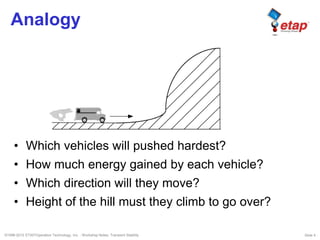
Analogy
• Which vehicles will pushed hardest?
• How much energy gained by each vehicle?
• Which direction will they move?
• Height of the hill must they climb to go over?
Slide 5©1996-2010 ETAP/Operation Technology, Inc. - Workshop Notes: Transient Stability
Introduction (cont’d)
• System protection requires consideration of:
Critical Fault Clearing Time (CFCT)
Critical Separation Time (CST)
Fast load transferring
Load Shedding
…
Slide 6©1996-2010 ETAP/Operation Technology, Inc. - Workshop Notes: Transient Stability
Causes of Instability
• Short-circuits
• Loss of utility connections
• Loss of a portion of in-plant generation
• Starting of a large motor
• Switching operations (lines or capacitors)
• Impact loading on motors
• Sudden large change in load and generation
Slide 7©1996-2010 ETAP/Operation Technology, Inc. - Workshop Notes: Transient Stability
Consequences of Instability
• Synchronous machine slip poles –
generator tripping
• Power swing
• Misoperation of protective devices
• Interruption of critical loads
• Low-voltage conditions – motor drop-offs
• Damage to equipment
• Area wide blackout
• …
Slide 8©1996-2010 ETAP/Operation Technology, Inc. - Workshop Notes: Transient Stability
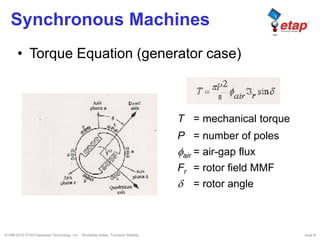
Synchronous Machines
• Torque Equation (generator case)
T = mechanical torque
P = number of poles
air = air-gap flux
Fr = rotor field MMF
 = rotor angle
Slide 9©1996-2010 ETAP/Operation Technology, Inc. - Workshop Notes: Transient Stability
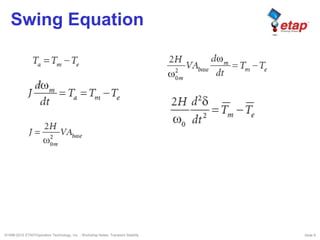
Swing Equation
Slide 10©1996-2010 ETAP/Operation Technology, Inc. - Workshop Notes: Transient Stability
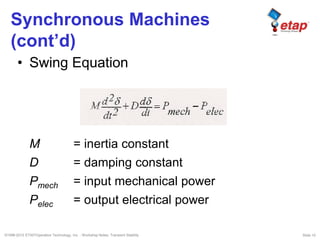
Synchronous Machines
(cont’d)
• Swing Equation
M = inertia constant
D = damping constant
Pmech = input mechanical power
Pelec = output electrical power
Slide 11©1996-2010 ETAP/Operation Technology, Inc. - Workshop Notes: Transient Stability
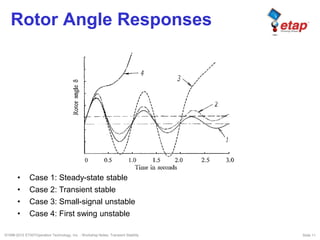
Rotor Angle Responses
• Case 1: Steady-state stable
• Case 2: Transient stable
• Case 3: Small-signal unstable
• Case 4: First swing unstable
Slide 12©1996-2010 ETAP/Operation Technology, Inc. - Workshop Notes: Transient Stability
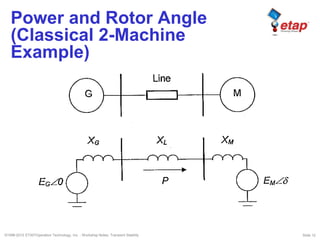
Power and Rotor Angle
(Classical 2-Machine
Example)
Slide 13©1996-2010 ETAP/Operation Technology, Inc. - Workshop Notes: Transient Stability
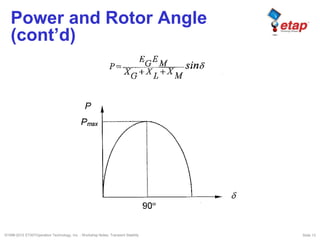
Power and Rotor Angle
(cont’d)
Slide 14©1996-2010 ETAP/Operation Technology, Inc. - Workshop Notes: Transient Stability
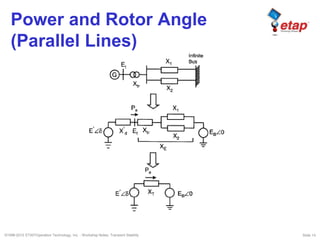
Power and Rotor Angle
(Parallel Lines)
Slide 15©1996-2010 ETAP/Operation Technology, Inc. - Workshop Notes: Transient Stability
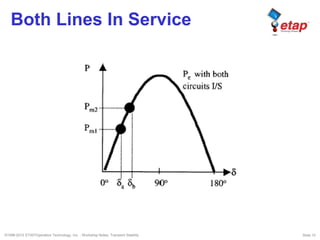
Both Lines In Service
Slide 16©1996-2010 ETAP/Operation Technology, Inc. - Workshop Notes: Transient Stability
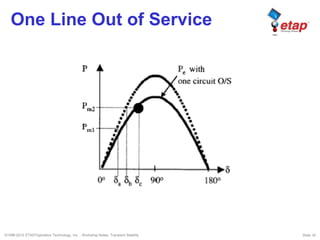
One Line Out of Service
Slide 17©1996-2010 ETAP/Operation Technology, Inc. - Workshop Notes: Transient Stability
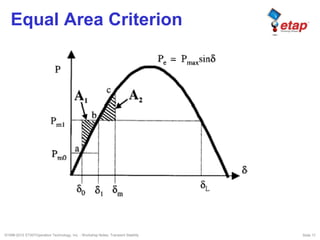
Equal Area Criterion
Slide 18©1996-2010 ETAP/Operation Technology, Inc. - Workshop Notes: Transient Stability
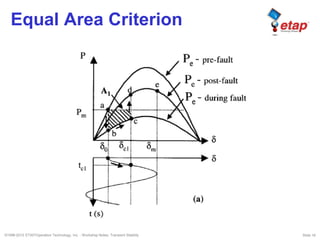
Equal Area Criterion
Slide 19©1996-2010 ETAP/Operation Technology, Inc. - Workshop Notes: Transient Stability
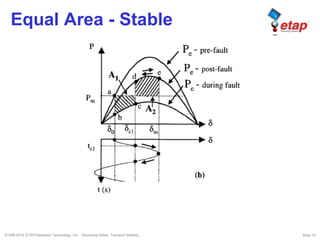
Equal Area - Stable
Slide 20©1996-2010 ETAP/Operation Technology, Inc. - Workshop Notes: Transient Stability
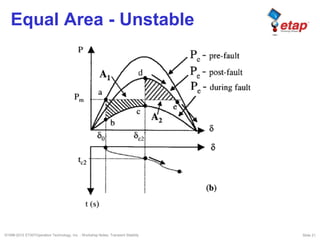
Equal Area – Unstable
Slide 21©1996-2010 ETAP/Operation Technology, Inc. - Workshop Notes: Transient Stability
Equal Area - Unstable
Slide 22©1996-2010 ETAP/Operation Technology, Inc. - Workshop Notes: Transient Stability
Power System Stability
Limit
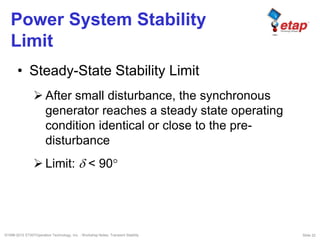
• Steady-State Stability Limit
 After small disturbance, the synchronous
generator reaches a steady state operating
condition identical or close to the pre-
disturbance
 Limit:  < 90
Slide 23©1996-2010 ETAP/Operation Technology, Inc. - Workshop Notes: Transient Stability
Power System Stability
Limit (con’d)
• Transient and Dynamic Stability Limit
 After a severe disturbance, the synchronous
generator reaches a steady-state operating
condition without a prolonged loss of
synchronism
 Limit:  < 180 during swing
Slide 24©1996-2010 ETAP/Operation Technology, Inc. - Workshop Notes: Transient Stability
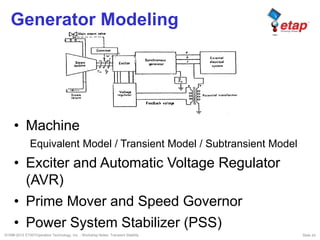
Generator Modeling
• Machine
Equivalent Model / Transient Model / Subtransient Model
• Exciter and Automatic Voltage Regulator
(AVR)
• Prime Mover and Speed Governor
• Power System Stabilizer (PSS)
Slide 25©1996-2010 ETAP/Operation Technology, Inc. - Workshop Notes: Transient Stability
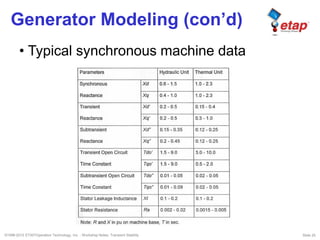
Generator Modeling (con’d)
• Typical synchronous machine data
Slide 26©1996-2010 ETAP/Operation Technology, Inc. - Workshop Notes: Transient Stability
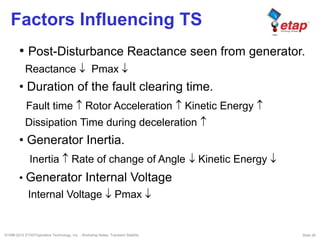
Factors Influencing TS
• Post-Disturbance Reactance seen from generator.
Reactance  Pmax 
• Duration of the fault clearing time.
Fault time  Rotor Acceleration  Kinetic Energy 
Dissipation Time during deceleration 
• Generator Inertia.
Inertia  Rate of change of Angle  Kinetic Energy 
• Generator Internal Voltage
Internal Voltage  Pmax 
Slide 27©1996-2010 ETAP/Operation Technology, Inc. - Workshop Notes: Transient Stability
Factors Influencing TS
• Generator Loading Prior To Disturbance
Loading  Closer to Pmax. Unstable during acceleration
• Generator Internal Reactance
Reactance  Peak Power  Initial Rotor Angle 
Dissipation Time during deceleration 
• Generator Output During Fault
Function of Fault Location and Type of Fault
Slide 28©1996-2010 ETAP/Operation Technology, Inc. - Workshop Notes: Transient Stability
Solution to Stability
Problems
• Improve system design
 Increase synchronizing power
• Design and selection of rotating equipment
 Use of induction machines
 Increase moment of inertia
 Reduce transient reactance
 Improve voltage regulator and exciter
characteristics
Slide 29©1996-2010 ETAP/Operation Technology, Inc. - Workshop Notes: Transient Stability
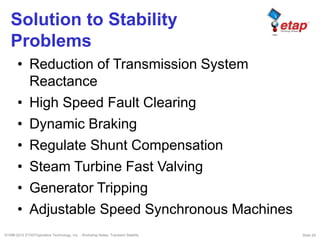
Solution to Stability
Problems
• Reduction of Transmission System
Reactance
• High Speed Fault Clearing
• Dynamic Braking
• Regulate Shunt Compensation
• Steam Turbine Fast Valving
• Generator Tripping
• Adjustable Speed Synchronous Machines
Slide 30©1996-2010 ETAP/Operation Technology, Inc. - Workshop Notes: Transient Stability
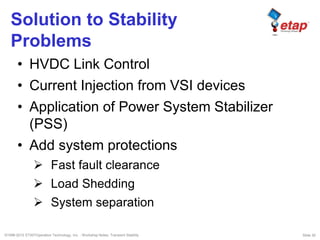
Solution to Stability
Problems
• HVDC Link Control
• Current Injection from VSI devices
• Application of Power System Stabilizer
(PSS)
• Add system protections
 Fast fault clearance
 Load Shedding
 System separation

ETAP - Transient stability

  • 1.
    ©1996-2010 ETAP/Operation Technology,Inc. – Workshop Notes: Transient Stability Transient Stability
  • 2.
    Slide 2©1996-2010 ETAP/OperationTechnology, Inc. - Workshop Notes: Transient Stability Time Frame of Power System Dynamic Phenomena
  • 3.
    Slide 3©1996-2010 ETAP/OperationTechnology, Inc. - Workshop Notes: Transient Stability Introduction • TS is also called Rotor Stability, Dynamic Stability • Electromechanical Phenomenon • All synchronous machines must remain in synchronism with one another • TS is no longer only the utility’s concern • Co-generation plants face TS problems
  • 4.
    Slide 4©1996-2010 ETAP/OperationTechnology, Inc. - Workshop Notes: Transient Stability Analogy • Which vehicles will pushed hardest? • How much energy gained by each vehicle? • Which direction will they move? • Height of the hill must they climb to go over?
  • 5.
    Slide 5©1996-2010 ETAP/OperationTechnology, Inc. - Workshop Notes: Transient Stability Introduction (cont’d) • System protection requires consideration of: Critical Fault Clearing Time (CFCT) Critical Separation Time (CST) Fast load transferring Load Shedding …
  • 6.
    Slide 6©1996-2010 ETAP/OperationTechnology, Inc. - Workshop Notes: Transient Stability Causes of Instability • Short-circuits • Loss of utility connections • Loss of a portion of in-plant generation • Starting of a large motor • Switching operations (lines or capacitors) • Impact loading on motors • Sudden large change in load and generation
  • 7.
    Slide 7©1996-2010 ETAP/OperationTechnology, Inc. - Workshop Notes: Transient Stability Consequences of Instability • Synchronous machine slip poles – generator tripping • Power swing • Misoperation of protective devices • Interruption of critical loads • Low-voltage conditions – motor drop-offs • Damage to equipment • Area wide blackout • …
  • 8.
    Slide 8©1996-2010 ETAP/OperationTechnology, Inc. - Workshop Notes: Transient Stability Synchronous Machines • Torque Equation (generator case) T = mechanical torque P = number of poles air = air-gap flux Fr = rotor field MMF  = rotor angle
  • 9.
    Slide 9©1996-2010 ETAP/OperationTechnology, Inc. - Workshop Notes: Transient Stability Swing Equation
  • 10.
    Slide 10©1996-2010 ETAP/OperationTechnology, Inc. - Workshop Notes: Transient Stability Synchronous Machines (cont’d) • Swing Equation M = inertia constant D = damping constant Pmech = input mechanical power Pelec = output electrical power
  • 11.
    Slide 11©1996-2010 ETAP/OperationTechnology, Inc. - Workshop Notes: Transient Stability Rotor Angle Responses • Case 1: Steady-state stable • Case 2: Transient stable • Case 3: Small-signal unstable • Case 4: First swing unstable
  • 12.
    Slide 12©1996-2010 ETAP/OperationTechnology, Inc. - Workshop Notes: Transient Stability Power and Rotor Angle (Classical 2-Machine Example)
  • 13.
    Slide 13©1996-2010 ETAP/OperationTechnology, Inc. - Workshop Notes: Transient Stability Power and Rotor Angle (cont’d)
  • 14.
    Slide 14©1996-2010 ETAP/OperationTechnology, Inc. - Workshop Notes: Transient Stability Power and Rotor Angle (Parallel Lines)
  • 15.
    Slide 15©1996-2010 ETAP/OperationTechnology, Inc. - Workshop Notes: Transient Stability Both Lines In Service
  • 16.
    Slide 16©1996-2010 ETAP/OperationTechnology, Inc. - Workshop Notes: Transient Stability One Line Out of Service
  • 17.
    Slide 17©1996-2010 ETAP/OperationTechnology, Inc. - Workshop Notes: Transient Stability Equal Area Criterion
  • 18.
    Slide 18©1996-2010 ETAP/OperationTechnology, Inc. - Workshop Notes: Transient Stability Equal Area Criterion
  • 19.
    Slide 19©1996-2010 ETAP/OperationTechnology, Inc. - Workshop Notes: Transient Stability Equal Area - Stable
  • 20.
    Slide 20©1996-2010 ETAP/OperationTechnology, Inc. - Workshop Notes: Transient Stability Equal Area – Unstable
  • 21.
    Slide 21©1996-2010 ETAP/OperationTechnology, Inc. - Workshop Notes: Transient Stability Equal Area - Unstable
  • 22.
    Slide 22©1996-2010 ETAP/OperationTechnology, Inc. - Workshop Notes: Transient Stability Power System Stability Limit • Steady-State Stability Limit  After small disturbance, the synchronous generator reaches a steady state operating condition identical or close to the pre- disturbance  Limit:  < 90
  • 23.
    Slide 23©1996-2010 ETAP/OperationTechnology, Inc. - Workshop Notes: Transient Stability Power System Stability Limit (con’d) • Transient and Dynamic Stability Limit  After a severe disturbance, the synchronous generator reaches a steady-state operating condition without a prolonged loss of synchronism  Limit:  < 180 during swing
  • 24.
    Slide 24©1996-2010 ETAP/OperationTechnology, Inc. - Workshop Notes: Transient Stability Generator Modeling • Machine Equivalent Model / Transient Model / Subtransient Model • Exciter and Automatic Voltage Regulator (AVR) • Prime Mover and Speed Governor • Power System Stabilizer (PSS)
  • 25.
    Slide 25©1996-2010 ETAP/OperationTechnology, Inc. - Workshop Notes: Transient Stability Generator Modeling (con’d) • Typical synchronous machine data
  • 26.
    Slide 26©1996-2010 ETAP/OperationTechnology, Inc. - Workshop Notes: Transient Stability Factors Influencing TS • Post-Disturbance Reactance seen from generator. Reactance  Pmax  • Duration of the fault clearing time. Fault time  Rotor Acceleration  Kinetic Energy  Dissipation Time during deceleration  • Generator Inertia. Inertia  Rate of change of Angle  Kinetic Energy  • Generator Internal Voltage Internal Voltage  Pmax 
  • 27.
    Slide 27©1996-2010 ETAP/OperationTechnology, Inc. - Workshop Notes: Transient Stability Factors Influencing TS • Generator Loading Prior To Disturbance Loading  Closer to Pmax. Unstable during acceleration • Generator Internal Reactance Reactance  Peak Power  Initial Rotor Angle  Dissipation Time during deceleration  • Generator Output During Fault Function of Fault Location and Type of Fault
  • 28.
    Slide 28©1996-2010 ETAP/OperationTechnology, Inc. - Workshop Notes: Transient Stability Solution to Stability Problems • Improve system design  Increase synchronizing power • Design and selection of rotating equipment  Use of induction machines  Increase moment of inertia  Reduce transient reactance  Improve voltage regulator and exciter characteristics
  • 29.
    Slide 29©1996-2010 ETAP/OperationTechnology, Inc. - Workshop Notes: Transient Stability Solution to Stability Problems • Reduction of Transmission System Reactance • High Speed Fault Clearing • Dynamic Braking • Regulate Shunt Compensation • Steam Turbine Fast Valving • Generator Tripping • Adjustable Speed Synchronous Machines
  • 30.
    Slide 30©1996-2010 ETAP/OperationTechnology, Inc. - Workshop Notes: Transient Stability Solution to Stability Problems • HVDC Link Control • Current Injection from VSI devices • Application of Power System Stabilizer (PSS) • Add system protections  Fast fault clearance  Load Shedding  System separation