Organized and summarized from
different sources by:
Joesron Alie Syahbana
For:
MASTER DEGREE PROGRAM IN
URBAN AND REGIONAL DEVELOPMENT PLANNING
DIPONEGORO UNIVERSITY
Semarang City, August – September 2024
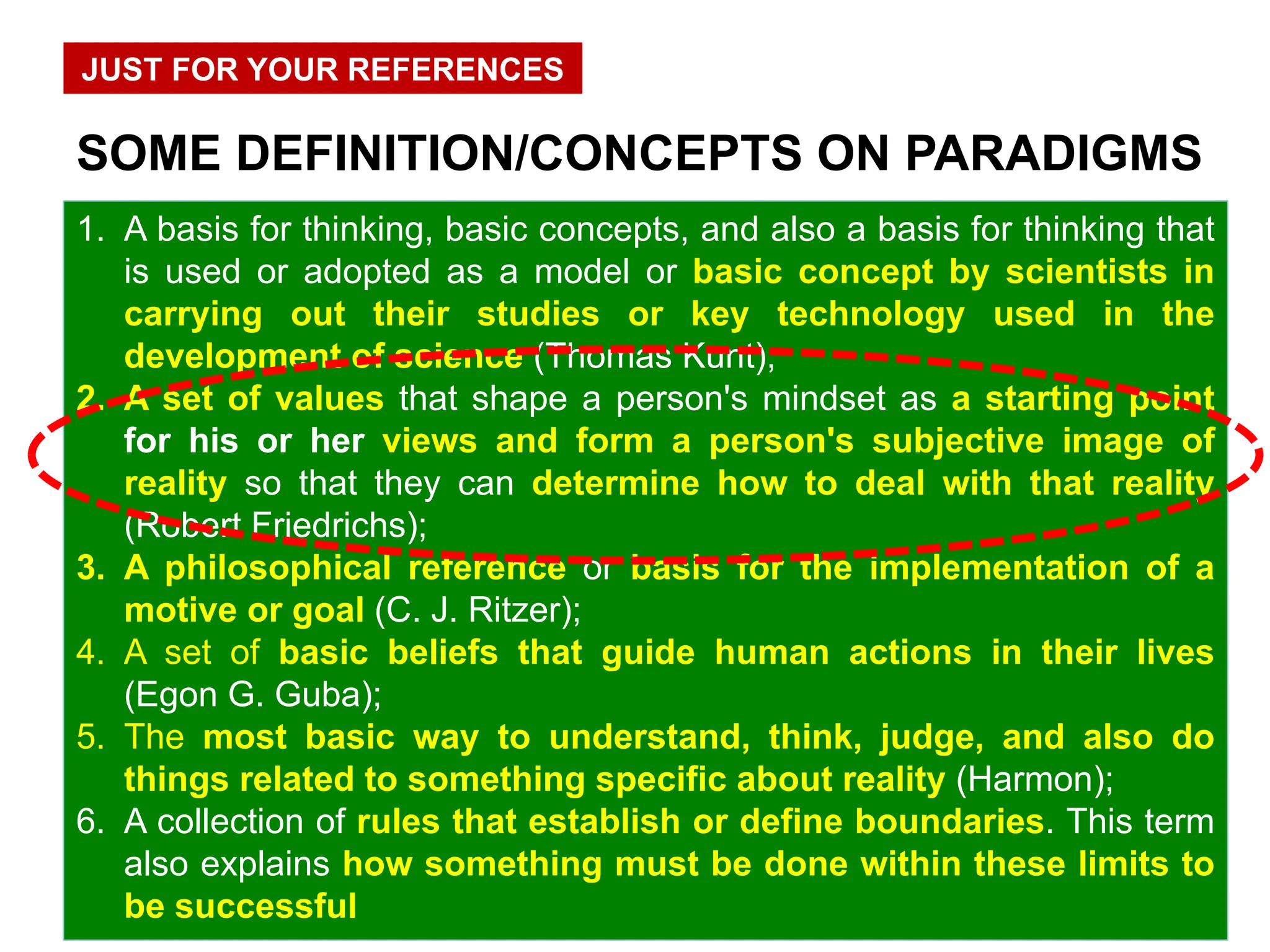
1. A basis for thinking, basic concepts, and also a basis for thinking that
is used or adopted as a model or basic concept by scientists in
carrying out their studies or key technology used in the
development of science (Thomas Kunt);
2. A set of values that shape a person's mindset as a starting point
for his or her views and form a person's subjective image of
reality so that they can determine how to deal with that reality
(Robert Friedrichs);
3. A philosophical reference or basis for the implementation of a
motive or goal (C. J. Ritzer);
4. A set of basic beliefs that guide human actions in their lives
(Egon G. Guba);
5. The most basic way to understand, think, judge, and also do
things related to something specific about reality (Harmon);
6. A collection of rules that establish or define boundaries. This term
also explains how something must be done within these limits to
be successful
SOME DEFINITION/CONCEPTS ON PARADIGMS
JUST FOR YOUR REFERENCES
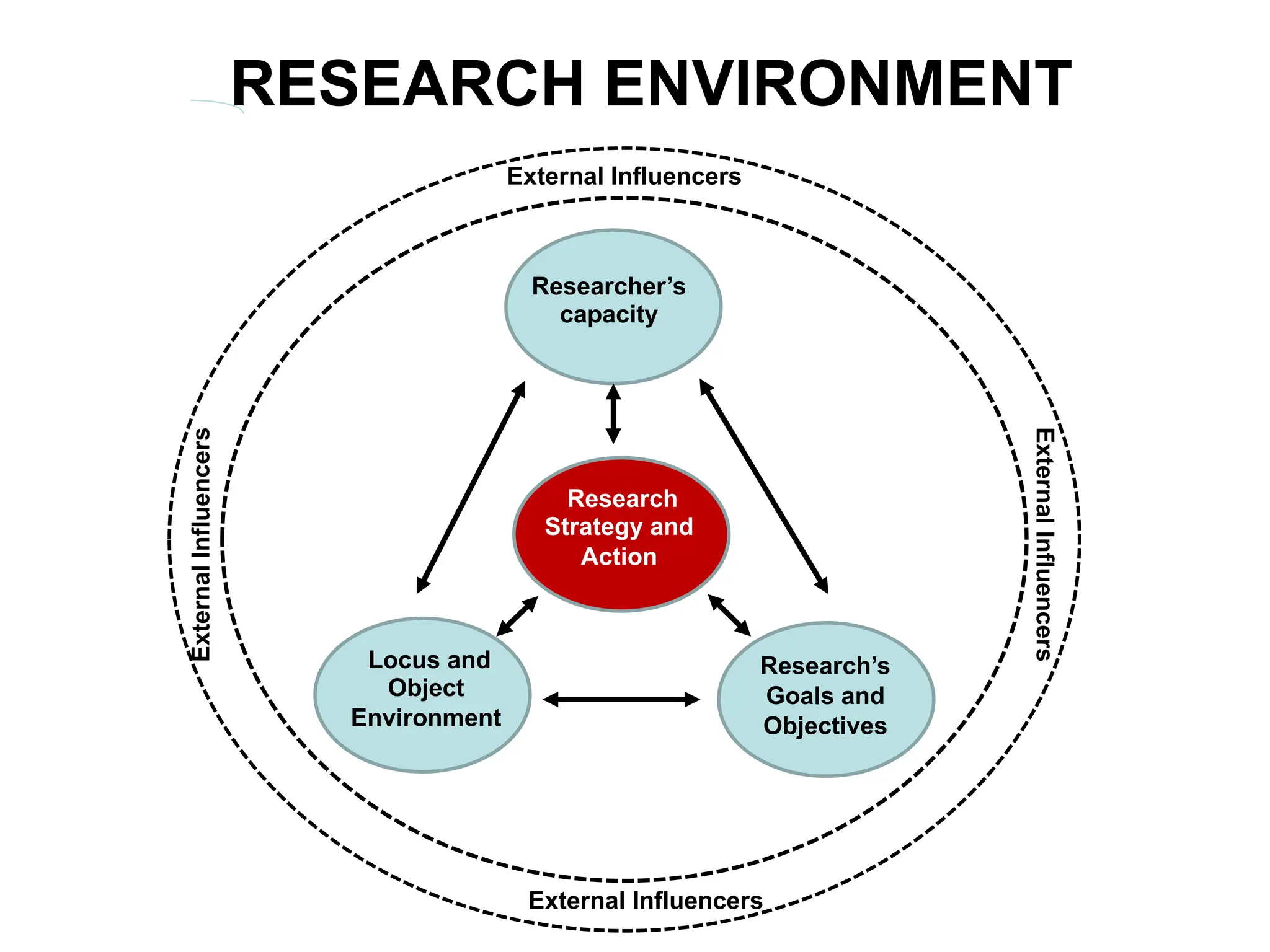
External Influencers
External
Influencers
External
Influencers
Researcher’s
capacity
Locus and
Object
Environment
Research’s
Goals and
Objectives
Research
Strategy and
Action
RESEARCH ENVIRONMENT
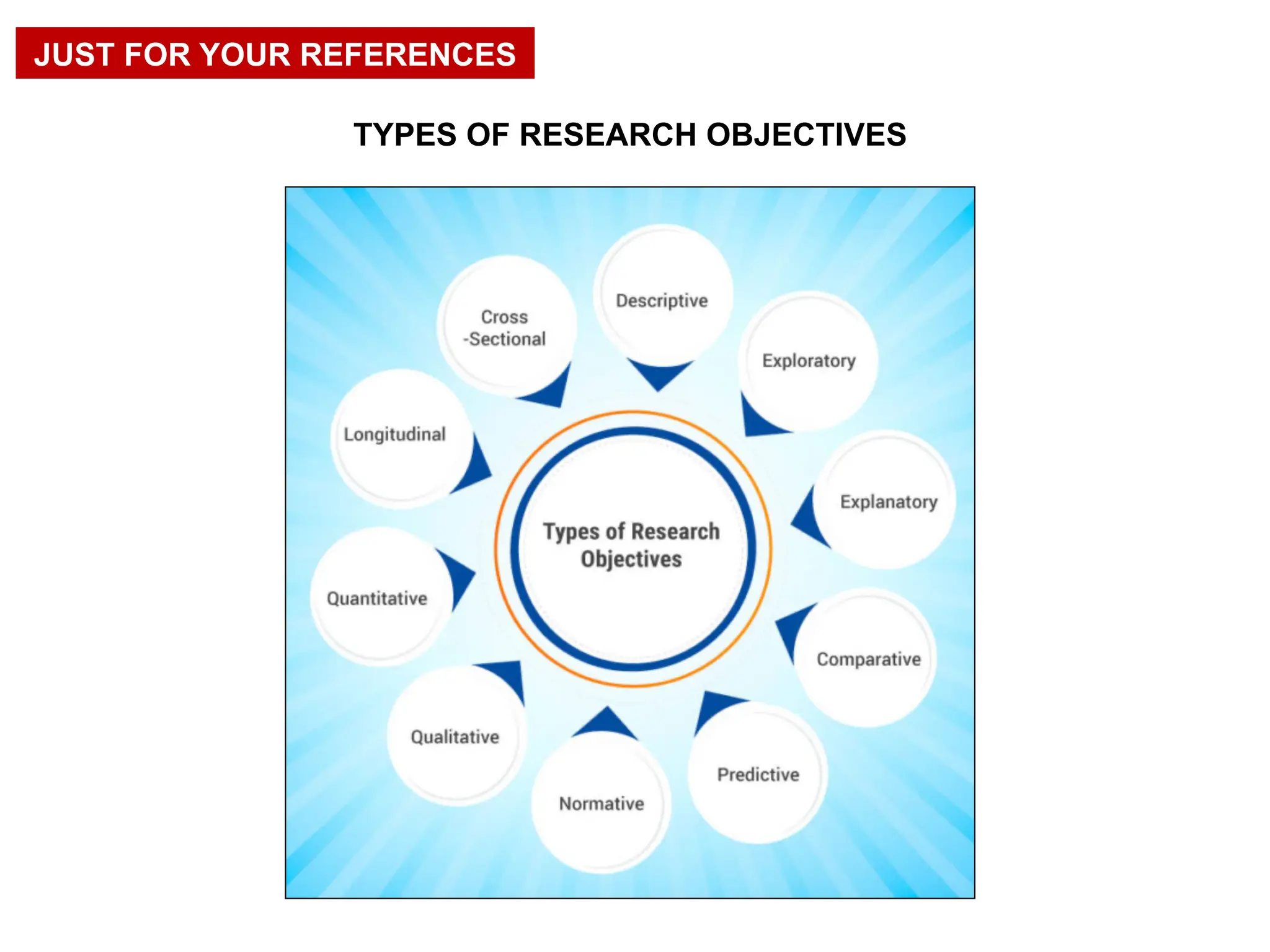
TYPES OF RESEARCH OBJECTIVES
JUST FOR YOUR REFERENCES
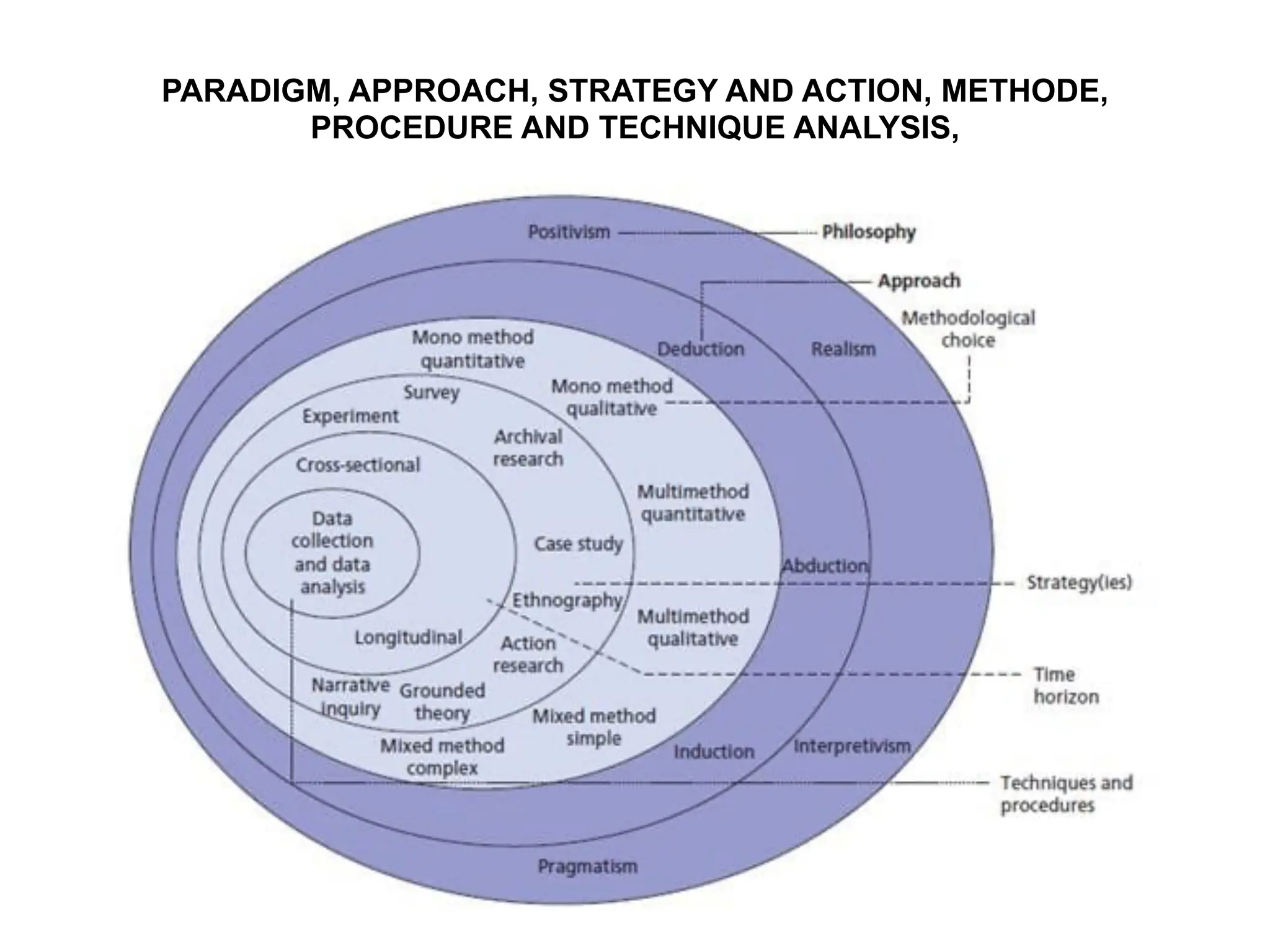
PARADIGM, APPROACH, STRATEGY AND ACTION, METHODE,
PROCEDURE AND TECHNIQUE ANALYSIS,
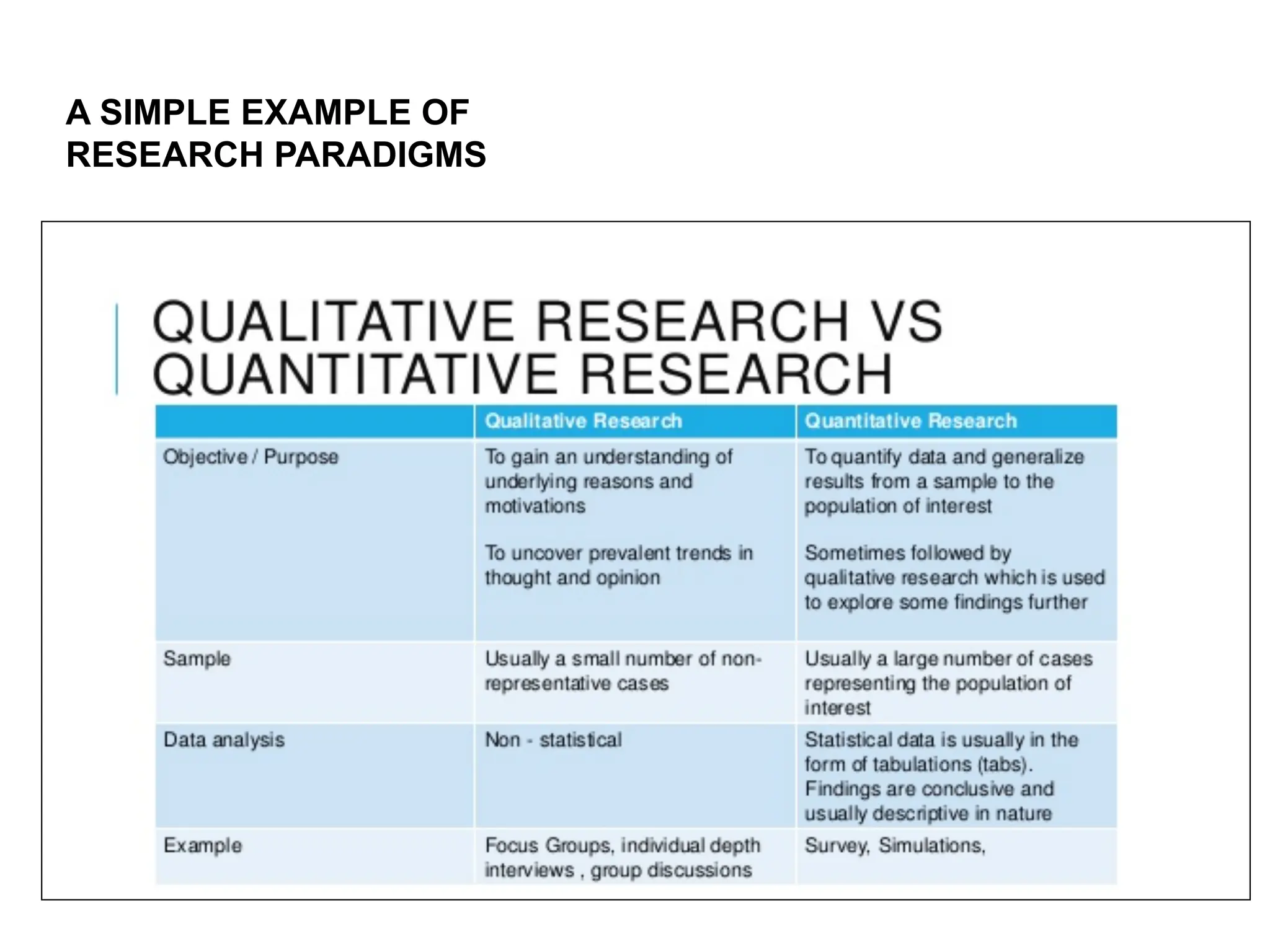
A SIMPLE EXAMPLE OF
RESEARCH PARADIGMS
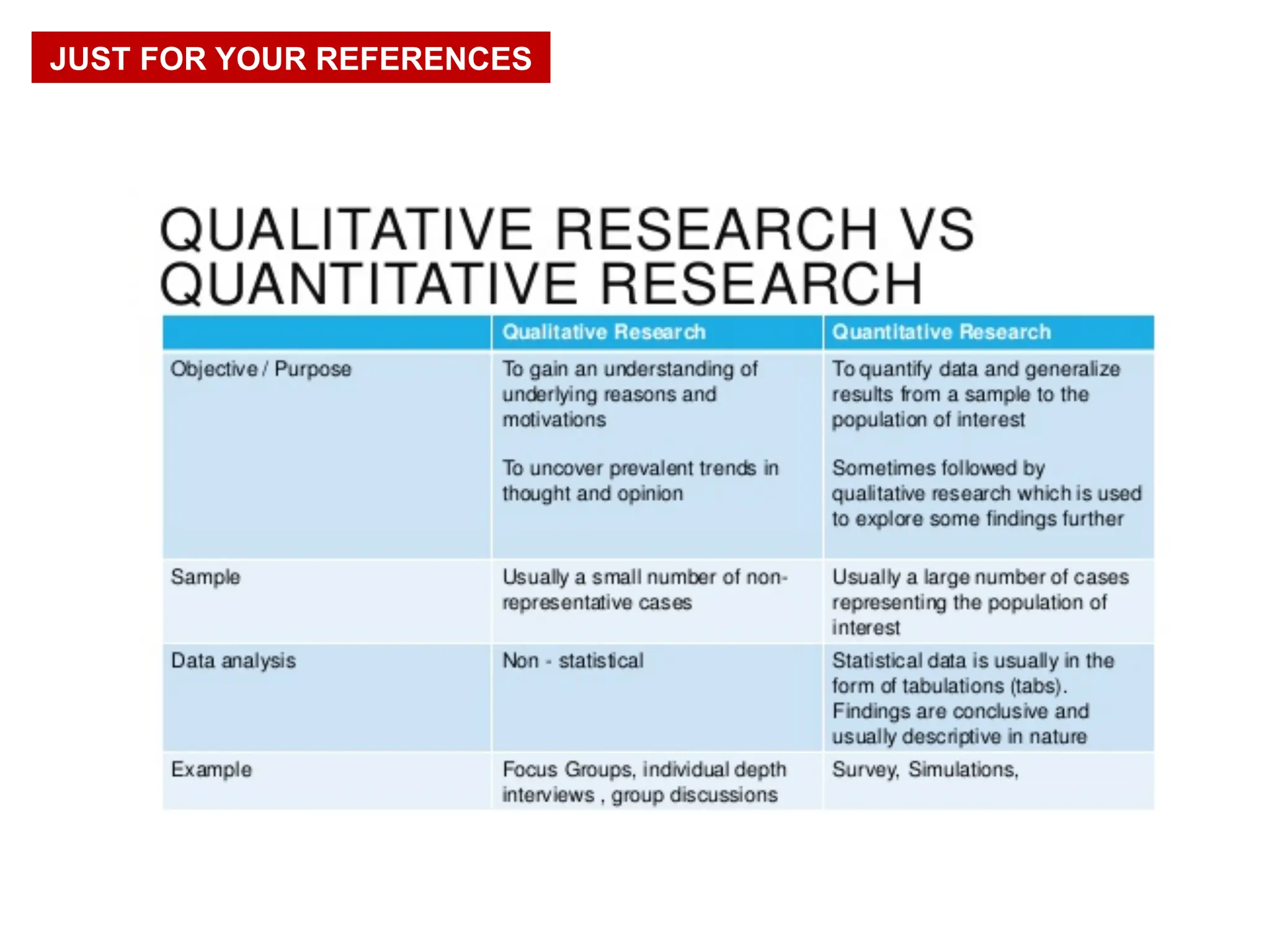
JUST FOR YOUR REFERENCES
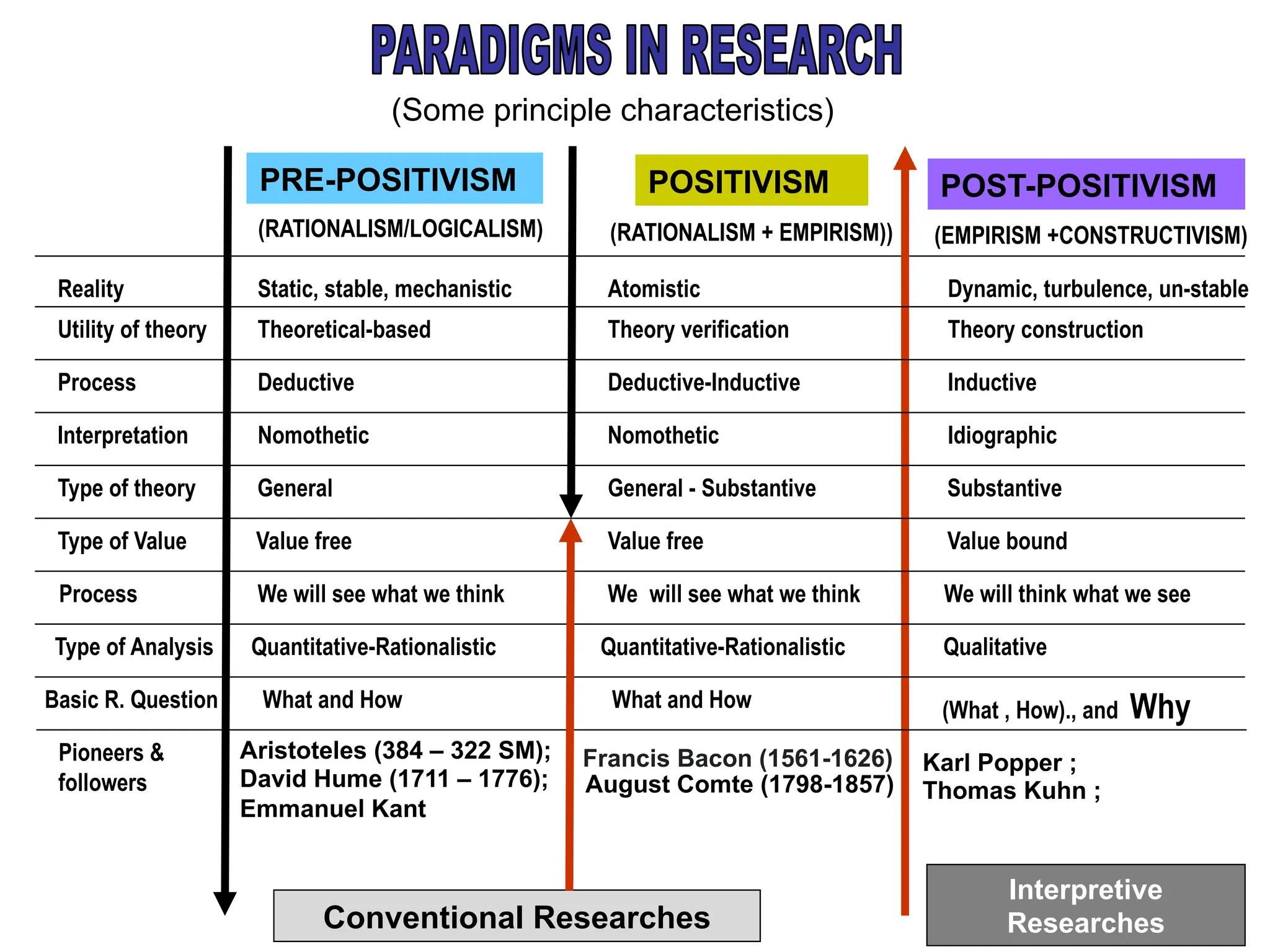
PRE-POSITIVISM POSITIVISM POST-POSITIVISM
Reality Static, stable, mechanistic Atomistic Dynamic, turbulence, un-stable
Theoretical-based Theory verification Theory construction
Deductive Deductive-Inductive Inductive
Nomothetic Nomothetic
Interpretation Idiographic
Process
General General - Substantive Substantive
Value free Value free Value bound
We will see what we think We will see what we think We will think what we see
Utility of theory
Type of theory
Type of Value
Type of Analysis Quantitative-Rationalistic
Quantitative-Rationalistic Qualitative
Process
What and How What and How (What , How)., and Why
Conventional Researches
(RATIONALISM/LOGICALISM) (EMPIRISM +CONSTRUCTIVISM)
Interpretive
Researches
Basic R. Question
(RATIONALISM + EMPIRISM))
(Some principle characteristics)
Pioneers &
followers
Aristoteles (384 – 322 SM);
David Hume (1711 – 1776);
Emmanuel Kant
August Comte (1798-1857)
Karl Popper ;
Thomas Kuhn ;
Francis Bacon (1561-1626)
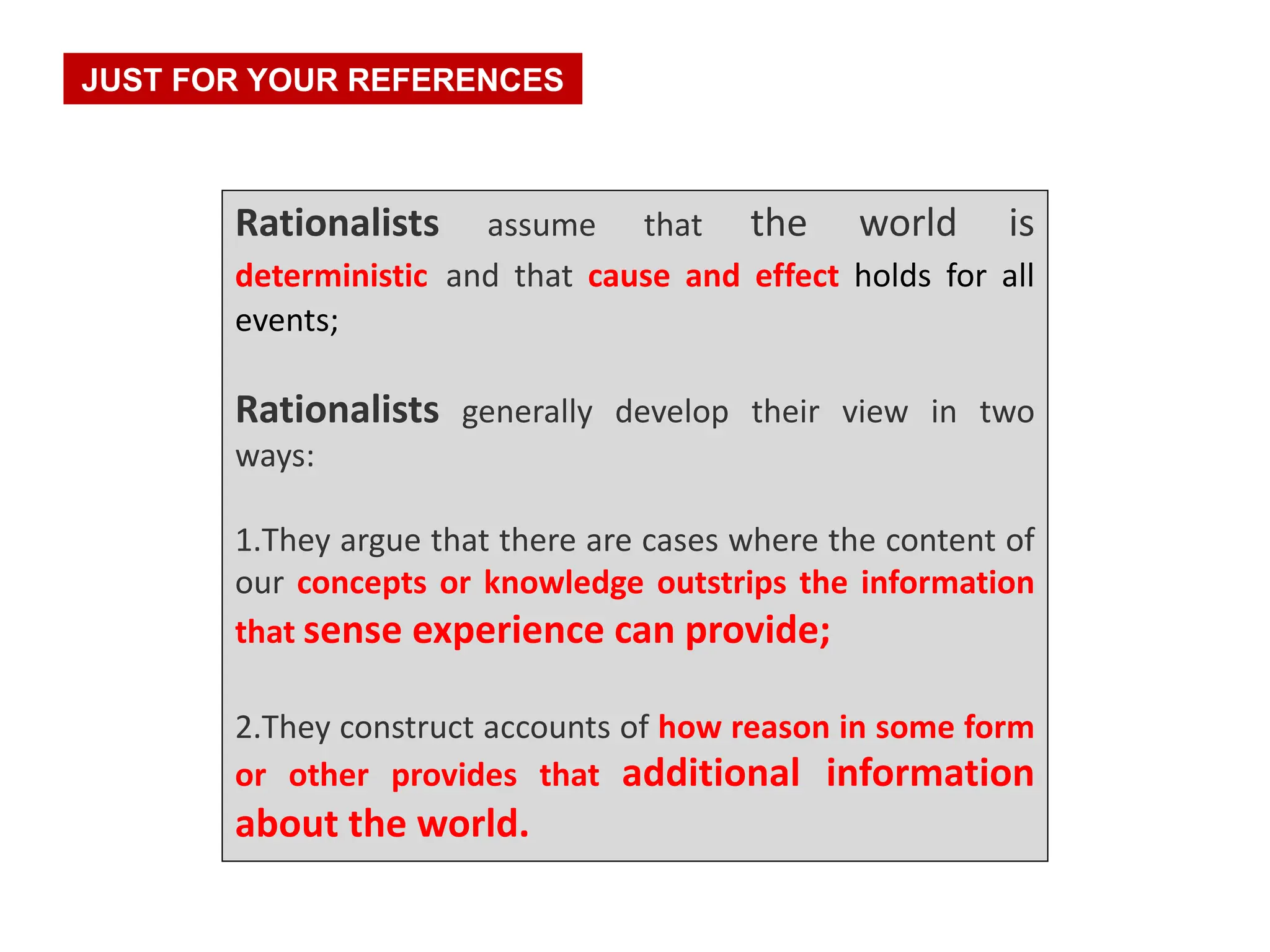
Rationalists assume that the world is
deterministic and that cause and effect holds for all
events;
Rationalists generally develop their view in two
ways:
1.They argue that there are cases where the content of
our concepts or knowledge outstrips the information
that sense experience can provide;
2.They construct accounts of how reason in some form
or other provides that additional information
about the world.
JUST FOR YOUR REFERENCES
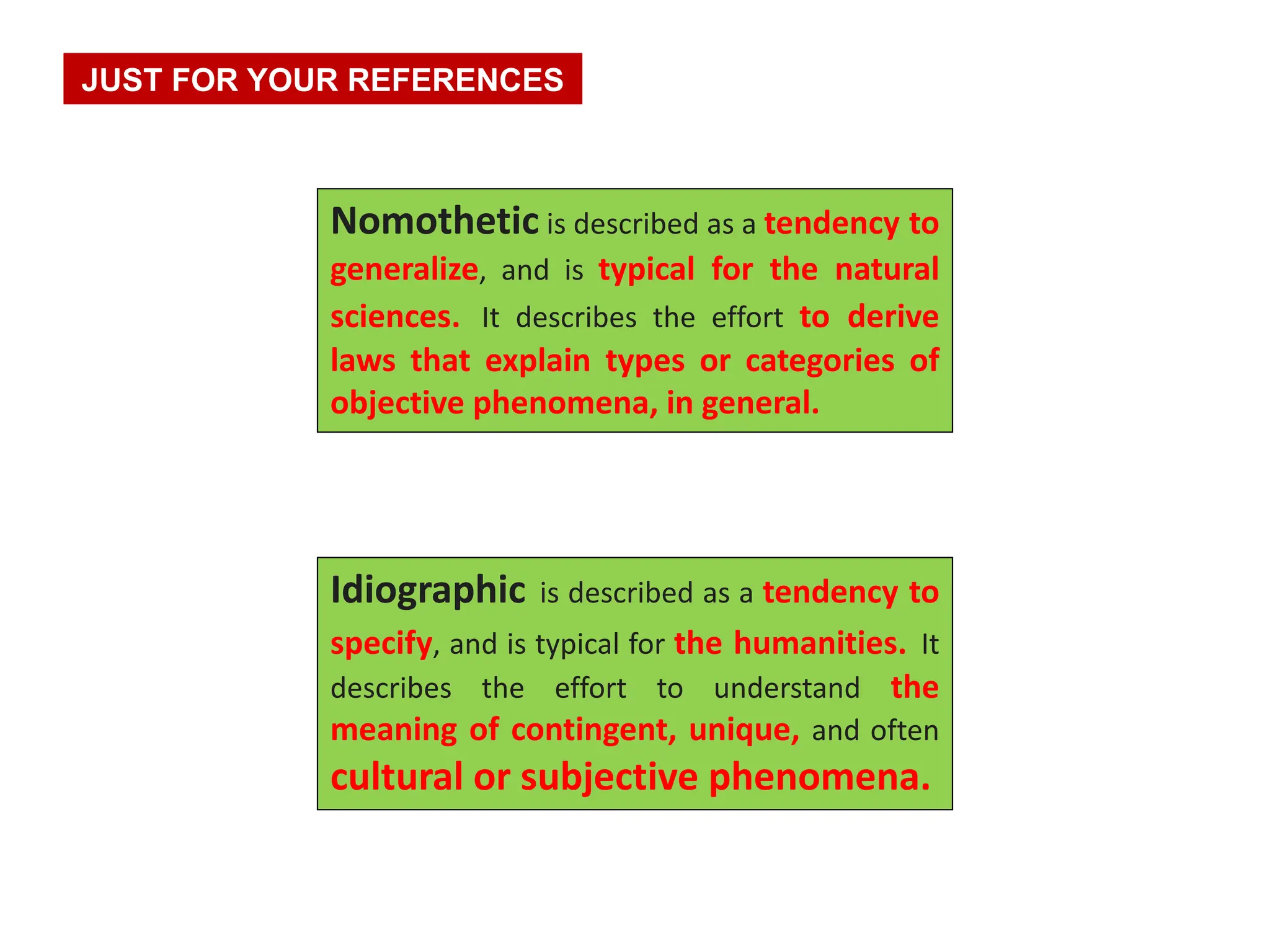
Nomothetic is described as a tendency to
generalize, and is typical for the natural
sciences. It describes the effort to derive
laws that explain types or categories of
objective phenomena, in general.
Idiographic is described as a tendency to
specify, and is typical for the humanities. It
describes the effort to understand the
meaning of contingent, unique, and often
cultural or subjective phenomena.
JUST FOR YOUR REFERENCES
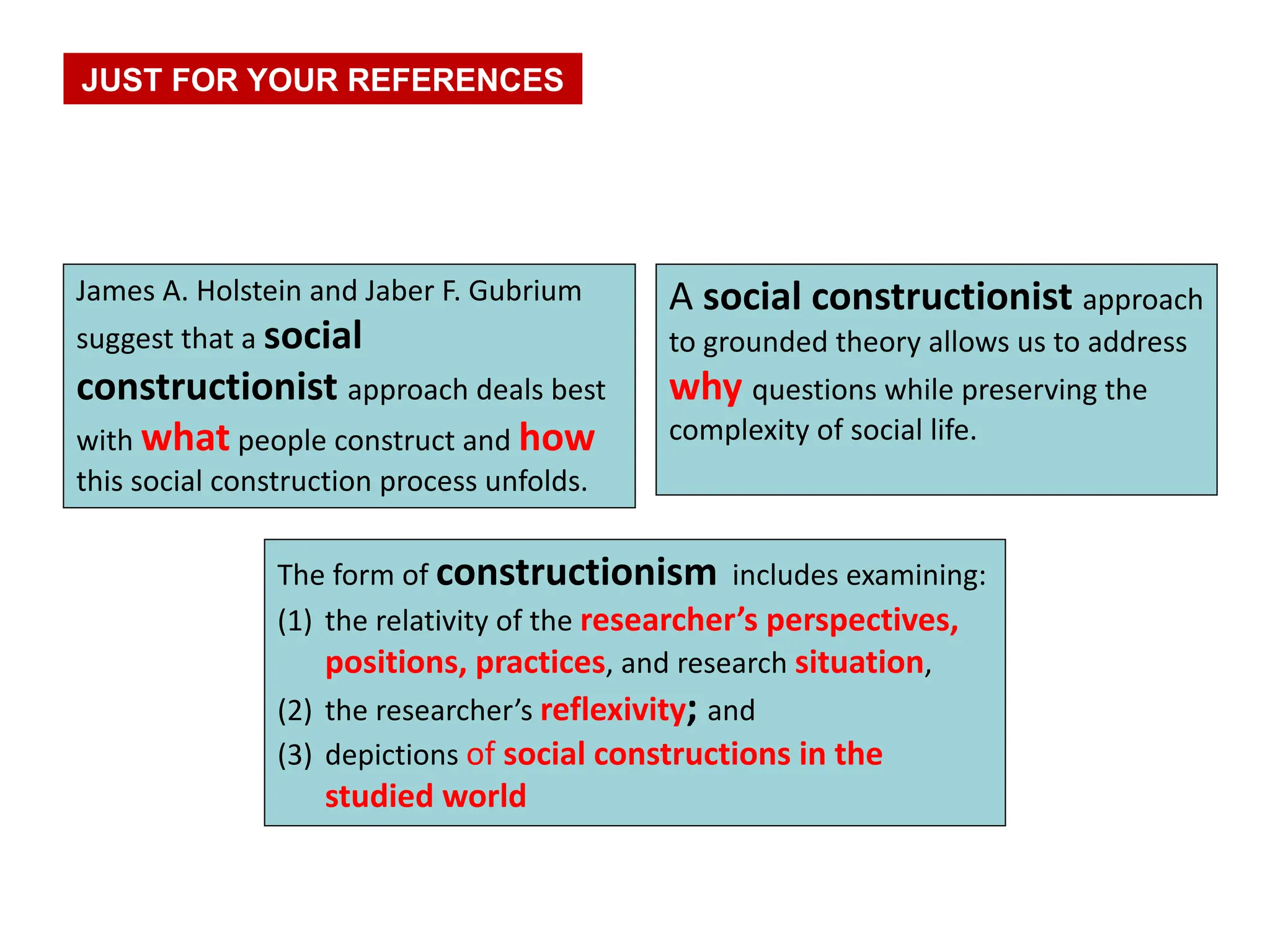
James A. Holstein and Jaber F. Gubrium
suggest that a social
constructionist approach deals best
with what people construct and how
this social construction process unfolds.
A social constructionist approach
to grounded theory allows us to address
why questions while preserving the
complexity of social life.
The form of constructionism includes examining:
(1) the relativity of the researcher’s perspectives,
positions, practices, and research situation,
(2) the researcher’s reflexivity; and
(3) depictions of social constructions in the
studied world
JUST FOR YOUR REFERENCES
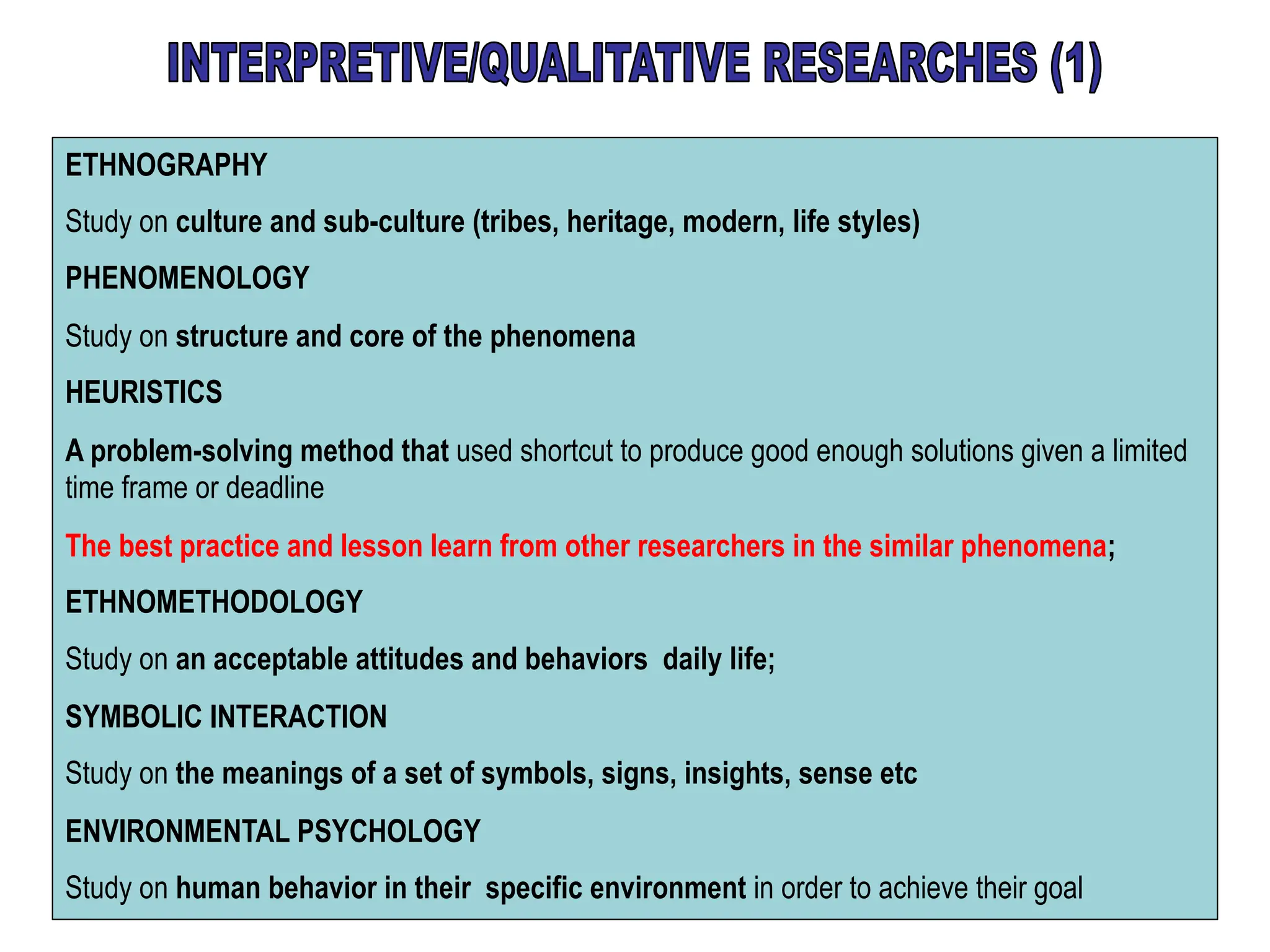
ETHNOGRAPHY
Study on culture and sub-culture (tribes, heritage, modern, life styles)
PHENOMENOLOGY
Study on structure and core of the phenomena
HEURISTICS
A problem-solving method that used shortcut to produce good enough solutions given a limited
time frame or deadline
The best practice and lesson learn from other researchers in the similar phenomena;
ETHNOMETHODOLOGY
Study on an acceptable attitudes and behaviors daily life;
SYMBOLIC INTERACTION
Study on the meanings of a set of symbols, signs, insights, sense etc
ENVIRONMENTAL PSYCHOLOGY
Study on human behavior in their specific environment in order to achieve their goal
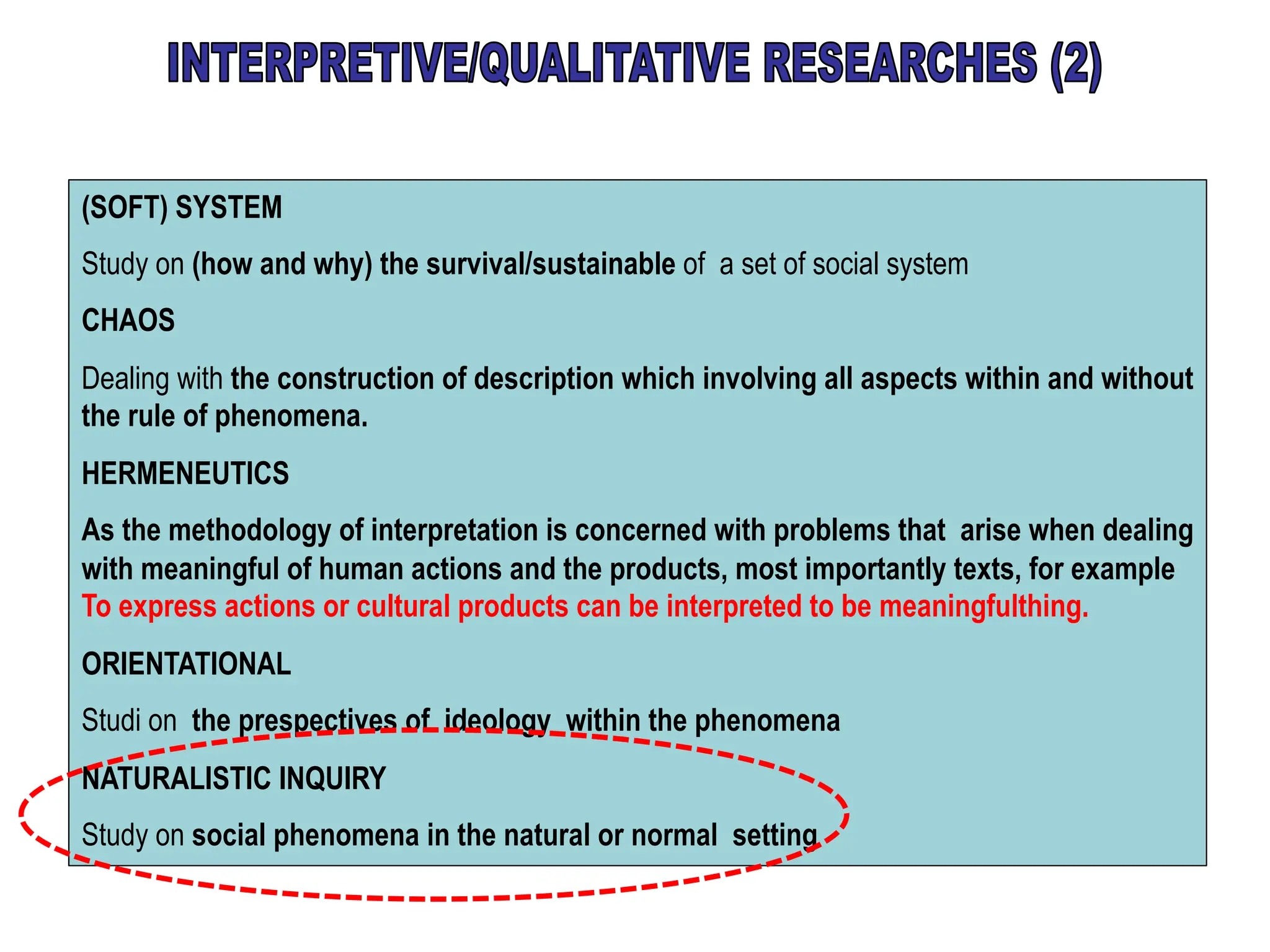
(SOFT) SYSTEM
Study on (how and why) the survival/sustainable of a set of social system
CHAOS
Dealing with the construction of description which involving all aspects within and without
the rule of phenomena.
HERMENEUTICS
As the methodology of interpretation is concerned with problems that arise when dealing
with meaningful of human actions and the products, most importantly texts, for example
To express actions or cultural products can be interpreted to be meaningfulthing.
ORIENTATIONAL
Studi on the prespectives of ideology within the phenomena
NATURALISTIC INQUIRY
Study on social phenomena in the natural or normal setting
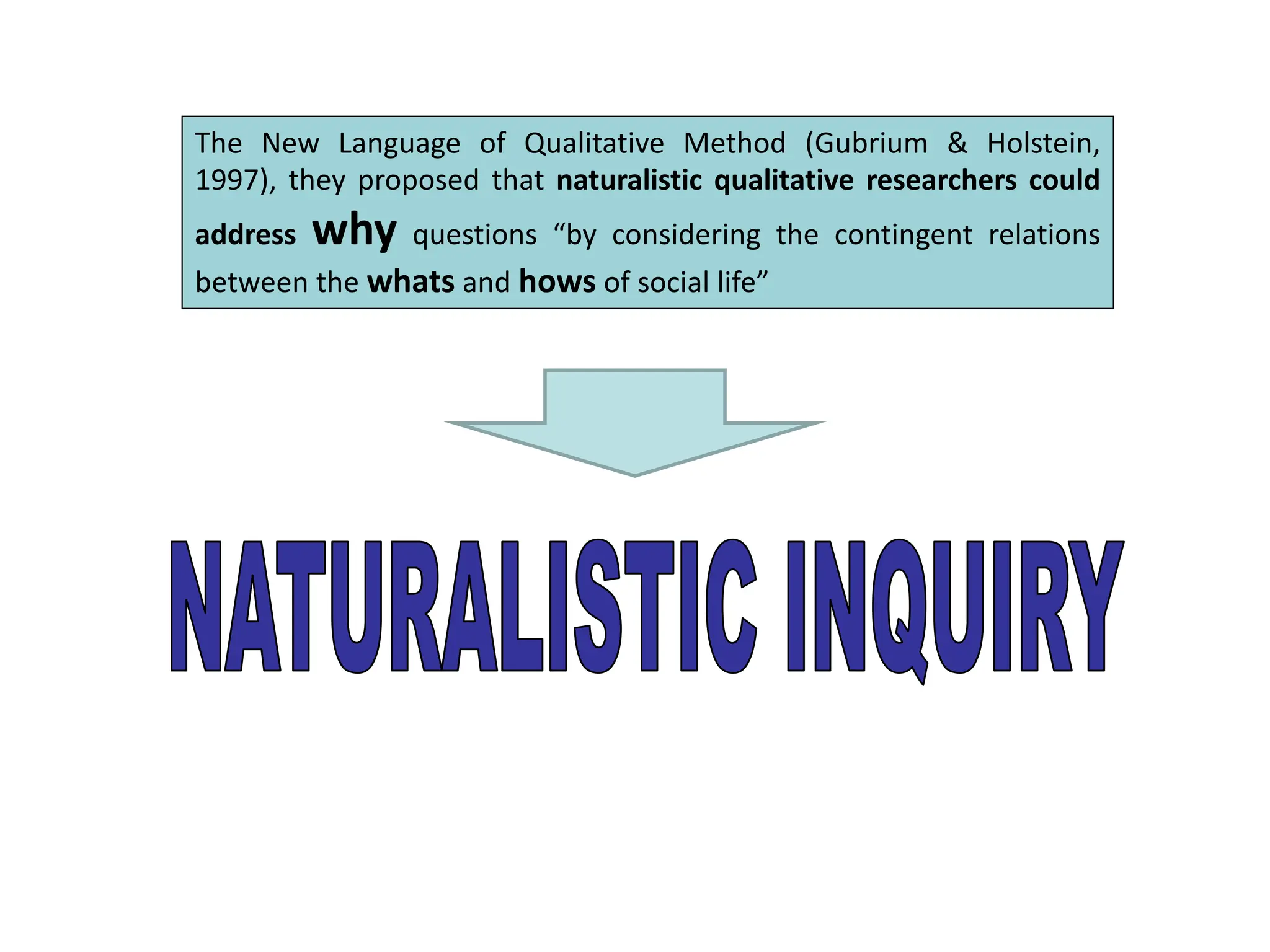
The New Language of Qualitative Method (Gubrium & Holstein,
1997), they proposed that naturalistic qualitative researchers could
address why questions “by considering the contingent relations
between the whats and hows of social life”
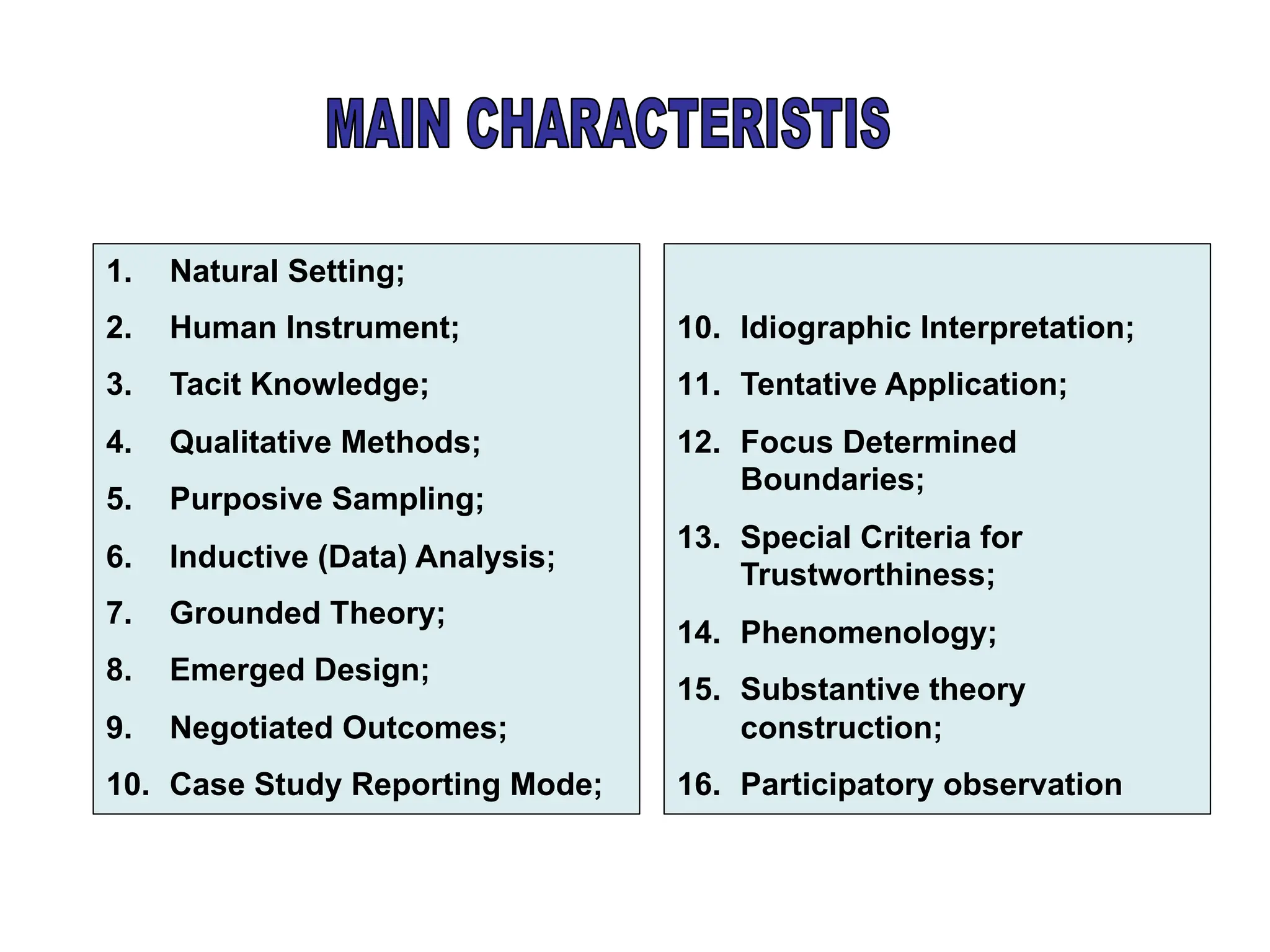
1. Natural Setting;
2. Human Instrument;
3. Tacit Knowledge;
4. Qualitative Methods;
5. Purposive Sampling;
6. Inductive (Data) Analysis;
7. Grounded Theory;
8. Emerged Design;
9. Negotiated Outcomes;
10. Case Study Reporting Mode;
10. Idiographic Interpretation;
11. Tentative Application;
12. Focus Determined
Boundaries;
13. Special Criteria for
Trustworthiness;
14. Phenomenology;
15. Substantive theory
construction;
16. Participatory observation
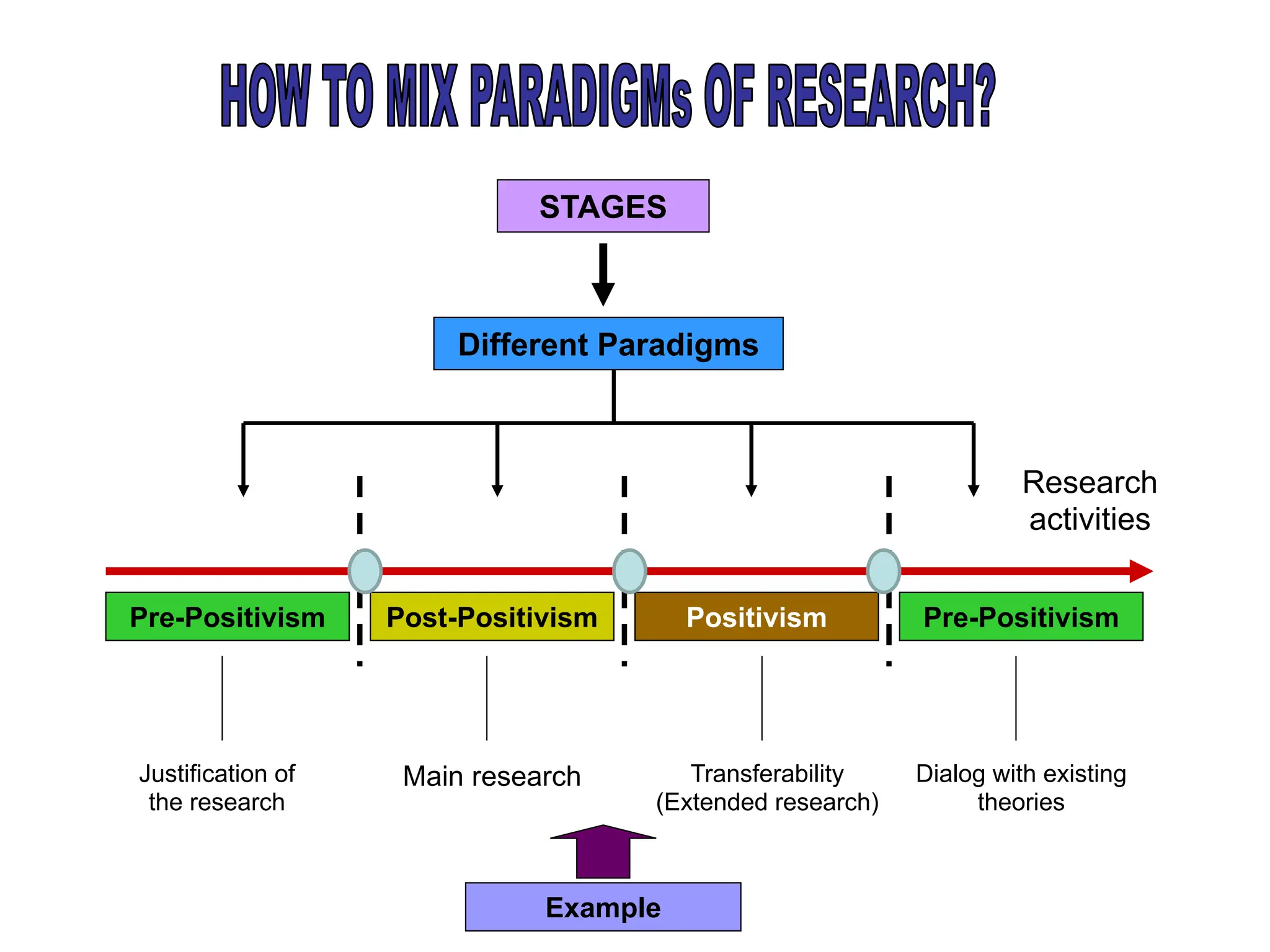
STAGES
Different Paradigms
Pre-Positivism Pre-Positivism
Post-Positivism Positivism
Justification of
the research
Main research
Example
Transferability
(Extended research)
Dialog with existing
theories
Research
activities
Conventional
Researches
Interpretive
Researches
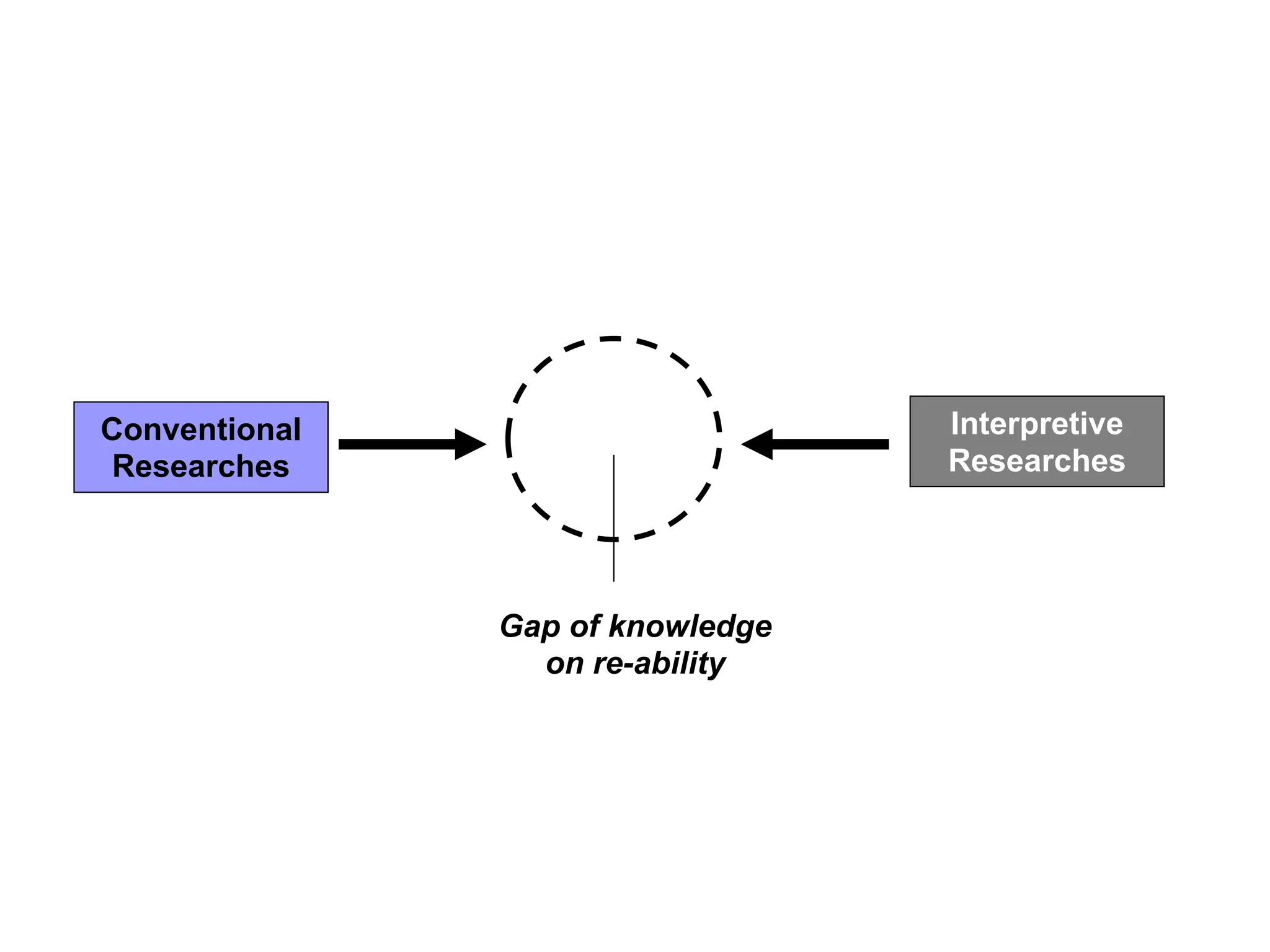
Gap of knowledge
on re-ability
Conventional
Researches
Interpretive
Researches
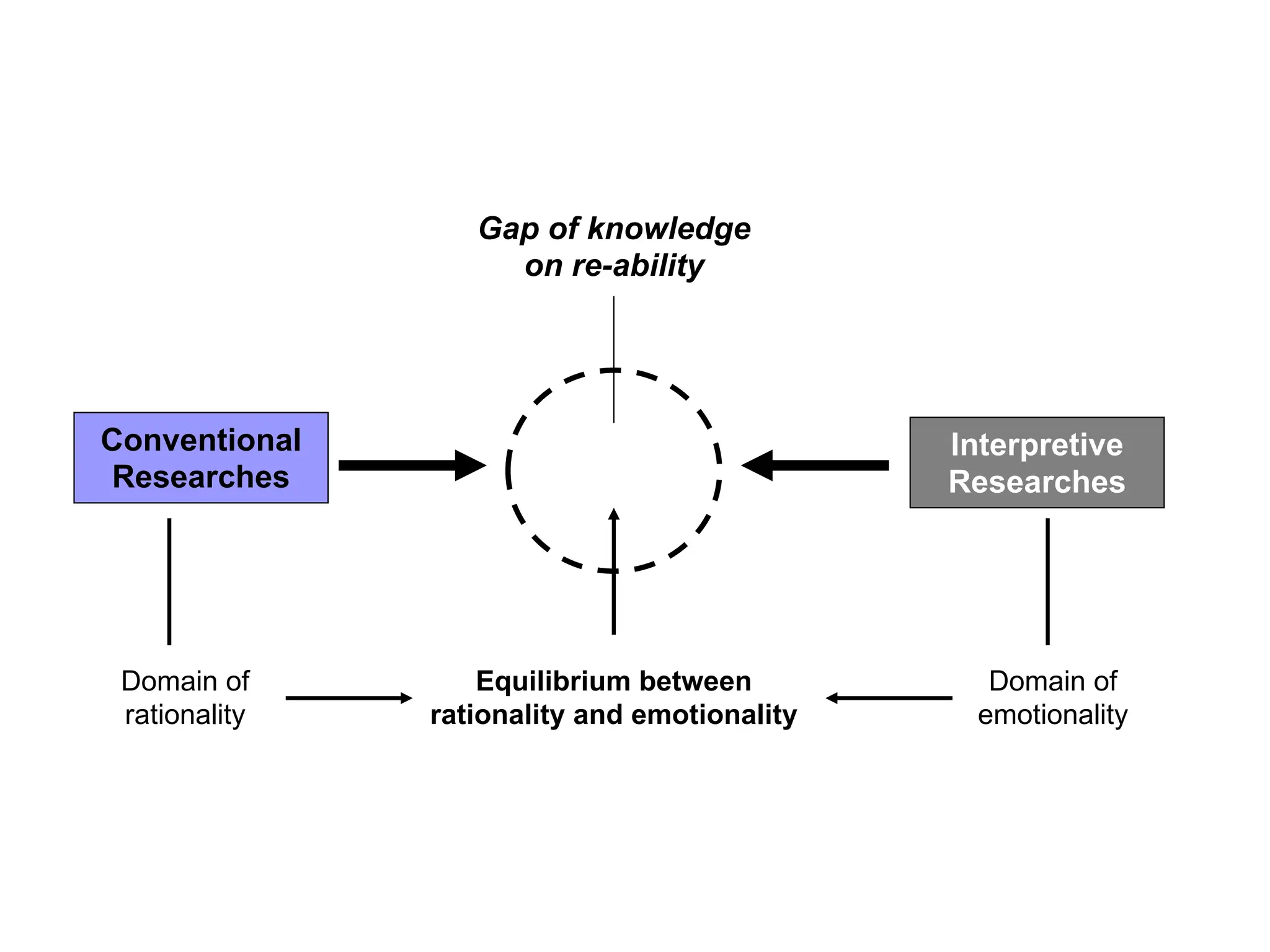
Gap of knowledge
on re-ability
Equilibrium between
rationality and emotionality
Domain of
rationality
Domain of
emotionality
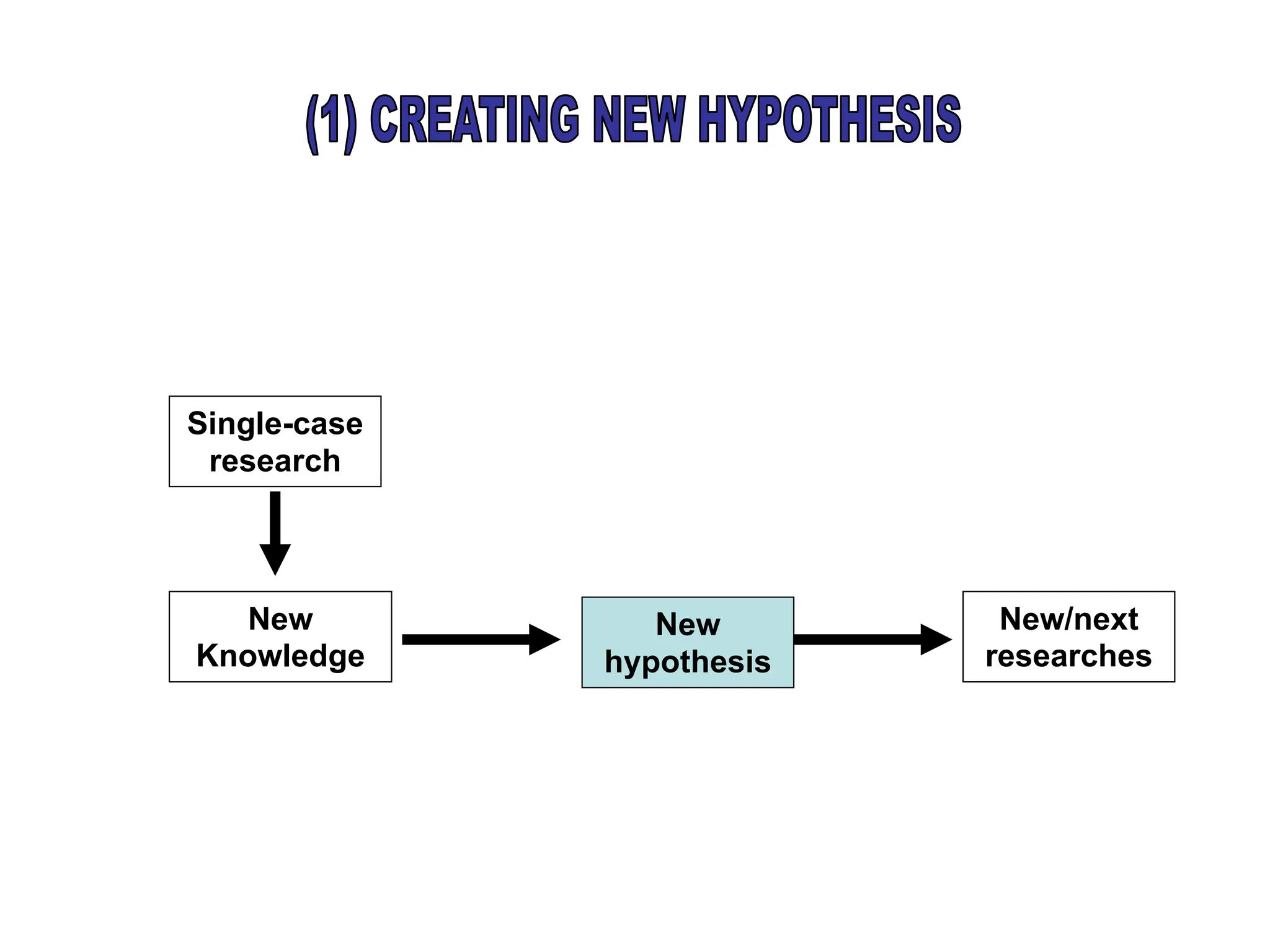
Single-case
research
New
Knowledge
New
hypothesis
New/next
researches
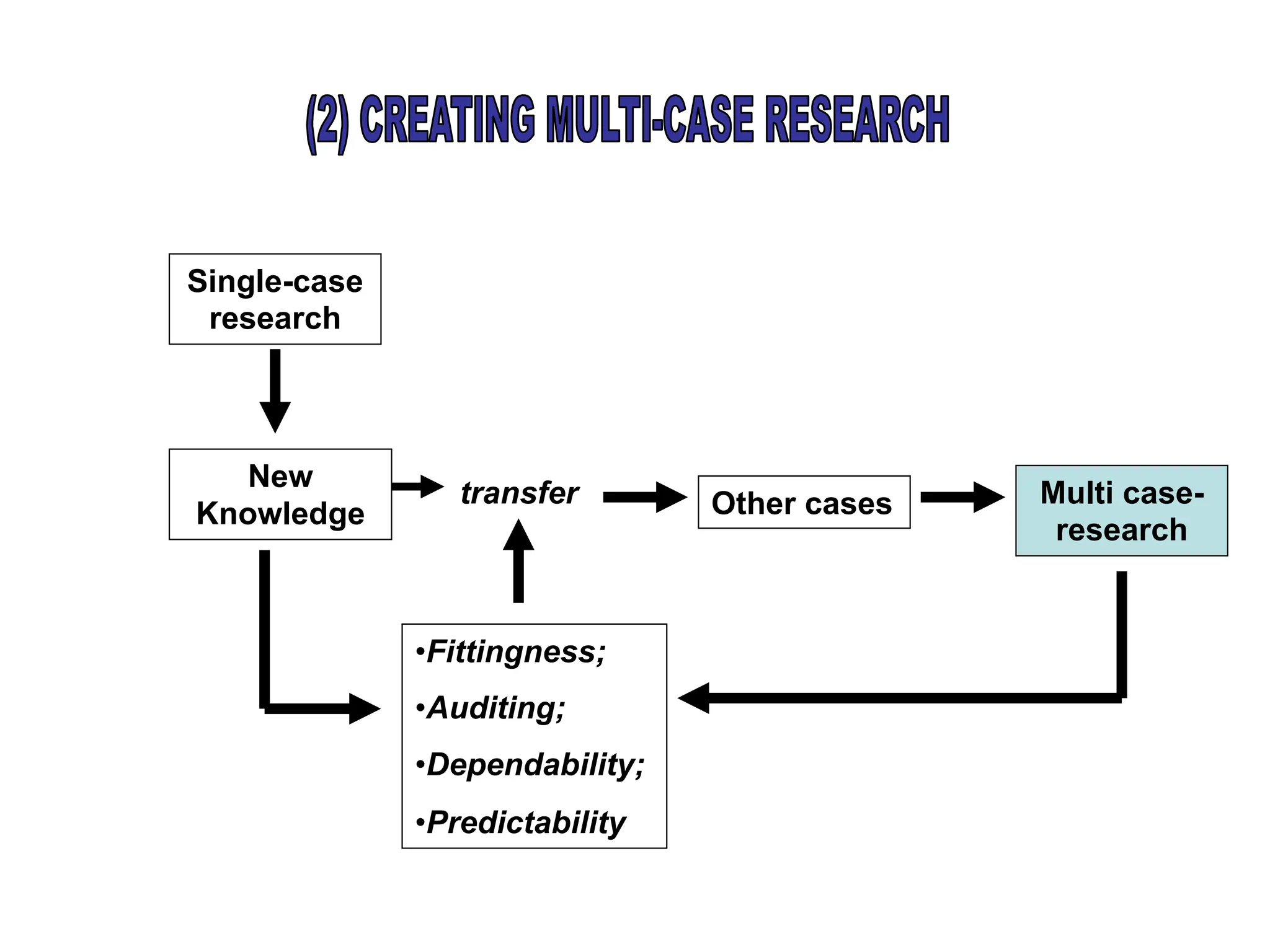
New
Knowledge
transfer Other cases
•Fittingness;
•Auditing;
•Dependability;
•Predictability
Multi case-
research
Single-case
research
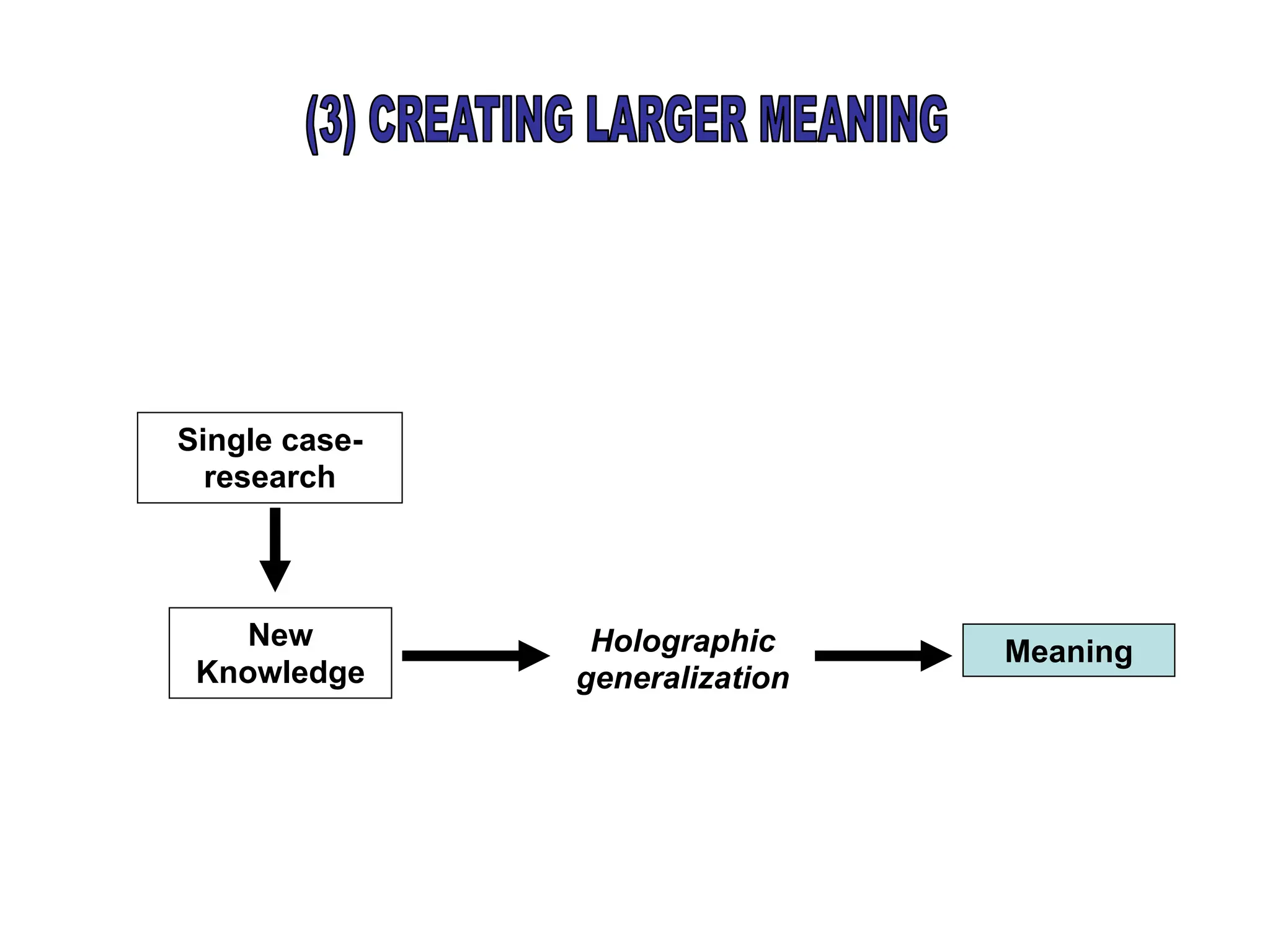
Single case-
research
New
Knowledge
Holographic
generalization
Meaning
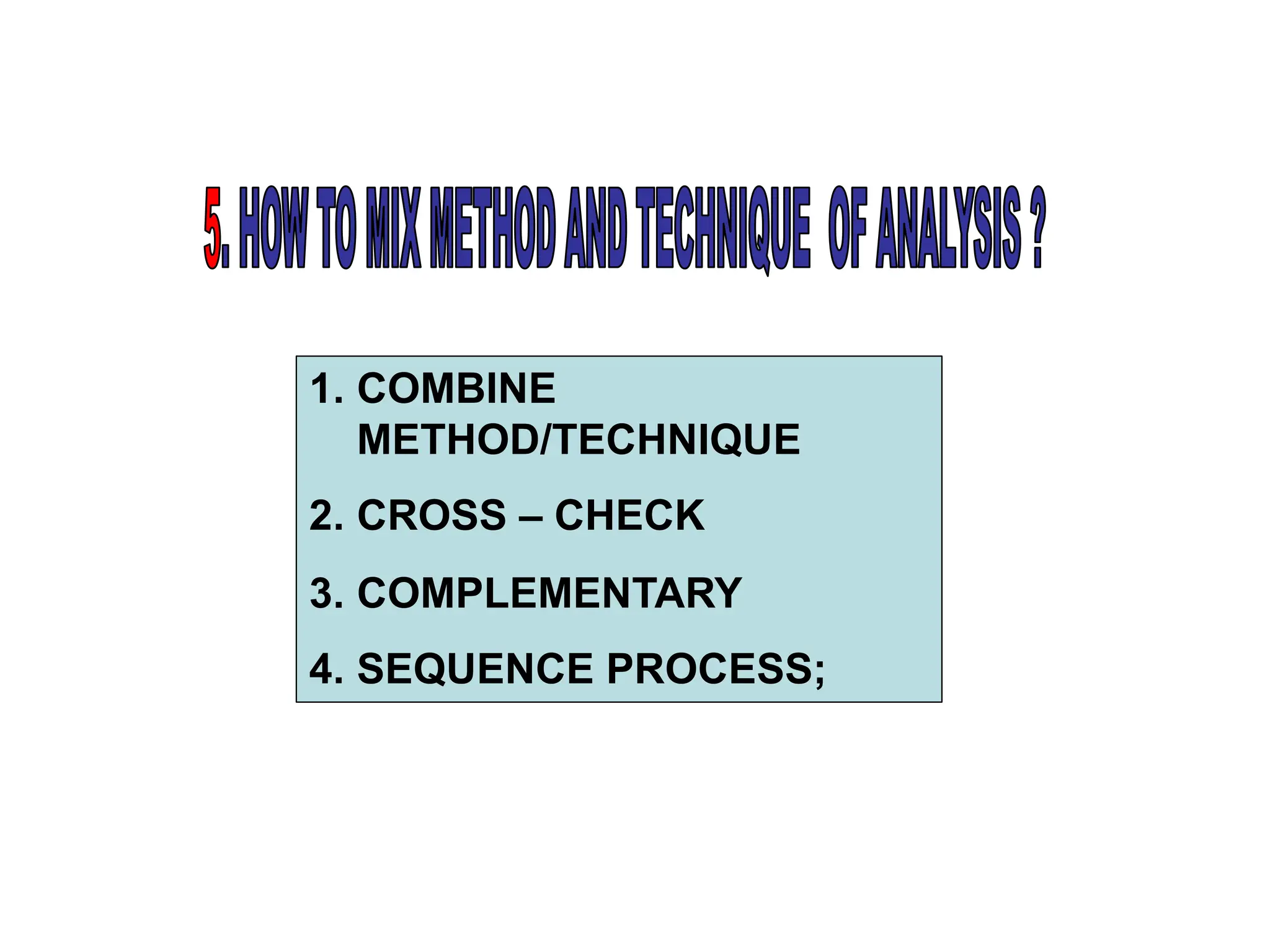
1. COMBINE
METHOD/TECHNIQUE
2. CROSS – CHECK
3. COMPLEMENTARY
4. SEQUENCE PROCESS;
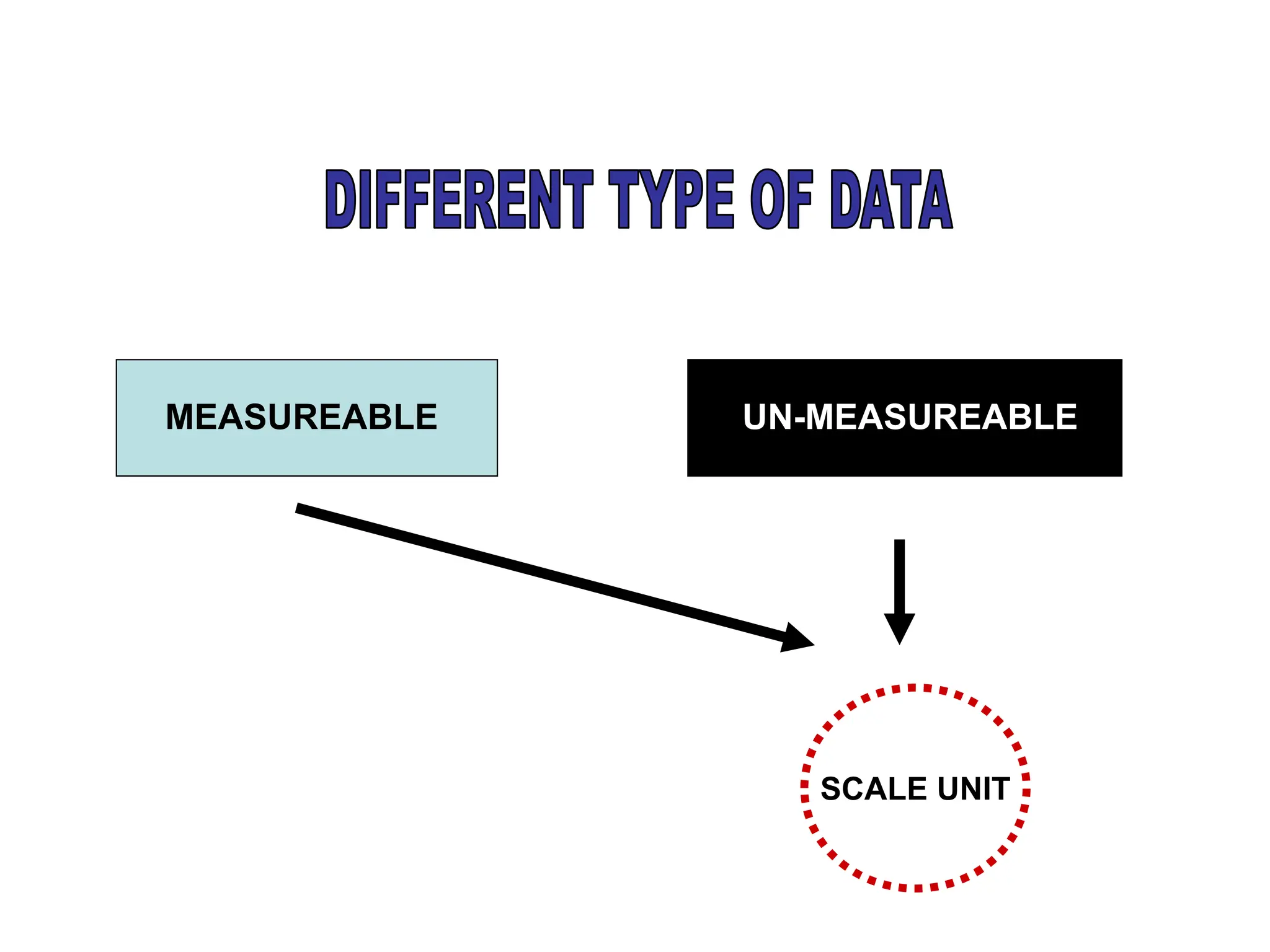
MEASUREABLE UN-MEASUREABLE
SCALE UNIT
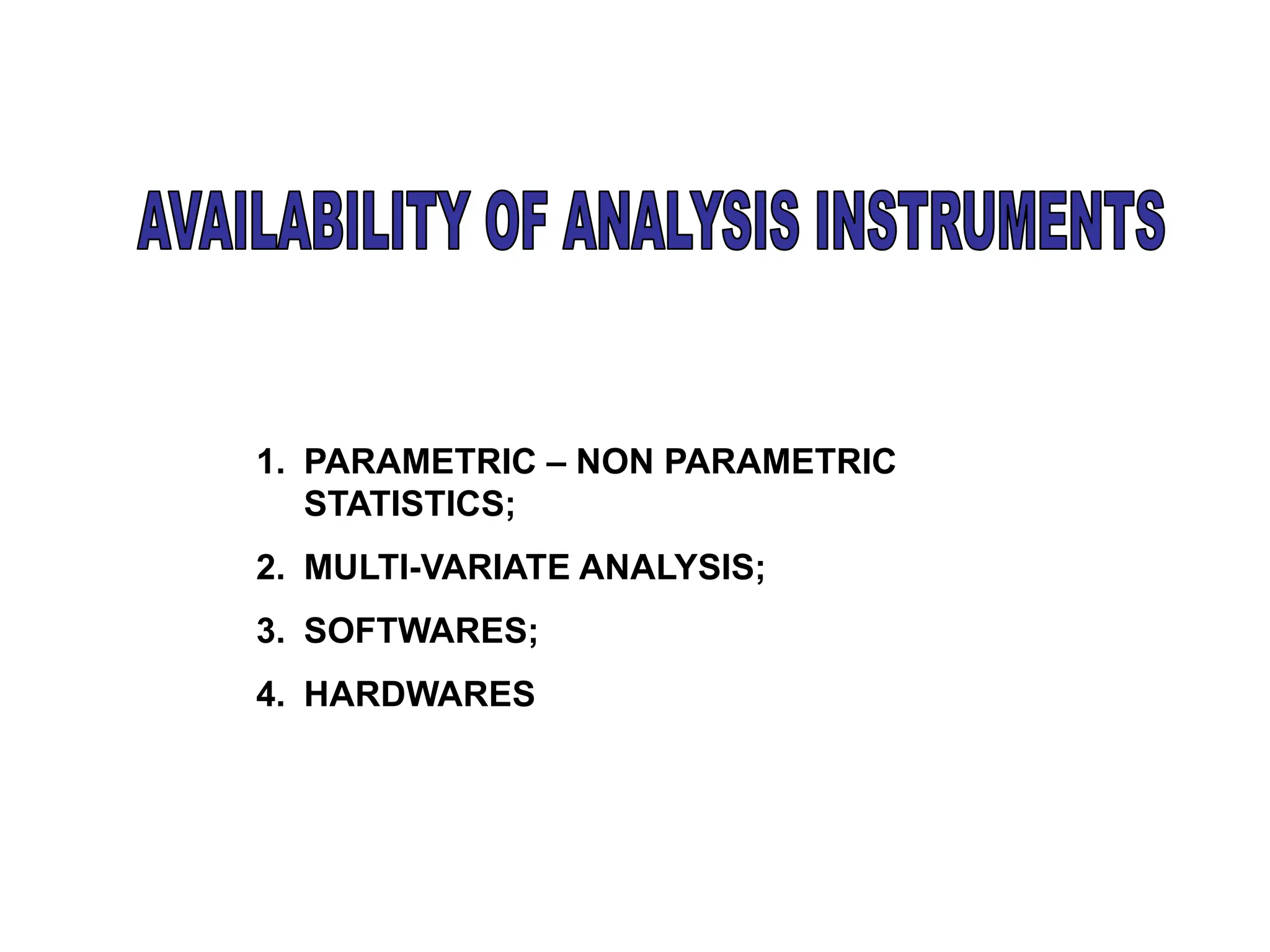
1. PARAMETRIC – NON PARAMETRIC
STATISTICS;
2. MULTI-VARIATE ANALYSIS;
3. SOFTWARES;
4. HARDWARES
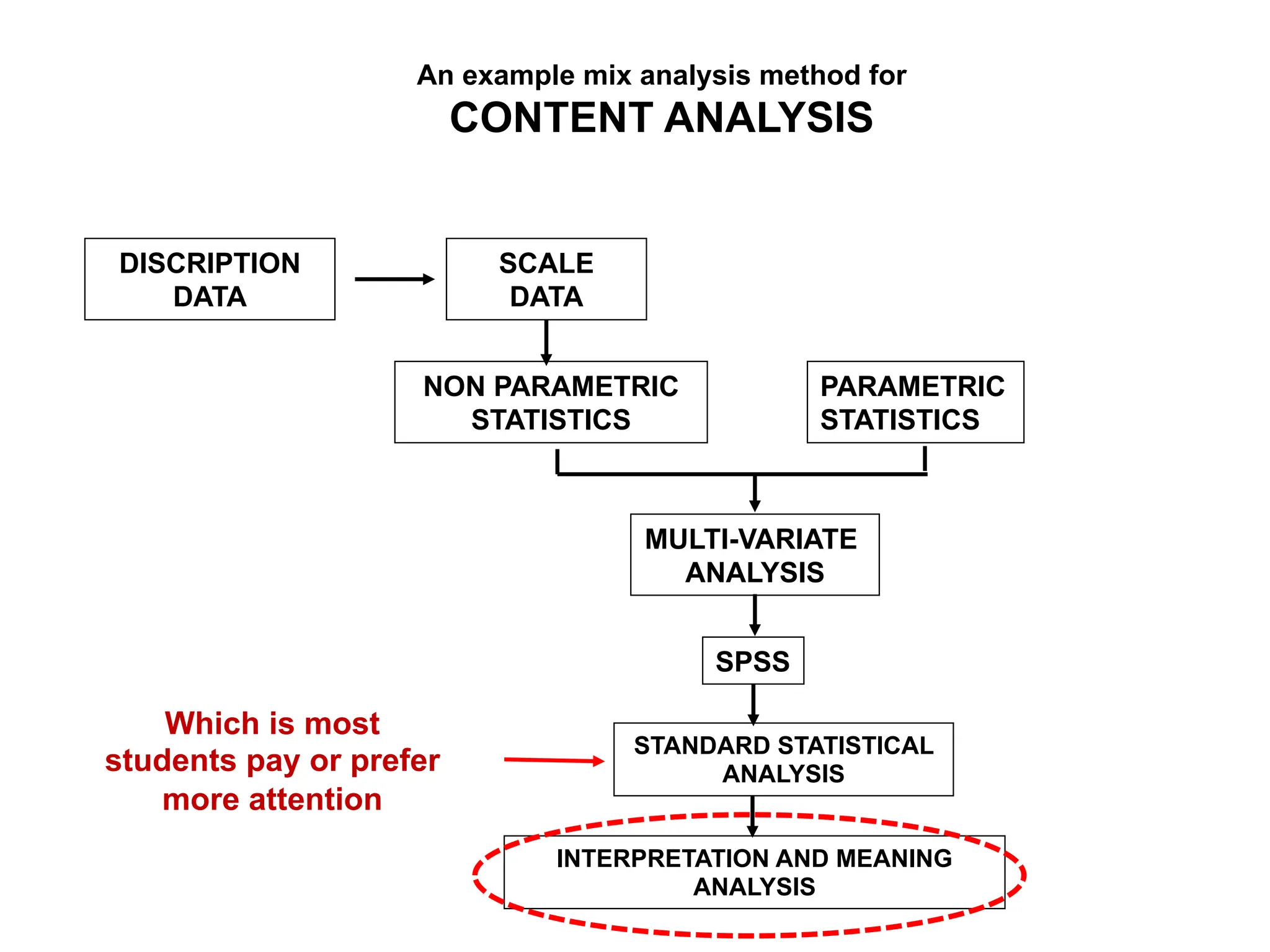
An example mix analysis method for
CONTENT ANALYSIS
DISCRIPTION
DATA
SCALE
DATA
NON PARAMETRIC
STATISTICS
PARAMETRIC
STATISTICS
MULTI-VARIATE
ANALYSIS
SPSS
INTERPRETATION AND MEANING
ANALYSIS
STANDARD STATISTICAL
ANALYSIS
Which is most
students pay or prefer
more attention
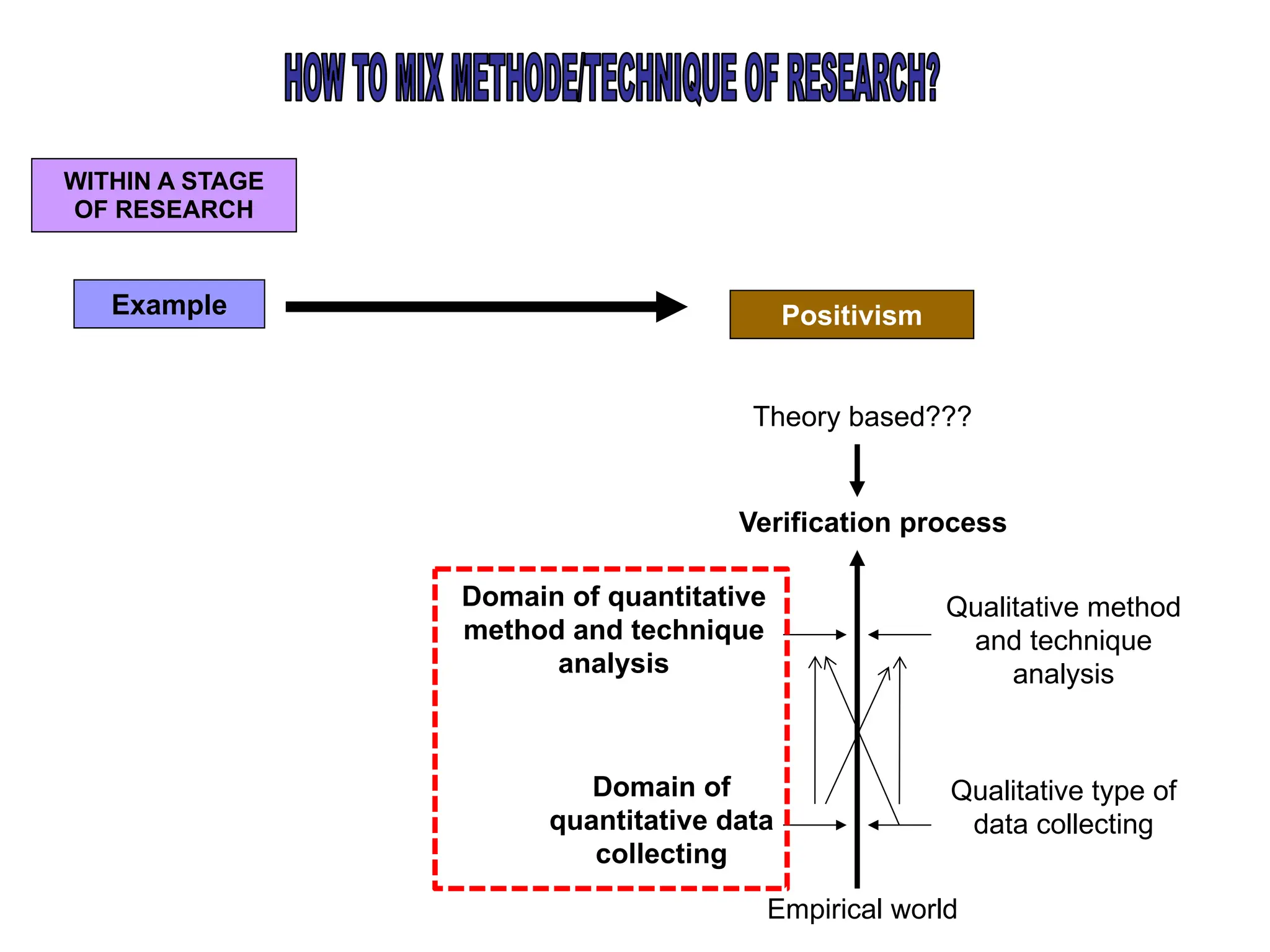
WITHIN A STAGE
OF RESEARCH
Example Positivism
Verification process
Theory based???
Qualitative method
and technique
analysis
Qualitative type of
data collecting
Domain of quantitative
method and technique
analysis
Domain of
quantitative data
collecting
Empirical world
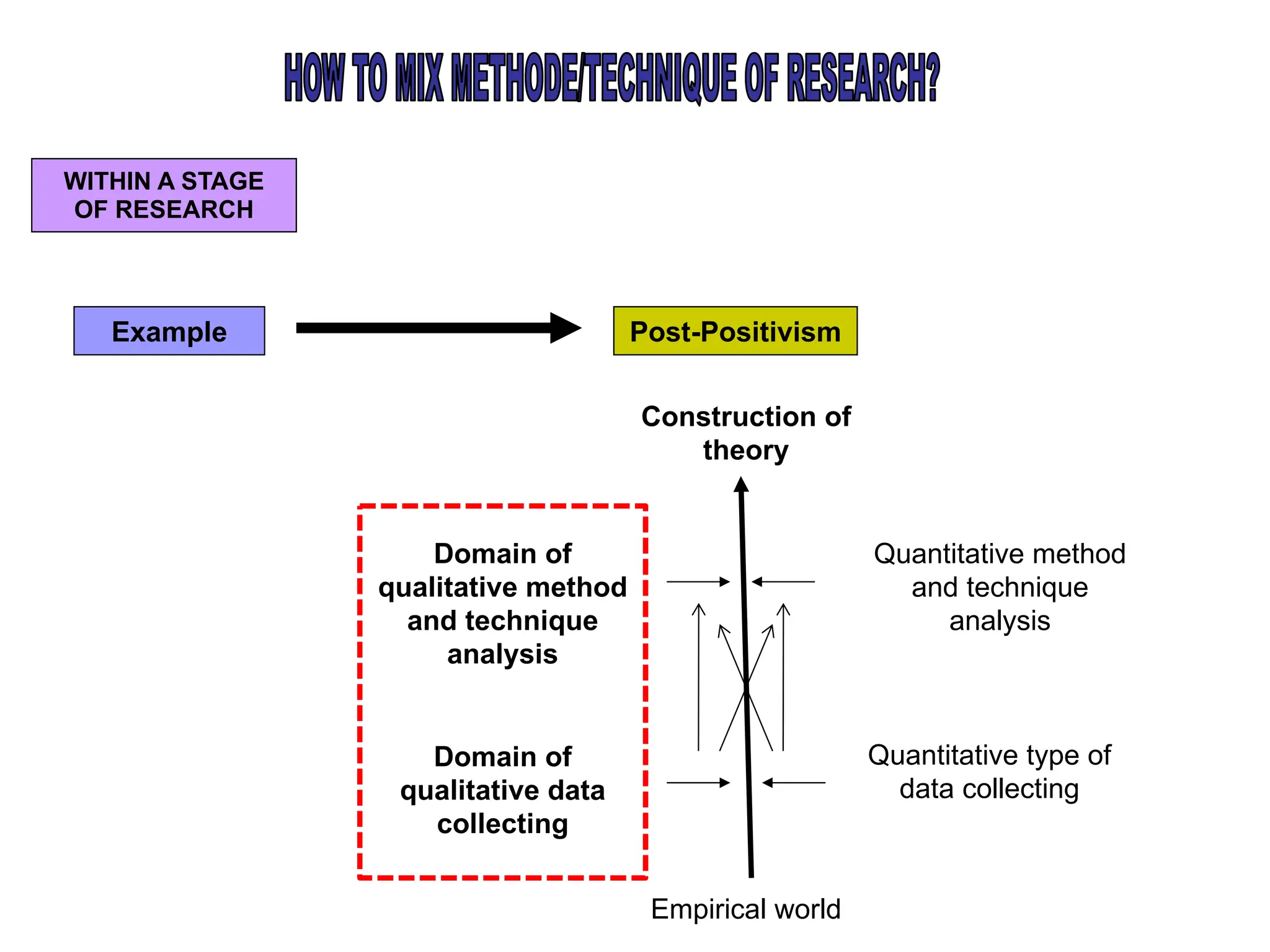
WITHIN A STAGE
OF RESEARCH
Example Post-Positivism
Construction of
theory
Empirical world
Quantitative method
and technique
analysis
Quantitative type of
data collecting
Domain of
qualitative method
and technique
analysis
Domain of
qualitative data
collecting
THANK YOU VERY MUCH
MERCI BEAUCOUP
MUCHAS GRACIAS
TERIMA KASIH BANYAK
MATUR NUWUN SANGET

Research Methodology Paradigms, Positivism, Pre-Positivism, Post-Positivism

  • 1.
    Organized and summarizedfrom different sources by: Joesron Alie Syahbana For: MASTER DEGREE PROGRAM IN URBAN AND REGIONAL DEVELOPMENT PLANNING DIPONEGORO UNIVERSITY Semarang City, August – September 2024
  • 3.
    1. A basisfor thinking, basic concepts, and also a basis for thinking that is used or adopted as a model or basic concept by scientists in carrying out their studies or key technology used in the development of science (Thomas Kunt); 2. A set of values that shape a person's mindset as a starting point for his or her views and form a person's subjective image of reality so that they can determine how to deal with that reality (Robert Friedrichs); 3. A philosophical reference or basis for the implementation of a motive or goal (C. J. Ritzer); 4. A set of basic beliefs that guide human actions in their lives (Egon G. Guba); 5. The most basic way to understand, think, judge, and also do things related to something specific about reality (Harmon); 6. A collection of rules that establish or define boundaries. This term also explains how something must be done within these limits to be successful SOME DEFINITION/CONCEPTS ON PARADIGMS JUST FOR YOUR REFERENCES
  • 4.
    External Influencers External Influencers External Influencers External Influencers Researcher’s capacity Locusand Object Environment Research’s Goals and Objectives Research Strategy and Action RESEARCH ENVIRONMENT
  • 5.
    TYPES OF RESEARCHOBJECTIVES JUST FOR YOUR REFERENCES
  • 6.
    PARADIGM, APPROACH, STRATEGYAND ACTION, METHODE, PROCEDURE AND TECHNIQUE ANALYSIS,
  • 7.
    A SIMPLE EXAMPLEOF RESEARCH PARADIGMS
  • 8.
    JUST FOR YOURREFERENCES
  • 10.
    PRE-POSITIVISM POSITIVISM POST-POSITIVISM RealityStatic, stable, mechanistic Atomistic Dynamic, turbulence, un-stable Theoretical-based Theory verification Theory construction Deductive Deductive-Inductive Inductive Nomothetic Nomothetic Interpretation Idiographic Process General General - Substantive Substantive Value free Value free Value bound We will see what we think We will see what we think We will think what we see Utility of theory Type of theory Type of Value Type of Analysis Quantitative-Rationalistic Quantitative-Rationalistic Qualitative Process What and How What and How (What , How)., and Why Conventional Researches (RATIONALISM/LOGICALISM) (EMPIRISM +CONSTRUCTIVISM) Interpretive Researches Basic R. Question (RATIONALISM + EMPIRISM)) (Some principle characteristics) Pioneers & followers Aristoteles (384 – 322 SM); David Hume (1711 – 1776); Emmanuel Kant August Comte (1798-1857) Karl Popper ; Thomas Kuhn ; Francis Bacon (1561-1626)
  • 11.
    Rationalists assume thatthe world is deterministic and that cause and effect holds for all events; Rationalists generally develop their view in two ways: 1.They argue that there are cases where the content of our concepts or knowledge outstrips the information that sense experience can provide; 2.They construct accounts of how reason in some form or other provides that additional information about the world. JUST FOR YOUR REFERENCES
  • 12.
    Nomothetic is describedas a tendency to generalize, and is typical for the natural sciences. It describes the effort to derive laws that explain types or categories of objective phenomena, in general. Idiographic is described as a tendency to specify, and is typical for the humanities. It describes the effort to understand the meaning of contingent, unique, and often cultural or subjective phenomena. JUST FOR YOUR REFERENCES
  • 13.
    James A. Holsteinand Jaber F. Gubrium suggest that a social constructionist approach deals best with what people construct and how this social construction process unfolds. A social constructionist approach to grounded theory allows us to address why questions while preserving the complexity of social life. The form of constructionism includes examining: (1) the relativity of the researcher’s perspectives, positions, practices, and research situation, (2) the researcher’s reflexivity; and (3) depictions of social constructions in the studied world JUST FOR YOUR REFERENCES
  • 15.
    ETHNOGRAPHY Study on cultureand sub-culture (tribes, heritage, modern, life styles) PHENOMENOLOGY Study on structure and core of the phenomena HEURISTICS A problem-solving method that used shortcut to produce good enough solutions given a limited time frame or deadline The best practice and lesson learn from other researchers in the similar phenomena; ETHNOMETHODOLOGY Study on an acceptable attitudes and behaviors daily life; SYMBOLIC INTERACTION Study on the meanings of a set of symbols, signs, insights, sense etc ENVIRONMENTAL PSYCHOLOGY Study on human behavior in their specific environment in order to achieve their goal
  • 16.
    (SOFT) SYSTEM Study on(how and why) the survival/sustainable of a set of social system CHAOS Dealing with the construction of description which involving all aspects within and without the rule of phenomena. HERMENEUTICS As the methodology of interpretation is concerned with problems that arise when dealing with meaningful of human actions and the products, most importantly texts, for example To express actions or cultural products can be interpreted to be meaningfulthing. ORIENTATIONAL Studi on the prespectives of ideology within the phenomena NATURALISTIC INQUIRY Study on social phenomena in the natural or normal setting
  • 17.
    The New Languageof Qualitative Method (Gubrium & Holstein, 1997), they proposed that naturalistic qualitative researchers could address why questions “by considering the contingent relations between the whats and hows of social life”
  • 18.
    1. Natural Setting; 2.Human Instrument; 3. Tacit Knowledge; 4. Qualitative Methods; 5. Purposive Sampling; 6. Inductive (Data) Analysis; 7. Grounded Theory; 8. Emerged Design; 9. Negotiated Outcomes; 10. Case Study Reporting Mode; 10. Idiographic Interpretation; 11. Tentative Application; 12. Focus Determined Boundaries; 13. Special Criteria for Trustworthiness; 14. Phenomenology; 15. Substantive theory construction; 16. Participatory observation
  • 20.
    STAGES Different Paradigms Pre-Positivism Pre-Positivism Post-PositivismPositivism Justification of the research Main research Example Transferability (Extended research) Dialog with existing theories Research activities
  • 21.
  • 22.
    Conventional Researches Interpretive Researches Gap of knowledge onre-ability Equilibrium between rationality and emotionality Domain of rationality Domain of emotionality
  • 23.
  • 24.
  • 25.
  • 26.
    1. COMBINE METHOD/TECHNIQUE 2. CROSS– CHECK 3. COMPLEMENTARY 4. SEQUENCE PROCESS;
  • 27.
  • 28.
    1. PARAMETRIC –NON PARAMETRIC STATISTICS; 2. MULTI-VARIATE ANALYSIS; 3. SOFTWARES; 4. HARDWARES
  • 29.
    An example mixanalysis method for CONTENT ANALYSIS DISCRIPTION DATA SCALE DATA NON PARAMETRIC STATISTICS PARAMETRIC STATISTICS MULTI-VARIATE ANALYSIS SPSS INTERPRETATION AND MEANING ANALYSIS STANDARD STATISTICAL ANALYSIS Which is most students pay or prefer more attention
  • 30.
    WITHIN A STAGE OFRESEARCH Example Positivism Verification process Theory based??? Qualitative method and technique analysis Qualitative type of data collecting Domain of quantitative method and technique analysis Domain of quantitative data collecting Empirical world
  • 31.
    WITHIN A STAGE OFRESEARCH Example Post-Positivism Construction of theory Empirical world Quantitative method and technique analysis Quantitative type of data collecting Domain of qualitative method and technique analysis Domain of qualitative data collecting
  • 32.
    THANK YOU VERYMUCH MERCI BEAUCOUP MUCHAS GRACIAS TERIMA KASIH BANYAK MATUR NUWUN SANGET