
Perspectives onPerspectives on
Research MethodologyResearch Methodology
Darleen OpferDarleen Opfer
Behind the welter of names – positivism, naturalism, post-Behind the welter of names – positivism, naturalism, post-
positivism, relativism, feminist standpoint epistemology,positivism, relativism, feminist standpoint epistemology,
foundationalism, postmodernism, each with an array offoundationalism, postmodernism, each with an array of
sub-species – lie important questions: Is there a single,sub-species – lie important questions: Is there a single,
absolute truth about educational phenomena, or are thereabsolute truth about educational phenomena, or are there
multiple truth? (Or is the concept of truth itself somultiple truth? (Or is the concept of truth itself so
problematic as to be of no value in understanding theproblematic as to be of no value in understanding the
world?) Can we count on our senses or on reason, toworld?) Can we count on our senses or on reason, to
distinguish that which is true about the world from thatdistinguish that which is true about the world from that
which is false? Are there methods that can lead us close towhich is false? Are there methods that can lead us close to
understanding, or are there inherent indeterminancies in allunderstanding, or are there inherent indeterminancies in all
methods? Is knowledge of the world discovered, ormethods? Is knowledge of the world discovered, or
constructed? Can knowledge of the world be evaluatedconstructed? Can knowledge of the world be evaluated
independent of the social and historical contexts in which itindependent of the social and historical contexts in which it
exists, or is it always contingent upon, or relative to,exists, or is it always contingent upon, or relative to,
particular circumstances?particular circumstances?
(Pallas, 2003, p.6)(Pallas, 2003, p.6)
Why Understand ResearchWhy Understand Research
Epistemology and Ontology?Epistemology and Ontology?
 to understand the interrelationship of theto understand the interrelationship of the
key components of research (includingkey components of research (including
methodology and methods);methodology and methods);
 to avoid confusion when discussingto avoid confusion when discussing
theoretical debates and approaches totheoretical debates and approaches to
social phenomena; andsocial phenomena; and
 to be able to recognize others’, andto be able to recognize others’, and
defend our own, positions.defend our own, positions.
OntologyOntology
claims and assumptions that are madeclaims and assumptions that are made
about the nature of social reality, claimsabout the nature of social reality, claims
about what exists, what it looks like, whatabout what exists, what it looks like, what
units make it up and how these unitsunits make it up and how these units
interact with each other. In short,interact with each other. In short,
ontological assumptions are concernedontological assumptions are concerned
with what we believe constitutes socialwith what we believe constitutes social
reality.’reality.’Blaikie, 2000, p. 8Blaikie, 2000, p. 8
EpistemologyEpistemology
the possible ways of gaining knowledge ofthe possible ways of gaining knowledge of
social reality, whatever it is understood tosocial reality, whatever it is understood to
be. In short, claims about how what isbe. In short, claims about how what is
assumed to exist can be known.assumed to exist can be known. Blaikie,Blaikie,
2000, p. 82000, p. 8
Epistemological AssumptionsEpistemological Assumptions
 ObjectivityObjectivity believes that knowledge existsbelieves that knowledge exists
whether we are conscious of it or not.whether we are conscious of it or not.
 ConstructionistConstructionist believes that we come tobelieves that we come to
“know” through our interactions.“know” through our interactions.
 SubjectivitySubjectivity believes that everyone has abelieves that everyone has a
different understanding of what we know.different understanding of what we know.
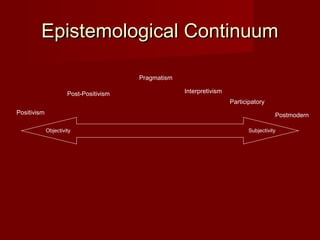
Epistemological ContinuumEpistemological Continuum
Post-Positivism
Positivism
Interpretivism
Pragmatism
Participatory
Postmodern
Objectivity Subjectivity
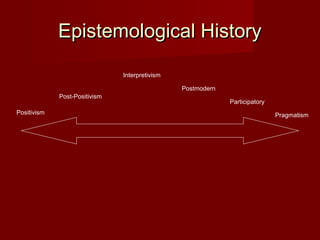
Epistemological HistoryEpistemological History
Post-Positivism
Positivism
Interpretivism
Pragmatism
Participatory
Postmodern
Assumptions of Post - PositivismAssumptions of Post - Positivism
 Absolute truthAbsolute truth can never be found.can never be found.
 Research is a process of making claims and thenResearch is a process of making claims and then
testing, refining or abandoning some of them for othertesting, refining or abandoning some of them for other
claims more strongly warranted.claims more strongly warranted.
 Data,Data, evidenceevidence and rational considerations shapeand rational considerations shape
knowledge.knowledge.
 Research seeks to develop relevant,Research seeks to develop relevant, truetrue statementsstatements
that can serve to explain the situation that is ofthat can serve to explain the situation that is of
concern or that describes theconcern or that describes the causalcausal relationship ofrelationship of
interest.interest.
 Researchers must examine their methods andResearchers must examine their methods and
conclusions and control orconclusions and control or limit biaslimit bias..
Assumptions of InterpretivismAssumptions of Interpretivism
 Meanings are constructedMeanings are constructed by humans asby humans as
they engage with the world they arethey engage with the world they are
interpretinginterpreting..
 Humans make sense of the world based onHumans make sense of the world based on
their historical and social perspective. Theytheir historical and social perspective. They
seek to understandseek to understand thethe contextcontext and thenand then
makemake an interpretationan interpretation of what they findof what they find
which is shaped by their own experiences andwhich is shaped by their own experiences and
backgrounds.backgrounds.
 The basic generation of meaning is alwaysThe basic generation of meaning is always
social.social.
Assumptions of ParticipatoryAssumptions of Participatory
 Participatory research is recursive andParticipatory research is recursive and
dialectical and is focused ondialectical and is focused on bringbring
about changeabout change in practices.in practices.
 Begins with a stance about the problemsBegins with a stance about the problems
in society.in society.
 It is emancipatory.It is emancipatory.
 It is inquiryIt is inquiry completed with otherscompleted with others
rather than on or to others.rather than on or to others.
 The research process isThe research process is cyclicalcyclical..
Assumptions of PragmatismAssumptions of Pragmatism
 Is not committed to any one system ofIs not committed to any one system of
philosophy or reality.philosophy or reality.
 Individual researchers haveIndividual researchers have freedom offreedom of
choicechoice to select procedures that best meetto select procedures that best meet
their needs.their needs.
 Pragmatists do not see the world as anPragmatists do not see the world as an
absolute unity.absolute unity.
 Truth isTruth is what works at the timewhat works at the time ..
 We need to stop asking questions about realityWe need to stop asking questions about reality
and the laws of nature andand the laws of nature and start solvingstart solving
problemsproblems..
Activity 1: Language Use inActivity 1: Language Use in
AbstractsAbstracts
Read the abstracts provided and underlineRead the abstracts provided and underline
words which you think may illustrate thewords which you think may illustrate the
epistemological and theoreticalepistemological and theoretical
assumptions of the researcher.assumptions of the researcher.
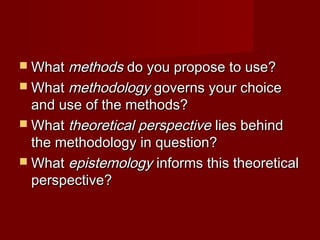
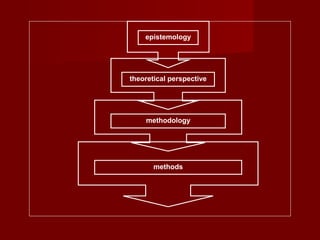
 WhatWhat methodsmethods do you propose to use?do you propose to use?
 WhatWhat methodologymethodology governs your choicegoverns your choice
and use of the methods?and use of the methods?
 WhatWhat theoretical perspectivetheoretical perspective lies behindlies behind
the methodology in question?the methodology in question?
 WhatWhat epistemologyepistemology informs this theoreticalinforms this theoretical
perspective?perspective?
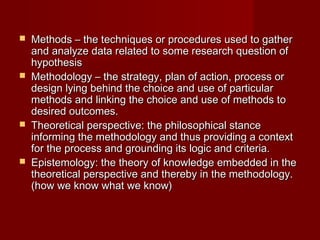
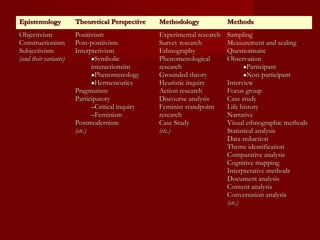
 Methods – the techniques or procedures used to gatherMethods – the techniques or procedures used to gather
and analyze data related to some research question ofand analyze data related to some research question of
hypothesishypothesis
 Methodology – the strategy, plan of action, process orMethodology – the strategy, plan of action, process or
design lying behind the choice and use of particulardesign lying behind the choice and use of particular
methods and linking the choice and use of methods tomethods and linking the choice and use of methods to
desired outcomes.desired outcomes.
 Theoretical perspective: the philosophical stanceTheoretical perspective: the philosophical stance
informing the methodology and thus providing a contextinforming the methodology and thus providing a context
for the process and grounding its logic and criteria.for the process and grounding its logic and criteria.
 Epistemology: the theory of knowledge embedded in theEpistemology: the theory of knowledge embedded in the
theoretical perspective and thereby in the methodology.theoretical perspective and thereby in the methodology.
(how we know what we know)(how we know what we know)
epistemology
theoretical perspective
methodology
methods
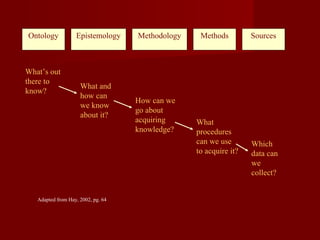
Ontology Epistemology Methodology Methods Sources
What’s out
there to
know?
What and
how can
we know
about it?
How can we
go about
acquiring
knowledge?
What
procedures
can we use
to acquire it?
Which
data can
we
collect?
Adapted from Hay, 2002, pg. 64
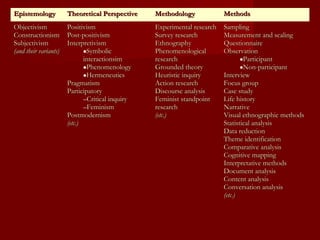
EpistemologyEpistemology Theoretical PerspectiveTheoretical Perspective MethodologyMethodology MethodsMethods
ObjectivismObjectivism
ConstructionismConstructionism
SubjectivismSubjectivism
(and their variants)(and their variants)
PositivismPositivism
Post-positivismPost-positivism
InterpretivismInterpretivism
•SymbolicSymbolic
interactionsiminteractionsim
•PhenomenologyPhenomenology
•HermeneuticsHermeneutics
PragmatismPragmatism
ParticipatoryParticipatory
–Critical inquiryCritical inquiry
–FeminismFeminism
PostmodernismPostmodernism
(etc.)(etc.)
Experimental researchExperimental research
Survey researchSurvey research
EthnographyEthnography
PhenomenologicalPhenomenological
researchresearch
Grounded theoryGrounded theory
Heuristic inquiryHeuristic inquiry
Action researchAction research
Discourse analysisDiscourse analysis
Feminist standpointFeminist standpoint
researchresearch
Case StudyCase Study
(etc.)(etc.)
SamplingSampling
Measurement and scalingMeasurement and scaling
QuestionnaireQuestionnaire
ObservationObservation
•ParticipantParticipant
•Non-participantNon-participant
InterviewInterview
Focus groupFocus group
Case studyCase study
Life historyLife history
NarrativeNarrative
Visual ethnographic methodsVisual ethnographic methods
Statistical analysisStatistical analysis
Data reductionData reduction
Theme identificationTheme identification
Comparative analysisComparative analysis
Cognitive mappingCognitive mapping
Interpretative methodsInterpretative methods
Document analysisDocument analysis
Content analysisContent analysis
Conversation analysisConversation analysis
(etc.)(etc.)
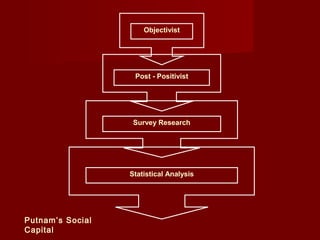
Objectivist
Post - Positivist
Survey Research
Statistical Analysis
Putnam’s Social
Capital
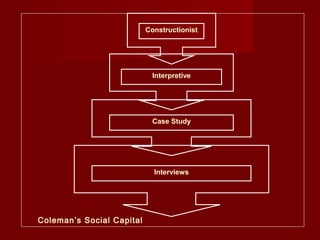
Constructionist
Interpretive
Case Study
Interviews
Coleman’s Social Capital
Activity 2: Your Own ResearchActivity 2: Your Own Research
DiagramDiagram
Use the blank Crotty Diagram to identifyUse the blank Crotty Diagram to identify
the chain that seems to underlie your ownthe chain that seems to underlie your own
research interests. We will share theseresearch interests. We will share these
when finished.when finished.
EpistemologyEpistemology Theoretical PerspectiveTheoretical Perspective MethodologyMethodology MethodsMethods
ObjectivismObjectivism
ConstructionismConstructionism
SubjectivismSubjectivism
(and their variants)(and their variants)
PositivismPositivism
Post-positivismPost-positivism
InterpretivismInterpretivism
•SymbolicSymbolic
interactionsiminteractionsim
•PhenomenologyPhenomenology
•HermeneuticsHermeneutics
PragmatismPragmatism
ParticipatoryParticipatory
–Critical inquiryCritical inquiry
–FeminismFeminism
PostmodernismPostmodernism
(etc.)(etc.)
Experimental researchExperimental research
Survey researchSurvey research
EthnographyEthnography
PhenomenologicalPhenomenological
researchresearch
Grounded theoryGrounded theory
Heuristic inquiryHeuristic inquiry
Action researchAction research
Discourse analysisDiscourse analysis
Feminist standpointFeminist standpoint
researchresearch
(etc.)(etc.)
SamplingSampling
Measurement and scalingMeasurement and scaling
QuestionnaireQuestionnaire
ObservationObservation
•ParticipantParticipant
•Non-participantNon-participant
InterviewInterview
Focus groupFocus group
Case studyCase study
Life historyLife history
NarrativeNarrative
Visual ethnographic methodsVisual ethnographic methods
Statistical analysisStatistical analysis
Data reductionData reduction
Theme identificationTheme identification
Comparative analysisComparative analysis
Cognitive mappingCognitive mapping
Interpretative methodsInterpretative methods
Document analysisDocument analysis
Content analysisContent analysis
Conversation analysisConversation analysis
(etc.)(etc.)

Research perspective overview_slides_2008-2009

  • 1.
    Perspectives onPerspectives on ResearchMethodologyResearch Methodology Darleen OpferDarleen Opfer
  • 2.
    Behind the welterof names – positivism, naturalism, post-Behind the welter of names – positivism, naturalism, post- positivism, relativism, feminist standpoint epistemology,positivism, relativism, feminist standpoint epistemology, foundationalism, postmodernism, each with an array offoundationalism, postmodernism, each with an array of sub-species – lie important questions: Is there a single,sub-species – lie important questions: Is there a single, absolute truth about educational phenomena, or are thereabsolute truth about educational phenomena, or are there multiple truth? (Or is the concept of truth itself somultiple truth? (Or is the concept of truth itself so problematic as to be of no value in understanding theproblematic as to be of no value in understanding the world?) Can we count on our senses or on reason, toworld?) Can we count on our senses or on reason, to distinguish that which is true about the world from thatdistinguish that which is true about the world from that which is false? Are there methods that can lead us close towhich is false? Are there methods that can lead us close to understanding, or are there inherent indeterminancies in allunderstanding, or are there inherent indeterminancies in all methods? Is knowledge of the world discovered, ormethods? Is knowledge of the world discovered, or constructed? Can knowledge of the world be evaluatedconstructed? Can knowledge of the world be evaluated independent of the social and historical contexts in which itindependent of the social and historical contexts in which it exists, or is it always contingent upon, or relative to,exists, or is it always contingent upon, or relative to, particular circumstances?particular circumstances? (Pallas, 2003, p.6)(Pallas, 2003, p.6)
  • 3.
    Why Understand ResearchWhyUnderstand Research Epistemology and Ontology?Epistemology and Ontology?  to understand the interrelationship of theto understand the interrelationship of the key components of research (includingkey components of research (including methodology and methods);methodology and methods);  to avoid confusion when discussingto avoid confusion when discussing theoretical debates and approaches totheoretical debates and approaches to social phenomena; andsocial phenomena; and  to be able to recognize others’, andto be able to recognize others’, and defend our own, positions.defend our own, positions.
  • 4.
    OntologyOntology claims and assumptionsthat are madeclaims and assumptions that are made about the nature of social reality, claimsabout the nature of social reality, claims about what exists, what it looks like, whatabout what exists, what it looks like, what units make it up and how these unitsunits make it up and how these units interact with each other. In short,interact with each other. In short, ontological assumptions are concernedontological assumptions are concerned with what we believe constitutes socialwith what we believe constitutes social reality.’reality.’Blaikie, 2000, p. 8Blaikie, 2000, p. 8
  • 5.
    EpistemologyEpistemology the possible waysof gaining knowledge ofthe possible ways of gaining knowledge of social reality, whatever it is understood tosocial reality, whatever it is understood to be. In short, claims about how what isbe. In short, claims about how what is assumed to exist can be known.assumed to exist can be known. Blaikie,Blaikie, 2000, p. 82000, p. 8
  • 6.
    Epistemological AssumptionsEpistemological Assumptions ObjectivityObjectivity believes that knowledge existsbelieves that knowledge exists whether we are conscious of it or not.whether we are conscious of it or not.  ConstructionistConstructionist believes that we come tobelieves that we come to “know” through our interactions.“know” through our interactions.  SubjectivitySubjectivity believes that everyone has abelieves that everyone has a different understanding of what we know.different understanding of what we know.
  • 7.
  • 8.
  • 9.
    Assumptions of Post- PositivismAssumptions of Post - Positivism  Absolute truthAbsolute truth can never be found.can never be found.  Research is a process of making claims and thenResearch is a process of making claims and then testing, refining or abandoning some of them for othertesting, refining or abandoning some of them for other claims more strongly warranted.claims more strongly warranted.  Data,Data, evidenceevidence and rational considerations shapeand rational considerations shape knowledge.knowledge.  Research seeks to develop relevant,Research seeks to develop relevant, truetrue statementsstatements that can serve to explain the situation that is ofthat can serve to explain the situation that is of concern or that describes theconcern or that describes the causalcausal relationship ofrelationship of interest.interest.  Researchers must examine their methods andResearchers must examine their methods and conclusions and control orconclusions and control or limit biaslimit bias..
  • 10.
    Assumptions of InterpretivismAssumptionsof Interpretivism  Meanings are constructedMeanings are constructed by humans asby humans as they engage with the world they arethey engage with the world they are interpretinginterpreting..  Humans make sense of the world based onHumans make sense of the world based on their historical and social perspective. Theytheir historical and social perspective. They seek to understandseek to understand thethe contextcontext and thenand then makemake an interpretationan interpretation of what they findof what they find which is shaped by their own experiences andwhich is shaped by their own experiences and backgrounds.backgrounds.  The basic generation of meaning is alwaysThe basic generation of meaning is always social.social.
  • 11.
    Assumptions of ParticipatoryAssumptionsof Participatory  Participatory research is recursive andParticipatory research is recursive and dialectical and is focused ondialectical and is focused on bringbring about changeabout change in practices.in practices.  Begins with a stance about the problemsBegins with a stance about the problems in society.in society.  It is emancipatory.It is emancipatory.  It is inquiryIt is inquiry completed with otherscompleted with others rather than on or to others.rather than on or to others.  The research process isThe research process is cyclicalcyclical..
  • 12.
    Assumptions of PragmatismAssumptionsof Pragmatism  Is not committed to any one system ofIs not committed to any one system of philosophy or reality.philosophy or reality.  Individual researchers haveIndividual researchers have freedom offreedom of choicechoice to select procedures that best meetto select procedures that best meet their needs.their needs.  Pragmatists do not see the world as anPragmatists do not see the world as an absolute unity.absolute unity.  Truth isTruth is what works at the timewhat works at the time ..  We need to stop asking questions about realityWe need to stop asking questions about reality and the laws of nature andand the laws of nature and start solvingstart solving problemsproblems..
  • 13.
    Activity 1: LanguageUse inActivity 1: Language Use in AbstractsAbstracts Read the abstracts provided and underlineRead the abstracts provided and underline words which you think may illustrate thewords which you think may illustrate the epistemological and theoreticalepistemological and theoretical assumptions of the researcher.assumptions of the researcher.
  • 14.
     WhatWhat methodsmethodsdo you propose to use?do you propose to use?  WhatWhat methodologymethodology governs your choicegoverns your choice and use of the methods?and use of the methods?  WhatWhat theoretical perspectivetheoretical perspective lies behindlies behind the methodology in question?the methodology in question?  WhatWhat epistemologyepistemology informs this theoreticalinforms this theoretical perspective?perspective?
  • 15.
     Methods –the techniques or procedures used to gatherMethods – the techniques or procedures used to gather and analyze data related to some research question ofand analyze data related to some research question of hypothesishypothesis  Methodology – the strategy, plan of action, process orMethodology – the strategy, plan of action, process or design lying behind the choice and use of particulardesign lying behind the choice and use of particular methods and linking the choice and use of methods tomethods and linking the choice and use of methods to desired outcomes.desired outcomes.  Theoretical perspective: the philosophical stanceTheoretical perspective: the philosophical stance informing the methodology and thus providing a contextinforming the methodology and thus providing a context for the process and grounding its logic and criteria.for the process and grounding its logic and criteria.  Epistemology: the theory of knowledge embedded in theEpistemology: the theory of knowledge embedded in the theoretical perspective and thereby in the methodology.theoretical perspective and thereby in the methodology. (how we know what we know)(how we know what we know)
  • 16.
  • 17.
    Ontology Epistemology MethodologyMethods Sources What’s out there to know? What and how can we know about it? How can we go about acquiring knowledge? What procedures can we use to acquire it? Which data can we collect? Adapted from Hay, 2002, pg. 64
  • 18.
    EpistemologyEpistemology Theoretical PerspectiveTheoreticalPerspective MethodologyMethodology MethodsMethods ObjectivismObjectivism ConstructionismConstructionism SubjectivismSubjectivism (and their variants)(and their variants) PositivismPositivism Post-positivismPost-positivism InterpretivismInterpretivism •SymbolicSymbolic interactionsiminteractionsim •PhenomenologyPhenomenology •HermeneuticsHermeneutics PragmatismPragmatism ParticipatoryParticipatory –Critical inquiryCritical inquiry –FeminismFeminism PostmodernismPostmodernism (etc.)(etc.) Experimental researchExperimental research Survey researchSurvey research EthnographyEthnography PhenomenologicalPhenomenological researchresearch Grounded theoryGrounded theory Heuristic inquiryHeuristic inquiry Action researchAction research Discourse analysisDiscourse analysis Feminist standpointFeminist standpoint researchresearch Case StudyCase Study (etc.)(etc.) SamplingSampling Measurement and scalingMeasurement and scaling QuestionnaireQuestionnaire ObservationObservation •ParticipantParticipant •Non-participantNon-participant InterviewInterview Focus groupFocus group Case studyCase study Life historyLife history NarrativeNarrative Visual ethnographic methodsVisual ethnographic methods Statistical analysisStatistical analysis Data reductionData reduction Theme identificationTheme identification Comparative analysisComparative analysis Cognitive mappingCognitive mapping Interpretative methodsInterpretative methods Document analysisDocument analysis Content analysisContent analysis Conversation analysisConversation analysis (etc.)(etc.)
  • 19.
    Objectivist Post - Positivist SurveyResearch Statistical Analysis Putnam’s Social Capital
  • 20.
  • 21.
    Activity 2: YourOwn ResearchActivity 2: Your Own Research DiagramDiagram Use the blank Crotty Diagram to identifyUse the blank Crotty Diagram to identify the chain that seems to underlie your ownthe chain that seems to underlie your own research interests. We will share theseresearch interests. We will share these when finished.when finished.
  • 22.
    EpistemologyEpistemology Theoretical PerspectiveTheoreticalPerspective MethodologyMethodology MethodsMethods ObjectivismObjectivism ConstructionismConstructionism SubjectivismSubjectivism (and their variants)(and their variants) PositivismPositivism Post-positivismPost-positivism InterpretivismInterpretivism •SymbolicSymbolic interactionsiminteractionsim •PhenomenologyPhenomenology •HermeneuticsHermeneutics PragmatismPragmatism ParticipatoryParticipatory –Critical inquiryCritical inquiry –FeminismFeminism PostmodernismPostmodernism (etc.)(etc.) Experimental researchExperimental research Survey researchSurvey research EthnographyEthnography PhenomenologicalPhenomenological researchresearch Grounded theoryGrounded theory Heuristic inquiryHeuristic inquiry Action researchAction research Discourse analysisDiscourse analysis Feminist standpointFeminist standpoint researchresearch (etc.)(etc.) SamplingSampling Measurement and scalingMeasurement and scaling QuestionnaireQuestionnaire ObservationObservation •ParticipantParticipant •Non-participantNon-participant InterviewInterview Focus groupFocus group Case studyCase study Life historyLife history NarrativeNarrative Visual ethnographic methodsVisual ethnographic methods Statistical analysisStatistical analysis Data reductionData reduction Theme identificationTheme identification Comparative analysisComparative analysis Cognitive mappingCognitive mapping Interpretative methodsInterpretative methods Document analysisDocument analysis Content analysisContent analysis Conversation analysisConversation analysis (etc.)(etc.)

Editor's Notes

  • #3 Rashomon Discussion What happened in the movie? What is the truth of what happened? The Rashomon effect in research – researchers have different beliefs about how knowledge is created and how we recognize ‘truth’ or knowledge
  • #4 Why understand research philosophies? The lack of clarity and consistency of the social science lexicon has led to a minefield of misused, abused, and misunderstood terms and phrases. This is especially true in education which lacks conceptual cohesiveness of most fields being a collection of researchers from many different traditions – educational history, educational sociology, maths education, science educations, arts education, etc. It is thus important to understand the underlying philosophies at work: to understand the interrelationship of the key components of research (including methodology and methods); to avoid confusion when discussing theoretical debates and approaches to social phenomena; and to be able to recognize others’, and defend our own, positions. If we are unclear about the ontological and epistemological basis of a piece of research, we may end up criticizing a colleague for not taking into account a factor which his or her ontological position does not allow for. For example, we may criticize a positivist (if there still is such a thing) for not taking into account the hidden structures at work in society when a positivist ontology and epistemology do not allow for unseen structures.
  • #5 Ontology and Epistemology: the Philosophical Building Blocks Ontology You may see or hear the word ontology mentioned but it isn’t included in Crotty’s schema. Blaikie (2000, pg 8) has described ontology as ‘claims and assumptions that are made about the nature of social reality, claims about what exists, what it looks like, what units make it up and how these units interact with each other. In short, ontological assumptions are concerned with what we believe constitutes social reality.’ An individual’s ontological position is their answer to the question: what is the nature of social and political reality to be investigated? In the Crotty framework it would sit alongside epistemology and also inform our theoretical perspective. We can not critique a researchers’ ontology – it is a personal assumption which is impossible to refute empirically – there are no wrong or right ontologies.
  • #6 Epistemology Blaikie (2000, pg 8) describes epistemology as ‘the possible ways of gaining knowledge of social reality, whatever it is understood to be. In short, claims about how what is assumed to exist can be known’. Many researchers confuse ontology, epistemology and theoretical perspective. Because of this confusion Crotty has left ontology out of his framework. But the assumptions underlying every piece of research are both ontological and epistemological.
  • #7 Crotty suggests that we have three epistemological positions: Objectivism where knowledge exists whether we are conscious of it or not. It is foundationalist and absolute. Researchers with this position try to find causes, effects, and explanations. They try to predict events and test theories and hypotheses. And this stands in opposition to the other two positions which seek to understand and describe rather than explain. Subjectivism may be defined as the view that comprehending human behavior consists solely in reconstructing the self-understandings of those engaged in performing them. To comprehend others is to understand their meaning of what they do and to understand this meaning is to understand them in their own terms. Constructivism believes that social phenomena develop in particular social contexts. The concepts or practices in a particular context may seem obvious and natural but are actually artifacts of that context. Individuals and groups participate in the creation of their perceived social reality and this reality is ever evolving as social interactions occur.
  • #8 We also in the Crotty diagram have a number of theoretical perspectives which form a continuum of epistemological positions.
  • #9 Another way to think about how these theroretical perspectives relate is to think of them historically. As you have sessions on each of these perspectives you’ll see how perspectives emerged along an historical continuum as well.
  • #10 We’ll briefly focus on the assumptions of 4 now: Assumptions of Post-positivism: Absolute truth can never be found – we can’t prove something we can only disprove something Research is a process of making claims and then refining or abandoning some of them for other claims more strongly warranted – we test a theory. Data, evidence and rational considerations shape knowledge. Research seeks to develop relevant true statements that can serve to explain the situation that is of concern or that describes the causal relationship of interest. Researchers must examine their methods and conclusions and identify bias. Positivism is not: Many times, critics of positivism confuse it with other concepts so let us also be clear about what positivism is not: Sometimes critics target positivism when they really mean behaviorism. – they have a lot in common. Behaviorism favors the operationalsim of concepts so behaviorists are positivists but not all positivists are behavioralists since positivists believe that you can do research on things that are not observable as long as they are quantifiable and measurable. Positivism is sometimes mistaken for empiricism. Empiricism assumes that our concepts and our knowledge are wholly or partly based on experience through the senses or introspection. Positivism then is a type of empiricism but not all varieties of empiricism are positivistic.
  • #11 Assumptions of Interpretivism: Meanings are constructed by humans as they engage with the world they are interpreting. Humans make sense of the world based on their historical and social perspective. They seek to understand the context and then make an interpretation of what they find which is shaped by their own experiences and backgrounds. The basic generation of meaning is always social.
  • #12 Assumptions of Participatory: Participatory research is recursive ad dialectical and is focused on bring about change in practices. It is focused on helping individuals free themselves from constraints and often begins with a stance about the problems in society. It is emancipatory – it aims to create a debate so that change will occur. It is inquiry completed with others rather than on or to others.
  • #13 Assumptions of Pragmatism: Is not committed to any one system of philosophy or reality. Individual researchers have freedom of choice to select procedures that best meet their needs. Pragmatists do not see the world as an absolute unity. Truth is what works at the time. Look to the “what” and “how” to research based on its intended consequences. Research always occurs in social, historical, political, and other contexts. We need to stop asking questions about reality and the laws of nature and start solving problems. Remember – mixed method/pragmatism would have a string without an epistemology and may also be lacking a theoretical perspective. In using the Crotty framework to design a study, the only limitations really exist between matching epistemology and theoretical perspective. Positivism is always paired with objectivism. Phenomenology is always constructionism. And postmodern could never be objectivist. Beyond these, anything in any column can be paired with anything else – any of the theoretical perspectives can be paired with the methodologies and any of the methodologies could be paired with any of the methods. While there are typical pairings, they are not mandatory.
  • #14 Activity 1: Language Used in Abstracts We can begin to distinguish between epistemologies and theoretical perspectives by focusing on the language researchers use to describe their studies. You have 4 abstracts. Read the abstracts and underline words which you think may illustrate the philosophical position of the researchers. I don’t expect you to be able to identify which epistemological position they are taking (this will come as you get more lectures on philosophies and paradigms) but I do want you to notice the differences in the words used to describe research which provide clues to these underlying assumptions.
  • #15 In Crotty, which you should have read for today, he suggestions that in developing your research you should be concerned then with asking four questions: What methods do you propose to use? What methodology governs your choice and use of the methods? What theoretical perspective lies behind the methodology in question? What epistemology informs this theoretical perspective?
  • #16 He defines these terms: Methods – the techniques or procedures used to gather and analyze data related to some research question of hypothesis Methodology – the strategy, plan of action, process or design lying behind the choice and use of particular methods and linking the choice and use of methods to desired outcomes. Theoretical perspective: the philosophical stance informing the methodology and thus providing a context for the process and grounding its logic and criteria. Epistemology: the theory of knowledge embedded in the theoretical perspective and thereby in the methodology.
  • #18 Hay (2002, pg 64) gives us another version of this same idea:
  • #19 The four elements inform one another. There are many choices in each category but this table provides the major examples:
  • #20 Looking at the most famous work on the concept of ‘social capital’ illustrates how the epistemology and ontology of the researcher drives the choices they make for the study. In Robert Putnam’s work on social capital in Italy, he believed that ideas like trust in government were psychological concepts that could be measured at the individual level. Then these individual measures could be aggregated to decide whether a community had sufficient levels of social capital for democratic governance to occur.
  • #21 James Coleman’s idea of social capital is based on a very different string: James Coleman believe that social capital should be understood as context dependent and as a resource created by actors working together – social capital doesn’t just exist, it is created through interaction between actors and contexts in which they act. In this way social capital moves from being an independent variable (in Putnams work it is required to be present for democracy to occur) to a dependent variable (in Coleman’s work it is the result of social interactions and context). Thus, these researchers are studying the same idea but their own epistemological and ontological assumptions lead to different methodologies, methods, and ultimately different conceptions of the concept itself. Thus far, we’ve been talking about having our epistemology and theoretical perspective lead us to methodology and methods. In the real world of research, we start with our methodology and methods and then go back to identify the theoretical perspective and epistemology. We don’t start research be saying – I’m a constructivist so I should study X. We begin with a problem, a real-life issue we want to research. We then identify the best strategy for understanding our problem (the methodology and methods). Later, because we want to provide a justification for our choices we will lay out the research processes we engaged in and we will defend those processes. In laying out our processes and defending them we identify for the reader our assumptions about the theories we use and how we know what we know. Most of the time though, even the questions you are interested in asking say something about how you view the world.
  • #22 Activity 2 Use the blank Crotty diagram to identify the chain that seems to underlie your own research interests. We’ll share examples when we are finished.