Philosophy of Management
Lecture 4
22-11-2022
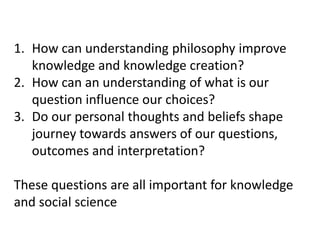
1. How can understanding philosophy improve
knowledge and knowledge creation?
2. How can an understanding of what is our
question influence our choices?
3. Do our personal thoughts and beliefs shape
journey towards answers of our questions,
outcomes and interpretation?
These questions are all important for knowledge
and social science
A research philosophy is a
belief about the way in
which data about a
phenomenon should be
gathered, analyzed and
used.
Phenomenon
Belief
Data
Philosophical underpinning
Philosophy provides both the natural and
social sciences with the general
principles of theoretical thinking, with a
method of reasoning and perspective,
and with self-awareness, all of which are
used to obtain knowledge of reality.
(Spirkin ,1983)
Four Key Concepts
Ontology Epistemology Axiology Methodology
Ontology, or the ‘study of being’, - Concerned with what actually exists in the world
about which humans can acquire knowledge.
Ontology helps human/researchers recognize how certain they can be about the
nature and existence of objects / phenomena they are questioning or
researching.
1. What ‘truth claims’ can a researcher make about reality?
2. Who decides the legitimacy of what is ‘real’?
3. How do human /researchers deal with different and conflicting ideas of
reality?
Realist ontology relates to the existence of one single reality which can be studied,
understood and experienced as a ‘truth’.
Relativist ontology is based on the philosophy that reality is constructed within
the human mind, such that no one ‘true’ reality exists. Instead, reality is ‘relative’
according to how individuals experience it at any given time and place.
Ontology
Why would someone want to
develop an ontology?
• To share common understanding of the
structure of information / knowledge among
human
• To enable reuse of domain knowledge
• To make domain assumptions explicit
• To further analyze domain knowledge
• Onto – in Greek ontos, 'being' , ology (“field of study
/ principles ”
• Knowledge creation is based on beliefs about the
world around us ,What can be said to exist?
• Reality which we possibly aim to discover by
research
• Ontology: Basic assumptions about the nature of
reality (Single or Multiple)
Ontology - What is reality?
Epistemology, the ‘study of knowledge’
Epistemology is concerned with all aspects of the validity, scope and methods of
acquiring knowledge, such as
a) What constitutes a knowledge claim?
b) How can knowledge be acquired or produced?
c) How the extent of its transferability can be assessed?
Epistemology is important because it influences how we frame our questions
and our attempts to discover knowledge.
By looking at the type of query, we can explore the idea of epistemology and how
it influences of process to get the answer of our question (s).
• Objectivist epistemology assumes that reality exists outside, or
independently, of the individual mind.
• Objectivist research is useful in providing reliability (consistency of results
obtained) and external validity (applicability of the results to other contexts).
• Constructionist epistemology: “truth,” or meaning, comes into existence in
and out of our engagement with the realities in our world; meanings are to be
discovered via human interaction and exploring their minds “what we call the
world is a product of some mind” (Bruner 1986:95)
Epistemology
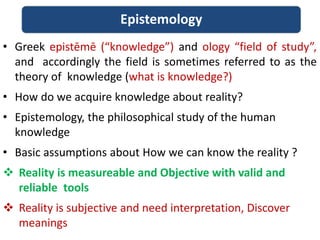
• Greek epistēmē (“knowledge”) and ology “field of study”,
and accordingly the field is sometimes referred to as the
theory of knowledge (what is knowledge?)
• How do we acquire knowledge about reality?
• Epistemology, the philosophical study of the human
knowledge
• Basic assumptions about How we can know the reality ?
 Reality is measureable and Objective with valid and
reliable tools
 Reality is subjective and need interpretation, Discover
meanings
Epistemology
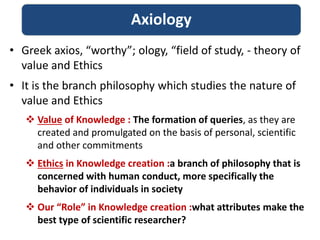
• Greek axios, “worthy”; ology, “field of study, - theory of
value and Ethics
• It is the branch philosophy which studies the nature of
value and Ethics
 Value of Knowledge : The formation of queries, as they are
created and promulgated on the basis of personal, scientific
and other commitments
 Ethics in Knowledge creation :a branch of philosophy that is
concerned with human conduct, more specifically the
behavior of individuals in society
 Our “Role” in Knowledge creation :what attributes make the
best type of scientific researcher?
Axiology
• The word methodology comprises two nouns:
method “a systematic way” and ology, “field
of study / principles
• Methodology is a branch of knowledge that
deals with the general principles in
generation of new knowledge.
• It refers to the rationale and the philosophical
assumption that underlie any natural, social
journey towards an answer.
Methodology - How do you go about finding it out?
Philosophy
Epistemology
Knowledge
Ontology
Reality
Axiology
Value/
Ethics
Methodology
Methods
and process
Philosophical perspectives
1. Ontology (what exists for people to know about)
2. Epistemology (how knowledge is created and what is
possible to know)
3. Axiology (Ethics and Role of researcher)
4. Methodology – Principles for Data Collection and Analysis
• Philosophical perspectives, a system of generalized views
of the world, which form beliefs that guide action (Crotty
1998).
• Philosophical perspectives, also called paradigms (Guba &
Lincoln 1994; Morgan 2007)
• Perspectives (Patton 2002)
• Worldviews (Creswell2009)
• Philosophical perspectives are important because, when
made explicit, they reveal the assumptions for knowledge
creation. Leading to choices that are applied to the
purpose, design, methodology and methods of the
knowledge creation
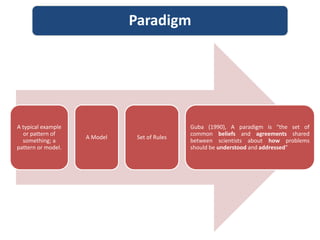
A typical example
or pattern of
something; a
pattern or model.
A Model Set of Rules
Guba (1990), A paradigm is “the set of
common beliefs and agreements shared
between scientists about how problems
should be understood and addressed”
Paradigm
Objectivity in social research is the principle drawn from
positivism
• we should remain distanced from what they study so finding
depend on the nature of what was studied rather than on the
our personality, beliefs and values.
In a positivist view of the world, science was seen as the way to
get at truth, to understand the world well enough so that we
might predict and control it. ... The positivist believed in
empiricism – the idea that observation and measurement was
the core of the scientific endeavor…….
Positivism : A deductive approach is concerned with
“developing a hypothesis (or hypotheses) based on
existing theory, and then designing a research strategy to
test the hypothesis”……
Subjective Reality
"Reality is subjective" means that each person has his or
her own unique perception of reality, and no two
people have quite the same understanding of what is real.
...
• Constructionism / Interpretivism
• Qualitative ---- Inductive Approach
Post Positivism : While positivists emphasize independence between the
researcher and the researched person (or object), post positivists argue that
theories, hypotheses, background knowledge and values of the researcher can
influence what is observed. Post positivists pursue objectivity by recognizing the
possible effects of biases.
Lecture Five Philisophy - Positivist .pptx

Lecture Five Philisophy - Positivist .pptx

  • 1.
  • 2.
    1. How canunderstanding philosophy improve knowledge and knowledge creation? 2. How can an understanding of what is our question influence our choices? 3. Do our personal thoughts and beliefs shape journey towards answers of our questions, outcomes and interpretation? These questions are all important for knowledge and social science
  • 3.
    A research philosophyis a belief about the way in which data about a phenomenon should be gathered, analyzed and used. Phenomenon Belief Data Philosophical underpinning Philosophy provides both the natural and social sciences with the general principles of theoretical thinking, with a method of reasoning and perspective, and with self-awareness, all of which are used to obtain knowledge of reality. (Spirkin ,1983)
  • 4.
    Four Key Concepts OntologyEpistemology Axiology Methodology
  • 5.
    Ontology, or the‘study of being’, - Concerned with what actually exists in the world about which humans can acquire knowledge. Ontology helps human/researchers recognize how certain they can be about the nature and existence of objects / phenomena they are questioning or researching. 1. What ‘truth claims’ can a researcher make about reality? 2. Who decides the legitimacy of what is ‘real’? 3. How do human /researchers deal with different and conflicting ideas of reality? Realist ontology relates to the existence of one single reality which can be studied, understood and experienced as a ‘truth’. Relativist ontology is based on the philosophy that reality is constructed within the human mind, such that no one ‘true’ reality exists. Instead, reality is ‘relative’ according to how individuals experience it at any given time and place. Ontology
  • 6.
    Why would someonewant to develop an ontology? • To share common understanding of the structure of information / knowledge among human • To enable reuse of domain knowledge • To make domain assumptions explicit • To further analyze domain knowledge
  • 7.
    • Onto –in Greek ontos, 'being' , ology (“field of study / principles ” • Knowledge creation is based on beliefs about the world around us ,What can be said to exist? • Reality which we possibly aim to discover by research • Ontology: Basic assumptions about the nature of reality (Single or Multiple) Ontology - What is reality?
  • 8.
    Epistemology, the ‘studyof knowledge’ Epistemology is concerned with all aspects of the validity, scope and methods of acquiring knowledge, such as a) What constitutes a knowledge claim? b) How can knowledge be acquired or produced? c) How the extent of its transferability can be assessed? Epistemology is important because it influences how we frame our questions and our attempts to discover knowledge. By looking at the type of query, we can explore the idea of epistemology and how it influences of process to get the answer of our question (s). • Objectivist epistemology assumes that reality exists outside, or independently, of the individual mind. • Objectivist research is useful in providing reliability (consistency of results obtained) and external validity (applicability of the results to other contexts). • Constructionist epistemology: “truth,” or meaning, comes into existence in and out of our engagement with the realities in our world; meanings are to be discovered via human interaction and exploring their minds “what we call the world is a product of some mind” (Bruner 1986:95) Epistemology
  • 9.
    • Greek epistēmē(“knowledge”) and ology “field of study”, and accordingly the field is sometimes referred to as the theory of knowledge (what is knowledge?) • How do we acquire knowledge about reality? • Epistemology, the philosophical study of the human knowledge • Basic assumptions about How we can know the reality ?  Reality is measureable and Objective with valid and reliable tools  Reality is subjective and need interpretation, Discover meanings Epistemology
  • 10.
    • Greek axios,“worthy”; ology, “field of study, - theory of value and Ethics • It is the branch philosophy which studies the nature of value and Ethics  Value of Knowledge : The formation of queries, as they are created and promulgated on the basis of personal, scientific and other commitments  Ethics in Knowledge creation :a branch of philosophy that is concerned with human conduct, more specifically the behavior of individuals in society  Our “Role” in Knowledge creation :what attributes make the best type of scientific researcher? Axiology
  • 11.
    • The wordmethodology comprises two nouns: method “a systematic way” and ology, “field of study / principles • Methodology is a branch of knowledge that deals with the general principles in generation of new knowledge. • It refers to the rationale and the philosophical assumption that underlie any natural, social journey towards an answer. Methodology - How do you go about finding it out?
  • 12.
  • 13.
    Philosophical perspectives 1. Ontology(what exists for people to know about) 2. Epistemology (how knowledge is created and what is possible to know) 3. Axiology (Ethics and Role of researcher) 4. Methodology – Principles for Data Collection and Analysis • Philosophical perspectives, a system of generalized views of the world, which form beliefs that guide action (Crotty 1998). • Philosophical perspectives, also called paradigms (Guba & Lincoln 1994; Morgan 2007) • Perspectives (Patton 2002) • Worldviews (Creswell2009) • Philosophical perspectives are important because, when made explicit, they reveal the assumptions for knowledge creation. Leading to choices that are applied to the purpose, design, methodology and methods of the knowledge creation
  • 14.
    A typical example orpattern of something; a pattern or model. A Model Set of Rules Guba (1990), A paradigm is “the set of common beliefs and agreements shared between scientists about how problems should be understood and addressed” Paradigm
  • 15.
    Objectivity in socialresearch is the principle drawn from positivism • we should remain distanced from what they study so finding depend on the nature of what was studied rather than on the our personality, beliefs and values. In a positivist view of the world, science was seen as the way to get at truth, to understand the world well enough so that we might predict and control it. ... The positivist believed in empiricism – the idea that observation and measurement was the core of the scientific endeavor……. Positivism : A deductive approach is concerned with “developing a hypothesis (or hypotheses) based on existing theory, and then designing a research strategy to test the hypothesis”……
  • 16.
    Subjective Reality "Reality issubjective" means that each person has his or her own unique perception of reality, and no two people have quite the same understanding of what is real. ... • Constructionism / Interpretivism • Qualitative ---- Inductive Approach Post Positivism : While positivists emphasize independence between the researcher and the researched person (or object), post positivists argue that theories, hypotheses, background knowledge and values of the researcher can influence what is observed. Post positivists pursue objectivity by recognizing the possible effects of biases.