PCSM 1534
Meeting 3
Research Paradigm
What is research?
What is research?
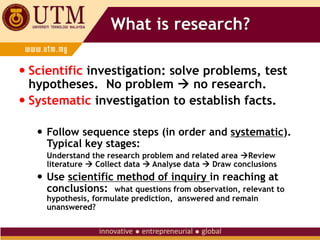
 Scientific investigation: solve problems, test
hypotheses. No problem  no research.
 Systematic investigation to establish facts.
 Follow sequence steps (in order and systematic).
Typical key stages:
Understand the research problem and related area Review
literature  Collect data  Analyse data  Draw conclusions
 Use scientific method of inquiry in reaching at
conclusions: what questions from observation, relevant to
hypothesis, formulate prediction, answered and remain
unanswered?
Objectives of research:
To discover answers to questions through the application
of scientific procedures. Some examples:
 To gain familiarity with a phenomenon or to achieve
new insights into it (studies with this object in view are
termed as exploratory research studies);
 To portray accurately the characteristics of a particular
individual, situation or a group (studies with this object
in view are known as descriptive research studies);
 To test a hypothesis of a causal relationship between
variables (such studies are known as hypothesis-testing
research studies).
4
Dr. Nor Hidayati Zakaria
Research Paradigm:
The philosophical stance need to be laid in a strong
foundation of: To discover answers to questions through
the application of scientific procedures. Some examples:
 To gain familiarity with a phenomenon or to achieve
new insights into it (studies with this object in view are
termed as exploratory research studies);
 To portray accurately the characteristics of a particular
individual, situation or a group (studies with this object
in view are known as descriptive research studies);
 To test a hypothesis of a causal relationship between
variables (such studies are known as hypothesis-testing
research studies).
5
Dr. Nor Hidayati Zakaria
RESEARCH PARADIGM:
Definition
• A framework within which theories are built, that
fundamentally influences how you see the world,
determines your perspective, and shapes your
understanding of how things are connected.
• Holding a particular world view influences your
personal behaviour, your professional practice, and
ultimately the position you take with regard to the
subject of your research (Henning et al. ).
• [Research] paradigms define for the [researcher] what
it is they are about, and what falls within and outside
the limits of legitimate [research].” (Guba and Lincoln,
1994 p. 108)
RESEARCH PARADIGM:
Definition
• basic beliefs that deals with first principles. It
represents a worldview that defines for its holder, the
nature of the “world”, the individual’s place in it, and
the range of possible relationships to that world and its
parts …
• The beliefs are basic in the sense that they must be
accepted simply on faith (however well argued); there is
no way to establish their ultimate truthfulness. (Guba
and Lincoln, 1994 p. 107-108)
Classifying research paradigms
 The basic beliefs that define a particular research
paradigm may be summarised by the responses
given to three fundamental questions (Guba and
Lincoln, 1994) :
 The ontological question i.e. what is the form
and nature of reality
 The epistemological question i.e. what is the
basic belief about knowledge (i.e. what can be
known)
 The methodological question i.e. how can the
researcher go about finding out whatever s/he
believes can be known.
Classifying research paradigms
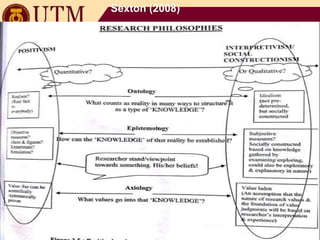
 Sexton (2008) summarised the responses given
to three fundamental questions where the first
& second quite similar with (Guba and Lincoln,
1994). The difference is for the third question,
where mentioned as :
The axiology question i.e. what values go into
that knowledge? (value free)
Ontology
• A systematic account of Existence
• Nature of the world around us (nature of
social reality)
• (From philosophy) An explicit formal
specification of how to represent the objects,
concepts and other entities that are assumed
to exist in some area of interest and the
relationships that hold among them.
15 JULY 2005
PM DR ROSE ALINDA ALIAS 11
Ontology of Positivism
• Universe comprised of objectively given, immutable
objects and structures, existing as empirical entities, on
their own, independent of the observer’s appreciation
of them.
• Contrasts with relativism or instrumentalism, where
reality is a subjective construction of the mind, thus
varying with different languages and cultures.
• While hugely successful in physical sciences, it is not
as successful for social science.
• Deals with observed and measured knowledge
• Holds that reality is a subjective construction of
the mind.
• Socially transmitted concepts and names direct
how reality is perceived and structured; reality
therefore varies with different languages and
cultures.
• What is subjectively experienced as an
objective reality exists only in the observer's
mind.
ONTOLOGY OF ANTI-POSITIVIST:
RELATIVISM OR INSTRUMENTALISM
15 JULY 2005
PM DR ROSE ALINDA ALIAS 13
Anti-Positivism
• Latter part of 19th century
• Man as an actor could not be studied through
the methods of natural sciences that focus on
establishing general laws. In the cultural
sphere man is free (Burrell and Morgan, 1979)
15 JULY 2005
PM DR ROSE ALINDA ALIAS 14
Post-Positivism
• Based on the concept of critical realism, that there is a
real world out there independent of our perception of
it and that the objective of science is to try and
understand it
• combined with triangulation, i.e., the recognition that
observations and measurements are inherently
imperfect and hence the need to measure phenomena
in many ways
• The post-positivist epistemology regards the acquisition
of knowledge as a process that is more than mere
deduction. Knowledge is acquired through both
deduction and induction.
POSITIVIST: Ontology view
• An objective, true reality exists which is
governed by unchangeable natural cause-effect
laws
• Consists of stable pre-existing patterns or order
that can be discovered
• Reality is not time- nor context-bound
• Reality can be generalised
• the social world is tangible, hard made up of
relatively immutable structures that exist
independently of our individual descriptions
16
Epistemology
• From the Greek words episteme (knowledge) and logos
(word/speech) is the branch of philosophy that deals with
the nature, origin and scope of knowledge.
• Refers to the theory of knowledge, in particular, how we
acquire knowledge (Hirschheim, 1992).
• the nature of knowing and construction of knowledge
• divided into the positivist and anti-positivist stance
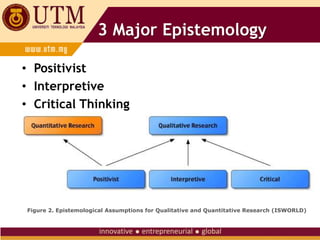
3 Major Epistemology
• Positivist
• Interpretive
• Critical Thinking
Figure 2. Epistemological Assumptions for Qualitative and Quantitative Research (ISWORLD)
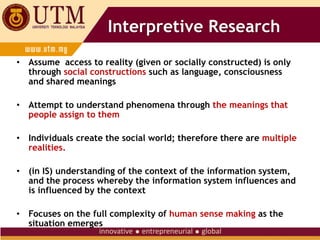
Interpretive Research
• Assume access to reality (given or socially constructed) is only
through social constructions such as language, consciousness
and shared meanings
• Attempt to understand phenomena through the meanings that
people assign to them
• Individuals create the social world; therefore there are multiple
realities.
• (in IS) understanding of the context of the information system,
and the process whereby the information system influences and
is influenced by the context
• Focuses on the full complexity of human sense making as the
situation emerges
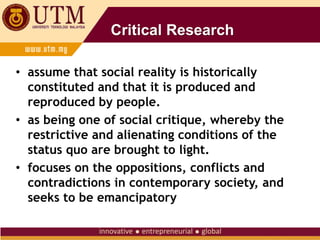
Critical Research
• assume that social reality is historically
constituted and that it is produced and
reproduced by people.
• as being one of social critique, whereby the
restrictive and alienating conditions of the
status quo are brought to light.
• focuses on the oppositions, conflicts and
contradictions in contemporary society, and
seeks to be emancipatory
Sexton (2008)
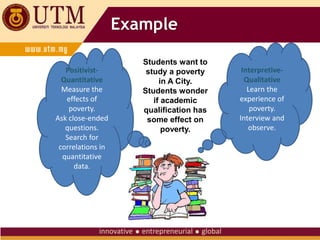
Example
Students want to
study a poverty
in A City.
Students wonder
if academic
qualification has
some effect on
poverty.
Interpretive-
Qualitative
Learn the
experience of
poverty.
Interview and
observe.
Positivist-
Quantitative
Measure the
effects of
poverty.
Ask close-ended
questions.
Search for
correlations in
quantitative
data.
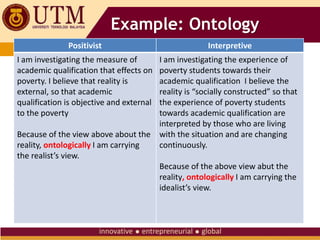
Example: Ontology
Positivist Interpretive
I am investigating the measure of
academic qualification that effects on
poverty. I believe that reality is
external, so that academic
qualification is objective and external
to the poverty
Because of the view above about the
reality, ontologically I am carrying
the realist’s view.
I am investigating the experience of
poverty students towards their
academic qualification I believe the
reality is “socially constructed” so that
the experience of poverty students
towards academic qualification are
interpreted by those who are living
with the situation and are changing
continuously.
Because of the above view abut the
reality, ontologically I am carrying the
idealist’s view.
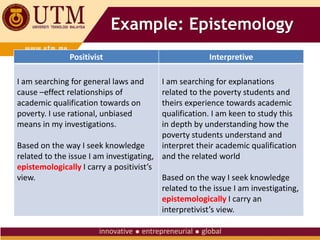
Example: Epistemology
Positivist Interpretive
I am searching for general laws and
cause –effect relationships of
academic qualification towards on
poverty. I use rational, unbiased
means in my investigations.
Based on the way I seek knowledge
related to the issue I am investigating,
epistemologically I carry a positivist’s
view.
I am searching for explanations
related to the poverty students and
theirs experience towards academic
qualification. I am keen to study this
in depth by understanding how the
poverty students understand and
interpret their academic qualification
and the related world
Based on the way I seek knowledge
related to the issue I am investigating,
epistemologically I carry an
interpretivist’s view.
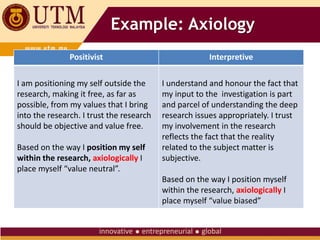
Example: Axiology
Positivist Interpretive
I am positioning my self outside the
research, making it free, as far as
possible, from my values that I bring
into the research. I trust the research
should be objective and value free.
Based on the way I position my self
within the research, axiologically I
place myself “value neutral”.
I understand and honour the fact that
my input to the investigation is part
and parcel of understanding the deep
research issues appropriately. I trust
my involvement in the research
reflects the fact that the reality
related to the subject matter is
subjective.
Based on the way I position myself
within the research, axiologically I
place myself “value biased”

Meeting 2 - Research Paradigm.ppt

  • 1.
  • 2.
  • 3.
    What is research? Scientific investigation: solve problems, test hypotheses. No problem  no research.  Systematic investigation to establish facts.  Follow sequence steps (in order and systematic). Typical key stages: Understand the research problem and related area Review literature  Collect data  Analyse data  Draw conclusions  Use scientific method of inquiry in reaching at conclusions: what questions from observation, relevant to hypothesis, formulate prediction, answered and remain unanswered?
  • 4.
    Objectives of research: Todiscover answers to questions through the application of scientific procedures. Some examples:  To gain familiarity with a phenomenon or to achieve new insights into it (studies with this object in view are termed as exploratory research studies);  To portray accurately the characteristics of a particular individual, situation or a group (studies with this object in view are known as descriptive research studies);  To test a hypothesis of a causal relationship between variables (such studies are known as hypothesis-testing research studies). 4 Dr. Nor Hidayati Zakaria
  • 5.
    Research Paradigm: The philosophicalstance need to be laid in a strong foundation of: To discover answers to questions through the application of scientific procedures. Some examples:  To gain familiarity with a phenomenon or to achieve new insights into it (studies with this object in view are termed as exploratory research studies);  To portray accurately the characteristics of a particular individual, situation or a group (studies with this object in view are known as descriptive research studies);  To test a hypothesis of a causal relationship between variables (such studies are known as hypothesis-testing research studies). 5 Dr. Nor Hidayati Zakaria
  • 6.
    RESEARCH PARADIGM: Definition • Aframework within which theories are built, that fundamentally influences how you see the world, determines your perspective, and shapes your understanding of how things are connected. • Holding a particular world view influences your personal behaviour, your professional practice, and ultimately the position you take with regard to the subject of your research (Henning et al. ). • [Research] paradigms define for the [researcher] what it is they are about, and what falls within and outside the limits of legitimate [research].” (Guba and Lincoln, 1994 p. 108)
  • 7.
    RESEARCH PARADIGM: Definition • basicbeliefs that deals with first principles. It represents a worldview that defines for its holder, the nature of the “world”, the individual’s place in it, and the range of possible relationships to that world and its parts … • The beliefs are basic in the sense that they must be accepted simply on faith (however well argued); there is no way to establish their ultimate truthfulness. (Guba and Lincoln, 1994 p. 107-108)
  • 8.
    Classifying research paradigms The basic beliefs that define a particular research paradigm may be summarised by the responses given to three fundamental questions (Guba and Lincoln, 1994) :  The ontological question i.e. what is the form and nature of reality  The epistemological question i.e. what is the basic belief about knowledge (i.e. what can be known)  The methodological question i.e. how can the researcher go about finding out whatever s/he believes can be known.
  • 9.
    Classifying research paradigms Sexton (2008) summarised the responses given to three fundamental questions where the first & second quite similar with (Guba and Lincoln, 1994). The difference is for the third question, where mentioned as : The axiology question i.e. what values go into that knowledge? (value free)
  • 10.
    Ontology • A systematicaccount of Existence • Nature of the world around us (nature of social reality) • (From philosophy) An explicit formal specification of how to represent the objects, concepts and other entities that are assumed to exist in some area of interest and the relationships that hold among them.
  • 11.
    15 JULY 2005 PMDR ROSE ALINDA ALIAS 11 Ontology of Positivism • Universe comprised of objectively given, immutable objects and structures, existing as empirical entities, on their own, independent of the observer’s appreciation of them. • Contrasts with relativism or instrumentalism, where reality is a subjective construction of the mind, thus varying with different languages and cultures. • While hugely successful in physical sciences, it is not as successful for social science. • Deals with observed and measured knowledge
  • 12.
    • Holds thatreality is a subjective construction of the mind. • Socially transmitted concepts and names direct how reality is perceived and structured; reality therefore varies with different languages and cultures. • What is subjectively experienced as an objective reality exists only in the observer's mind. ONTOLOGY OF ANTI-POSITIVIST: RELATIVISM OR INSTRUMENTALISM
  • 13.
    15 JULY 2005 PMDR ROSE ALINDA ALIAS 13 Anti-Positivism • Latter part of 19th century • Man as an actor could not be studied through the methods of natural sciences that focus on establishing general laws. In the cultural sphere man is free (Burrell and Morgan, 1979)
  • 14.
    15 JULY 2005 PMDR ROSE ALINDA ALIAS 14 Post-Positivism • Based on the concept of critical realism, that there is a real world out there independent of our perception of it and that the objective of science is to try and understand it • combined with triangulation, i.e., the recognition that observations and measurements are inherently imperfect and hence the need to measure phenomena in many ways • The post-positivist epistemology regards the acquisition of knowledge as a process that is more than mere deduction. Knowledge is acquired through both deduction and induction.
  • 15.
    POSITIVIST: Ontology view •An objective, true reality exists which is governed by unchangeable natural cause-effect laws • Consists of stable pre-existing patterns or order that can be discovered • Reality is not time- nor context-bound • Reality can be generalised • the social world is tangible, hard made up of relatively immutable structures that exist independently of our individual descriptions
  • 16.
    16 Epistemology • From theGreek words episteme (knowledge) and logos (word/speech) is the branch of philosophy that deals with the nature, origin and scope of knowledge. • Refers to the theory of knowledge, in particular, how we acquire knowledge (Hirschheim, 1992). • the nature of knowing and construction of knowledge • divided into the positivist and anti-positivist stance
  • 17.
    3 Major Epistemology •Positivist • Interpretive • Critical Thinking Figure 2. Epistemological Assumptions for Qualitative and Quantitative Research (ISWORLD)
  • 18.
    Interpretive Research • Assumeaccess to reality (given or socially constructed) is only through social constructions such as language, consciousness and shared meanings • Attempt to understand phenomena through the meanings that people assign to them • Individuals create the social world; therefore there are multiple realities. • (in IS) understanding of the context of the information system, and the process whereby the information system influences and is influenced by the context • Focuses on the full complexity of human sense making as the situation emerges
  • 19.
    Critical Research • assumethat social reality is historically constituted and that it is produced and reproduced by people. • as being one of social critique, whereby the restrictive and alienating conditions of the status quo are brought to light. • focuses on the oppositions, conflicts and contradictions in contemporary society, and seeks to be emancipatory
  • 20.
  • 21.
    Example Students want to studya poverty in A City. Students wonder if academic qualification has some effect on poverty. Interpretive- Qualitative Learn the experience of poverty. Interview and observe. Positivist- Quantitative Measure the effects of poverty. Ask close-ended questions. Search for correlations in quantitative data.
  • 22.
    Example: Ontology Positivist Interpretive Iam investigating the measure of academic qualification that effects on poverty. I believe that reality is external, so that academic qualification is objective and external to the poverty Because of the view above about the reality, ontologically I am carrying the realist’s view. I am investigating the experience of poverty students towards their academic qualification I believe the reality is “socially constructed” so that the experience of poverty students towards academic qualification are interpreted by those who are living with the situation and are changing continuously. Because of the above view abut the reality, ontologically I am carrying the idealist’s view.
  • 23.
    Example: Epistemology Positivist Interpretive Iam searching for general laws and cause –effect relationships of academic qualification towards on poverty. I use rational, unbiased means in my investigations. Based on the way I seek knowledge related to the issue I am investigating, epistemologically I carry a positivist’s view. I am searching for explanations related to the poverty students and theirs experience towards academic qualification. I am keen to study this in depth by understanding how the poverty students understand and interpret their academic qualification and the related world Based on the way I seek knowledge related to the issue I am investigating, epistemologically I carry an interpretivist’s view.
  • 24.
    Example: Axiology Positivist Interpretive Iam positioning my self outside the research, making it free, as far as possible, from my values that I bring into the research. I trust the research should be objective and value free. Based on the way I position my self within the research, axiologically I place myself “value neutral”. I understand and honour the fact that my input to the investigation is part and parcel of understanding the deep research issues appropriately. I trust my involvement in the research reflects the fact that the reality related to the subject matter is subjective. Based on the way I position myself within the research, axiologically I place myself “value biased”