
Online Teaching TechniquesPresentation developed for the discipline of PPEL - Unit 2 - task 2 of the Mestrado de Pedagogia do E-learning – UniversidadeAberta - PortugalBy Juliana AntunesAbr/2010
What are they?   Boyle (1981, 213) defined technique as the form used to present material to be learned, for example lecture, panel, and group discussion. In this study, a pedagogical technique is defined as a manner of accomplishing teaching objectives.
What are they?	When this teaching techniques Will Be Applies in Computer-Mediated Communication (CMC), where transmission and reception of messages is performed by computers, as input, storage and production, called Online Teaching Techniques.
What are your goals?Replying to queries and requests from students,Providing advice and guidance,Helping students to solve problems with regard to the subject matter,Serving as a transmission medium for homework and test papers,
What are your goals?Discussing projects and work with the tutor,Bringing students together in accordance with their interests and their needs, and Encouraging team projects and setting up self-help groups.
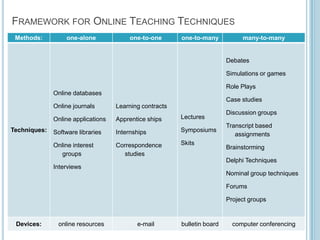
Framework for Online Teaching Techniques	The techniques are organized according to the four communication paradigms used in computer-mediated communication: information retrieval, electronic mail, bulletin boards, and computer conferencing.
Framework for Online Teaching Techniques
Learning ApproachesOne-AloneCharacterized by the retrieval of information through online resources and the fact that a student can accomplish the learning task without communication with the teacher or other students.
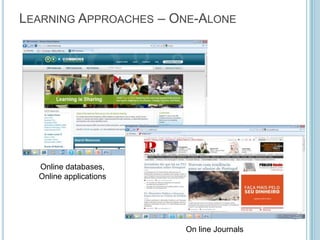
Learning Approaches – One-AloneOn line JournalsOnline databases, Online applications
Learning ApproachesOne-To-OneThese techniques are characterized by a one-to-one relationship and by individualized teaching and learning. can be an effective support for these techniques when the communication can be conveyed by written text.
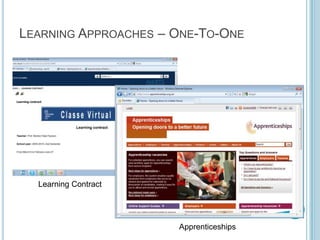
Learning Approaches – One-To-OneLearning ContractApprenticeships
Learning ApproachesOne-To-ManyAre characterized by presentation to students by one or more individual experts or by interacting experts. The techniques discussed as one-to-many will typically be conducted via bulletin boards or distribution lists for e-mail.
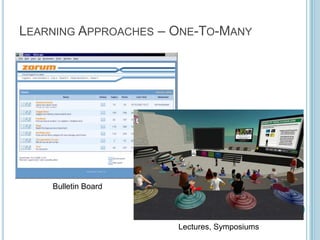
Learning Approaches – One-To-ManyBulletin BoardLectures, Symposiums
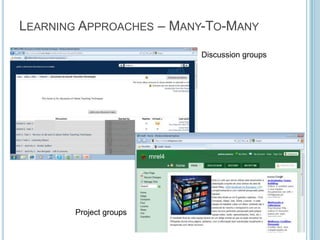
Learning ApproachesMany-To-Many	A characteristic of the techniques presented in this section is that all participants have the opportunity to take part in the interaction. Can be organized within computer conferencing systems, bulletin board systems, or distribution lists for e-mail.
Learning Approaches – Many-To-ManyDiscussion groupsProject groups
Conclusion	The techniques presented here are intended to present some pedagogical techniques CMC. 	They represent examples of the range of pedagogical techniques that are available to teachers, program planners and designers of courses in computer-mediated communication.
Conclusion	Is able to use various teaching techniques and styles in the same training program as it is possible to have different training programs based on the same techniques and teaching styles.
Reference:Paulsen, M. F. Online Education and Learning Management Systems: Global E-learning in a Scandinavian Perspective,August 1995 (www.studymentor.com)

Online teaching techniques

  • 1.
    Online Teaching TechniquesPresentationdeveloped for the discipline of PPEL - Unit 2 - task 2 of the Mestrado de Pedagogia do E-learning – UniversidadeAberta - PortugalBy Juliana AntunesAbr/2010
  • 2.
    What are they? Boyle (1981, 213) defined technique as the form used to present material to be learned, for example lecture, panel, and group discussion. In this study, a pedagogical technique is defined as a manner of accomplishing teaching objectives.
  • 3.
    What are they? Whenthis teaching techniques Will Be Applies in Computer-Mediated Communication (CMC), where transmission and reception of messages is performed by computers, as input, storage and production, called Online Teaching Techniques.
  • 4.
    What are yourgoals?Replying to queries and requests from students,Providing advice and guidance,Helping students to solve problems with regard to the subject matter,Serving as a transmission medium for homework and test papers,
  • 5.
    What are yourgoals?Discussing projects and work with the tutor,Bringing students together in accordance with their interests and their needs, and Encouraging team projects and setting up self-help groups.
  • 6.
    Framework for OnlineTeaching Techniques The techniques are organized according to the four communication paradigms used in computer-mediated communication: information retrieval, electronic mail, bulletin boards, and computer conferencing.
  • 7.
    Framework for OnlineTeaching Techniques
  • 8.
    Learning ApproachesOne-AloneCharacterized bythe retrieval of information through online resources and the fact that a student can accomplish the learning task without communication with the teacher or other students.
  • 9.
    Learning Approaches –One-AloneOn line JournalsOnline databases, Online applications
  • 10.
    Learning ApproachesOne-To-OneThese techniquesare characterized by a one-to-one relationship and by individualized teaching and learning. can be an effective support for these techniques when the communication can be conveyed by written text.
  • 11.
    Learning Approaches –One-To-OneLearning ContractApprenticeships
  • 12.
    Learning ApproachesOne-To-ManyAre characterizedby presentation to students by one or more individual experts or by interacting experts. The techniques discussed as one-to-many will typically be conducted via bulletin boards or distribution lists for e-mail.
  • 13.
    Learning Approaches –One-To-ManyBulletin BoardLectures, Symposiums
  • 14.
    Learning ApproachesMany-To-Many A characteristicof the techniques presented in this section is that all participants have the opportunity to take part in the interaction. Can be organized within computer conferencing systems, bulletin board systems, or distribution lists for e-mail.
  • 15.
    Learning Approaches –Many-To-ManyDiscussion groupsProject groups
  • 16.
    Conclusion The techniques presentedhere are intended to present some pedagogical techniques CMC. They represent examples of the range of pedagogical techniques that are available to teachers, program planners and designers of courses in computer-mediated communication.
  • 17.
    Conclusion Is able touse various teaching techniques and styles in the same training program as it is possible to have different training programs based on the same techniques and teaching styles.
  • 18.
    Reference:Paulsen, M. F.Online Education and Learning Management Systems: Global E-learning in a Scandinavian Perspective,August 1995 (www.studymentor.com)