NEETHU D
Commerce
Reg. No. 19014303009
Mount Tabor Training College
Pathanapuram
ONLINE LEARNING
Page 2 of 12
INTRODUCTION
We live in the era of Information Technology. We have to learn where we
are? Andequip us suitable to the changing scenarios. „Learning that is
supported by information and communication technologies (ICT) is the new
technology. Online-learning is, notlimited to „digital literacy‟ (the acquisition of
IT competence) but may encompass multiple formats and hybrid
methodologies, in particular, the use of software, Internet, CD-ROM, online
learning or any other electronic or interactive media.‟
Online Learning is defined as all forms of electronic supported learning
and teaching,which are procedural in character and aim to effect the
construction of knowledge withreference to individual experience, practice and
knowledge of the learner. Information and communication systems, whether
networked or not, serve as specific media to implement thelearning process.
Online learning is essentially the computer and network enabled transfer
of skills andknowledge. E-learning refers to using electronic applications and
processes to learn. E learning applications and processes include Web-based
learning, computer-based learning, virtual classrooms and digital collaboration.
Content is delivered via the Internetintranet/extranet, audio or video tape,
satellite TV, and CD-ROM. It is used by the educational Institutions to enhance
and support the class room teaching and offering course to a larger population
of learners across the Globe. It can be self-paced or instructor led and includes
media in the form of text, image, animation, streaming video and audio.
Online learning is a product of modern technological advancements.it
provide a wide range of opportunities to the learner and give a new meaning to
the process of learning. It envisages the scope of learning.
Page 3 of 12
ONLINE LEARNING
Online learning is a process of learning with the assistance of the internet
and allied online facilities. The term online learning is often used
interchangeable with e- learning. In other words, online learning is a way of
studying for an internationally recognised qualification without needing to
attend classes on campus. The most important benefit of online learning is that,
it can span time and distance
Online learning is a computer based educational tool or system that
enables you to learn anywhere and at any time. Today e-learning is mostly
delivered though the internet, although in the past it was delivered using a blend
of computer-based methods like CD-ROM.
Technology has advanced so much that the geographical gap is bridged
with the use of tools that make you feel as if you are inside the classroom. E-
learning offers the ability to share material in all kinds of formats such as
videos, slideshows, word documents and PDFs. Conducting webinars (live
online classes) and communicating with professors via chat and message forums
is also an option available to users.
Online learning provides the learners with the ability to fit learning
around their lifestyles, effectively allowing even the busiest person to further a
career and gain new qualifications.
Page 4 of 12
The history of e-learning
The term “e-learning” has only been in existence since 1999, when the
word was first utilized at a CBT systems seminar. Other words also began to
spring up in search of an accurate description such as “online learning” and
“virtual learning”. However, the principles behind e-learning have been well
documented throughout history, and there is even evidence which suggests that
early forms of e-learning existed as far back as the 19th century.
Online learning today
With the introduction of the computer and internet in the late 20th
century, e-learning tools and delivery methods expanded. The first MAC in the
1980′s enabled individuals to have computers in their homes, making it easier
for them to learn about particular subjects and develop certain skill sets. Then,
in the following decade, virtual learning environments began to truly thrive,
with people gaining access to a wealth of online information and e-learning
opportunities.
By the early 90s several schools had been set up that delivered courses online
only, making the most of the internet and bringing education to people who
wouldn't previously have been able to attend a college due to geographical or
time constraints. Technological advancements also helped educational
establishments reduce the costs of distance learning, a saving that would also be
passed on to the students - helping bring education to a wider audience.
In the 2000′s, businesses began using e-learning to train their employees. New
and experienced workers alike now had the opportunity to improve upon their
industry knowledge base and expand their skill sets. At home individuals were
granted access to programs that offered them the ability to earn online degrees
and enrich their lives through expanded knowledge.
Page 5 of 12
TOOLS OF ONLINE LEARNING
 Email
o Every teacher should have an e-mail account
o Communicate with students
o Communicate with parents
o Students can submit assignment
o Can have attachments
o Create a paperless environment
o Simple but effective
o Efficient and cost effective
 Chat
o Synchronous communication tool
o Communicate with students
o Communicate with parents
o More students participate
o Collaborative learning
 Online forums
o Teacher can create discussion groups
o Teacher could post a question and request students to comment
o Students can post their comments
o Can encourage community participation
o Collaborative learning can be fostered
o Feedback from diverse culture
 Web
o Wide range of materials available
o Teacher will need to narrow down
o It is a resource Centre
o Sharing of resources
Page 6 of 12
o Supported by images, audio, simulation and multimedia
 Management systems
o Management of content
o Tracking students
o Administrative features
o Integration with various tools such as chat, forum, e-mail, etc.
o Reporting
 Video conferences
o Can conduct a live lecture
o Communication with students
o Communication with parents
o Support by audio, chat and whiteboard
o Support sharing of applications
o Can be recorded and later be used for on demand lectures
ELEMENTS OF ONLINE LEARNING
 Text: The alphabet, words, sentences, paragraphs. Text processing refers
to the ability to manipulate words, lines, and pages.
 Pictures/images: A picture or image is data represented in a two-
dimensional scene
 Animations: An animation is a simulation of movement created by
displaying a series of pictures, or frames.A cartoon on television is one
example of animation.
 Audio: Audio is sound within the acoustic range available to humans. On
a computer an audio file is a record of captured sound that can be played
back.
Page 7 of 12
 Video: Video refers to displaying still images, in such a high speed that
our mind interpreters the sequence of images as a movement.
BENEFITS OF ONLINE LEARNING
1. No Boundaries, No Restrictions-Online learning facilitates learning
without having to organize when and where everyone who is interested
in a course can be present.
2. It is economical in nature, because it reduces material cost, travel and
accommodation
3. It is convenient in nature as it is provided on demand
4. It is more flexible
5. It is available at anywhere, at any time
6. It attracts learners through different learning opportunities and activities
DRAWBACKS OF ONLINE LEARNING
1. Though online learning offers ease, flexibility and the ability to remotely
access a classroom in the student‟s own time, learners may feel a sense of
isolation. That means it is a solo act.
2. Online learning requires the use of a computer and other such devices;
this means that eyestrain, bad posture and other physical problems may
affect the learner.When running an online course it‟s a good practice to
send out guidelines about correct sitting posture, desk height, and
recommendations for regular breaks
BLENDED LEARNING
Blended learning is a combination of offline (face-to-face, traditional
learning) and online learning in a way that the one compliments the other.
Page 8 of 12
It provides individuals with the opportunity to enjoy the best of both
worlds. For example, a student might attend classes in a real-world
classroom setting, and then supplement the lesson plan by completing
online multimedia coursework. As such, the student would only have to
physically attend class once a week and would be free to go at their own
pace.Blended learning is often also referred to as “hybrid” learning, and
can take on a variety of forms in online education environment.
ONLINE LEARNING SYSTEMS
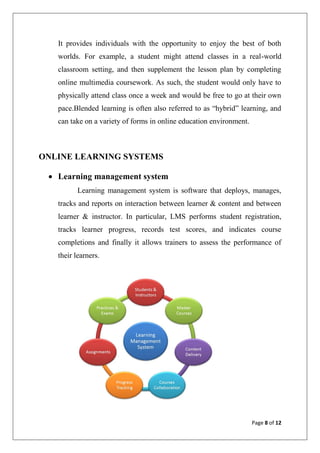
 Learning management system
Learning management system is software that deploys, manages,
tracks and reports on interaction between learner & content and between
learner & instructor. In particular, LMS performs student registration,
tracks learner progress, records test scores, and indicates course
completions and finally it allows trainers to assess the performance of
their learners.
Page 9 of 12
 Main features of an LMS:
o Registration - enroll and administer learners online for web-based,
instructor-led, and all other learning activities.
o Scheduling - schedule courses and define curricula to address
individual and organizational learning needs. Also off-line
resources can be included (classrooms, books, coaches etc.).
o Delivery - deliver online courses and assessments or schedule
instructor-led courses.
o Tracking - track the progress of the learners and create reports.
o Communication - communicate by chat, discussion forum, mail,
screensharing and e-seminars.
o Testing - test and assess competency, learning styles and student
committee
General requirements for LMS system
o Support of different possibilities of learning.
o Integration of solution in the context of IS firm.
o Wide administration range.
o Compatibility with standards.
o The support of the applications of the other suppliers.
o Possibility of using new technologies so called mobile
communication.
o An access thanks web client.
Page 10 of 12
LMS consists of three basic type application
 applications for learning (documents, examples)
 testing applications (test, checking of tests)
 support applications (notepad, discussion forum, chat)
 IMS (Instructional Management System)
The IMS (Instructional Management System) Global Learning
Consortium is developing and promoting open specifications (no
standards) for facilitating online distributed learning activities such as
locating and using educational content, tracking learner progress,
reporting learner performance, and exchanging student records between
administrative systems.
IMS has two key goals:
 Defining the technical standards for interoperability of applications
and services in distributed learning
 Supporting the incorporation of IMS specifications into products
and services worldwide. IMS promotes widespread adoption of
specifications that will allow distributed learning environments and
content from multiple authors to work together.
Page 11 of 12
CONCLUSION
Online learning is one of the fastest growing trends in educational users
of technology.Online learning is the internet enabled learning. The use of
internet technologies to deliver a broad array of solutions that enhances
knowledge and performance. Here the traditional classroom has to be
transformed. Now internet has started to reshape our education system. In
online learning the process of learning is one to one which means it is
individualised in nature. E learning is changing and we will see new models,
new technologies and designs emerge. So, let‟s drop the “e” or at least give it a
new wider definition.
Online learning has become popular because of its potential for
providingmore flexible access to content and instruction at any time, fromany
place. Frequently, the motivation for online learning programs entails,
increasing the availability of learning experiences for learnerswho cannot or
choose not to attend traditional face-to-face offerings, assembling and
disseminating instructional content more cost-efficiently,and/or providing
access to qualified instructors to learners in placeswhere such instructors are not
available. Online learning advocates arguefurther that additional reasons for
embracing this medium of instructioninclude current technology‟s support of a
degree of interactivity, socialnetworking, collaboration, and reflection that can
enhance learning relativeto normal classroom conditions
Thus online learning offers a new idea to the field of teaching. that is, we
must teach tomorrow‟s skills today
Page 12 of 12
REFERENCE
 Retrieved from http://www.elearningindustry.com dated on 23-10-2015
 Retrieved from http://www.frostburg.edu.orgdated on 23-10-2015
 Retrieved from http://en.wikipedia.org/blended_learning dated on 23-
10-2015
 Retrieved from http://www.study.com/academy dated on 23- 10-2015
 Retrieved fromhttp://www.slideshare.net/IASLonline/elearning-project-
9665683?next_slideshow=1 dated on 23-10- 2015
 Retrieved fromhttp://www.english.heacademy.ac.uk/explore dated on
23-10-2015

Online learning assignment

  • 1.
    NEETHU D Commerce Reg. No.19014303009 Mount Tabor Training College Pathanapuram ONLINE LEARNING
  • 2.
    Page 2 of12 INTRODUCTION We live in the era of Information Technology. We have to learn where we are? Andequip us suitable to the changing scenarios. „Learning that is supported by information and communication technologies (ICT) is the new technology. Online-learning is, notlimited to „digital literacy‟ (the acquisition of IT competence) but may encompass multiple formats and hybrid methodologies, in particular, the use of software, Internet, CD-ROM, online learning or any other electronic or interactive media.‟ Online Learning is defined as all forms of electronic supported learning and teaching,which are procedural in character and aim to effect the construction of knowledge withreference to individual experience, practice and knowledge of the learner. Information and communication systems, whether networked or not, serve as specific media to implement thelearning process. Online learning is essentially the computer and network enabled transfer of skills andknowledge. E-learning refers to using electronic applications and processes to learn. E learning applications and processes include Web-based learning, computer-based learning, virtual classrooms and digital collaboration. Content is delivered via the Internetintranet/extranet, audio or video tape, satellite TV, and CD-ROM. It is used by the educational Institutions to enhance and support the class room teaching and offering course to a larger population of learners across the Globe. It can be self-paced or instructor led and includes media in the form of text, image, animation, streaming video and audio. Online learning is a product of modern technological advancements.it provide a wide range of opportunities to the learner and give a new meaning to the process of learning. It envisages the scope of learning.
  • 3.
    Page 3 of12 ONLINE LEARNING Online learning is a process of learning with the assistance of the internet and allied online facilities. The term online learning is often used interchangeable with e- learning. In other words, online learning is a way of studying for an internationally recognised qualification without needing to attend classes on campus. The most important benefit of online learning is that, it can span time and distance Online learning is a computer based educational tool or system that enables you to learn anywhere and at any time. Today e-learning is mostly delivered though the internet, although in the past it was delivered using a blend of computer-based methods like CD-ROM. Technology has advanced so much that the geographical gap is bridged with the use of tools that make you feel as if you are inside the classroom. E- learning offers the ability to share material in all kinds of formats such as videos, slideshows, word documents and PDFs. Conducting webinars (live online classes) and communicating with professors via chat and message forums is also an option available to users. Online learning provides the learners with the ability to fit learning around their lifestyles, effectively allowing even the busiest person to further a career and gain new qualifications.
  • 4.
    Page 4 of12 The history of e-learning The term “e-learning” has only been in existence since 1999, when the word was first utilized at a CBT systems seminar. Other words also began to spring up in search of an accurate description such as “online learning” and “virtual learning”. However, the principles behind e-learning have been well documented throughout history, and there is even evidence which suggests that early forms of e-learning existed as far back as the 19th century. Online learning today With the introduction of the computer and internet in the late 20th century, e-learning tools and delivery methods expanded. The first MAC in the 1980′s enabled individuals to have computers in their homes, making it easier for them to learn about particular subjects and develop certain skill sets. Then, in the following decade, virtual learning environments began to truly thrive, with people gaining access to a wealth of online information and e-learning opportunities. By the early 90s several schools had been set up that delivered courses online only, making the most of the internet and bringing education to people who wouldn't previously have been able to attend a college due to geographical or time constraints. Technological advancements also helped educational establishments reduce the costs of distance learning, a saving that would also be passed on to the students - helping bring education to a wider audience. In the 2000′s, businesses began using e-learning to train their employees. New and experienced workers alike now had the opportunity to improve upon their industry knowledge base and expand their skill sets. At home individuals were granted access to programs that offered them the ability to earn online degrees and enrich their lives through expanded knowledge.
  • 5.
    Page 5 of12 TOOLS OF ONLINE LEARNING  Email o Every teacher should have an e-mail account o Communicate with students o Communicate with parents o Students can submit assignment o Can have attachments o Create a paperless environment o Simple but effective o Efficient and cost effective  Chat o Synchronous communication tool o Communicate with students o Communicate with parents o More students participate o Collaborative learning  Online forums o Teacher can create discussion groups o Teacher could post a question and request students to comment o Students can post their comments o Can encourage community participation o Collaborative learning can be fostered o Feedback from diverse culture  Web o Wide range of materials available o Teacher will need to narrow down o It is a resource Centre o Sharing of resources
  • 6.
    Page 6 of12 o Supported by images, audio, simulation and multimedia  Management systems o Management of content o Tracking students o Administrative features o Integration with various tools such as chat, forum, e-mail, etc. o Reporting  Video conferences o Can conduct a live lecture o Communication with students o Communication with parents o Support by audio, chat and whiteboard o Support sharing of applications o Can be recorded and later be used for on demand lectures ELEMENTS OF ONLINE LEARNING  Text: The alphabet, words, sentences, paragraphs. Text processing refers to the ability to manipulate words, lines, and pages.  Pictures/images: A picture or image is data represented in a two- dimensional scene  Animations: An animation is a simulation of movement created by displaying a series of pictures, or frames.A cartoon on television is one example of animation.  Audio: Audio is sound within the acoustic range available to humans. On a computer an audio file is a record of captured sound that can be played back.
  • 7.
    Page 7 of12  Video: Video refers to displaying still images, in such a high speed that our mind interpreters the sequence of images as a movement. BENEFITS OF ONLINE LEARNING 1. No Boundaries, No Restrictions-Online learning facilitates learning without having to organize when and where everyone who is interested in a course can be present. 2. It is economical in nature, because it reduces material cost, travel and accommodation 3. It is convenient in nature as it is provided on demand 4. It is more flexible 5. It is available at anywhere, at any time 6. It attracts learners through different learning opportunities and activities DRAWBACKS OF ONLINE LEARNING 1. Though online learning offers ease, flexibility and the ability to remotely access a classroom in the student‟s own time, learners may feel a sense of isolation. That means it is a solo act. 2. Online learning requires the use of a computer and other such devices; this means that eyestrain, bad posture and other physical problems may affect the learner.When running an online course it‟s a good practice to send out guidelines about correct sitting posture, desk height, and recommendations for regular breaks BLENDED LEARNING Blended learning is a combination of offline (face-to-face, traditional learning) and online learning in a way that the one compliments the other.
  • 8.
    Page 8 of12 It provides individuals with the opportunity to enjoy the best of both worlds. For example, a student might attend classes in a real-world classroom setting, and then supplement the lesson plan by completing online multimedia coursework. As such, the student would only have to physically attend class once a week and would be free to go at their own pace.Blended learning is often also referred to as “hybrid” learning, and can take on a variety of forms in online education environment. ONLINE LEARNING SYSTEMS  Learning management system Learning management system is software that deploys, manages, tracks and reports on interaction between learner & content and between learner & instructor. In particular, LMS performs student registration, tracks learner progress, records test scores, and indicates course completions and finally it allows trainers to assess the performance of their learners.
  • 9.
    Page 9 of12  Main features of an LMS: o Registration - enroll and administer learners online for web-based, instructor-led, and all other learning activities. o Scheduling - schedule courses and define curricula to address individual and organizational learning needs. Also off-line resources can be included (classrooms, books, coaches etc.). o Delivery - deliver online courses and assessments or schedule instructor-led courses. o Tracking - track the progress of the learners and create reports. o Communication - communicate by chat, discussion forum, mail, screensharing and e-seminars. o Testing - test and assess competency, learning styles and student committee General requirements for LMS system o Support of different possibilities of learning. o Integration of solution in the context of IS firm. o Wide administration range. o Compatibility with standards. o The support of the applications of the other suppliers. o Possibility of using new technologies so called mobile communication. o An access thanks web client.
  • 10.
    Page 10 of12 LMS consists of three basic type application  applications for learning (documents, examples)  testing applications (test, checking of tests)  support applications (notepad, discussion forum, chat)  IMS (Instructional Management System) The IMS (Instructional Management System) Global Learning Consortium is developing and promoting open specifications (no standards) for facilitating online distributed learning activities such as locating and using educational content, tracking learner progress, reporting learner performance, and exchanging student records between administrative systems. IMS has two key goals:  Defining the technical standards for interoperability of applications and services in distributed learning  Supporting the incorporation of IMS specifications into products and services worldwide. IMS promotes widespread adoption of specifications that will allow distributed learning environments and content from multiple authors to work together.
  • 11.
    Page 11 of12 CONCLUSION Online learning is one of the fastest growing trends in educational users of technology.Online learning is the internet enabled learning. The use of internet technologies to deliver a broad array of solutions that enhances knowledge and performance. Here the traditional classroom has to be transformed. Now internet has started to reshape our education system. In online learning the process of learning is one to one which means it is individualised in nature. E learning is changing and we will see new models, new technologies and designs emerge. So, let‟s drop the “e” or at least give it a new wider definition. Online learning has become popular because of its potential for providingmore flexible access to content and instruction at any time, fromany place. Frequently, the motivation for online learning programs entails, increasing the availability of learning experiences for learnerswho cannot or choose not to attend traditional face-to-face offerings, assembling and disseminating instructional content more cost-efficiently,and/or providing access to qualified instructors to learners in placeswhere such instructors are not available. Online learning advocates arguefurther that additional reasons for embracing this medium of instructioninclude current technology‟s support of a degree of interactivity, socialnetworking, collaboration, and reflection that can enhance learning relativeto normal classroom conditions Thus online learning offers a new idea to the field of teaching. that is, we must teach tomorrow‟s skills today
  • 12.
    Page 12 of12 REFERENCE  Retrieved from http://www.elearningindustry.com dated on 23-10-2015  Retrieved from http://www.frostburg.edu.orgdated on 23-10-2015  Retrieved from http://en.wikipedia.org/blended_learning dated on 23- 10-2015  Retrieved from http://www.study.com/academy dated on 23- 10-2015  Retrieved fromhttp://www.slideshare.net/IASLonline/elearning-project- 9665683?next_slideshow=1 dated on 23-10- 2015  Retrieved fromhttp://www.english.heacademy.ac.uk/explore dated on 23-10-2015