CONSUMER RESEARCH:
TYPES |COSTS | EFFECTIVENESS
Three
Major
Categories
Of
Market
Research
Tools
•Qualitative
•Quantitative
•Secondary
What Is
Qualitative?
❖The primary aim of Qualitative
Research is usually exploratory.
❖It reveals a target audience’s
range of behavior and the
perceptions in reference to
specific topics or issues.
❖It uses in-depth studies of small
groups of people to guide and
support the construction of
hypotheses.
❖The results are descriptive rather
than predictive.
Benefits Of
Qualitative
❖Respondents can build on each other’s
comments and ideas.
❖The interview or group discussion
engages respondents more actively
versus a more structured survey.
❖Respondents can engage in projective
techniques/exercises, overcoming the
self-consciousness that can inhibit
spontaneous reactions/comments.
❖Moderator can probe to reach beyond
initial responses and rationales.
❖Ability to observe, record and
interpret verbal and non-verbal
communication.
Key Types Of
Qualitative
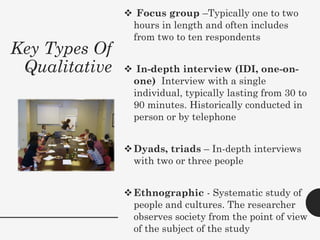
❖ Focus group –Typically one to two
hours in length and often includes
from two to ten respondents
❖ In-depth interview (IDI, one-on-
one) Interview with a single
individual, typically lasting from 30 to
90 minutes. Historically conducted in
person or by telephone
❖Dyads, triads – In-depth interviews
with two or three people
❖Ethnographic - Systematic study of
people and cultures. The researcher
observes society from the point of view
of the subject of the study
When To Use
Qualitative
❖Evaluating New Product or
Services
❖Positioning/Marketing Strategy
❖Reaction to Advertising, Social
Strategy, PR, Branding, Packaging
❖Strengths/Weakness
❖Understanding Purchase Dynamics
❖Exploring market segments, such
as demographic/customer groups
❖Determining consumer language
❖Defining consumer attributes
Package Design Options
What Not To
Expect From
Qualitative
❖Count, measure or offer statistical
validation
❖Determine the best product concept
or price point
❖Establish the importance of specific
customer needs or satisfaction
criteria
❖Be a substitute for quantitative
research
What’s Online
Qualitative?
❖Qualitative Research such as
focus groups have historically
been conducted in person
❖Digital tools have been
developed to allow them to be
conducted remotely:
– Internet text chat
– Online bulletin boards
– Desktop video conferencing
– Smartphone
Video
The Cost Of
In Person
Qualitative
$32,600
Plus Travel Expenses For
Moderator and Client.
Refreshments For Respondents
Focus Group Cost Calculator
The Cost Of
Online
Qualitative
$23,600
No Travel Expenses For
Moderator or Client. No
Refreshments for Respondents
Moderator $6,000
Screener $400
Platform $1,800
Recruiting Costs $2,000
Respondent Incentives $3,000
Project Management $300
Video $100
Moderator’s Analysis/Full Report $10,000
What Is
Quantitative?
❖Focuses more on empirical data
collection and statistical models to
explain what is observed
❖ It is conclusive in its purpose, as it
tries to quantify a problem and
understand how prevalent it is by
looking for projectable results to a
larger population
❖ Typically involves development
and completion of a questionnaire
along with measurement scales
Product Purchase Interest
Percentages National
Top Two Box 74.7
Definitely Would
Purchase
40.0
Probably Would
Purchase
34.7
Might Or Might Not
Purchase
13.0
Definitely Would Not
Purchase
12.3
After reading the description of this food product rate your
level of interest in purchasing. N=300 People
Benefits Of
Quantitative
❖More reliable and objective
❖Large amounts of information can
be collected from a large number of
people in a short period of time and
in a relatively cost effective way
❖Looks at relationships between
variables and can establish cause
and effect in highly controlled
circumstances
❖ Excellent finalizing results and
proving or disproving a hypothesis.
❖The structure has not changed for
centuries, so is standard across
many scientific fields and
disciplines.
Key Types Of
Quantitative
❖ Concept Testing
❖In-Home Use / Taste Test
❖Ad Testing | A/B
❖Attitude and Usage
❖Brand Tracking
❖Media Testing: Online & Offline
❖Package Design
❖Segmentation/Market Sizing
❖Pricing/Purchase Intent
❖Positioning
❖Social Media
❖Shopper Behavior
Original 6 Options Reduced To 3 Options
for Quantitative Testing
Explored in
Qualitative Study
Finalized In
Quantitative Study
When To Use
Quantitative?
❖When you seek to tests theories or
hypotheses against a large number
of people
❖When you want be confident about
moving forward with a service,
product or strategy
What Not To
Expect From
Quantitative
❖Exploration – it is structured with
few if any opened ended questions.
Respondents have limited options
to make a selection
❖It may not allow for understanding
some forms of information - i.e.
changes of emotions, behavior,
feelings etc.
❖ Ability to change in process
The Cost Of
Quantitative…
Varies
Considerably
• Concept Test
– $100/Idea Omnibus
– Free to $5,000 Single
Concept with 20 Questions
• Digital Advertising
– Emma
• Attitude & Usage $40,000
• Market Segmentation $50,000
• In Home Testing $40,000 +
Secondary
Research
❖Resources published by others:
Newspapers/Magazines
Industry Reports
Government Publications
Data.gov
Census Data
Educational Journals
Institutional Reports
Blogs
Websites
Corporate Publications
POS Data: Volume/Share
They Are Dedicated To
Health & Wellness
1/3 Own Pets
2016 Nielson Social Media Report
They Are Connected
Qualitative: Exploratory Quantitative: Conclusive
Hypothesis Broad: Big Picture
Early In Process
Hypothesis Narrow: Focused
Later In Process
Seeks to explore, explore and
understand – What? Why?
Seeks to confirm the hypothesis –
How Many?
Data provided as a narrative,
pictures
Data is in the form of numbers and
statistical results
Methods less structured Highly structured method – data
gathered using tools, questionnaires
Asks open-ended questions,
projective exercises to explore
Asks closed-ended questions that
give quantifiable answers
Research has flexibility-can evolve as
study develops
Research design highly structured
and developed in advance of study
Results may be presented
subjectively. May reveal biases,
values or experiences that impact
how results are interpreted
Results documented objectively
Multi- Strategy Process
Trend
Research
Qualitative
Quantitative
QuestionTo Be Solved
Brainstorming
Ideation
Brainstorming
Ideation
Trend
Research
Qualitative
Quantitative
Qualitative
Multi- Strategy Process
Brainstorming
Ideation
Brainstorming
Ideation
Thank You
Earnestine Benford
Earnestine@cbt13.com
407.451.2665

Consumer research presentation 2017

  • 1.
  • 3.
  • 4.
    What Is Qualitative? ❖The primaryaim of Qualitative Research is usually exploratory. ❖It reveals a target audience’s range of behavior and the perceptions in reference to specific topics or issues. ❖It uses in-depth studies of small groups of people to guide and support the construction of hypotheses. ❖The results are descriptive rather than predictive.
  • 5.
    Benefits Of Qualitative ❖Respondents canbuild on each other’s comments and ideas. ❖The interview or group discussion engages respondents more actively versus a more structured survey. ❖Respondents can engage in projective techniques/exercises, overcoming the self-consciousness that can inhibit spontaneous reactions/comments. ❖Moderator can probe to reach beyond initial responses and rationales. ❖Ability to observe, record and interpret verbal and non-verbal communication.
  • 6.
    Key Types Of Qualitative ❖Focus group –Typically one to two hours in length and often includes from two to ten respondents ❖ In-depth interview (IDI, one-on- one) Interview with a single individual, typically lasting from 30 to 90 minutes. Historically conducted in person or by telephone ❖Dyads, triads – In-depth interviews with two or three people ❖Ethnographic - Systematic study of people and cultures. The researcher observes society from the point of view of the subject of the study
  • 7.
    When To Use Qualitative ❖EvaluatingNew Product or Services ❖Positioning/Marketing Strategy ❖Reaction to Advertising, Social Strategy, PR, Branding, Packaging ❖Strengths/Weakness ❖Understanding Purchase Dynamics ❖Exploring market segments, such as demographic/customer groups ❖Determining consumer language ❖Defining consumer attributes
  • 9.
  • 10.
    What Not To ExpectFrom Qualitative ❖Count, measure or offer statistical validation ❖Determine the best product concept or price point ❖Establish the importance of specific customer needs or satisfaction criteria ❖Be a substitute for quantitative research
  • 11.
    What’s Online Qualitative? ❖Qualitative Researchsuch as focus groups have historically been conducted in person ❖Digital tools have been developed to allow them to be conducted remotely: – Internet text chat – Online bulletin boards – Desktop video conferencing – Smartphone
  • 12.
  • 13.
    The Cost Of InPerson Qualitative $32,600 Plus Travel Expenses For Moderator and Client. Refreshments For Respondents Focus Group Cost Calculator
  • 14.
    The Cost Of Online Qualitative $23,600 NoTravel Expenses For Moderator or Client. No Refreshments for Respondents Moderator $6,000 Screener $400 Platform $1,800 Recruiting Costs $2,000 Respondent Incentives $3,000 Project Management $300 Video $100 Moderator’s Analysis/Full Report $10,000
  • 16.
    What Is Quantitative? ❖Focuses moreon empirical data collection and statistical models to explain what is observed ❖ It is conclusive in its purpose, as it tries to quantify a problem and understand how prevalent it is by looking for projectable results to a larger population ❖ Typically involves development and completion of a questionnaire along with measurement scales
  • 17.
    Product Purchase Interest PercentagesNational Top Two Box 74.7 Definitely Would Purchase 40.0 Probably Would Purchase 34.7 Might Or Might Not Purchase 13.0 Definitely Would Not Purchase 12.3 After reading the description of this food product rate your level of interest in purchasing. N=300 People
  • 20.
    Benefits Of Quantitative ❖More reliableand objective ❖Large amounts of information can be collected from a large number of people in a short period of time and in a relatively cost effective way ❖Looks at relationships between variables and can establish cause and effect in highly controlled circumstances ❖ Excellent finalizing results and proving or disproving a hypothesis. ❖The structure has not changed for centuries, so is standard across many scientific fields and disciplines.
  • 21.
    Key Types Of Quantitative ❖Concept Testing ❖In-Home Use / Taste Test ❖Ad Testing | A/B ❖Attitude and Usage ❖Brand Tracking ❖Media Testing: Online & Offline ❖Package Design ❖Segmentation/Market Sizing ❖Pricing/Purchase Intent ❖Positioning ❖Social Media ❖Shopper Behavior
  • 24.
    Original 6 OptionsReduced To 3 Options for Quantitative Testing Explored in Qualitative Study Finalized In Quantitative Study
  • 25.
    When To Use Quantitative? ❖Whenyou seek to tests theories or hypotheses against a large number of people ❖When you want be confident about moving forward with a service, product or strategy
  • 26.
    What Not To ExpectFrom Quantitative ❖Exploration – it is structured with few if any opened ended questions. Respondents have limited options to make a selection ❖It may not allow for understanding some forms of information - i.e. changes of emotions, behavior, feelings etc. ❖ Ability to change in process
  • 27.
    The Cost Of Quantitative… Varies Considerably •Concept Test – $100/Idea Omnibus – Free to $5,000 Single Concept with 20 Questions • Digital Advertising – Emma • Attitude & Usage $40,000 • Market Segmentation $50,000 • In Home Testing $40,000 +
  • 29.
    Secondary Research ❖Resources published byothers: Newspapers/Magazines Industry Reports Government Publications Data.gov Census Data Educational Journals Institutional Reports Blogs Websites Corporate Publications POS Data: Volume/Share
  • 30.
    They Are DedicatedTo Health & Wellness
  • 31.
  • 32.
    2016 Nielson SocialMedia Report They Are Connected
  • 34.
    Qualitative: Exploratory Quantitative:Conclusive Hypothesis Broad: Big Picture Early In Process Hypothesis Narrow: Focused Later In Process Seeks to explore, explore and understand – What? Why? Seeks to confirm the hypothesis – How Many? Data provided as a narrative, pictures Data is in the form of numbers and statistical results Methods less structured Highly structured method – data gathered using tools, questionnaires Asks open-ended questions, projective exercises to explore Asks closed-ended questions that give quantifiable answers Research has flexibility-can evolve as study develops Research design highly structured and developed in advance of study Results may be presented subjectively. May reveal biases, values or experiences that impact how results are interpreted Results documented objectively
  • 35.
    Multi- Strategy Process Trend Research Qualitative Quantitative QuestionToBe Solved Brainstorming Ideation Brainstorming Ideation
  • 36.
  • 38.