CHAPTER 7 ONLINE CONSUMER BEHAVIOR DIPLOMA IN INTERNATIONAL BUSINESS (BUS2513)
Learning Objectives Describe the factors that influence consumer behavior online. Understand the decision-making process of consumer purchasing online. Distinguish online consumer from traditional consumer.
Types Of Markets Consumer Business
Consumer Market Purchasers and household members who intend to consume or benefit from the purchased products and do not buy products to make products.
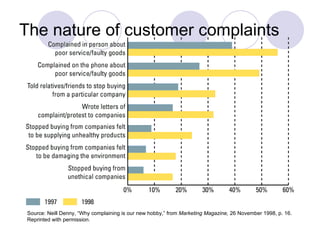
The nature of customer complaints Source: Neill Denny, “Why complaining is our new hobby,” from  Marketing Magazine,  26 November 1998, p. 16. Reprinted with permission.
Buying Behavior The decision processes and acts of people involved in buying and using products.
Consumer Buying Behavior The decision processes and purchasing activities of people who purchase products for personal or household use and not for business purposes.
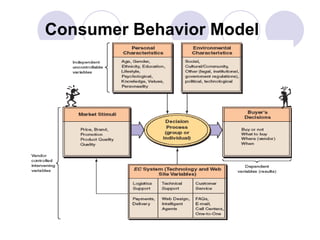
Consumer Behavior Model
Level Of Involvement An individual’s intensity of interest in a product and the importance of the product for that person.
Levels Of Involvement Enduring Situational
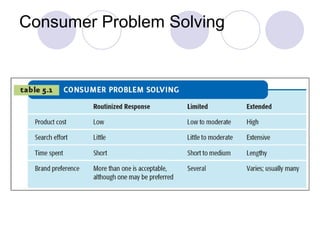
Consumer Problem Solving
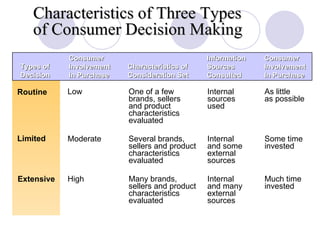
Slide 6-7 Characteristics of Three Types  of Consumer Decision Making Table 6.1 Types of Decision Routine Consumer Involvement In Purchase Limited Extensive One of a few brands, sellers  and product characteristics evaluated Characteristics of Consideration Set Information Sources Consulted Consumer Involvement In Purchase Several brands, sellers and product characteristics evaluated Many brands, sellers and product characteristics evaluated Low Moderate High Internal sources used Internal and some external sources Internal and many external sources As little as possible Some time invested Much time invested
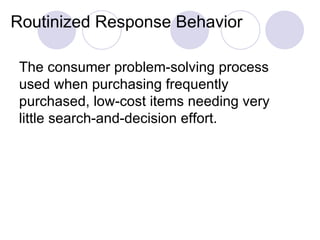
Routinized Response Behavior The consumer problem-solving process used when purchasing frequently purchased, low-cost items needing very little search-and-decision effort.
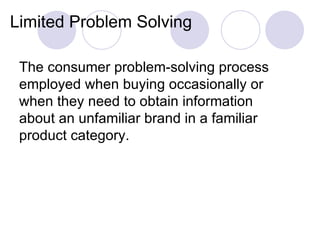
Limited Problem Solving The consumer problem-solving process employed when buying occasionally or when they need to obtain information about an unfamiliar brand in a familiar product category.
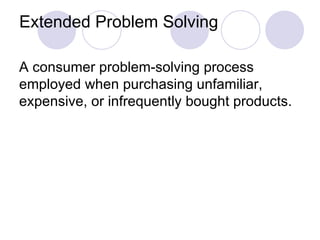
Extended Problem Solving A consumer problem-solving process employed when purchasing unfamiliar, expensive, or infrequently bought products.
Impulse Buying An unplanned buying behavior resulting from a powerful urge to buy something immediately.
Consumer Buying Decision Process A five-stage purchase decision process that includes problem recognition, information search, evaluation of alternatives, purchase, and postpurchase evaluation.
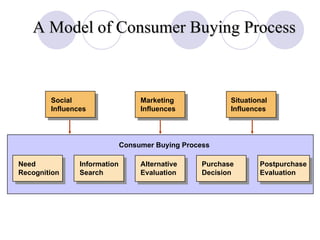
A Model of Consumer Buying Process Figure 6.1 Slide 6-1 Situational Influences Social Influences Marketing Influences Postpurchase Evaluation Need Recognition Information Search Alternative Evaluation Purchase Decision Consumer Buying Process
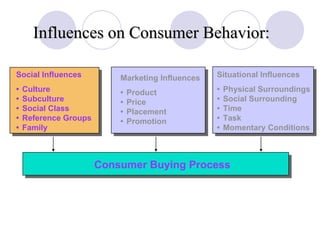
Slide 6-8 Influences on Consumer Behavior: Figure 6.5 Social Influences • Culture • Subculture • Social Class • Reference Groups • Family Marketing Influences • Product • Price • Placement • Promotion Situational Influences • Physical Surroundings • Social Surrounding • Time • Task • Momentary Conditions Consumer Buying Process
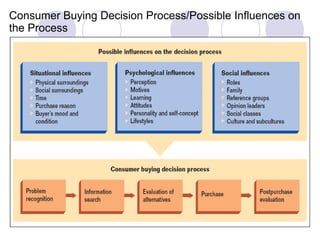
Consumer Buying Decision Process/Possible Influences on the Process
Problem Recognition Difference between desired state and actual condition.
Aspects Of Information Search Internal Search External Search
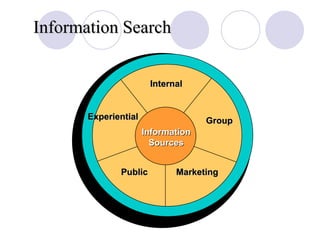
Slide 6-3 Information Search Internal Information Sources Group Marketing Public Experiential
Internal Search An information search in which buyers search their memories for information about their products that might solve their problem.
External Search An information search in which buyers seek information from sources other than memory.
Evaluation Of Alternatives Consideration Set Evaluative Criteria Framing Alternatives
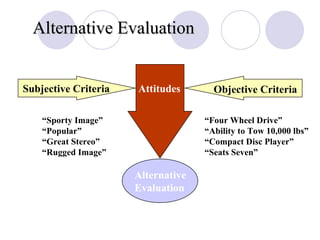
Slide 6-4 Alternative Evaluation Attitudes Alternative Evaluation Subjective Criteria Objective Criteria “ Four Wheel Drive” “Ability to Tow 10,000 lbs” “Compact Disc Player” “Seats Seven” “ Sporty Image” “Popular” “Great Stereo” “Rugged Image”
Cognitive Dissonance A buyer’s doubts shortly after a purchase about whether the decision was the right one. Sample ads of cognitive dissonance
Situational Influences Influences resulting from circumstances, time, and location that affect the consumer buying decision process.
Categories Of Situational Factors Physical Surroundings Social Surroundings Time Perspective Reason For Purchase Buyer’s Mood/Condition
Psychological Influences Factors that in part determine people’s general behavior, thus influencing their behavior as consumers.
Types Of Perception Information Inputs Selective Exposure Selective Distortion Selective Retention
Motives An internal energizing force that directs a person’s behavior toward satisfying needs or achieving goals. Motive for buying organic foods
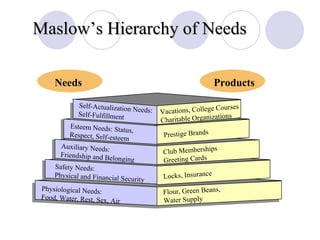
Maslow’s Hierarchy of Needs Vacations, College Courses Charitable Organizations Auxiliary Needs: Friendship and Belonging Esteem Needs: Status, Respect, Self-esteem Prestige Brands Club Memberships Greeting Cards Locks, Insurance Flour, Green Beans, Water Supply Safety Needs: Physical and Financial Security Physiological Needs: Food, Water, Rest, Sex, Air Self-Actualization Needs: Self-Fulfillment Needs Products
Sources Of Learning Behavior Consequences Information Processing Experience
Attitude An individual’s enduring evaluation of feelings about and behavioral tendencies toward an object or idea.
Components Of Attitude Cognitive- knowledge or information Affective- feelings or emotions Behavioral- actions regarding object or idea
Personality And Self-Concept Personality – internal traits and behavioral tendencies Self-Concept – perception or view of oneself
Lifestyle An individual’s pattern of living expressed through activities, interests, and opinions.
Lifestyle Affected By: Age Education Income Social Class
Role Actions and activities that a person in a particular position is supposed to perform based on expectations of the individual and surrounding persons.
Consumer Socialization The process through which a person acquires the knowledge and skills to function as a consumer.
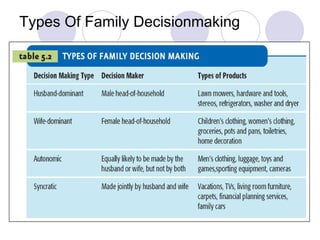
Types Of Family Decisionmaking
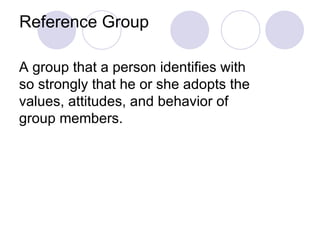
Reference Group A group that a person identifies with so strongly that he or she adopts the values, attitudes, and behavior of group members.
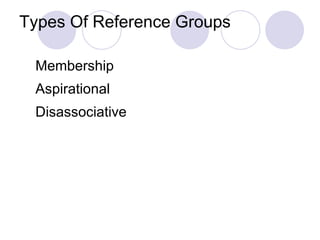
Types Of Reference Groups Membership Aspirational Disassociative
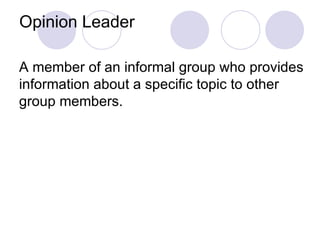
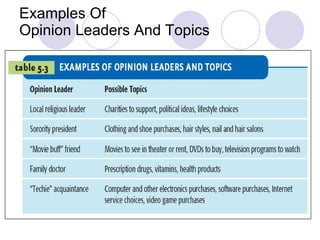
Opinion Leader A member of an informal group who provides information about a specific topic to other group members.
Examples Of Opinion Leaders And Topics
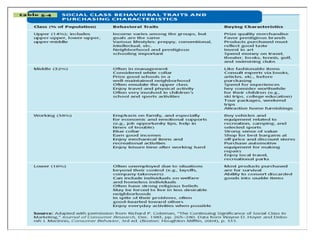
Social Class An open group of individuals with similar social rank.
 
Culture The accumulation of values, knowledge, beliefs, customs, objects, and concepts of a society.
Subcultures A group of individuals whose characteristic values ( religion , etc.) and behavior patterns are similar and different from those of the surrounding culture.
U.S. Ethnic Subcultures African American Hispanic Asian American How about Malaysian ethnic subcultures?
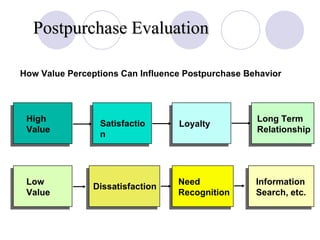
Slide 6-6 Postpurchase Evaluation Figure 6.4 Dissatisfaction Low Value Need Recognition Information Search, etc. Satisfaction High Value Loyalty Long Term Relationship How Value Perceptions Can Influence Postpurchase Behavior
Types of Online Shoppers Time-starved consumers :  Usually found in a house with two sources of income. They are willing to pay higher prices or costs more to save time shopping, no matter whether they like it or not on-line buying experience. Shopping avoiders  : Do not like shopping and may use the Internet just to avoid the crowd, queue or traffic congestion.
Types of Online Shoppers New technologist : Usually young people and comfortable with technology, online shopping because "it's cool". Time-sensitive materialist  atau  click-and-mortar consumers : Only use the Internet to view the products they prefer to make purchases from traditional stores for taking security or other reasons.
Types of Online Shoppers Traditionals :  Just like a traditional store. Probably not going to do shopping online. Hunter-gatherers :  20 percent of the total number of on-line customers. Like to compare prices and find the best prices.
Types of Online Shoppers Brand loyalists : Purchase online for a particular brand as it gets more benefits. Single shoppers : 16 percent of the total number of on-line customers. Liked the Internet not only for shopping but also for banking, communication, playing games, news and other activities.
Online Purchase Decision Aids Shopping Portals : comprehensive portals linked to many different vendors comparison shopping sites there is a comparison tool niche oriented have specialized in a product (cattoys.com) there is a referral fee quotation there is a portal that has a formal relationship with partners
Online Purchase Decision Aids Shopbots  ( Shopping robot )   dan  Agent  ( Shopping agent ): A review tools (Scout) Web to customers who specify the search criteria. Different Shopbots using different search methods . Zdnet.com/computershopper – computer Office.com – office furniture Business Rating Sites : Enhance the rating of the various types of e-tailer and online products based on many criteria. Gomez.com Bizrate.com
Online Purchase Decision Aids Trust Verification Sites : Works to assess and confirm whether a given e-tailer is reliable or not. For example, TRUSTe, BBBOnLine, Secure ASSURE and Ernst & Young. TRUSTe Stamp available on e-tailer Web site reflect the credit. E-tailer has to pay to TRUSTe to use such stamps. Other   Shopping   Tools : Escrow services- 3rd party to assure quality Communities of consumers
Learning about  Consumer Behavior Online A Model of Consumer Behavior Online The purpose of a consumer behavior model is to help vendors understand how a consumer makes a purchasing decision Independent  (or uncontrollable)  variables – personal characteristics and environmental characteristics Intervening  or  moderating variables – market stimuli and EC systems (vendor-controlled) Dependent variables – buyers’ decisions
–  Personal Characteristics Higher education and/or income levels are associated with more online shopping. More experience people have with Internet shopping, the more likely they are to spend more money online. Most-cited reasons people do not purchase: Shipping charges (51%) Difficulty in judging the quality of product (44%) Cannot return items easily (32%) Credit card safety (24%)
–  Environmental Characteristics Social – people are influenced by family members, friends, coworkers, and trends. Of importance are Internet communities, discussion groups. Cultural/community – where people live influence what they buy. Rural shoppers differ from urban shoppers, Europe shoppers differ from Asian shoppers.
The Consumer Decision-Making Process Roles people play in the decision-making process: Initiator – the person who suggests a product/service Influencer – a person whose advice influence purchasing decision Decider – the person who makes the buying decision Buyer – the person who makes an actual purchase User – the person who consumes or uses a product/service
The Consumer Decision-Making Process Online Consumer decision making models: Generic Purchasing-Decision Model Customer Decision Model in Web Purchasing Online Buyer Decision Support Model
Generic Purchasing-Decision Model Consists of five phases: Need identification – consumer convinced the need of a product/service Information search – on various alternatives to satisfy the need Evaluation of alternatives – a set of criteria is developed to help evaluation and comparison Purchase and delivery – payment, purchase warranties After purchase evaluation – customer service and evaluation of usefulness
Web Purchasing Model Each of the phases of the purchasing model can be supported by Consumer Decision Support System facilities and Internet and Web facilities. CDSS facilities support the specific decisions in the process. EC technologies provide necessary mechanisms and enhance communication and collaboration.
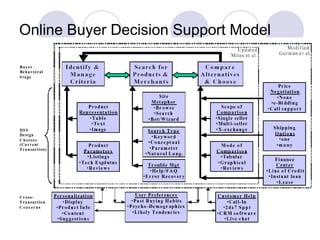
Online Buyer Decision Support Model
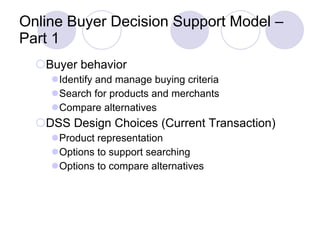
Online Buyer Decision Support Model – Part 1 Buyer behavior Identify and manage buying criteria Search for products and merchants Compare alternatives DSS Design Choices (Current Transaction) Product representation Options to support searching Options to compare alternatives
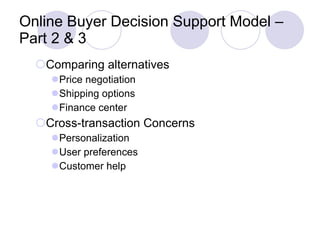
Online Buyer Decision Support Model – Part 2 & 3 Comparing alternatives Price negotiation Shipping options Finance center Cross-transaction Concerns Personalization User preferences Customer help
Online versus traditional consumer Technology adoption Online consumer is best predicted by Internet self-efficacy, followed by perceived financial benefits. Convenience and Decision Support Online consumer only desire is convenience and timesaving. Depth and breadth of information available on the Internet meets the consumer’s need of information to make purchase decision.
Online versus traditional consumer Market dynamics More alternatives can be considered online because of lower search costs and greater availability of information. Online consumers becoming less price conscious over time.
Online versus traditional consumer Loyalty and trust The ability to customize products/services and transactional environment online is far beyond the capability of traditional store. Consumer loyalty to access competitor’s site is only a  click away . Trust for online consumer is an expectation based on past performance, a strategy to reduce uncertainty, a willingness to rely  on an exchanging partner, and a perception of reliability.
Online versus traditional consumer Products versus services Products are tangible and services are intangible in traditional commerce but both products and services are intangible online. Online shopping consumers concern about risk for products than services, more concern about perceived ease of use for services rather than products.
Online versus traditional consumer Site design The impact of the shop window are correlated to the impact of a site’s home page but the impact of store layout versus site layout has some differences. Thus, more study is needed to examine what design elements affect online consumer behavior.
Online versus traditional consumer Empowerment, persuasion and entertainment The ability to shop worldwide at anytime from virtually any location with the availability of real-time product and competitor information increase consumer’s sense of freedom and power. Personalized welcome pages and tailored recommendations list provide customers with a powerful feeling of discovery. Online consumers can react to persuasive media more often than a human at selling. Online shopping is also a form of entertainment and/or social interaction.

Chp 7 online customer behavior

  • 1.
    CHAPTER 7 ONLINECONSUMER BEHAVIOR DIPLOMA IN INTERNATIONAL BUSINESS (BUS2513)
  • 2.
    Learning Objectives Describethe factors that influence consumer behavior online. Understand the decision-making process of consumer purchasing online. Distinguish online consumer from traditional consumer.
  • 3.
    Types Of MarketsConsumer Business
  • 4.
    Consumer Market Purchasersand household members who intend to consume or benefit from the purchased products and do not buy products to make products.
  • 5.
    The nature ofcustomer complaints Source: Neill Denny, “Why complaining is our new hobby,” from Marketing Magazine, 26 November 1998, p. 16. Reprinted with permission.
  • 6.
    Buying Behavior Thedecision processes and acts of people involved in buying and using products.
  • 7.
    Consumer Buying BehaviorThe decision processes and purchasing activities of people who purchase products for personal or household use and not for business purposes.
  • 8.
  • 9.
    Level Of InvolvementAn individual’s intensity of interest in a product and the importance of the product for that person.
  • 10.
    Levels Of InvolvementEnduring Situational
  • 11.
  • 12.
    Slide 6-7 Characteristicsof Three Types of Consumer Decision Making Table 6.1 Types of Decision Routine Consumer Involvement In Purchase Limited Extensive One of a few brands, sellers and product characteristics evaluated Characteristics of Consideration Set Information Sources Consulted Consumer Involvement In Purchase Several brands, sellers and product characteristics evaluated Many brands, sellers and product characteristics evaluated Low Moderate High Internal sources used Internal and some external sources Internal and many external sources As little as possible Some time invested Much time invested
  • 13.
    Routinized Response BehaviorThe consumer problem-solving process used when purchasing frequently purchased, low-cost items needing very little search-and-decision effort.
  • 14.
    Limited Problem SolvingThe consumer problem-solving process employed when buying occasionally or when they need to obtain information about an unfamiliar brand in a familiar product category.
  • 15.
    Extended Problem SolvingA consumer problem-solving process employed when purchasing unfamiliar, expensive, or infrequently bought products.
  • 16.
    Impulse Buying Anunplanned buying behavior resulting from a powerful urge to buy something immediately.
  • 17.
    Consumer Buying DecisionProcess A five-stage purchase decision process that includes problem recognition, information search, evaluation of alternatives, purchase, and postpurchase evaluation.
  • 18.
    A Model ofConsumer Buying Process Figure 6.1 Slide 6-1 Situational Influences Social Influences Marketing Influences Postpurchase Evaluation Need Recognition Information Search Alternative Evaluation Purchase Decision Consumer Buying Process
  • 19.
    Slide 6-8 Influenceson Consumer Behavior: Figure 6.5 Social Influences • Culture • Subculture • Social Class • Reference Groups • Family Marketing Influences • Product • Price • Placement • Promotion Situational Influences • Physical Surroundings • Social Surrounding • Time • Task • Momentary Conditions Consumer Buying Process
  • 20.
    Consumer Buying DecisionProcess/Possible Influences on the Process
  • 21.
    Problem Recognition Differencebetween desired state and actual condition.
  • 22.
    Aspects Of InformationSearch Internal Search External Search
  • 23.
    Slide 6-3 InformationSearch Internal Information Sources Group Marketing Public Experiential
  • 24.
    Internal Search Aninformation search in which buyers search their memories for information about their products that might solve their problem.
  • 25.
    External Search Aninformation search in which buyers seek information from sources other than memory.
  • 26.
    Evaluation Of AlternativesConsideration Set Evaluative Criteria Framing Alternatives
  • 27.
    Slide 6-4 AlternativeEvaluation Attitudes Alternative Evaluation Subjective Criteria Objective Criteria “ Four Wheel Drive” “Ability to Tow 10,000 lbs” “Compact Disc Player” “Seats Seven” “ Sporty Image” “Popular” “Great Stereo” “Rugged Image”
  • 28.
    Cognitive Dissonance Abuyer’s doubts shortly after a purchase about whether the decision was the right one. Sample ads of cognitive dissonance
  • 29.
    Situational Influences Influencesresulting from circumstances, time, and location that affect the consumer buying decision process.
  • 30.
    Categories Of SituationalFactors Physical Surroundings Social Surroundings Time Perspective Reason For Purchase Buyer’s Mood/Condition
  • 31.
    Psychological Influences Factorsthat in part determine people’s general behavior, thus influencing their behavior as consumers.
  • 32.
    Types Of PerceptionInformation Inputs Selective Exposure Selective Distortion Selective Retention
  • 33.
    Motives An internalenergizing force that directs a person’s behavior toward satisfying needs or achieving goals. Motive for buying organic foods
  • 34.
    Maslow’s Hierarchy ofNeeds Vacations, College Courses Charitable Organizations Auxiliary Needs: Friendship and Belonging Esteem Needs: Status, Respect, Self-esteem Prestige Brands Club Memberships Greeting Cards Locks, Insurance Flour, Green Beans, Water Supply Safety Needs: Physical and Financial Security Physiological Needs: Food, Water, Rest, Sex, Air Self-Actualization Needs: Self-Fulfillment Needs Products
  • 35.
    Sources Of LearningBehavior Consequences Information Processing Experience
  • 36.
    Attitude An individual’senduring evaluation of feelings about and behavioral tendencies toward an object or idea.
  • 37.
    Components Of AttitudeCognitive- knowledge or information Affective- feelings or emotions Behavioral- actions regarding object or idea
  • 38.
    Personality And Self-ConceptPersonality – internal traits and behavioral tendencies Self-Concept – perception or view of oneself
  • 39.
    Lifestyle An individual’spattern of living expressed through activities, interests, and opinions.
  • 40.
    Lifestyle Affected By:Age Education Income Social Class
  • 41.
    Role Actions andactivities that a person in a particular position is supposed to perform based on expectations of the individual and surrounding persons.
  • 42.
    Consumer Socialization Theprocess through which a person acquires the knowledge and skills to function as a consumer.
  • 43.
    Types Of FamilyDecisionmaking
  • 44.
    Reference Group Agroup that a person identifies with so strongly that he or she adopts the values, attitudes, and behavior of group members.
  • 45.
    Types Of ReferenceGroups Membership Aspirational Disassociative
  • 46.
    Opinion Leader Amember of an informal group who provides information about a specific topic to other group members.
  • 47.
    Examples Of OpinionLeaders And Topics
  • 48.
    Social Class Anopen group of individuals with similar social rank.
  • 49.
  • 50.
    Culture The accumulationof values, knowledge, beliefs, customs, objects, and concepts of a society.
  • 51.
    Subcultures A groupof individuals whose characteristic values ( religion , etc.) and behavior patterns are similar and different from those of the surrounding culture.
  • 52.
    U.S. Ethnic SubculturesAfrican American Hispanic Asian American How about Malaysian ethnic subcultures?
  • 53.
    Slide 6-6 PostpurchaseEvaluation Figure 6.4 Dissatisfaction Low Value Need Recognition Information Search, etc. Satisfaction High Value Loyalty Long Term Relationship How Value Perceptions Can Influence Postpurchase Behavior
  • 54.
    Types of OnlineShoppers Time-starved consumers : Usually found in a house with two sources of income. They are willing to pay higher prices or costs more to save time shopping, no matter whether they like it or not on-line buying experience. Shopping avoiders : Do not like shopping and may use the Internet just to avoid the crowd, queue or traffic congestion.
  • 55.
    Types of OnlineShoppers New technologist : Usually young people and comfortable with technology, online shopping because "it's cool". Time-sensitive materialist atau click-and-mortar consumers : Only use the Internet to view the products they prefer to make purchases from traditional stores for taking security or other reasons.
  • 56.
    Types of OnlineShoppers Traditionals : Just like a traditional store. Probably not going to do shopping online. Hunter-gatherers : 20 percent of the total number of on-line customers. Like to compare prices and find the best prices.
  • 57.
    Types of OnlineShoppers Brand loyalists : Purchase online for a particular brand as it gets more benefits. Single shoppers : 16 percent of the total number of on-line customers. Liked the Internet not only for shopping but also for banking, communication, playing games, news and other activities.
  • 58.
    Online Purchase DecisionAids Shopping Portals : comprehensive portals linked to many different vendors comparison shopping sites there is a comparison tool niche oriented have specialized in a product (cattoys.com) there is a referral fee quotation there is a portal that has a formal relationship with partners
  • 59.
    Online Purchase DecisionAids Shopbots ( Shopping robot ) dan Agent ( Shopping agent ): A review tools (Scout) Web to customers who specify the search criteria. Different Shopbots using different search methods . Zdnet.com/computershopper – computer Office.com – office furniture Business Rating Sites : Enhance the rating of the various types of e-tailer and online products based on many criteria. Gomez.com Bizrate.com
  • 60.
    Online Purchase DecisionAids Trust Verification Sites : Works to assess and confirm whether a given e-tailer is reliable or not. For example, TRUSTe, BBBOnLine, Secure ASSURE and Ernst & Young. TRUSTe Stamp available on e-tailer Web site reflect the credit. E-tailer has to pay to TRUSTe to use such stamps. Other Shopping Tools : Escrow services- 3rd party to assure quality Communities of consumers
  • 61.
    Learning about Consumer Behavior Online A Model of Consumer Behavior Online The purpose of a consumer behavior model is to help vendors understand how a consumer makes a purchasing decision Independent (or uncontrollable) variables – personal characteristics and environmental characteristics Intervening or moderating variables – market stimuli and EC systems (vendor-controlled) Dependent variables – buyers’ decisions
  • 62.
    – PersonalCharacteristics Higher education and/or income levels are associated with more online shopping. More experience people have with Internet shopping, the more likely they are to spend more money online. Most-cited reasons people do not purchase: Shipping charges (51%) Difficulty in judging the quality of product (44%) Cannot return items easily (32%) Credit card safety (24%)
  • 63.
    – EnvironmentalCharacteristics Social – people are influenced by family members, friends, coworkers, and trends. Of importance are Internet communities, discussion groups. Cultural/community – where people live influence what they buy. Rural shoppers differ from urban shoppers, Europe shoppers differ from Asian shoppers.
  • 64.
    The Consumer Decision-MakingProcess Roles people play in the decision-making process: Initiator – the person who suggests a product/service Influencer – a person whose advice influence purchasing decision Decider – the person who makes the buying decision Buyer – the person who makes an actual purchase User – the person who consumes or uses a product/service
  • 65.
    The Consumer Decision-MakingProcess Online Consumer decision making models: Generic Purchasing-Decision Model Customer Decision Model in Web Purchasing Online Buyer Decision Support Model
  • 66.
    Generic Purchasing-Decision ModelConsists of five phases: Need identification – consumer convinced the need of a product/service Information search – on various alternatives to satisfy the need Evaluation of alternatives – a set of criteria is developed to help evaluation and comparison Purchase and delivery – payment, purchase warranties After purchase evaluation – customer service and evaluation of usefulness
  • 67.
    Web Purchasing ModelEach of the phases of the purchasing model can be supported by Consumer Decision Support System facilities and Internet and Web facilities. CDSS facilities support the specific decisions in the process. EC technologies provide necessary mechanisms and enhance communication and collaboration.
  • 68.
    Online Buyer DecisionSupport Model
  • 69.
    Online Buyer DecisionSupport Model – Part 1 Buyer behavior Identify and manage buying criteria Search for products and merchants Compare alternatives DSS Design Choices (Current Transaction) Product representation Options to support searching Options to compare alternatives
  • 70.
    Online Buyer DecisionSupport Model – Part 2 & 3 Comparing alternatives Price negotiation Shipping options Finance center Cross-transaction Concerns Personalization User preferences Customer help
  • 71.
    Online versus traditionalconsumer Technology adoption Online consumer is best predicted by Internet self-efficacy, followed by perceived financial benefits. Convenience and Decision Support Online consumer only desire is convenience and timesaving. Depth and breadth of information available on the Internet meets the consumer’s need of information to make purchase decision.
  • 72.
    Online versus traditionalconsumer Market dynamics More alternatives can be considered online because of lower search costs and greater availability of information. Online consumers becoming less price conscious over time.
  • 73.
    Online versus traditionalconsumer Loyalty and trust The ability to customize products/services and transactional environment online is far beyond the capability of traditional store. Consumer loyalty to access competitor’s site is only a click away . Trust for online consumer is an expectation based on past performance, a strategy to reduce uncertainty, a willingness to rely on an exchanging partner, and a perception of reliability.
  • 74.
    Online versus traditionalconsumer Products versus services Products are tangible and services are intangible in traditional commerce but both products and services are intangible online. Online shopping consumers concern about risk for products than services, more concern about perceived ease of use for services rather than products.
  • 75.
    Online versus traditionalconsumer Site design The impact of the shop window are correlated to the impact of a site’s home page but the impact of store layout versus site layout has some differences. Thus, more study is needed to examine what design elements affect online consumer behavior.
  • 76.
    Online versus traditionalconsumer Empowerment, persuasion and entertainment The ability to shop worldwide at anytime from virtually any location with the availability of real-time product and competitor information increase consumer’s sense of freedom and power. Personalized welcome pages and tailored recommendations list provide customers with a powerful feeling of discovery. Online consumers can react to persuasive media more often than a human at selling. Online shopping is also a form of entertainment and/or social interaction.

Editor's Notes