VIRAL ONCOGENESIS
Submitted by- Submitted to-
 Rekha Panwar  Prof S. Maherchandani
INTRODUCTION
 ONCOGENIC VIRUSES
Viruses that produce tumours in their natural host /
experimental animals
or
which induce malignant transformation of cells on culture.
 Features of viral oncogenesis
- cause cancer in humans & animals
- long latency between viral infection and tumorigenesis
- modulate growth control pathways in cells
- viral markers are present in tumor cells
 Oncogenesis -An abnormal growth of tissue resulting from
uncontrolled,
progressive multiplication of cells and serving no physiological
function. Result of genetic changes that alter the expression or
function of proteins that play critical roles in the control of cell
growth and division
 Proto-oncogenes - normal (pre-mutation) (pre-diseased) genes
- present in normal cells
- conserved in their genomes
- code for proteins which regulate cell growth
&differentiation
 Oncogenes - mutated versions of proto-oncogenes
- contribute to cancer development by disrupting a cell's
ability to control its own growth.
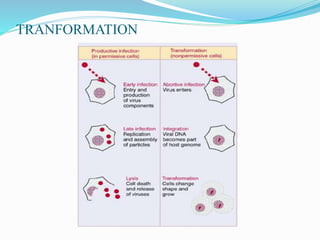
 TRANSFORMATION
alteration in a cell’s properties that leads to immortalization and
different growth patterns that result from alteration in cell cycle.
 Acute tranforming viruses
- retrovirus(alpha ,gamma)
- replication defective (does not produce viral infection)
- contain viral oncogene( transform cells in culture )
 Non acute transforming viruses
- retrovirus (alpha,beta,gamma)
- replication competent (cause viral disease)
- lack viral oncogene (high level of infection months before tumor )
TRANFORMATION
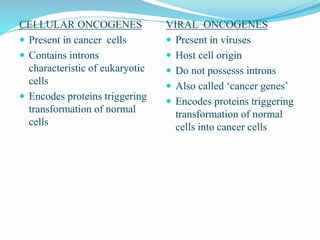
CELLULAR ONCOGENES
 Present in cancer cells
 Contains introns
characteristic of eukaryotic
cells
 Encodes proteins triggering
transformation of normal
cells
VIRAL ONCOGENES
 Present in viruses
 Host cell origin
 Do not possesss introns
 Also called ‘cancer genes’
 Encodes proteins triggering
transformation of normal
cells into cancer cells
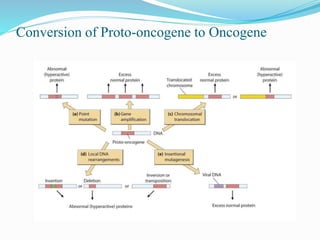
Conversion of Proto-oncogene to Oncogene
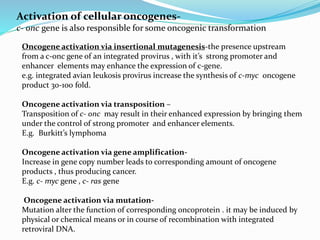
Activation of cellular oncogenes-
c- onc gene is also responsible for some oncogenic transformation
Oncogene activation via insertional mutagenesis-the presence upstream
from a c-onc gene of an integrated provirus , with it’s strong promoter and
enhancer elements may enhance the expression of c-gene.
e.g. integrated avian leukosis provirus increase the synthesis of c-myc oncogene
product 30-100 fold.
Oncogene activation via transposition –
Transposition of c- onc may result in their enhanced expression by bringing them
under the control of strong promoter and enhancer elements.
E.g. Burkitt’s lymphoma
Oncogene activation via gene amplification-
Increase in gene copy number leads to corresponding amount of oncogene
products , thus producing cancer.
E.g. c- myc gene , c- ras gene
Oncogene activation via mutation-
Mutation alter the function of corresponding oncoprotein . it may be induced by
physical or chemical means or in course of recombination with integrated
retroviral DNA.
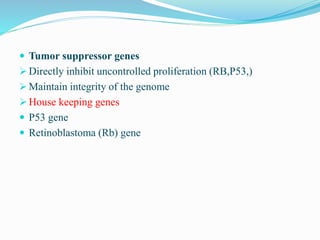
 Tumor suppressor genes
 Directly inhibit uncontrolled proliferation (RB,P53,)
 Maintain integrity of the genome
 House keeping genes
 P53 gene
 Retinoblastoma (Rb) gene
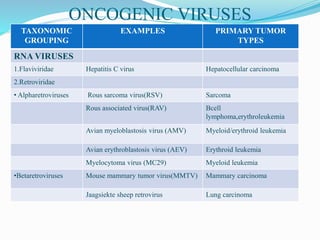
ONCOGENIC VIRUSES
TAXONOMIC
GROUPING
EXAMPLES PRIMARY TUMOR
TYPES
RNA VIRUSES
1.Flaviviridae Hepatitis C virus Hepatocellular carcinoma
2.Retroviridae
• Alpharetroviruses Rous sarcoma virus(RSV) Sarcoma
Rous associated virus(RAV) Bcell
lymphoma,erythroleukemia
Avian myeloblastosis virus (AMV) Myeloid/erythroid leukemia
Avian erythroblastosis virus (AEV) Erythroid leukemia
Myelocytoma virus (MC29) Myeloid leukemia
•Betaretroviruses Mouse mammary tumor virus(MMTV) Mammary carcinoma
Jaagsiekte sheep retrovirus Lung carcinoma
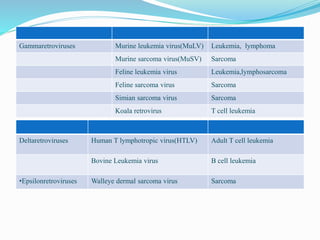
Gammaretroviruses Murine leukemia virus(MuLV) Leukemia, lymphoma
Murine sarcoma virus(MuSV) Sarcoma
Feline leukemia virus Leukemia,lymphosarcoma
Feline sarcoma virus Sarcoma
Simian sarcoma virus Sarcoma
Koala retrovirus T cell leukemia
Deltaretroviruses Human T lymphotropic virus(HTLV) Adult T cell leukemia
Bovine Leukemia virus B cell leukemia
•Epsilonretroviruses Walleye dermal sarcoma virus Sarcoma
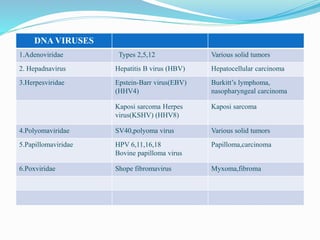
DNA VIRUSES
1.Adenoviridae Types 2,5,12 Various solid tumors
2. Hepadnavirus Hepatitis B virus (HBV) Hepatocellular carcinoma
3.Herpesviridae Epstein-Barr virus(EBV)
(HHV4)
Burkitt’s lymphoma,
nasopharyngeal carcinoma
Kaposi sarcoma Herpes
virus(KSHV) (HHV8)
Kaposi sarcoma
4.Polyomaviridae SV40,polyoma virus Various solid tumors
5.Papillomaviridae HPV 6,11,16,18
Bovine papilloma virus
Papilloma,carcinoma
6.Poxviridae Shope fibromavirus Myxoma,fibroma
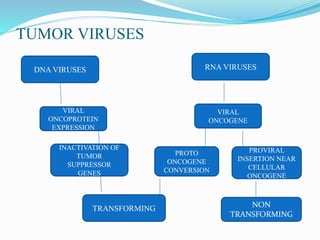
TUMOR VIRUSES
DNA VIRUSES RNA VIRUSES
VIRAL
ONCOPROTEIN
EXPRESSION
VIRAL
ONCOGENE
PROTO
ONCOGENE
CONVERSION
PROVIRAL
INSERTION NEAR
CELLULAR
ONCOGENE
TRANSFORMING NON
TRANSFORMING
INACTIVATION OF
TUMOR
SUPPRESSOR
GENES
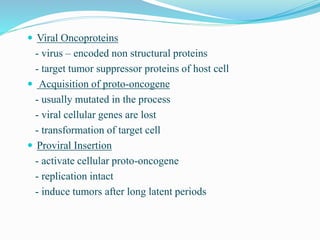
 Viral Oncoproteins
- virus – encoded non structural proteins
- target tumor suppressor proteins of host cell
 Acquisition of proto-oncogene
- usually mutated in the process
- viral cellular genes are lost
- transformation of target cell
 Proviral Insertion
- activate cellular proto-oncogene
- replication intact
- induce tumors after long latent periods
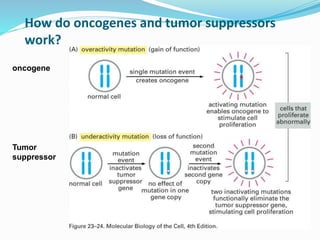
How do oncogenes and tumor suppressors
work?
oncogene
Tumor
suppressor
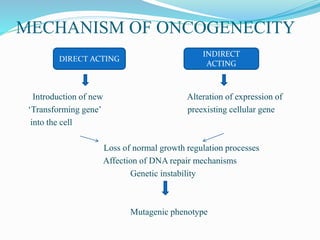
MECHANISM OF ONCOGENECITY
Introduction of new Alteration of expression of
‘Transforming gene’ preexisting cellular gene
into the cell
Loss of normal growth regulation processes
Affection of DNA repair mechanisms
Genetic instability
Mutagenic phenotype
DIRECT ACTING
INDIRECT
ACTING
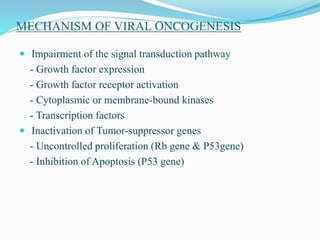
MECHANISM OF VIRAL ONCOGENESIS
 Impairment of the signal transduction pathway
- Growth factor expression
- Growth factor receptor activation
- Cytoplasmic or membrane-bound kinases
- Transcription factors
 Inactivation of Tumor-suppressor genes
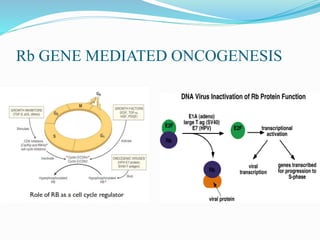
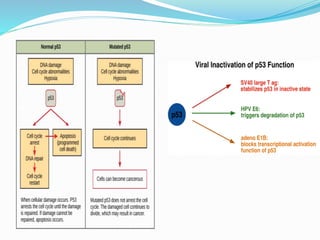
- Uncontrolled proliferation (Rb gene & P53gene)
- Inhibition of Apoptosis (P53 gene)
Rb GENE MEDIATED ONCOGENESIS
19
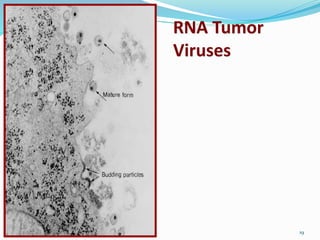
RNA Tumor
Viruses
 FLAVIVIRIDAE (HCV)
 RETROVIRIDAE (HTLV-1)
 XENOTROPIC MURINE LEUKEMIA VIRUS(XMRV)
 Viral oncogenes capture cellular oncogene(proto-oncogene)
(reverse transcriptase mediated in retrovirus)
proto-oncogene is mutated to cause cancer
 About 70 proto-oncogenes identified
code for key cell signaling proteins involved in the control of
cellular proliferation and apoptosis
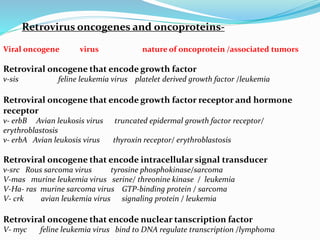
Retrovirus oncogenes and oncoproteins-
Viral oncogene virus nature of oncoprotein /associated tumors
Retroviral oncogene that encode growth factor
v-sis feline leukemia virus platelet derived growth factor /leukemia
Retroviral oncogene that encode growth factor receptor and hormone
receptor
v- erbB Avian leukosis virus truncated epidermal growth factor receptor/
erythroblastosis
v- erbA Avian leukosis virus thyroxin receptor/ erythroblastosis
Retroviral oncogene that encode intracellular signal transducer
v-src Rous sarcoma virus tyrosine phosphokinase/sarcoma
V-mas murine leukemia virus serine/ threonine kinase / leukemia
V-Ha- ras murine sarcoma virus GTP-binding protein / sarcoma
V- crk avian leukemia virus signaling protein / leukemia
Retroviral oncogene that encode nuclear tanscription factor
V- myc feline leukemia virus bind to DNA regulate transcription /lymphoma
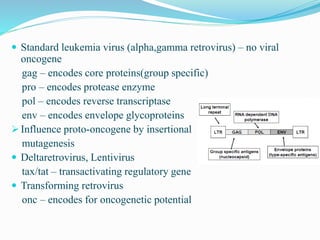
 Standard leukemia virus (alpha,gamma retrovirus) – no viral
oncogene
gag – encodes core proteins(group specific)
pro – encodes protease enzyme
pol – encodes reverse transcriptase
env – encodes envelope glycoproteins
 Influence proto-oncogene by insertional
mutagenesis
 Deltaretrovirus, Lentivirus
tax/tat – transactivating regulatory gene
 Transforming retrovirus
onc – encodes for oncogenetic potential
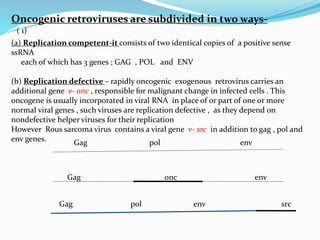
Oncogenic retroviruses are subdivided in two ways-
(a) Replication competent-it consists of two identical copies of a positive sense
ssRNA
each of which has 3 genes ; GAG , POL and ENV
(b) Replication defective – rapidly oncogenic exogenous retrovirus carries an
additional gene v- onc , responsible for malignant change in infected cells . This
oncogene is usually incorporated in viral RNA in place of or part of one or more
normal viral genes , such viruses are replication defective , as they depend on
nondefective helper viruses for their replication
However Rous sarcoma virus contains a viral gene v- src in addition to gag , pol and
env genes. Gag pol env
Gag onc env
Gag pol env src
( 1)
MECHANISM OF TUMORINDUCTION BY
RETROVIRUSES-
They produce tumor in one of three ways-
 Transducing retroviruses introduce a v-onc in to the chromosome
of the cell.
 Cis activating retroviruses which lack a v-onc gene , transform cell
by becoming integrated in host cell DNA close to c-onc and thus
usurping normal cellular regulation of this gene.
 Trans activating retroviruses contain a gene that codes for a
regulatory protein that may either increase transcription from viral
LTR or interfere with transcriptional control of cellular genes .
Oncogenesis

Oncogenesis

  • 1.
    VIRAL ONCOGENESIS Submitted by-Submitted to-  Rekha Panwar  Prof S. Maherchandani
  • 2.
    INTRODUCTION  ONCOGENIC VIRUSES Virusesthat produce tumours in their natural host / experimental animals or which induce malignant transformation of cells on culture.  Features of viral oncogenesis - cause cancer in humans & animals - long latency between viral infection and tumorigenesis - modulate growth control pathways in cells - viral markers are present in tumor cells
  • 3.
     Oncogenesis -Anabnormal growth of tissue resulting from uncontrolled, progressive multiplication of cells and serving no physiological function. Result of genetic changes that alter the expression or function of proteins that play critical roles in the control of cell growth and division  Proto-oncogenes - normal (pre-mutation) (pre-diseased) genes - present in normal cells - conserved in their genomes - code for proteins which regulate cell growth &differentiation  Oncogenes - mutated versions of proto-oncogenes - contribute to cancer development by disrupting a cell's ability to control its own growth.
  • 4.
     TRANSFORMATION alteration ina cell’s properties that leads to immortalization and different growth patterns that result from alteration in cell cycle.  Acute tranforming viruses - retrovirus(alpha ,gamma) - replication defective (does not produce viral infection) - contain viral oncogene( transform cells in culture )  Non acute transforming viruses - retrovirus (alpha,beta,gamma) - replication competent (cause viral disease) - lack viral oncogene (high level of infection months before tumor )
  • 5.
  • 6.
    CELLULAR ONCOGENES  Presentin cancer cells  Contains introns characteristic of eukaryotic cells  Encodes proteins triggering transformation of normal cells VIRAL ONCOGENES  Present in viruses  Host cell origin  Do not possesss introns  Also called ‘cancer genes’  Encodes proteins triggering transformation of normal cells into cancer cells
  • 7.
  • 8.
    Activation of cellularoncogenes- c- onc gene is also responsible for some oncogenic transformation Oncogene activation via insertional mutagenesis-the presence upstream from a c-onc gene of an integrated provirus , with it’s strong promoter and enhancer elements may enhance the expression of c-gene. e.g. integrated avian leukosis provirus increase the synthesis of c-myc oncogene product 30-100 fold. Oncogene activation via transposition – Transposition of c- onc may result in their enhanced expression by bringing them under the control of strong promoter and enhancer elements. E.g. Burkitt’s lymphoma Oncogene activation via gene amplification- Increase in gene copy number leads to corresponding amount of oncogene products , thus producing cancer. E.g. c- myc gene , c- ras gene Oncogene activation via mutation- Mutation alter the function of corresponding oncoprotein . it may be induced by physical or chemical means or in course of recombination with integrated retroviral DNA.
  • 9.
     Tumor suppressorgenes  Directly inhibit uncontrolled proliferation (RB,P53,)  Maintain integrity of the genome  House keeping genes  P53 gene  Retinoblastoma (Rb) gene
  • 10.
    ONCOGENIC VIRUSES TAXONOMIC GROUPING EXAMPLES PRIMARYTUMOR TYPES RNA VIRUSES 1.Flaviviridae Hepatitis C virus Hepatocellular carcinoma 2.Retroviridae • Alpharetroviruses Rous sarcoma virus(RSV) Sarcoma Rous associated virus(RAV) Bcell lymphoma,erythroleukemia Avian myeloblastosis virus (AMV) Myeloid/erythroid leukemia Avian erythroblastosis virus (AEV) Erythroid leukemia Myelocytoma virus (MC29) Myeloid leukemia •Betaretroviruses Mouse mammary tumor virus(MMTV) Mammary carcinoma Jaagsiekte sheep retrovirus Lung carcinoma
  • 11.
    Gammaretroviruses Murine leukemiavirus(MuLV) Leukemia, lymphoma Murine sarcoma virus(MuSV) Sarcoma Feline leukemia virus Leukemia,lymphosarcoma Feline sarcoma virus Sarcoma Simian sarcoma virus Sarcoma Koala retrovirus T cell leukemia Deltaretroviruses Human T lymphotropic virus(HTLV) Adult T cell leukemia Bovine Leukemia virus B cell leukemia •Epsilonretroviruses Walleye dermal sarcoma virus Sarcoma
  • 12.
    DNA VIRUSES 1.Adenoviridae Types2,5,12 Various solid tumors 2. Hepadnavirus Hepatitis B virus (HBV) Hepatocellular carcinoma 3.Herpesviridae Epstein-Barr virus(EBV) (HHV4) Burkitt’s lymphoma, nasopharyngeal carcinoma Kaposi sarcoma Herpes virus(KSHV) (HHV8) Kaposi sarcoma 4.Polyomaviridae SV40,polyoma virus Various solid tumors 5.Papillomaviridae HPV 6,11,16,18 Bovine papilloma virus Papilloma,carcinoma 6.Poxviridae Shope fibromavirus Myxoma,fibroma
  • 13.
    TUMOR VIRUSES DNA VIRUSESRNA VIRUSES VIRAL ONCOPROTEIN EXPRESSION VIRAL ONCOGENE PROTO ONCOGENE CONVERSION PROVIRAL INSERTION NEAR CELLULAR ONCOGENE TRANSFORMING NON TRANSFORMING INACTIVATION OF TUMOR SUPPRESSOR GENES
  • 14.
     Viral Oncoproteins -virus – encoded non structural proteins - target tumor suppressor proteins of host cell  Acquisition of proto-oncogene - usually mutated in the process - viral cellular genes are lost - transformation of target cell  Proviral Insertion - activate cellular proto-oncogene - replication intact - induce tumors after long latent periods
  • 15.
    How do oncogenesand tumor suppressors work? oncogene Tumor suppressor
  • 16.
    MECHANISM OF ONCOGENECITY Introductionof new Alteration of expression of ‘Transforming gene’ preexisting cellular gene into the cell Loss of normal growth regulation processes Affection of DNA repair mechanisms Genetic instability Mutagenic phenotype DIRECT ACTING INDIRECT ACTING
  • 17.
    MECHANISM OF VIRALONCOGENESIS  Impairment of the signal transduction pathway - Growth factor expression - Growth factor receptor activation - Cytoplasmic or membrane-bound kinases - Transcription factors  Inactivation of Tumor-suppressor genes - Uncontrolled proliferation (Rb gene & P53gene) - Inhibition of Apoptosis (P53 gene)
  • 18.
    Rb GENE MEDIATEDONCOGENESIS
  • 19.
  • 21.
     FLAVIVIRIDAE (HCV) RETROVIRIDAE (HTLV-1)  XENOTROPIC MURINE LEUKEMIA VIRUS(XMRV)  Viral oncogenes capture cellular oncogene(proto-oncogene) (reverse transcriptase mediated in retrovirus) proto-oncogene is mutated to cause cancer  About 70 proto-oncogenes identified code for key cell signaling proteins involved in the control of cellular proliferation and apoptosis
  • 22.
    Retrovirus oncogenes andoncoproteins- Viral oncogene virus nature of oncoprotein /associated tumors Retroviral oncogene that encode growth factor v-sis feline leukemia virus platelet derived growth factor /leukemia Retroviral oncogene that encode growth factor receptor and hormone receptor v- erbB Avian leukosis virus truncated epidermal growth factor receptor/ erythroblastosis v- erbA Avian leukosis virus thyroxin receptor/ erythroblastosis Retroviral oncogene that encode intracellular signal transducer v-src Rous sarcoma virus tyrosine phosphokinase/sarcoma V-mas murine leukemia virus serine/ threonine kinase / leukemia V-Ha- ras murine sarcoma virus GTP-binding protein / sarcoma V- crk avian leukemia virus signaling protein / leukemia Retroviral oncogene that encode nuclear tanscription factor V- myc feline leukemia virus bind to DNA regulate transcription /lymphoma
  • 23.
     Standard leukemiavirus (alpha,gamma retrovirus) – no viral oncogene gag – encodes core proteins(group specific) pro – encodes protease enzyme pol – encodes reverse transcriptase env – encodes envelope glycoproteins  Influence proto-oncogene by insertional mutagenesis  Deltaretrovirus, Lentivirus tax/tat – transactivating regulatory gene  Transforming retrovirus onc – encodes for oncogenetic potential
  • 24.
    Oncogenic retroviruses aresubdivided in two ways- (a) Replication competent-it consists of two identical copies of a positive sense ssRNA each of which has 3 genes ; GAG , POL and ENV (b) Replication defective – rapidly oncogenic exogenous retrovirus carries an additional gene v- onc , responsible for malignant change in infected cells . This oncogene is usually incorporated in viral RNA in place of or part of one or more normal viral genes , such viruses are replication defective , as they depend on nondefective helper viruses for their replication However Rous sarcoma virus contains a viral gene v- src in addition to gag , pol and env genes. Gag pol env Gag onc env Gag pol env src ( 1)
  • 25.
    MECHANISM OF TUMORINDUCTIONBY RETROVIRUSES- They produce tumor in one of three ways-  Transducing retroviruses introduce a v-onc in to the chromosome of the cell.  Cis activating retroviruses which lack a v-onc gene , transform cell by becoming integrated in host cell DNA close to c-onc and thus usurping normal cellular regulation of this gene.  Trans activating retroviruses contain a gene that codes for a regulatory protein that may either increase transcription from viral LTR or interfere with transcriptional control of cellular genes .