Groundnut
B.MOHANAPRIYA
2017600808
• Botanical name: Arachis hypogea
• Family: Papilionaceae
• Groundnut is also called as Peanut, Monkey-nut, Earthnut and
Mungfalli.
• Arachis hypogea word is derived from two Greek words:
Arachis means Legume
hypogea means below the ground or soil
• Groundnut is a self pollinated and day neutral plant.
Nutritional qualities of groundnut
• Oil content 44-55%
• Protein content 22-32%
• Soluble sugars 8-14%
• Ca, Fe, Vit. B & E
• Cake contain 45-50% protein- rich in all amino acids except
Leucine & Methionine
• It has antinutritional factors- Trypsin inhibitor & Phytic
acid (inactivated by boiling & roasting)
• Aflatoxin (mycotoxin): produced my Aspergillus flavus
& A. parasiticus, both are f. saprophytes invades G.nut
before or after harvest, during storage & transit.
• Aflatoxin cause liver cirrosis, cancer in animals(also
human)
• Upper limit of aflatoxin for human use-30µg/kg
• Wild proginatorss: Smalt Itle(1978)- probable ancestors of A.hypogaea are
A. duranensis (A genome)
A. ipaensis (B genome)
According to centromeric bands & RFLP data A. villosa & A.ipaensis are
diploid proginators of A. hypogaea & A. monticola
Arachis Genus has more than 70 wild species existing in nature
4 cultivated species of Arachis are
• Diploid species (2n=2x=20)
A villosulicarpa
A repens (fodder & cover crop)
• Tetraploid species (2n=4x=40)
A glabrata (fodder & cover crop)
A hypogaea (oil seed) - Segmental amphidiploid
• 33 species named
A. monticola is only a wild Arachis taxon which can
be crossed with A hypogaea to produce fertile progeny
CLASSIFICATION
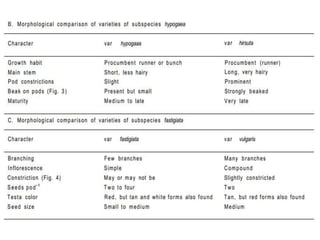
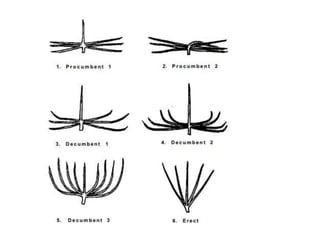
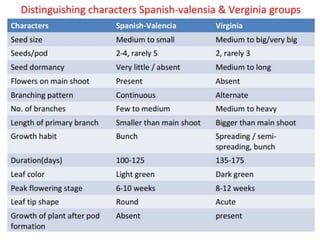
Based on growth habit
a) Spreading: branches are spreading, main shoot
may erect or bent
b) Semi-spreading: main shoot always erect
c) Bunch: branches makes acute angle with the
erect main shoot
Virginia Peruvian runner Valencia Spanish
TYPES OF PEANUTS
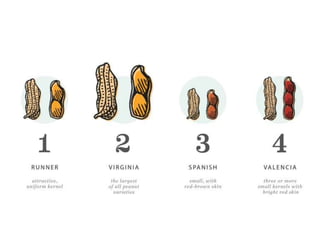
Runner Peanuts
Runners have become the dominant type due to the introduction in the early
1970's of a new runner variety, the Florunner, which was responsible for a
spectacular increase in peanut yields. Runners have rapidly gained wide
acceptance because of the attractive, uniform kernel size. Fifty-four percent
of the runners grown are used for peanut butter.
Virginia Peanuts
Virginias have the largest kernels and account for most of the peanuts
roasted and processed in-the-shell. When shelled, the larger kernels are sold
as snack peanuts.
Spanish Peanuts
Spanish-type peanuts have smaller kernels covered with a reddish-
brown skin. They are used predominantly in peanut candies, with
significant quantities used for snack nuts and peanut butter. They
have a higher oil content than the other types of peanuts which is
advantageous when crushing for oil.
Valencia Peanuts
Valencias usually have three or more small kernels to a pod and are
covered in a bright-red skin. They are very sweet peanuts and are
usually roasted and sold in-the-shell. They are also excellent for fresh
use as boiled peanuts.
Spanish Bunch type Virginia spreading type
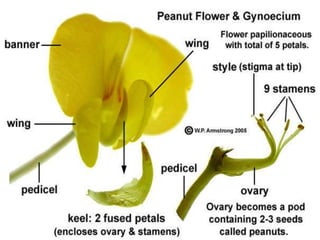
Flowering
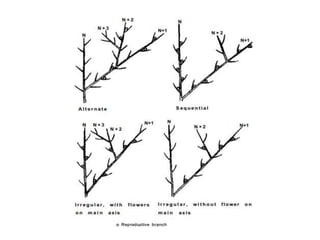
• A flowering branch never occurs at the same node as a
vegetative branch.
• Indeterminate growth, better at good sunshine
• Anthesis - 5.30 to 7.30am
• Stigma becomes receptive about 24 h before anthesis and
its receptivity persists for about 12 hours after anthesis
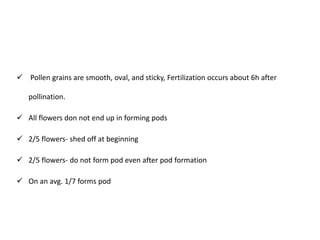
 Pollen grains are smooth, oval, and sticky, Fertilization occurs about 6h after
pollination.
 All flowers don not end up in forming pods
 2/5 flowers- shed off at beginning
 2/5 flowers- do not form pod even after pod formation
 On an avg. 1/7 forms pod
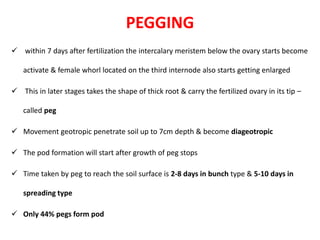
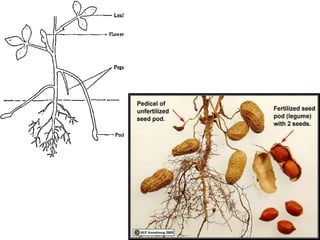
PEGGING
 within 7 days after fertilization the intercalary meristem below the ovary starts become
activate & female whorl located on the third internode also starts getting enlarged
 This in later stages takes the shape of thick root & carry the fertilized ovary in its tip –
called peg
 Movement geotropic penetrate soil up to 7cm depth & become diageotropic
 The pod formation will start after growth of peg stops
 Time taken by peg to reach the soil surface is 2-8 days in bunch type & 5-10 days in
spreading type
 Only 44% pegs form pod
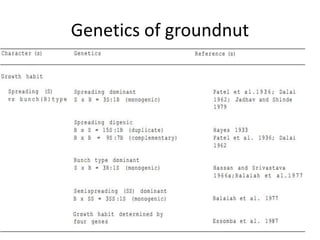
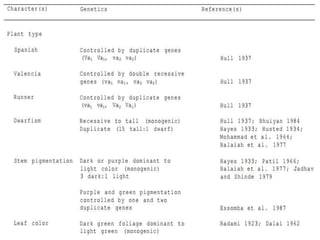
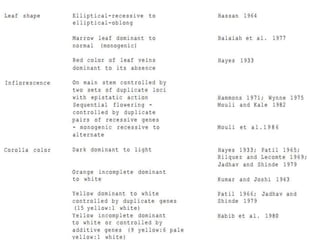
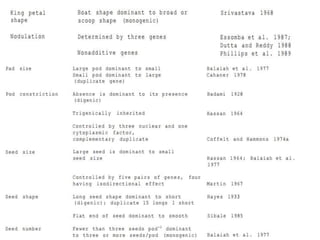
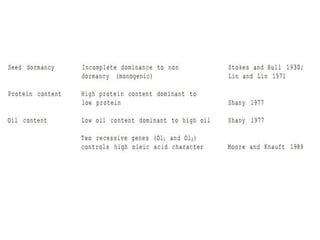
Genetics of groundnut
Breeding objective
• Breeding high yielding bunch groundnut with
dormancy suitable for dryland condition
• Breeding for quality
high shelling percentage
high oil content
table purpose varieties
• Pest and disease resistance
• Short duration varieties
Breeding methods
Introduction
Selection
i) pure line selection
TMV 2- selection from gudiyatham bunch
ii) mass selection
JL 24 – from Taiwan variety
Hybridization and selection
a.)intervarietal
bunch x bunch – VRI 2 ( CO 2 x JL 24)
SSP x Bunch – VRI 3 ( R 33-1 x Ah selection)
• Interspecific
A.batizoccoi – for transfer of disease resistance
A. monticola – for thin shelled condition
A.Villoulicarpa – for increased number of pods
Mutation breeding
• Co 2 EMS mutant from POL 1
• TMV 10- natural mutant from Agrentina local
• TG1 to TG 6( vikram) from BARC Trombay
• GNLM – Gujarat Narrow leaf Mutant
References
• Faujdar Singh and D.L. Oswalt, Genetics and Breeding of Groundnut, International
Crops Research Institute for the Semi-Arid Tropics Patancheru, Andhra Pradesh 502
324, India
• Faujdar Singh and D.L. Oswalt, Groundnut Production Practices, International
Crops Research Institute for the Semi-Arid Tropics Patancheru, Andhra Pradesh 502
324, India
• Bertioli et al, Phenotypic effects of allotetraploidization of wild Arachis and their
implications for peanut domestication , American Journal of Botany, 104 (3): 1 – 10
, 2017
Thank you

Groundnut

  • 1.
  • 2.
    • Botanical name:Arachis hypogea • Family: Papilionaceae • Groundnut is also called as Peanut, Monkey-nut, Earthnut and Mungfalli. • Arachis hypogea word is derived from two Greek words: Arachis means Legume hypogea means below the ground or soil • Groundnut is a self pollinated and day neutral plant.
  • 3.
    Nutritional qualities ofgroundnut • Oil content 44-55% • Protein content 22-32% • Soluble sugars 8-14% • Ca, Fe, Vit. B & E • Cake contain 45-50% protein- rich in all amino acids except Leucine & Methionine
  • 4.
    • It hasantinutritional factors- Trypsin inhibitor & Phytic acid (inactivated by boiling & roasting) • Aflatoxin (mycotoxin): produced my Aspergillus flavus & A. parasiticus, both are f. saprophytes invades G.nut before or after harvest, during storage & transit. • Aflatoxin cause liver cirrosis, cancer in animals(also human) • Upper limit of aflatoxin for human use-30µg/kg
  • 6.
    • Wild proginatorss:Smalt Itle(1978)- probable ancestors of A.hypogaea are A. duranensis (A genome) A. ipaensis (B genome) According to centromeric bands & RFLP data A. villosa & A.ipaensis are diploid proginators of A. hypogaea & A. monticola Arachis Genus has more than 70 wild species existing in nature
  • 7.
    4 cultivated speciesof Arachis are • Diploid species (2n=2x=20) A villosulicarpa A repens (fodder & cover crop) • Tetraploid species (2n=4x=40) A glabrata (fodder & cover crop) A hypogaea (oil seed) - Segmental amphidiploid • 33 species named A. monticola is only a wild Arachis taxon which can be crossed with A hypogaea to produce fertile progeny
  • 9.
    CLASSIFICATION Based on growthhabit a) Spreading: branches are spreading, main shoot may erect or bent b) Semi-spreading: main shoot always erect c) Bunch: branches makes acute angle with the erect main shoot
  • 10.
    Virginia Peruvian runnerValencia Spanish
  • 11.
    TYPES OF PEANUTS RunnerPeanuts Runners have become the dominant type due to the introduction in the early 1970's of a new runner variety, the Florunner, which was responsible for a spectacular increase in peanut yields. Runners have rapidly gained wide acceptance because of the attractive, uniform kernel size. Fifty-four percent of the runners grown are used for peanut butter. Virginia Peanuts Virginias have the largest kernels and account for most of the peanuts roasted and processed in-the-shell. When shelled, the larger kernels are sold as snack peanuts.
  • 12.
    Spanish Peanuts Spanish-type peanutshave smaller kernels covered with a reddish- brown skin. They are used predominantly in peanut candies, with significant quantities used for snack nuts and peanut butter. They have a higher oil content than the other types of peanuts which is advantageous when crushing for oil. Valencia Peanuts Valencias usually have three or more small kernels to a pod and are covered in a bright-red skin. They are very sweet peanuts and are usually roasted and sold in-the-shell. They are also excellent for fresh use as boiled peanuts.
  • 15.
    Spanish Bunch typeVirginia spreading type
  • 21.
    Flowering • A floweringbranch never occurs at the same node as a vegetative branch. • Indeterminate growth, better at good sunshine • Anthesis - 5.30 to 7.30am • Stigma becomes receptive about 24 h before anthesis and its receptivity persists for about 12 hours after anthesis
  • 22.
     Pollen grainsare smooth, oval, and sticky, Fertilization occurs about 6h after pollination.  All flowers don not end up in forming pods  2/5 flowers- shed off at beginning  2/5 flowers- do not form pod even after pod formation  On an avg. 1/7 forms pod
  • 23.
    PEGGING  within 7days after fertilization the intercalary meristem below the ovary starts become activate & female whorl located on the third internode also starts getting enlarged  This in later stages takes the shape of thick root & carry the fertilized ovary in its tip – called peg  Movement geotropic penetrate soil up to 7cm depth & become diageotropic  The pod formation will start after growth of peg stops  Time taken by peg to reach the soil surface is 2-8 days in bunch type & 5-10 days in spreading type  Only 44% pegs form pod
  • 25.
  • 30.
    Breeding objective • Breedinghigh yielding bunch groundnut with dormancy suitable for dryland condition • Breeding for quality high shelling percentage high oil content table purpose varieties • Pest and disease resistance • Short duration varieties
  • 31.
    Breeding methods Introduction Selection i) pureline selection TMV 2- selection from gudiyatham bunch ii) mass selection JL 24 – from Taiwan variety Hybridization and selection a.)intervarietal bunch x bunch – VRI 2 ( CO 2 x JL 24) SSP x Bunch – VRI 3 ( R 33-1 x Ah selection)
  • 32.
    • Interspecific A.batizoccoi –for transfer of disease resistance A. monticola – for thin shelled condition A.Villoulicarpa – for increased number of pods Mutation breeding • Co 2 EMS mutant from POL 1 • TMV 10- natural mutant from Agrentina local • TG1 to TG 6( vikram) from BARC Trombay • GNLM – Gujarat Narrow leaf Mutant
  • 33.
    References • Faujdar Singhand D.L. Oswalt, Genetics and Breeding of Groundnut, International Crops Research Institute for the Semi-Arid Tropics Patancheru, Andhra Pradesh 502 324, India • Faujdar Singh and D.L. Oswalt, Groundnut Production Practices, International Crops Research Institute for the Semi-Arid Tropics Patancheru, Andhra Pradesh 502 324, India • Bertioli et al, Phenotypic effects of allotetraploidization of wild Arachis and their implications for peanut domestication , American Journal of Botany, 104 (3): 1 – 10 , 2017
  • 34.