Presentation by : Shital Magar
Department of Pharmacology
M.Pharm (II-Sem)
R.C.P. I.P.E.R
INVITRO GENOTOXICITY-
OECD Guidelines
Objectives
๏ƒผ To achieve sustainable economic growth and employment and
rising standards of living
๏ƒผ To maintain financial stability
๏ƒผ To assist sound economic expansion
๏ƒผ To contribute to growth in world trade on a multilateral, non-
discriminatory basis
2
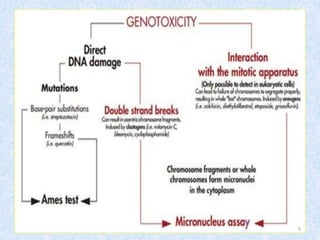
Introduction to Genotoxicity
๏ƒผ Genotoxicity is a word in genetics defined as a destructive effect on
a cell's genetic material (DNA, RNA) affecting its integrity.
Genotoxins are mutagens; they can cause mutations. Genotoxins
include both radiation and chemical genotoxins. A substance that
has the property of genotoxicity is known as a genotoxin.
๏ƒผ Genetic information, encoded chemically in DNA, is maintained,
replicated and transmitted to successive generations with high
fidelity.
3
History of Genotoxicity
๏ƒผ The role of radiation in producing heritable changes in a
living organism was first reported by Muller (Muller, 1927).
๏ƒผ Auerbach was the first to report the ability of chemicals
to cause mutations (Auerbach et al.,1947).
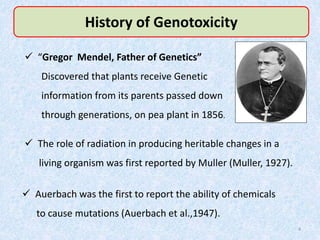
๏ƒผ โ€œGregor Mendel, Father of Geneticsโ€
Discovered that plants receive Genetic
information from its parents passed down
through generations, on pea plant in 1856.
4
5
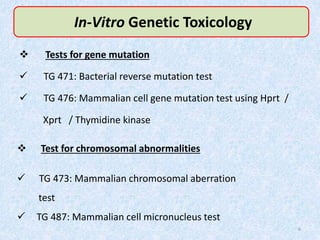
In-Vitro Genetic Toxicology
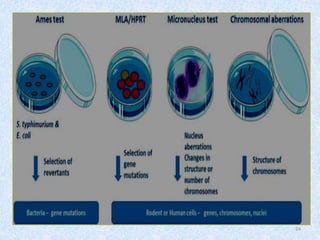
๏ถ Tests for gene mutation
๏ƒผ TG 471: Bacterial reverse mutation test
๏ƒผ TG 476: Mammalian cell gene mutation test using Hprt /
Xprt / Thymidine kinase
๏ถ Test for chromosomal abnormalities
๏ƒผ TG 473: Mammalian chromosomal aberration
test
๏ƒผ TG 487: Mammalian cell micronucleus test
6
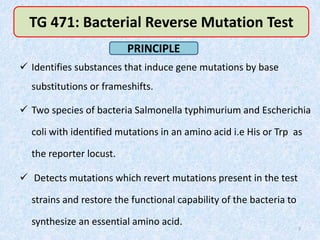
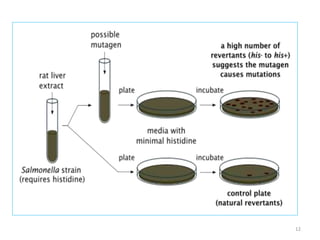
๏ƒผ Identifies substances that induce gene mutations by base
substitutions or frameshifts.
๏ƒผ Two species of bacteria Salmonella typhimurium and Escherichia
coli with identified mutations in an amino acid i.e His or Trp as
the reporter locust.
๏ƒผ Detects mutations which revert mutations present in the test
strains and restore the functional capability of the bacteria to
synthesize an essential amino acid.
7
TG 471: Bacterial Reverse Mutation Test
PRINCIPLE
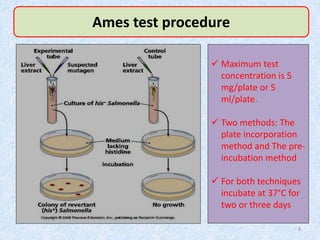
Ames test procedure
๏ƒผ Maximum test
concentration is 5
mg/plate or 5
ml/plate.
๏ƒผ Two methods: The
plate incorporation
method and The pre-
incubation method
๏ƒผ For both techniques
incubate at 37ยฐC for
two or three days
8
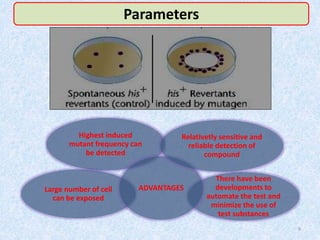
Large number of cell
can be exposed
There have been
developments to
automate the test and
minimize the use of
test substances
Highest induced
mutant frequency can
be detected
ADVANTAGES
Relativetly sensitive and
reliable detection of
compound
Parameters
9
10
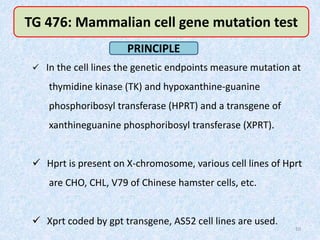
๏ƒผ In the cell lines the genetic endpoints measure mutation at
thymidine kinase (TK) and hypoxanthine-guanine
phosphoribosyl transferase (HPRT) and a transgene of
xanthineguanine phosphoribosyl transferase (XPRT).
๏ƒผ Hprt is present on X-chromosome, various cell lines of Hprt
are CHO, CHL, V79 of Chinese hamster cells, etc.
๏ƒผ Xprt coded by gpt transgene, AS52 cell lines are used.
TG 476: Mammalian cell gene mutation test
PRINCIPLE
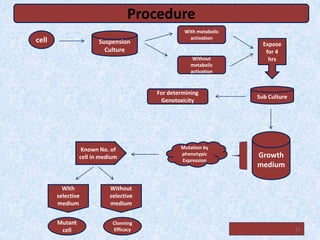
cell Suspension
Culture
With metabolic
activation
Without
metabolic
activation
Expose
for 4
hrs
Sub Culture
For determining
Genotoxicity
Growth
medium
Mutation by
phenotypic
Expression
Known No. of
cell in medium
With
selective
medium
Without
selective
medium
Mutant
cell
Clonning
Efficacy
Procedure
11
12
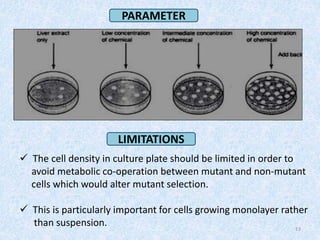
๏ƒผ The cell density in culture plate should be limited in order to
avoid metabolic co-operation between mutant and non-mutant
cells which would alter mutant selection.
๏ƒผ This is particularly important for cells growing monolayer rather
than suspension.
PARAMETER
LIMITATIONS
13
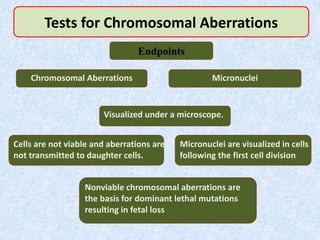
Tests for Chromosomal Aberrations
Chromosomal Aberrations
Endpoints
Micronuclei
Cells are not viable and aberrations are
not transmitted to daughter cells.
Micronuclei are visualized in cells
following the first cell division
Visualized under a microscope.
Nonviable chromosomal aberrations are
the basis for dominant lethal mutations
resulting in fetal loss
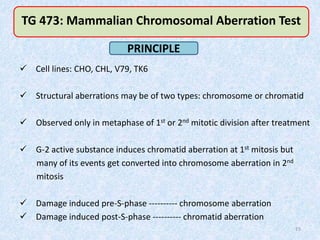
๏ƒผ Cell lines: CHO, CHL, V79, TK6
๏ƒผ Structural aberrations may be of two types: chromosome or chromatid
๏ƒผ Observed only in metaphase of 1st or 2nd mitotic division after treatment
๏ƒผ G-2 active substance induces chromatid aberration at 1st mitosis but
many of its events get converted into chromosome aberration in 2nd
mitosis
๏ƒผ Damage induced pre-S-phase ---------- chromosome aberration
๏ƒผ Damage induced post-S-phase ---------- chromatid aberration
15
TG 473: Mammalian Chromosomal Aberration Test
PRINCIPLE
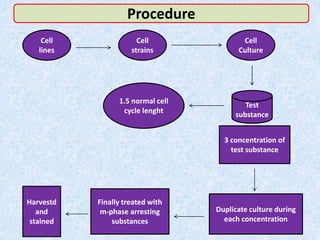
Cell
strains
Test
substance
3 concentration of
test substance
Duplicate culture during
each concentration
Finally treated with
m-phase arresting
substances
Harvestd
and
stained
1.5 normal cell
cycle lenght
Cell
Culture
Cell
lines
Procedure
17
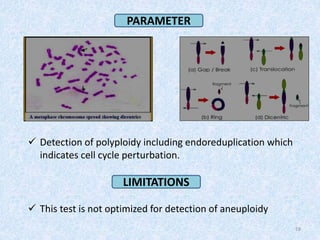
๏ƒผ Detection of polyploidy including endoreduplication which
indicates cell cycle perturbation.
๏ƒผ This test is not optimized for detection of aneuploidy
18
PARAMETER
LIMITATIONS
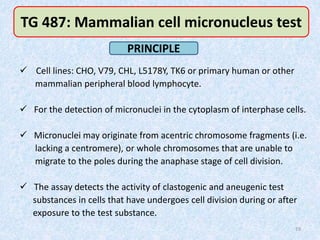
๏ƒผ Cell lines: CHO, V79, CHL, L5178Y, TK6 or primary human or other
mammalian peripheral blood lymphocyte.
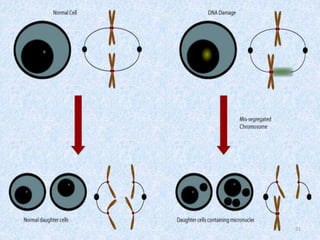
๏ƒผ For the detection of micronuclei in the cytoplasm of interphase cells.
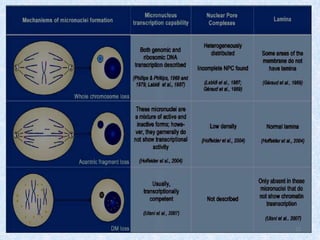
๏ƒผ Micronuclei may originate from acentric chromosome fragments (i.e.
lacking a centromere), or whole chromosomes that are unable to
migrate to the poles during the anaphase stage of cell division.
๏ƒผ The assay detects the activity of clastogenic and aneugenic test
substances in cells that have undergoes cell division during or after
exposure to the test substance.
19
TG 487: Mammalian cell micronucleus test
PRINCIPLE
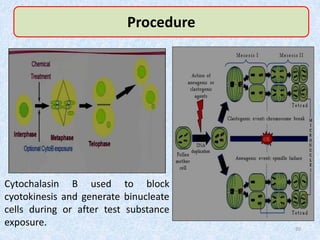
Cytochalasin B used to block
cyotokinesis and generate binucleate
cells during or after test substance
exposure. 20
Procedure
21
22
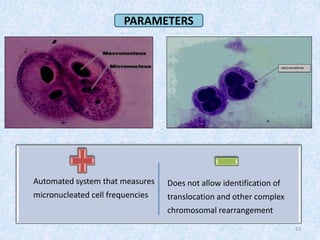
Automated system that measures
micronucleated cell frequencies
Does not allow identification of
translocation and other complex
chromosomal rearrangement
23
PARAMETERS
24
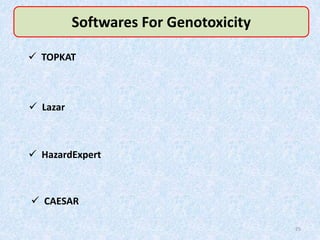
Softwares For Genotoxicity
๏ƒผ Lazar
๏ƒผ CAESAR
๏ƒผ TOPKAT
๏ƒผ HazardExpert
25
REFERENCES
๏ƒผ Combes RD, Gaunt, I, Balls M (2004). A Scientific and Animal Welfare Assessment of
the OECD Health Effects Test Guidelines for the Safety Testing of Chemicals under
the European Union REACH System. ATLA 32, 163-208.
NRC (2007).
๏ƒผ Toxicity Testing in the 21st Century: A Vision and a Strategy. Washington, DC: The
National Academies Press.
๏ƒผ www.oecd.org
๏ƒผ Genetic toxicology guidance document,2015 Hacettepe University, Faculty of
Pharmacy, Department of Toxicology, Ankara
๏ƒผ Department of Environmental Biotechnology, University of Warmia and Mazury in
Olsztyn, ul. Sloneczna 45G, 10โ€“712 Olsztyn, Polan 26
27

OECD Guidlines By Genotoxicity

  • 1.
    Presentation by :Shital Magar Department of Pharmacology M.Pharm (II-Sem) R.C.P. I.P.E.R INVITRO GENOTOXICITY- OECD Guidelines
  • 2.
    Objectives ๏ƒผ To achievesustainable economic growth and employment and rising standards of living ๏ƒผ To maintain financial stability ๏ƒผ To assist sound economic expansion ๏ƒผ To contribute to growth in world trade on a multilateral, non- discriminatory basis 2
  • 3.
    Introduction to Genotoxicity ๏ƒผGenotoxicity is a word in genetics defined as a destructive effect on a cell's genetic material (DNA, RNA) affecting its integrity. Genotoxins are mutagens; they can cause mutations. Genotoxins include both radiation and chemical genotoxins. A substance that has the property of genotoxicity is known as a genotoxin. ๏ƒผ Genetic information, encoded chemically in DNA, is maintained, replicated and transmitted to successive generations with high fidelity. 3
  • 4.
    History of Genotoxicity ๏ƒผThe role of radiation in producing heritable changes in a living organism was first reported by Muller (Muller, 1927). ๏ƒผ Auerbach was the first to report the ability of chemicals to cause mutations (Auerbach et al.,1947). ๏ƒผ โ€œGregor Mendel, Father of Geneticsโ€ Discovered that plants receive Genetic information from its parents passed down through generations, on pea plant in 1856. 4
  • 5.
  • 6.
    In-Vitro Genetic Toxicology ๏ถTests for gene mutation ๏ƒผ TG 471: Bacterial reverse mutation test ๏ƒผ TG 476: Mammalian cell gene mutation test using Hprt / Xprt / Thymidine kinase ๏ถ Test for chromosomal abnormalities ๏ƒผ TG 473: Mammalian chromosomal aberration test ๏ƒผ TG 487: Mammalian cell micronucleus test 6
  • 7.
    ๏ƒผ Identifies substancesthat induce gene mutations by base substitutions or frameshifts. ๏ƒผ Two species of bacteria Salmonella typhimurium and Escherichia coli with identified mutations in an amino acid i.e His or Trp as the reporter locust. ๏ƒผ Detects mutations which revert mutations present in the test strains and restore the functional capability of the bacteria to synthesize an essential amino acid. 7 TG 471: Bacterial Reverse Mutation Test PRINCIPLE
  • 8.
    Ames test procedure ๏ƒผMaximum test concentration is 5 mg/plate or 5 ml/plate. ๏ƒผ Two methods: The plate incorporation method and The pre- incubation method ๏ƒผ For both techniques incubate at 37ยฐC for two or three days 8
  • 9.
    Large number ofcell can be exposed There have been developments to automate the test and minimize the use of test substances Highest induced mutant frequency can be detected ADVANTAGES Relativetly sensitive and reliable detection of compound Parameters 9
  • 10.
    10 ๏ƒผ In thecell lines the genetic endpoints measure mutation at thymidine kinase (TK) and hypoxanthine-guanine phosphoribosyl transferase (HPRT) and a transgene of xanthineguanine phosphoribosyl transferase (XPRT). ๏ƒผ Hprt is present on X-chromosome, various cell lines of Hprt are CHO, CHL, V79 of Chinese hamster cells, etc. ๏ƒผ Xprt coded by gpt transgene, AS52 cell lines are used. TG 476: Mammalian cell gene mutation test PRINCIPLE
  • 11.
    cell Suspension Culture With metabolic activation Without metabolic activation Expose for4 hrs Sub Culture For determining Genotoxicity Growth medium Mutation by phenotypic Expression Known No. of cell in medium With selective medium Without selective medium Mutant cell Clonning Efficacy Procedure 11
  • 12.
  • 13.
    ๏ƒผ The celldensity in culture plate should be limited in order to avoid metabolic co-operation between mutant and non-mutant cells which would alter mutant selection. ๏ƒผ This is particularly important for cells growing monolayer rather than suspension. PARAMETER LIMITATIONS 13
  • 14.
    Tests for ChromosomalAberrations Chromosomal Aberrations Endpoints Micronuclei Cells are not viable and aberrations are not transmitted to daughter cells. Micronuclei are visualized in cells following the first cell division Visualized under a microscope. Nonviable chromosomal aberrations are the basis for dominant lethal mutations resulting in fetal loss
  • 15.
    ๏ƒผ Cell lines:CHO, CHL, V79, TK6 ๏ƒผ Structural aberrations may be of two types: chromosome or chromatid ๏ƒผ Observed only in metaphase of 1st or 2nd mitotic division after treatment ๏ƒผ G-2 active substance induces chromatid aberration at 1st mitosis but many of its events get converted into chromosome aberration in 2nd mitosis ๏ƒผ Damage induced pre-S-phase ---------- chromosome aberration ๏ƒผ Damage induced post-S-phase ---------- chromatid aberration 15 TG 473: Mammalian Chromosomal Aberration Test PRINCIPLE
  • 16.
    Cell strains Test substance 3 concentration of testsubstance Duplicate culture during each concentration Finally treated with m-phase arresting substances Harvestd and stained 1.5 normal cell cycle lenght Cell Culture Cell lines Procedure
  • 17.
  • 18.
    ๏ƒผ Detection ofpolyploidy including endoreduplication which indicates cell cycle perturbation. ๏ƒผ This test is not optimized for detection of aneuploidy 18 PARAMETER LIMITATIONS
  • 19.
    ๏ƒผ Cell lines:CHO, V79, CHL, L5178Y, TK6 or primary human or other mammalian peripheral blood lymphocyte. ๏ƒผ For the detection of micronuclei in the cytoplasm of interphase cells. ๏ƒผ Micronuclei may originate from acentric chromosome fragments (i.e. lacking a centromere), or whole chromosomes that are unable to migrate to the poles during the anaphase stage of cell division. ๏ƒผ The assay detects the activity of clastogenic and aneugenic test substances in cells that have undergoes cell division during or after exposure to the test substance. 19 TG 487: Mammalian cell micronucleus test PRINCIPLE
  • 20.
    Cytochalasin B usedto block cyotokinesis and generate binucleate cells during or after test substance exposure. 20 Procedure
  • 21.
  • 22.
  • 23.
    Automated system thatmeasures micronucleated cell frequencies Does not allow identification of translocation and other complex chromosomal rearrangement 23 PARAMETERS
  • 24.
  • 25.
    Softwares For Genotoxicity ๏ƒผLazar ๏ƒผ CAESAR ๏ƒผ TOPKAT ๏ƒผ HazardExpert 25
  • 26.
    REFERENCES ๏ƒผ Combes RD,Gaunt, I, Balls M (2004). A Scientific and Animal Welfare Assessment of the OECD Health Effects Test Guidelines for the Safety Testing of Chemicals under the European Union REACH System. ATLA 32, 163-208. NRC (2007). ๏ƒผ Toxicity Testing in the 21st Century: A Vision and a Strategy. Washington, DC: The National Academies Press. ๏ƒผ www.oecd.org ๏ƒผ Genetic toxicology guidance document,2015 Hacettepe University, Faculty of Pharmacy, Department of Toxicology, Ankara ๏ƒผ Department of Environmental Biotechnology, University of Warmia and Mazury in Olsztyn, ul. Sloneczna 45G, 10โ€“712 Olsztyn, Polan 26
  • 27.