WELCOME
TO BSBT 105
OCED Guideline for the testing of Chemicals
[473]-In Vitro Mammalian Chromosomal Aberration Test
Submitted to:
Dr. M.S.Vyas
FUNDAMENTALS OF TOXICOLOGY
2
Introduction
• The original Test Guideline 473 was adopted in 1983.
• This Test Guideline is part of a series of Test Guidelines on genetic toxicology.
• in vitro chromosomal aberration test is to identify substances that cause structural
chromosomal aberrations in cultured mammalian cells.
• Structural aberrations may be of two types, chromosome or chromatid.
• The in vitro chromosomal aberration test may employ cultures of established cell lines or
primary cell cultures of human or rodent origin
• The cells used should be selected on the basis of growth ability in culture, stability of the
karyotype (including chromosome number) and spontaneous frequency of chromosomal
aberrations
• DNA repair capacity and origin (rodent versus human) of the cells chosen for testing.
3
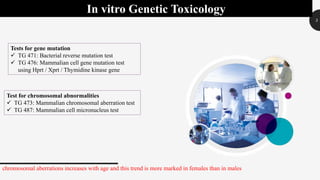
In vitro Genetic Toxicology
Tests for gene mutation
 TG 471: Bacterial reverse mutation test
 TG 476: Mammalian cell gene mutation test
using Hprt / Xprt / Thymidine kinase gene
Test for chromosomal abnormalities
 TG 473: Mammalian chromosomal aberration test
 TG 487: Mammalian cell micronucleus test
chromosomal aberrations increases with age and this trend is more marked in females than in males
INITIAL CONSIDERATIONS AND LIMITATIONS
1
• Tests conducted in vitro
generally require the use
of an exogenous source
of metabolic activation
unless the cells are
metabolically competent
with respect to the test
substances.
2
• chromosome damage not
caused by direct
interaction between the
test chemicals and
chromosomes; such
conditions include
changes in pH or
osmolality, interaction
with the medium
components or excessive
levels of cytotoxicity .
3
• This test is
used to
detect
chromoso
mal
aberrations
that may
result from
clastogenic
events.
4
5`
Cell cultures of human or other mammalian origin are exposed to the test chemical both with and
without an exogenous source of metabolic activation unless cells with an adequate metabolizing
capability are used.
They are treated with a metaphase-arresting substance (e.g. Colcemid® or colchicine), harvested,
stained and metaphase cells are analysed microscopically for the presence of chromatid-type and
chromosome-type aberrations.
PRINCIPLE OF THE TEST
 Damage induced pre-S-phase ---------- chromosome aberration
 Damage induced post-S-phase ---------- chromatid aberration
6
DESCRIPTION OF THE METHOD
1. Preparations of Cells
Cell lines: Chinese Hamster Ovary (CHO), Chinese Hamster lung V79, Chinese Hamster Lung (CHL)/IU, TK6
Primary cell cultures: including human or other mammalian peripheral blood lymphocytes
2. Media and culture conditions
Culture medium and incubation conditions :
Culture vessels
Humidified atmosphere of 5% CO2
Incubation temperature of 37°C
Cells should not be used if contaminated or if the modal chromosome number has changed
3. Preparation of cultures
Cell lines: cells are propagated from stock cultures, seeded in culture medium at a density such that the cells in suspensions or in
monolayers will continue to grow exponentially until harvest time
Lymphocytes: whole blood treated with an anti-coagulant (e.g. heparin) or separated lymphocytes are cultured (e.g. for 48 hours
for human lymphocytes)
7
5. Test chemical preparation
 Solid test: chemicals should be prepared in appropriate solvents and diluted
 Liquid test: chemicals may be added directly to the test system
 Gaseous or volatile test: chemicals should be tested by appropriate modifications to the
standard protocols, such as treatment in sealed culture vessels
Test conditions
• When determining the highest test chemical concentration, concentrations that have the capability of producing artifactual
positive responses, such as those producing excessive cytotoxicity, precipitation in the culture medium or marked changes
in pH or osmolality, should be avoided. If the test chemical causes a marked change in the pH of the medium at the time of
addition, the pH might be adjusted by buffering the final treatment medium so as to avoid artifactual positive results and to
maintain appropriate culture conditions.
• Cytotoxicity should be determined with and without metabolic activation in the main experiment using an appropriate
indication of cell death and growth.
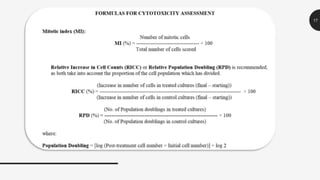
• While RICC and RPD for cell lines and MI for primary culture of lymphocytes are the recommended cytotoxicity
parameters, other indicators (e.g. cell integrity, apoptosis, necrosis, cell cycle) could provide useful additional information.
8PROCEDURE
Test may employ cultures of established cell lines, cell
strains or primary cell cultures
Cell cultures are exposed to the test substance (liquid or solid) both
with and without metabolic activation during about 1.5 normal cell
cycle lengths
At least three analyzable concentrations of the test substance should be used.
At each concentration duplicate cultures should normally be used.
At predetermined intervals after exposure of cell cultures to the test substance, the cells are treated with a
metaphase arresting substance, harvested, stained
9
Analysis
All slides, including those of the positive and negative controls, should be independently coded before microscopic analysis
for chromosomal aberrations. Since fixation procedures often result in a proportion of metaphase cells which have lost
chromosomes.
The number of metaphases scored can be reduced when high numbers of cells with chromosome aberrations are observed and
the test chemical considered as clearly positive.
Chromatid- and chromosome-type aberrations should be recorded separately and classified by sub-types (breaks, exchanges).
Procedures in use in the laboratory should ensure that analysis of chromosomal aberrations is performed by well-trained
scorers and peer-reviewed if appropriate.
the purpose of the test is to detect structural chromosomal aberrations, it is important to record polyploidy and
endoreduplication frequencies when these events are seen
10
Presentation of the results
 The percentage of cells with structural chromosomal aberration(s) should be evaluated.
 Chromatid- and chromosome-type aberrations classified by sub-types (breaks, exchanges) should be listed separately with their
numbers and frequencies for experimental and control cultures.
 Percentage of polyploidy and/or endoreduplicated cells are reported when seen.
 Concurrent measures of cytotoxicity for all treated, negative and positive control cultures in the main aberration experiment(s)
should be recorded.
 Individual culture data should be provided. Additionally, all data should be summarised in tabular form.
11Test report
The test report should include the following information:
 Test chemical:
- source, lot number, limit date for use, if available
- stability of the test chemical itself, if known;
- solubility and stability of the test chemical in solvent, if known.
- measurement of pH, osmolality and precipitate in the culture medium to which the test chemical was added, as
appropriate.
12 Mono-constituent substance
- physical appearance, water solubility, and additional relevant physicochemical properties;
- chemical identification, such as IUPAC or CAS name, CAS number, SMILES or InChI code, structural formula, purity,
chemical identity of impurities as appropriate and practically feasible, etc.
 Multi-constituent substance, UVBCs and mixtures:
- Characterised as far as possible by chemical identity (see above), quantitative occurrence and relevant physicochemical
properties of the constituents.
 Solvent:
- Justification for choice of solvent.
- Percentage of solvent in the final culture medium should also be indicated.
13
 Cells:
─ Type and source of cells
─ Karyotype features and suitability of the cell type used;
─ Absence of mycoplasma, for cell lines;
─ For cell lines, information on cell cycle length, doubling time or proliferation index;
─ Sex of blood donors, age and any relevant information on the donor, whole blood or
separated lymphocytes, mitogen used;
─ Number of passages, if available, for cell lines;
─ Methods for maintenance of cell cultures, for cell lines;
─ Modal number of chromosomes, for cell lines.
14
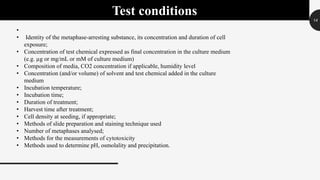
•
• Identity of the metaphase-arresting substance, its concentration and duration of cell
exposure;
• Concentration of test chemical expressed as final concentration in the culture medium
(e.g. µg or mg/mL or mM of culture medium)
• Composition of media, CO2 concentration if applicable, humidity level
• Concentration (and/or volume) of solvent and test chemical added in the culture
medium
• Incubation temperature;
• Incubation time;
• Duration of treatment;
• Harvest time after treatment;
• Cell density at seeding, if appropriate;
• Methods of slide preparation and staining technique used
• Number of metaphases analysed;
• Methods for the measurements of cytotoxicity
• Methods used to determine pH, osmolality and precipitation.
Test conditions
15Evaluation and interpretation of result
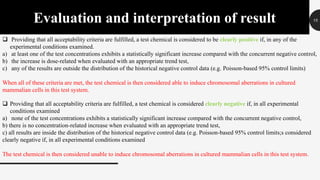
 Providing that all acceptability criteria are fulfilled, a test chemical is considered to be clearly positive if, in any of the
experimental conditions examined.
a) at least one of the test concentrations exhibits a statistically significant increase compared with the concurrent negative control,
b) the increase is dose-related when evaluated with an appropriate trend test,
c) any of the results are outside the distribution of the historical negative control data (e.g. Poisson-based 95% control limits)
When all of these criteria are met, the test chemical is then considered able to induce chromosomal aberrations in cultured
mammalian cells in this test system.
 Providing that all acceptability criteria are fulfilled, a test chemical is considered clearly negative if, in all experimental
conditions examined
a) none of the test concentrations exhibits a statistically significant increase compared with the concurrent negative control,
b) there is no concentration-related increase when evaluated with an appropriate trend test,
c) all results are inside the distribution of the historical negative control data (e.g. Poisson-based 95% control limits;s considered
clearly negative if, in all experimental conditions examined
The test chemical is then considered unable to induce chromosomal aberrations in cultured mammalian cells in this test system.
16Results
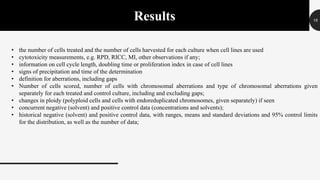
• the number of cells treated and the number of cells harvested for each culture when cell lines are used
• cytotoxicity measurements, e.g. RPD, RICC, MI, other observations if any;
• information on cell cycle length, doubling time or proliferation index in case of cell lines
• signs of precipitation and time of the determination
• definition for aberrations, including gaps
• Number of cells scored, number of cells with chromosomal aberrations and type of chromosomal aberrations given
separately for each treated and control culture, including and excluding gaps;
• changes in ploidy (polyploid cells and cells with endoreduplicated chromosomes, given separately) if seen
• concurrent negative (solvent) and positive control data (concentrations and solvents);
• historical negative (solvent) and positive control data, with ranges, means and standard deviations and 95% control limits
for the distribution, as well as the number of data;
17
18

Oced 473 chromosomal aberration

  • 1.
    WELCOME TO BSBT 105 OCEDGuideline for the testing of Chemicals [473]-In Vitro Mammalian Chromosomal Aberration Test Submitted to: Dr. M.S.Vyas FUNDAMENTALS OF TOXICOLOGY
  • 2.
    2 Introduction • The originalTest Guideline 473 was adopted in 1983. • This Test Guideline is part of a series of Test Guidelines on genetic toxicology. • in vitro chromosomal aberration test is to identify substances that cause structural chromosomal aberrations in cultured mammalian cells. • Structural aberrations may be of two types, chromosome or chromatid. • The in vitro chromosomal aberration test may employ cultures of established cell lines or primary cell cultures of human or rodent origin • The cells used should be selected on the basis of growth ability in culture, stability of the karyotype (including chromosome number) and spontaneous frequency of chromosomal aberrations • DNA repair capacity and origin (rodent versus human) of the cells chosen for testing.
  • 3.
    3 In vitro GeneticToxicology Tests for gene mutation  TG 471: Bacterial reverse mutation test  TG 476: Mammalian cell gene mutation test using Hprt / Xprt / Thymidine kinase gene Test for chromosomal abnormalities  TG 473: Mammalian chromosomal aberration test  TG 487: Mammalian cell micronucleus test chromosomal aberrations increases with age and this trend is more marked in females than in males
  • 4.
    INITIAL CONSIDERATIONS ANDLIMITATIONS 1 • Tests conducted in vitro generally require the use of an exogenous source of metabolic activation unless the cells are metabolically competent with respect to the test substances. 2 • chromosome damage not caused by direct interaction between the test chemicals and chromosomes; such conditions include changes in pH or osmolality, interaction with the medium components or excessive levels of cytotoxicity . 3 • This test is used to detect chromoso mal aberrations that may result from clastogenic events. 4
  • 5.
    5` Cell cultures ofhuman or other mammalian origin are exposed to the test chemical both with and without an exogenous source of metabolic activation unless cells with an adequate metabolizing capability are used. They are treated with a metaphase-arresting substance (e.g. Colcemid® or colchicine), harvested, stained and metaphase cells are analysed microscopically for the presence of chromatid-type and chromosome-type aberrations. PRINCIPLE OF THE TEST  Damage induced pre-S-phase ---------- chromosome aberration  Damage induced post-S-phase ---------- chromatid aberration
  • 6.
    6 DESCRIPTION OF THEMETHOD 1. Preparations of Cells Cell lines: Chinese Hamster Ovary (CHO), Chinese Hamster lung V79, Chinese Hamster Lung (CHL)/IU, TK6 Primary cell cultures: including human or other mammalian peripheral blood lymphocytes 2. Media and culture conditions Culture medium and incubation conditions : Culture vessels Humidified atmosphere of 5% CO2 Incubation temperature of 37°C Cells should not be used if contaminated or if the modal chromosome number has changed 3. Preparation of cultures Cell lines: cells are propagated from stock cultures, seeded in culture medium at a density such that the cells in suspensions or in monolayers will continue to grow exponentially until harvest time Lymphocytes: whole blood treated with an anti-coagulant (e.g. heparin) or separated lymphocytes are cultured (e.g. for 48 hours for human lymphocytes)
  • 7.
    7 5. Test chemicalpreparation  Solid test: chemicals should be prepared in appropriate solvents and diluted  Liquid test: chemicals may be added directly to the test system  Gaseous or volatile test: chemicals should be tested by appropriate modifications to the standard protocols, such as treatment in sealed culture vessels Test conditions • When determining the highest test chemical concentration, concentrations that have the capability of producing artifactual positive responses, such as those producing excessive cytotoxicity, precipitation in the culture medium or marked changes in pH or osmolality, should be avoided. If the test chemical causes a marked change in the pH of the medium at the time of addition, the pH might be adjusted by buffering the final treatment medium so as to avoid artifactual positive results and to maintain appropriate culture conditions. • Cytotoxicity should be determined with and without metabolic activation in the main experiment using an appropriate indication of cell death and growth. • While RICC and RPD for cell lines and MI for primary culture of lymphocytes are the recommended cytotoxicity parameters, other indicators (e.g. cell integrity, apoptosis, necrosis, cell cycle) could provide useful additional information.
  • 8.
    8PROCEDURE Test may employcultures of established cell lines, cell strains or primary cell cultures Cell cultures are exposed to the test substance (liquid or solid) both with and without metabolic activation during about 1.5 normal cell cycle lengths At least three analyzable concentrations of the test substance should be used. At each concentration duplicate cultures should normally be used. At predetermined intervals after exposure of cell cultures to the test substance, the cells are treated with a metaphase arresting substance, harvested, stained
  • 9.
    9 Analysis All slides, includingthose of the positive and negative controls, should be independently coded before microscopic analysis for chromosomal aberrations. Since fixation procedures often result in a proportion of metaphase cells which have lost chromosomes. The number of metaphases scored can be reduced when high numbers of cells with chromosome aberrations are observed and the test chemical considered as clearly positive. Chromatid- and chromosome-type aberrations should be recorded separately and classified by sub-types (breaks, exchanges). Procedures in use in the laboratory should ensure that analysis of chromosomal aberrations is performed by well-trained scorers and peer-reviewed if appropriate. the purpose of the test is to detect structural chromosomal aberrations, it is important to record polyploidy and endoreduplication frequencies when these events are seen
  • 10.
    10 Presentation of theresults  The percentage of cells with structural chromosomal aberration(s) should be evaluated.  Chromatid- and chromosome-type aberrations classified by sub-types (breaks, exchanges) should be listed separately with their numbers and frequencies for experimental and control cultures.  Percentage of polyploidy and/or endoreduplicated cells are reported when seen.  Concurrent measures of cytotoxicity for all treated, negative and positive control cultures in the main aberration experiment(s) should be recorded.  Individual culture data should be provided. Additionally, all data should be summarised in tabular form.
  • 11.
    11Test report The testreport should include the following information:  Test chemical: - source, lot number, limit date for use, if available - stability of the test chemical itself, if known; - solubility and stability of the test chemical in solvent, if known. - measurement of pH, osmolality and precipitate in the culture medium to which the test chemical was added, as appropriate.
  • 12.
    12 Mono-constituent substance -physical appearance, water solubility, and additional relevant physicochemical properties; - chemical identification, such as IUPAC or CAS name, CAS number, SMILES or InChI code, structural formula, purity, chemical identity of impurities as appropriate and practically feasible, etc.  Multi-constituent substance, UVBCs and mixtures: - Characterised as far as possible by chemical identity (see above), quantitative occurrence and relevant physicochemical properties of the constituents.  Solvent: - Justification for choice of solvent. - Percentage of solvent in the final culture medium should also be indicated.
  • 13.
    13  Cells: ─ Typeand source of cells ─ Karyotype features and suitability of the cell type used; ─ Absence of mycoplasma, for cell lines; ─ For cell lines, information on cell cycle length, doubling time or proliferation index; ─ Sex of blood donors, age and any relevant information on the donor, whole blood or separated lymphocytes, mitogen used; ─ Number of passages, if available, for cell lines; ─ Methods for maintenance of cell cultures, for cell lines; ─ Modal number of chromosomes, for cell lines.
  • 14.
    14 • • Identity ofthe metaphase-arresting substance, its concentration and duration of cell exposure; • Concentration of test chemical expressed as final concentration in the culture medium (e.g. µg or mg/mL or mM of culture medium) • Composition of media, CO2 concentration if applicable, humidity level • Concentration (and/or volume) of solvent and test chemical added in the culture medium • Incubation temperature; • Incubation time; • Duration of treatment; • Harvest time after treatment; • Cell density at seeding, if appropriate; • Methods of slide preparation and staining technique used • Number of metaphases analysed; • Methods for the measurements of cytotoxicity • Methods used to determine pH, osmolality and precipitation. Test conditions
  • 15.
    15Evaluation and interpretationof result  Providing that all acceptability criteria are fulfilled, a test chemical is considered to be clearly positive if, in any of the experimental conditions examined. a) at least one of the test concentrations exhibits a statistically significant increase compared with the concurrent negative control, b) the increase is dose-related when evaluated with an appropriate trend test, c) any of the results are outside the distribution of the historical negative control data (e.g. Poisson-based 95% control limits) When all of these criteria are met, the test chemical is then considered able to induce chromosomal aberrations in cultured mammalian cells in this test system.  Providing that all acceptability criteria are fulfilled, a test chemical is considered clearly negative if, in all experimental conditions examined a) none of the test concentrations exhibits a statistically significant increase compared with the concurrent negative control, b) there is no concentration-related increase when evaluated with an appropriate trend test, c) all results are inside the distribution of the historical negative control data (e.g. Poisson-based 95% control limits;s considered clearly negative if, in all experimental conditions examined The test chemical is then considered unable to induce chromosomal aberrations in cultured mammalian cells in this test system.
  • 16.
    16Results • the numberof cells treated and the number of cells harvested for each culture when cell lines are used • cytotoxicity measurements, e.g. RPD, RICC, MI, other observations if any; • information on cell cycle length, doubling time or proliferation index in case of cell lines • signs of precipitation and time of the determination • definition for aberrations, including gaps • Number of cells scored, number of cells with chromosomal aberrations and type of chromosomal aberrations given separately for each treated and control culture, including and excluding gaps; • changes in ploidy (polyploid cells and cells with endoreduplicated chromosomes, given separately) if seen • concurrent negative (solvent) and positive control data (concentrations and solvents); • historical negative (solvent) and positive control data, with ranges, means and standard deviations and 95% control limits for the distribution, as well as the number of data;
  • 17.
  • 18.