OECD Organisation for Economic Co-operation and Development
OECD groups 30 member countries committed to democracy and the market economy provides statistics and economic and social data analyses and forecasts economic developments researches social changes and evolving patterns in trade, environment, agriculture, technology, fiscal policy and more
Helping governments to  compare policy experiences  seek answers to common problems identify good practice co-ordinate domestic and international policies
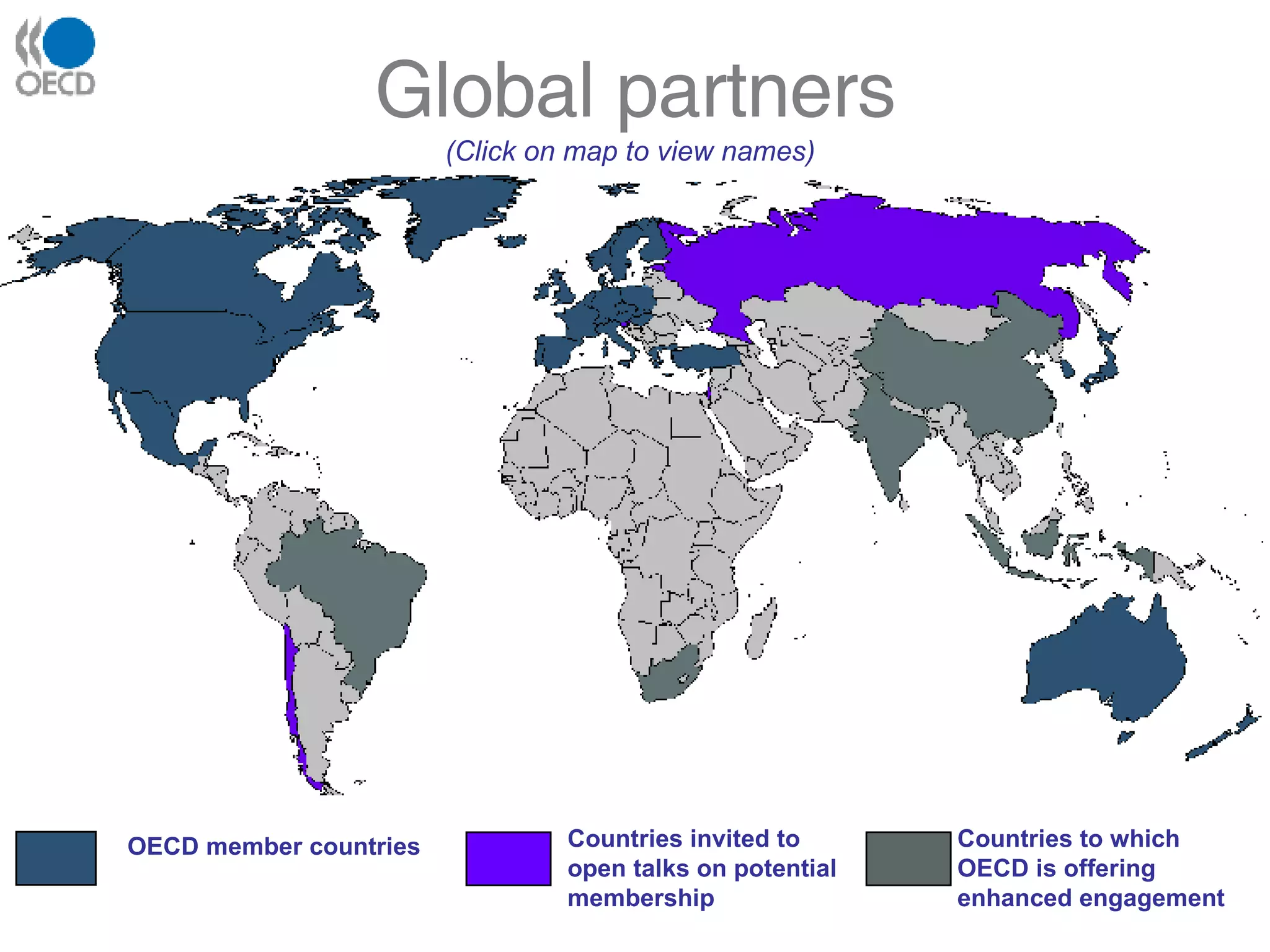
Global partners OECD member countries Countries invited to open talks on potential membership  Countries to which  OECD is offering  enhanced engagement  (Click on map to view names)
30 member countries   AUSTRALIA AUSTRIA  BELGIUM  CANADA   CZECH REPUBLIC  DENMARK  FINLAND  FRANCE  GERMANY  GREECE  HUNGARY  ICELAND  IRELAND  ITALY  JAPAN KOREA LUXEMBOURG MEXICO NETHERLANDS NEW ZEALAND NORWAY POLAND PORTUGAL SLOVAK REPUBLIC SPAIN SWEDEN SWITZERLAND TURKEY UNITED KINGDOM UNITED STATES Countries invited to  membership talks CHILE ESTONIA ISRAEL RUSSIA SLOVENIA Enhanced engagement   BRAZIL CHINA INDIA INDONESIA SOUTH AFRICA
OECD’s mission Article 1  of the OECD Convention defines the Organisation’s mission as being to: support economic growth boost employment  raise living standards  maintain financial stability assist other countries’ economic development  contribute to growth in world trade
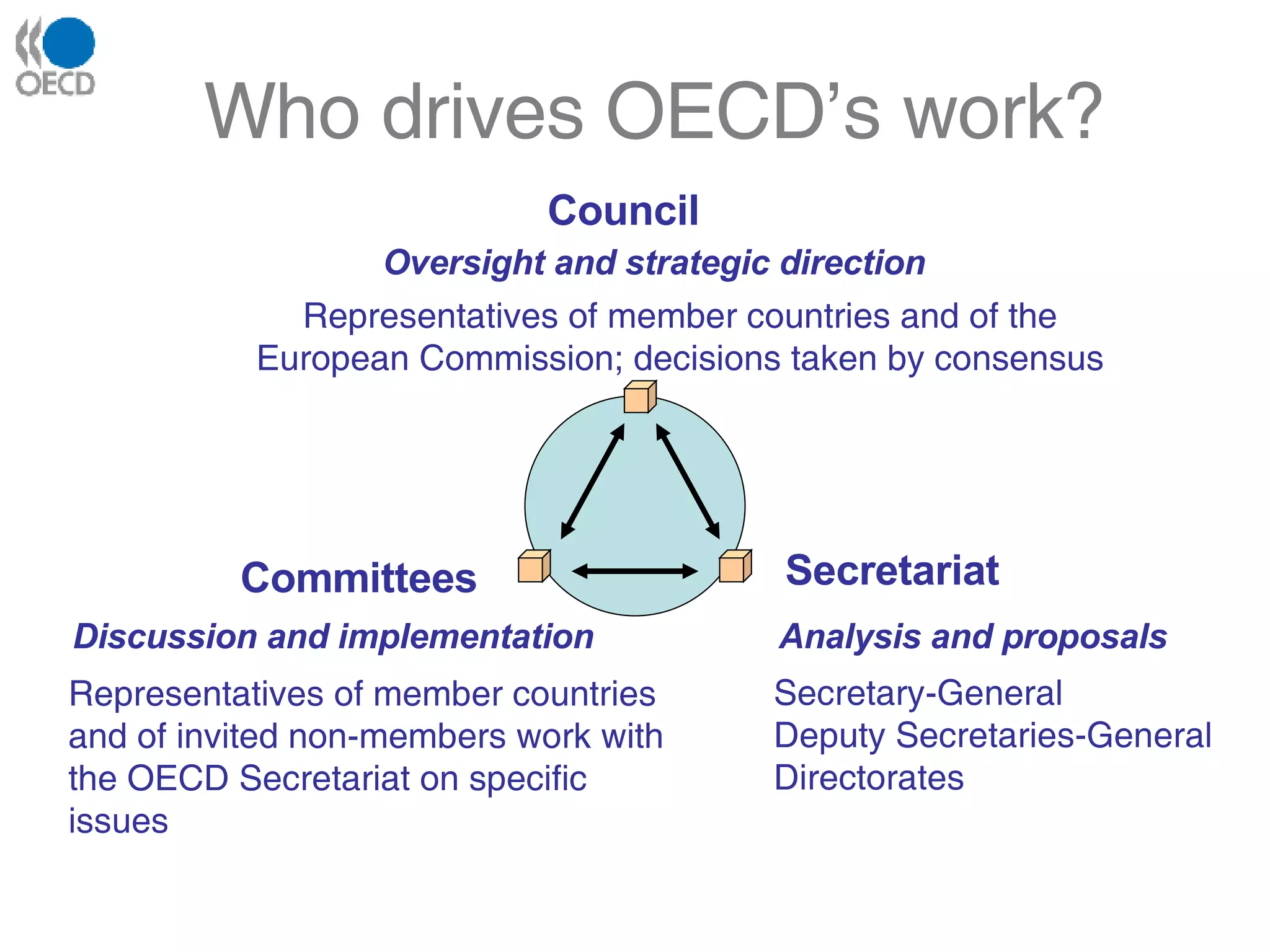
Who drives OECD’s work?   Council Oversight and strategic direction Representatives of member countries and of the European Commission; decisions taken by consensus Committees Discussion and implementation Representatives of member countries and of invited non-members work with the OECD Secretariat on specific issues Secretariat Analysis and proposals Secretary-General Deputy Secretaries-General Directorates
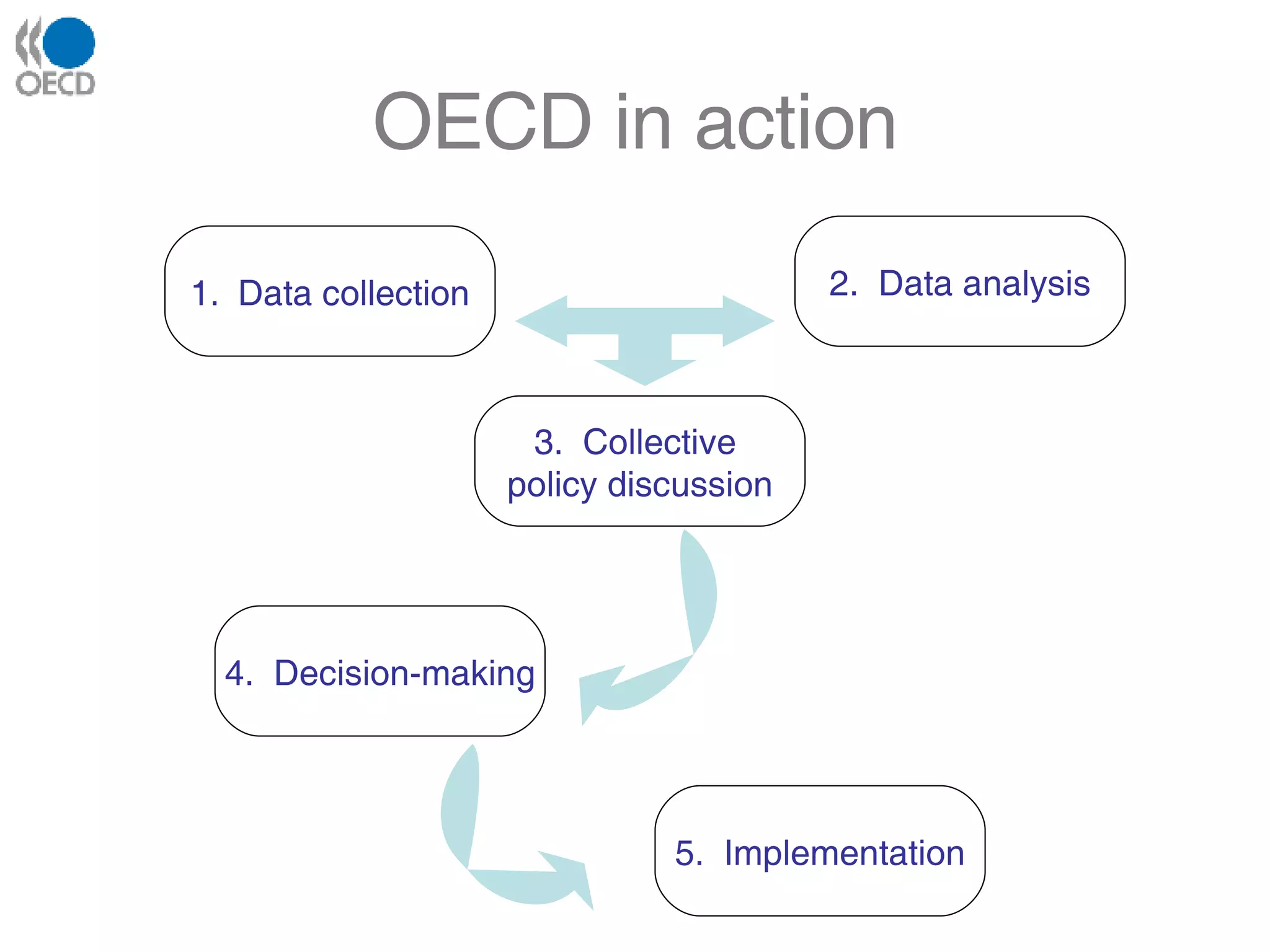
OECD in action Data collection 2.  Data analysis 3.  Collective  policy discussion 4.  Decision-making 5.  Implementation
Major work areas Employment, education, social welfare ensure equal access to education for all  promote effective and accessible health systems fight social exclusion and unemployment bridge the  “digital divide”  between rich and poor
Economy analyse and publish comparative data produce forecasts develop policies for growth and stability foster open markets promote cross-border investment share best practices study how international development co-ordination helps developing countries  offer knowledge and experience to help countries or regions in the process of development
Environment, sustainable development make markets work for a healthier environment use science and technology to benefit people everywhere cut wastage and pollution  bring together member countries to discuss fundamental energy issues through the International Energy Agency (IEA) and the Nuclear Energy Agency (NEA)
Finance promoting liberalisation in financial services and the development of international financial best practices. working to promote investment policy reform and international co-operation.  analysing national tax systems and their impact on labour, capital and product markets. studying the  consequences of ageing populations and their implications for insurance and pensions.
Governance promote effective public administration encourage companies to run their affairs better ensure transparent and fair tax systems  foster fair competition  fight corruption and money-laundering promote high ethical standards encourage citizen-participation in policy-making
Innovation a strong record on biotechnology-related topics through work that spans more than 25 years. improving our understanding of how Information and Communications Technologies (ICT) contribute to sustainable economic growth and social well-being and their role in the shift towards knowledge-based societies. development of indicators to benchmark  countries' innovation performance.
OECD achievements some  examples Improving transparency and ethics in international business Principles of Corporate Governance Guidelines for Multinational Enterprises Anti-Bribery Convention Polluter-Pays Principle (PPP) Simplifying tax issues in international transactions Model Tax Convention Helping emerging and transition economies Co-operation programmes with emerging market economies including China, India and Brazil
Some OECD facts Two official  languages:  English & French Secretariat staff:  more than 2500 OECD’s  headquarters  are located  in Paris, France OECD’s  Secretary-General is  Mr. Angel  Gurría The OECD’s  total budget is  €  340 million (2007)
OECD communications publications (over 150 titles per year) a regularly updated  website  (statistics, data, studies…) a corporate magazine  OECD Observer radio and TV studios an annual civil society  Forum OECD Centres  (Berlin, Mexico City, Tokyo and Washington) which organise events to disseminate OECD’s work
For more information www.oecd.org References mentioned in the presentation:  www.oecd.org/powerpointreferences

Oecd

  • 1.
    OECD Organisation forEconomic Co-operation and Development
  • 2.
    OECD groups 30member countries committed to democracy and the market economy provides statistics and economic and social data analyses and forecasts economic developments researches social changes and evolving patterns in trade, environment, agriculture, technology, fiscal policy and more
  • 3.
    Helping governments to compare policy experiences seek answers to common problems identify good practice co-ordinate domestic and international policies
  • 4.
    Global partners OECDmember countries Countries invited to open talks on potential membership Countries to which OECD is offering enhanced engagement (Click on map to view names)
  • 5.
    30 member countries AUSTRALIA AUSTRIA BELGIUM CANADA CZECH REPUBLIC DENMARK FINLAND FRANCE GERMANY GREECE HUNGARY ICELAND IRELAND ITALY JAPAN KOREA LUXEMBOURG MEXICO NETHERLANDS NEW ZEALAND NORWAY POLAND PORTUGAL SLOVAK REPUBLIC SPAIN SWEDEN SWITZERLAND TURKEY UNITED KINGDOM UNITED STATES Countries invited to membership talks CHILE ESTONIA ISRAEL RUSSIA SLOVENIA Enhanced engagement BRAZIL CHINA INDIA INDONESIA SOUTH AFRICA
  • 6.
    OECD’s mission Article1 of the OECD Convention defines the Organisation’s mission as being to: support economic growth boost employment raise living standards maintain financial stability assist other countries’ economic development contribute to growth in world trade
  • 7.
    Who drives OECD’swork? Council Oversight and strategic direction Representatives of member countries and of the European Commission; decisions taken by consensus Committees Discussion and implementation Representatives of member countries and of invited non-members work with the OECD Secretariat on specific issues Secretariat Analysis and proposals Secretary-General Deputy Secretaries-General Directorates
  • 8.
    OECD in actionData collection 2. Data analysis 3. Collective policy discussion 4. Decision-making 5. Implementation
  • 9.
    Major work areasEmployment, education, social welfare ensure equal access to education for all promote effective and accessible health systems fight social exclusion and unemployment bridge the “digital divide” between rich and poor
  • 10.
    Economy analyse andpublish comparative data produce forecasts develop policies for growth and stability foster open markets promote cross-border investment share best practices study how international development co-ordination helps developing countries offer knowledge and experience to help countries or regions in the process of development
  • 11.
    Environment, sustainable developmentmake markets work for a healthier environment use science and technology to benefit people everywhere cut wastage and pollution bring together member countries to discuss fundamental energy issues through the International Energy Agency (IEA) and the Nuclear Energy Agency (NEA)
  • 12.
    Finance promoting liberalisationin financial services and the development of international financial best practices. working to promote investment policy reform and international co-operation. analysing national tax systems and their impact on labour, capital and product markets. studying the consequences of ageing populations and their implications for insurance and pensions.
  • 13.
    Governance promote effectivepublic administration encourage companies to run their affairs better ensure transparent and fair tax systems foster fair competition fight corruption and money-laundering promote high ethical standards encourage citizen-participation in policy-making
  • 14.
    Innovation a strongrecord on biotechnology-related topics through work that spans more than 25 years. improving our understanding of how Information and Communications Technologies (ICT) contribute to sustainable economic growth and social well-being and their role in the shift towards knowledge-based societies. development of indicators to benchmark countries' innovation performance.
  • 15.
    OECD achievements some examples Improving transparency and ethics in international business Principles of Corporate Governance Guidelines for Multinational Enterprises Anti-Bribery Convention Polluter-Pays Principle (PPP) Simplifying tax issues in international transactions Model Tax Convention Helping emerging and transition economies Co-operation programmes with emerging market economies including China, India and Brazil
  • 16.
    Some OECD factsTwo official languages: English & French Secretariat staff: more than 2500 OECD’s headquarters are located in Paris, France OECD’s Secretary-General is Mr. Angel Gurría The OECD’s total budget is € 340 million (2007)
  • 17.
    OECD communications publications(over 150 titles per year) a regularly updated website (statistics, data, studies…) a corporate magazine OECD Observer radio and TV studios an annual civil society Forum OECD Centres (Berlin, Mexico City, Tokyo and Washington) which organise events to disseminate OECD’s work
  • 18.
    For more informationwww.oecd.org References mentioned in the presentation: www.oecd.org/powerpointreferences