CHRONOPHARMACOLOGY
Ms. Pranali A. Chandurkar
Assistant Professor
Department of Pharmacology
Dr. Rajendra Gode Institute of Pharmacy, Amravati
HISTORY
 Jean-Jaques d’Ortous de Mairan: Described
circardian rhythm in plants in the 18th century.
 Franz Halberg : coined the term ‘Circardian’ in
20th century (about 24 hr or about a day)
 Franz Halberg : Founder of Chronobiology.
CHRONOBIOLOGY
 Chronos: time
Bio: life
Logos: study
 It is the branch of science which deals with the
study of biological rhythm & their mechanism in
the living organism.
 It is concerned with the effects of drugs upon the
timing of biological events and rhythms.
CHRONOPHARMACOLOGY
 Chronos: time
Pharmacon: drug
Logos: study
 It is the branch of science which deals with the pharmacological
action of a drug in relation to biological rhythm.
 It is concerned with the effects of drugs upon the timing of
biological events and rhythms.
 It is important to enhance the therapeutic efficacy, optimization of
drug effects, minimization of adverse effects by using timing
medications in relation to biological rhythm.
BIOLOGICAL RHYTHM
 Biological rhythm: It is the determined rhythmic
biological process or function within a defined time
period.
TYPES OF RHYTHM
 Circadian (last for 24 hr) – Sleep wake cycle
 Infradian (> 24 hr) – Menstrual cycle
 Ultradian (< 24 hr) – Neuronal firing time
CIRCADIAN RHYTHM CYCLE
BIOLOGICAL CLOCK
 An internal biological clock located in mammals, in the
suprachiasmatic nucleus of the hypothalamus (SCN),
delivering its message of time throughout the body.
 It is responsible for circadian rhythms and annual/seasonal
rhythm.
 The SCN uses its connections with the autonomic nervous
system for spreading its time-of-day message, either by
setting the sensitivity of endocrine glands (thyroid, adrenal,
ovary) or by directly controlling an endocrine output of
pineal gland (i.e. melatonin synthesis)
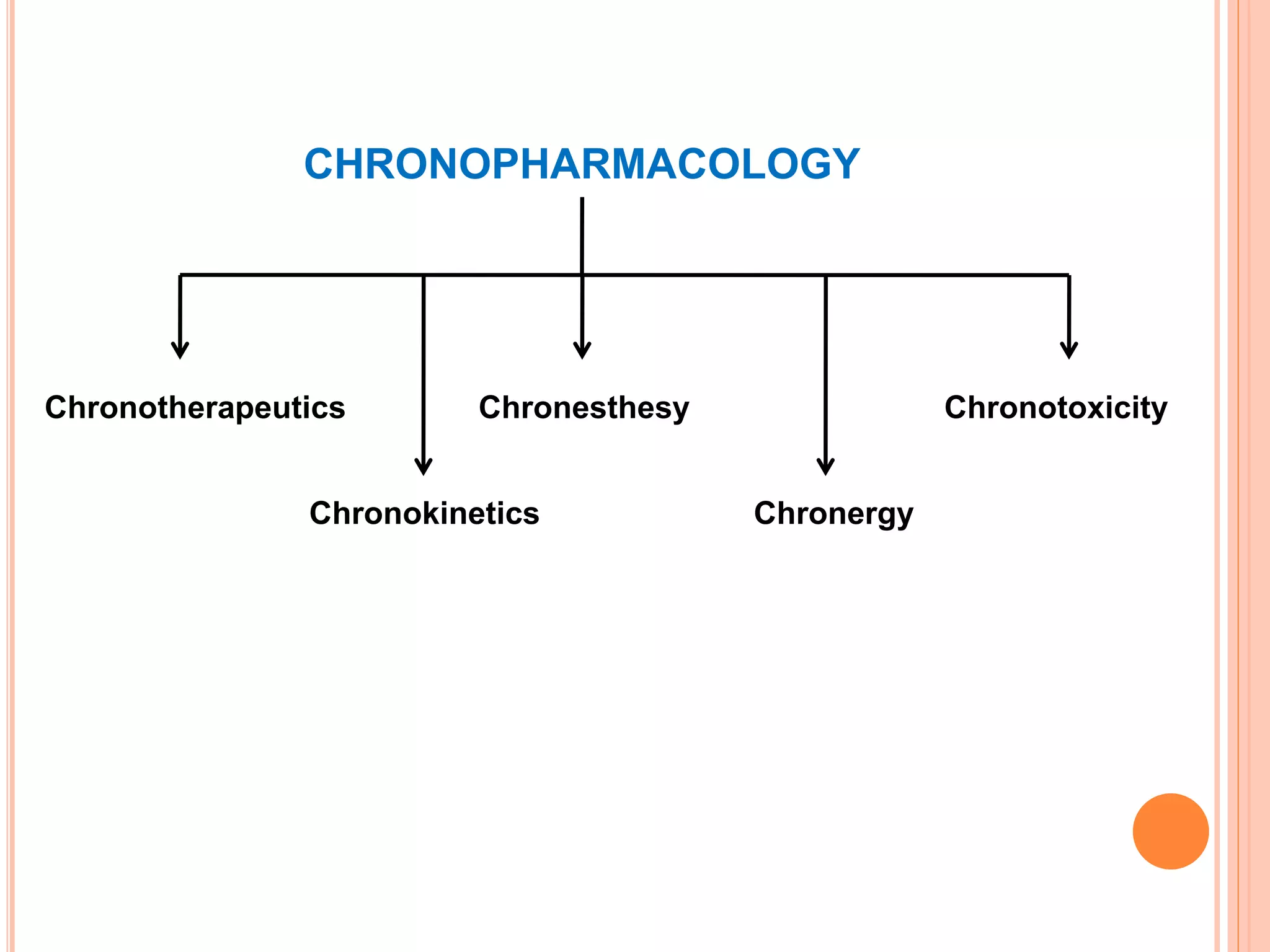
CHRONOPHARMACOLOGY
Chronotherapeutics
Chronokinetics
Chronesthesy
Chronergy
Chronotoxicity
 Chronotherapeutics:
- Effective therapy relation to biological rhythm of a disease.
- It refers to treatment method in which drug availability is timed to
match rhythm of disease in order to optimize the therapeutic
outcomes and minimize side effects.
 Chronokinetics:
- It deals with the study of the temporal changes in the
pharmacokinetics (ADME) of the drug with respective time.
 Chronesthesy:
- The rhythmic changes in susceptibility or sensitivity of a target
system to a drug
 Chronergy:
- Rhythmic changes of both the desired
(effectiveness) and undesired (toxicity, tolerance)
effects on the organism as a whole.
 Chronotoxicity:
- It may be defined as the changes in an organisms
sensitivity to toxicants in relation to time.
APPLICATION OF CHRONOPHARMACOLOGY
Chronotherapy found useful in
 Asthma therapy
 Strokes
 Sleep disorders
 GI tract disorders
 Allergies
 Oncology
ASTHMA
 Acute attack of asthma: more common between midnight and 6.00
am.
 Increase bronchoconstriction at night due to:
- Increase parasympathetic tone
- Decrease adrenaline
- Decrease cortisol at midnight
- Increase sensitivity to irritant and allergens at night
 E.g. Chronopharmacotherapy for asthma is aim to getting max.
beneficial effect from bronchodilators during early morning.
 Sustained release long acting theophylline taken once a day in the
evening causes theophylline blood levels to reach their peak and
improve lung function.
STROKE
 BP rises about 20% immediately after awakening & leaser
during sleep.
 1st two hours after arising are the peak hours for Myocardial
infraction, hemorrhagic stroke and thrombiotic infarcts.
 Reasons:
- Physical activity
- catecholamine levels
- platelet aggregation
- vascular tone
Treatment:
 A new COER Verapamil use in Hypertension.
 It is formulated as a pill with a shell that dissolves
slowly. Taken at bed-time, exerts peak effects
between 5 am and noon & no mid-night dip in BP is
seen.
 Diltiazam: once in a morning strong influence in
evening.
PEPTIC ULCER
 Pathogenesis: Helicobacter pylori and H+ ions
secretion by the stomach.
 Acidity (H+) peak-evening.
 Treatment:
- Once daily given conventional H2 blockers (Ranitidine,
Cemitidine, Famotidine) are given at evening time.
ALLERGIC RHINITIS
 Rhinitis worst in the morning and evening.
 It is a Type-I (Anaphylactic) reaction, in which antibodies
(IgE) are produced which get fixed to the mast cells.
 On exposure to antigens, AG:AB reaction takes place on
mast cell surface releasing Histamine, LTs, PGs etc.
 Resulting in urticaria, itching, brochospasm, rhinitis like
conditions.
 Immediate Hypersensitivity.
Treatment:
 Once daily, non-sedating antihistamine (like
chlorpheniramine 10-20 mg) by giving it before
bedtime to control overnight exacerbations and during
sleep.
 Morning oral corticosteroid therapy for severe
allergic rhinitis.
CANCERS
 Different biological rhythms for normal and tumor
cells.
 Appropriate timing
 Cancer cells
- Duration of the phase of cell cycle
- Cell proliferation rate
 Tumor: fast growing- 2 am, slow growing- 10 pm
 Later half of the menstrual cycle have more clearance
rate than early half of the cycle
Treatment:
 Progesterone in the later half inhibit the enzymes
responsible for spread of cancer cells.
 Cancer drug administered more in night time (Not all
drugs), because cancer cells divide more in night time.
 Treatment with 6-mercaptopurine and methotrexate –
evening dose given to patients.
 Oxaliplatin : given during daytime
 Flurouracil : at night
RECENT ADVANCES
 Casein Kinase 1 (CK-1) inhibitor: Potential new drug
 Reset the circadian clock enzymes.
 Uses: Jet lag, sleep disorder, bipolar disorder
 Animal trials completed.
 Clinical trials are awaited.
THANK YOU….

CHRONOPHARMACOLOGY.pptx

  • 1.
    CHRONOPHARMACOLOGY Ms. Pranali A.Chandurkar Assistant Professor Department of Pharmacology Dr. Rajendra Gode Institute of Pharmacy, Amravati
  • 2.
    HISTORY  Jean-Jaques d’Ortousde Mairan: Described circardian rhythm in plants in the 18th century.  Franz Halberg : coined the term ‘Circardian’ in 20th century (about 24 hr or about a day)  Franz Halberg : Founder of Chronobiology.
  • 3.
    CHRONOBIOLOGY  Chronos: time Bio:life Logos: study  It is the branch of science which deals with the study of biological rhythm & their mechanism in the living organism.  It is concerned with the effects of drugs upon the timing of biological events and rhythms.
  • 4.
    CHRONOPHARMACOLOGY  Chronos: time Pharmacon:drug Logos: study  It is the branch of science which deals with the pharmacological action of a drug in relation to biological rhythm.  It is concerned with the effects of drugs upon the timing of biological events and rhythms.  It is important to enhance the therapeutic efficacy, optimization of drug effects, minimization of adverse effects by using timing medications in relation to biological rhythm.
  • 5.
    BIOLOGICAL RHYTHM  Biologicalrhythm: It is the determined rhythmic biological process or function within a defined time period. TYPES OF RHYTHM  Circadian (last for 24 hr) – Sleep wake cycle  Infradian (> 24 hr) – Menstrual cycle  Ultradian (< 24 hr) – Neuronal firing time
  • 6.
  • 8.
    BIOLOGICAL CLOCK  Aninternal biological clock located in mammals, in the suprachiasmatic nucleus of the hypothalamus (SCN), delivering its message of time throughout the body.  It is responsible for circadian rhythms and annual/seasonal rhythm.  The SCN uses its connections with the autonomic nervous system for spreading its time-of-day message, either by setting the sensitivity of endocrine glands (thyroid, adrenal, ovary) or by directly controlling an endocrine output of pineal gland (i.e. melatonin synthesis)
  • 9.
  • 10.
     Chronotherapeutics: - Effectivetherapy relation to biological rhythm of a disease. - It refers to treatment method in which drug availability is timed to match rhythm of disease in order to optimize the therapeutic outcomes and minimize side effects.  Chronokinetics: - It deals with the study of the temporal changes in the pharmacokinetics (ADME) of the drug with respective time.  Chronesthesy: - The rhythmic changes in susceptibility or sensitivity of a target system to a drug
  • 11.
     Chronergy: - Rhythmicchanges of both the desired (effectiveness) and undesired (toxicity, tolerance) effects on the organism as a whole.  Chronotoxicity: - It may be defined as the changes in an organisms sensitivity to toxicants in relation to time.
  • 12.
    APPLICATION OF CHRONOPHARMACOLOGY Chronotherapyfound useful in  Asthma therapy  Strokes  Sleep disorders  GI tract disorders  Allergies  Oncology
  • 13.
    ASTHMA  Acute attackof asthma: more common between midnight and 6.00 am.  Increase bronchoconstriction at night due to: - Increase parasympathetic tone - Decrease adrenaline - Decrease cortisol at midnight - Increase sensitivity to irritant and allergens at night  E.g. Chronopharmacotherapy for asthma is aim to getting max. beneficial effect from bronchodilators during early morning.  Sustained release long acting theophylline taken once a day in the evening causes theophylline blood levels to reach their peak and improve lung function.
  • 14.
    STROKE  BP risesabout 20% immediately after awakening & leaser during sleep.  1st two hours after arising are the peak hours for Myocardial infraction, hemorrhagic stroke and thrombiotic infarcts.  Reasons: - Physical activity - catecholamine levels - platelet aggregation - vascular tone
  • 15.
    Treatment:  A newCOER Verapamil use in Hypertension.  It is formulated as a pill with a shell that dissolves slowly. Taken at bed-time, exerts peak effects between 5 am and noon & no mid-night dip in BP is seen.  Diltiazam: once in a morning strong influence in evening.
  • 16.
    PEPTIC ULCER  Pathogenesis:Helicobacter pylori and H+ ions secretion by the stomach.  Acidity (H+) peak-evening.  Treatment: - Once daily given conventional H2 blockers (Ranitidine, Cemitidine, Famotidine) are given at evening time.
  • 17.
    ALLERGIC RHINITIS  Rhinitisworst in the morning and evening.  It is a Type-I (Anaphylactic) reaction, in which antibodies (IgE) are produced which get fixed to the mast cells.  On exposure to antigens, AG:AB reaction takes place on mast cell surface releasing Histamine, LTs, PGs etc.  Resulting in urticaria, itching, brochospasm, rhinitis like conditions.  Immediate Hypersensitivity.
  • 18.
    Treatment:  Once daily,non-sedating antihistamine (like chlorpheniramine 10-20 mg) by giving it before bedtime to control overnight exacerbations and during sleep.  Morning oral corticosteroid therapy for severe allergic rhinitis.
  • 19.
    CANCERS  Different biologicalrhythms for normal and tumor cells.  Appropriate timing  Cancer cells - Duration of the phase of cell cycle - Cell proliferation rate  Tumor: fast growing- 2 am, slow growing- 10 pm  Later half of the menstrual cycle have more clearance rate than early half of the cycle
  • 20.
    Treatment:  Progesterone inthe later half inhibit the enzymes responsible for spread of cancer cells.  Cancer drug administered more in night time (Not all drugs), because cancer cells divide more in night time.  Treatment with 6-mercaptopurine and methotrexate – evening dose given to patients.  Oxaliplatin : given during daytime  Flurouracil : at night
  • 21.
    RECENT ADVANCES  CaseinKinase 1 (CK-1) inhibitor: Potential new drug  Reset the circadian clock enzymes.  Uses: Jet lag, sleep disorder, bipolar disorder  Animal trials completed.  Clinical trials are awaited.
  • 22.