SUBACUTE TOXICITY TESTING AS
PER OECD GUIDELINES
AASIFA SHAIKH
18SSRMPH023
M. PHARMACOLOGY, SEM2
SSRCP
What is toxicity testing?
General Toxicity testing is referred to:
a series of toxicity testing required by International
regulatory for
compliance to Good Laboratory Practices (GLP) for
proof of
safety in experimental animal prior to their testing in
human.
It comprises of : Acute, Sub-acute and chronic toxicity.
These studies are conducted based on “OECD guidelines of
testing of chemicals”
They are performed in rodents and non rodents.
What is subacute toxicity?
The effect of exposure is generally for 28 days.
OECD Test Guidelines describing short‐term repeat‐dose
toxicity testing of chemicals administered via different
routes are:
oral- 407
dermal- 410 and
inhalation- 412
Goal: To estimate safety margin
History of subacute toxicity
 The initial guidelines were published in 1981
Revised in 1995 to include neuro and immunotoxicities.
Ammended in 1998, to obtain information related to
endocrine disruptors
Principle of the Test
OECD 407
Test substance administered
once daily, by oral route, for 28
d. Animals observed closely,
each day for signs of toxicity
OECD 410
Test substance administered
dermally for 28 days. Observed
closely, each day for signs of
toxicity
OECD 412
Test substance - inhalation
administered for a defined
period. Observed closely, each
day for signs of toxicity
Establish dose dependent relation-ship for the toxic effect
Allows to determination of the No-Observed Adverse Effect Level (NOAEL) and provide
information on selection of doses for long term studies
Mode of exposure
of Test substance
OECD 407 Oral route
- orally administered
for a defined period.
Observed closely,
each day for signs of
toxicity
OECD 410 Dermal
route
- skin administered
for a defined period.
Observed closely,
each day for signs of
toxicity
OECD 412 Inhalation
route
- inhalation
administered for a
defined period.
Observed closely,
each day for signs of
toxicity
OECD Guidelines No. 407: Repeated Dose 28-day
Oral Toxicity Study in Rodents
Principle
Provides information on health hazard likely to arise from
exposure (daily) to test substance via oral administration.
The method is based on the repeated oral administration of
the substance of interest during one limited period (one dose
level daily during 28 days).
This Guideline is intended primarily for use with rodents
(rat preferably). At least 10 animals (5 female and 5 male)
should be used for each dose level.
Three tests groups, should be used.
The test compound is administered by gavage or via the diet
or drinking water. A limit test may be performed if no effects
would be expected at a dose of 1000 mg/kg bw/d.
Subacute (Guidelines
407) SD Rats, male
and Female
Control Low dose Medium dose High dose
Study
group
Dose level and selection
Admission of test Subs, oral
Findings
DEFINITIONS RELATIVE TO DOSES
 ADI: Acceptable Daily Intake
(established for food additives/ residues & published by EPA)
 NOEL: No Observed Effect Level.
Dose at which no effect is seen
 NOAEL: No Observed Adverse Effect Level.
Dose at which no adverse/toxic effect is seen
• Dosing should be initiated as early after the weaning period.
• At any case dosing should not be delayed more than 9 weeks old.
• Body weight variation should not exceed greater than 20%
Selection and Preparation of Animals
Rats are the preferred species.(Young healthy adult animals should
be employed)
(Lower species - increase variability. Other species are accepted
under suitable justification.)
Female rats should be nulliparous and non pregnant.
Housing
Husbandry conditions similar to Acute toxicity studies:
Temperature : 19 to 25 deg C
RH : 55%- 65%
Light : dark :12:12
What dose has to be administered??
Expected therapeutic level (daily) or increasing dose phase-wise
manner.
The test substance is administered orally for =/>28 days, and regular
changes are observed.
At the end of the study, the experimental animals are sacrificed.
Gross pathological changes are observed, and all the tissues are
subjected to histopathological analyses.
Used to determine the maximum tolerable dose and nature of
toxicity.
First High dose is
decided
Low Dose.
- Should not produce
any observed toxic
effect
- May be 10 times
lower than the
medium dose levels or
higher dose levels
Medium Dose
Usually 2 to 4 times
reduced as compared
to the highest dose
levels.
- Preferentially falls on
the human exposure
dose.
High Dose
This dose should
induce toxic effect but
not severe toxicity or
death
- Toxicokinetic data,
SAR, Previous
experience, Efficacy
study, LD10 may help
in predicting this dose
Grouping and number of animals
25 males + 25
Females
Control (5 M+ 5F) Low dose (5 M+5F)
Medium dose
(5M+5F)
High dose (5M +
5F)
Satellite receives
high dose (5M+5F)
5 groups
• Additional animals can be kept in each group if interim sacrifices are
planned.
• Exposure to various routes is as per acute toxicity exposure.
• Limit dose studies can be done at 1000 mg/kg
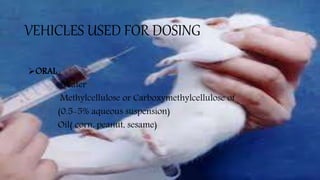
VEHICLES USED FOR DOSING
ORAL :
Water
Methylcellulose or Carboxymethylcellulose of
(0.5-5% aqueous suspension)
Oil( corn, peanut, sesame)
CLINICAL SIGNS OF TOXICITY
• RESPIRATORY :
blockage in the nostrils, changes in rate & depth of breathing,
changes in color of body surfaces
• Signs like dyspnea, abdominal breathing, gasping, Apnea, pulmonary
edema, cholinergic inhibition, pulmonary cardiac insufficiency.
MOTOR ACTIVITY
Changes in frequency & nature of movements
Signs like decrease/increase in spontaneous motor activity,
Somnolence, Loss of righting reflex,
Anesthesia, Catalepsy, Ataxia, Unusual locomotion,
prostrations, Tremors
CONVULSIONS
Marked involuntary contractions or seizures of contraction of
voluntary muscles
Signs like Clonic convulsions
Tonic convulsions
Tonic-Clonic convulsions
Asphyxial convulsion
REFLEXES
CORNEAL
PINNAL
RIGHTING
LIGHT(pupillary)
STARTLE REFLEX
All signs indicates involvement of CNS, sensory, autonomic &
neuromuscular systems
OCULAR SIGNS
Lacrimation, Chromodacryorrhea ( red lacrimation )
 Miosis, Mydriasis, corneal opacity, iritis, conjunctivitis
 Exophthalmos, Ptosis, relaxation of nictating membrane.
Mainly due to autonomic system involement
CARDIO-VASCULAR SIGNS
 Bradycardia, tachycardia,
 vasodilation, vasoconstriction,
arrhythmias
Due to autonomic, CNS, cardiac-pulmonary insufficiency,
myocardiac infraction, cold environment.
OTHER SIGNS
Salivation
Piloerection
Analgesia
Muscle tone - hypotonia - hypertonia
GIT signs: dropping feces, emesis, diuresis(hematuria & involuntary
urination)
EFFECTS OF DECREASED BODY WEIGHTS ON
RELATIVE ORGAN WEIGHTS OF RATS
Decreases = liver
No change = heart, kidneys, prostrate, spleen, ovaries.
Increases =adrenal gland, brain, epididymides, pituitary, testes,
thyroid, uterus.
Observations
Daily observations: Clinical observations, General health record of
animals, Mortality and morbidity
– Preferably at the same time on each day and at anticipated peak
period
Weekly observations: - Body weight changes, Food and water intake
- Behavioral, neurological and autonomical profiles
End observations: - Functional observations like grip strength,
auditory, visual stimuli etc.
- Vaginal smears, Blood collection, Gross necropsy and
organ collection
- Additional Blood sampling can be done to establish
Toxicokinetics and pharmacokinetics as per ICH guidelines
OECD Guidelines No. 41o: Repeated Dose
28-day dermal Toxicity Study in Rodents
Defination
Dose in a dermal test is the amount of test substance applied to the
skin.
Dose is expressed as weight (g, mg) or as weight of test substance per
unit weight of test animal (e.g. mg/kg).
410 ??
 In the assessment and evaluation of both the Federal Insecticide,
Fungicide and Rodenticide Act (FIFRA) and the Toxic Substances
Control Act (TSCA).
There is sufficient similarity between the considerations involved in
the conduct of a 21day or 28-day repeated dose dermal study to
allow one Guideline to cover both test durations.
Principle
The test substance is applied daily to the skin in graduated doses to
several groups of experimental animals, one dose per group, for a
period of 21/28 days.
During the period of application the animals are observed daily to
detect signs of toxicity.
Animals which die during the test are necropsied, and at the
conclusion of the test the surviving animals are sacrificed and
necropsied.
TEST PROCEDURE
Experimental animals:
 Selection of species adult rat, rabbit or guinea pig
 Weights: rats, 200 to 300 g;
rabbits, 2.0 to 3.0 kg;
guinea pigs, 350 to 450 g.
Number and sex: At least 10 animals (5 female and 5 male) with
healthy skin should be used at each dose level.
Housing and feeding conditions
 Animals should be caged individually.
Temperature: 22°C (± 3°) for rodents or
20°C (± 3°) for rabbits
Relative humidity: 30-70 %
12 hours light, 12 hours dark cycle.
Feeding: conventional laboratory diets & unlimited supply of
drinking water.
Dose levels
At least three dose levels, with a control and, where appropriate, a
vehicle control, should be used.
The highest dose level should result in toxic effects but not produce
an incidence of fatalities which would prevent a meaningful
evaluation.
The lowest dose level should not produce any evidence of toxicity.
If application of the test substance produces severe skin irritation,
the concentration may be reduced
Vehicles used in dermal toxicity testing
Physiological saline
Water,
Ethanol, Acetone,
Mineral oil
Procedure
Healthy young adult animals are acclimatized to the laboratory
conditions for at least 5 days prior to the test.
Before the test, animals are randomized and assigned to the
treatment and control groups.
Shortly before testing, fur is clipped from the dorsal area of the trunk
of the test animals.
Shaving may be employed but it should be carried out approximately
24 hours before the test.
Repeat clipping or shaving is usually needed at approximately
weekly intervals.
When clipping or shaving the fur, care must be taken to avoid
abrading the skin, which could alter its permeability, unless a
requirement for abraded skin is part of the test design.
Not less than 10 per cent of the body surface area should be clear for
the application of the test substance.
The test substance should be moistened sufficiently with water, a
suitable vehicle to ensure good contact with the skin.
When a vehicle is used, the influence of the vehicle on penetration of
skin by the test substance should be taken into account.
Liquid test substances are generally used undiluted.
Test substance , given for 6 hours per day per week, for a period of
21/28 days.
 Application on a 5-day per week basis is considered to be
acceptable.
 Animals in a satellite group scheduled for follow-up observations
should be kept for a further 14 days without treatment to detect
recovery from, or persistence of, toxic effects
Observations
A careful clinical examination should be made at least once each
day.
Additional observations should be made daily with appropriate
actions taken to minimize loss of animals to the study, e.g.
necropsy or refrigeration of those animals found dead and
isolation or sacrifice of weak or moribund animals.
Clinical observations
 Hematological parameters
Clinical biochemistry determination
Gross necropsy
Histopathology
Urinalysis is not required on a routine basis, but only when there is
an indication based on expected or observed toxicity.
DATA
Individual animal data should be provided
Additionally, all data should be summarized in tabular forms
(statistical method).
the number of animals showing lesions, the type of lesions and the
percentage of animals displaying each type of lesion
Interpretation of result
Extrapolation from the results of the study to man is valid to a
limited degree, but it can provide useful information on the degree of
percutaneous absorption of a substance.
TEST REPORT
 The test report must include the following information:
- species/strain used & toxic response data by sex and dose;
- time of death during the study or whether animals survived to
termination;
- Toxic effects and the time of observation of each abnormal sign
and its subsequent course & food and body weight data
- hematological tests employed and results with relevant baseline
data
- clinical biochemistry tests
- necropsy findings
Discussion & interpretation of results
Conclusion
OECD Guidelines No. 412: Repeated Dose
28-day inhalation Toxicity Study in
Rodents
History
The original subacute inhalation Test Guideline 412 (TG 412) was
adopted in 1981.
 It was revised in 2009 to accommodate the testing of particle
aerosols including nanomaterials.
412 ??
This test guidelines is designed to fully characterize test chemicals
toxicity by inhalation route.
Toxico-kinetics and systemic toxicity study is also studied.
 Provide robust data for quantitative inhalation risk assessments.
Subacute inhalation toxicity studies are primarily used to derive
regulatory concentrations for assessing worker risk in occupational
settings.
The data derived from subacute inhalation toxicity studies can be
used for quantitative risk assessments and for the selection of
concentrations for chronic studies.
Principle
Accommodate the testing of nanomaterials as well as to reflect the
evolving state-of-the-science for the testing of inhaled gases,
vapours, and aerosols.
 Broncho-alveolar lavage fluid (BALF) to be performed for all test
chemicals--- by splitting the lung for histopathology and BAL
analysis.
POE ----BALF analysis (by splitting the lung for histopathology)
and lung burden measurements are performed
for all test chemicals within 24h after exposure termination and may
be undertaken at one or two additional post-exposure observation
(PEO) intervals.
(Q)SAR data and toxicological data on structurally related chemicals
 When testing a solid aerosol, it is useful to have information on its
retention and kinetics in the lung.
Dilutions of corrosive or irritating test chemicals may be tested at
concentrations that will yield the desired degree of toxicity
Description of the method
1. Selection of Animal Species
 Healthy young adult rodents of commonly used laboratory strains
should be employed. The preferred species is the rat. Justification
should be provided if other species are used.
2 Preparation of Animals
5 males and 5 females should be exposed at each concentration
level.
Females should be nulliparous and non-pregnant.
On the day of randomization, animals should be young adults 7 to 9
weeks of age.
Body weights should be within ± 20% of the mean weight for each
sex.
The animals are randomly selected, marked for individual
identification, and kept in their cages for at least five days prior to
the start of the test to allow for acclimatization to laboratory
conditions.
3 Inhalation Chambers
Subacute inhalation toxicity studies are always performed in
dynamic inhalation chambers.
The use of a static inhalation chamber, which has no airflow, is not
acceptable.
Toxicity studies
1 Limit Concentrations
The maximum concentration tested should consider:
1) the maximum attainable concentration,
2) the need to maintain an adequate oxygen supply, and/or
3) animal welfare considerations.
 Up to a maximum concentration of 5 mg/L for aerosols,
 20 mg/L for vapors, and
20,000 ppm for gases
2 Range-Finding Study
To inform the selection of concentration levels for a main study.
No Observed Adverse Effects Concentration (NOAEC),
Lowest Observed Adverse Effects Concentration (LOAEC),
Maximum Tolerated Concentration (MTC), and/or
the benchmark concentration (BMC) in a main study.
The study director should use a range-finding study to identify the
upper concentration that is tolerated without undue stress to the
animals.
A range-finding study should last a minimum of 5 days and
generally no more than 14 days, and may include a post-exposure
period and animal numbers should be adjusted accordingly.
When testing poorly soluble particles, it may be necessary for a
range-finding study to be longer than 14 days to allow for a robust
assessment of test chemical solubility and lung burden.
 The rationale for the selection of concentrations for the main study
should be provided in the study report.
3 Main Study
The main study consists of at least three test chemical concentration
levels and concurrent negative (air) or vehicle controls.
This guideline differentiates two study designs depending on the
nature of the test chemical.
Option A, which is generally used for test chemicals (as gas,
vapour, aerosol, or a mixture thereof),
option B is used when testing chemicals that are likely to be
retained in the lungs.
OBSERVATIONS
Cage-side observations should include changes in the skin and fur,
eyes, and mucous membranes; changes in the respiratory and
circulatory systems; changes in the nervous system; and changes in
somato-motor activity and behavior patterns.
tremors, convulsions, salivation, diarrhea, lethargy, sleep, and coma.
The measurement of rectal temperatures may provide supportive
evidence of reflex bradypnea, a Paintal (C-fiber stimulation) reflex,
or evidence of hypo/hyperthermia related to test chemical treatment
or confinement.
 Additional assessments may be included in the study protocol such
as biomonitoring (urine/faeces collection), lung function assessment,
and behavioural changes.
BODY WEIGHTS
• Individual animal weights should be recorded shortly before the first
exposure (day 0), twice weekly thereafter.
• When there is a post-exposure period, animals should be weighed
weekly. At study termination, all animals should be weighed shortly
before sacrifice to allow for an unbiased calculation of organ to body
weight ratios.
Haematology
• Erythrocyte count Hematocrit Haemoglobin concentration, Mean
corpuscular haemoglobin, Mean corpuscular volume, Mean
corpuscular haemoglobin concentration , Reticulocytes
• Total leukocyte count Differential leukocyte count Platelet count
Clotting potential (select one): Prothrombin time Clotting time
Partial thromboplastin time
BRONCHOALVEOLAR LAVAGE
• BAL should be performed at PEO-1 (within 24h at termination of
exposure) and at one post-exposure interval (PEO-2)
• When testing a poorly soluble aerosol, BAL should be performed at
PEO-1 (within 24 hours of exposure termination) in both sexes and
in female animals at PEO-2 if a recovery group is scheduled.
• The right lung is generally preferred for lavage. The duration of the
post-exposure period and the timing of the PEOs are determined by
the study director based on findings in the range-finding study and
other available, relevant information.
• The mandatory BALF analysis encompasses the following parameters:
Lactate dehydrogenase (LDH)
Total protein or albumin
Cell counts and differentials for alveolar macrophages,
lymphocytes, neutrophils, and eosinophils
LUNG BURDEN
• When testing poorly soluble solid aerosols, measurements of lung
burden can provide clarity on the retained dose.
• Males are used because they have a higher minute volume than
females and may thus have greater lung burdens.
• To obtain clear information on lung clearance kinetics the same lung
(the right lung is recommended) should be measured for lung
burden at all post-exposure time points.
OPHTHALMOLOGICAL EXAMINATION
• Fundus, refractive media, iris, and conjunctivae.
GROSS PATHOLOGY AND ORGAN WEIGHTS
DATA AND REPORTING
• Individual animal data on body weights, food consumption, clinical
pathology, BALF analysis, gross pathology, organ weights, lung
burden (when evaluated) and histopathology should be provided for
both the range-finding and main study.
• Clinical observation data should be summarized in tabular form
showing for each test group the number of animals used, the number
of animals displaying specific signs of toxicity, the number of
animals found dead during the test or killed for humane reasons,
time of death of individual animals, a description and time course of
toxic effects and reversibility, and necropsy findings.
Discussion and interpretation of results
• The respirability of aerosol particles in light of the overall findings
should be addressed, especially if the MMAD standard could not be
met.
• The consistency of methods used to determine analytical and
nominal concentrations, and the relation of analytical concentrations
to nominal concentrations should be included in the overall
assessment of the study.
Thank you

Sub acute

  • 1.
    SUBACUTE TOXICITY TESTINGAS PER OECD GUIDELINES AASIFA SHAIKH 18SSRMPH023 M. PHARMACOLOGY, SEM2 SSRCP
  • 2.
    What is toxicitytesting? General Toxicity testing is referred to: a series of toxicity testing required by International regulatory for compliance to Good Laboratory Practices (GLP) for proof of safety in experimental animal prior to their testing in human.
  • 3.
    It comprises of: Acute, Sub-acute and chronic toxicity. These studies are conducted based on “OECD guidelines of testing of chemicals” They are performed in rodents and non rodents.
  • 4.
    What is subacutetoxicity? The effect of exposure is generally for 28 days. OECD Test Guidelines describing short‐term repeat‐dose toxicity testing of chemicals administered via different routes are: oral- 407 dermal- 410 and inhalation- 412 Goal: To estimate safety margin
  • 5.
    History of subacutetoxicity  The initial guidelines were published in 1981 Revised in 1995 to include neuro and immunotoxicities. Ammended in 1998, to obtain information related to endocrine disruptors
  • 6.
    Principle of theTest OECD 407 Test substance administered once daily, by oral route, for 28 d. Animals observed closely, each day for signs of toxicity OECD 410 Test substance administered dermally for 28 days. Observed closely, each day for signs of toxicity OECD 412 Test substance - inhalation administered for a defined period. Observed closely, each day for signs of toxicity Establish dose dependent relation-ship for the toxic effect Allows to determination of the No-Observed Adverse Effect Level (NOAEL) and provide information on selection of doses for long term studies
  • 7.
    Mode of exposure ofTest substance OECD 407 Oral route - orally administered for a defined period. Observed closely, each day for signs of toxicity OECD 410 Dermal route - skin administered for a defined period. Observed closely, each day for signs of toxicity OECD 412 Inhalation route - inhalation administered for a defined period. Observed closely, each day for signs of toxicity
  • 8.
    OECD Guidelines No.407: Repeated Dose 28-day Oral Toxicity Study in Rodents
  • 9.
    Principle Provides information onhealth hazard likely to arise from exposure (daily) to test substance via oral administration. The method is based on the repeated oral administration of the substance of interest during one limited period (one dose level daily during 28 days).
  • 10.
    This Guideline isintended primarily for use with rodents (rat preferably). At least 10 animals (5 female and 5 male) should be used for each dose level. Three tests groups, should be used. The test compound is administered by gavage or via the diet or drinking water. A limit test may be performed if no effects would be expected at a dose of 1000 mg/kg bw/d.
  • 11.
    Subacute (Guidelines 407) SDRats, male and Female Control Low dose Medium dose High dose Study group Dose level and selection Admission of test Subs, oral Findings
  • 12.
    DEFINITIONS RELATIVE TODOSES  ADI: Acceptable Daily Intake (established for food additives/ residues & published by EPA)  NOEL: No Observed Effect Level. Dose at which no effect is seen  NOAEL: No Observed Adverse Effect Level. Dose at which no adverse/toxic effect is seen
  • 13.
    • Dosing shouldbe initiated as early after the weaning period. • At any case dosing should not be delayed more than 9 weeks old. • Body weight variation should not exceed greater than 20%
  • 14.
    Selection and Preparationof Animals Rats are the preferred species.(Young healthy adult animals should be employed) (Lower species - increase variability. Other species are accepted under suitable justification.) Female rats should be nulliparous and non pregnant.
  • 15.
    Housing Husbandry conditions similarto Acute toxicity studies: Temperature : 19 to 25 deg C RH : 55%- 65% Light : dark :12:12
  • 16.
    What dose hasto be administered?? Expected therapeutic level (daily) or increasing dose phase-wise manner. The test substance is administered orally for =/>28 days, and regular changes are observed.
  • 17.
    At the endof the study, the experimental animals are sacrificed. Gross pathological changes are observed, and all the tissues are subjected to histopathological analyses. Used to determine the maximum tolerable dose and nature of toxicity.
  • 18.
    First High doseis decided Low Dose. - Should not produce any observed toxic effect - May be 10 times lower than the medium dose levels or higher dose levels Medium Dose Usually 2 to 4 times reduced as compared to the highest dose levels. - Preferentially falls on the human exposure dose. High Dose This dose should induce toxic effect but not severe toxicity or death - Toxicokinetic data, SAR, Previous experience, Efficacy study, LD10 may help in predicting this dose
  • 19.
    Grouping and numberof animals 25 males + 25 Females Control (5 M+ 5F) Low dose (5 M+5F) Medium dose (5M+5F) High dose (5M + 5F) Satellite receives high dose (5M+5F) 5 groups
  • 20.
    • Additional animalscan be kept in each group if interim sacrifices are planned. • Exposure to various routes is as per acute toxicity exposure. • Limit dose studies can be done at 1000 mg/kg
  • 21.
    VEHICLES USED FORDOSING ORAL : Water Methylcellulose or Carboxymethylcellulose of (0.5-5% aqueous suspension) Oil( corn, peanut, sesame)
  • 22.
    CLINICAL SIGNS OFTOXICITY • RESPIRATORY : blockage in the nostrils, changes in rate & depth of breathing, changes in color of body surfaces • Signs like dyspnea, abdominal breathing, gasping, Apnea, pulmonary edema, cholinergic inhibition, pulmonary cardiac insufficiency.
  • 23.
    MOTOR ACTIVITY Changes infrequency & nature of movements Signs like decrease/increase in spontaneous motor activity, Somnolence, Loss of righting reflex, Anesthesia, Catalepsy, Ataxia, Unusual locomotion, prostrations, Tremors
  • 24.
    CONVULSIONS Marked involuntary contractionsor seizures of contraction of voluntary muscles Signs like Clonic convulsions Tonic convulsions Tonic-Clonic convulsions Asphyxial convulsion
  • 25.
    REFLEXES CORNEAL PINNAL RIGHTING LIGHT(pupillary) STARTLE REFLEX All signsindicates involvement of CNS, sensory, autonomic & neuromuscular systems
  • 26.
    OCULAR SIGNS Lacrimation, Chromodacryorrhea( red lacrimation )  Miosis, Mydriasis, corneal opacity, iritis, conjunctivitis  Exophthalmos, Ptosis, relaxation of nictating membrane. Mainly due to autonomic system involement
  • 27.
    CARDIO-VASCULAR SIGNS  Bradycardia,tachycardia,  vasodilation, vasoconstriction, arrhythmias Due to autonomic, CNS, cardiac-pulmonary insufficiency, myocardiac infraction, cold environment.
  • 28.
    OTHER SIGNS Salivation Piloerection Analgesia Muscle tone- hypotonia - hypertonia GIT signs: dropping feces, emesis, diuresis(hematuria & involuntary urination)
  • 29.
    EFFECTS OF DECREASEDBODY WEIGHTS ON RELATIVE ORGAN WEIGHTS OF RATS Decreases = liver No change = heart, kidneys, prostrate, spleen, ovaries. Increases =adrenal gland, brain, epididymides, pituitary, testes, thyroid, uterus.
  • 30.
    Observations Daily observations: Clinicalobservations, General health record of animals, Mortality and morbidity – Preferably at the same time on each day and at anticipated peak period Weekly observations: - Body weight changes, Food and water intake - Behavioral, neurological and autonomical profiles
  • 31.
    End observations: -Functional observations like grip strength, auditory, visual stimuli etc. - Vaginal smears, Blood collection, Gross necropsy and organ collection - Additional Blood sampling can be done to establish Toxicokinetics and pharmacokinetics as per ICH guidelines
  • 32.
    OECD Guidelines No.41o: Repeated Dose 28-day dermal Toxicity Study in Rodents
  • 33.
    Defination Dose in adermal test is the amount of test substance applied to the skin. Dose is expressed as weight (g, mg) or as weight of test substance per unit weight of test animal (e.g. mg/kg).
  • 34.
    410 ??  Inthe assessment and evaluation of both the Federal Insecticide, Fungicide and Rodenticide Act (FIFRA) and the Toxic Substances Control Act (TSCA). There is sufficient similarity between the considerations involved in the conduct of a 21day or 28-day repeated dose dermal study to allow one Guideline to cover both test durations.
  • 35.
    Principle The test substanceis applied daily to the skin in graduated doses to several groups of experimental animals, one dose per group, for a period of 21/28 days. During the period of application the animals are observed daily to detect signs of toxicity. Animals which die during the test are necropsied, and at the conclusion of the test the surviving animals are sacrificed and necropsied.
  • 36.
    TEST PROCEDURE Experimental animals: Selection of species adult rat, rabbit or guinea pig  Weights: rats, 200 to 300 g; rabbits, 2.0 to 3.0 kg; guinea pigs, 350 to 450 g. Number and sex: At least 10 animals (5 female and 5 male) with healthy skin should be used at each dose level.
  • 37.
    Housing and feedingconditions  Animals should be caged individually. Temperature: 22°C (± 3°) for rodents or 20°C (± 3°) for rabbits Relative humidity: 30-70 % 12 hours light, 12 hours dark cycle. Feeding: conventional laboratory diets & unlimited supply of drinking water.
  • 38.
    Dose levels At leastthree dose levels, with a control and, where appropriate, a vehicle control, should be used. The highest dose level should result in toxic effects but not produce an incidence of fatalities which would prevent a meaningful evaluation.
  • 39.
    The lowest doselevel should not produce any evidence of toxicity. If application of the test substance produces severe skin irritation, the concentration may be reduced
  • 40.
    Vehicles used indermal toxicity testing Physiological saline Water, Ethanol, Acetone, Mineral oil
  • 41.
    Procedure Healthy young adultanimals are acclimatized to the laboratory conditions for at least 5 days prior to the test. Before the test, animals are randomized and assigned to the treatment and control groups. Shortly before testing, fur is clipped from the dorsal area of the trunk of the test animals.
  • 42.
    Shaving may beemployed but it should be carried out approximately 24 hours before the test. Repeat clipping or shaving is usually needed at approximately weekly intervals. When clipping or shaving the fur, care must be taken to avoid abrading the skin, which could alter its permeability, unless a requirement for abraded skin is part of the test design.
  • 43.
    Not less than10 per cent of the body surface area should be clear for the application of the test substance. The test substance should be moistened sufficiently with water, a suitable vehicle to ensure good contact with the skin. When a vehicle is used, the influence of the vehicle on penetration of skin by the test substance should be taken into account. Liquid test substances are generally used undiluted.
  • 44.
    Test substance ,given for 6 hours per day per week, for a period of 21/28 days.  Application on a 5-day per week basis is considered to be acceptable.  Animals in a satellite group scheduled for follow-up observations should be kept for a further 14 days without treatment to detect recovery from, or persistence of, toxic effects
  • 45.
    Observations A careful clinicalexamination should be made at least once each day. Additional observations should be made daily with appropriate actions taken to minimize loss of animals to the study, e.g. necropsy or refrigeration of those animals found dead and isolation or sacrifice of weak or moribund animals.
  • 46.
    Clinical observations  Hematologicalparameters Clinical biochemistry determination Gross necropsy Histopathology
  • 47.
    Urinalysis is notrequired on a routine basis, but only when there is an indication based on expected or observed toxicity.
  • 48.
    DATA Individual animal datashould be provided Additionally, all data should be summarized in tabular forms (statistical method). the number of animals showing lesions, the type of lesions and the percentage of animals displaying each type of lesion
  • 49.
    Interpretation of result Extrapolationfrom the results of the study to man is valid to a limited degree, but it can provide useful information on the degree of percutaneous absorption of a substance.
  • 50.
    TEST REPORT  Thetest report must include the following information: - species/strain used & toxic response data by sex and dose; - time of death during the study or whether animals survived to termination; - Toxic effects and the time of observation of each abnormal sign and its subsequent course & food and body weight data
  • 51.
    - hematological testsemployed and results with relevant baseline data - clinical biochemistry tests - necropsy findings Discussion & interpretation of results Conclusion
  • 52.
    OECD Guidelines No.412: Repeated Dose 28-day inhalation Toxicity Study in Rodents
  • 53.
    History The original subacuteinhalation Test Guideline 412 (TG 412) was adopted in 1981.  It was revised in 2009 to accommodate the testing of particle aerosols including nanomaterials.
  • 54.
    412 ?? This testguidelines is designed to fully characterize test chemicals toxicity by inhalation route. Toxico-kinetics and systemic toxicity study is also studied.  Provide robust data for quantitative inhalation risk assessments.
  • 55.
    Subacute inhalation toxicitystudies are primarily used to derive regulatory concentrations for assessing worker risk in occupational settings. The data derived from subacute inhalation toxicity studies can be used for quantitative risk assessments and for the selection of concentrations for chronic studies.
  • 56.
    Principle Accommodate the testingof nanomaterials as well as to reflect the evolving state-of-the-science for the testing of inhaled gases, vapours, and aerosols.  Broncho-alveolar lavage fluid (BALF) to be performed for all test chemicals--- by splitting the lung for histopathology and BAL analysis.
  • 57.
    POE ----BALF analysis(by splitting the lung for histopathology) and lung burden measurements are performed for all test chemicals within 24h after exposure termination and may be undertaken at one or two additional post-exposure observation (PEO) intervals.
  • 58.
    (Q)SAR data andtoxicological data on structurally related chemicals  When testing a solid aerosol, it is useful to have information on its retention and kinetics in the lung. Dilutions of corrosive or irritating test chemicals may be tested at concentrations that will yield the desired degree of toxicity
  • 59.
    Description of themethod 1. Selection of Animal Species  Healthy young adult rodents of commonly used laboratory strains should be employed. The preferred species is the rat. Justification should be provided if other species are used.
  • 60.
    2 Preparation ofAnimals 5 males and 5 females should be exposed at each concentration level. Females should be nulliparous and non-pregnant. On the day of randomization, animals should be young adults 7 to 9 weeks of age.
  • 61.
    Body weights shouldbe within ± 20% of the mean weight for each sex. The animals are randomly selected, marked for individual identification, and kept in their cages for at least five days prior to the start of the test to allow for acclimatization to laboratory conditions.
  • 62.
    3 Inhalation Chambers Subacuteinhalation toxicity studies are always performed in dynamic inhalation chambers. The use of a static inhalation chamber, which has no airflow, is not acceptable.
  • 63.
    Toxicity studies 1 LimitConcentrations The maximum concentration tested should consider: 1) the maximum attainable concentration, 2) the need to maintain an adequate oxygen supply, and/or 3) animal welfare considerations.  Up to a maximum concentration of 5 mg/L for aerosols,  20 mg/L for vapors, and 20,000 ppm for gases
  • 64.
    2 Range-Finding Study Toinform the selection of concentration levels for a main study. No Observed Adverse Effects Concentration (NOAEC), Lowest Observed Adverse Effects Concentration (LOAEC), Maximum Tolerated Concentration (MTC), and/or the benchmark concentration (BMC) in a main study.
  • 65.
    The study directorshould use a range-finding study to identify the upper concentration that is tolerated without undue stress to the animals. A range-finding study should last a minimum of 5 days and generally no more than 14 days, and may include a post-exposure period and animal numbers should be adjusted accordingly.
  • 66.
    When testing poorlysoluble particles, it may be necessary for a range-finding study to be longer than 14 days to allow for a robust assessment of test chemical solubility and lung burden.  The rationale for the selection of concentrations for the main study should be provided in the study report.
  • 67.
    3 Main Study Themain study consists of at least three test chemical concentration levels and concurrent negative (air) or vehicle controls. This guideline differentiates two study designs depending on the nature of the test chemical. Option A, which is generally used for test chemicals (as gas, vapour, aerosol, or a mixture thereof), option B is used when testing chemicals that are likely to be retained in the lungs.
  • 68.
    OBSERVATIONS Cage-side observations shouldinclude changes in the skin and fur, eyes, and mucous membranes; changes in the respiratory and circulatory systems; changes in the nervous system; and changes in somato-motor activity and behavior patterns. tremors, convulsions, salivation, diarrhea, lethargy, sleep, and coma.
  • 69.
    The measurement ofrectal temperatures may provide supportive evidence of reflex bradypnea, a Paintal (C-fiber stimulation) reflex, or evidence of hypo/hyperthermia related to test chemical treatment or confinement.  Additional assessments may be included in the study protocol such as biomonitoring (urine/faeces collection), lung function assessment, and behavioural changes.
  • 70.
    BODY WEIGHTS • Individualanimal weights should be recorded shortly before the first exposure (day 0), twice weekly thereafter. • When there is a post-exposure period, animals should be weighed weekly. At study termination, all animals should be weighed shortly before sacrifice to allow for an unbiased calculation of organ to body weight ratios.
  • 71.
    Haematology • Erythrocyte countHematocrit Haemoglobin concentration, Mean corpuscular haemoglobin, Mean corpuscular volume, Mean corpuscular haemoglobin concentration , Reticulocytes • Total leukocyte count Differential leukocyte count Platelet count Clotting potential (select one): Prothrombin time Clotting time Partial thromboplastin time
  • 72.
    BRONCHOALVEOLAR LAVAGE • BALshould be performed at PEO-1 (within 24h at termination of exposure) and at one post-exposure interval (PEO-2) • When testing a poorly soluble aerosol, BAL should be performed at PEO-1 (within 24 hours of exposure termination) in both sexes and in female animals at PEO-2 if a recovery group is scheduled.
  • 73.
    • The rightlung is generally preferred for lavage. The duration of the post-exposure period and the timing of the PEOs are determined by the study director based on findings in the range-finding study and other available, relevant information. • The mandatory BALF analysis encompasses the following parameters: Lactate dehydrogenase (LDH) Total protein or albumin Cell counts and differentials for alveolar macrophages, lymphocytes, neutrophils, and eosinophils
  • 74.
    LUNG BURDEN • Whentesting poorly soluble solid aerosols, measurements of lung burden can provide clarity on the retained dose. • Males are used because they have a higher minute volume than females and may thus have greater lung burdens. • To obtain clear information on lung clearance kinetics the same lung (the right lung is recommended) should be measured for lung burden at all post-exposure time points.
  • 75.
    OPHTHALMOLOGICAL EXAMINATION • Fundus,refractive media, iris, and conjunctivae. GROSS PATHOLOGY AND ORGAN WEIGHTS
  • 76.
    DATA AND REPORTING •Individual animal data on body weights, food consumption, clinical pathology, BALF analysis, gross pathology, organ weights, lung burden (when evaluated) and histopathology should be provided for both the range-finding and main study. • Clinical observation data should be summarized in tabular form showing for each test group the number of animals used, the number of animals displaying specific signs of toxicity, the number of animals found dead during the test or killed for humane reasons, time of death of individual animals, a description and time course of toxic effects and reversibility, and necropsy findings.
  • 77.
    Discussion and interpretationof results • The respirability of aerosol particles in light of the overall findings should be addressed, especially if the MMAD standard could not be met. • The consistency of methods used to determine analytical and nominal concentrations, and the relation of analytical concentrations to nominal concentrations should be included in the overall assessment of the study.
  • 78.