DCE 5632ORGANIZATIONAL DEVELOPMENT PROCESSPRESENTER :INSTRUCTOR :NOR AZMI AHMADDR KHAIRUDDIN IDRISMOHD ZAMRI MAT ZAINHAPDZAN HUSAINILAI LUNG KWANG
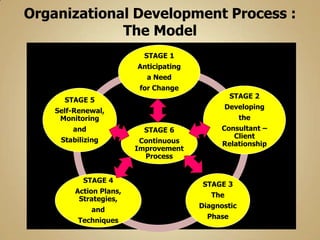
Organizational Development Process :The Model
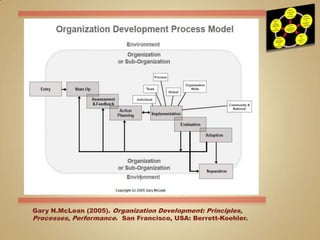
Gary N.McLean (2005). Organization Development: Principles, Processes, Performance.  San Francisco, USA: Berrett-Koehler.
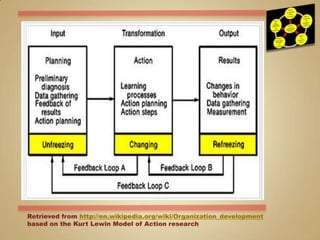
Retrieved from http://en.wikipedia.org/wiki/Organization_development based on the Kurt Lewin Model of Action research
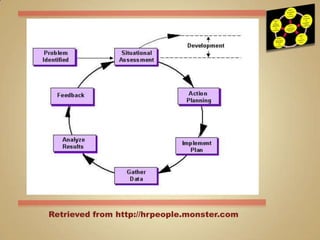
Retrieved from http://hrpeople.monster.com
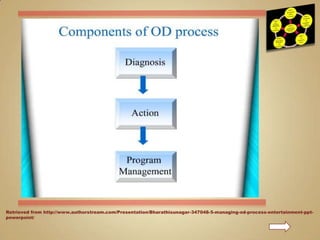
Retrieved from http://www.authorstream.com/Presentation/Bharathisunagar-347048-5-managing-od-process-entertainment-ppt-powerpoint/
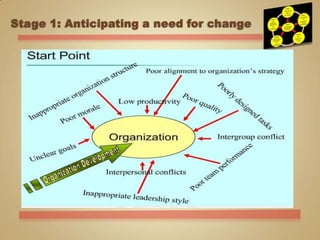
Stage 1: Anticipating a need for change
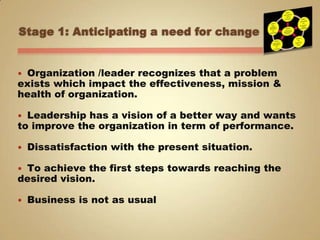
Stage 1: Anticipating a need for change Organization /leader recognizes that a problem exists which impact the effectiveness, mission & health of organization.Leadership has a vision of a better way and wants to improve the organization in term of performance.Dissatisfaction with the present situation.To achieve the first steps towards reaching the desired vision.Business is not as usual
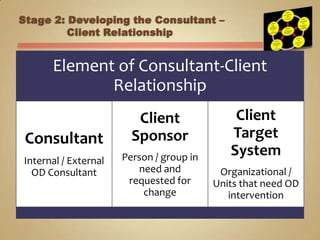
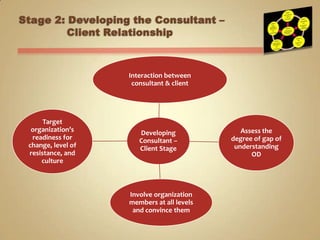
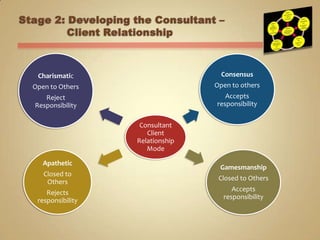
Stage 2: Developing the Consultant –Client Relationship
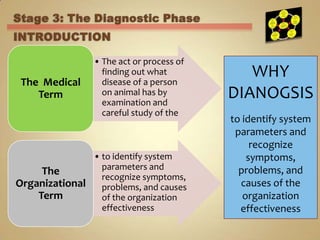
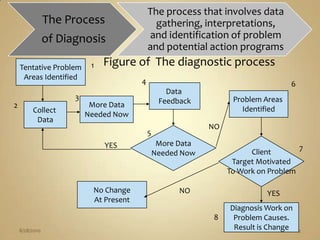
Stage 3: The Diagnostic PhaseINTRODUCTIONWHY DIANOGSISto identify system parameters and recognize symptoms, problems, and causes of the organization effectiveness
8/25/201013                 Figure of  The diagnostic processTentative ProblemAreas Identified146Data FeedbackProblem Areas Identified3More DataNeeded Now2Collect DataNOMore DataNeeded Now5ClientTarget MotivatedTo Work on ProblemYES7No ChangeAt PresentNOYESDiagnosis Work onProblem Causes.Result is Change8
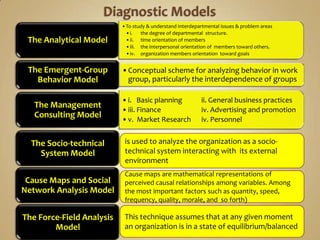
Diagnostic Modelsis used to analyze the organization as a socio-technical system interacting with  its external environmentCause maps are mathematical representations of perceived causal relationships among variables. Among the most important factors such as quantity, speed, frequency, quality, morale, and  so forth)This technique assumes that at any given moment an organization is in a state of equilibrium/balanced
The Method of Diagnosis
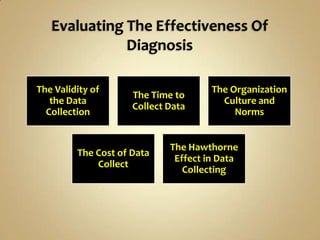
Evaluating The Effectiveness Of Diagnosis
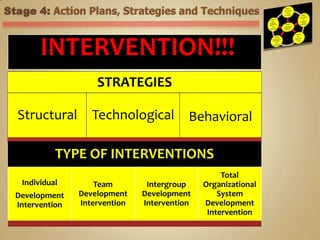
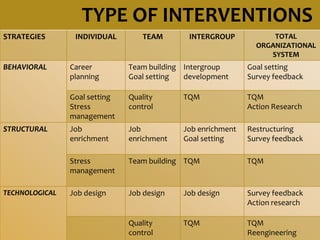
Stage 4: Action Plans, Strategies and TechniquesINTERVENTION!!!
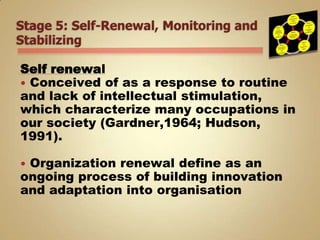
Stage 5: Self-Renewal, Monitoring and StabilizingSelf renewalConceived of as a response to routine and lack of intellectual stimulation, which characterize many occupations in our society (Gardner,1964; Hudson, 1991). Organization renewal define as an ongoing process of building innovation and adaptation into organisation
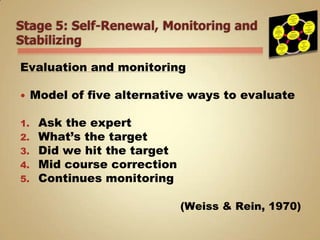
Stage 5: Self-Renewal, Monitoring and StabilizingEvaluation and monitoringModel of five alternative ways to evaluateAsk the expertWhat’s the targetDid we hit the targetMid course correctionContinues monitoring(Weiss & Rein, 1970)
Stage 5: Self-Renewal, Monitoring and StabilizingStabilizing process maintenance phase.takes place under conditions of unfreeze ness which are necessary for the changes to have an impact once introducedhowever it is necessary that the changed system should stabilize to allow the changes to permeate the culture of the organization. The process consists of activities to maintain the effectiveness of the intervention by receiving feed back about the change & produced modifications
Stage 6: Continous Improvement ProcessCIP IS An ongoing effort to improve products, services or processes   through intervention.WHY NEED  CIP ? Organization environment became more-more competitive  and business became usual.  Only two type of organization -  those that are changing and   those that are going out of business.HOW TO DO? Continuously introduce changes through repeating the cycle  of organization development process.
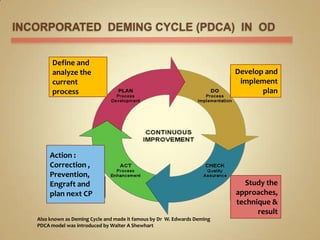
INCORPORATED  DEMING CYCLE (PDCA)  IN  ODDefine and analyze the current processDevelop and implement planAction : Correction , Prevention,Engraft and plan next CPStudy the approaches, technique & resultAlso known as Deming Cycle and made it famous by Dr  W. Edwards Deming  PDCA model was introduced by Walter A Shewhart
OTHERS MODEL OF CONTINUOUS IMPROVEMENTKAIZENBENCHMARKINGTQM
CONCLUSIONOrganization need to continuously introduce changes through repeating the cycle of organization development process for continues existing in the market.
Thank you

Od process devlpmnt slide background1

  • 1.
    DCE 5632ORGANIZATIONAL DEVELOPMENTPROCESSPRESENTER :INSTRUCTOR :NOR AZMI AHMADDR KHAIRUDDIN IDRISMOHD ZAMRI MAT ZAINHAPDZAN HUSAINILAI LUNG KWANG
  • 2.
  • 3.
    Gary N.McLean (2005).Organization Development: Principles, Processes, Performance. San Francisco, USA: Berrett-Koehler.
  • 4.
    Retrieved from http://en.wikipedia.org/wiki/Organization_developmentbased on the Kurt Lewin Model of Action research
  • 5.
  • 6.
  • 7.
    Stage 1: Anticipatinga need for change
  • 8.
    Stage 1: Anticipatinga need for change Organization /leader recognizes that a problem exists which impact the effectiveness, mission & health of organization.Leadership has a vision of a better way and wants to improve the organization in term of performance.Dissatisfaction with the present situation.To achieve the first steps towards reaching the desired vision.Business is not as usual
  • 9.
    Stage 2: Developingthe Consultant –Client Relationship
  • 10.
    Stage 2: Developingthe Consultant –Client Relationship
  • 11.
    Stage 2: Developingthe Consultant –Client Relationship
  • 12.
    Stage 3: TheDiagnostic PhaseINTRODUCTIONWHY DIANOGSISto identify system parameters and recognize symptoms, problems, and causes of the organization effectiveness
  • 13.
    8/25/201013 Figure of The diagnostic processTentative ProblemAreas Identified146Data FeedbackProblem Areas Identified3More DataNeeded Now2Collect DataNOMore DataNeeded Now5ClientTarget MotivatedTo Work on ProblemYES7No ChangeAt PresentNOYESDiagnosis Work onProblem Causes.Result is Change8
  • 14.
    Diagnostic Modelsis usedto analyze the organization as a socio-technical system interacting with its external environmentCause maps are mathematical representations of perceived causal relationships among variables. Among the most important factors such as quantity, speed, frequency, quality, morale, and so forth)This technique assumes that at any given moment an organization is in a state of equilibrium/balanced
  • 15.
    The Method ofDiagnosis
  • 16.
  • 18.
    Stage 4: ActionPlans, Strategies and TechniquesINTERVENTION!!!
  • 20.
    Stage 5: Self-Renewal,Monitoring and StabilizingSelf renewalConceived of as a response to routine and lack of intellectual stimulation, which characterize many occupations in our society (Gardner,1964; Hudson, 1991). Organization renewal define as an ongoing process of building innovation and adaptation into organisation
  • 21.
    Stage 5: Self-Renewal,Monitoring and StabilizingEvaluation and monitoringModel of five alternative ways to evaluateAsk the expertWhat’s the targetDid we hit the targetMid course correctionContinues monitoring(Weiss & Rein, 1970)
  • 22.
    Stage 5: Self-Renewal,Monitoring and StabilizingStabilizing process maintenance phase.takes place under conditions of unfreeze ness which are necessary for the changes to have an impact once introducedhowever it is necessary that the changed system should stabilize to allow the changes to permeate the culture of the organization. The process consists of activities to maintain the effectiveness of the intervention by receiving feed back about the change & produced modifications
  • 23.
    Stage 6: ContinousImprovement ProcessCIP IS An ongoing effort to improve products, services or processes through intervention.WHY NEED CIP ? Organization environment became more-more competitive and business became usual. Only two type of organization - those that are changing and those that are going out of business.HOW TO DO? Continuously introduce changes through repeating the cycle of organization development process.
  • 24.
    INCORPORATED DEMINGCYCLE (PDCA) IN ODDefine and analyze the current processDevelop and implement planAction : Correction , Prevention,Engraft and plan next CPStudy the approaches, technique & resultAlso known as Deming Cycle and made it famous by Dr W. Edwards Deming PDCA model was introduced by Walter A Shewhart
  • 25.
    OTHERS MODEL OFCONTINUOUS IMPROVEMENTKAIZENBENCHMARKINGTQM
  • 26.
    CONCLUSIONOrganization need tocontinuously introduce changes through repeating the cycle of organization development process for continues existing in the market.
  • 27.

Editor's Notes