DCE 5632 Organizational Change & Development Title: Change As An Organization Process Instructor: Dr Khairuddin B. Idris Group Member: Zulhilmi Sham B. Mohd Noor  GS27893 Nurul Aishah Bt. Musa  GS28101 Shaaheda Bt. Mat Ariff GS27780
Definition of Change Change is the continuous adoption of corporate strategies and structures to changing external conditions .(Colin, 1990)
Types Of Change Organizational Development  : This is the more gradual and evolutionary approach to change. It bases on the assumption that it is possible to align corporate objectives with the individual employees objectives. Reengineering  : This is known as corporate transformation or business transformation.
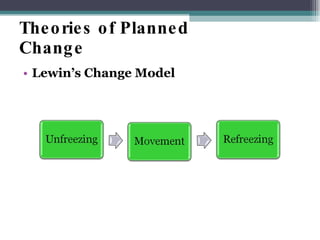
Theories of Planned Change Lewin’s Change Model
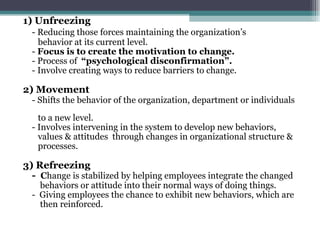
1) Unfreezing - Reducing those forces maintaining the organization’s  behavior at its current level. -  Focus is to create the motivation to change. - Process of  “psychological disconfirmation”.  - Involve creating ways to reduce barriers to change. 2) Movement - Shifts the behavior of the organization, department or individuals  to a new level. - Involves intervening in the system to develop new behaviors,  values & attitudes  through changes in organizational structure &  processes. 3) Refreezing -  C hange is stabilized by helping employees integrate the changed  behaviors or attitude into their normal ways of doing things. -  Giving employees the chance to exhibit new behaviors, which are  then reinforced.
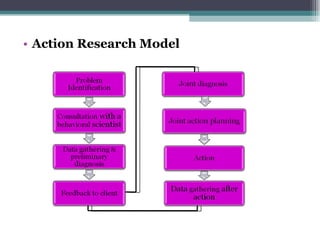
Action Research Model
Focuses on planned change as a cyclical process in which initial research about the organization provides information to guide subsequent action. Objective :  -  help organizations implement planned change & develop more general knowledge that can be applied to other settings Trends in the application of action research include movement from smaller subunits of organizations to total systems & communities.
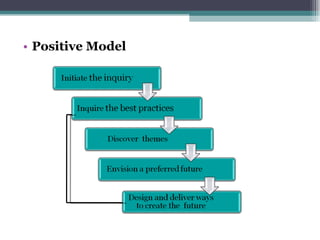
Positive Model
Focuses on what the organization is doing right. Has been applied to planned change primarily through a process called “ appreciative inquiry (AI)”. AI encourages a positive orientation to how change is conceived & managed.
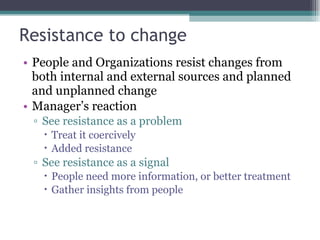
Resistance to change People and Organizations resist changes from both internal and external sources and planned and unplanned change Manager’s reaction See resistance as a problem Treat it coercively Added resistance See resistance as a signal People need more information, or better treatment Gather insights from people
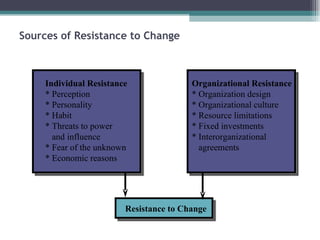
Sources of Resistance to Change Individual Resistance * Perception * Personality * Habit * Threats to power and influence * Fear of the unknown * Economic reasons Organizational Resistance * Organization design * Organizational culture * Resource limitations * Fixed investments * Interorganizational agreements Resistance to Change
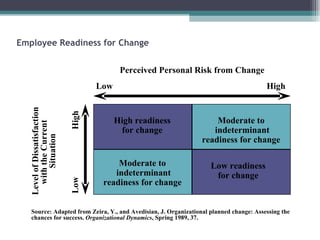
Employee Readiness for Change Source: Adapted from Zeira, Y., and Avedisian, J. Organizational planned change: Assessing the chances for success.  Organizational Dynamics , Spring 1989, 37. Perceived Personal Risk from Change Level of Dissatisfaction with the Current  Situation Low Low High High High readiness for change Moderate to indeterminant readiness for change Low readiness for change Moderate to indeterminant readiness for change
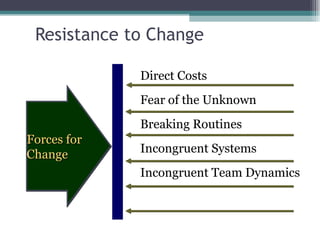
Resistance to Change Direct Costs Fear of the Unknown Breaking Routines Incongruent Systems Incongruent Team Dynamics Forces for Change
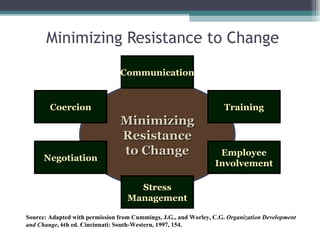
Minimizing Resistance to Change Minimizing Resistance to Change Communication Training Employee Involvement Stress Management Negotiation Coercion Source: Adapted with permission from Cummings, J.G., and Worley, C.G.  Organization Development and Change , 6th ed. Cincinnati: South-Western, 1997, 154.
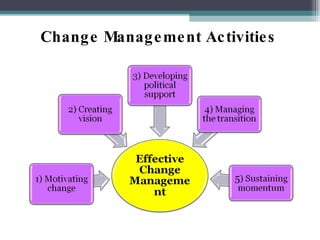
Change Management Activities
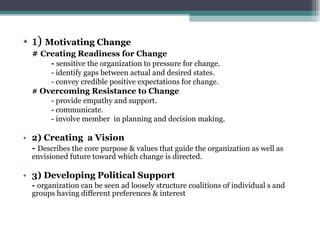
1)  Motivating Change #  Creating Readiness for Change -  sensitive the organization to pressure for change. - identify gaps between actual and desired states. - convey credible positive expectations for change. # Overcoming Resistance to Change - provide empathy and support. - communicate. - involve member  in planning and decision making. 2) Creating  a Vision -  Describes the core purpose & values that guide the organization as well as envisioned future toward which change is directed. 3) Developing Political Support -  organization can be seen ad loosely structure coalitions of individual s and groups having different preferences & interest
4) Managing the Transition -  Beckhard & Harris  pointed that the transition may be quite different from the current state of the organization & consequently require special management structures & activities. 5) Sustaining Momentum # Activities to sustain momentum:- - provide resources for change. - build a support system for change agents. - develop a new competencies and skills. - reinforce new behaviors. - stay the course.
Strategies Of Organizational Change Six ways: Individual change strategies Techno structural strategies Data-base strategies Organizational development Violent and coercive strategies Nonviolent yet direct action strategies
Key Element Of Successful Change Committed and active participation of leadership Culture change Energetic involvement of an empowered and educated work force Effective communication and measurement Aligning human resource systems with the goals and objectives of change
Definition of Organizational Development Burke’s Definition of OD OD is a planned process of  change in an organization’s culture  through  the utilization of behavioral science technology, research and theory. Beckhard’s Definition of OD OD is an effort  (1) planned, (2) organization-wide, and (3) managed from the top, to (4) increase organization effectiveness and health through (5) planned interventions  in the organization’s “processes”  using behavioral science knowledge . Beer’s Definition of OD OD is a system-wide process of data collection, diagnosis, action planning, intervention, and evaluation aimed at:  (1) enhancing congruence between organizational structure,  process, strategy, people, and culture; (2) developing new and creative organizational solutions; and (3) developing the organization’s self –renewing capacity.  It occurs through collaboration of organizational members working with change agent using behavioral science theory, research, and technology.
Organization Development is…. a system-wide application and transfer of behavioral science knowledge to the planned development, improvement, and reinforcement of the  strategies structure, and process that lead to organization effectiveness.
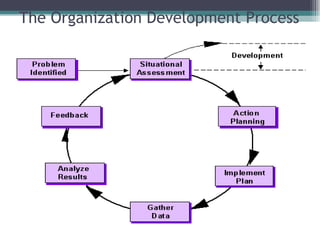
The Organization Development Process
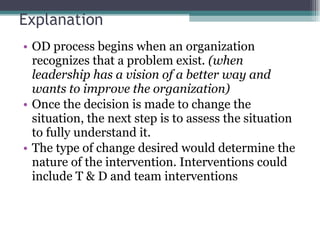
Explanation OD process begins when an organization recognizes that a problem exist . (when leadership has a vision of a better way and wants to improve the organization) Once the decision is made to change the situation, the next step is to assess the situation to fully understand it.  The type of change desired would determine the nature of the intervention. Interventions could include T & D and team interventions
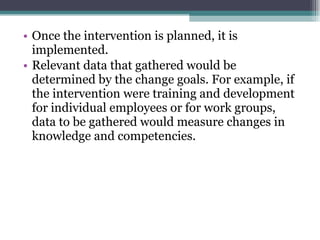
Once the intervention is planned, it is implemented. Relevant data that gathered would be determined by the change goals. For example, if the intervention were training and development for individual employees or for work groups, data to be gathered would measure changes in knowledge and competencies.
Why Is OD Process Important It will give impact achievement towards organizational goals Increasing trend to maximize an organization's investment in its employees Organizations need to "work smarter" and apply creative ideas Employees expect more from a day's work  customers demand continually improving quality
What is Organization Process??? The systematic way a company defines, organizes and implements its operations through the stages of the product life cycle
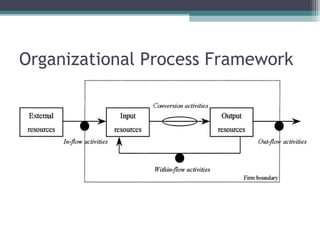
Organizational Process Framework
Flow activities are the routines and activities that effect the flow of tangible and intangible  resources into, within and out of the organization. Conversion activities are the routines and activities that combine or  change the form of input resources.
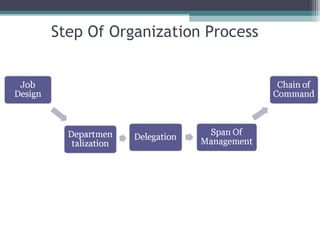
Step Of Organization Process
Conclusion Change is one of organization development process.  Change is important for company development. Company development is important to ensure company survival.
THANK YOU

Change As An Organization Process

  • 1.
    DCE 5632 OrganizationalChange & Development Title: Change As An Organization Process Instructor: Dr Khairuddin B. Idris Group Member: Zulhilmi Sham B. Mohd Noor GS27893 Nurul Aishah Bt. Musa GS28101 Shaaheda Bt. Mat Ariff GS27780
  • 2.
    Definition of ChangeChange is the continuous adoption of corporate strategies and structures to changing external conditions .(Colin, 1990)
  • 3.
    Types Of ChangeOrganizational Development : This is the more gradual and evolutionary approach to change. It bases on the assumption that it is possible to align corporate objectives with the individual employees objectives. Reengineering : This is known as corporate transformation or business transformation.
  • 4.
    Theories of PlannedChange Lewin’s Change Model
  • 5.
    1) Unfreezing -Reducing those forces maintaining the organization’s behavior at its current level. - Focus is to create the motivation to change. - Process of “psychological disconfirmation”. - Involve creating ways to reduce barriers to change. 2) Movement - Shifts the behavior of the organization, department or individuals to a new level. - Involves intervening in the system to develop new behaviors, values & attitudes through changes in organizational structure & processes. 3) Refreezing - C hange is stabilized by helping employees integrate the changed behaviors or attitude into their normal ways of doing things. - Giving employees the chance to exhibit new behaviors, which are then reinforced.
  • 6.
  • 7.
    Focuses on plannedchange as a cyclical process in which initial research about the organization provides information to guide subsequent action. Objective : - help organizations implement planned change & develop more general knowledge that can be applied to other settings Trends in the application of action research include movement from smaller subunits of organizations to total systems & communities.
  • 8.
  • 9.
    Focuses on whatthe organization is doing right. Has been applied to planned change primarily through a process called “ appreciative inquiry (AI)”. AI encourages a positive orientation to how change is conceived & managed.
  • 10.
    Resistance to changePeople and Organizations resist changes from both internal and external sources and planned and unplanned change Manager’s reaction See resistance as a problem Treat it coercively Added resistance See resistance as a signal People need more information, or better treatment Gather insights from people
  • 11.
    Sources of Resistanceto Change Individual Resistance * Perception * Personality * Habit * Threats to power and influence * Fear of the unknown * Economic reasons Organizational Resistance * Organization design * Organizational culture * Resource limitations * Fixed investments * Interorganizational agreements Resistance to Change
  • 12.
    Employee Readiness forChange Source: Adapted from Zeira, Y., and Avedisian, J. Organizational planned change: Assessing the chances for success. Organizational Dynamics , Spring 1989, 37. Perceived Personal Risk from Change Level of Dissatisfaction with the Current Situation Low Low High High High readiness for change Moderate to indeterminant readiness for change Low readiness for change Moderate to indeterminant readiness for change
  • 13.
    Resistance to ChangeDirect Costs Fear of the Unknown Breaking Routines Incongruent Systems Incongruent Team Dynamics Forces for Change
  • 14.
    Minimizing Resistance toChange Minimizing Resistance to Change Communication Training Employee Involvement Stress Management Negotiation Coercion Source: Adapted with permission from Cummings, J.G., and Worley, C.G. Organization Development and Change , 6th ed. Cincinnati: South-Western, 1997, 154.
  • 15.
  • 16.
    1) MotivatingChange # Creating Readiness for Change - sensitive the organization to pressure for change. - identify gaps between actual and desired states. - convey credible positive expectations for change. # Overcoming Resistance to Change - provide empathy and support. - communicate. - involve member in planning and decision making. 2) Creating a Vision - Describes the core purpose & values that guide the organization as well as envisioned future toward which change is directed. 3) Developing Political Support - organization can be seen ad loosely structure coalitions of individual s and groups having different preferences & interest
  • 17.
    4) Managing theTransition - Beckhard & Harris pointed that the transition may be quite different from the current state of the organization & consequently require special management structures & activities. 5) Sustaining Momentum # Activities to sustain momentum:- - provide resources for change. - build a support system for change agents. - develop a new competencies and skills. - reinforce new behaviors. - stay the course.
  • 18.
    Strategies Of OrganizationalChange Six ways: Individual change strategies Techno structural strategies Data-base strategies Organizational development Violent and coercive strategies Nonviolent yet direct action strategies
  • 19.
    Key Element OfSuccessful Change Committed and active participation of leadership Culture change Energetic involvement of an empowered and educated work force Effective communication and measurement Aligning human resource systems with the goals and objectives of change
  • 20.
    Definition of OrganizationalDevelopment Burke’s Definition of OD OD is a planned process of change in an organization’s culture through the utilization of behavioral science technology, research and theory. Beckhard’s Definition of OD OD is an effort (1) planned, (2) organization-wide, and (3) managed from the top, to (4) increase organization effectiveness and health through (5) planned interventions in the organization’s “processes” using behavioral science knowledge . Beer’s Definition of OD OD is a system-wide process of data collection, diagnosis, action planning, intervention, and evaluation aimed at: (1) enhancing congruence between organizational structure, process, strategy, people, and culture; (2) developing new and creative organizational solutions; and (3) developing the organization’s self –renewing capacity. It occurs through collaboration of organizational members working with change agent using behavioral science theory, research, and technology.
  • 21.
    Organization Development is….a system-wide application and transfer of behavioral science knowledge to the planned development, improvement, and reinforcement of the strategies structure, and process that lead to organization effectiveness.
  • 22.
  • 23.
    Explanation OD processbegins when an organization recognizes that a problem exist . (when leadership has a vision of a better way and wants to improve the organization) Once the decision is made to change the situation, the next step is to assess the situation to fully understand it. The type of change desired would determine the nature of the intervention. Interventions could include T & D and team interventions
  • 24.
    Once the interventionis planned, it is implemented. Relevant data that gathered would be determined by the change goals. For example, if the intervention were training and development for individual employees or for work groups, data to be gathered would measure changes in knowledge and competencies.
  • 25.
    Why Is ODProcess Important It will give impact achievement towards organizational goals Increasing trend to maximize an organization's investment in its employees Organizations need to "work smarter" and apply creative ideas Employees expect more from a day's work customers demand continually improving quality
  • 26.
    What is OrganizationProcess??? The systematic way a company defines, organizes and implements its operations through the stages of the product life cycle
  • 27.
  • 28.
    Flow activities arethe routines and activities that effect the flow of tangible and intangible resources into, within and out of the organization. Conversion activities are the routines and activities that combine or change the form of input resources.
  • 29.
  • 30.
    Conclusion Change isone of organization development process. Change is important for company development. Company development is important to ensure company survival.
  • 31.