Strategic Human Resource Management
and the HR Scorecard
Prof. Abhipsa Mishra
SHRM, HR Metrics and HR Scorecard; Prof. Abhipsa Mishra
Session objectives
1. Outline the steps in the strategic management process.
2. Explain and give examples of each type of companywide and
competitive strategy.
3. Explain what a strategy-oriented human resource
management system is and why it is important.
4. Illustrate and explain the HR Scorecard approach to creating
human resource management systems
5. Discuss HR Metrics
6. Elaborate High Performance Work Systems
SHRM, HR Metrics and HR Scorecard; Prof. Abhipsa Mishra
Strategic Human Resource Management
 It is the linking of HRM with strategic goals and
objectives in order to improve business
performance and develop organizational cultures
that foster innovation and flexibility.
• It involves formulating and executing HR systems—HR
policies and activities—that produce the employee
competencies and behaviors, that the company needs
to achieve its strategic aims.
SHRM, HR Metrics and HR Scorecard; Prof. Abhipsa Mishra
The Strategic Management Process
• Strategic Management
– The process of identifying and executing the organization’s
mission by matching its capabilities with the demands of its
environment.
• Strategy
– A chosen course of action.
• Strategic Plan
– How an organization intends to balance its internal strengths
and weaknesses with its external opportunities and threats to
maintain a competitive advantage over the long-term.
SHRM, HR Metrics and HR Scorecard; Prof. Abhipsa Mishra
Business Vision and Mission
• Vision
– A general statement of an organization’s intended
direction that evokes emotional feelings in
organization members.
• Mission
– Spells out who the company is, what it does, and
where it’s headed.
SHRM, HR Metrics and HR Audit; Prof. Abhipsa Mishra
Types of Strategies
Diversification
Strategy
Geographic
Expansion
Strategy
Vertical
Integration
Strategy
Corporate-Level
Strategies
Consolidation
Strategy
SHRM, HR Metrics and HR Audit; Prof. Abhipsa Mishra
Types of Strategies (cont’d)
Cost Leadership Focus/Niche
Business-Level/
Competitive Strategies
Differentiation
SHRM, HR Metrics and HR Scorecard; Prof. Abhipsa Mishra
Porter’s generic strategies
1. Overall cost leadership (McDonalds, Wal-Mart)
• Low-cost-position relative to a firm’s peers
• Manage relationships throughout the entire value chain
2. Differentiation (Harley Davison, Apple)
• Create products and/or services that are unique and valued
• Non-price attributes for which customers will pay a premium
3. Focus strategy (Rolex, Lamborghini)
• Narrow product lines, buyer segments, or targeted geographic
markets
• Attain advantages either through differentiation or cost leadership
SHRM, HR Metrics and HR Scorecard; Prof. Abhipsa Mishra
Value Chain
SHRM, HR Metrics and HR Scorecard; Prof. Abhipsa Mishra
Porter’s generic strategies
SHRM, HR Metrics and HR Scorecard; Prof. Abhipsa Mishra
Achieving Strategic Fit
• The “Fit” Point of View (Porter)
– All of the firm’s activities must be tailored to or fit the
chosen strategy such that the firm’s functional strategies
support its corporate and competitive strategies.
• Leveraging (Hamel and Prahalad)
– “Stretch” in leveraging resources—supplementing what
you have and doing more with what you have—can be
more important than just fitting the strategic plan to
current resources.
SHRM, HR Metrics and HR Audit; Prof. Abhipsa Mishra
Strategic Human Resource Challenges
Corporate
productivity &
performance
improvement
efforts
Increased HR
team’s
involvement in
design of
strategic plans
Basic Strategic
Challenges
Expanded role of
employees in the
organization’s
performance
efforts
SHRM, HR Metrics and HR Audit; Prof. Abhipsa Mishra
Human Resource Management’s Strategic
Roles
Strategy
Execution Role
Strategic Planning
Roles
Strategy
Formulation Role
SHRM, HR Metrics and HR Audit; Prof. Abhipsa Mishra
Creating the Strategic Human Resource
Management System
Human Resource
Professionals
Employee Behaviors
and Competencies
Components of a
Strategic HRM System
Human Resource
Policies and Practices
HR Metrics
HR’s role as an Information Analyst
SHRM, HR Metrics and HR Scorecard; Prof. Abhipsa Mishra
What are HR Metrics?
• Relating to measures
• Involving or proceeding by measurements
• Method of tracking the effectiveness of HR
• What you value about HR programs and
the equivalent monetary value
SHRM, HR Metrics and HR Scorecard; Prof. Abhipsa Mishra
HR Excuses Against Metrics
• “You can’t measure what we do…”
• Lack of clear purpose for measuring
• Lack of cooperation between departments
• Difficulty extracting data from multiple
systems
• Difficulty understanding and analyzing metrics
• Numbers used to draw inaccurate conclusions
SHRM, HR Metrics and HR Scorecard; Prof. Abhipsa Mishra
Why Measure?
If you can’t measure it, you can’t understand it.
If you can’t understand it, you can’t control it.
If you can’t control it, you can’t improve it.
The Improvement Process
Understand
Measure
Control
Improve
SHRM, HR Metrics and HR Scorecard; Prof. Abhipsa Mishra
Importance of HR Metrics
• Quantify the value of HR
• Guide workforce strategies
• Maximize HR’s return on investments
• Provide measurement standards
• Show what HR contributes to business results
• Make the business case for HR’s objectives
SHRM, HR Metrics and HR Scorecard; Prof. Abhipsa Mishra
Metrics helps to…
• Communicate performance expectations
• Discover gaps in strategies
• Make better decisions
• Address the trend towards value reporting
SHRM, HR Metrics and HR Scorecard; Prof. Abhipsa Mishra
What to Measure?
 Measure outcomes not activity
 Begin with efficiency measures
 Develop metrics geared towards your organization’s
goals and strategies
 Establish metrics to monitor key HR practices proven
to grow human capital
 Use metrics that will encourage change and help us
make better decisions about human capital
SHRM, HR Metrics and HR Scorecard; Prof. Abhipsa Mishra
• Creating a measurement team is recommended
• Communicate importance of metrics to team
• Team should select metrics together
• Determine how metrics will be defined
• Obtain leadership buy-in
• Disseminate the tasks
Collecting Data
SHRM, HR Metrics and HR Scorecard; Prof. Abhipsa Mishra
Strategic Relationships
• Process must be owned by Executives, Managers, HR,
Finance, and IT
• Takes time and will power
• May require an investment in information technology
support services to support human capital measurement
and reporting opportunities
• Requires the fostering of key strategic relationships to
ensure favorable outcomes
SHRM, HR Metrics and HR Scorecard; Prof. Abhipsa Mishra
Getting Started
Assess
your data
Build your
metrics
Create
meaningful
measures
SHRM, HR Metrics and HR Scorecard; Prof. Abhipsa Mishra
• What do you already track?
• Where should you focus?
• What metrics would be useful?
Assessing Your Data
SHRM, HR Metrics and HR Scorecard; Prof. Abhipsa Mishra
• Determine your measures
• Select benchmarks for comparison
 Similar services
 Same size
 Similar organizational structure
 Similar budget
• Compare your results
Building Your Measures
SHRM, HR Metrics and HR Scorecard; Prof. Abhipsa Mishra
Data Integrity
• Quality of data is critical
• Garbage in….garbage out
• So…..
 Check the math
 Watch out for zeros
 Compare results to each other
 Conduct a sanity test
SHRM, HR Metrics and HR Scorecard; Prof. Abhipsa Mishra
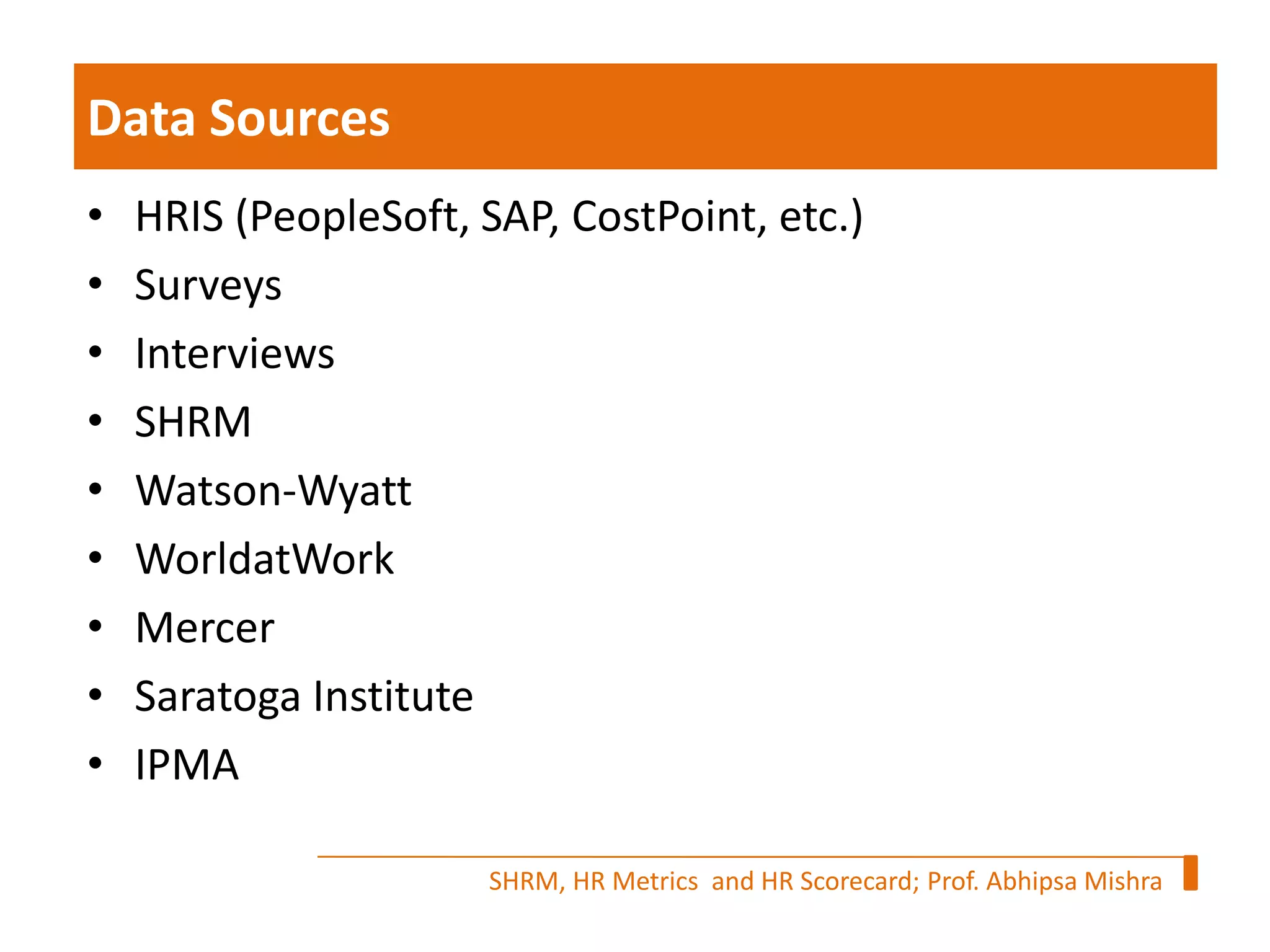
Data Sources
• HRIS (PeopleSoft, SAP, CostPoint, etc.)
• Surveys
• Interviews
• SHRM
• Watson-Wyatt
• WorldatWork
• Mercer
• Saratoga Institute
• IPMA
SHRM, HR Metrics and HR Scorecard; Prof. Abhipsa Mishra
What Can Be Measured?
Staffing and Hiring Work Processes Competent Employees
Turnover Rates
Reduced Time-to-Fill for
Vacancies
Training Costs
Number of Employees
Trained
Cost per Hire Voluntary Separations
SHRM, HR Metrics and HR Scorecard; Prof. Abhipsa Mishra
Formula:
Total Voluntary Separations / Regular Headcount
Purpose:
• Voluntary Separation Rate looks at the percentage of regular
headcount that voluntarily left the organization.
• This metric is an excellent indicator of problems within the
organization, including but not limited to inadequate
compensation and/or benefits, lack of opportunities for
promotion, low employee morale, inadequate training,
and/or improper assessment of employee's qualifications
(over or under qualified).
Voluntary Separation Rate
SHRM, HR Metrics and HR Scorecard; Prof. Abhipsa Mishra
Voluntary Separation Rate
Calculation:
13,894 / 141,277 = 9.8%
Total Voluntary Separations / Regular Headcount
SHRM, HR Metrics and HR Scorecard; Prof. Abhipsa Mishra
Formula:
The number of business days to fill a vacant position. This is
counted from the day the position becomes vacant to the date
a new employee starts in the job.
Date of Hire - Date of Vacancy
Purpose:
• Time to Hire shows length of time it takes to fill vacant
positions.
• This metric is an indicator of organization's ability to recruit
and hire new employees.
Time to Hire - Definition
SHRM, HR Metrics and HR Scorecard; Prof. Abhipsa Mishra
Time to Hire - Calculation
1/6/2006 - 5/10/2006
Date of Hire - Date of Vacancy
=
44 business days
SHRM, HR Metrics and HR Scorecard; Prof. Abhipsa Mishra
Formula:
Total Training Cost / Regular Headcount Trained
Purpose:
• Training Cost Factor - average rupees spent on
training for each regular employee receiving training
• This metric is an indicator of the organization's investment in
training and can also be used to
monitor training costs and the organization's
return on investment.
Training Cost Factor - Definition
SHRM, HR Metrics and HR Scorecard; Prof. Abhipsa Mishra
Training Cost Factor - Calculation
Rs. 31,131,631 / 249,700
Total Training Cost / Regular Headcount Trained
=
Rs. 124.68
SHRM, HR Metrics and HR Scorecard; Prof. Abhipsa Mishra
Analyzing Data
Microsoft Excel
• Formulas
 Sum
 Average & Median
 Time Calculations
• Charts & Graphs
 Pie
 Bar
 Scatter
Reporting Data
Microsoft Word
• Reports
 Tables
 Graphs
 Charts
Microsoft Access
• Database
 Tables
 Queries
 Reports
Powerpoint
Inserting graphs
Exit Salaries vs. Years Exp.
$20,000.00
$25,000.00
$30,000.00
$35,000.00
$40,000.00
$45,000.00
$50,000.00
$55,000.00
$60,000.00
$65,000.00
$70,000.00
0.00 2.00 4.00 6.00 8.00 10.00 12.00 14.00 16.00 18.00 20.00
Years Experience
ExitSalary
Strategic Human Resource Management and HR Scorecard
SHRM, HR Metrics and HR Audit; Prof. Abhipsa Mishra
Shining the Light on the Real Value of HR
via the Human Resources Scorecard
SHRM, HR Metrics and HR Audit; Prof. Abhipsa Mishra
Creating an HR Scorecard
1
2
3
4
5
Outline value chain activities
Define the business strategy
Outline a strategy map
Identify strategically required
outcomes
Identify required workforce
competencies and behaviors
6
7
8
9
10
Create HR Scorecard
Identify required HR policies and
activities
Choose HR Scorecard measures
Summarize Scorecard measures
on digital dashboard
Monitor, predict, evaluate
The 10-Step HR Scorecard Process
SHRM, HR Metrics and HR Scorecard; Prof. Abhipsa Mishra
What is (balanced) scorecard?
• A set of measures/indicators (usually 16 – 36 max) that
directly reflect or represent the strategy/strategic
objectives
• Their prime purpose is to measure that the desired
change or development defined by the strategic
objectives actually takes place
• In short, strategic indicators allow you to measure and
manage strategy execution and achievement progress
SHRM, HR Metrics and HR Scorecard; Prof. Abhipsa Mishra
What is it all about…
Scorecard Objectives
 Enable a focus on the “vital few”
 Achieve alignment and focus on
strategy and achievement of our
mission
 Balance short-term, operational
decisions with long-term
strategic decisions more
effectively
 Unlock organizational capacity
by enabling employees to clearly
see where their actions fit into
the bigger picture
 An organizational alignment
& performance management
tool/process
 A communication tool
 A tool for ongoing learning
and refinement of strategy
The scorecard is not
just a set of
indicators …
SHRM, HR Metrics and HR Scorecard; Prof. Abhipsa Mishra
A true balanced scorecard…
• Demonstrates alignment with corporate
strategy/objectives (departments & BU’s),
• Contains a limited set of strategic objectives
and indicators,
• Is focused on indicator quality rather than
quantity (focused on measuring what matters
strategically)
SHRM, HR Metrics and HR Scorecard; Prof. Abhipsa Mishra
The HR Scorecard Development Process
3. Create Existing
Indicator List
11. Define HR
BSC
Implementation
Plan
6. Detail HR BSC
Indicators
9. HR BSC
Indicator
Review Workshop
10. HR BSC
Indicators
FINALIZED
8. Define HR BSC
Governance
Model
7. Document HR
BSC
Hierarchy
1. Cascade
Corporate Strategy
2. Create HR
Strategy Map
5. HR BSC
Development
Workshop
4. Define HR BSC
Philosophy
SHRM, HR Metrics and HR Scorecard; Prof. Abhipsa Mishra
You CANNOT have an HR BSC indicator set without an
HR Strategy Map!
MISSIONMISSION
Strategy Map
SHRM, HR Metrics and HR Scorecard; Prof. Abhipsa Mishra
What is a Strategy Map?
 It uses the same framework as the balanced scorecard
 It’s a one page document that describes how your
organization “creates value” and contributes at an
actionable/operational level to the achievement of the
overall strategy
 It provides a “picture” of your strategy
 It provides a uniform & consistent way of describing your
strategy
 A visual representation of the cause & effect relationships
between the components of your strategy (your “theory” of how
everything/everyone works together to achieve results – the story of your
strategy)
SHRM, HR Metrics and HR Scorecard; Prof. Abhipsa Mishra
The Strategy Map – Key Elements
Mis s io n : Vis io n :Priv ate Se c to r
Strate g y Map
Fo rm at
CORE VALUES:
Fin a n cia l
Cu s t o m er
In t e r n a l
Pr o cess
Or g a n iz a t io n a l
Ca p a b ilit ie s
Strategy Focused Business Solutions Inc.
sandyrichardson_bsc@yahoo.ca
(416) 722-1367
Mission:
Bringing Protection to Life.
Vision 2015:
Be a world class financial services provider, delivering exceptional customer value
through the excellence and integrity of our people.
Group Life &
Health Insurer
CORE
VALUES
Financial
Customer
Internal Process
Organizational
Capabilities
Partnership Entrepreneurship Continuous
Learning
A Factual Approach to
Decision Making
Community
Citizenship
Develop Competencies
in Key Strategic Roles
Foster a Constructive
Culture
Implement One System,
One Overall Process
Focus on Process
Improvement
Become a Long-Term Disability
Industry Leader
Develop Non-Advisor
Distribution Channels
Be Easy to Do Business
With
Focus on Drivers of Customer
Satisfaction
Optimize Advisor
Distribution Channels
Achieve Sustained
Profitable Growth
Improve Cost
Structures
Maintain Existing Profitable Group
Insurance Business
Acquire New Profitable
Group Insurance Business
SHRM, HR Metrics and HR Scorecard; Prof. Abhipsa Mishra
The Strategy Map
Mis s io n : Vis io n :Priv ate Se c to r
Strate g y Map
Fo rm at
CORE VALUES:
Fin a n cia l
Cu s t o m er
In t e r n a l
Pr o cess
Or g a n iz a t io n a l
Ca p a b ilit ie s
To deliver the results our shareholders demand and achieve our
mission and vision, how must we perform financially?
To achieve the financial returns we desire, what must we deliver to
our customers so they will reward us with their business & loyalty?
To give our customers what they expect, what business processes
must we focus on and excel at?
To execute our businesses processes at the required level, what skills
and capabilities, culture, and tools and technologies must we have in place?
SHRM, HR Metrics and HR Audit; Prof. Abhipsa Mishra
High-Performance Work Systems
SHRM, HR Metrics and HR Scorecard; Prof. Abhipsa Mishra
High-Performance Work System (HPWS)
 It is a specific combination of HR practices, work
structures and processes that maximizes employee
knowledge, skill, commitment and flexibility.
 Is composed of many interrelated parts that
complement one another to reach the goals of an
organization, large or small.
Developing High-Performance Work Systems
Underlying Principles of HPWS
SHRM, HR Metrics and HR Scorecard; Prof. Abhipsa Mishra
Principles of HPWS
• Egalitarianism and Engagement
 Egalitarian work environments eliminates status
and power differences and, in the process,
increase collaboration and teamwork.
 When this happens, productivity can improve if
people who once worked in isolation from (or
opposition to) one another begin to work
together.
SHRM, HR Metrics and HR Scorecard; Prof. Abhipsa Mishra
• Shared Information
 A shift away from the mentality of command and
control towards more focused on employee
commitment.
 Creating a culture of information sharing where
employees are more willing (and able) to work
towards the goals of the organization.
Principles of HPWS
SHRM, HR Metrics and HR Scorecard; Prof. Abhipsa Mishra
• Knowledge Development
 Employees in high-performance work systems
need to learn in “real time,” on-the-job, using
innovative new approaches to solve novel
problems
 Learning organizations
 Technology Enhanced Learning Environments
Principles of HPWS
SHRM, HR Metrics and HR Scorecard; Prof. Abhipsa Mishra
• Performance-Reward Linkage
 It is important to align employee and
organizational goals.
 When rewards are connected to performance,
employees will naturally pursue outcomes that are
mutually beneficial to themselves and the
organization.
Principles of HPWS
Anatomy of High-Performance Work Systems
SHRM, HR Metrics and HR Scorecard; Prof. Abhipsa Mishra
Complementary Human Resources
Policies and Practices
Staffing Practices
Training and
Development
Compensation
SHRM, HR Metrics and HR Scorecard; Prof. Abhipsa Mishra
Implementing the System
Ensure that change is owned by senior and line managers
Allocate sufficient resources and support for the change effort
Ensure early and broad communication
Ensure that teams are implemented in a systemic context
Establish methods for measuring the results of change
Ensure continuity of leadership and champions of the initiative
Necessary Actions for a Successful HPWS:
SHRM, HR Metrics and HR Scorecard; Prof. Abhipsa Mishra
Benefits of HPWS
• Employee Benefits
 Have more involvement in the organization
 Experience growth and satisfaction, and become more
valuable as contributors
• Organizational Benefits
 High productivity
 Quality
 Flexibility
 Customer satisfaction
SHRM, HR Metrics and HR Scorecard; Prof. Abhipsa Mishra
Evaluating the Success of the System
Are employees actually working together, or is the term “team” just a label?
Are employees getting the information they need to make empowered
decisions?
Are training programs developing the knowledge and skills employees need?
Are employees being rewarded for good performance and useful suggestions?
Are employees treated fairly so that power differences are minimal?
Determining whether a high-performance work system has
been implemented as designed:
SHRM, HR Metrics and HR Scorecard; Prof. Abhipsa Mishra
Outcomes of High-Performance Work Systems
• Employee Outcomes and Quality of Work Life
 More involved in work
 More satisfied and find that needs for growth are more
fully met
 More informed and empowered, feel that they have a
fuller role to play in the organization and that their
opinions and expertise are valued more
 Have a greater commitment that comes from higher skills
and greater potential for contribution
SHRM, HR Metrics and HR Scorecard; Prof. Abhipsa Mishra
Outcomes of High-Performance Work Systems cont’d..
• Organizational Outcomes and Competitive
Advantages
– Higher productivity
– Lower costs
– Better responsiveness to customers
– Greater flexibility
– Higher profitability
SHRM, HR Metrics and HR Audit; Prof. Abhipsa Mishra
HR Audit
SHRM, HR Metrics and HR Audit; Prof. Abhipsa Mishra
THANK YOU
This leads to a High Performance Work System

Stratetic HRM & HR Scorecard

  • 1.
    Strategic Human ResourceManagement and the HR Scorecard Prof. Abhipsa Mishra
  • 2.
    SHRM, HR Metricsand HR Scorecard; Prof. Abhipsa Mishra Session objectives 1. Outline the steps in the strategic management process. 2. Explain and give examples of each type of companywide and competitive strategy. 3. Explain what a strategy-oriented human resource management system is and why it is important. 4. Illustrate and explain the HR Scorecard approach to creating human resource management systems 5. Discuss HR Metrics 6. Elaborate High Performance Work Systems
  • 3.
    SHRM, HR Metricsand HR Scorecard; Prof. Abhipsa Mishra Strategic Human Resource Management  It is the linking of HRM with strategic goals and objectives in order to improve business performance and develop organizational cultures that foster innovation and flexibility. • It involves formulating and executing HR systems—HR policies and activities—that produce the employee competencies and behaviors, that the company needs to achieve its strategic aims.
  • 4.
    SHRM, HR Metricsand HR Scorecard; Prof. Abhipsa Mishra The Strategic Management Process • Strategic Management – The process of identifying and executing the organization’s mission by matching its capabilities with the demands of its environment. • Strategy – A chosen course of action. • Strategic Plan – How an organization intends to balance its internal strengths and weaknesses with its external opportunities and threats to maintain a competitive advantage over the long-term.
  • 5.
    SHRM, HR Metricsand HR Scorecard; Prof. Abhipsa Mishra Business Vision and Mission • Vision – A general statement of an organization’s intended direction that evokes emotional feelings in organization members. • Mission – Spells out who the company is, what it does, and where it’s headed.
  • 6.
    SHRM, HR Metricsand HR Audit; Prof. Abhipsa Mishra Types of Strategies Diversification Strategy Geographic Expansion Strategy Vertical Integration Strategy Corporate-Level Strategies Consolidation Strategy
  • 7.
    SHRM, HR Metricsand HR Audit; Prof. Abhipsa Mishra Types of Strategies (cont’d) Cost Leadership Focus/Niche Business-Level/ Competitive Strategies Differentiation
  • 8.
    SHRM, HR Metricsand HR Scorecard; Prof. Abhipsa Mishra Porter’s generic strategies 1. Overall cost leadership (McDonalds, Wal-Mart) • Low-cost-position relative to a firm’s peers • Manage relationships throughout the entire value chain 2. Differentiation (Harley Davison, Apple) • Create products and/or services that are unique and valued • Non-price attributes for which customers will pay a premium 3. Focus strategy (Rolex, Lamborghini) • Narrow product lines, buyer segments, or targeted geographic markets • Attain advantages either through differentiation or cost leadership
  • 9.
    SHRM, HR Metricsand HR Scorecard; Prof. Abhipsa Mishra Value Chain
  • 10.
    SHRM, HR Metricsand HR Scorecard; Prof. Abhipsa Mishra Porter’s generic strategies
  • 11.
    SHRM, HR Metricsand HR Scorecard; Prof. Abhipsa Mishra Achieving Strategic Fit • The “Fit” Point of View (Porter) – All of the firm’s activities must be tailored to or fit the chosen strategy such that the firm’s functional strategies support its corporate and competitive strategies. • Leveraging (Hamel and Prahalad) – “Stretch” in leveraging resources—supplementing what you have and doing more with what you have—can be more important than just fitting the strategic plan to current resources.
  • 12.
    SHRM, HR Metricsand HR Audit; Prof. Abhipsa Mishra Strategic Human Resource Challenges Corporate productivity & performance improvement efforts Increased HR team’s involvement in design of strategic plans Basic Strategic Challenges Expanded role of employees in the organization’s performance efforts
  • 13.
    SHRM, HR Metricsand HR Audit; Prof. Abhipsa Mishra Human Resource Management’s Strategic Roles Strategy Execution Role Strategic Planning Roles Strategy Formulation Role
  • 14.
    SHRM, HR Metricsand HR Audit; Prof. Abhipsa Mishra Creating the Strategic Human Resource Management System Human Resource Professionals Employee Behaviors and Competencies Components of a Strategic HRM System Human Resource Policies and Practices
  • 15.
    HR Metrics HR’s roleas an Information Analyst
  • 16.
    SHRM, HR Metricsand HR Scorecard; Prof. Abhipsa Mishra What are HR Metrics? • Relating to measures • Involving or proceeding by measurements • Method of tracking the effectiveness of HR • What you value about HR programs and the equivalent monetary value
  • 17.
    SHRM, HR Metricsand HR Scorecard; Prof. Abhipsa Mishra HR Excuses Against Metrics • “You can’t measure what we do…” • Lack of clear purpose for measuring • Lack of cooperation between departments • Difficulty extracting data from multiple systems • Difficulty understanding and analyzing metrics • Numbers used to draw inaccurate conclusions
  • 18.
    SHRM, HR Metricsand HR Scorecard; Prof. Abhipsa Mishra Why Measure? If you can’t measure it, you can’t understand it. If you can’t understand it, you can’t control it. If you can’t control it, you can’t improve it. The Improvement Process Understand Measure Control Improve
  • 19.
    SHRM, HR Metricsand HR Scorecard; Prof. Abhipsa Mishra Importance of HR Metrics • Quantify the value of HR • Guide workforce strategies • Maximize HR’s return on investments • Provide measurement standards • Show what HR contributes to business results • Make the business case for HR’s objectives
  • 20.
    SHRM, HR Metricsand HR Scorecard; Prof. Abhipsa Mishra Metrics helps to… • Communicate performance expectations • Discover gaps in strategies • Make better decisions • Address the trend towards value reporting
  • 21.
    SHRM, HR Metricsand HR Scorecard; Prof. Abhipsa Mishra What to Measure?  Measure outcomes not activity  Begin with efficiency measures  Develop metrics geared towards your organization’s goals and strategies  Establish metrics to monitor key HR practices proven to grow human capital  Use metrics that will encourage change and help us make better decisions about human capital
  • 22.
    SHRM, HR Metricsand HR Scorecard; Prof. Abhipsa Mishra • Creating a measurement team is recommended • Communicate importance of metrics to team • Team should select metrics together • Determine how metrics will be defined • Obtain leadership buy-in • Disseminate the tasks Collecting Data
  • 23.
    SHRM, HR Metricsand HR Scorecard; Prof. Abhipsa Mishra Strategic Relationships • Process must be owned by Executives, Managers, HR, Finance, and IT • Takes time and will power • May require an investment in information technology support services to support human capital measurement and reporting opportunities • Requires the fostering of key strategic relationships to ensure favorable outcomes
  • 24.
    SHRM, HR Metricsand HR Scorecard; Prof. Abhipsa Mishra Getting Started Assess your data Build your metrics Create meaningful measures
  • 25.
    SHRM, HR Metricsand HR Scorecard; Prof. Abhipsa Mishra • What do you already track? • Where should you focus? • What metrics would be useful? Assessing Your Data
  • 26.
    SHRM, HR Metricsand HR Scorecard; Prof. Abhipsa Mishra • Determine your measures • Select benchmarks for comparison  Similar services  Same size  Similar organizational structure  Similar budget • Compare your results Building Your Measures
  • 27.
    SHRM, HR Metricsand HR Scorecard; Prof. Abhipsa Mishra Data Integrity • Quality of data is critical • Garbage in….garbage out • So…..  Check the math  Watch out for zeros  Compare results to each other  Conduct a sanity test
  • 28.
    SHRM, HR Metricsand HR Scorecard; Prof. Abhipsa Mishra Data Sources • HRIS (PeopleSoft, SAP, CostPoint, etc.) • Surveys • Interviews • SHRM • Watson-Wyatt • WorldatWork • Mercer • Saratoga Institute • IPMA
  • 29.
    SHRM, HR Metricsand HR Scorecard; Prof. Abhipsa Mishra What Can Be Measured? Staffing and Hiring Work Processes Competent Employees Turnover Rates Reduced Time-to-Fill for Vacancies Training Costs Number of Employees Trained Cost per Hire Voluntary Separations
  • 30.
    SHRM, HR Metricsand HR Scorecard; Prof. Abhipsa Mishra Formula: Total Voluntary Separations / Regular Headcount Purpose: • Voluntary Separation Rate looks at the percentage of regular headcount that voluntarily left the organization. • This metric is an excellent indicator of problems within the organization, including but not limited to inadequate compensation and/or benefits, lack of opportunities for promotion, low employee morale, inadequate training, and/or improper assessment of employee's qualifications (over or under qualified). Voluntary Separation Rate
  • 31.
    SHRM, HR Metricsand HR Scorecard; Prof. Abhipsa Mishra Voluntary Separation Rate Calculation: 13,894 / 141,277 = 9.8% Total Voluntary Separations / Regular Headcount
  • 32.
    SHRM, HR Metricsand HR Scorecard; Prof. Abhipsa Mishra Formula: The number of business days to fill a vacant position. This is counted from the day the position becomes vacant to the date a new employee starts in the job. Date of Hire - Date of Vacancy Purpose: • Time to Hire shows length of time it takes to fill vacant positions. • This metric is an indicator of organization's ability to recruit and hire new employees. Time to Hire - Definition
  • 33.
    SHRM, HR Metricsand HR Scorecard; Prof. Abhipsa Mishra Time to Hire - Calculation 1/6/2006 - 5/10/2006 Date of Hire - Date of Vacancy = 44 business days
  • 34.
    SHRM, HR Metricsand HR Scorecard; Prof. Abhipsa Mishra Formula: Total Training Cost / Regular Headcount Trained Purpose: • Training Cost Factor - average rupees spent on training for each regular employee receiving training • This metric is an indicator of the organization's investment in training and can also be used to monitor training costs and the organization's return on investment. Training Cost Factor - Definition
  • 35.
    SHRM, HR Metricsand HR Scorecard; Prof. Abhipsa Mishra Training Cost Factor - Calculation Rs. 31,131,631 / 249,700 Total Training Cost / Regular Headcount Trained = Rs. 124.68
  • 36.
    SHRM, HR Metricsand HR Scorecard; Prof. Abhipsa Mishra Analyzing Data Microsoft Excel • Formulas  Sum  Average & Median  Time Calculations • Charts & Graphs  Pie  Bar  Scatter Reporting Data Microsoft Word • Reports  Tables  Graphs  Charts Microsoft Access • Database  Tables  Queries  Reports
  • 37.
    Powerpoint Inserting graphs Exit Salariesvs. Years Exp. $20,000.00 $25,000.00 $30,000.00 $35,000.00 $40,000.00 $45,000.00 $50,000.00 $55,000.00 $60,000.00 $65,000.00 $70,000.00 0.00 2.00 4.00 6.00 8.00 10.00 12.00 14.00 16.00 18.00 20.00 Years Experience ExitSalary Strategic Human Resource Management and HR Scorecard
  • 38.
    SHRM, HR Metricsand HR Audit; Prof. Abhipsa Mishra Shining the Light on the Real Value of HR via the Human Resources Scorecard
  • 39.
    SHRM, HR Metricsand HR Audit; Prof. Abhipsa Mishra Creating an HR Scorecard 1 2 3 4 5 Outline value chain activities Define the business strategy Outline a strategy map Identify strategically required outcomes Identify required workforce competencies and behaviors 6 7 8 9 10 Create HR Scorecard Identify required HR policies and activities Choose HR Scorecard measures Summarize Scorecard measures on digital dashboard Monitor, predict, evaluate The 10-Step HR Scorecard Process
  • 40.
    SHRM, HR Metricsand HR Scorecard; Prof. Abhipsa Mishra What is (balanced) scorecard? • A set of measures/indicators (usually 16 – 36 max) that directly reflect or represent the strategy/strategic objectives • Their prime purpose is to measure that the desired change or development defined by the strategic objectives actually takes place • In short, strategic indicators allow you to measure and manage strategy execution and achievement progress
  • 41.
    SHRM, HR Metricsand HR Scorecard; Prof. Abhipsa Mishra What is it all about… Scorecard Objectives  Enable a focus on the “vital few”  Achieve alignment and focus on strategy and achievement of our mission  Balance short-term, operational decisions with long-term strategic decisions more effectively  Unlock organizational capacity by enabling employees to clearly see where their actions fit into the bigger picture  An organizational alignment & performance management tool/process  A communication tool  A tool for ongoing learning and refinement of strategy The scorecard is not just a set of indicators …
  • 42.
    SHRM, HR Metricsand HR Scorecard; Prof. Abhipsa Mishra A true balanced scorecard… • Demonstrates alignment with corporate strategy/objectives (departments & BU’s), • Contains a limited set of strategic objectives and indicators, • Is focused on indicator quality rather than quantity (focused on measuring what matters strategically)
  • 43.
    SHRM, HR Metricsand HR Scorecard; Prof. Abhipsa Mishra The HR Scorecard Development Process 3. Create Existing Indicator List 11. Define HR BSC Implementation Plan 6. Detail HR BSC Indicators 9. HR BSC Indicator Review Workshop 10. HR BSC Indicators FINALIZED 8. Define HR BSC Governance Model 7. Document HR BSC Hierarchy 1. Cascade Corporate Strategy 2. Create HR Strategy Map 5. HR BSC Development Workshop 4. Define HR BSC Philosophy
  • 44.
    SHRM, HR Metricsand HR Scorecard; Prof. Abhipsa Mishra You CANNOT have an HR BSC indicator set without an HR Strategy Map! MISSIONMISSION Strategy Map
  • 45.
    SHRM, HR Metricsand HR Scorecard; Prof. Abhipsa Mishra What is a Strategy Map?  It uses the same framework as the balanced scorecard  It’s a one page document that describes how your organization “creates value” and contributes at an actionable/operational level to the achievement of the overall strategy  It provides a “picture” of your strategy  It provides a uniform & consistent way of describing your strategy  A visual representation of the cause & effect relationships between the components of your strategy (your “theory” of how everything/everyone works together to achieve results – the story of your strategy)
  • 46.
    SHRM, HR Metricsand HR Scorecard; Prof. Abhipsa Mishra The Strategy Map – Key Elements Mis s io n : Vis io n :Priv ate Se c to r Strate g y Map Fo rm at CORE VALUES: Fin a n cia l Cu s t o m er In t e r n a l Pr o cess Or g a n iz a t io n a l Ca p a b ilit ie s
  • 47.
    Strategy Focused BusinessSolutions Inc. sandyrichardson_bsc@yahoo.ca (416) 722-1367 Mission: Bringing Protection to Life. Vision 2015: Be a world class financial services provider, delivering exceptional customer value through the excellence and integrity of our people. Group Life & Health Insurer CORE VALUES Financial Customer Internal Process Organizational Capabilities Partnership Entrepreneurship Continuous Learning A Factual Approach to Decision Making Community Citizenship Develop Competencies in Key Strategic Roles Foster a Constructive Culture Implement One System, One Overall Process Focus on Process Improvement Become a Long-Term Disability Industry Leader Develop Non-Advisor Distribution Channels Be Easy to Do Business With Focus on Drivers of Customer Satisfaction Optimize Advisor Distribution Channels Achieve Sustained Profitable Growth Improve Cost Structures Maintain Existing Profitable Group Insurance Business Acquire New Profitable Group Insurance Business
  • 48.
    SHRM, HR Metricsand HR Scorecard; Prof. Abhipsa Mishra The Strategy Map Mis s io n : Vis io n :Priv ate Se c to r Strate g y Map Fo rm at CORE VALUES: Fin a n cia l Cu s t o m er In t e r n a l Pr o cess Or g a n iz a t io n a l Ca p a b ilit ie s To deliver the results our shareholders demand and achieve our mission and vision, how must we perform financially? To achieve the financial returns we desire, what must we deliver to our customers so they will reward us with their business & loyalty? To give our customers what they expect, what business processes must we focus on and excel at? To execute our businesses processes at the required level, what skills and capabilities, culture, and tools and technologies must we have in place?
  • 49.
    SHRM, HR Metricsand HR Audit; Prof. Abhipsa Mishra High-Performance Work Systems
  • 50.
    SHRM, HR Metricsand HR Scorecard; Prof. Abhipsa Mishra High-Performance Work System (HPWS)  It is a specific combination of HR practices, work structures and processes that maximizes employee knowledge, skill, commitment and flexibility.  Is composed of many interrelated parts that complement one another to reach the goals of an organization, large or small.
  • 51.
  • 52.
  • 53.
    SHRM, HR Metricsand HR Scorecard; Prof. Abhipsa Mishra Principles of HPWS • Egalitarianism and Engagement  Egalitarian work environments eliminates status and power differences and, in the process, increase collaboration and teamwork.  When this happens, productivity can improve if people who once worked in isolation from (or opposition to) one another begin to work together.
  • 54.
    SHRM, HR Metricsand HR Scorecard; Prof. Abhipsa Mishra • Shared Information  A shift away from the mentality of command and control towards more focused on employee commitment.  Creating a culture of information sharing where employees are more willing (and able) to work towards the goals of the organization. Principles of HPWS
  • 55.
    SHRM, HR Metricsand HR Scorecard; Prof. Abhipsa Mishra • Knowledge Development  Employees in high-performance work systems need to learn in “real time,” on-the-job, using innovative new approaches to solve novel problems  Learning organizations  Technology Enhanced Learning Environments Principles of HPWS
  • 56.
    SHRM, HR Metricsand HR Scorecard; Prof. Abhipsa Mishra • Performance-Reward Linkage  It is important to align employee and organizational goals.  When rewards are connected to performance, employees will naturally pursue outcomes that are mutually beneficial to themselves and the organization. Principles of HPWS
  • 57.
  • 58.
    SHRM, HR Metricsand HR Scorecard; Prof. Abhipsa Mishra Complementary Human Resources Policies and Practices Staffing Practices Training and Development Compensation
  • 59.
    SHRM, HR Metricsand HR Scorecard; Prof. Abhipsa Mishra Implementing the System Ensure that change is owned by senior and line managers Allocate sufficient resources and support for the change effort Ensure early and broad communication Ensure that teams are implemented in a systemic context Establish methods for measuring the results of change Ensure continuity of leadership and champions of the initiative Necessary Actions for a Successful HPWS:
  • 60.
    SHRM, HR Metricsand HR Scorecard; Prof. Abhipsa Mishra Benefits of HPWS • Employee Benefits  Have more involvement in the organization  Experience growth and satisfaction, and become more valuable as contributors • Organizational Benefits  High productivity  Quality  Flexibility  Customer satisfaction
  • 61.
    SHRM, HR Metricsand HR Scorecard; Prof. Abhipsa Mishra Evaluating the Success of the System Are employees actually working together, or is the term “team” just a label? Are employees getting the information they need to make empowered decisions? Are training programs developing the knowledge and skills employees need? Are employees being rewarded for good performance and useful suggestions? Are employees treated fairly so that power differences are minimal? Determining whether a high-performance work system has been implemented as designed:
  • 62.
    SHRM, HR Metricsand HR Scorecard; Prof. Abhipsa Mishra Outcomes of High-Performance Work Systems • Employee Outcomes and Quality of Work Life  More involved in work  More satisfied and find that needs for growth are more fully met  More informed and empowered, feel that they have a fuller role to play in the organization and that their opinions and expertise are valued more  Have a greater commitment that comes from higher skills and greater potential for contribution
  • 63.
    SHRM, HR Metricsand HR Scorecard; Prof. Abhipsa Mishra Outcomes of High-Performance Work Systems cont’d.. • Organizational Outcomes and Competitive Advantages – Higher productivity – Lower costs – Better responsiveness to customers – Greater flexibility – Higher profitability
  • 64.
    SHRM, HR Metricsand HR Audit; Prof. Abhipsa Mishra HR Audit
  • 65.
    SHRM, HR Metricsand HR Audit; Prof. Abhipsa Mishra
  • 66.
    SHRM, HR Metricsand HR Audit; Prof. Abhipsa Mishra
  • 67.
    SHRM, HR Metricsand HR Audit; Prof. Abhipsa Mishra
  • 68.
    SHRM, HR Metricsand HR Audit; Prof. Abhipsa Mishra
  • 69.
    SHRM, HR Metricsand HR Audit; Prof. Abhipsa Mishra
  • 70.
    SHRM, HR Metricsand HR Audit; Prof. Abhipsa Mishra
  • 71.
    SHRM, HR Metricsand HR Audit; Prof. Abhipsa Mishra
  • 72.
    SHRM, HR Metricsand HR Audit; Prof. Abhipsa Mishra
  • 73.
    SHRM, HR Metricsand HR Audit; Prof. Abhipsa Mishra
  • 74.
    SHRM, HR Metricsand HR Audit; Prof. Abhipsa Mishra
  • 75.
    SHRM, HR Metricsand HR Audit; Prof. Abhipsa Mishra
  • 76.
    SHRM, HR Metricsand HR Audit; Prof. Abhipsa Mishra
  • 77.
    SHRM, HR Metricsand HR Audit; Prof. Abhipsa Mishra
  • 78.
    SHRM, HR Metricsand HR Audit; Prof. Abhipsa Mishra
  • 79.
    SHRM, HR Metricsand HR Audit; Prof. Abhipsa Mishra
  • 80.
    SHRM, HR Metricsand HR Audit; Prof. Abhipsa Mishra
  • 81.
    SHRM, HR Metricsand HR Audit; Prof. Abhipsa Mishra
  • 82.
    SHRM, HR Metricsand HR Audit; Prof. Abhipsa Mishra
  • 83.
    SHRM, HR Metricsand HR Audit; Prof. Abhipsa Mishra
  • 84.
    SHRM, HR Metricsand HR Audit; Prof. Abhipsa Mishra
  • 85.
    SHRM, HR Metricsand HR Audit; Prof. Abhipsa Mishra
  • 86.
    SHRM, HR Metricsand HR Audit; Prof. Abhipsa Mishra
  • 87.
    SHRM, HR Metricsand HR Audit; Prof. Abhipsa Mishra
  • 88.
    SHRM, HR Metricsand HR Audit; Prof. Abhipsa Mishra
  • 89.
    SHRM, HR Metricsand HR Audit; Prof. Abhipsa Mishra
  • 90.
    SHRM, HR Metricsand HR Audit; Prof. Abhipsa Mishra
  • 91.
    SHRM, HR Metricsand HR Audit; Prof. Abhipsa Mishra
  • 92.
    SHRM, HR Metricsand HR Audit; Prof. Abhipsa Mishra
  • 93.
    SHRM, HR Metricsand HR Audit; Prof. Abhipsa Mishra
  • 94.
    SHRM, HR Metricsand HR Audit; Prof. Abhipsa Mishra
  • 95.
    SHRM, HR Metricsand HR Audit; Prof. Abhipsa Mishra
  • 96.
    SHRM, HR Metricsand HR Audit; Prof. Abhipsa Mishra
  • 97.
    THANK YOU This leadsto a High Performance Work System