


RECRUITMENT ,
SELECTION &
INDUCTION
Definition and Meaning
of Recruitment
According to Edwin B. Flippo,“ Profession is
the process of looking the candidates for
career which promotes them to apply for
projects in the organization”
Meaning:
• Career is the game that hyperlinks the
companies and the job hunters.
• A process of finding and gaining capable
candidates for employment
 A procedure of finding and gaining capable
candidates for employment. The procedure
starts when new workers are desired and
ends when their programs are presented.
The result is a share of programs from
which new workers are selected.
 It is the procedure to discover types of
human resources to meet the element of
employment and to employ efficient actions
for gaining that human resources in
sufficient numbers to accomplish efficient
Recruitment needs are of
three types
PLANNED
The needs as a result of changes in company
and pension plan.
ANTICIPATED
Expected needs are those motions in
employees, which an organization can
estimate by studying styles in exterior and
internal environment.
UNEXPECTED
Resignation, fatalities, accidents, illness
IMPORTANCE OF RECRUITMENT
• Entice and motivate more and more
applicants to apply in the company.
• Create a skills share of applicants to enable
the choice of best applicants for the
company.
• Recruitment is the procedure which
hyperlinks the companies with the workers.
• Increase the share of job applicants at
minimum cost.
• Help improve the success rate of choice
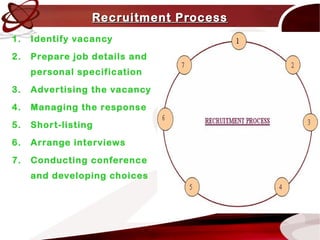
Recruitment ProcessRecruitment Process
1. Identify vacancy
2. Prepare job details and
personal specification
3. Advertising the vacancy
4. Managing the response
5. Short-listing
6. Arrange interviews
7. Conducting conference
and developing choices
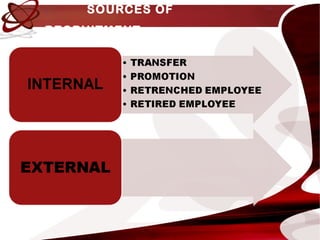
SOURCES OF
RECRUITMENT
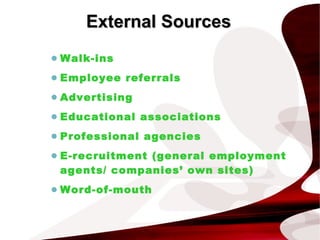
• Walk-ins
• Employee referrals
• Advertising
• Educational associations
• Professional agencies
• E-recruitment (general employment
agents/ companies’ own sites)
• Word-of-mouth
External SourcesExternal Sources
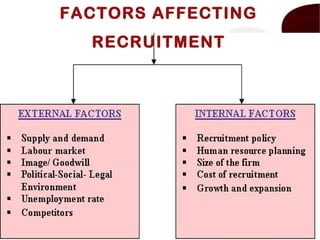
FACTORS AFFECTING
RECRUITMENT
Trends are being seenTrends are being seen
in recruitmentin recruitment
• Outsourcing
• Poaching
• E-Recruitment
“E-Recruitment
The buzzword and the newest styles in employment
is the “E-Recruitment”. Also known as “Online
recruitment”, it is the use of technological
innovation or the on the internet resources to
conserve the employment procedure. The device
can be either a job web page like naukri.com, the
organisation’s business website or its own intranet.
The on the internet transmission in Indian is improving
and has remarkable prospective. According to a
research by NASSCOM – “Jobs is among the top
explanation why new customers will come on to the
entire globe wide web, besides e-mail.” There are
The two kinds of e- recruitment that an
organisation can use is –
Job sites –posting the place with the job information and
the job requirements on the job website and also looking for
the appropriate continues published on the website
corresponding to the starting in the company.
Creating a complete on the internet
recruitment/application area in the organizations own
website. - Companies have involved a software package
system to its website, where the ‘passive’ job predators can
post their carries on into the databases of the company for
issue later on, as and when the roles become available.
Selection
According to Johnson rock “Selection is the process of
distinguishing between candidates in order to indentify
and seek the services of those with a greater chance of
success on the tasks. ”
In simple words……
It is the features conducted by the control over choosing
the right workers .After determining the sources of
recruiting, looking for potential workers which stimulates
them to apply for tasks in an company .
The purpose of the choice decision is to choose the
individual who can most efficiently execute the job from
the share of certified candidates.
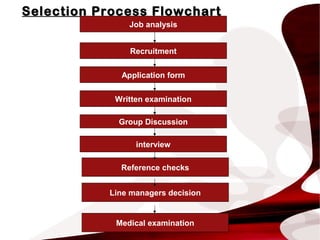
Selection Process FlowchartSelection Process Flowchart
Job analysis
Recruitment
Application form
Written examination
Group Discussion
interview
Medical examination
Reference checks
Line managers decision
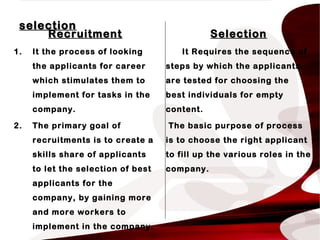
selectionselection
RecruitmentRecruitment
1. It the process of looking
the applicants for career
which stimulates them to
implement for tasks in the
company.
2. The primary goal of
recruitments is to create a
skills share of applicants
to let the selection of best
applicants for the
company, by gaining more
and more workers to
implement in the company.
SelectionSelection
It Requires the sequence of
steps by which the applicants
are tested for choosing the
best individuals for empty
content.
The basic purpose of process
is to choose the right applicant
to fill up the various roles in the
company.
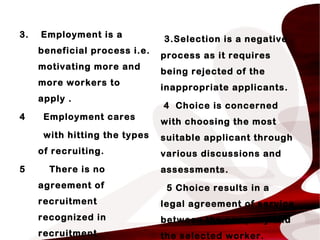
3. Employment is a
beneficial process i.e.
motivating more and
more workers to
apply .
4 Employment cares
with hitting the types
of recruiting.
5 There is no
agreement of
recruitment
recognized in
recruitment
3.Selection is a negative
process as it requires
being rejected of the
inappropriate applicants.
4 Choice is concerned
with choosing the most
suitable applicant through
various discussions and
assessments.
5 Choice results in a
legal agreement of service
between the company and
the selected worker.
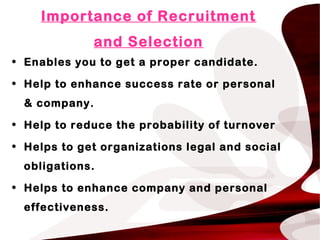
Importance of Recruitment
and Selection
• Enables you to get a proper candidate.
• Help to enhance success rate or personal
& company.
• Help to reduce the probability of turnover
• Helps to get organizations legal and social
obligations.
• Helps to enhance company and personal
effectiveness.
Alignment is the procedure of acquainting new
workers with the organization. Alignment subjects
variety from such primary items as within the
organization cafeteria to such issues as various
profession routes within the company.
Hence we can say that introduction or orientation is
the procedure through which a new worker is
presented to the job and the organization.
In the terms of Remedy, introduction is "the
procedure of getting and pleasant an worker when
he first connects a organization and providing him
the standard information he needs to stay down
Definition: Alignment is a thorough and
organized release of employees to their
tasks, their co-workers and the company.
It is also known as Introduction.
Orientation is created to provide a new
worker with the information he/she needs to
operate perfectly and successfully in the
company.
Should be a process, not a meeting.
 To lessen starting costs (associated with job
learning)
 To lessen anxiety
 To lessen employee turnover
 To saving time for supervisor & colleagues
 To Develop Realistic Job Expectations and Job
Satisfaction
The concept is to make the new workers feel
‘at home’ in the new environment
Expedite proficiency
Enhance modification to work team and
norms
Encourage beneficial attitude
The circumstances and regards to career
It allows a new implement to know the job, its
material, guidelines, guidelines.
The people with whom he is expected to
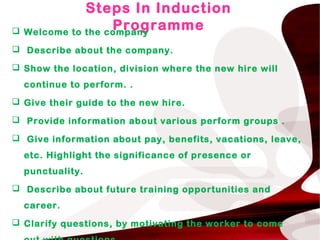
Steps In Induction
Programme Welcome to the company
 Describe about the company.
 Show the location, division where the new hire will
continue to perform. .
 Give their guide to the new hire.
 Provide information about various perform groups .
 Give information about pay, benefits, vacations, leave,
etc. Highlight the significance of presence or
punctuality.
 Describe about future training opportunities and
career.
 Clarify questions, by motivating the worker to come
The places protected
in worker introduction
program may be
mentioned as follows -
CONTENT of
introduction
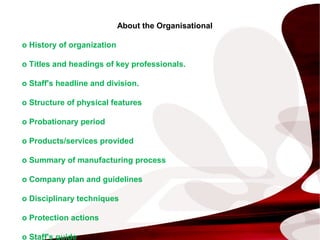
About the Organisational
o History of organization
o Titles and headings of key professionals.
o Staff's headline and division.
o Structure of physical features
o Probationary period
o Products/services provided
o Summary of manufacturing process
o Company plan and guidelines
o Disciplinary techniques
o Protection actions
o Staff's guide
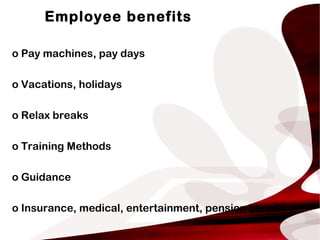
Employee benefits
o Pay machines, pay days
o Vacations, holidays
o Relax breaks
o Training Methods
o Guidance
o Insurance, medical, entertainment, pension benefit
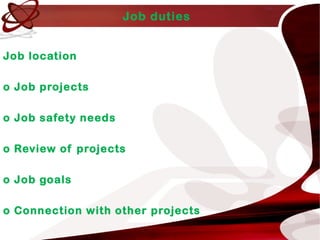
Job duties
Job location
o Job projects
o Job safety needs
o Review of projects
o Job goals
o Connection with other projects
1 worker guide and alignment program.
2.Communicate pleasure in the
organization by giving each new worker
an product with the company logo on it.
3.Encourage interaction, and a sense
worth focusing on, by welcoming new
workers to have coffee or lunchtime
with the organization owner or a mature
administrator.
4. Motivate new workers to example the
item and or support that the company
offers (i.e. Some dining places provide
new workers a free meal).
5. Reduce the pressure of beginning a
new job by coupling new workers with
someone (a more mature or
knowledgeable group member) that can
help trainer them through the first few a
few weeks on the job.
Here are some concepts to consider, when
creating the alignment program:
The MIND believes in IMAGES… not WORDS!
Repetition is Key… Repeating is Key…
Repeating is Key.
Employee is most thrilled on the first day of
labor. You need to keep that enjoyment in
existence for as lengthy as possible!
Activities can offer for an casual and fun
alignment.. For example:
Picture coordinate after the tour
Too much paperwork
high Price to company
Only expenses no earnings
Information overload
Too much “selling” of the organization
Too much one-way communication
Difficult for the worker to relate.

Recruitment, Selection & Induction by Arthur Marshall

  • 1.
  • 2.
    Definition and Meaning ofRecruitment According to Edwin B. Flippo,“ Profession is the process of looking the candidates for career which promotes them to apply for projects in the organization” Meaning: • Career is the game that hyperlinks the companies and the job hunters. • A process of finding and gaining capable candidates for employment
  • 3.
     A procedureof finding and gaining capable candidates for employment. The procedure starts when new workers are desired and ends when their programs are presented. The result is a share of programs from which new workers are selected.  It is the procedure to discover types of human resources to meet the element of employment and to employ efficient actions for gaining that human resources in sufficient numbers to accomplish efficient
  • 4.
    Recruitment needs areof three types PLANNED The needs as a result of changes in company and pension plan. ANTICIPATED Expected needs are those motions in employees, which an organization can estimate by studying styles in exterior and internal environment. UNEXPECTED Resignation, fatalities, accidents, illness
  • 5.
    IMPORTANCE OF RECRUITMENT •Entice and motivate more and more applicants to apply in the company. • Create a skills share of applicants to enable the choice of best applicants for the company. • Recruitment is the procedure which hyperlinks the companies with the workers. • Increase the share of job applicants at minimum cost. • Help improve the success rate of choice
  • 6.
    Recruitment ProcessRecruitment Process 1.Identify vacancy 2. Prepare job details and personal specification 3. Advertising the vacancy 4. Managing the response 5. Short-listing 6. Arrange interviews 7. Conducting conference and developing choices
  • 7.
  • 8.
    • Walk-ins • Employeereferrals • Advertising • Educational associations • Professional agencies • E-recruitment (general employment agents/ companies’ own sites) • Word-of-mouth External SourcesExternal Sources
  • 9.
  • 10.
    Trends are beingseenTrends are being seen in recruitmentin recruitment • Outsourcing • Poaching • E-Recruitment
  • 11.
    “E-Recruitment The buzzword andthe newest styles in employment is the “E-Recruitment”. Also known as “Online recruitment”, it is the use of technological innovation or the on the internet resources to conserve the employment procedure. The device can be either a job web page like naukri.com, the organisation’s business website or its own intranet. The on the internet transmission in Indian is improving and has remarkable prospective. According to a research by NASSCOM – “Jobs is among the top explanation why new customers will come on to the entire globe wide web, besides e-mail.” There are
  • 12.
    The two kindsof e- recruitment that an organisation can use is – Job sites –posting the place with the job information and the job requirements on the job website and also looking for the appropriate continues published on the website corresponding to the starting in the company. Creating a complete on the internet recruitment/application area in the organizations own website. - Companies have involved a software package system to its website, where the ‘passive’ job predators can post their carries on into the databases of the company for issue later on, as and when the roles become available.
  • 13.
    Selection According to Johnsonrock “Selection is the process of distinguishing between candidates in order to indentify and seek the services of those with a greater chance of success on the tasks. ” In simple words…… It is the features conducted by the control over choosing the right workers .After determining the sources of recruiting, looking for potential workers which stimulates them to apply for tasks in an company . The purpose of the choice decision is to choose the individual who can most efficiently execute the job from the share of certified candidates.
  • 14.
    Selection Process FlowchartSelectionProcess Flowchart Job analysis Recruitment Application form Written examination Group Discussion interview Medical examination Reference checks Line managers decision
  • 15.
    selectionselection RecruitmentRecruitment 1. It theprocess of looking the applicants for career which stimulates them to implement for tasks in the company. 2. The primary goal of recruitments is to create a skills share of applicants to let the selection of best applicants for the company, by gaining more and more workers to implement in the company. SelectionSelection It Requires the sequence of steps by which the applicants are tested for choosing the best individuals for empty content. The basic purpose of process is to choose the right applicant to fill up the various roles in the company.
  • 16.
    3. Employment isa beneficial process i.e. motivating more and more workers to apply . 4 Employment cares with hitting the types of recruiting. 5 There is no agreement of recruitment recognized in recruitment 3.Selection is a negative process as it requires being rejected of the inappropriate applicants. 4 Choice is concerned with choosing the most suitable applicant through various discussions and assessments. 5 Choice results in a legal agreement of service between the company and the selected worker.
  • 17.
    Importance of Recruitment andSelection • Enables you to get a proper candidate. • Help to enhance success rate or personal & company. • Help to reduce the probability of turnover • Helps to get organizations legal and social obligations. • Helps to enhance company and personal effectiveness.
  • 19.
    Alignment is theprocedure of acquainting new workers with the organization. Alignment subjects variety from such primary items as within the organization cafeteria to such issues as various profession routes within the company. Hence we can say that introduction or orientation is the procedure through which a new worker is presented to the job and the organization. In the terms of Remedy, introduction is "the procedure of getting and pleasant an worker when he first connects a organization and providing him the standard information he needs to stay down
  • 20.
    Definition: Alignment isa thorough and organized release of employees to their tasks, their co-workers and the company. It is also known as Introduction. Orientation is created to provide a new worker with the information he/she needs to operate perfectly and successfully in the company. Should be a process, not a meeting.
  • 21.
     To lessenstarting costs (associated with job learning)  To lessen anxiety  To lessen employee turnover  To saving time for supervisor & colleagues  To Develop Realistic Job Expectations and Job Satisfaction
  • 22.
    The concept isto make the new workers feel ‘at home’ in the new environment Expedite proficiency Enhance modification to work team and norms Encourage beneficial attitude The circumstances and regards to career It allows a new implement to know the job, its material, guidelines, guidelines. The people with whom he is expected to
  • 23.
    Steps In Induction ProgrammeWelcome to the company  Describe about the company.  Show the location, division where the new hire will continue to perform. .  Give their guide to the new hire.  Provide information about various perform groups .  Give information about pay, benefits, vacations, leave, etc. Highlight the significance of presence or punctuality.  Describe about future training opportunities and career.  Clarify questions, by motivating the worker to come
  • 24.
    The places protected inworker introduction program may be mentioned as follows - CONTENT of introduction
  • 25.
    About the Organisational oHistory of organization o Titles and headings of key professionals. o Staff's headline and division. o Structure of physical features o Probationary period o Products/services provided o Summary of manufacturing process o Company plan and guidelines o Disciplinary techniques o Protection actions o Staff's guide
  • 26.
    Employee benefits o Paymachines, pay days o Vacations, holidays o Relax breaks o Training Methods o Guidance o Insurance, medical, entertainment, pension benefit
  • 27.
    Job duties Job location oJob projects o Job safety needs o Review of projects o Job goals o Connection with other projects
  • 28.
    1 worker guide andalignment program. 2.Communicate pleasure in the organization by giving each new worker an product with the company logo on it. 3.Encourage interaction, and a sense worth focusing on, by welcoming new workers to have coffee or lunchtime with the organization owner or a mature administrator.
  • 29.
    4. Motivate newworkers to example the item and or support that the company offers (i.e. Some dining places provide new workers a free meal). 5. Reduce the pressure of beginning a new job by coupling new workers with someone (a more mature or knowledgeable group member) that can help trainer them through the first few a few weeks on the job.
  • 30.
    Here are someconcepts to consider, when creating the alignment program: The MIND believes in IMAGES… not WORDS! Repetition is Key… Repeating is Key… Repeating is Key. Employee is most thrilled on the first day of labor. You need to keep that enjoyment in existence for as lengthy as possible!
  • 31.
    Activities can offerfor an casual and fun alignment.. For example: Picture coordinate after the tour
  • 32.
    Too much paperwork highPrice to company Only expenses no earnings Information overload Too much “selling” of the organization Too much one-way communication Difficult for the worker to relate.